
Life, 1911-02-02 · page 30 of 52
Life — February 2, 1911 — page 30: what you’re looking at
What you’re looking at
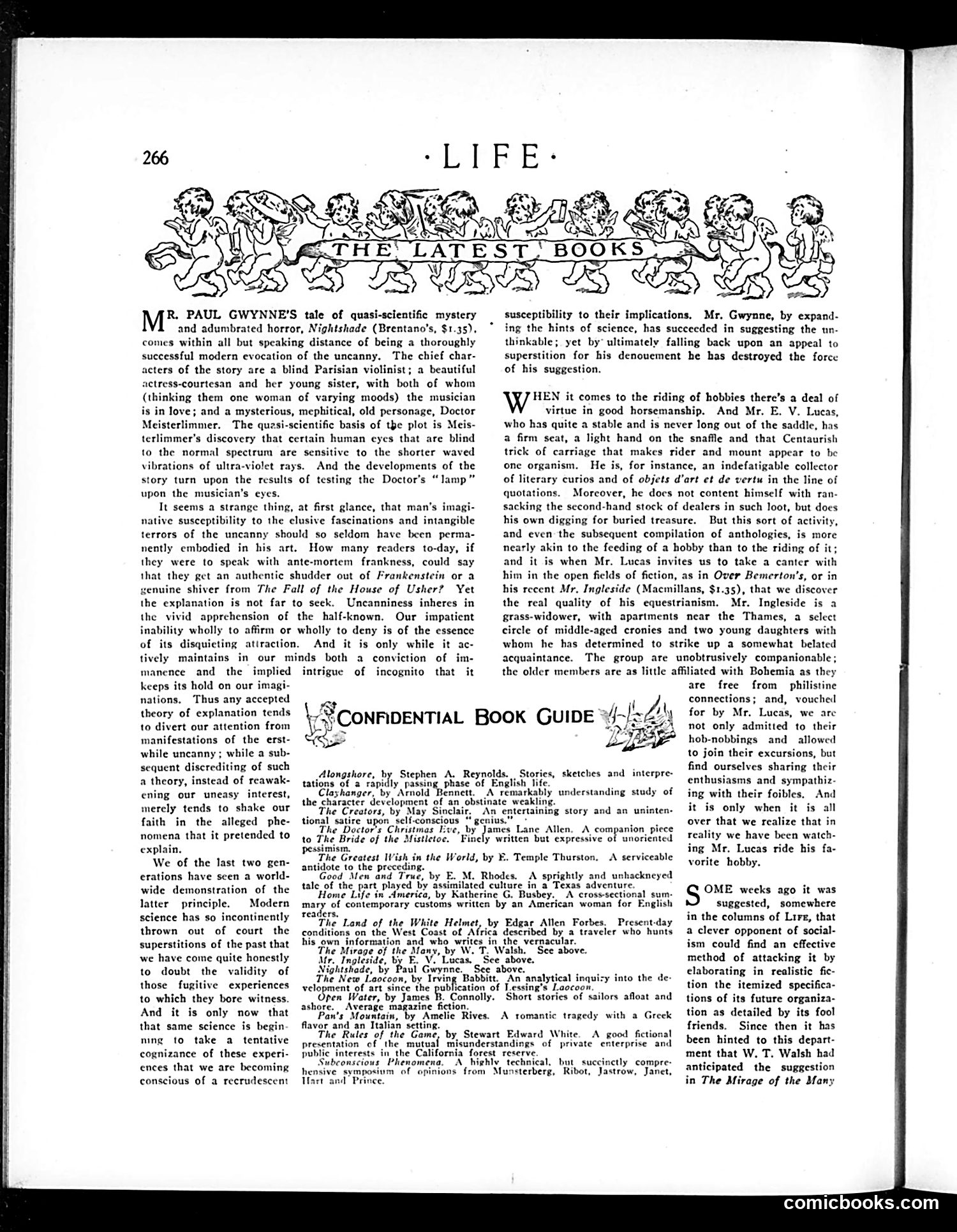
This is a **book review section**, not a political cartoon. The page features literary criticism of contemporary novels, particularly Paul Gwynne's *Nightshade*, a quasi-scientific mystery novel about a blind Parisian violinist and a doctor who discovers that blind human eyes can perceive ultraviolet rays. The critic discusses why horror fiction often fails: once scientific explanations are offered for supernatural phenomena, the uncanniness dissipates. Gwynne initially creates intrigue through mysterious science but undermines it by ultimately resorting to superstition for his ending. The page also praises E.V. Lucas's skill as a writer and collector of literary curiosities. The ornamental header with cherubs reading "The Latest Books" is typical decorative typography for *Life* magazine's book review section from this era.
📄 Transcribed text from this page (OCR, searchable)
Machine-transcribed from the original scan — historical spelling and the odd misread are preserved.
R. PAUL GWYNNE'S tale of quasi-scientific mystery and adumbrated horror, Nightshade (Brentano's, $1.35), comes within all but speaking distance of being a thoroughly successful modern evocation of the uncanny. The chief char- acters of the story are a blind Parisian violinist; a beautiful netress-courtesan and her young sister, with both of whom (thinking them one woman of varying moods) the musician is in love; and a mysterious, mephitical, old personage, Doctor Meisterlimmer. The quasi-scientific basis of the plot is Mecis- terlimmer’s discovery that certain human cycs that are blind to the normal spectrum are sensitive to the shorter waved vibrations of ultra-violet rays. And the developments of the story turn upon the results of testing the Doctor’s “lamp” upon the musician's eyes. It seems a strange thing, at first glance, that man’s imagi- native susceptibility to the clusive fascinations and intangible terrors of the uncanny should so seldom have been perma- nently embodied in his art. How many readers to-day, if they were to speak with ante-mortem frankness, could say that they get an authentic shudder out of Frankenstein or a genuine shiver fi m The Fall of the House of Usher? Yet the explanation not far to seek. Uncanniness inheres in the vivid apprehension of the half-known. Our impatient inability wholly to affirm or wholly to deny is of the essence of its disquieting attraction. And it is only while it ac- tively maintains in our minds both a conviction of im- manence and the implied intrigue of incognito that it keeps its hold on our imagi- nations. Thus any accepted theory of explanation tends to divert our attention from manifestations of the erst- while uncanny ; while a sub- sequent discrediting of such a theory, instead of reawak- ening our uneasy interest, merely tends to shake our faith in the alleged phe- nomena that it pretended to ss tations of a rapid Clashanger, by Arnold Bennett. The Creators, by May Sinclair, tional ‘satire upon_self-conscious to The Bride of the Mistletoe. Doctor's Christmas Eve, by -SCONADENTIAL Book GUIDE “4-/=Z2 Alongshore, by Stephen A. Reynolds. Stories, sketches and interpre: diy passing phase of English. life A remarkably understanding study of the character development of an obstinate weakling. ; An entertaining story and an uninten- it genius.” > james Lane Allen. Finely written but expressive o} susceptibility to their implications, Mr. Gwynne, by expand- ing the hints of science, has succecded in suggesting the un- thinkable; yet by’ ultimately falling back upon an appeal to superstition for his denouement he has destroyed the force of his suggestion. HEN it comes to the riding of hobbies there’s a deal of virtue in good horsemanship. And Mr. E. V. Lucas, who has quite a stable and is never long out of the saddle, has a firm seat, a light hand on the snaffle and that Centaurish trick of carriage that makes rider and mount appear to be one organism. He is, for instance, an indefatigable collector of literary curios and of objets d'art et de vertu in the line of quotations. Morcover, he docs not content himself with ran- sacking the second-hand stock of dealers in such loot, but does his own digging for buried treasure. But this sort of activity, and even the subsequent compilation of anthologies, is more nearly akin to the feeding of a hobby than to the riding of it; and it is when Mr. Lucas invites us to take a canter with him in the open fields of fiction, as in Over Bemerton’s, or in his recent Mr. Ingleside (Macmillans, $1.35), that we discover the real quality of his equestrianism. Mr. Ingleside is a grass-widower, with apartments near the Thames, a select circle of middle-aged cronies and two young daughters with whom he has determined to strike up a somewhat belated acquaintance. The group are unobtrusively companionable ; the older members are as little affiliated with Bohemia as they are free from philistine connections; and, vouched for by Mr. Lucas, we are not only admitted to their hob-nobbings and allowed to join their excursions, but find ourselves sharing their enthusiasms and sympathiz- ing with their foibles, And is only when it is all over that we realize that in reality we have been watch- “pg ke pe A companion piece unoriented explain. We of the last two gen- erations have seen a world- wide demonstration of the latter principle. Modern science has so incontinently thrown out of court the superstitions of the past that we have come quite honestly to doubt the validity of those fugitive experiences to which they bore witness. And it is only now that that same science is begin ning to take a tentative cognizance of these experi- ences that we are becoming conscious of a recrudescent pessimism. The Greatest Wish in the World, by E. Temple Thurston. antidote to the preceding. Good Men and True, by Rhodes. A sprightly and unhackneyed tale of the part played by assimilated culture in a Texas adventure. Home Life in America, by Katherine G. Busbey. A cross-sectional sum- mary of contemporary customs written by an American woman for English readers. The Land of the White Helmet, by Edgar Allen Forbes. Present-day conditions on the West Coast of Africa described by a traveler who hunts his own information and who writes in the vernacular. The Mirage of the Many, by W. T. Walsh. "See above. Mr. Ingleside, by V.’ Lucas. See above. Nightshade, by Paul Gwynne. See above. cam tg The New I-aocoon, by Ieving Babbitt, An analytical inquizy into the de velopment of art since the publication of Lessing's Laocoon Open Water, by James Secmaalie Shar wories of tailors afloat and ashore. Average magazine fiction. Pan's Mountain, by Amelie Rives. flavor and an Italian setting. The Rules of the Game, by Stewart Edward White. A good fictional presentation of the mutaal cclsunderstandings of private enterprise and public interests in the California forest reserve. Subconscious Phenomena, A highly technical, hensive symposium of opinions from Munsterberg, Ribot, Mart and’ Prince. A serviceable A romantic tragedy with a Greek but. succinctly compre Jastrow, Janet, ing Mr. Lucas ride his fa- vorite hobby. OME weeks ago it was suggested, somewhere in the columns of Lire, that a clever opponent of social- ism could find an effective method of attacking it by elaborating in realistic fic- tion the itemized specifica- tions of its future organiza- tion as detailed by its fool friends. Since then it has been hinted to this depart- ment that W. T. Walsh had anticipated the suggestion in The Mirage of the Ma comicbooks.com