
Life, 1911-02-02 · page 14 of 52
Life — February 2, 1911 — page 14: what you’re looking at
What you’re looking at
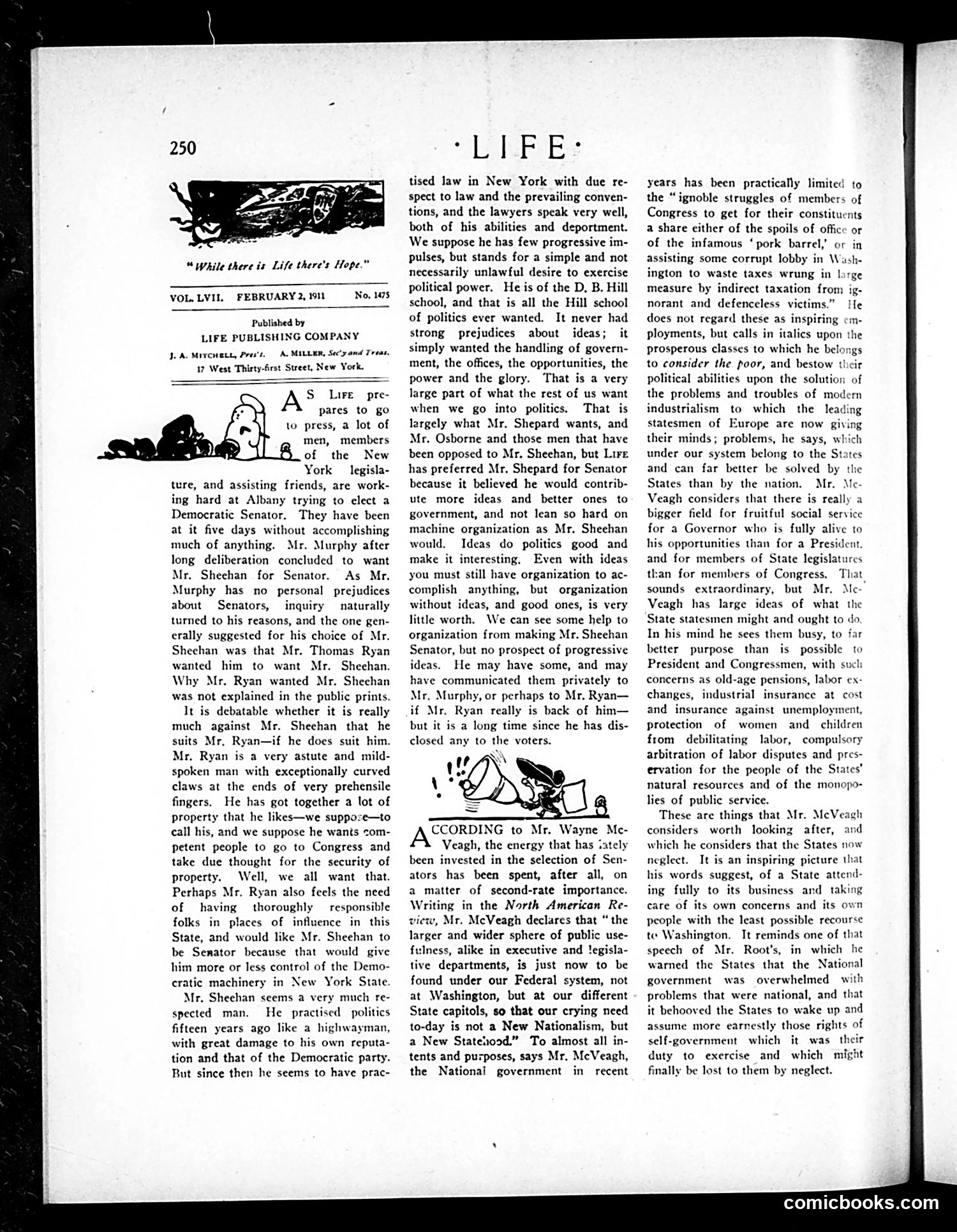
This page satirizes the 1911 New York State Democratic Senate election. The piece attacks political machine control, specifically targeting: **The Setup:** Machine boss **Charles F. Murphy** wants to elect **William F. Sheehan** as Senator, allegedly at the behest of wealthy financier **Thomas Ryan**, whose influence over candidates Life finds concerning. **The Satire:** Life criticizes Sheehan as representing the old "D. B. Hill school" of politics—interested only in power and patronage, lacking progressive ideas. Though respecting Sheehan's recent legal practice, Life prefers candidate **Shepard** (or **Osborne**) for bringing actual ideas to government, not just machine organization. **The Cartoon** (left, partially visible) appears to mock this backroom wheeling. **The Point:** Life argues that property-holder Ryan and machine politician Murphy control candidates without regard for genuine reform or public interest—a classic Progressive Era critique of political corruption and corporate influence over nominations.
📄 Transcribed text from this page (OCR, searchable)
Machine-transcribed from the original scan — historical spelling and the odd misread are preserved.
“While there is Life there's Hope.” VOL. LVI, FEBRUARY 2, 1911 No, 1475 Published by LIFE PUBLISHING COMPANY JoAL MITCHELL, Pres't, A. MILLER, Sec'y and Tr 17 West Thirty-first Street, New York. S Lire pre- pares to go to press, a lot of members the New York — legisla- ture, and assisting friends, are work- ing hard at Albany trying to elect a Democratic Senator. They have been at it five days without accomplishing much of anything. Mr. Murphy after long deliberation concluded to want Mr. Sheehan for Senator. As Mr. men, Murphy has no personal prejudices about Senators, inquiry naturally turned to his reasons, and the one gen- erally suggested for his choice of Mr. Sheehan was that Mr. Thomas Ryan wanted him to want Mr. Sheehan. Why Mr. Ryan wanted Mr. Sheehan was not explained in the public prints. It is debatable whether it is really much against Mr. Sheehan that he suits Mr, Ryan—if he does suit him. Mr. Ryan is a very astute and mild- spoken man with exceptionally curved claws at the ends of very prehensile fingers. He has got together a lot of property that he likes—we suppose—to call his, and we suppose he wants com- petent people to go to Congress and take due thought for the security of property. Well, we all want that. Perhaps Mr. Ryan also feels the need of having thoroughly — responsible folks in places of influence in this State, and would like Mr. Sheehan to be Senator because that would give him more or less control of the Demo- cratic machinery in New York State. Mr. Sheehan seems a very much re- spected man. He practised politics fifteen years ago like a highwayman, with great damage to his own reputa- tion and that of the Democratic party. But since then he seems to have prac- BIL, |e Je tised law in New York with due re- spect to law and the prevailing conven- tions, and the lawyers speak very well, both of his abilities and deportment. We suppose he has few progressive im- pulses, but stands for a simple and not necessarily unlawful desire to exercise political power. He is of the D, B. Hill school, and that is all the Hill school of politics ever wanted. It never had strong prejudices about ideas; it simply wanted the handling of govern- ment, the offices, the opportunities, the power and the glory. That is a very large part of what the rest of us want when we go into politics. That is largely what Mr. Shepard wants, and Mr. Osborne and those men that have been opposed to Mr. Sheehan, but Lire has preferred Mr. Shepard for Senator because it believed he would contrib- ute more ideas and better ones to government, and not lean so hard on machine organization as Mr. Sheehan would. Ideas do politics good and make it interesting, Even with ideas you must still have organization to ac- complish anything, but organization without ideas, and good ones, is very little worth. We can see some help to organization from making Mr. Sheehan Senator, but no prospect of progressive ideas. He may have some, and may have communicated them privately to Mr, Murphy, or perhaps to Mr. Ryan— if Mr, Ryan really is back of him— but it is a long time since he has dis- closed any to the voters. CCORDING to Mr. Wayne Mc- Veagh, the energy that has iately been invested in the selection of Sen- ators has been spent, after all, on a matter of second-rate importance. Writing in the North American Re- view, Mr. McVeagh declares that “ the larger and wider sphere of public use- ness, alike in executive and !egisla- tive departments, is just now to be found under our Federal system, not at Washington, but at our different State capitols, so that our crying need to-day is not a New Nationalism, but a New Statehood.” To almost all in- tents and purposes, says Mr. McVeagh, the National government in recent years has been practically limited to the “ignoble struggles of members of Congress to get for their constituents a share either of the spoils of office or of the infamous ‘pork barrel,’ or in assisting some corrupt lobby in Wash- ington to waste taxes wrung in large measure by indirect taxation from ig- norant and defenceless victims.” does not regard these as inspiring ployments, but calls in italics upon the prosperous classes to which he belongs to consider the poor, and bestow thei political abilities upon the solution of the problems and troubles of modem industrialism to which the leading statesmen of Europe are now giving their minds; problems, he says, which under our system belong to the States and can far better be solved by t States than by the nation. Mr. Me- Veagh considers that there is really bigger field for fruitful social service for a Governor who is fully alive to his opportunities than for a President. and for members of State legislatures tkan for members of Congress. That sounds extraordinary, but Mr. Me- Veagh has large ideas of what the State statesmen might and ought to do, In his mind he sees them busy, to far better purpose than is possible to President and Congressmen, with sucli concerns as old-age pensions, labor ¢ changes, industrial insurance at cost and insurance against unemployment, protection of women and children from debilitating labor, compulsory arbitration of labor disputes and pre ervation for the people of the Sta natural resources and of the monopo- lies of public service. These are things that Mr. MeVeagh considers worth looking after, an which he considers that the States now neglect. It is an inspiring picture that his words suggest, of a State attend- ing fully to its business and taking care of its own concerns and its own people with the least possible recourse te Washington. It reminds one of that speech of Mr. Root’s, in which he warned the States that the National government was overwhelmed with problems that were national, and that it behooved the States to wake up and assume more earnestly those rights of self-government which it was their duty to exercise and which might finally be lost to them by neglect. comicbooks.com