
Life, 1911-02-02 · page 24 of 52
Life — February 2, 1911 — page 24: what you’re looking at
What you’re looking at
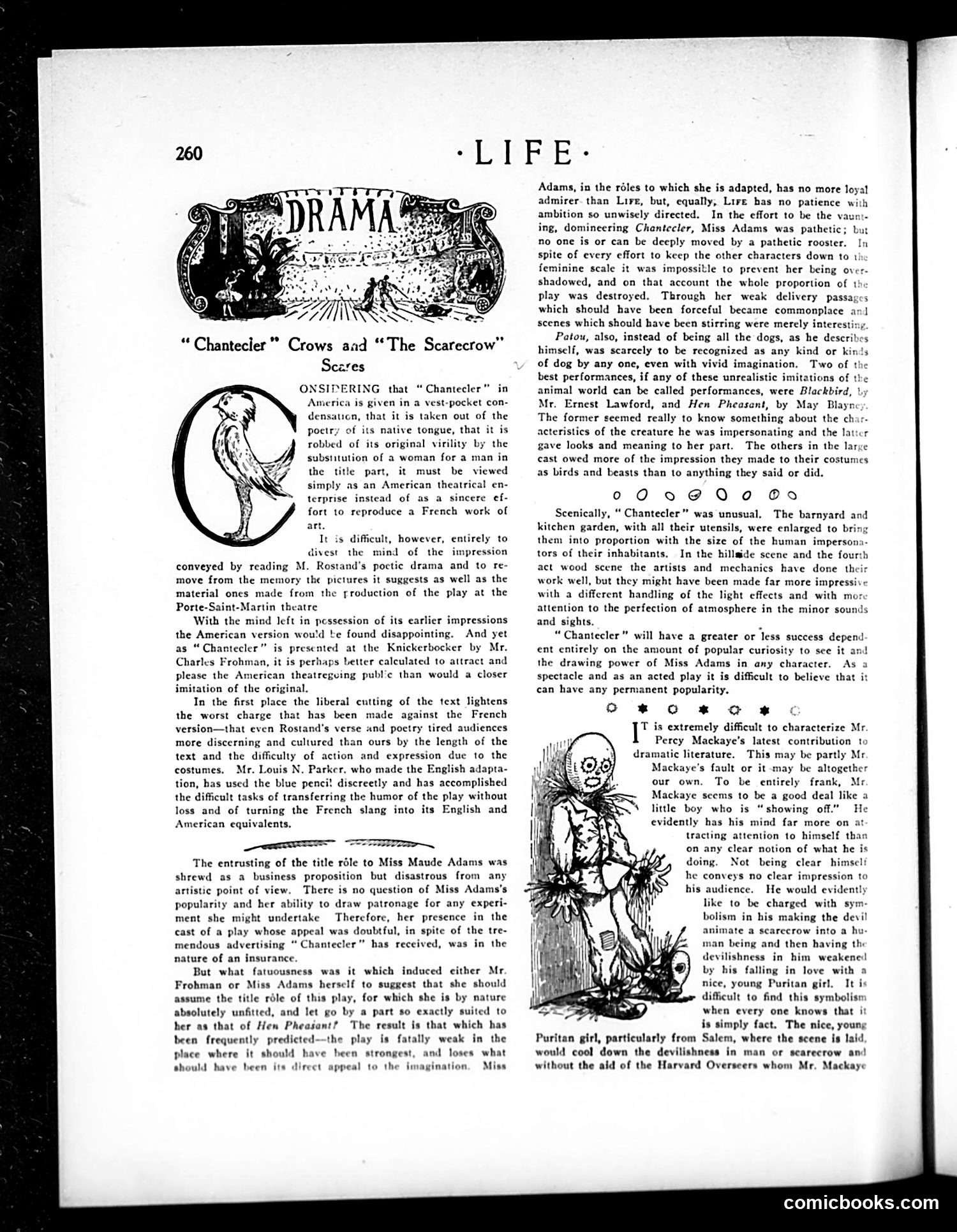
This is a theater review critiquing the American production of Edmond Rostand's French play *Chanticleer*. The key complaint: **Maude Adams, a popular American actress, was miscast in the title role.** The reviewer argues that while Adams excels in other roles and draws audiences reliably, she was "absolutely unfitted" to play the domineering rooster Chanticleer. Her performance was "pathetic," and casting her weakened the entire production—especially scenes meant to be forceful became commonplace. The reviewer notes she would have been perfectly suited to play "Hen Pheasant" instead. The cartoon of the scarecrow (right) appears to illustrate this casting disaster—a poorly constructed figure representing the hollowed-out dramatic effect of misplaced talent. The review acknowledges Adams' star power helped market the play but argues this commercial decision sacrificed artistic integrity.
📄 Transcribed text from this page (OCR, searchable)
Machine-transcribed from the original scan — historical spelling and the odd misread are preserved.
“IOPESE: “ Chantecler” Crows aad “The Scarecrow” Scar es ONSIDERING that “Chantecler” in America is given in a vest-pocket con- densation, that it is taken out of the poetry of its native tongue, that it is robbed of its original virility by the substitution of a woman for a man in the title part, it must be viewed simply as an American theatrical en- terprise instead of as a sincere ef- fort to reproduce a French work of art. It is difficult, however, entirely to divest the mind of the impression conveyed by reading M. Rostand’s poctic drama and to re- move from the memory the pictures it suggests as well as the material ones made from the froduction of the play at the Porte-Saint-Martin theatre With the mind left in pcssession of its earlier impressions the American version wou'd te found disappointing. And yet as “Chantecler” is presented at the Knickerbocker by Mr. Charles Frohman, it is perhaps better calculated to attract and please the American theatreguing publ’c than would a closer imitation of the original. In the first place the liberal cutting of the text lightens the worst charge that has been made against the French version—that even Rostand’s verse and poctry tired audiences more discerning and cultured than ours by the length of the text and the difficulty of action and expression due to the costumes, Mr. Louis N. Parker, who made the English adapta- tion, has used the blue penci! discreetly and has accomplished the difficult tasks of transferring the humor of the play without loss and of turning the French slang into its English and American equivalents. aa see a The entrusting of the title rile to Miss Maude Adams was shrewd as a business proposition but disastrous from any artistic point of view. There is no question of Miss Adams's popularity and her ability to draw patronage for any experi- ment she might undertake Therefore, her presence in the cast of a play whose appeal was doubtful, in spite of the tre- mendous advertising “ Chantecler” has received, was in the nature of an insurance. But what fatuousness was it which induced either Mr. Frohman or Miss Adams herself to suggest that she should assume the title rdle of this play, for which she is by nature absolutely unfitted, and let go by a part so exactly suited to her as that of Hen Pheasant? The result is that which has been frequently predicted—the play is fatally weak in the place where it should have heen strongest, and loses what should have been its direct appeal to the imagination, Miss Adams, in the réles to which she is adapted, has no more loyal admirer than Lire, but, equally, Live has no patience with ambition so unwisely directed. In the effort to be the vaunt- ing, domineering Chantecler, Miss Adams was pathetic; but no one is or can be deeply moved by a pathetic rooster, In spite of every effort to keep the other characters down to i feminine scale it was impossitle to prevent her being over- shadowed, and on that account the whole proportion of t play was destroyed. Through her weak delivery passages which should have been forceful became commonplace scenes which should have been stirring were merely interes: Patou, also, instead of being all the dogs, as he describ himself, was scarcely to be recognized as any kind or k: of dog by any one, even with vivid imagination. Two of the best performances, if any of these unrealistic imitations of 1 animal world can be called performances, were Blackbird, \, Mr. Ernest Lawford, and Hen Pheasant, by May Blayn The former seemed really to know something about the char- acteristics of the creature he was impersonating and the latier gave looks and meaning to her part. The others in the large cast owed more of the impression they made to their costumes as birds and beasts than to anything they said or did. °©0O008@00 090 Scenically, “ Chantecler” was unusual, The barnyard and kitchen garden, with all their utensils, were enlarged to bring them into proportion with the size of the human impersona- tors of their inhabitants. In the hillaide scene and the fourth act wood scene the artists and mechanics have done the work well, but they might have been made far more impressi with a different handling of the light effects and with mor. attention to the perfection of atmosphere in the minor sounds and sights. . “ Chantecler” will have a greater or less success depend. ent entirely on the amount of popular curiosity to see it and the drawing power of Miss Adams in any character. As a spectacle and as an acted play it is difficult to believe that it can have any permanent popularity. o * © * @ * T is extremely difficult to characterize Mr. Percy Mackaye’s latest contribution to dramatic literature. This may be partly Mr Mackaye’s fault or it may be altogeth our own. To be entirely frank, Mr Mackaye seems to be a good deal like a little boy who is “showing off.” evidently has his mind far more on tracting attention to himself tha on any clear notion of what he is doing. Not being clear himseli he conveys no clear impression to his audience. He would evidently like to be charged with sym- bolism in his making the devil animate a scarecrow into a hu- man being and then having the devilishness in him weakened by his falling in love with » nice, young Puritan girl. It is difficult to find this symbolism when every one knows that it is simply fact. The nice, young Puritan girl, particularly from Salem, where the scene is laid. would cool down the devilishness in man or scarecrow an’ without the aid of the Harvard Overseers whom Mr, Mackaye comicbooks.com