
Life, 1911-02-02 · page 39 of 52
Life — February 2, 1911 — page 39: what you’re looking at
What you’re looking at
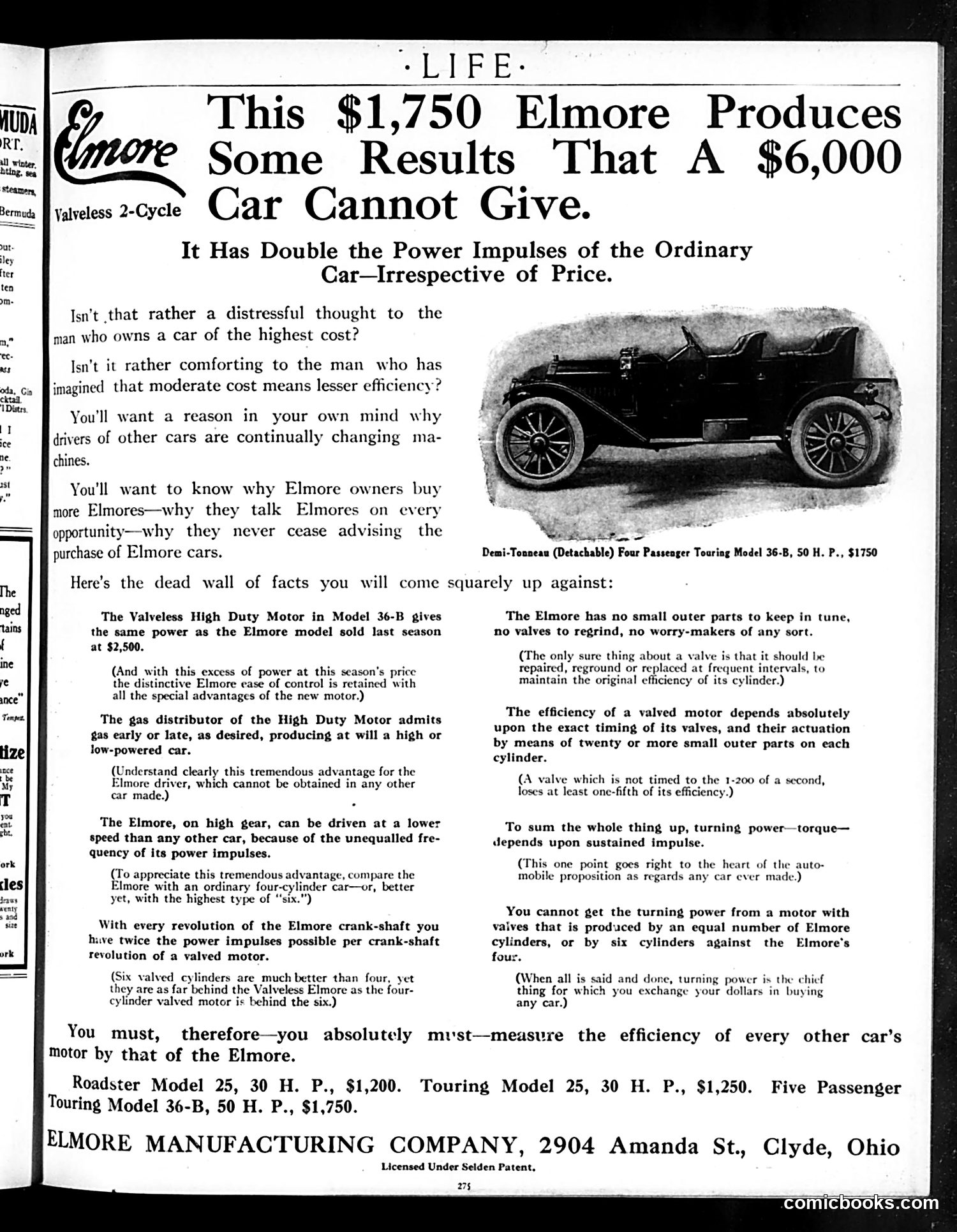
This is a **car advertisement**, not satire or political content. The Elmore Manufacturing Company promotes its $1,750 automobile by claiming technical superiority over more expensive competitors (implicitly $6,000 luxury cars). The pitch targets middle-class buyers with anxiety about spending: a cheaper car outperforms expensive ones because its **valveless 2-cycle engine** produces "double the power impulses" of conventional 4-cylinder motors. The ad contrasts Elmore owners' loyalty ("buy more Elmores") against wealthy car owners' constant upgrades. The technical claims are the selling point—no valve maintenance, superior torque, lower operating costs—framed as objective facts that supposedly make price irrelevant to quality. The repeated parenthetical "proof" statements attempt to preempt skepticism. This reflects early 1900s automotive competition when engine technology varied widely and consumer knowledge was limited. The Elmore company ultimately failed, suggesting these claims didn't withstand market reality.
📄 Transcribed text from this page (OCR, searchable)
Machine-transcribed from the original scan — historical spelling and the odd misread are preserved.
pia ™ @ This $1,750 Elmore Produces Some Results That A $6,000 vies -cyle Car Cannot Give. It Has Double the Power Impulses of the Ordinary Car—Irrespective of Price. Isn't that rather a distressful thought to the man who owns a car of the highest cost? Isn't it rather comforting to the man who has imagined that moderate cost means lesser efficiency? You'll want a reason in your own mind why drivers of other cars are continually changing ma- chines. You'll want to know why Elmore owners buy more Elmores—why they talk Elmores on every opportunity—why they never cease advising the purchase of Elmore cars. Here's the dead wall of facts you will come The Valveless High Duty Motor in Model 36-B gives the same power as the Elmore model sold last season at $2,500. (And with this excess of power at this season's price the distinctive Elmore ease of control is retained with all the special advantages of the new motor.) The gas distributor of the High Duty Motor admits gas early or late, as desired, producing at will a high or low-powered car. (Understand clearly this tremendous advantage for the Elmore driver, which cannot be obtained in any other car made.) The Elmore, on high gear, can be driven at a lower speed than any other car, because of the unequalled fre- quency of its power impulses. (To appreciate this tremendous advantage, compare the Elmore with an ordinary four-cylinder car—or, better yet, with the highest type of ‘“six.") With every revolution of the Elmore crank-shaft you hive twice the power impulses possible per crank-shaft revolution of a valved motor. (Six valved cylinders are much better than four, yet they are as far behind the Valveless Elmore as the four- cylinder valved motor is behind the six.) You must, motor by that of the Elmore. Roadster Model 25, 30 H. P., $1,200. Touring Model 25, 30 H. P., $1,250. Five Passenger Touring Model 36-B, 50 H. P., $1,750. ELMORE MANUFACTURING COMPANY, 2904 Amanda St., Clyde, Ohio e Lak = Demi-Tonneau (Detachable) Four Passenger Touring Model 36-B, SO H. P., $1750 squarely up against: The Elmore has no small outer parts to keep in tune, no valves to regrind, no worry-makers of any sort. (The only sure thing about a valve is that it should be repaired, reground or replaced at frequent intervals, to maintain the original efficiency of its cylinder.) The efficiency of a valved motor depends absolutely upon the exact timing of its valves, and their actuation by means of twenty or more small outer parts on each cylinder. (A valve which is not timed to the 1-200 of a second, loses at least one-fifth of its efficiency.) To sum the whole thing up, turning power—torque— depends upon sustained impulse. (This one point goes right to the heart of the auto- mobile proposition as regards any car ever made.) You cannot get the turning power from a motor with vaives that is produced by an equal number of Elmore cylinders, or by six cylinders against the Elmore’s four. (When all is said and done, turning power is the chief thing for which you exchange your dollars in buying any car.) therefore—you absolutely must—measvre the efficiency of every other car’s Licensed Under Selden Patent.