
A complete issue · 44 pages · 1911
Life — January 12, 1911
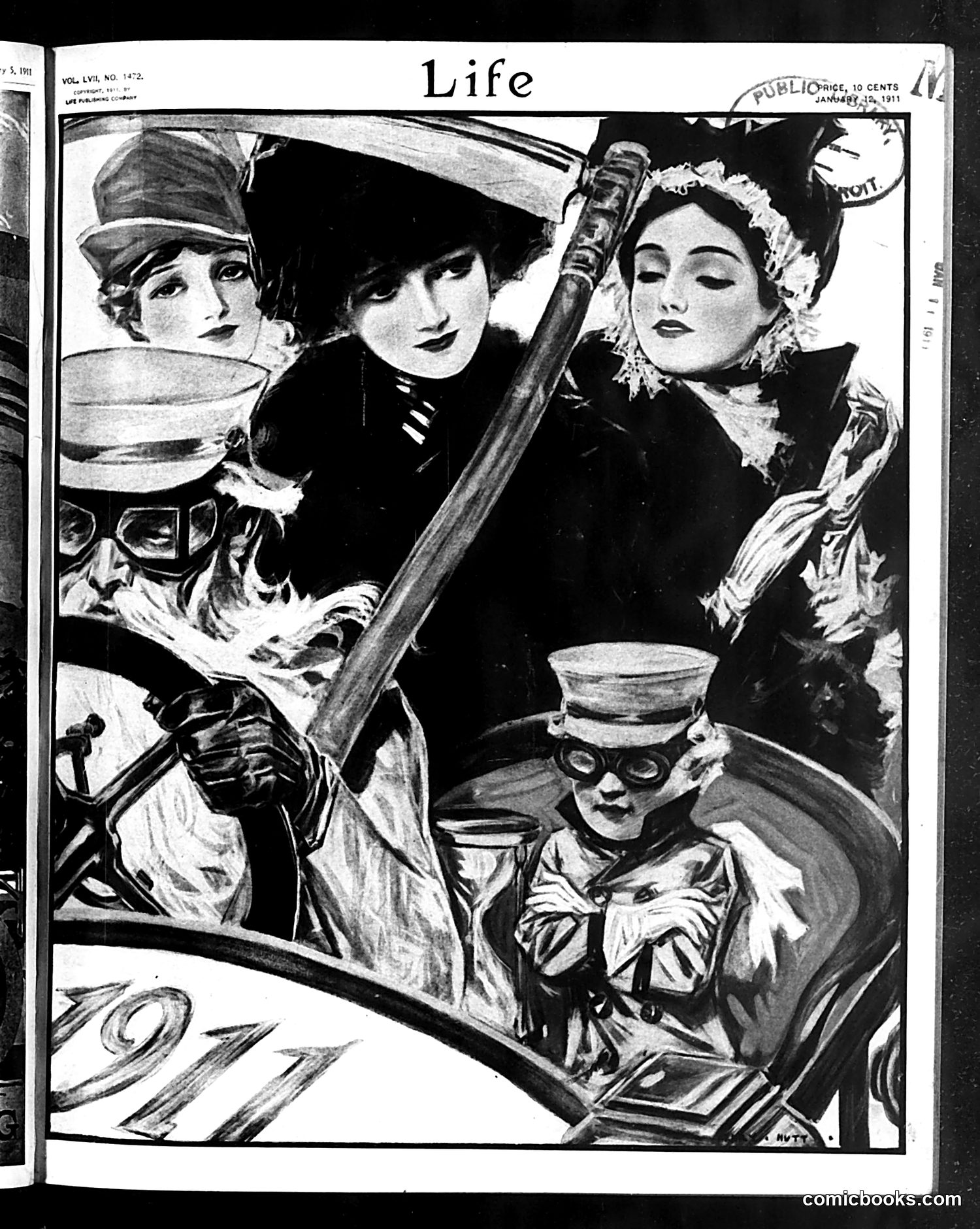
This Life magazine cover from January 25, 1911 depicts four women in elaborate costumes wielding baseball bats and other sporting equipment. The artwork appears to satirize the emerging women's suffrage movement of the early 1900s, a period when women were increasingly demanding voting rights and greater social freedoms. The "masculine" activity of baseball—traditionally male-dominated—combined with the women's determined expressions suggests the cartoonist is mocking women's push for equality as an unnatural or comedic inversion of gender roles. The ornate hats and clothing contrast sharply with their aggressive sporting poses, heightening the satirical effect. This reflects common anti-suffrage rhetoric of the era, which portrayed women's rights advocates as threats to traditional society.
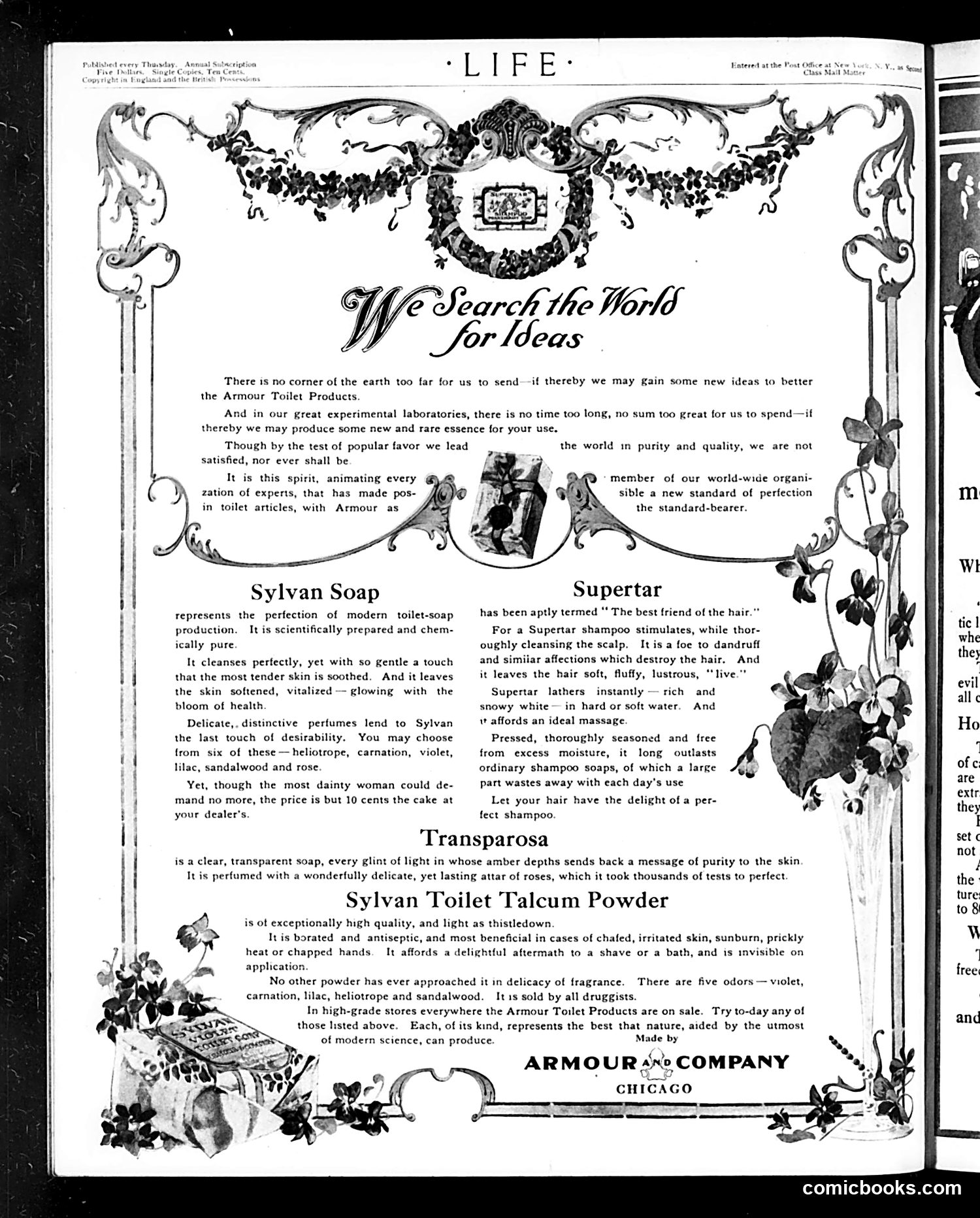
This page is primarily **advertising, not satire or political content**. It's a full-page advertisement for Armour and Company's toilet products (soap, shampoo, talcum powder) from Chicago. The decorative header reads "We Search the World for Ideas," presenting Armour's philosophy of sourcing ingredients globally. The ornamental borders feature floral designs typical of early 20th-century advertising aesthetics. The copy emphasizes product purity and quality—"chemically pure," "light as thistledown"—using language meant to appeal to consumers concerned with hygiene and elegance. Product names like "Sylvan Soap" and "Supertar" suggest naturalness and efficacy. There is **no political cartoon or satire present**. This is straightforward commercial advertising designed to promote Armour's consumer toiletry line.
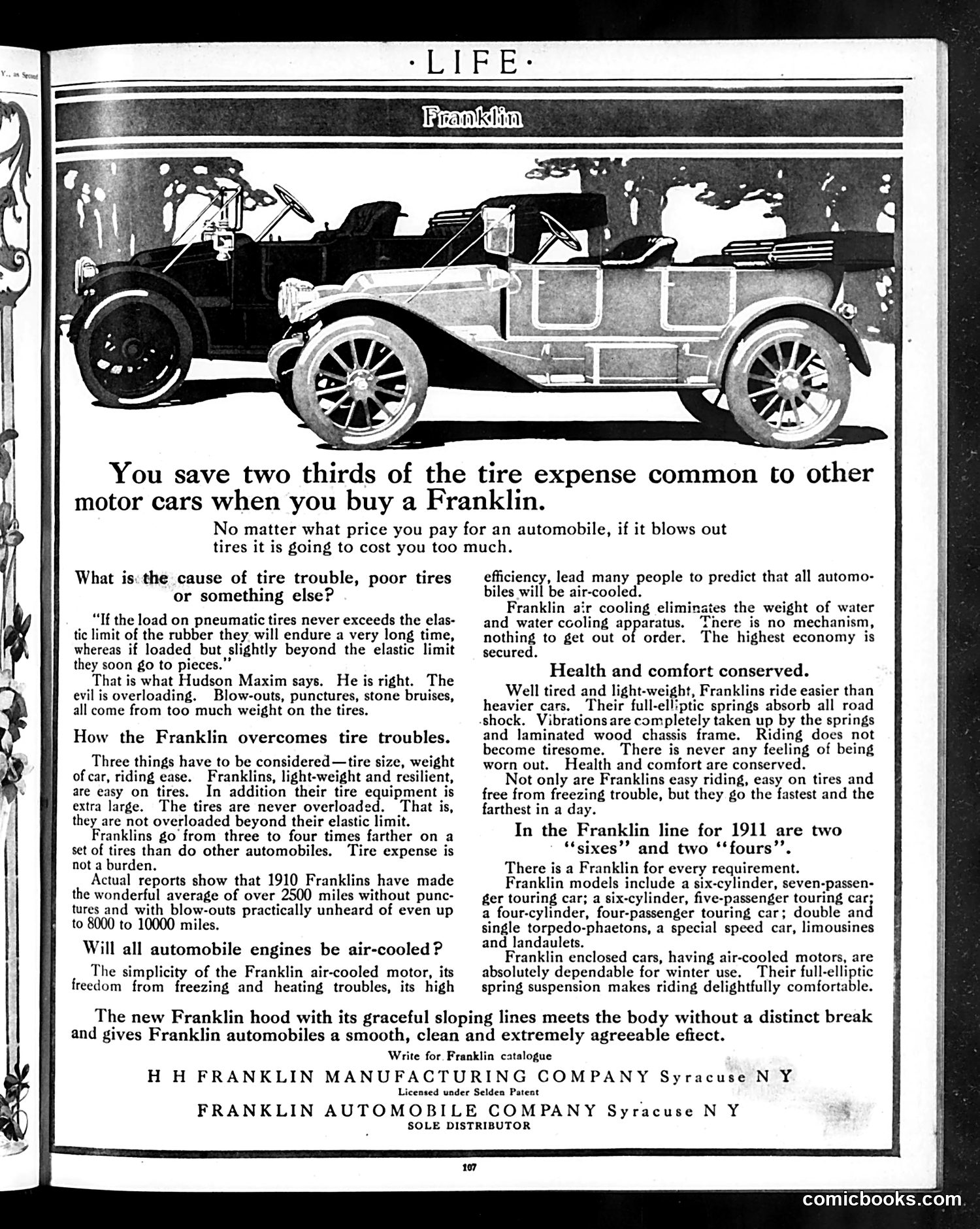
This is **not a cartoon or satire**, but rather a straightforward **product advertisement** for Franklin automobiles, published in Life magazine around 1911. The ad promotes the Franklin's key innovation: **air-cooling** rather than water-cooling. It argues this design saves owners two-thirds of typical tire expenses by reducing weight and strain on pneumatic tires. The advertisement addresses consumer concerns about tire reliability—a genuine problem for early automobiles—by explaining the mechanical advantages of the Franklin's engineering. The ad emphasizes practical benefits: durability, comfort, health, and economy. It lists available models (ranging from four to six cylinders) and claims the 1910 model averaged over 2,500 miles without punctures. This reflects early automotive marketing's focus on **technical specifications and reliability** rather than style or luxury.
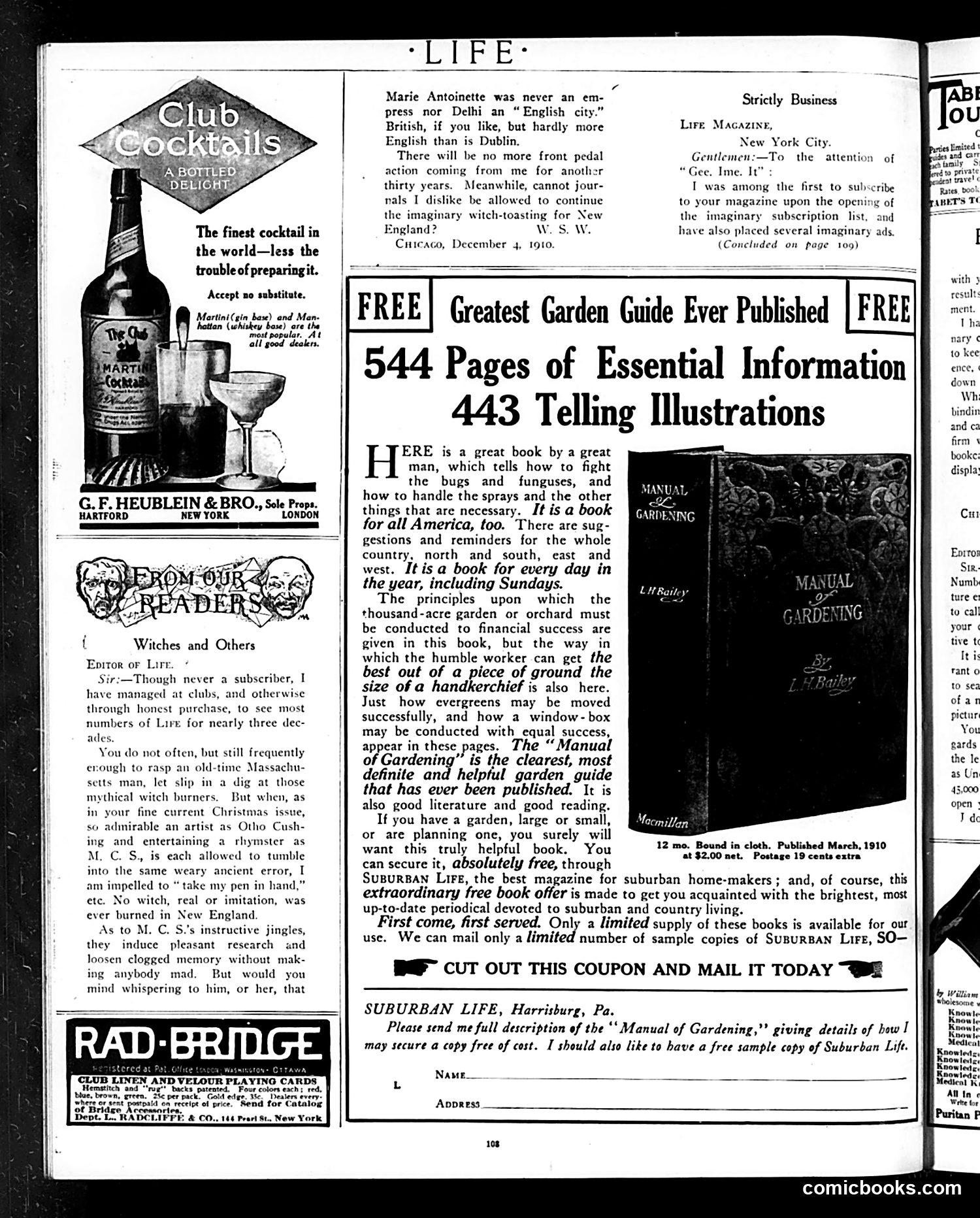
This page is primarily **advertising and reader mail**, not political satire. The main content includes: 1. **Club Cocktails advertisement** (top left) - promoting a bottled cocktail product by G.F. Heublein & Bros. 2. **"From Our Readers"** section - letters to the editor, including one from a long-time subscriber discussing Life magazine's Christmas issue and comparing it favorably to competitor *The Life*. 3. **Rad-Bridge advertisement** (bottom left) - promoting club linen and playing cards. 4. **Major feature**: A full-page advertisement for a free "Manual of Gardening" guide (544 pages, 443 illustrations), offered by *Suburban Life* magazine to acquire new subscribers. There is **no political cartoon** on this page. It's a typical early-20th-century magazine page mixing reader correspondence with commercial advertisements and promotional offers.
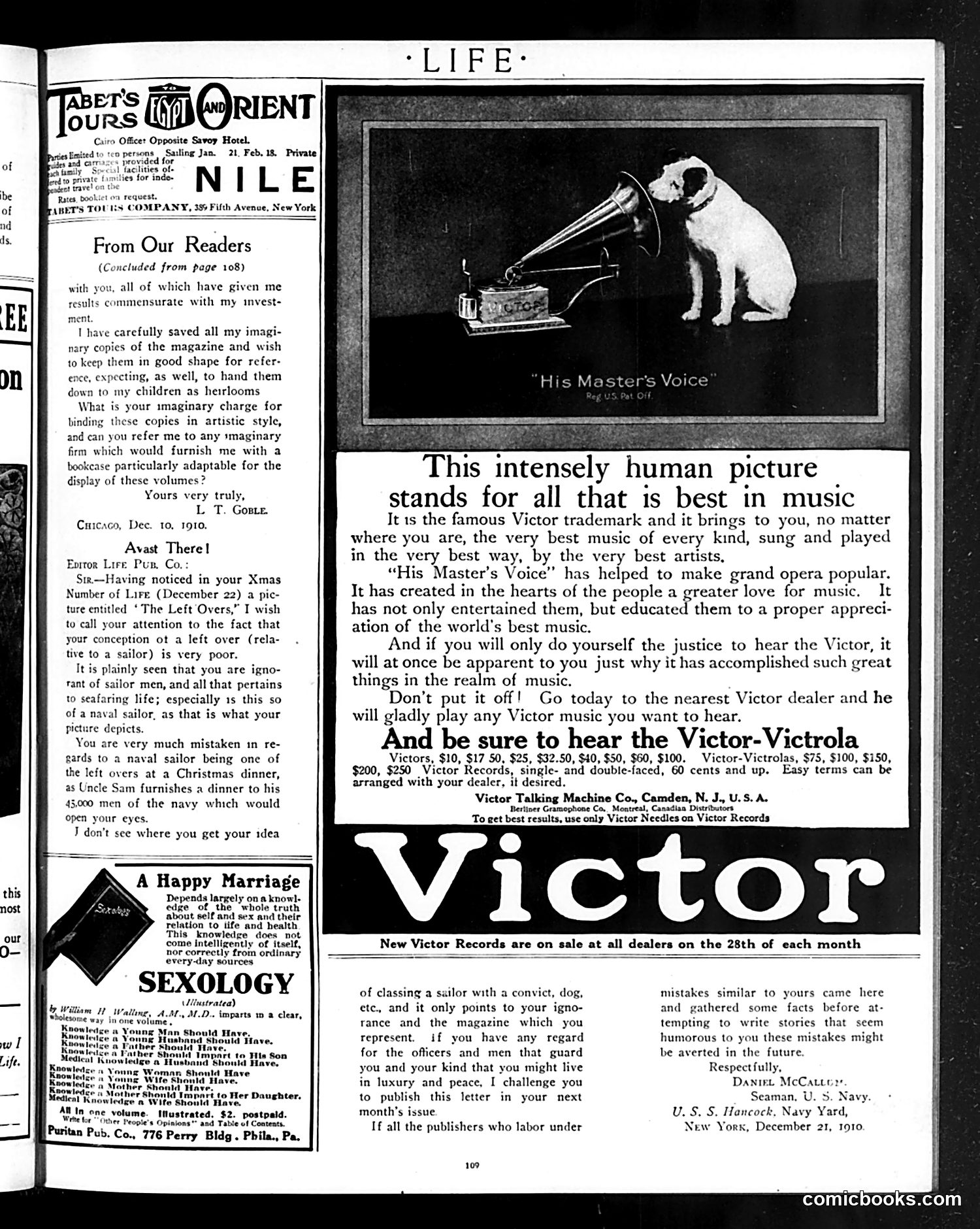
This page is primarily a **Victor Talking Machine advertisement**, not a political cartoon. The main image shows the famous "His Master's Voice" trademark—a dog listening to a gramophone—alongside promotional text emphasizing Victor's superiority in music quality and artist selection. The left column contains "From Our Readers," a letters section with readers' correspondence about magazine binding and other topics, plus separate advertisements for books on marriage and "Sexology." **There is no political satire here.** This is a commercial magazine page from December 1910 focused on advertising Victor phonographs and related products. The dog-and-gramophone image is a corporate logo, not commentary on contemporary events or politics.
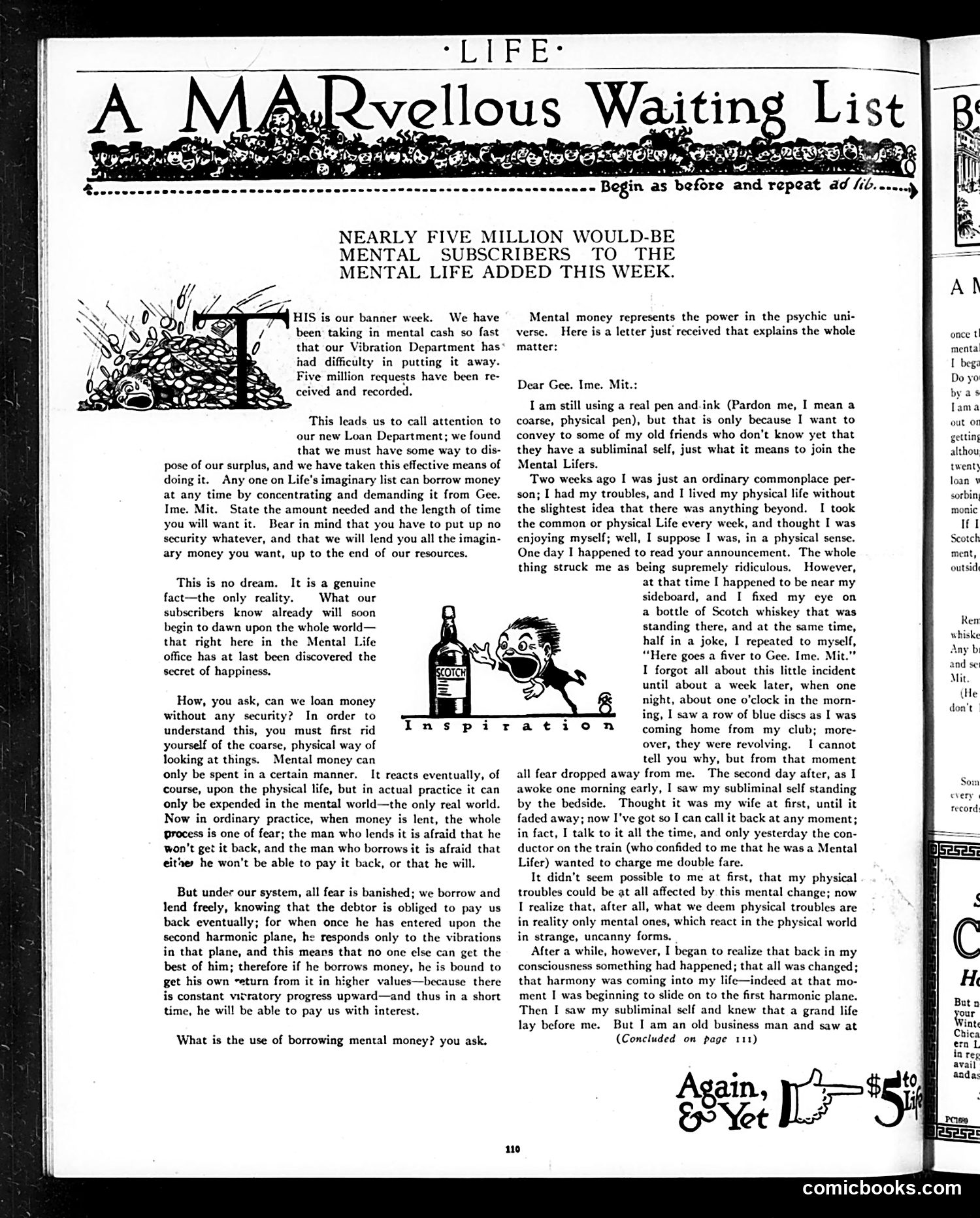
This page satirizes the "Mental Life" movement's financial system, which allegedly lends "mental money" to subscribers. The satire mocks the pseudoscientific concept that psychological/psychic energy can be borrowed and repaid like currency. The central cartoon shows a figure frantically juggling a bottle labeled "Inspiration," illustrating the absurdity of treating intangible mental states as tradeable commodities. The accompanying letter from a reader describes experiencing physical ailments that mysteriously vanished after receiving "mental money"—likely a true believer's testimonial that the editors are ridiculing. The overall point: Life ridicules the gullibility of people accepting imaginary financial systems based on occult or pseudoscientific claims about consciousness and energy transfer. This was apparently a widespread fad warranting satirical coverage.
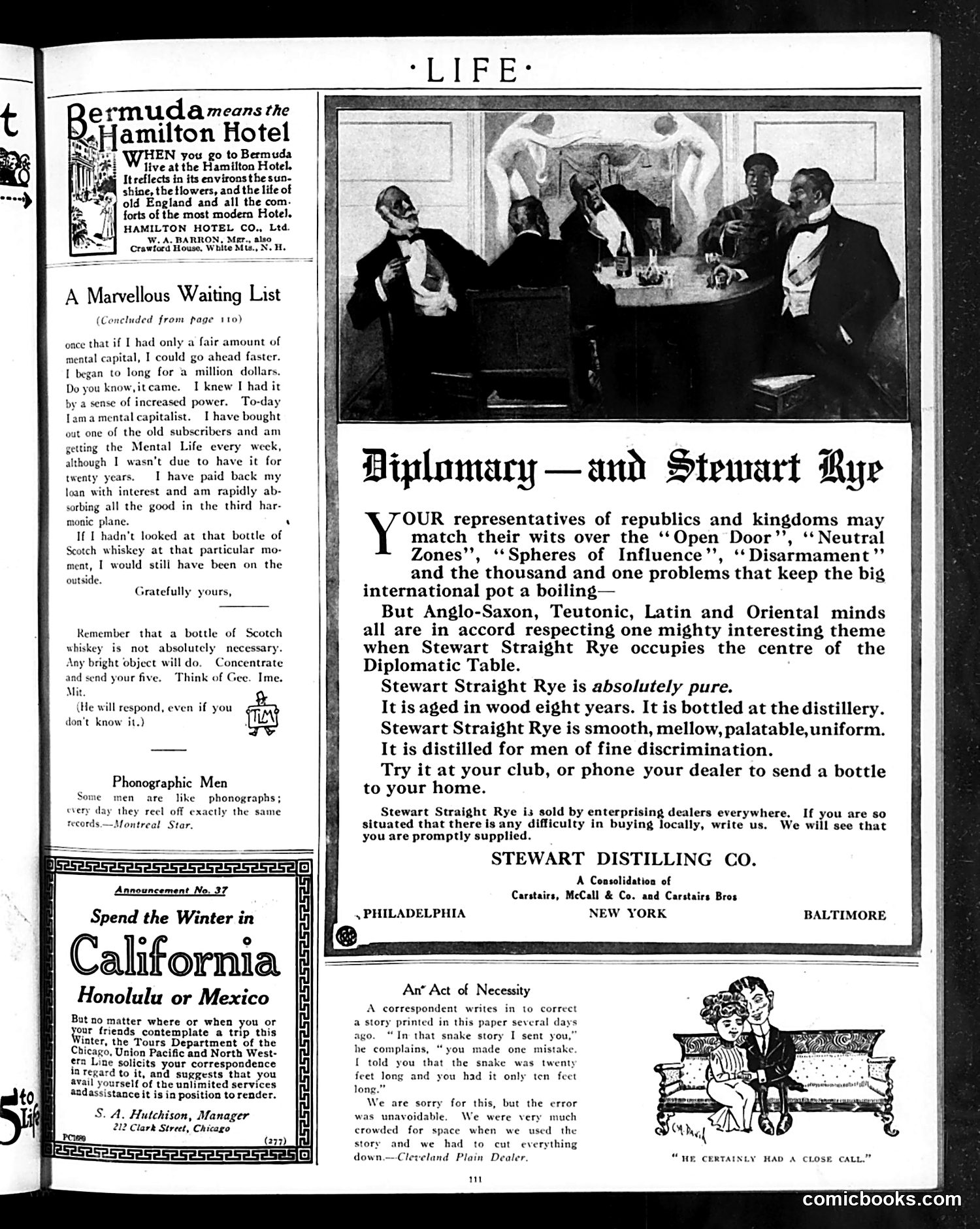
This page is primarily **advertising**, not satire or political commentary. The large advertisement for Stewart Straight Rye whiskey (center-right) uses a photograph showing diplomats or representatives from different nations gathered around a dining table, apparently debating international issues ("Open Door," "Neutral Zones," "Spheres of Influence"). The ad's joke is that while these international representatives argue about weighty political matters, they can all agree on Stewart Rye whiskey as a common ground—suggesting the product's universal appeal transcends political divisions. The page also includes smaller items: a Bermuda hotel advertisement (top-left), a travel advertisement for California/Mexico (bottom-left), and unrelated short pieces about waiting lists and photographic men (bottom).
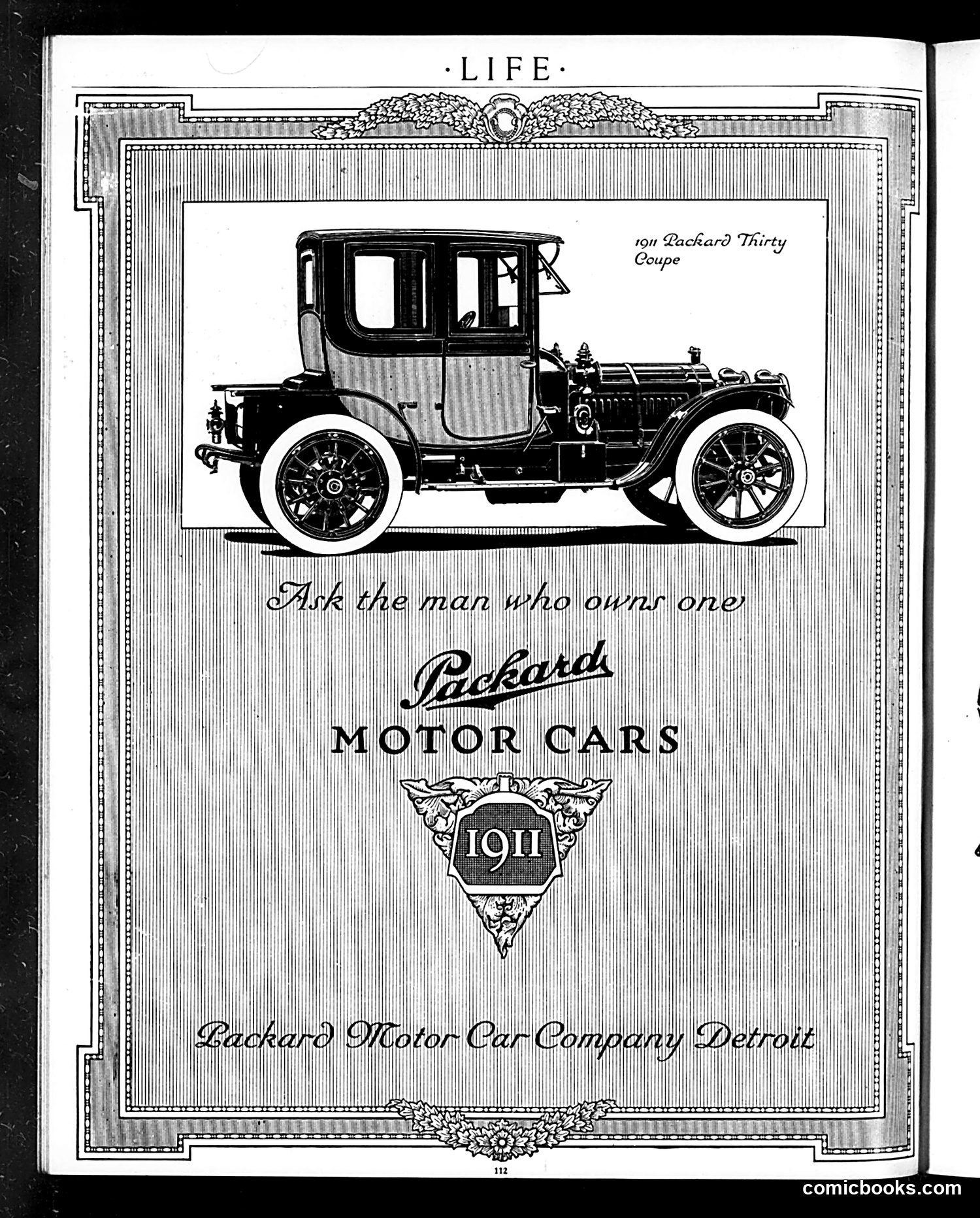
This is a **Packard automobile advertisement**, not a political cartoon or satire. The page appears from *Life* magazine circa 1911 and promotes the "1911 Packard Thirty Coupe" motor car. The ad's tagline—"Ask the man who owns one"—was Packard's actual famous marketing slogan, positioning the vehicle as prestigious enough that satisfied owners would serve as testimonials. The decorative side-view illustration emphasizes the car's modern engineering and elegant design. There is no satire or political commentary present. This is straightforward commercial advertising from the early automotive era, when motorized carriages represented luxury consumer goods marketed to wealthy Americans. The ornate Art Deco border design reflects the magazine's high-end aesthetic conventions of the period.
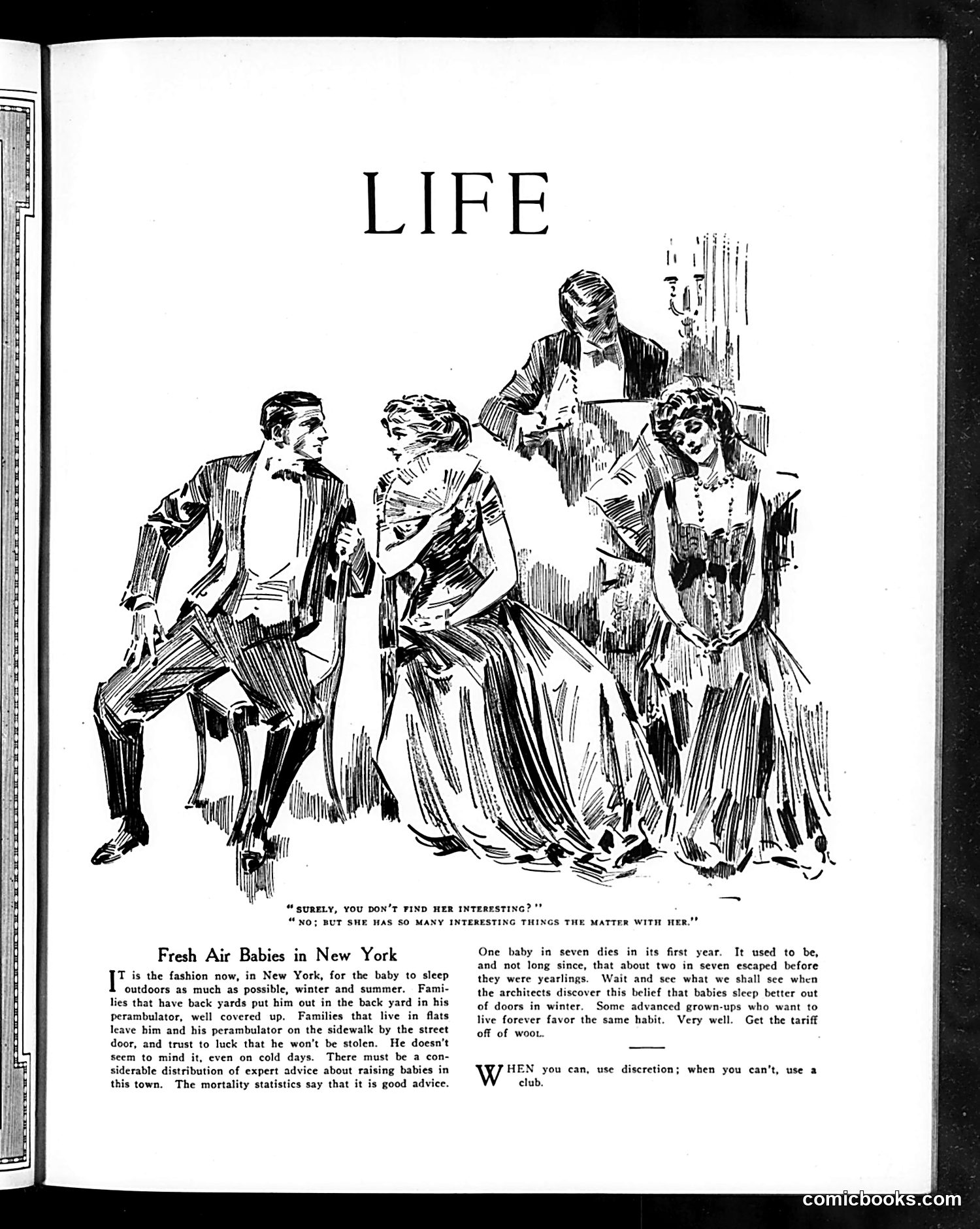
This *Life* magazine page satirizes parenting practices and child-rearing advice in early 20th-century New York City. The cartoon's caption—"Surely, you don't find her interesting?" "No; but she has so many interesting things the matter with her"—mocks society's focus on children's ailments and medical conditions as conversation topics. The article "Fresh Air Babies in New York" addresses a genuine public health concern: high infant mortality rates. It discusses the practice of sending babies outdoors year-round and critiques the casual, sometimes negligent attitudes toward infant welfare among wealthy families who employ nannies. The satire targets both overzealous parenting discourse and class-based indifference to child welfare—poking fun at how New York's elite discuss their children's health problems as fashionable social currency rather than genuine concern.
This page from *Life* (January 12, 1911) discusses Democratic senatorial candidates in New York and Ohio, criticizing their qualifications. The text contrasts William Sheehan (New York) and John McLean (Ohio) unfavorably with their Republican opponents, suggesting they lack the strength to advance Democratic causes in the Senate. The page includes a decorative illustration of animals (appearing to be donkeys or similar creatures) that likely represents the Democratic Party symbolically, though its specific satirical meaning is unclear without additional context. The main satire targets Democratic leadership choices, arguing they represent the old political machine rather than progressive reform—a common Progressive Era critique. The piece questions whether these candidates truly represent Democratic hopes for the future.
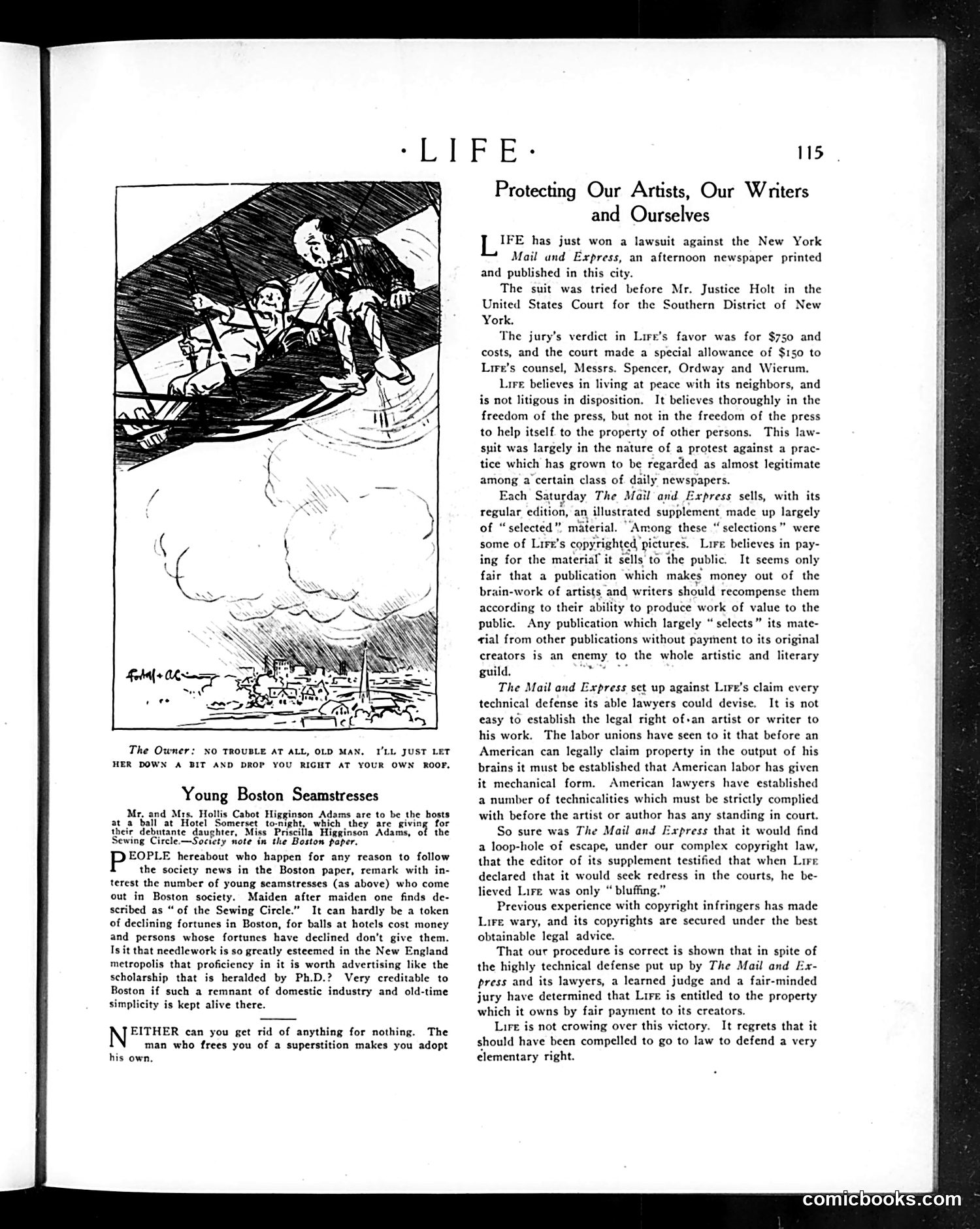
The cartoon depicts a wealthy man in a top hat sheltering poor people under an umbrella during a storm, with the caption: "No trouble at all, old man. I'll just let her down a bit and drop you right at your own roof." This is **class satire**. The "owner" (likely a landlord or wealthy businessman) condescendingly offers minimal assistance to working-poor tenants, suggesting he'll merely "drop" them at their modest homes rather than provide genuine aid. The imagery contrasts his comfort and authority (the umbrella, formal dress) with their vulnerability and dependence. The joke satirizes how the wealthy use performative charity—appearing generous while maintaining social hierarchy and control. The patronizing tone ("old man") emphasizes the power imbalance inherent in landlord-tenant relationships of the era.
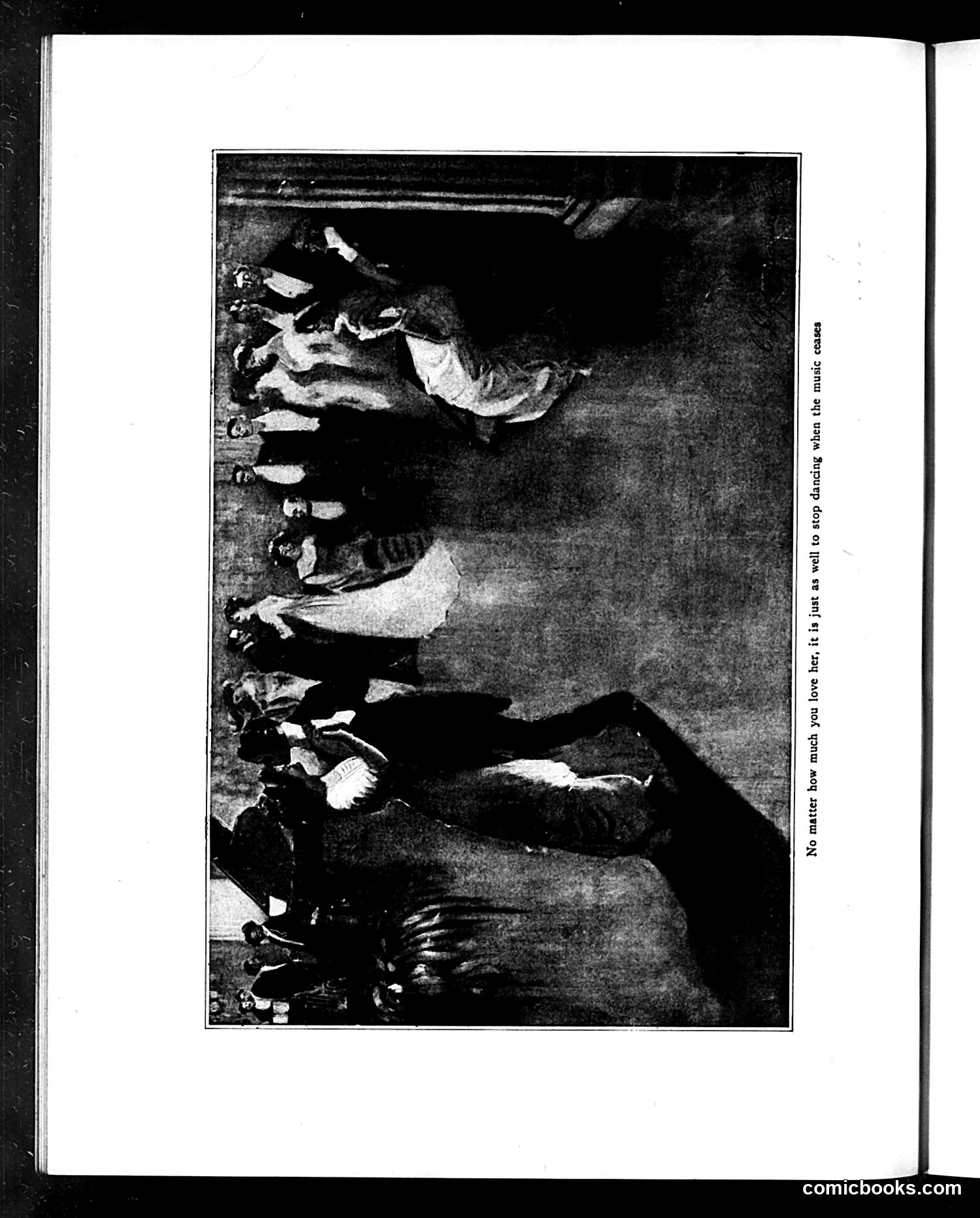
This page contains a black and white photograph (rotated 90 degrees) showing what appears to be a formal social gathering or event with multiple people. The caption reads: "No matter how much you love her, it is just as well to stop dancing when the music cases." This is a humorous social commentary piece, not political satire. The joke appears to be about propriety and decorum at social events—specifically warning against continuing intimate physical contact or dancing with a partner after the music has stopped. The caption suggests this applies universally ("no matter how much you love her"), implying that excessive public displays of affection, even between couples, were considered improper by the standards of Life magazine's era. The satire targets social etiquette violations rather than political figures or events.
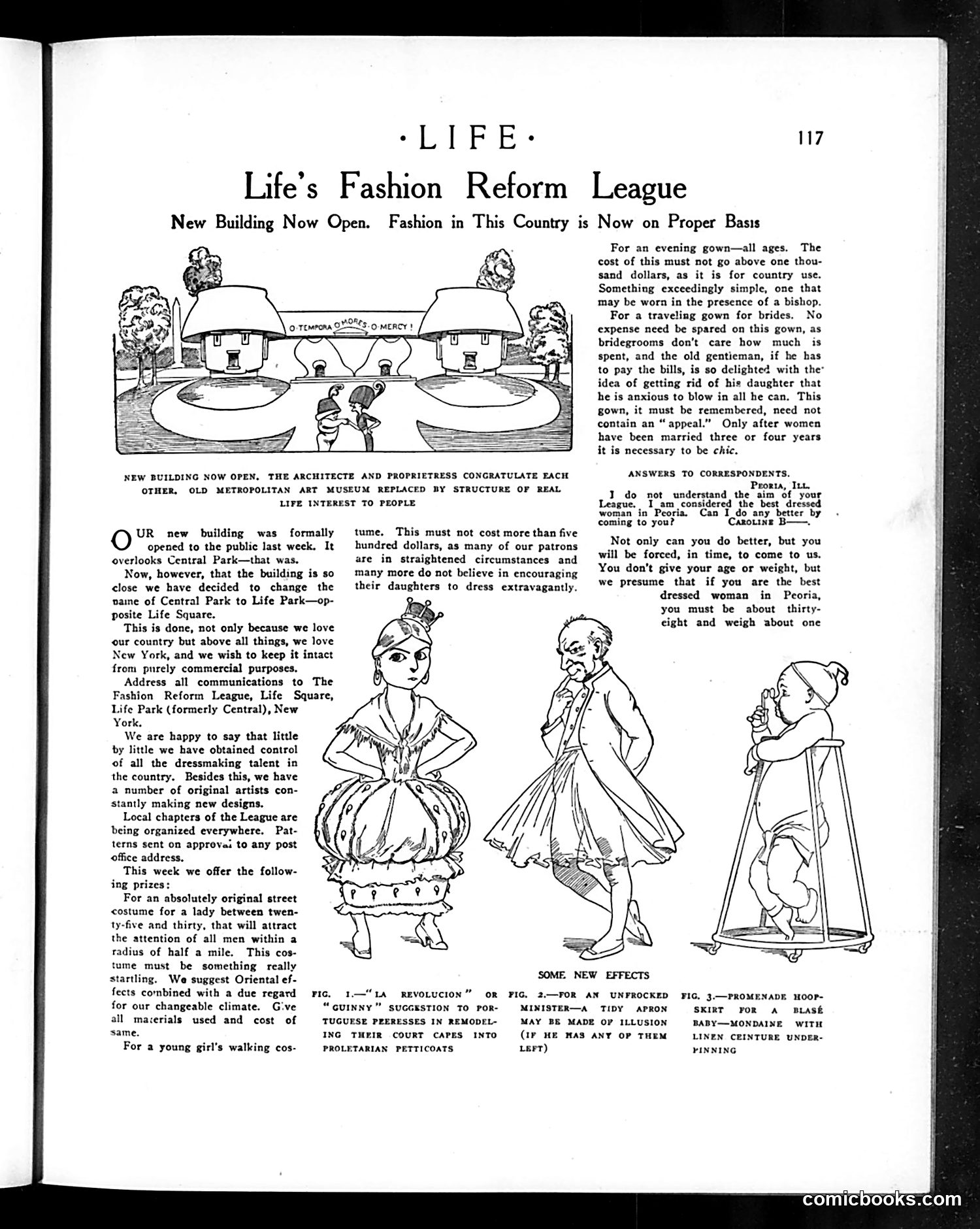
This page announces Life's "Fashion Reform League," promoting practical, affordable clothing for women. The satirical angle targets excessive spending on fashions—the league advocates for simple traveling gowns costing no more than $1,000 and practical daywear. The three cartoon figures labeled "Some New Effects" mock exaggerated fashion trends of the era: Fig. 1 shows an absurdly puffy "revolucion" skirt; Fig. 2 depicts a woman in an impractical hoop-skirt apron; Fig. 3 illustrates an enormous hoopskirt for children. The satire criticizes both the impracticality and expense of women's fashions while proposing sensible alternatives. The building illustration shows this as an institutional effort to reform American fashion standards toward modesty and economy.
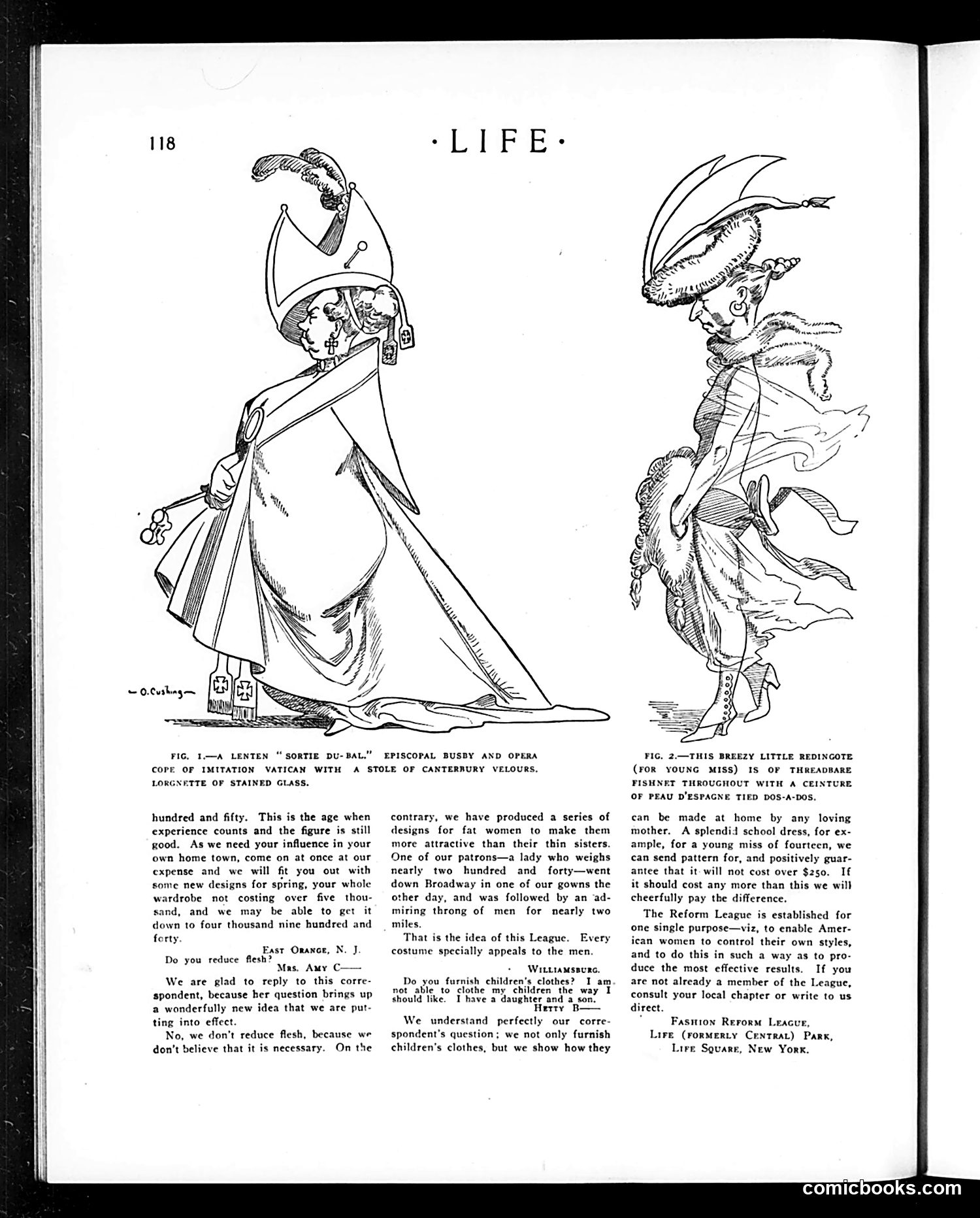
This page satirizes the "Fashion Reform League," a real early-20th-century movement promoting rational dress for women. The two illustrated figures mock the movement's pretensions: Figure 1 shows an absurdly ornate "Lenten" outfit with ecclesiastical elements (bishop's hat, Vatican-inspired cope), while Figure 2 depicts a supposedly practical young girl's dress made of threadbare fishnet—impractical and expensive. The text's deadpan responses to reader letters expose the hypocrisy: the League claims to help women dress affordably and sensibly, yet quotes astronomical costs ($250 for a school dress, $4,000+ for spring wardrobes). The anecdote about a 240-pound woman attracting admirers in Broadway mocks the League's dubious claims about flattering fuller figures. The satire targets how fashion reformers dressed up commercialism and vanity in the language of women's liberation and practical improvement.
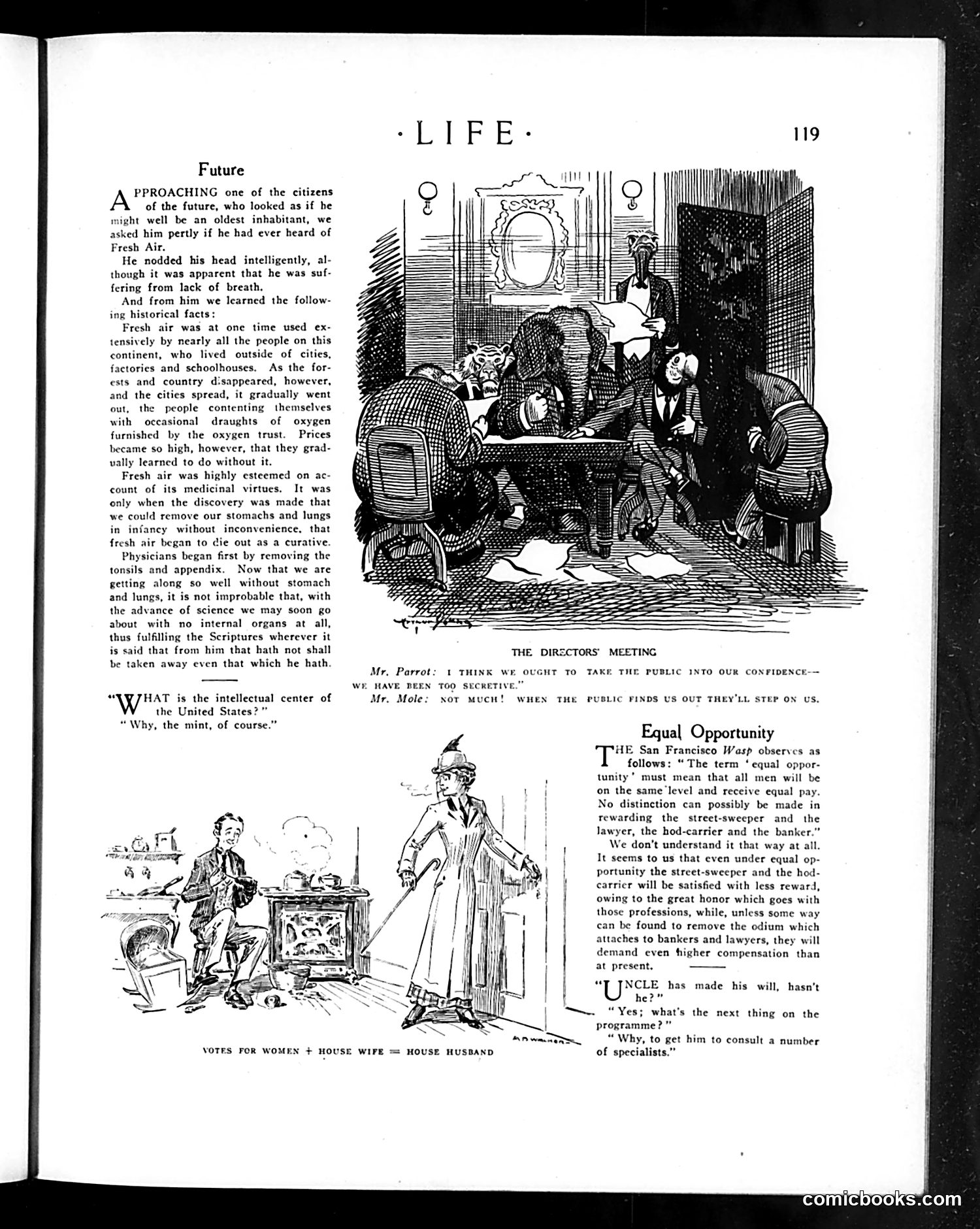
This page contains three satirical pieces mocking early 20th-century American society: **"Future"** imagines a dystopian world where corporations monopolize natural resources. The "oxygen trust" has made fresh air so expensive that people abandon it entirely. Scientists then remove citizens' internal organs (stomach, lungs) unnecessarily, reducing them to hollow shells—a critique of both monopoly capitalism and blind faith in medical "progress." **"The Directors' Meeting"** cartoon shows two businessmen (Parrot and Mole, likely representing corporate types) discussing secrecy. Mole warns that hiding from the public is pointless; "when the public finds us out they'll step on us"—satirizing corporate corruption and public inevitability of exposure. **"Equal Opportunity"** sardonically critiques the concept itself. While theoretically meaning equal pay for all work, Life argues that social prejudice means street-sweepers will accept lower wages due to "honor," while bankers demand higher pay because their profession carries "odium" (disgrace). The satire exposes how class systems persist despite egalitarian rhetoric.
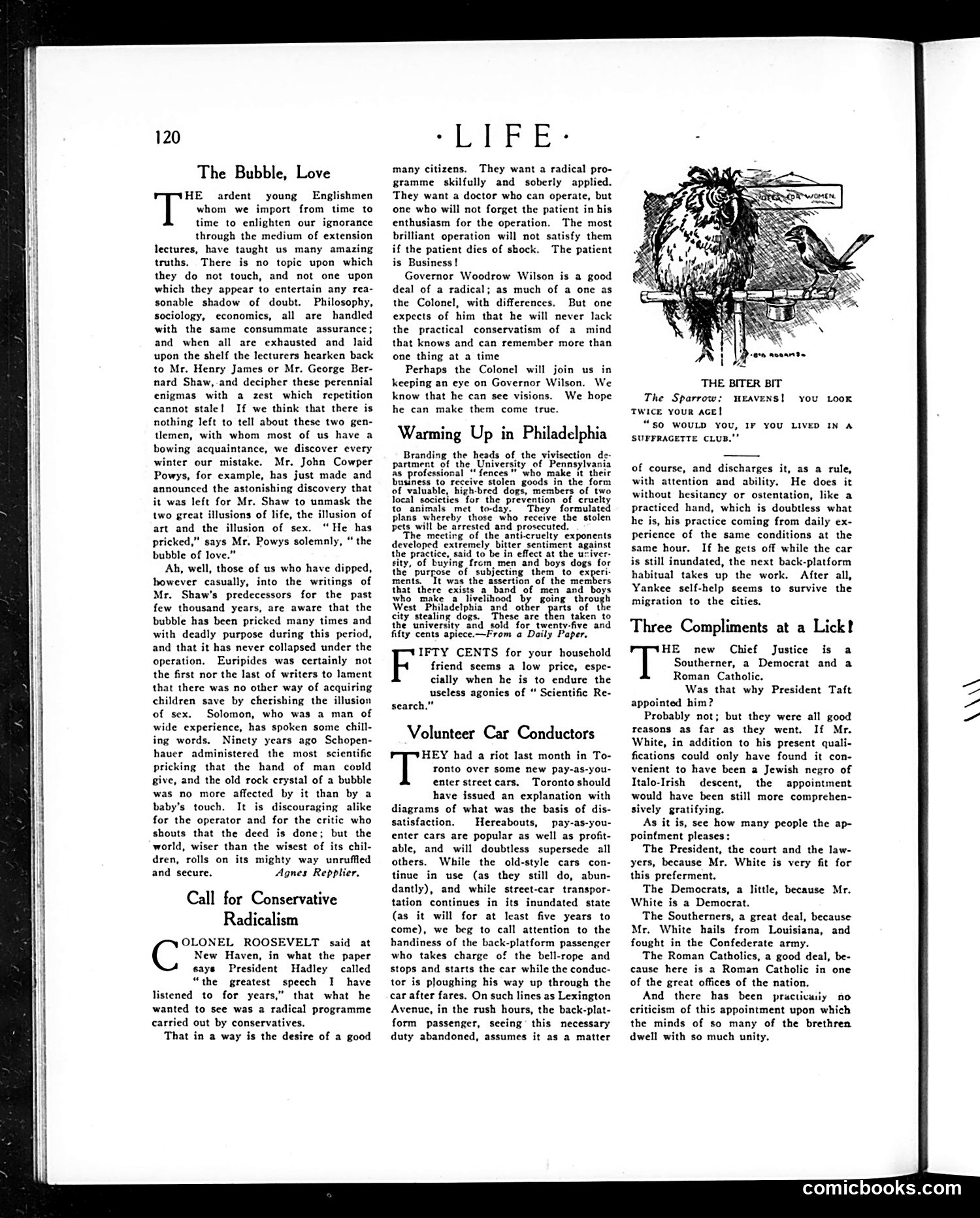
This page contains three satirical essays typical of Life's early 20th-century format: **"The Bubble, Love"** mocks visiting English lecturers (particularly citing John Cowper Powys discussing George Bernard Shaw) who claim to have debunked love as mere illusion. The author (Agnes Repplier) argues this "bubble-pricking" is ancient and futile—philosophers from Euripides to Schopenhauer have tried and failed. The world continues unchanged, indifferent to intellectual critique. **"Call for Conservative Radicalism"** discusses Colonel Roosevelt's New Haven speech advocating radical reform executed conservatively. The piece supports this balance, using medicine as metaphor: brilliant operations mean nothing if the patient (Business) dies from shock. It expresses cautious hope that Wilson, also radical but more prudent, will be similarly responsible. **"Warming Up in Philadelphia"** reports on anti-cruelty societies accusing the University of Pennsylvania's vivisection department of receiving stolen dogs—framing medical researchers as criminal "fences." The cartoon "The Bitter Bit" (top right) appears to show a sparrow and cat, likely illustrating ironic comeuppance.
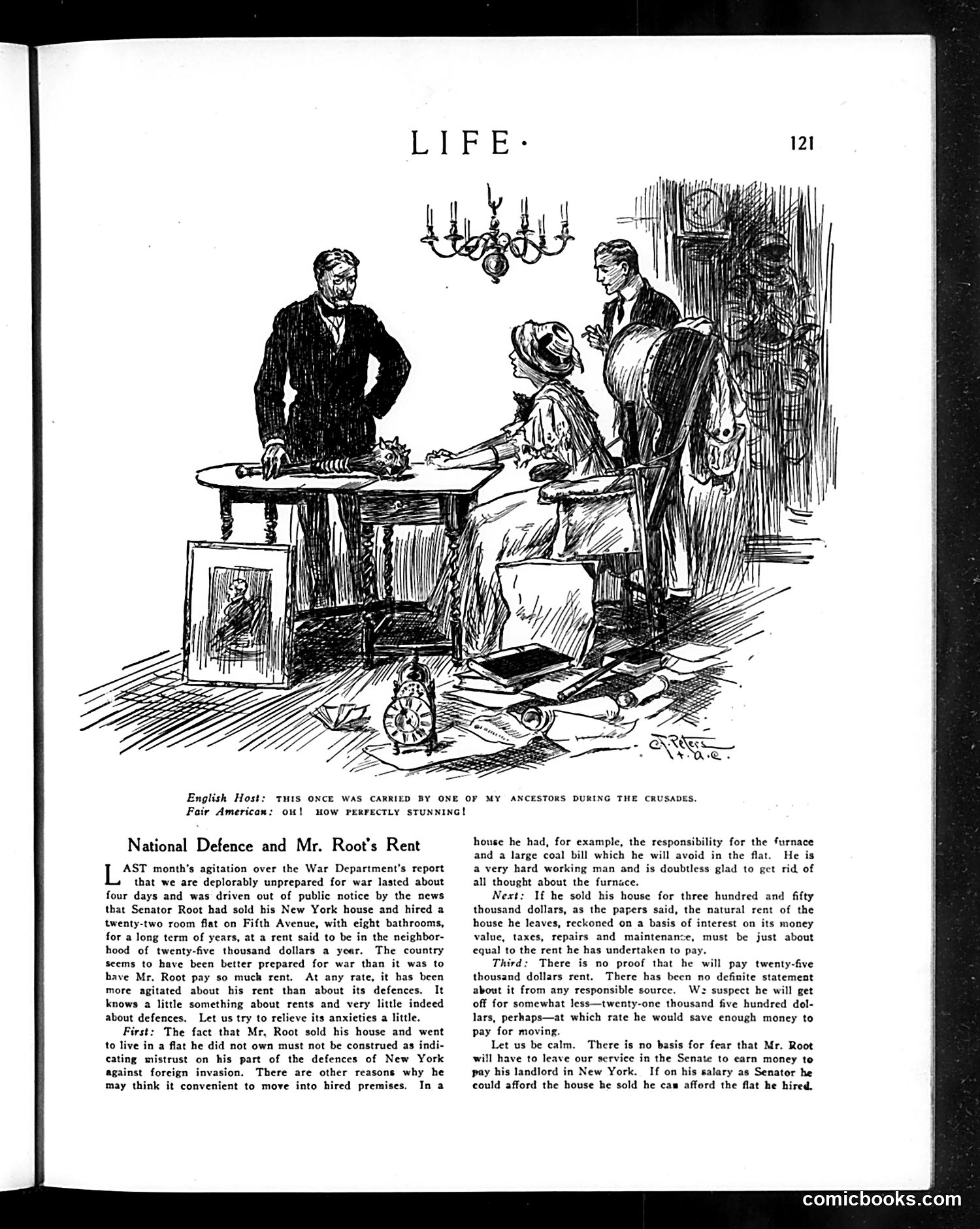
The cartoon satirizes public concern over Senator Elihu Root's expensive New York City rental—a twenty-two room apartment on Fifth Avenue for approximately $25,000 annually—at a moment when the nation faces military unpreparedness. The sketch depicts Root (left, in suit) showing the apartment to a woman, who admires a decorative object, claiming it belonged to her ancestor during the Crusades. The satire operates on two levels: the English visitor's pretentious name-dropping contrasts with American obsession over Root's rent rather than national defense. The accompanying article defends Root through ironic logic, suggesting his move to a rented flat (rather than owned house) shouldn't be interpreted as doubting New York's defenses, and that his Senate salary suffices for the expense. The satire targets both the public's misplaced priorities—fixating on gossip about a wealthy senator's luxury housing while ignoring defense vulnerabilities—and Root's ostentatious spending during a period of military concern.
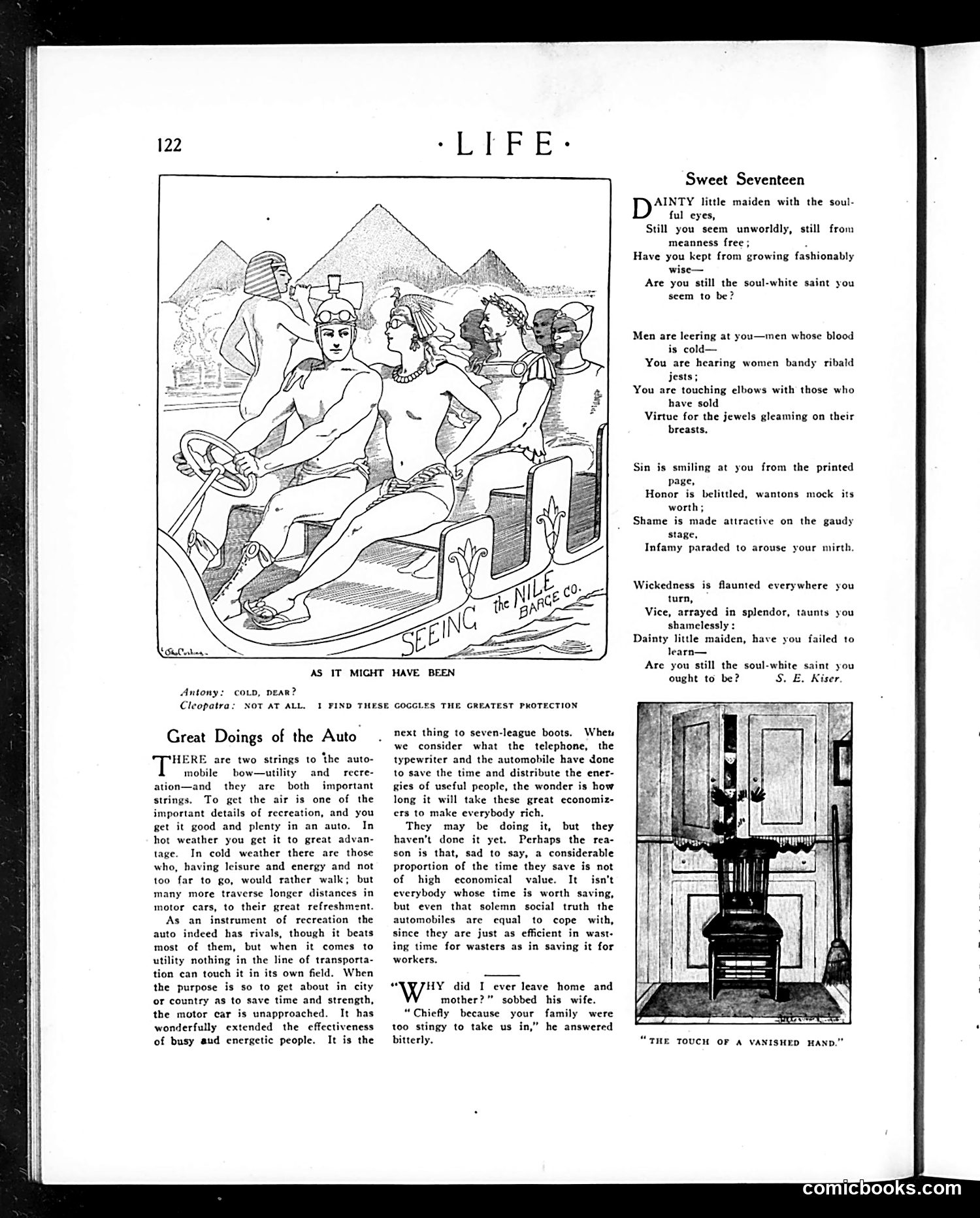
**The Main Cartoon ("As It Might Have Been"):** This is a classical allusion joke. The image depicts Antony and Cleopatra in a motorcar wearing goggles, rather than their historical setting. Antony asks "Cold, dear?" and Cleopatra responds that she finds her goggles "the greatest protection"—a deadpan joke suggesting the goggles, not the car or romance, are her primary concern. The satire mocks how modern conveniences (automobiles) have replaced the exotic drama of history with mundane practicality. **The Automobile Article:** A serious piece praising cars' dual utility: recreation and practical time-saving for workers. It notes automobiles are equally effective at wasting time for idle people as saving it for productive ones—a gentle social commentary on class differences in leisure time. **"Sweet Seventeen" Poem:** A moralistic verse warning young women about urban corruption—leering men, ribald talk, vice, and shamelessness everywhere. It questions whether innocent girls can remain "soul-white saints" amid societal wickedness. This reflects early 20th-century anxieties about female virtue and modern city life's corrupting influences.
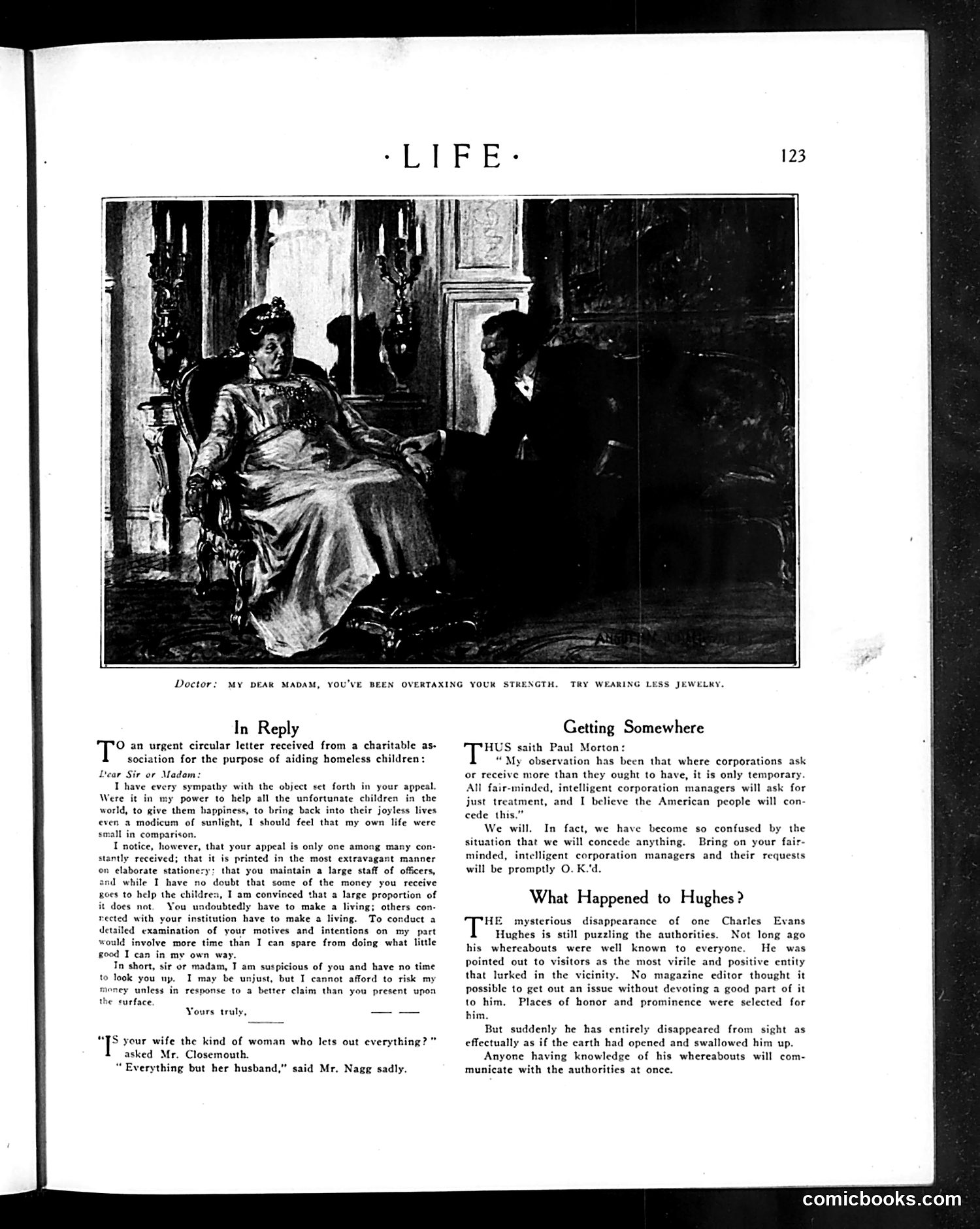
The top illustration depicts a doctor advising an overdressed wealthy woman to wear less jewelry—satirizing frivolous spending by the rich while claiming financial hardship. The three text pieces below mock various aspects of American society: 1. **"In Reply"**: A scathing response to a charitable appeal from a homeless children's organization, criticizing bloated administrative overhead and extravagant fundraising materials. The writer suspects most donations fund staff salaries rather than helping children—sharp commentary on charity inefficiency. 2. **"Getting Somewhere"**: Sarcasm about Paul Morton's claim that corporations only temporarily overreach. Life mocks the public's resigned acceptance of corporate excess, suggesting Americans have become so confused they'll agree to anything. 3. **"What Happened to Hughes?"**: A satirical "missing person" notice for Charles Evans Hughes (likely the politician/lawyer prominent in early 1900s), suggesting he's vanished from public prominence and media attention as mysteriously as if the earth swallowed him. The page collectively critiques wealth inequality, charitable fraud, corporate power, and the fickle nature of public attention.
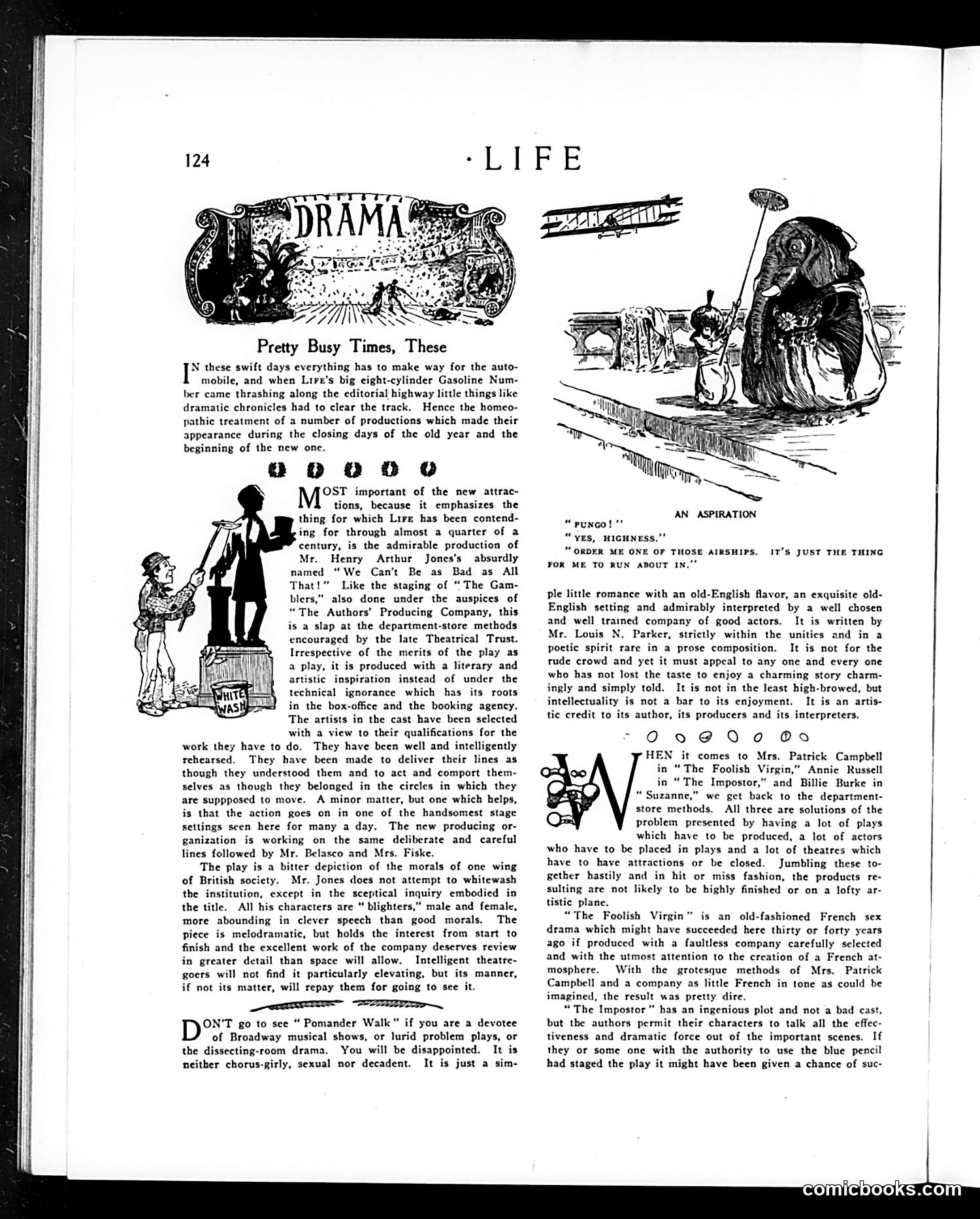
This page reviews several Broadway productions while satirizing theatrical business practices. The main cartoon depicts a child asking a dignitary ("Punco!") to order an airship—a topical joke about the era's fascination with early aviation technology as the ultimate luxury item. The text criticizes the "department-store methods" of the defunct Theatrical Trust, praising Henry Arthur Jones's "We Can't Be as Bad as All That!" for prioritizing artistic merit over commercial shortcuts. It contrasts this with productions starring Mrs. Patrick Campbell, Annie Russell, and Billie Burke, which the critic dismisses as assembly-line products where famous actresses are merely plugged into existing plays rather than thoughtfully cast. The overarching satire: Broadway producers treat theater like retail—casting marquee names without artistic consideration, much as a store arranges stock. The airship joke reinforces this era's obsession with technology and status symbols.
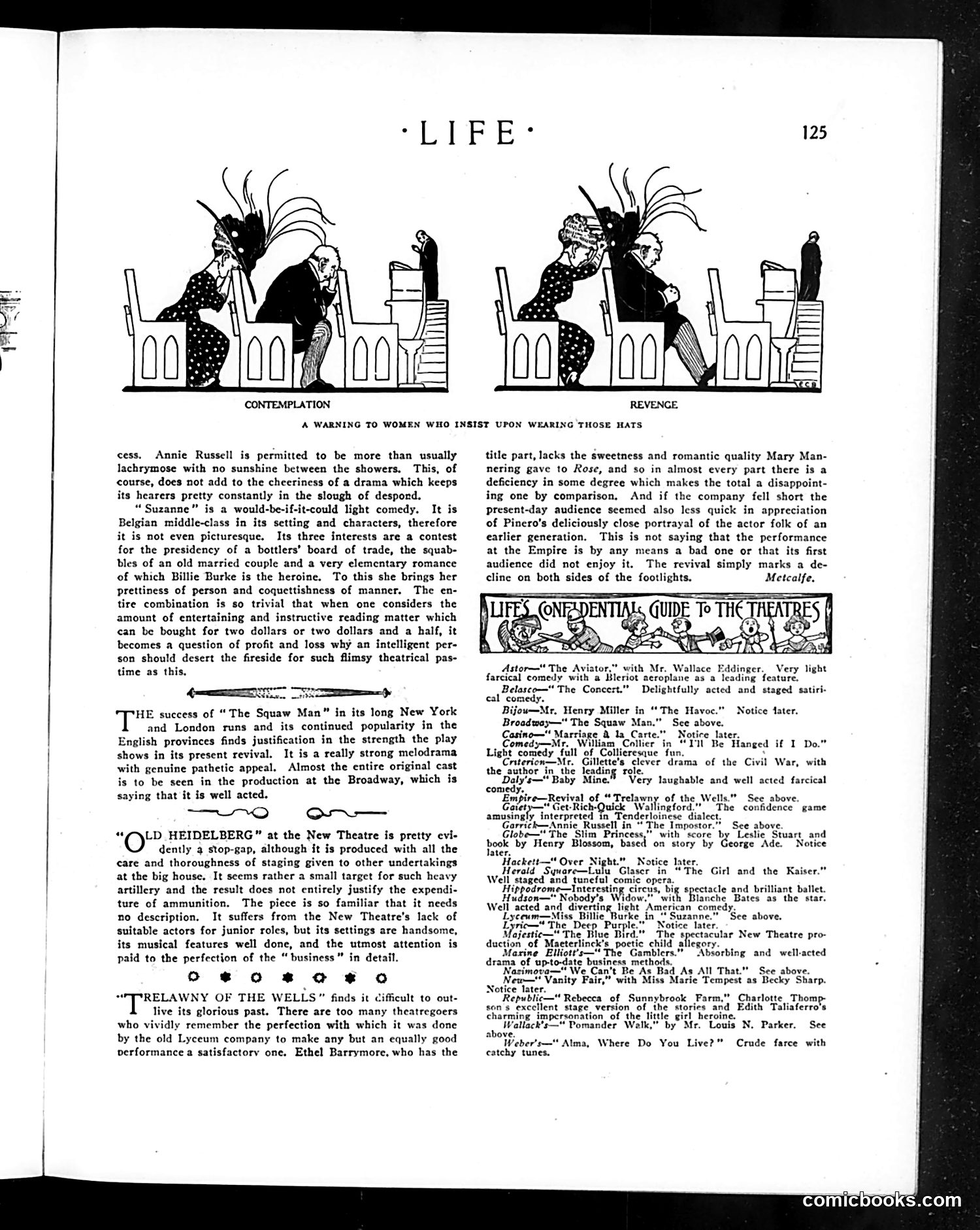
This page contains two related satirical cartoons titled "Contemplation" and "Revenge," accompanied by the subtitle "A Warning to Women Who Insist Upon Wearing Those Hats." The cartoons depict identical scenes of two women seated in a theater. In the first panel, they sit calmly; in the second, one woman's enormous feathered hat has grown so large it blocks the other woman's view entirely. The joke satirizes the early 20th-century fashion trend of oversized, elaborately plumed women's hats—particularly their notorious obstruction of theater-goers' sightlines. The "revenge" occurs when the offended woman appears to retaliate by wearing an even larger hat. The satire targets both the impracticality of fashionable millinery and women's competitive vanity regarding dress, presenting the situation as a humorous "arms race" of headwear. This reflects genuine contemporary complaints about theatrical etiquette and women's fashion excess documented in period literature.
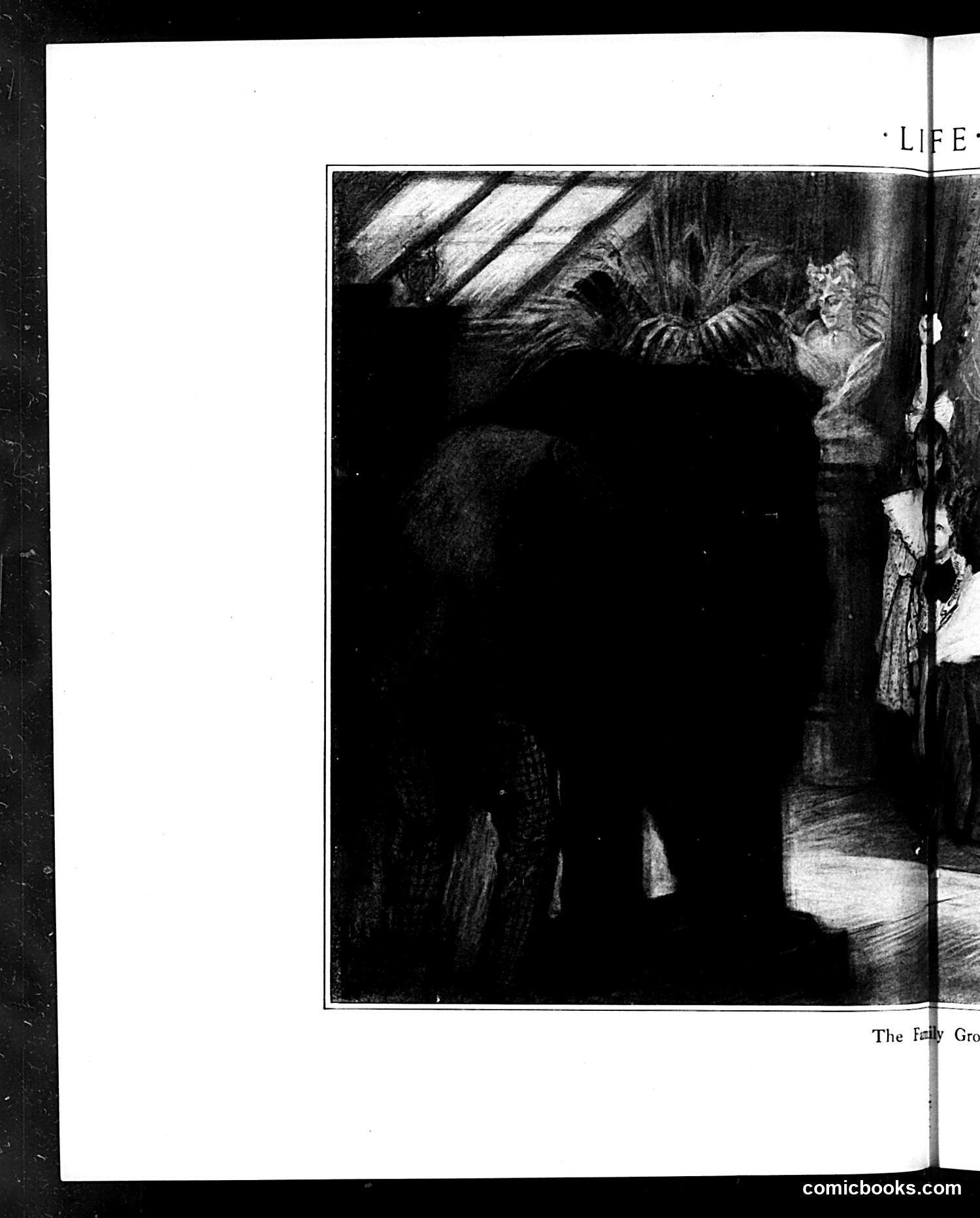
This page appears to be from a *Life* magazine satirical illustration, though the image quality and heavy contrast make details difficult to discern. The caption reads "The Felly Gro[...]" (text cut off). The image shows what appears to be an interior scene with figures in shadow. Without clearer visibility of facial features or identifying details, I cannot confidently identify specific individuals being caricatured. The composition suggests a domestic or social scene, possibly meant to satirize contemporary behavior or social conventions typical of *Life* magazine's editorial approach. The OCR text provides only a partial caption, insufficient to determine the cartoon's specific political or social commentary. More context or a clearer image would be needed to accurately explain this satire to a modern reader.
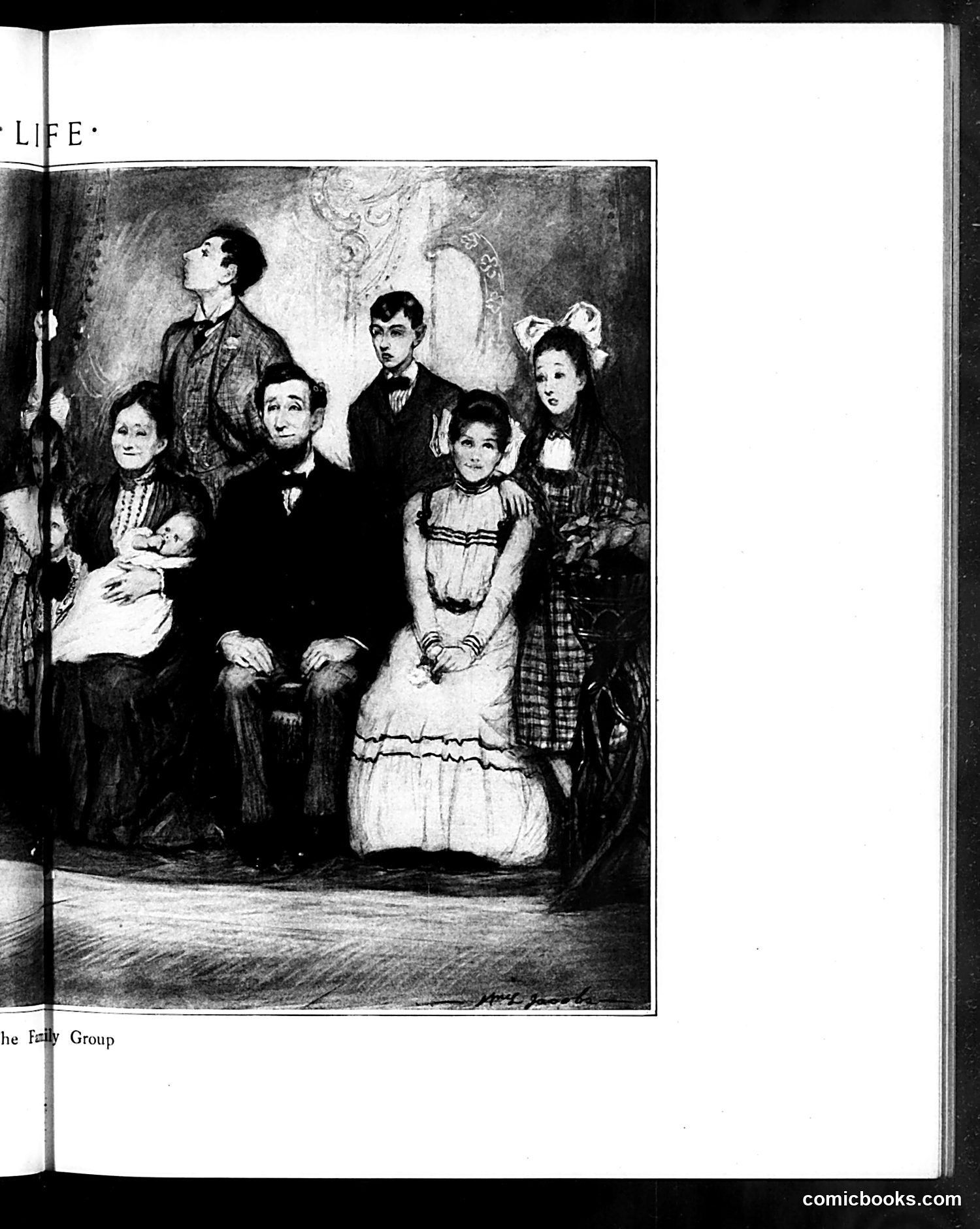
This appears to be a satirical family portrait from *Life* magazine. The caption reads "The Fetid Group," with "fetid" meaning foul-smelling—suggesting the cartoon ridicules this family as morally or socially corrupt or distasteful. The image shows six figures in Victorian-era dress arranged as a formal family group portrait. Without additional context or clearer identification of the subjects, I cannot specify which particular family or public figures are being caricatured here. The satirical intent seems to be mocking either their social pretensions (posing formally for a portrait) or their actual behavior/reputation that the artist found contemptible. The artistic style and format are consistent with late 19th or early 20th-century American satirical illustration.
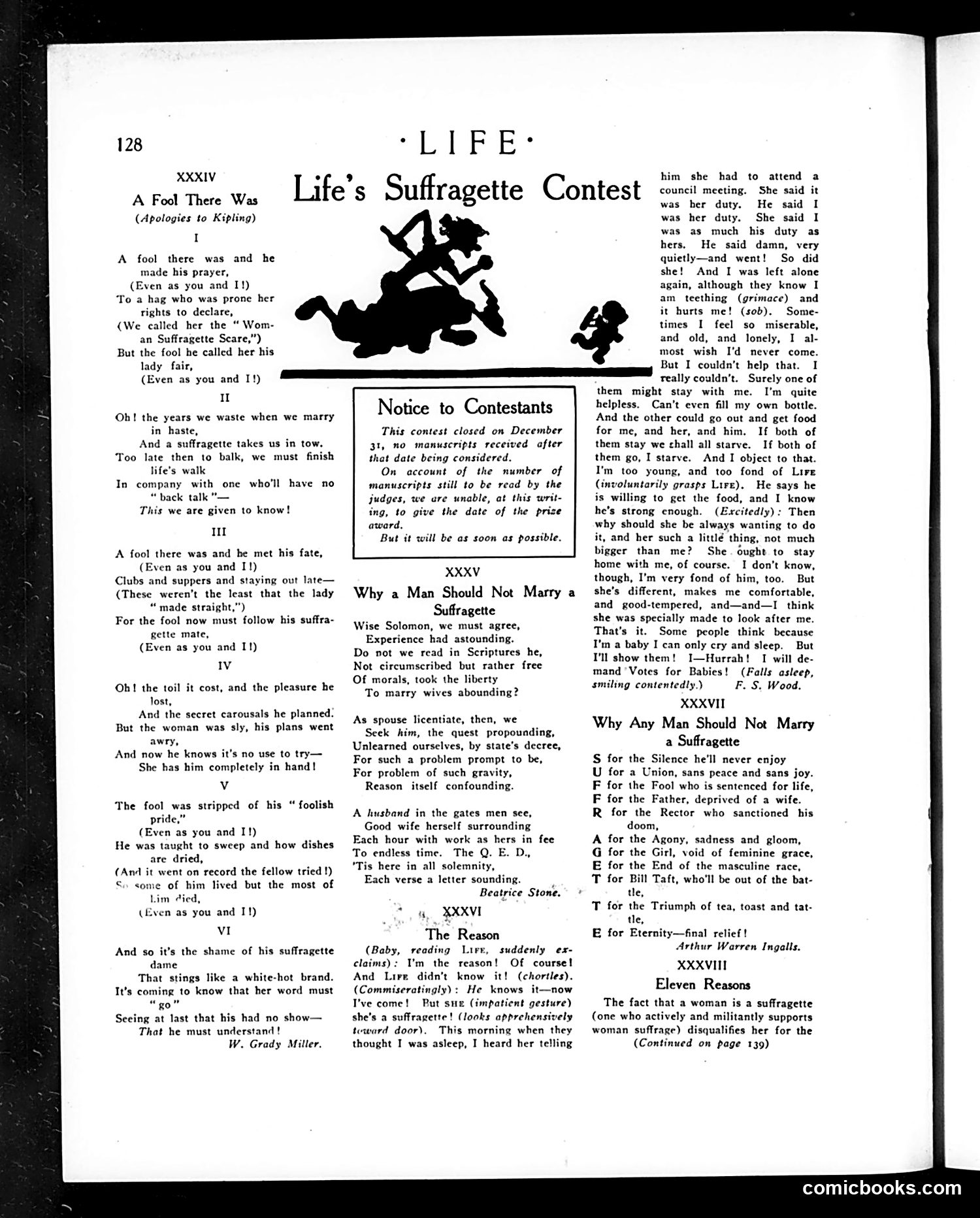
This page attacks women's suffrage through mock-heroic poetry and acerbic humor. The central cartoon depicts a woman suffragette as a domineering figure literally overpowering a man—visual shorthand for the satirist's fear that voting rights would emasculate husbands. The poems mock suffragettes as shrewish wives who strip men of "foolish pride," force them into domestic servitude (sweeping, dishwashing), and eliminate male autonomy. "A Fool There Was" directly parodies Kipling, suggesting men are duped into marrying political activists. The competing pro/anti-suffrage arguments (XXXV-XXXVIII) present the satirist's view that suffragettes neglect maternal duties. Most telling: the baby's monologue complains that both parents abandon him for political commitment—the implication being that suffragettes are selfish, unnatural mothers. This reflects pre-1920 anti-suffrage rhetoric equating women's political participation with family destruction and gender chaos. The satire assumes readers share contempt for assertive women.
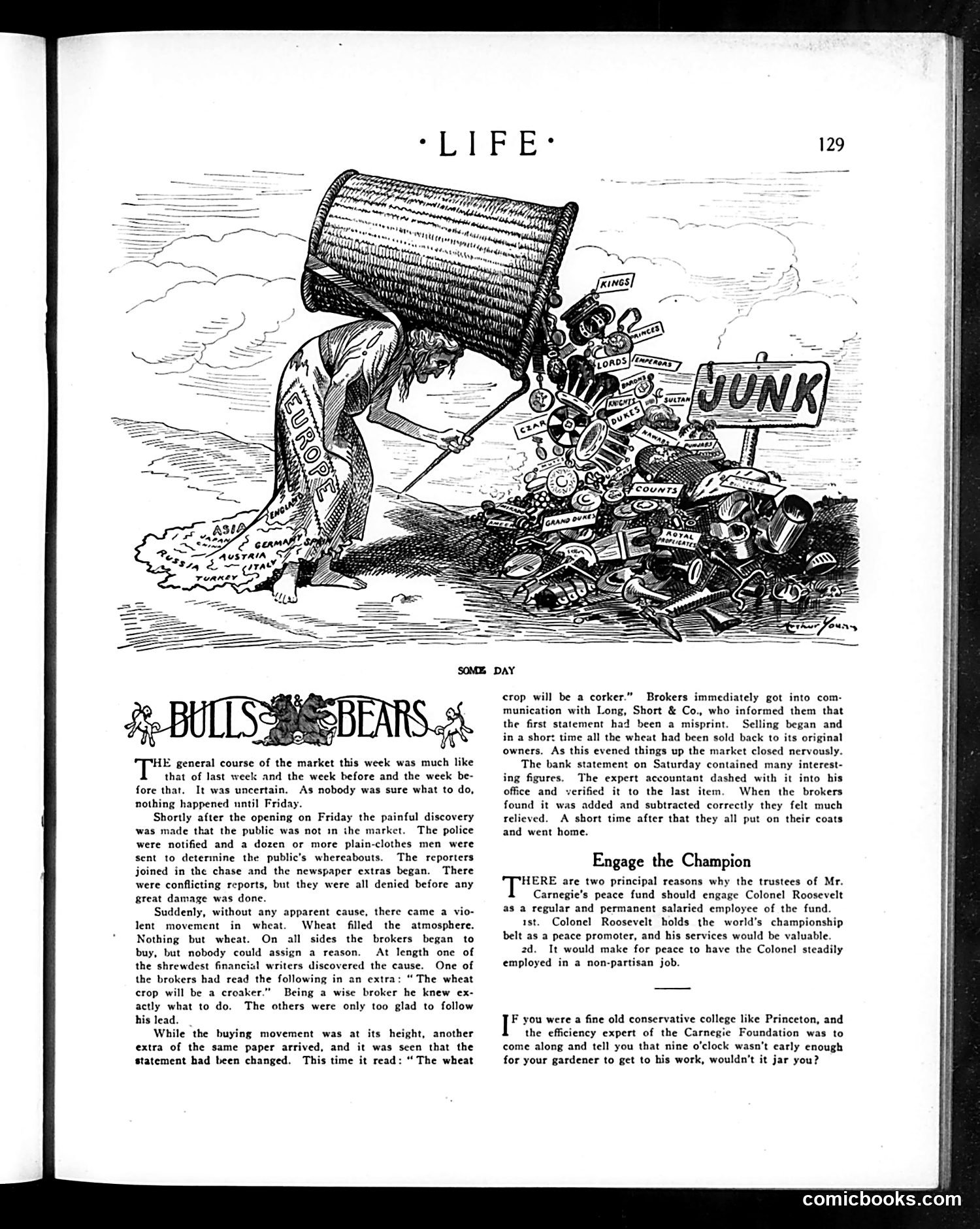
This page contains political satire about early 20th-century financial markets and public figures. **The Cartoon**: The illustration depicts a figure (representing the public or market) dumping garbage labeled "JUNK" while carrying a large basket on their head. This satirizes the chaotic, irrational wheat market described in the text below—where brokers buy and sell frantically based on contradictory newspaper reports ("croaker" vs. "corker"), treating the market like garbage rather than legitimate commerce. **"Bulls & Bears" Section**: The article mocks stock market volatility and herd mentality. A single misprint causes frenzy; when corrected, the opposite occurs. The satire highlights how brokers lack independent judgment, blindly following whoever acts first. **"Engage the Champion"**: This section satirizes Theodore Roosevelt as a "peace promoter," suggesting he should be employed by Carnegie's peace fund—implying Roosevelt is so combative that keeping him busy would paradoxically promote peace. The final paragraph mocks efficiency experts imposing rigid standards on traditional institutions like Princeton, criticizing intrusive "scientific management" trends of the era. The page exemplifies Life's role as social and political commentary.
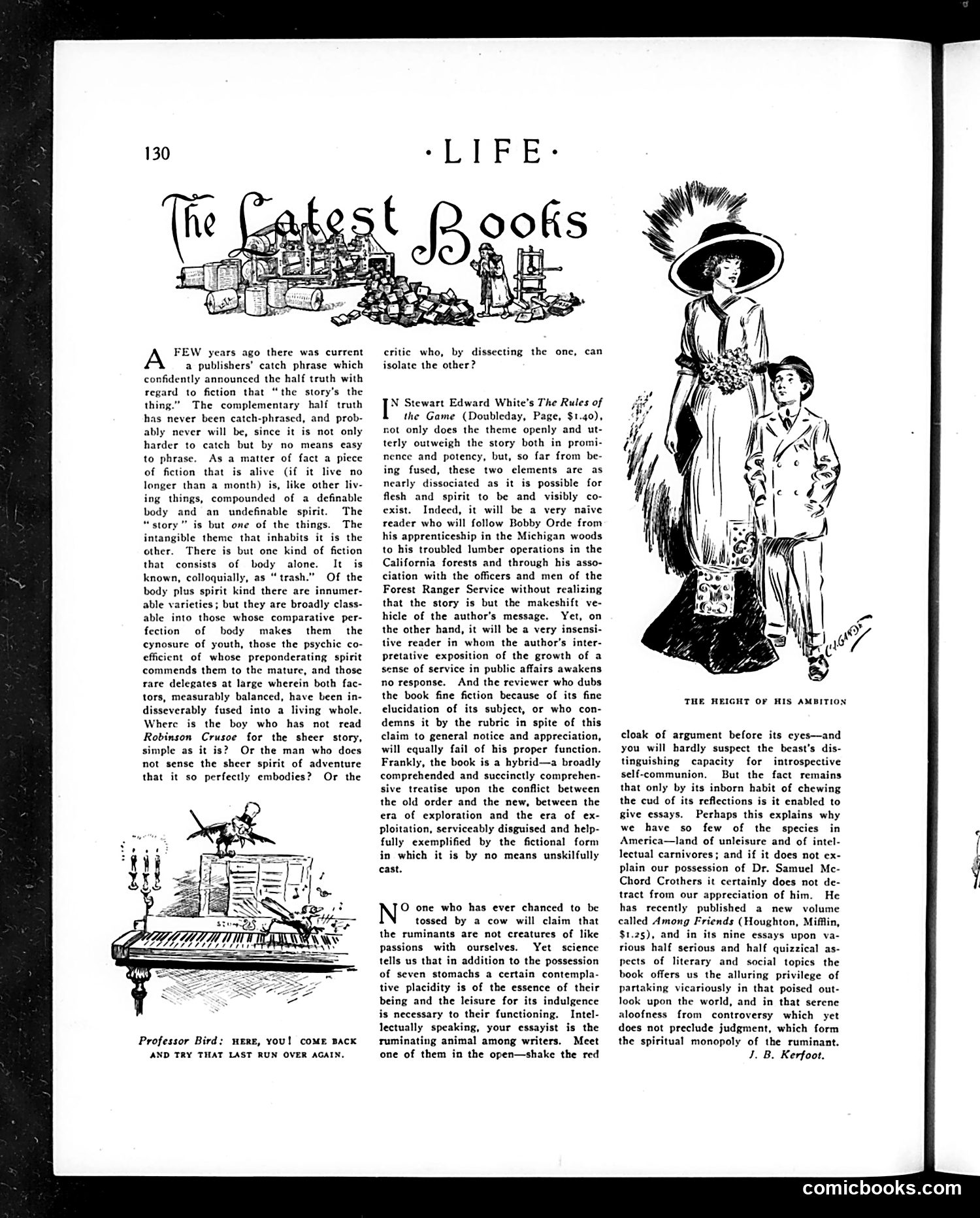
This is a literary criticism page reviewing Stewart Edward White's novel *The Rules of the Game*. The main article argues that successful fiction requires both "body" (plot/story) and "spirit" (theme/meaning) fused together as a living whole. The reviewer critiques White's book as a "hybrid"—one where theme overwhelmingly dominates story. While the narrative follows protagonist Bobby Orde through lumber camps and forest service work, it's primarily a treatise on the conflict between old and new orders of society, disguised as fiction rather than integrated with it. The small cartoon labeled "Professor Bird" depicts a bird at a piano, captioned "Here, you! Come back and try that last run over again"—a musical joke about practice and repetition, likely commenting on the craft of writing itself. The essay's closing analogy compares essayists to ruminating cattle—animals that chew their cud repeatedly—suggesting writers need contemplative habits for introspective thought. The tone is sophisticated literary criticism aimed at educated readers.
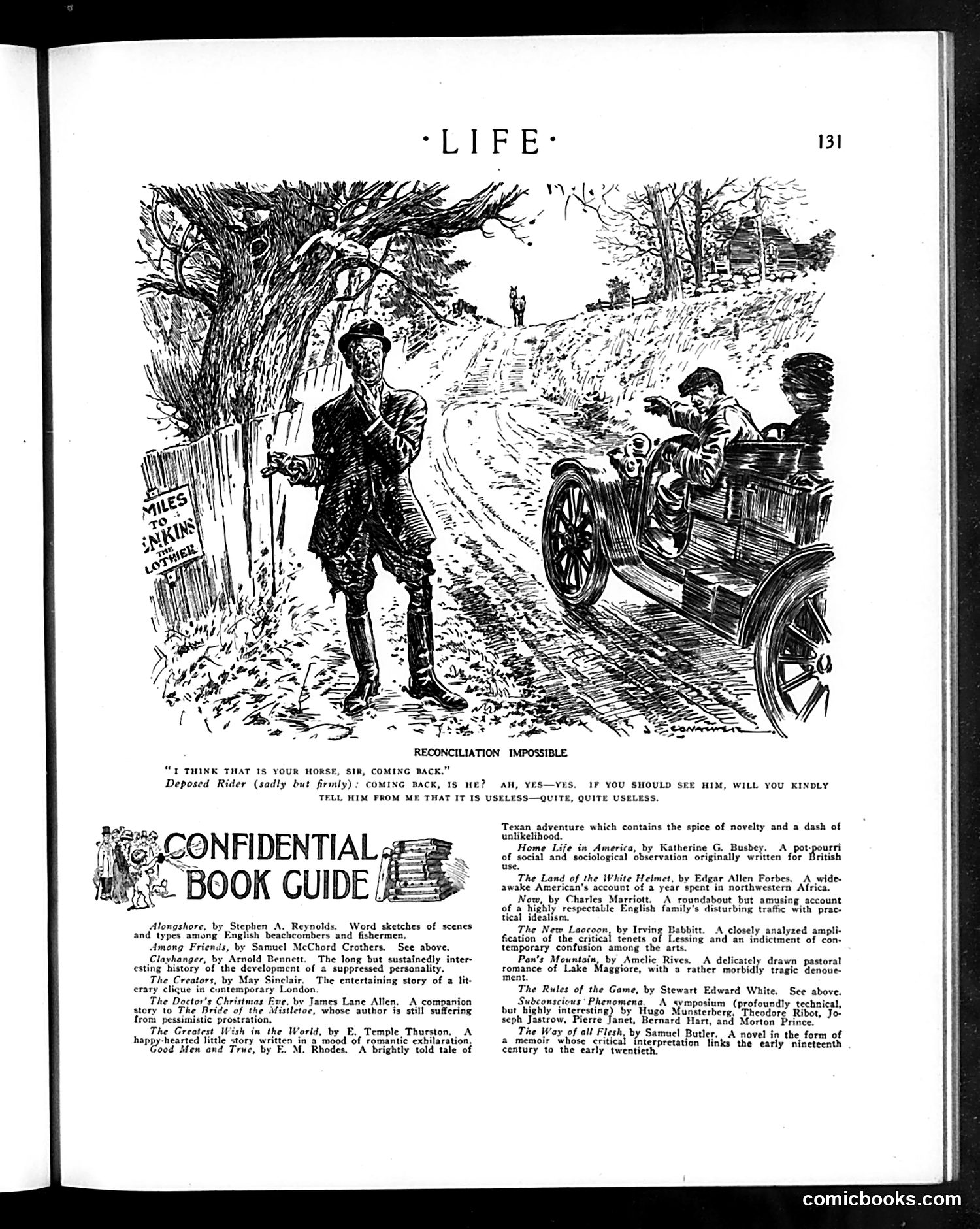
This cartoon depicts a social/political dispute using a horse as metaphor. A "Deposed Rider" stands beside a country road, addressing someone who has just returned with his horse. The rider refuses to remount, declaring the situation "useless—quite, quite useless," despite the horse's apparent willingness to return. The satire likely concerns a failed reconciliation or political settlement. The "deposed rider" represents someone removed from power who refuses reinstatement, suggesting that certain rifts cannot be healed through simple restoration of previous arrangements. The horse symbolizes the mechanism or institution being disputed—perhaps a government office or political position. Without the publication date visible, the specific political context remains unclear, but the cartoon's title and tone suggest it critiques attempts at reconciliation that are fundamentally doomed by underlying disagreement or principle.
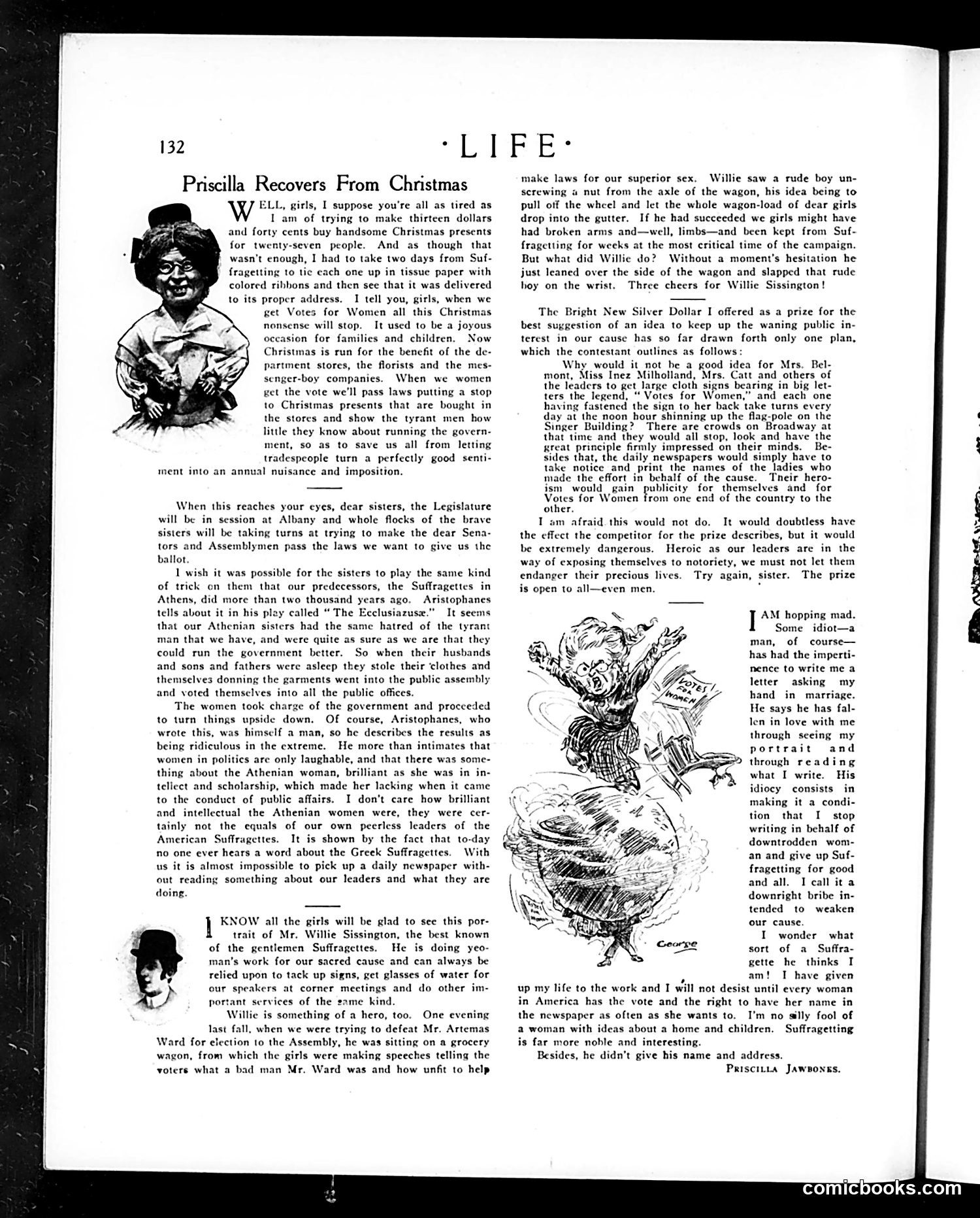
This 1910s *Life* magazine page satirizes the women's suffrage movement through Priscilla Jawbones's voice. The humor targets suffragists' perceived self-righteousness and contradictions. **Main satire:** Priscilla complains Christmas shopping is exhausting, then declares women will fix government once they vote—implying suffragists oversimplify complex issues. She references the Greek play *Lysistrata* (misidentified as "Ecclesiazusae"), where Athenian women supposedly governed better, yet acknowledges Aristophanes mocked female politicians as ridiculous. **The "Willie Sissington" portrait** mocks male suffrage supporters as emasculated helpers—relegated to menial tasks like getting water and posting signs. The anecdote about him stopping a boy from sabotaging a wagon shows male allies as well-meaning but ineffectual. **The satire's point:** Anti-suffrage propaganda suggesting women are emotional, naive about governance, and that even sympathetic men are inadequate. This was typical *Life* content opposing women's voting rights during the pre-1920 suffrage debates.
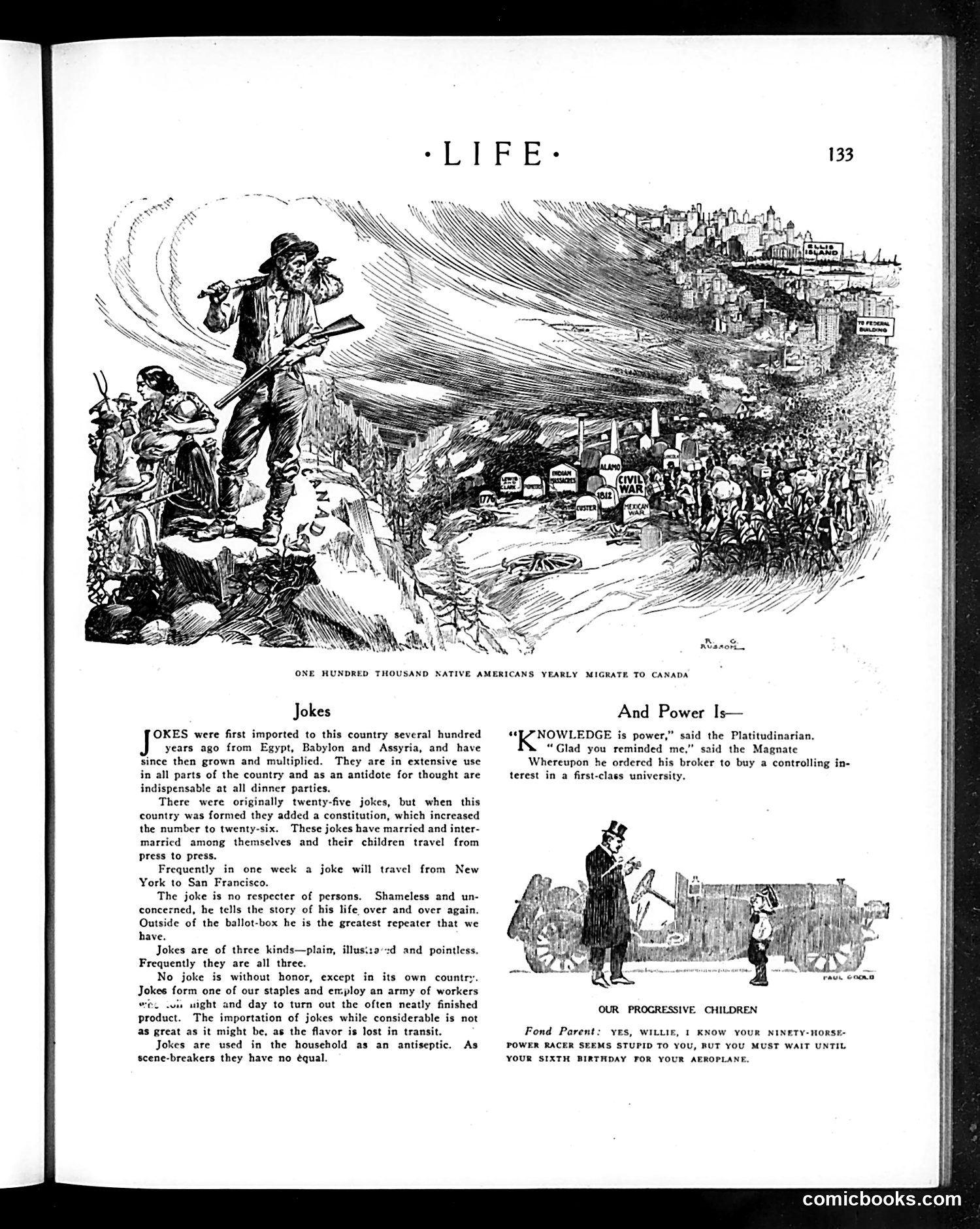
This page contains three separate satirical pieces: **"Jokes"** (left column): A mock-serious essay treating jokes as if they were biological organisms—imported, breeding, multiplying across the nation. The satire critiques Americans' dependence on hackneyed humor at social gatherings and the newspaper industry's recycling of tired material from coast to coast. It's poking fun at both joke-telling culture and the press's reliance on familiar content. **"And Power Is—"** (right column): A brief dialogue mocking wealthy industrialists. A platitude-spouting philosopher quotes that "knowledge is power"; a rich magnate responds by buying controlling interest in a university—demonstrating that to the wealthy, actual *economic* power matters more than intellectual pursuits. The satire suggests corrupt robber-baron mentality. **"Our Progressive Children"** (bottom): Shows a parent telling a child he must wait until age six for an airplane, implying wealthy families casually purchase expensive vehicles for children. It satirizes excess wealth and indulgent parenting among the elite. All three pieces mock American materialism, intellectual laziness, and class pretension.
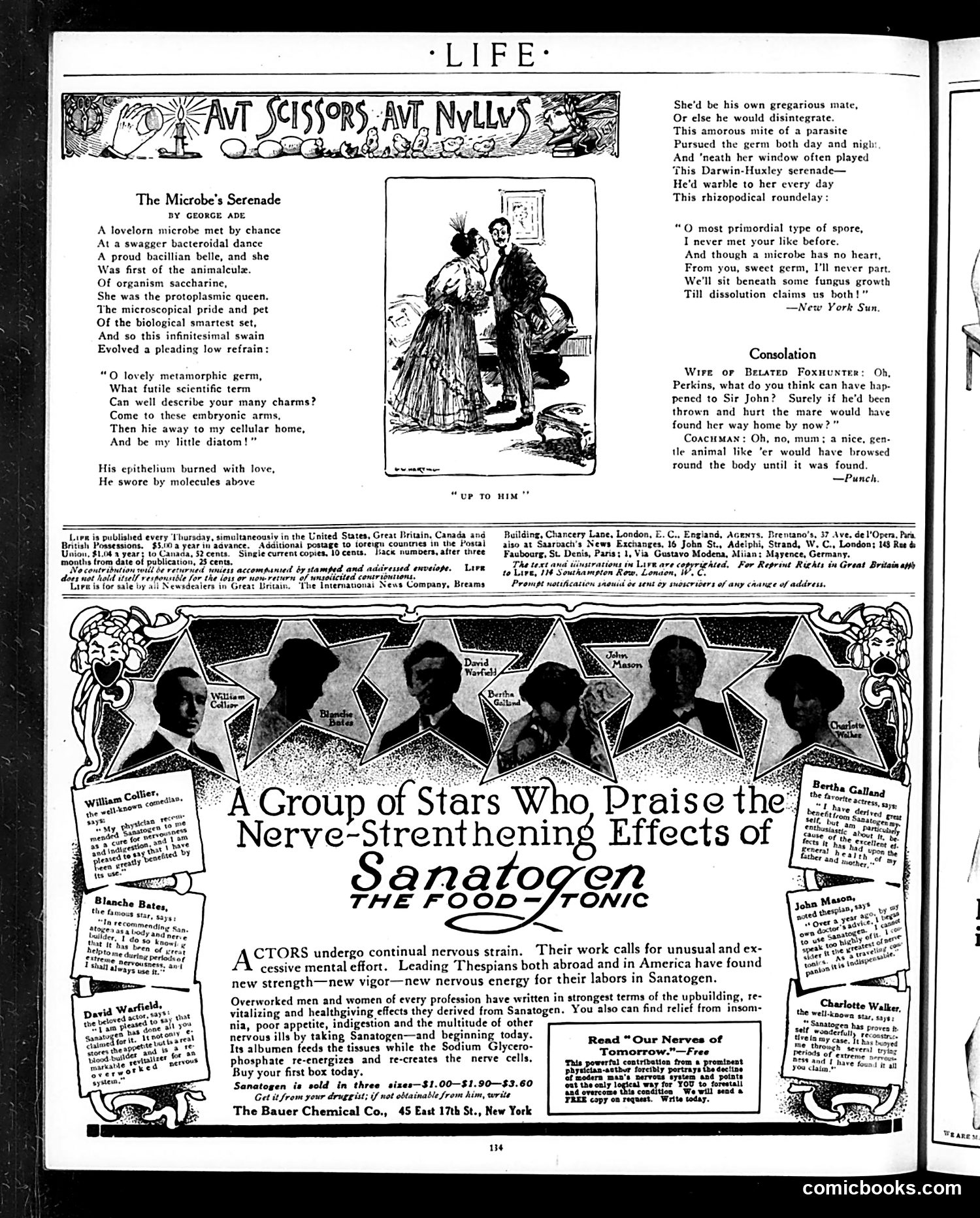
This page contains two distinct elements: **satirical poetry and advertisement**. **"The Microbe's Serenade"** by George Ade is a humorous poem personifying microscopic organisms in romantic courtship. It satirizes scientific jargon by applying grandiose romantic language to microbes ("O lovely metamorphic germ"). The joke relies on the absurdity of treating bacteria as tragic lovers, mocking both sentimental romance literature and the specialized vocabulary of emerging microbiology—making science seem simultaneously profound and ridiculous. **The lower section is a straightforward advertisement** for Sanatogen, a patent medicine marketed as a "food-tonic" claiming to strengthen nerves and relieve fatigue. It features testimonials from actors and public figures (names visible include William Collier, Blanche Bates, David Warfield, John Mason, Bertha Galland, and Charlotte Walker), exploiting celebrity endorsements to sell a product whose health claims would be questionable by modern standards. This represents early-20th-century advertising's common practice of using celebrity testimonials for tonics of dubious efficacy.
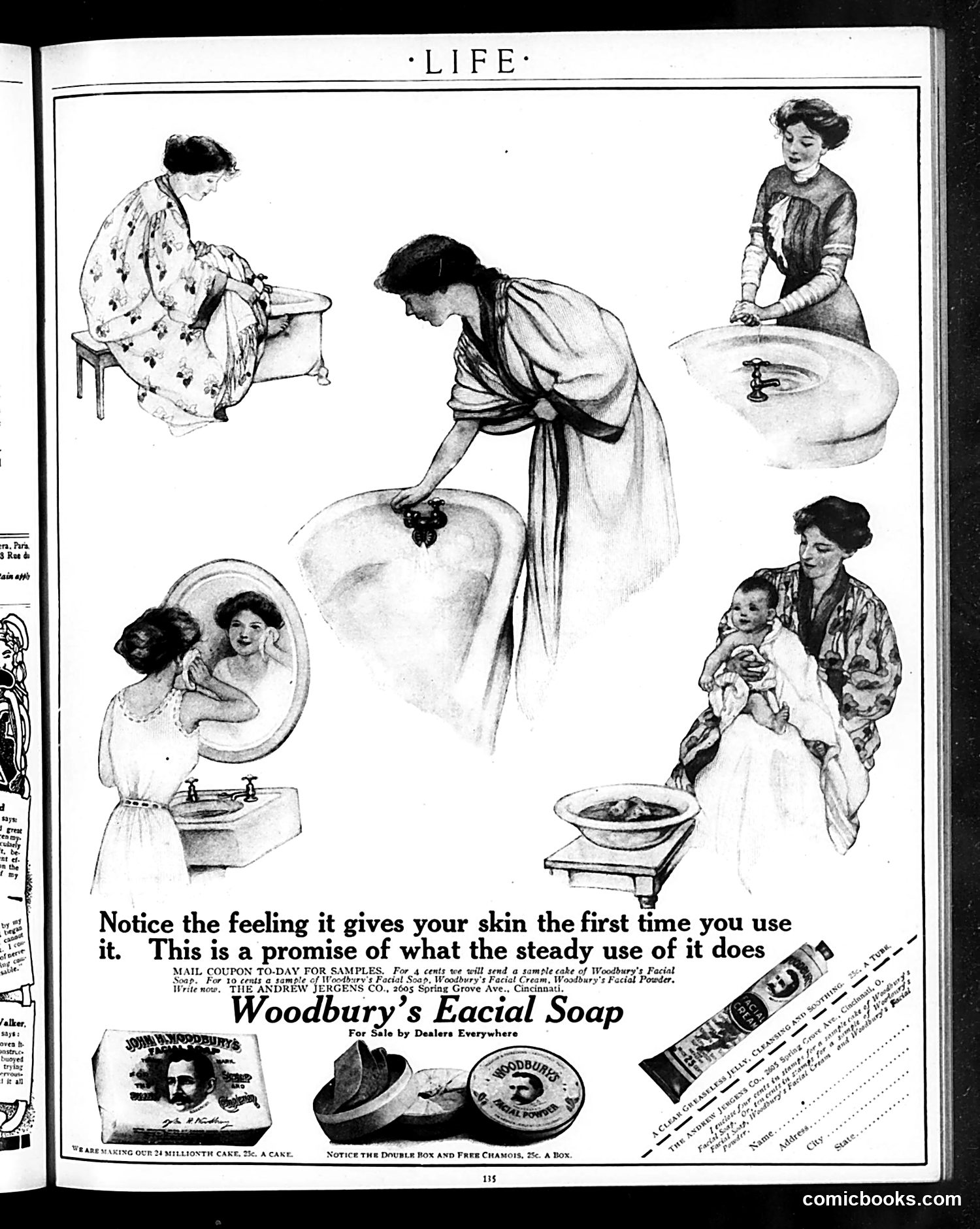
This is a **product advertisement**, not satire or political commentary. It promotes Woodbury's Facial Soap through illustrated vignettes showing women using the product for skincare routines—washing faces, applying creams, and caring for children. The ad employs early 20th-century advertising strategy: aspirational imagery of well-dressed women to suggest the soap delivers beauty and refinement. The headline promises that initial use signals future benefits from "steady use." The bottom section advertises product variants (soap, cream, powder) and offers free samples by mail coupon for 4-10 cents. It notes the soap is mass-produced ("24 millionth cake") and sold widely, positioning it as an affordable luxury item. This reflects period beauty culture where facial soap was marketed as essential to feminine appearance and social standing.
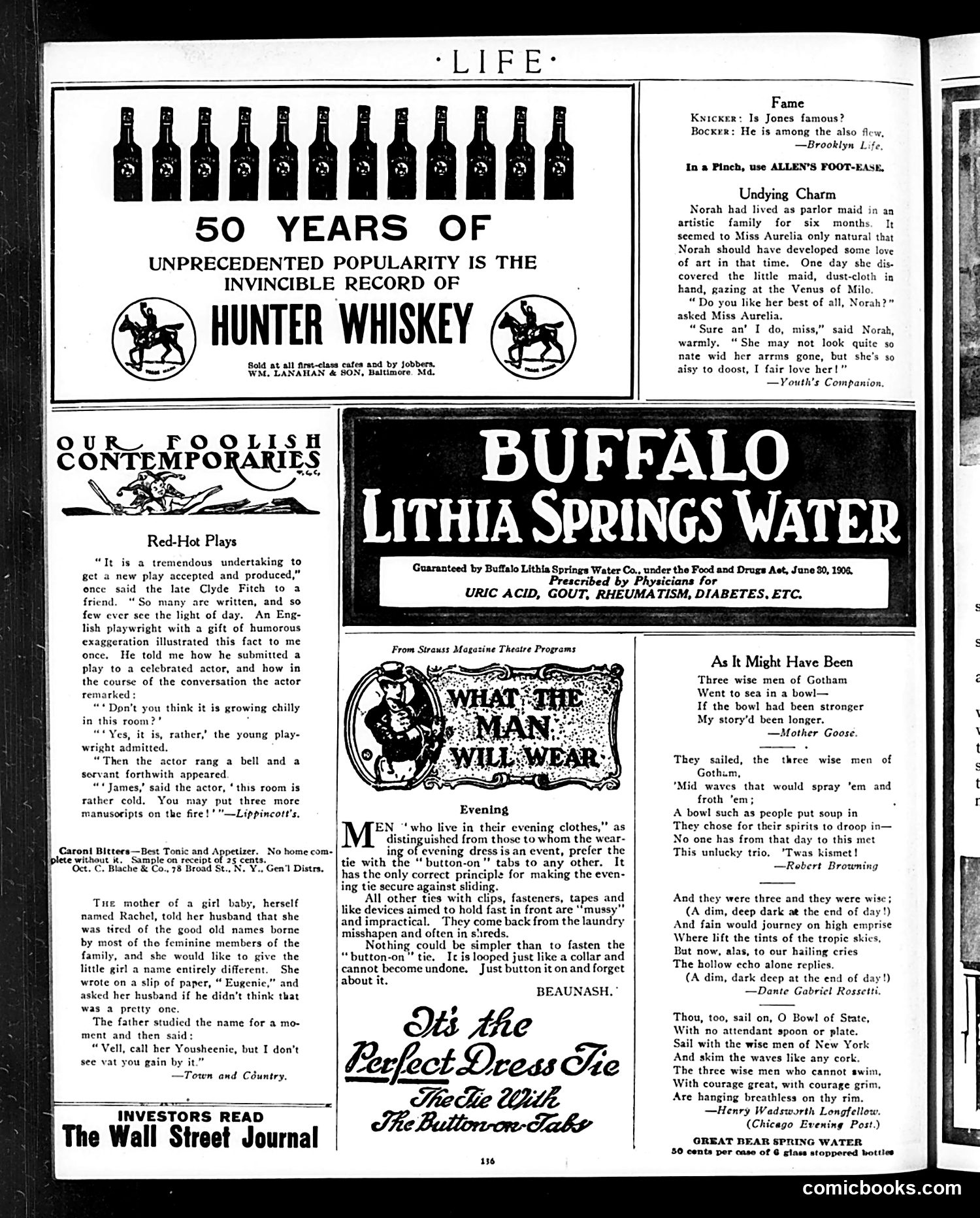
This page is primarily **advertisements and light humor pieces**, not political satire. The main content includes: **Advertisements**: Hunter Whiskey (50 years of popularity), Buffalo Lithia Springs Water (marketed for gout and rheumatism), and evening wear with button-on ties. **Humor pieces**: Brief anecdotes mocking human folly—a maid admiring classical art for practical reasons ("easy to dust"), an actor rejecting a playwright's script by burning manuscripts as fuel, and ethnic humor about immigrants choosing "Yousheenie" as a baby name. **Poetry parodies**: Playful retellings of "Three Wise Men of Gotham," treating the nursery rhyme literally. The satire is gentle and domestic rather than political. The "foolish contemporaries" section gently ridicules pretension, bureaucratic absurdity, and social climbing. There are no identifiable political figures or events referenced—this reflects Life's era as a general-audience humor and culture magazine.
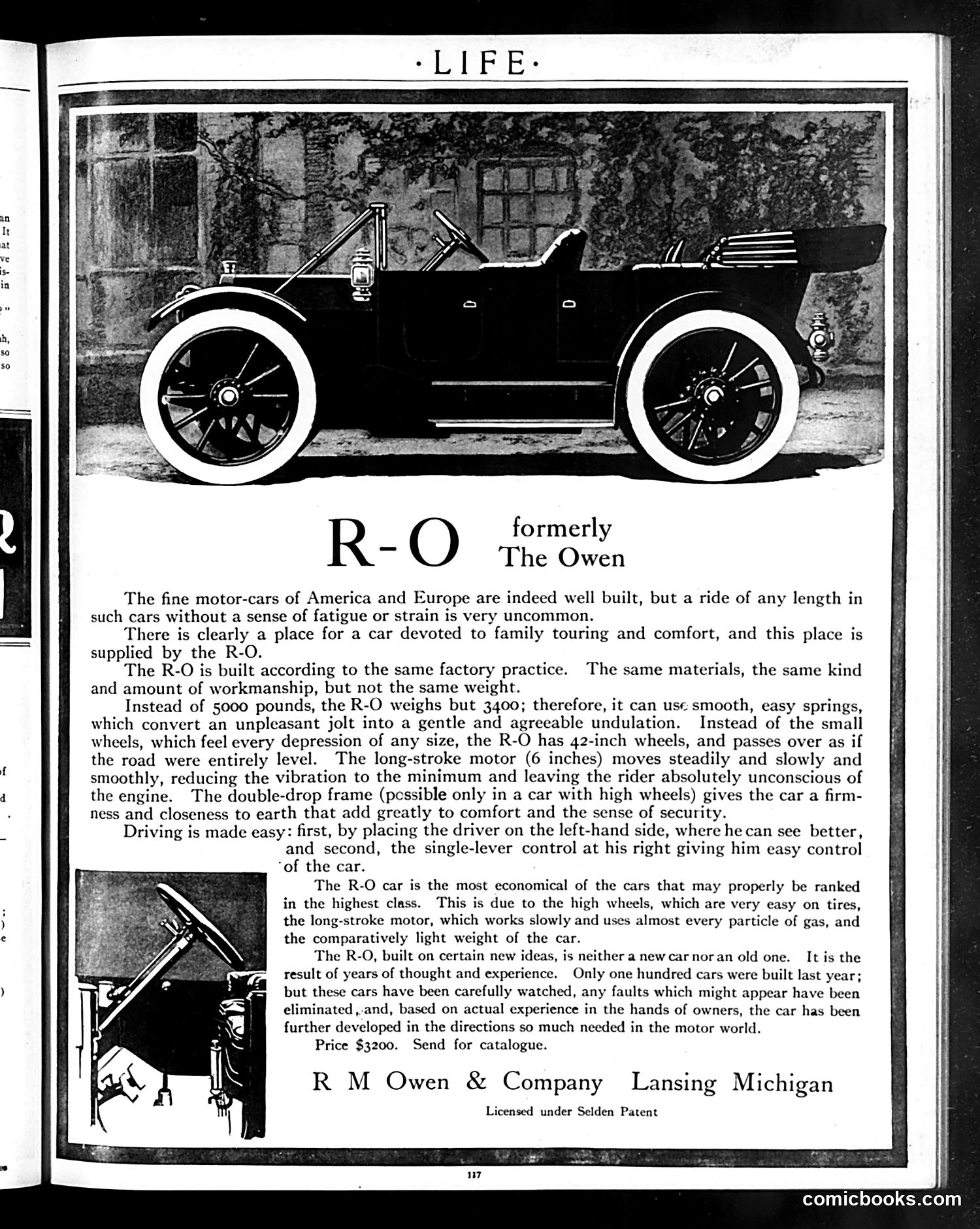
This is **not a cartoon or satire** — it's a straightforward automobile advertisement from Life magazine's early automotive era. The R-O ("formerly The Owen") was a motorcar manufactured by R M Owen & Company in Lansing, Michigan. The ad emphasizes comfort and economy by highlighting the vehicle's lightweight construction (3,400 pounds versus typical 5,000-pound cars), large 42-inch wheels for smooth rides, long-stroke motor for fuel efficiency, and innovative frame design. The marketing pitch targets affluent buyers seeking comfort without excessive weight — a "highest class" vehicle at $3,200. The ad notes only 100 cars were built the previous year, emphasizing exclusivity and careful quality control. A small technical diagram shows the steering mechanism. The reference to "Licensed under Selden Patent" indicates compliance with automotive patent licensing of the era — a significant legal/business issue in early car manufacturing.
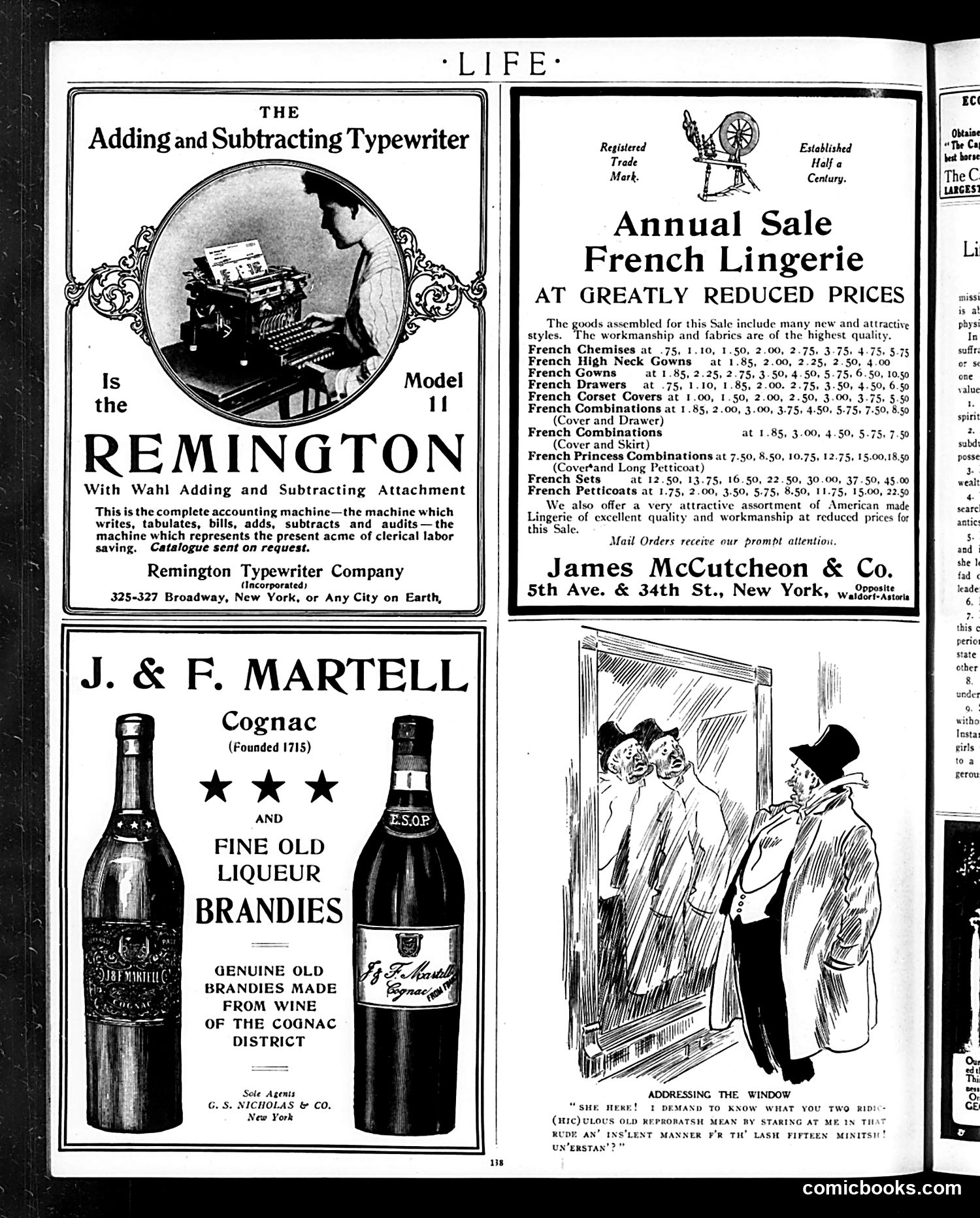
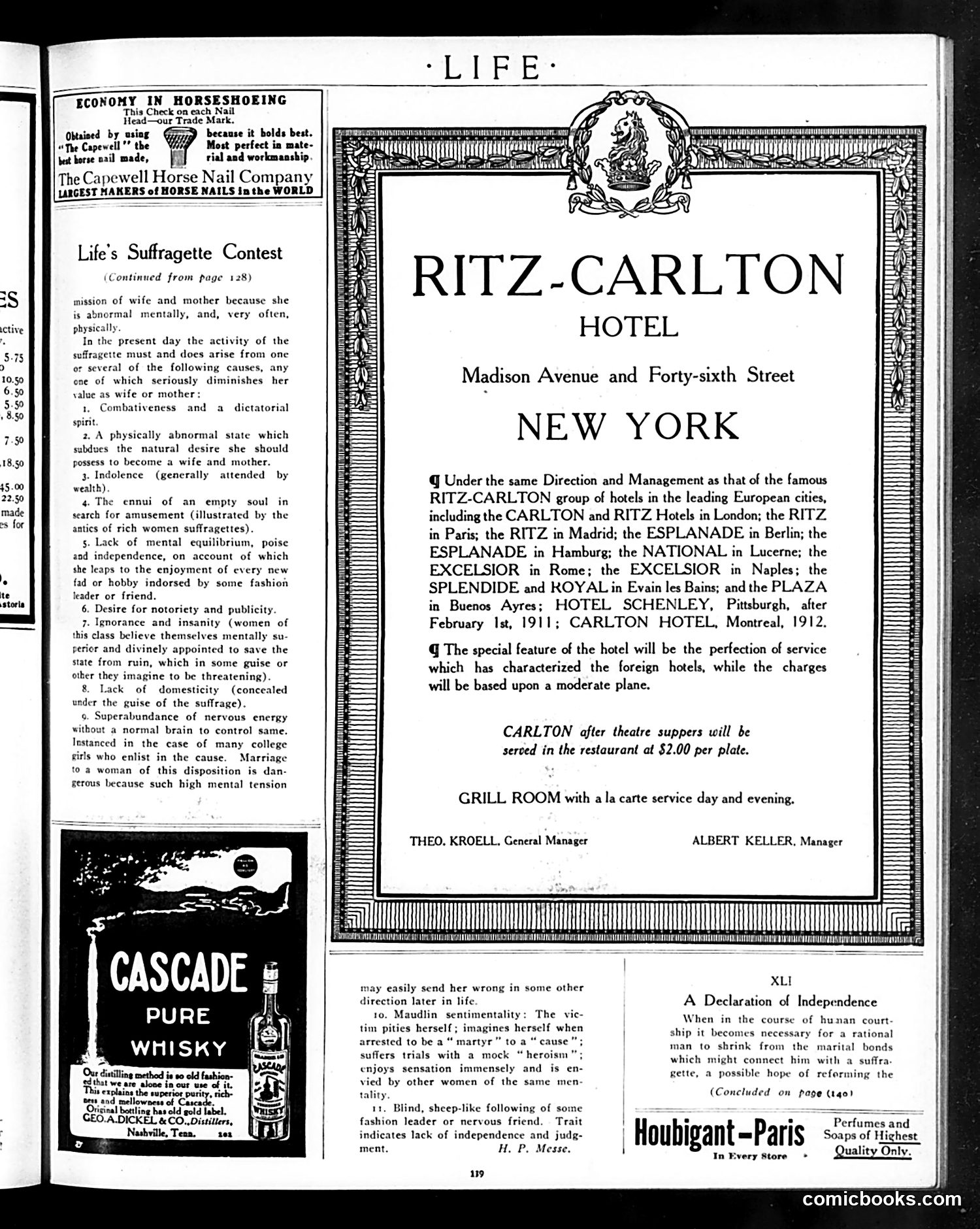
This page is primarily **advertising and serialized content**, not satire or political cartoons. The main feature is "Life's Suffragette Contest" (continued from page 128), which lists eleven reasons why women become suffragettes. The piece is **anti-suffrage propaganda**—it pathologizes women's voting rights activism by claiming suffragettes are mentally abnormal, physically defective, emotionally unstable, or seeking attention. Points include "combativeness," "abnormal" physical states, "ignorance and insanity," and "maudlin sentimentality." This reflects **early 1910s opposition to women's suffrage**, presenting activism as a psychological disorder rather than legitimate political engagement. The remainder features hotel and product advertisements (Ritz-Carlton, horse nails, whisky, perfume)—typical of Life's mixed content model. No political cartoons appear on this particular page.
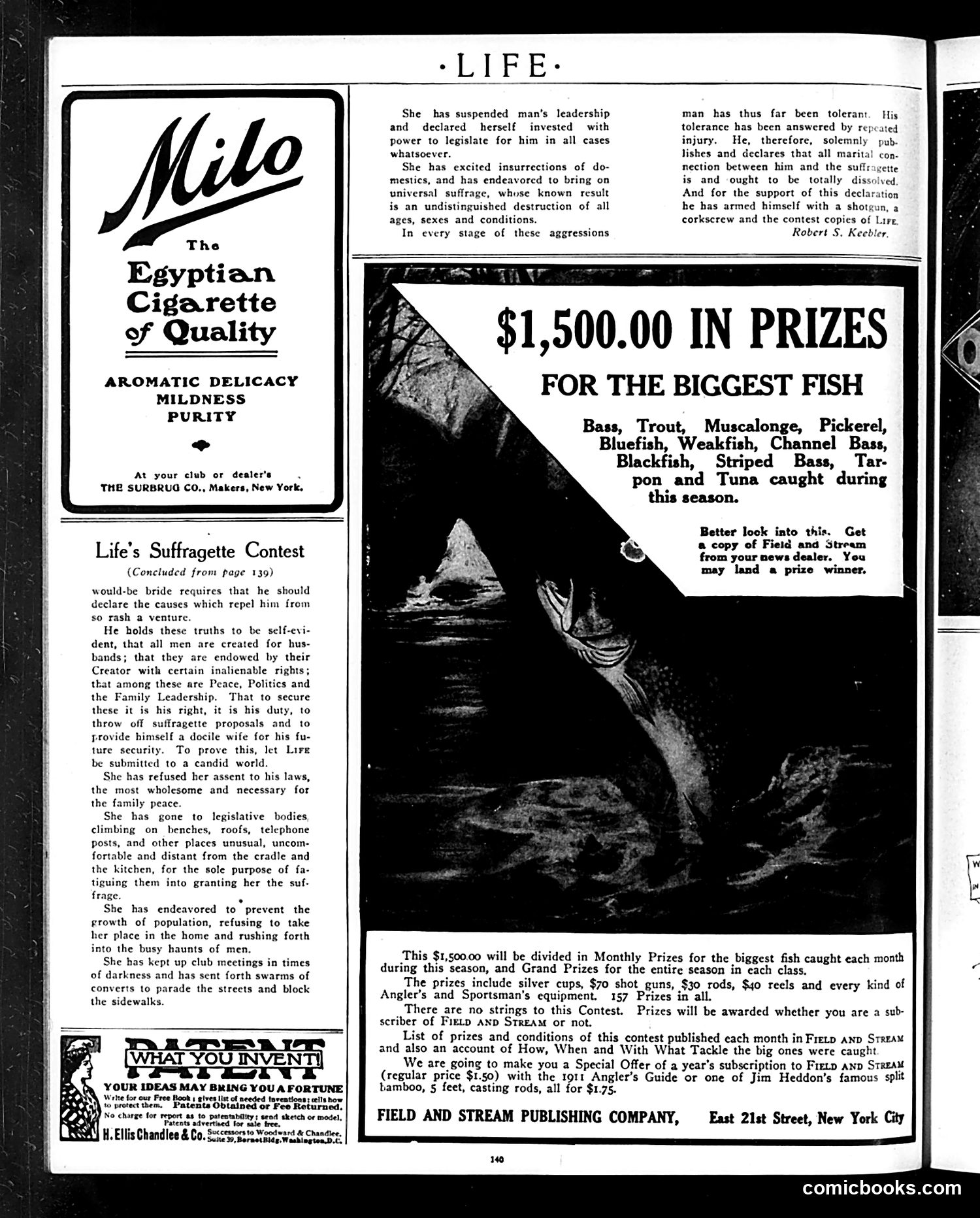
This page satirizes the women's suffrage movement through mock-heroic parody. The main text mimics the Declaration of Independence's language and structure—"We hold these truths to be self-evident"—but inverts it as a "declaration" by men against suffragettes. The satire mocks anti-suffrage arguments: women are accused of "insurrections," refusing domestic duties, blocking sidewalks with parades, and preventing population growth by pursuing public life instead of motherhood. The joke escalates absurdly—a man defending himself against suffragettes arms himself with "a shotgun, a corkscrew and the contest copies of Life." The author, Robert S. Keebler, ridicules both suffragettes' actual activism (climbing on benches to be heard) and the hysterical male resistance to women's political participation. By treating the conflict as a quasi-revolutionary war with dramatic legal language, the satire exposes the disproportionate anxiety men felt about women's rights. The page also contains unrelated advertisements for Egyptian cigarettes and a fishing contest.
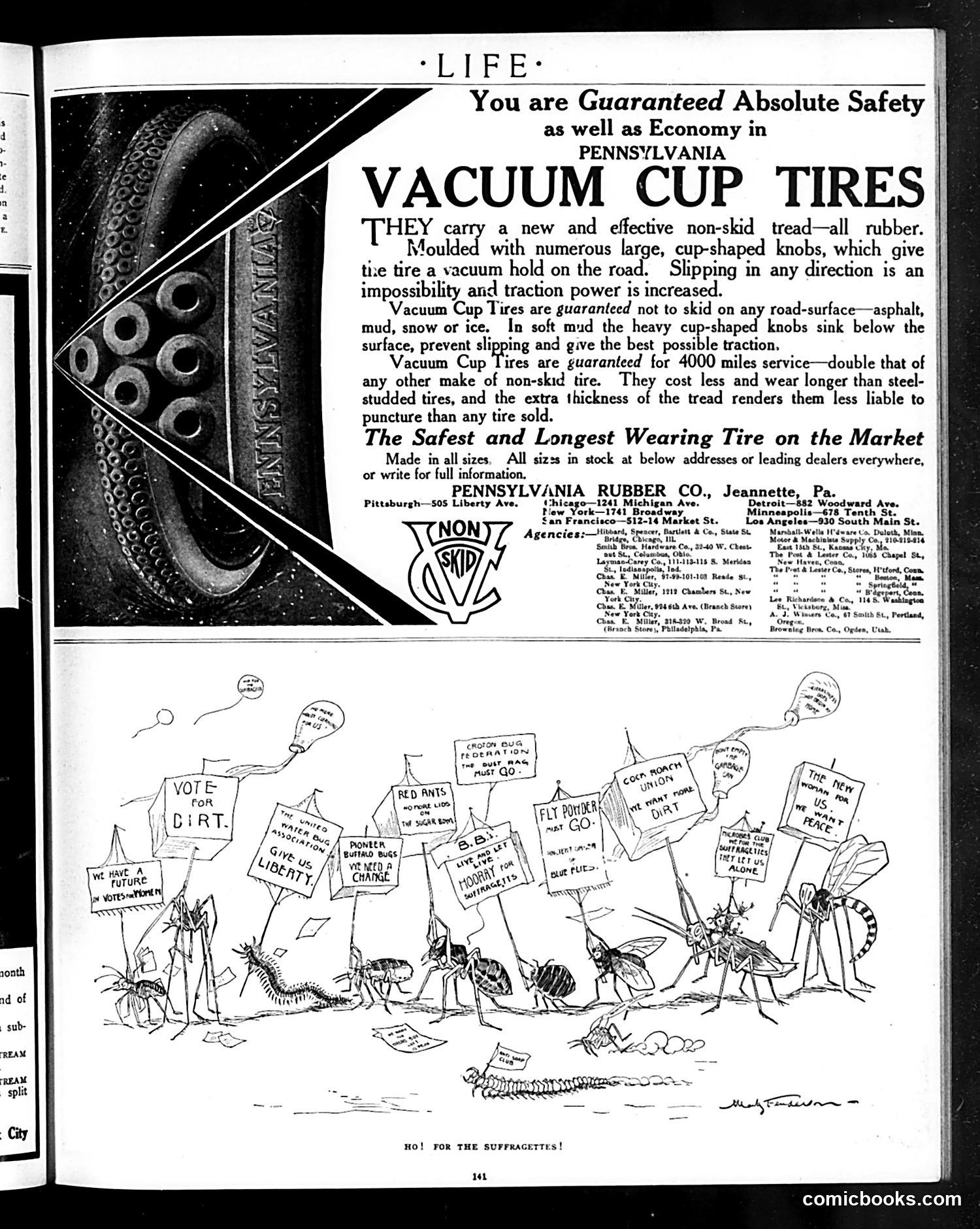
**Content:** This page is primarily a tire advertisement (top two-thirds) for Pennsylvania Vacuum Cup Tires, with a political cartoon below. **The Cartoon ("Ho! For the Suffragettes!"):** The bottom illustration depicts insects—mosquitoes, flies, and other pests—carrying protest signs and marching like suffragettes demanding voting rights. Signs read "VOTE DIRT," "LIBERTY," "RED ANTS," "BLUE FLIES," and similar declarations. The cartoon is anti-suffrage satire, mocking the women's suffrage movement by equating female voters to insects and pests—a crude rhetorical tactic suggesting women's political participation would be as unwelcome and irritating as an insect infestation. **Historical Context:** This reflects early-20th-century opposition to women's voting rights, common in American media before the 19th Amendment (1920). The juxtaposition of a safety/reliability advertisement with anti-women's-rights propaganda is jarring to modern readers but typical of *Life* magazine's satirical approach.
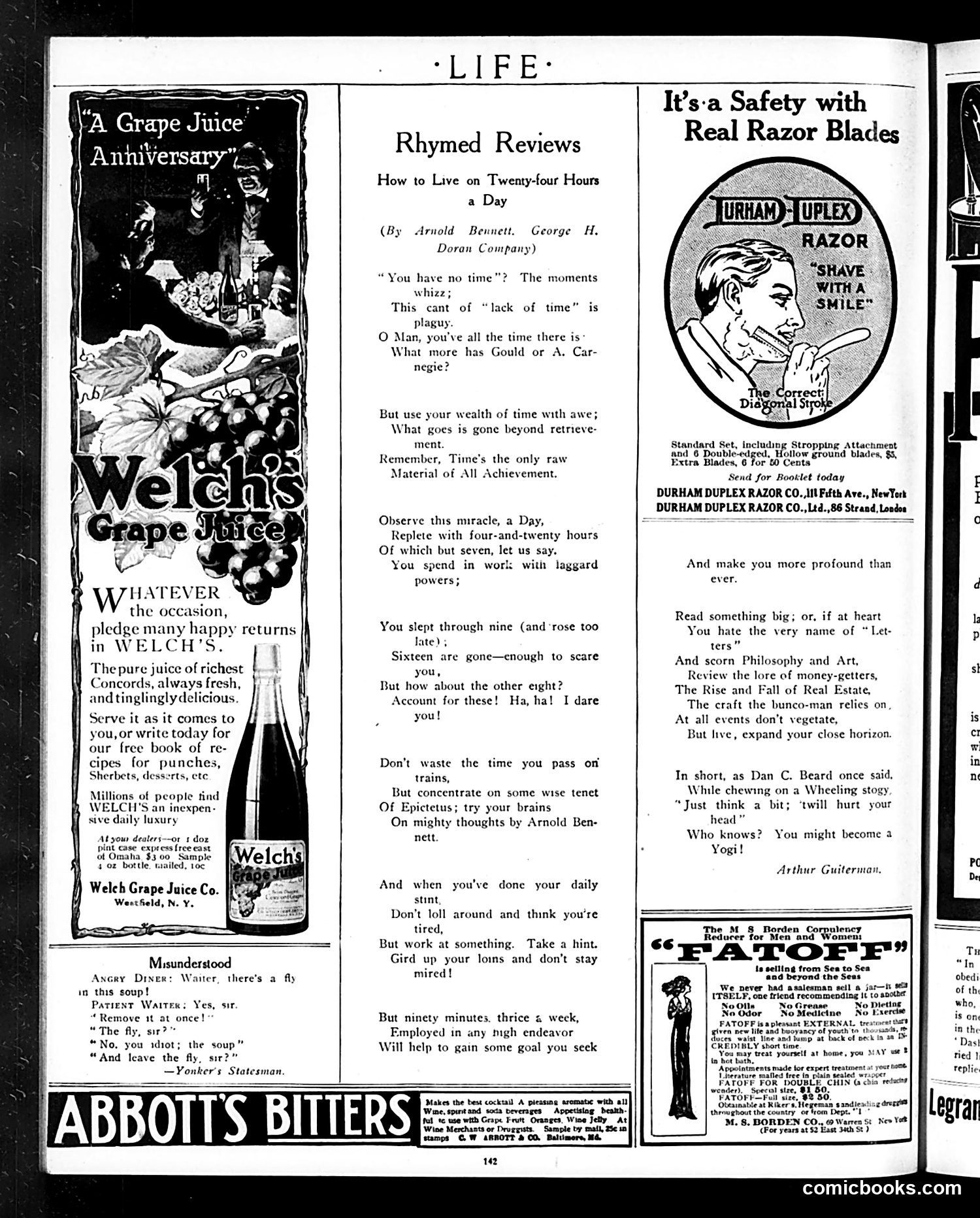
This page is primarily **advertising with some editorial content**—typical of early 20th-century Life magazine. The main editorial piece is a rhymed book review of Arnold Bennett's *How to Live on Twenty-four Hours a Day*, written by Arthur Guiterman. The satire gently mocks Bennett's self-help philosophy about time management. Guiterman humorously catalogs how people actually spend their day (sleeping 9 hours, working with "laggard powers," etc.), then sarcastically urges readers to use every spare moment productively—studying Epictetus, reading about real estate or "bunco-man" schemes, or becoming a Yogi. The joke is that Bennett's earnest advice about maximizing time is absurdly demanding. The advertisements include Welch's Grape Juice, Durham Duplex Razors, and Abbott's Bitters (a patent medicine claiming to reduce body fat without diet or exercise—typical of the era's dubious health claims). A small "Misunderstood" joke about a fly in soup appears at bottom left—standard vaudeville humor of the period.
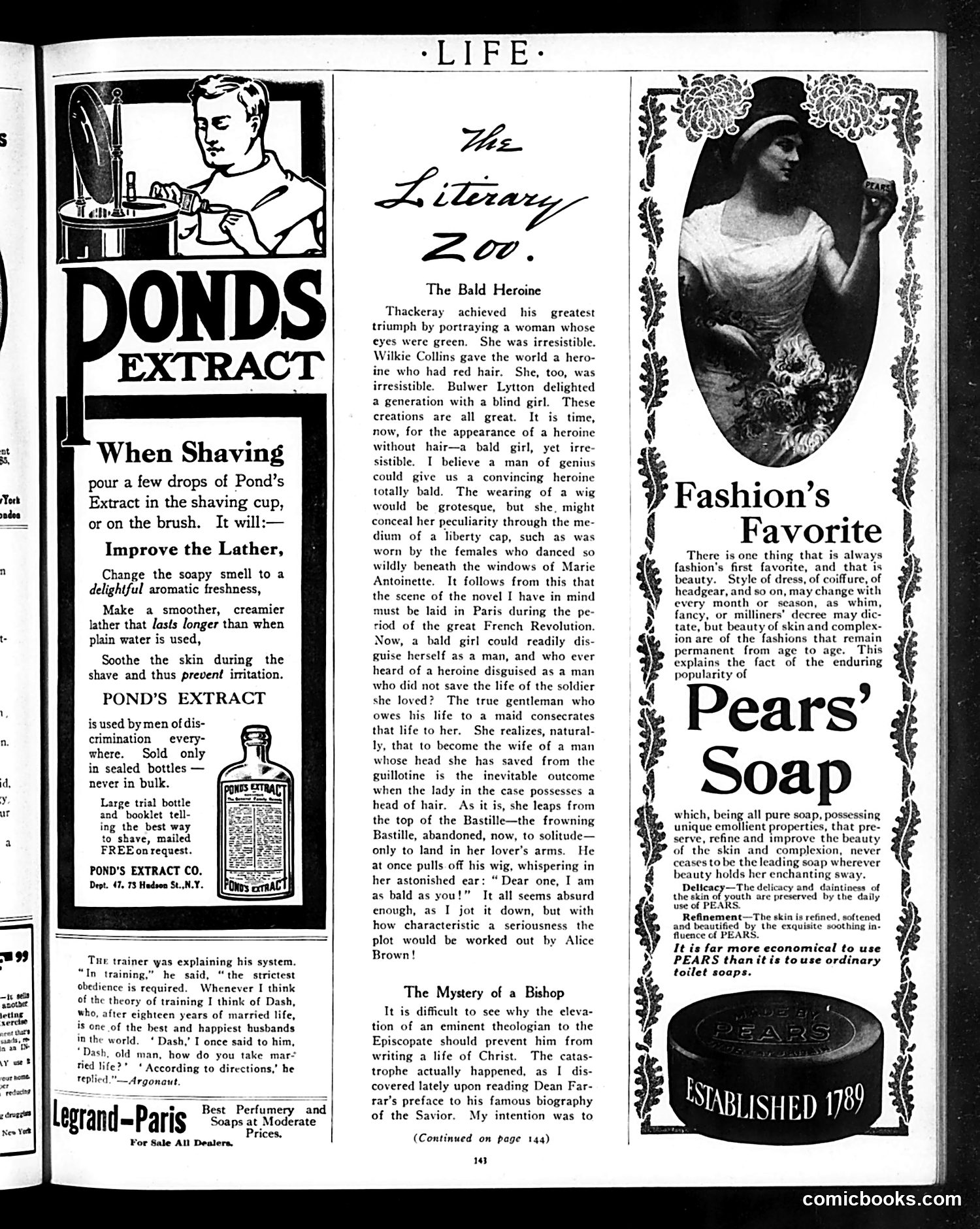
This page from *Life* magazine consists primarily of **advertisements and literary humor**, not political satire. The left side features a **Pond's Extract shaving product ad**, using a simple illustration of a man shaving to promote the extract's benefits. The center contains a humorous essay titled "The Bald Heroine" by (or about) **Alice Brown**, satirizing literary conventions. The writer mocks how famous authors (Thackeray, Wilkie Collins, Bulwer Lytton) built entire novels around heroines with distinctive physical features—green eyes, red hair, blindness. He proposes, tongue-in-cheek, that Brown could write a revolutionary-era novel featuring a bald heroine who disguises herself as a man, saves her lover's life, only for him to reveal he's equally bald. It's gentle literary satire about the contrivances of Victorian fiction. The right side advertises **Pears' Soap**, emphasizing that beauty of skin transcends fashion trends. The brief anecdote at bottom uses "Dash" (a dog's name) as wordplay about marital obedience—a mild joke about following instructions. No specific political figures or events are referenced.
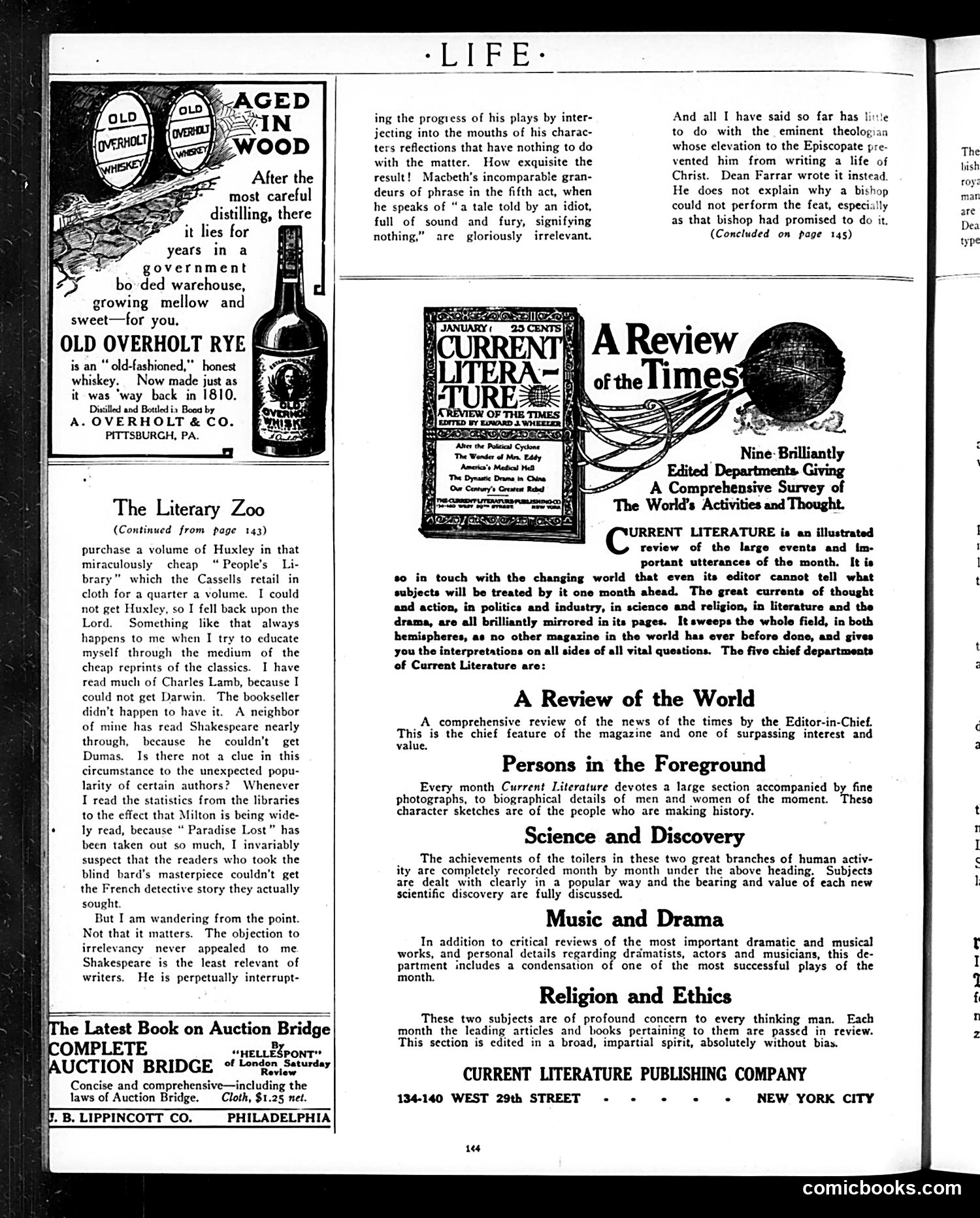
This page is primarily **advertising and magazine promotion** rather than satirical content. The main elements are: 1. **Old Overholt Rye whiskey advertisement** (left): A straightforward liquor ad emphasizing the product's age and traditional distilling methods since 1810—no satire evident. 2. **"The Literary Zoo" column** (left): A literary commentary discussing how readers of modest means access classics through cheap reprints, often settling for available books rather than their first choice. The author ironically notes this might explain why certain authors are widely read—not necessarily by choice but by circumstance. 3. **Current Literature magazine promotion** (center/right): An advertisement describing the magazine's departments (world news, biography, science, music/drama, religion/ethics). There is **no political cartoon visible** on this page. The content reflects early 20th-century concerns about literary accessibility and magazine publishing, but contains no identifiable caricatures or satirical imagery targeting specific figures or events.
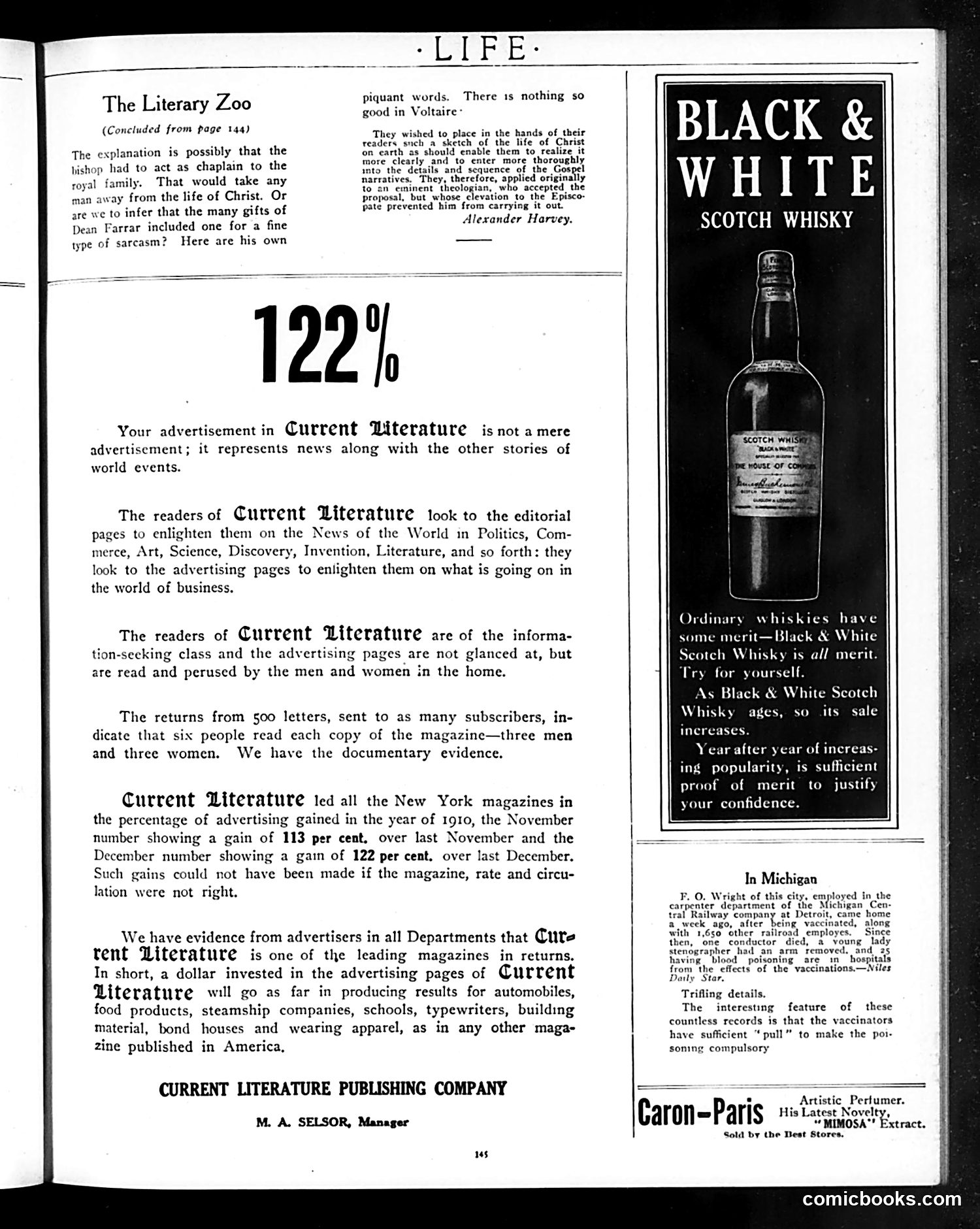
This page is primarily **advertising and promotional content**, not satire or political commentary. The main text is a self-promotional advertisement for *Current Literature* magazine, claiming superior advertising returns (122% growth) and asserting that their readership actively engages with advertisements, not just editorial content. It targets business advertisers across industries. The sidebar contains two product advertisements: **Black & White Scotch Whisky** and **Caron-Paris Perfume**. Below the whisky ad is a brief news item titled "In Michigan" describing vaccination complications among railroad employees—numbering deaths and injuries. The final line, "Trifling details," appears to sarcastically critique authorities for dismissing these serious health outcomes as minor, suggesting the vaccinators have political protection ("pull"). This represents early-1900s vaccine skepticism, though the context for the vaccination campaign itself is unclear from this page alone.
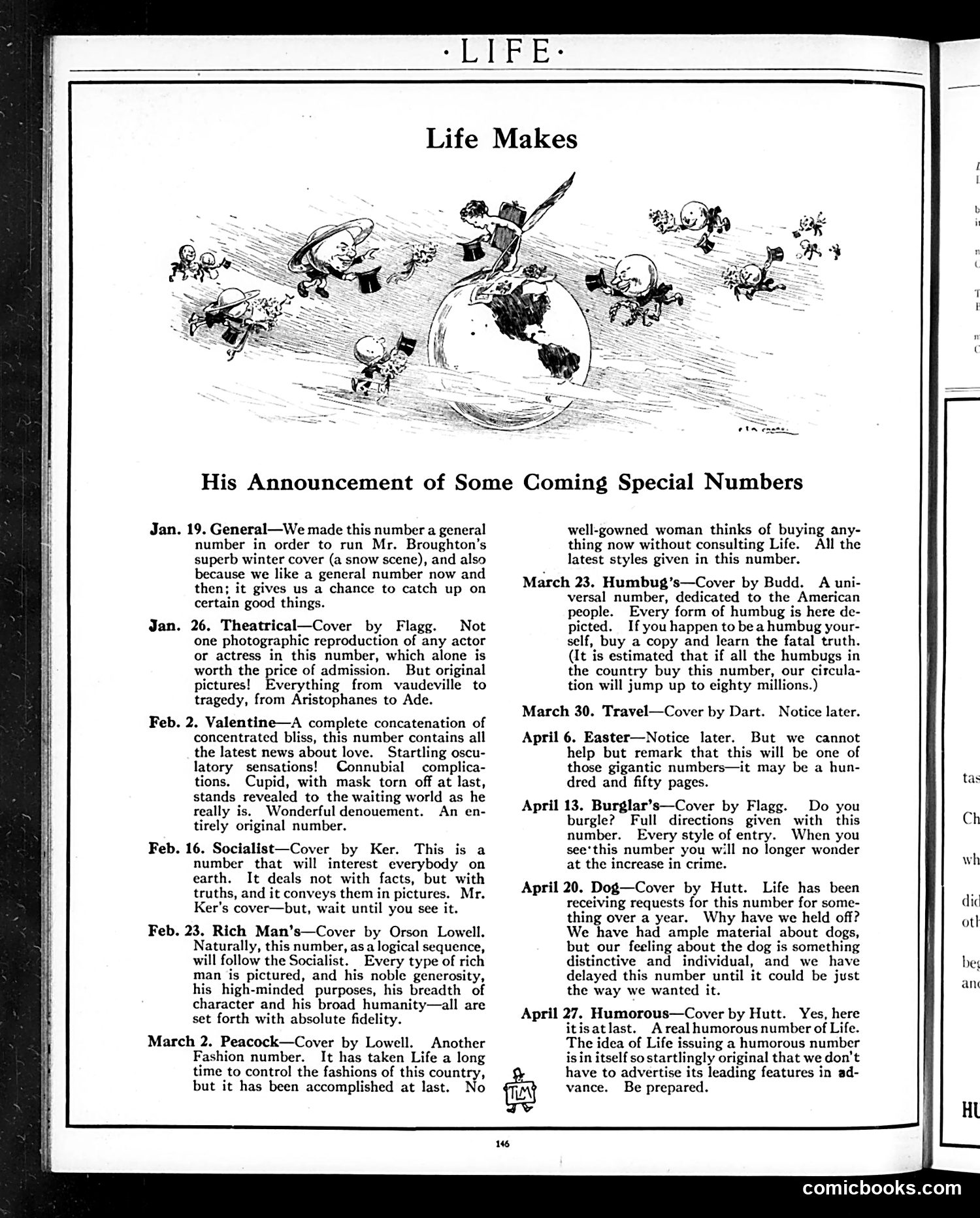
This page announces Life magazine's upcoming themed issues with characteristic satirical humor. The illustration shows tiny figures riding on a large globe, representing Life's editorial reach and influence. The satire operates through mock-serious descriptions of issues dedicated to Socialists, Rich Men, Fashion, Humbugs, Burglars, and Dogs. Life ironically claims to control American fashion and warns that humbugs nationwide should buy the "Humbug's" issue to learn uncomfortable truths about themselves. The Burglar's issue joke—offering "full directions" for breaking in—satirizes crime while tongue-in-cheek blaming the magazine for increased burglaries. The final joke about the Humorous issue is self-aware: Life suggests the concept is so "startlingly original" it needs no advance promotion. This reflects Life's actual prominence in early 20th-century American humor and social commentary, where the magazine positioned itself as arbiter of taste, morality, and public discourse.
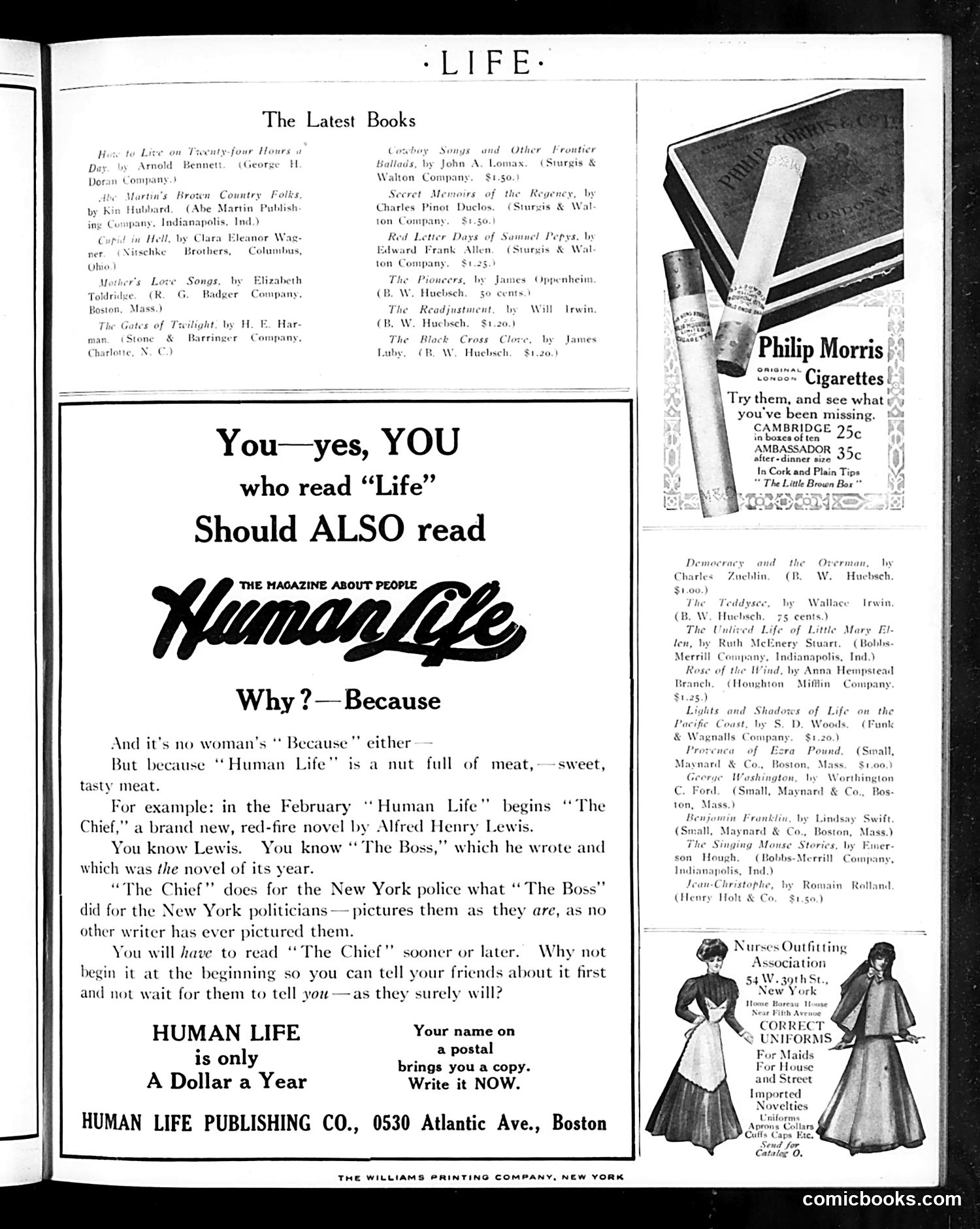
This page is primarily advertising and book reviews, not a political cartoon. The main content is a promotion for *Human Life* magazine (a competitor publication), which uses a playful sales pitch rather than satire. The advertisement references Alfred Henry Lewis's novel *"The Chief,"* comparing it to his earlier work *"The Boss."* The pitch suggests *"The Chief"* exposes New York police corruption similarly to how *"The Boss"* exposed political corruption—implying contemporary concerns about institutional corruption and police conduct. The ad employs gentle humor by addressing *Life* readers directly, suggesting they'd want to read *Human Life* for its serialized fiction. It's a trade publication advertisement rather than satirical commentary. The page also lists recent book releases and includes ads for Philip Morris cigarettes and a nurses' uniform supplier, typical period advertising. No specific political figures or events are caricatured.
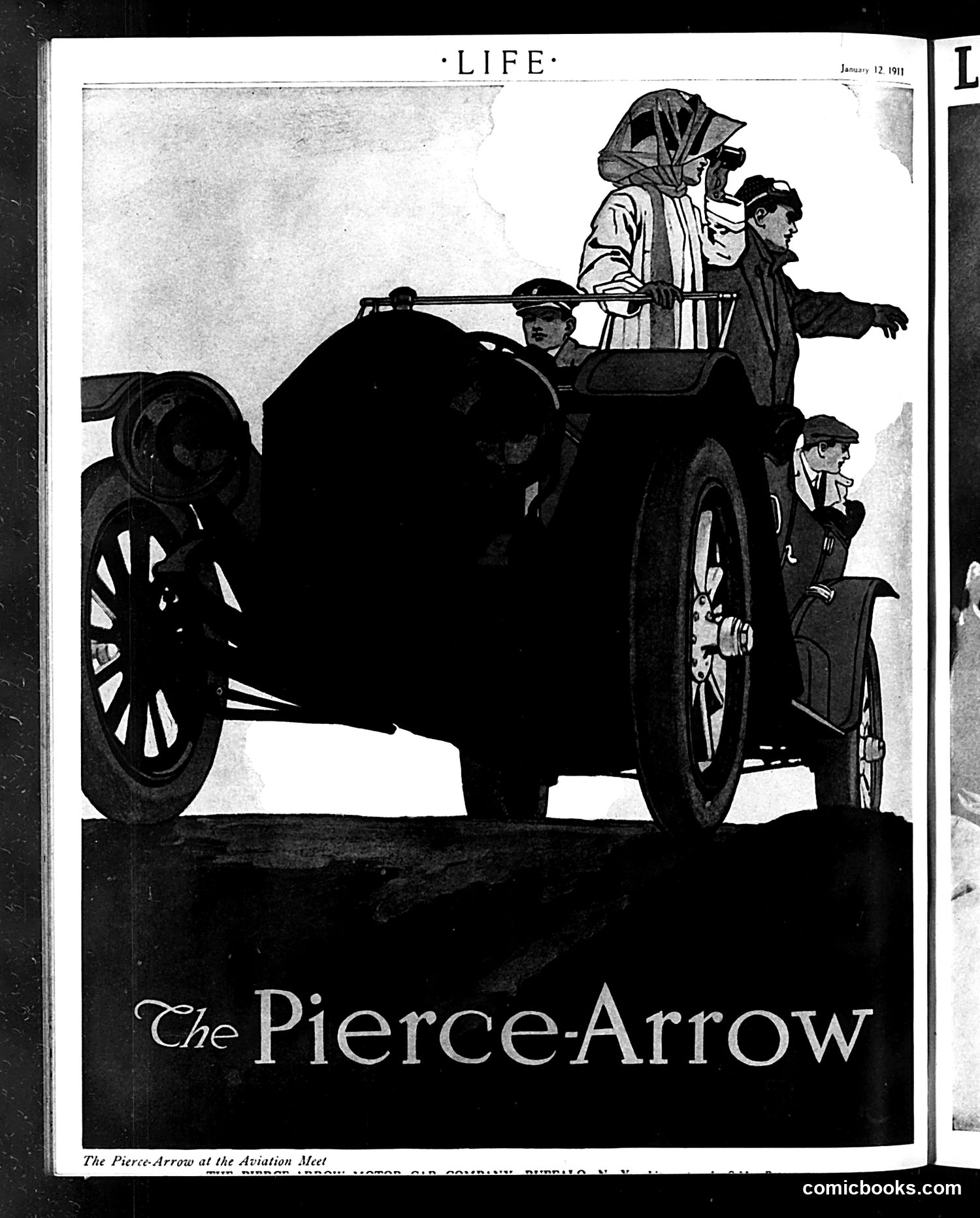
This is a **Pierce-Arrow automobile advertisement**, not political satire. The silhouetted image depicts an early 1910s luxury car with passengers in period clothing—a woman in a large hat and coat, men in suits and caps. One figure points dramatically ahead, suggesting adventure or direction. The caption references "The Pierce-Arrow at the Aviation Meet," likely promoting the vehicle at an early aviation exhibition—a cutting-edge event of the era. The advertisement associates this luxury automobile brand with modernity, innovation, and aspirational leisure activities. The silhouette style was a popular artistic technique for advertisements in this period. This represents how early 20th-century marketing linked expensive consumer goods to excitement and progress.