
Life, 1911-01-12 · page 19 of 44
Life — January 12, 1911 — page 19: what you’re looking at
What you’re looking at
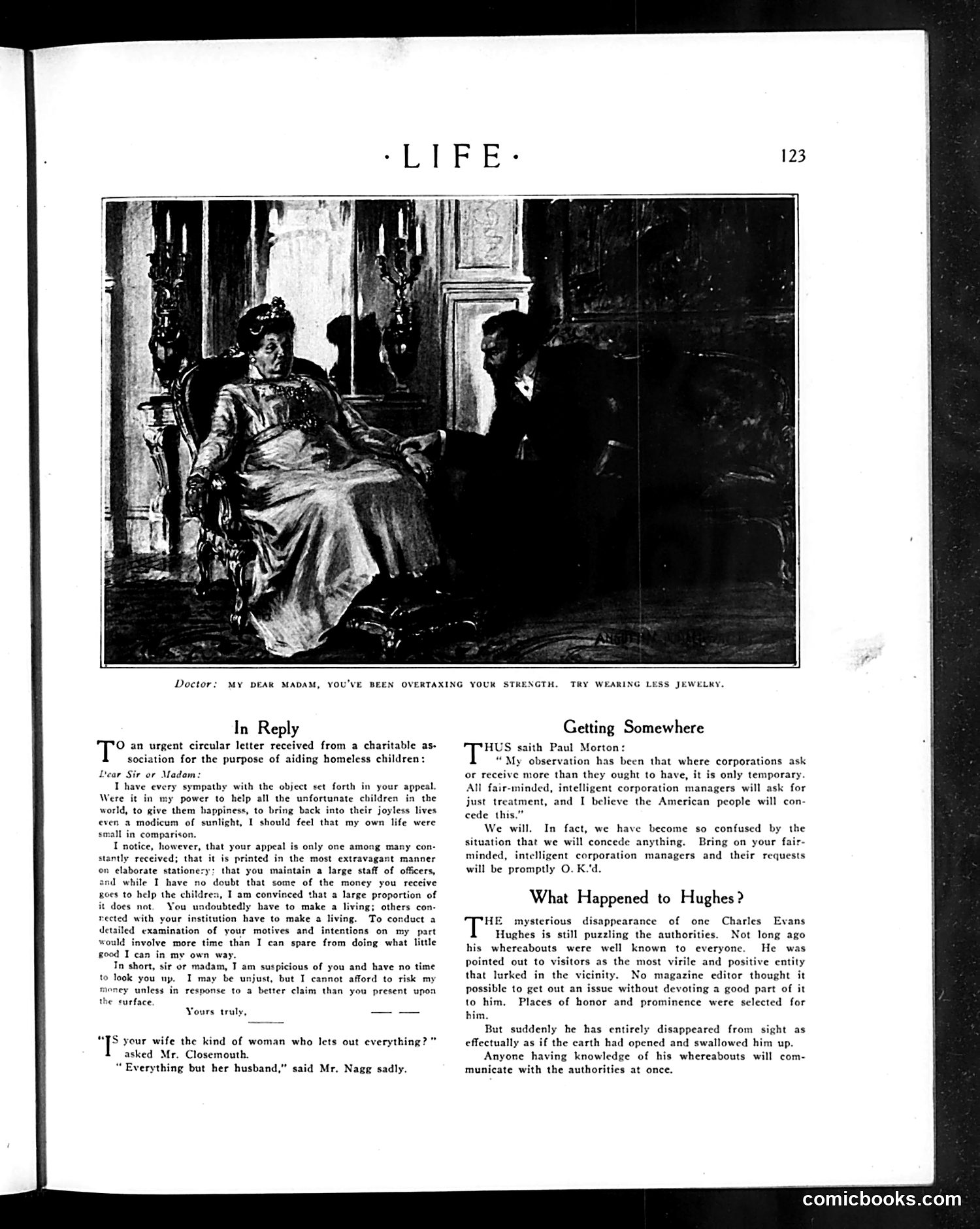
The top illustration depicts a doctor advising an overdressed wealthy woman to wear less jewelry—satirizing frivolous spending by the rich while claiming financial hardship. The three text pieces below mock various aspects of American society: 1. **"In Reply"**: A scathing response to a charitable appeal from a homeless children's organization, criticizing bloated administrative overhead and extravagant fundraising materials. The writer suspects most donations fund staff salaries rather than helping children—sharp commentary on charity inefficiency. 2. **"Getting Somewhere"**: Sarcasm about Paul Morton's claim that corporations only temporarily overreach. Life mocks the public's resigned acceptance of corporate excess, suggesting Americans have become so confused they'll agree to anything. 3. **"What Happened to Hughes?"**: A satirical "missing person" notice for Charles Evans Hughes (likely the politician/lawyer prominent in early 1900s), suggesting he's vanished from public prominence and media attention as mysteriously as if the earth swallowed him. The page collectively critiques wealth inequality, charitable fraud, corporate power, and the fickle nature of public attention.
📄 Transcribed text from this page (OCR, searchable)
Machine-transcribed from the original scan — historical spelling and the odd misread are preserved.
Doctor; MY DEAR MADAM, YOU'VE BEEN OVERTAXING YOUK STRENGTH. TRY WEARING LESS JEWELRY. In Reply 'O an urgent circular letter received from a charitable as sociation for the purpose of aiding homeless children: Lear Sir or Madom: T have every sympathy with the object set forth in your appeal. Were it in my power to help all the unfortunate children in the world, to give them happiness, to bring back into their joyless lives even a modicum of sunlight, I should feel that my own life were small in comparison. I notice, however, that your appeal is only one among many con- stantly received; that it is printed in the most extravagant manner on elaborate stationery: that you maintain a large staff of officers, d while T have no doubt that some of the money you receive goes to help the children, I am convinced that a large proportion of it does not. You undoubtedly have to make a living; others con- rected with your institution have to make a living. To conduct a detailed examination of your motives and intentions on my part would involve more time than I can spare from doing what little good I can in my own way. In short, sir or madam, T am suspicious of you and have no time to look you up, I may be unjust, but I cannot afford to risk my money unless in response to a better claim than you present upon the surface Yours truly, ders I your wife the kind of woman who lets out everything?” asked Mr. Closemouth. “Everything but her husband,” said Mr. Nagg sadly. Getting Somewhere HUS saith Paul Morton: “My observation has been that where corporations ask or receive more than they ought to have, it is only temporary. All fair-minded, intelligent corporation managers will ask for just treatment, and I believe the American people will con- cede this.” We will. In fact, we have become so confused by the situation that we will concede anything. Bring on your fair minded, intelligent corporation managers and their requests will be promptly 0. K. What Happened to Hughes? HE mysterious disappearance of one Charles Evans Hughes is still puzzling the authorities. Not long ago his whereabouts were well known to everyone. He was pointed out to visitors as the most virile and positive entity that lurked in the vicinity. No magazine editor thought it possible to get out an issue without devoting a good part of it to him, Places of honor and prominence were selected for him. But suddenly he has entirely disappeared from sight as effectually as if the carth had opened and swallowed him up. Anyone having knowledge of his whereabouts will com- municate with the authorities at once. comicbooks.com