
Life, 1911-01-12 · page 17 of 44
Life — January 12, 1911 — page 17: what you’re looking at
What you’re looking at
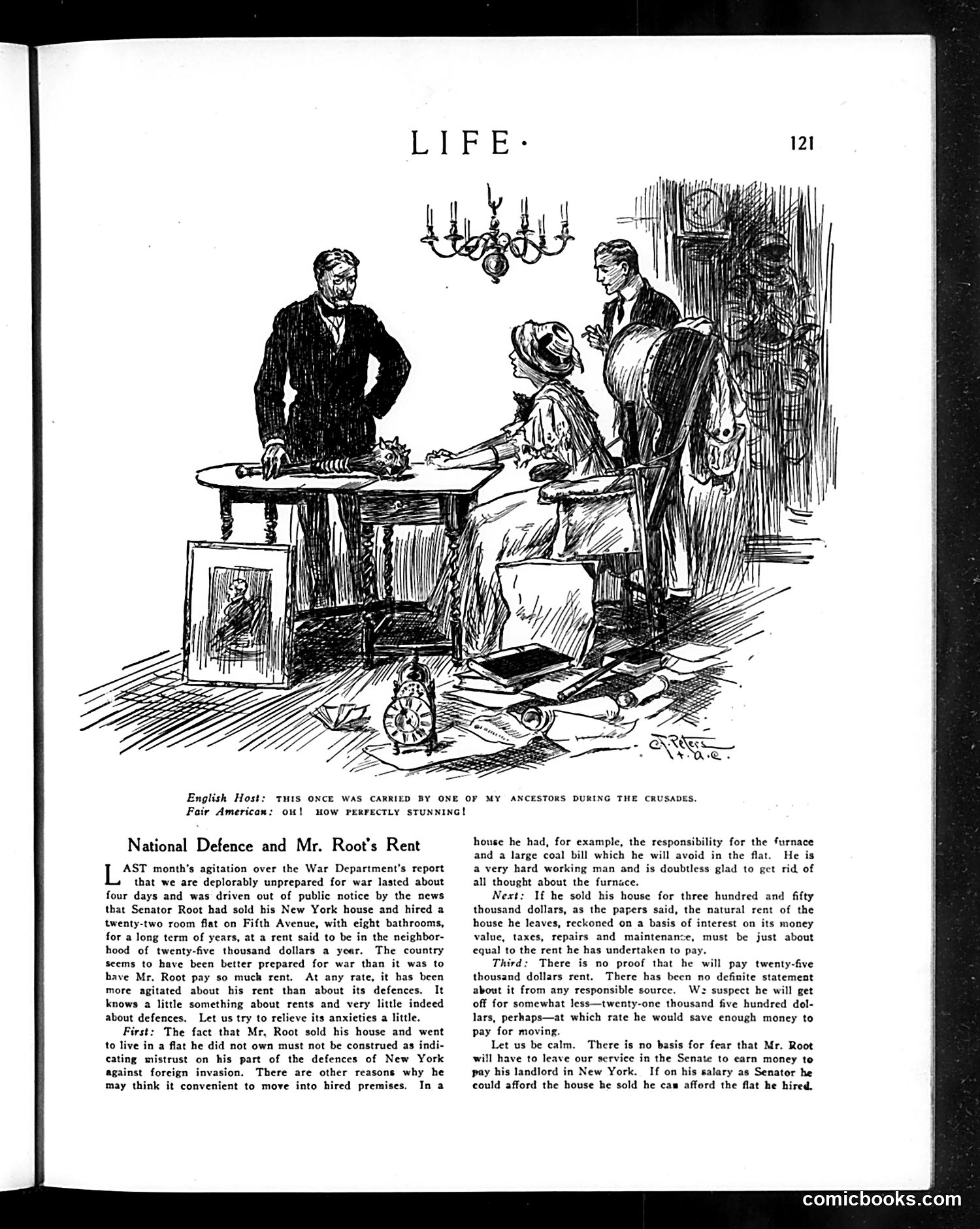
The cartoon satirizes public concern over Senator Elihu Root's expensive New York City rental—a twenty-two room apartment on Fifth Avenue for approximately $25,000 annually—at a moment when the nation faces military unpreparedness. The sketch depicts Root (left, in suit) showing the apartment to a woman, who admires a decorative object, claiming it belonged to her ancestor during the Crusades. The satire operates on two levels: the English visitor's pretentious name-dropping contrasts with American obsession over Root's rent rather than national defense. The accompanying article defends Root through ironic logic, suggesting his move to a rented flat (rather than owned house) shouldn't be interpreted as doubting New York's defenses, and that his Senate salary suffices for the expense. The satire targets both the public's misplaced priorities—fixating on gossip about a wealthy senator's luxury housing while ignoring defense vulnerabilities—and Root's ostentatious spending during a period of military concern.
📄 Transcribed text from this page (OCR, searchable)
Machine-transcribed from the original scan — historical spelling and the odd misread are preserved.
English Host: Fair American: National Defence and Mr. Root’s Rent AST month's agitation over the War Department's report that we are deplorably unprepared for war lasted about four days and was driven out of public notice by the news that Senator Root had sold his New York house and hired a twenty-two room fiat on Fifth Avenue, with eight bathrooms, for a long term of years, at a rent said to be in the neighbor- hood of twenty-five thousand dollars a year. The country seems to have been better prepared for war than it was to have Mr. Root pay so much rent. At any rate, it has been more agitated about his rent than about its defences. It knows a little something about rents and very little indeed about defences. Let us try to relieve its anxieties a little. First: The fact that Mr, Root sold his house and went to live in a flat he did not own must not be construed as indi- cating mistrust on his part of the defences of New York against foreign invasion. There are other reasons why he may think it convenient to move into hired premises. In a ou! HOW PERFECTLY STUNNING! THIS ONCE WAS CARRIED BY ONE OP MY ANCESTORS DURING THE CRUSADES. house he had, for example, the responsibility for the furnace and a large coal bill which he will avoid in the flat. He is a very hard working man and is doubtless glad to get rid of all thought about the furnace. Next: If he sold his house for three hundred and fifty thousand dollars, as the papers said, the natural rent of the house he leaves, reckoned on a basis of interest on its money value, taxes, repairs and maintenance, must be just about equal to the rent he has undertaken to pay. Third: There is no proof that he will pay twenty-five thousand dollars rent. There has been no definite statement about it from any responsible source. We: suspect he will get off for somewhat less—twenty-one thousand five hundred dol- lars, perhaps—at which rate he would save enough money to pay for moving. Let us be calm. There is no basis for fear that Mr. Root will have to leave our service in the Senate to earn money to pay his landlord in New York. If on his salary as Senator he could afford the house he sold he cam afford the flat he hired. comicbooks.com