
Life, 1911-01-12 · page 20 of 44
Life — January 12, 1911 — page 20: what you’re looking at
What you’re looking at
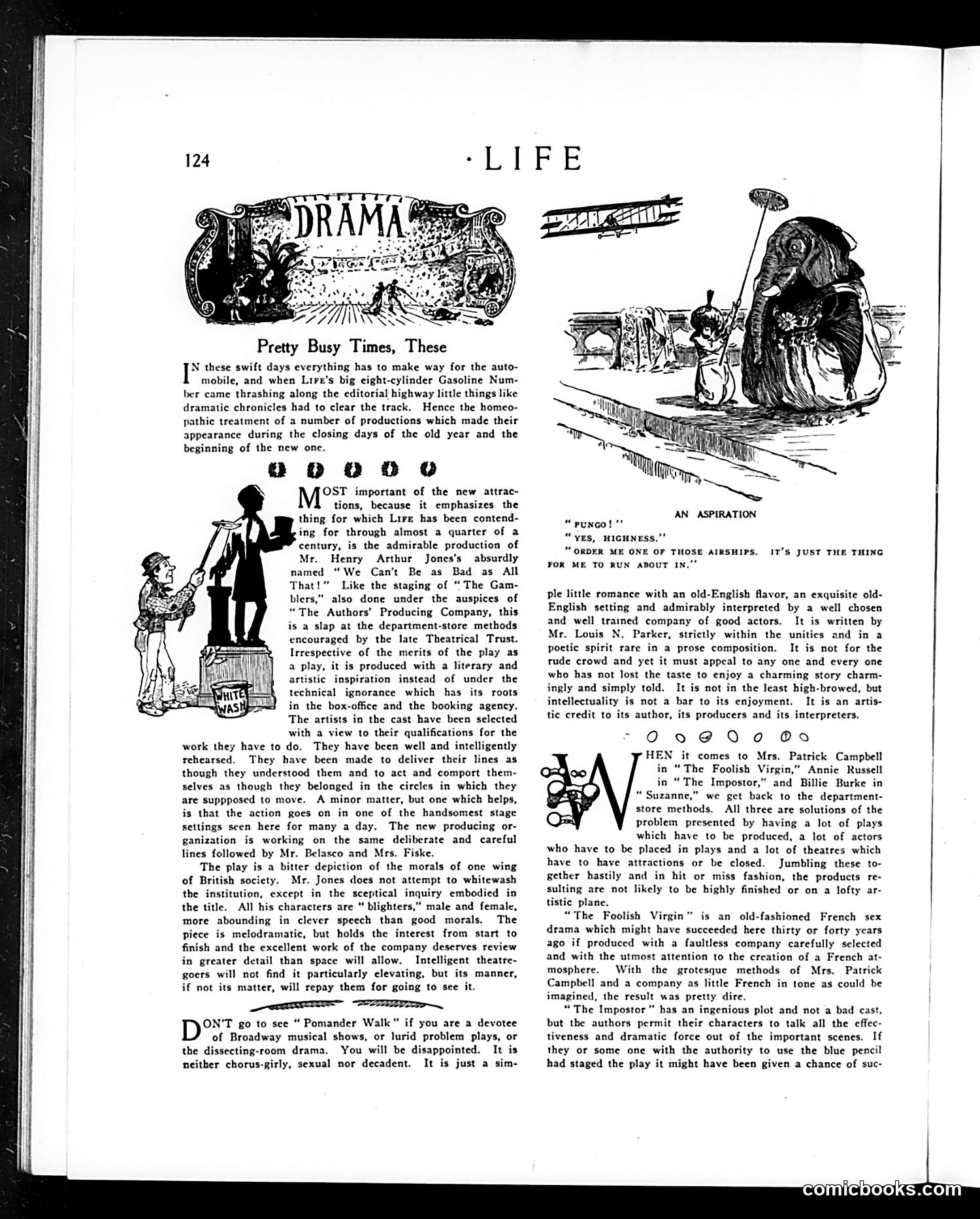
This page reviews several Broadway productions while satirizing theatrical business practices. The main cartoon depicts a child asking a dignitary ("Punco!") to order an airship—a topical joke about the era's fascination with early aviation technology as the ultimate luxury item. The text criticizes the "department-store methods" of the defunct Theatrical Trust, praising Henry Arthur Jones's "We Can't Be as Bad as All That!" for prioritizing artistic merit over commercial shortcuts. It contrasts this with productions starring Mrs. Patrick Campbell, Annie Russell, and Billie Burke, which the critic dismisses as assembly-line products where famous actresses are merely plugged into existing plays rather than thoughtfully cast. The overarching satire: Broadway producers treat theater like retail—casting marquee names without artistic consideration, much as a store arranges stock. The airship joke reinforces this era's obsession with technology and status symbols.
📄 Transcribed text from this page (OCR, searchable)
Machine-transcribed from the original scan — historical spelling and the odd misread are preserved.
Pretty Busy Times, These [Nt swift days everything has to make way for the auto- mobile, and when Live's big eight-cylinder Gasoline Num- ber came thrashing along the editorial highway little things like dramatic chronicles had to clear the track. Hence the homeo- pathic treatment of a number of productions which made their appearance during the closing days of the old year and the beginning of the new one. @o0o 8 0 OST important of the new attrac- tions, because it emphasizes the thing for which Lire has been contend- ing for through almost a quarter of a century, is the admirable production of Mr. Henry Arthur Jones's absurdly named “We Can't Be as Bad as All That!” Like the staging of “The Gam- blers,” also done under the auspices of “The Authors’ Producing Company, this is a slap at the department-store methods encouraged by the late Theatrical Trust. Irrespective of the merits of the play as a play, it is produced with a literary and artistic inspiration instead of under the technical ignorance which has its roots in the box-office and the booking agency. The artists in the cast have been selected with a view to their qualifications for the work they have to do. They have been well and intelligently rehearsed. They have been made to deliver their lines as though they understood them and to act and comport them- selves as though they belonged in the circles in which they are suppposed to move. A minor matter, but one which helps, is that the action goes on in one of the handsomest stage settings scen here for many a day. The new producing or- ganization is working on the same deliberate and careful lines followed by Mr. Belasco and Mrs. Fiske. The play is a bitter depiction of the morals of one wing of British society. Mr. Jones does not attempt to whitewash the institution, except in the sceptical inquiry embodied in the title. All his characters are “ blighters,” male and female, more abounding in clever speech than good morals. The piece is melodramatic, but holds the interest from start to finish and the excellent work of the company deserves review in greater detail than space will allow. Intelligent theatre- goers will not find it particularly elevating, but its manner, if not its matter, will repay them for going to see it. ee ST ON'T go to see “ Pomander Walk” if you are a devotee of Broadway musical shows, or lurid problem plays, or the dissecting-room drama. You will be disappointed. It is neither chorus-girly, sexual nor decadent. It is just a sim- AN ASPIRATION “puxco!"’ “YES, HIGHNESS."’ “ORDER ME ONE OF THOSE AIRSHIPS. IT’S JUST THR THING FOR ME TO RUN ABOUT ple little romance with an old-English flavor, an exquisite old- English setting and admirably interpreted by a well chosen and well trained company of good actors. It i: Mr. Louis N. Parker, strictly within the uni poetic spirit rare in a prose composition. It is not for the rude crowd and yet it must appeal to any one and every one who has not lost the taste to enjoy a charming story charm- ingly and simply told. It is not in the least high-browed, but intellectuality is not a bar to its enjoyment. It is an artis- tic credit to its author, its producers and its interpreters. - 009000 006 HEN it comes to Mrs. Patrick Campbell i in “The Foolish Virgin,” Annie Russell in “The Impostor,” and Billie Burke in “ Suzanne,” we get back to the department- store methods. All three are solutions of the problem presented by having a lot of plays which have to be produced, a lot of actors who have to be placed in plays and a lot of theatres which have to have attractions or be closed. Jumbling these to- gether hastily and in hit or miss fashion, the products re- sulting are not likely to be highly finished or on a lofty ar- tistic plane. “The Foolish Virgin” is an old-fashioned French sex drama which might have succeeded here thirty or forty years ago if produced with a faultless company carefully selected and with the utmost attention to the creation of a French at- mosphere. With the grotesque methods of Mrs. Patrick Campbell and a company as little French in tone as could be imagined, the result was pretty dire. “The Impostor” has an ingenious plot and not a bad cast, but the authors permit their characters to talk all the effec- tiveness and dramatic force out of the important scenes. If they or some one with the authority to use the blue pencil had staged the play it might have been given a chance of suc-