
Life, 1911-01-12 · page 27 of 44
Life — January 12, 1911 — page 27: what you’re looking at
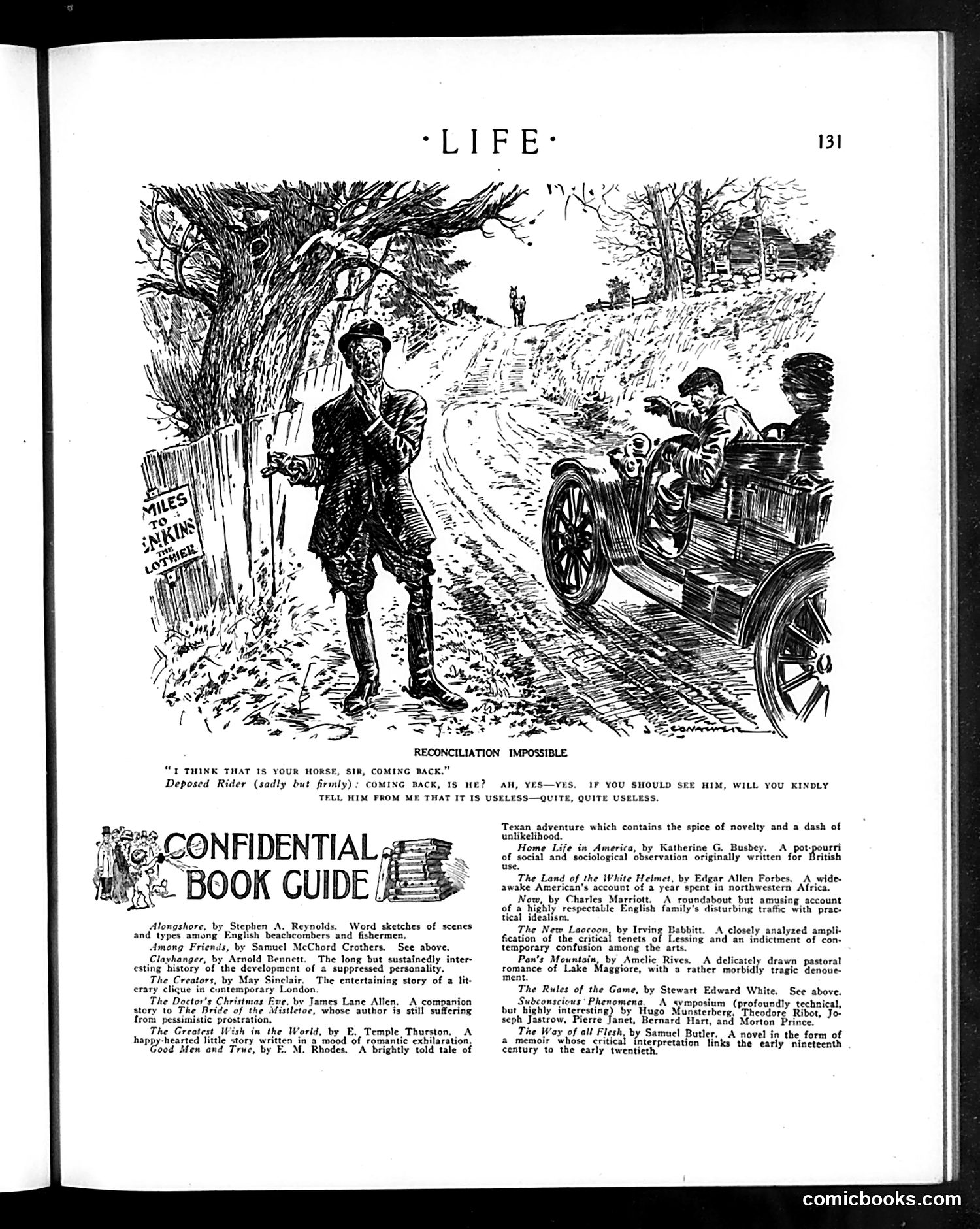
What you’re looking at
This cartoon depicts a social/political dispute using a horse as metaphor. A "Deposed Rider" stands beside a country road, addressing someone who has just returned with his horse. The rider refuses to remount, declaring the situation "useless—quite, quite useless," despite the horse's apparent willingness to return. The satire likely concerns a failed reconciliation or political settlement. The "deposed rider" represents someone removed from power who refuses reinstatement, suggesting that certain rifts cannot be healed through simple restoration of previous arrangements. The horse symbolizes the mechanism or institution being disputed—perhaps a government office or political position. Without the publication date visible, the specific political context remains unclear, but the cartoon's title and tone suggest it critiques attempts at reconciliation that are fundamentally doomed by underlying disagreement or principle.
📄 Transcribed text from this page (OCR, searchable)
Machine-transcribed from the original scan — historical spelling and the odd misread are preserved.
RECONCILIATION IMPOSSIBLE “T THINK THAT 1S YOUR HORSE, SIR, COMING BACK. Deposed Rider (sadly but firmly): comING BACK, 18 WE? AM, YES—YES. 1” YOU SHOULD SEE HIM, WILL YOU KINDLY TELL HIM PROM ME THAT IT IS USELESS—QUITE, QUITE USELESS. “CONFIDENTIAL BOOK GUIDE Alongshore, by Stephen A. Reynolds. Word sketches of scenes and types among English beachcombers and fishermen. Among Friends, by Samuel McChord Crothers. See above. Clayhanger, by Arnold Bennett. The long but sustainedly inter- esting history ‘of the development of a suppressed personality. The Creators, by May Sinclair. The entertaining story of a lit- erary clique in contemporary London. The Doctor’s Christmas Eve. by James Lane Allen. A companion story to The Bride of the Mistletoe, whose author is still suffering from pessimistic prostration, The Greatest Wish in t happy-hearted little story wri ‘ood Men and True, by World, by E. Temple Thurston. A na mood of romantic exhilaration. |. Rhodes. A brightly told tale of Texan adventure which contains the spice of novelty and a dash of unlikelibood. Home Lije in America, by Katherine G. Busbey. A_poty of social and sociological observation originally written for tse. The Land of the White Helmet, by Edgar Allen Forbes, A wide awake American's account of a year spent in northwestern Africa. Now, by Charles Marriott, A roundabout but amusing account of a highly respectable English family’s disturbing traffic with prac. tical idealism. The Neto Laocoon, by Irving Babbitt. A closely analyzed ampli+ fication of the critical tenets of Lessing and‘an indictment of con: temporary confusion among the arts. Pan's Mountain, by Amelie Rives. romance of Lake Maggiore, with rather ‘morbid ment, The Rules of the Game, by Stewart Edward White. See above. Subconscicus Phenomena. A symposium (profoundly technical, but highly interesting) by Hugo Munsterberg. Theodore Ribot, Jo: seph Jastrow, Pierre Janct, Bernard Hart, and Morton Prive The Way of all Flesh. by Samuel Butler. A novel in the form of a memoir whose critical interpretation links early nin th century to the early twentieth the 7 teen! A delicately drawn pastoral é tragic denoue- comicbooks.com