
Life, 1911-01-12 · page 26 of 44
Life — January 12, 1911 — page 26: what you’re looking at
What you’re looking at
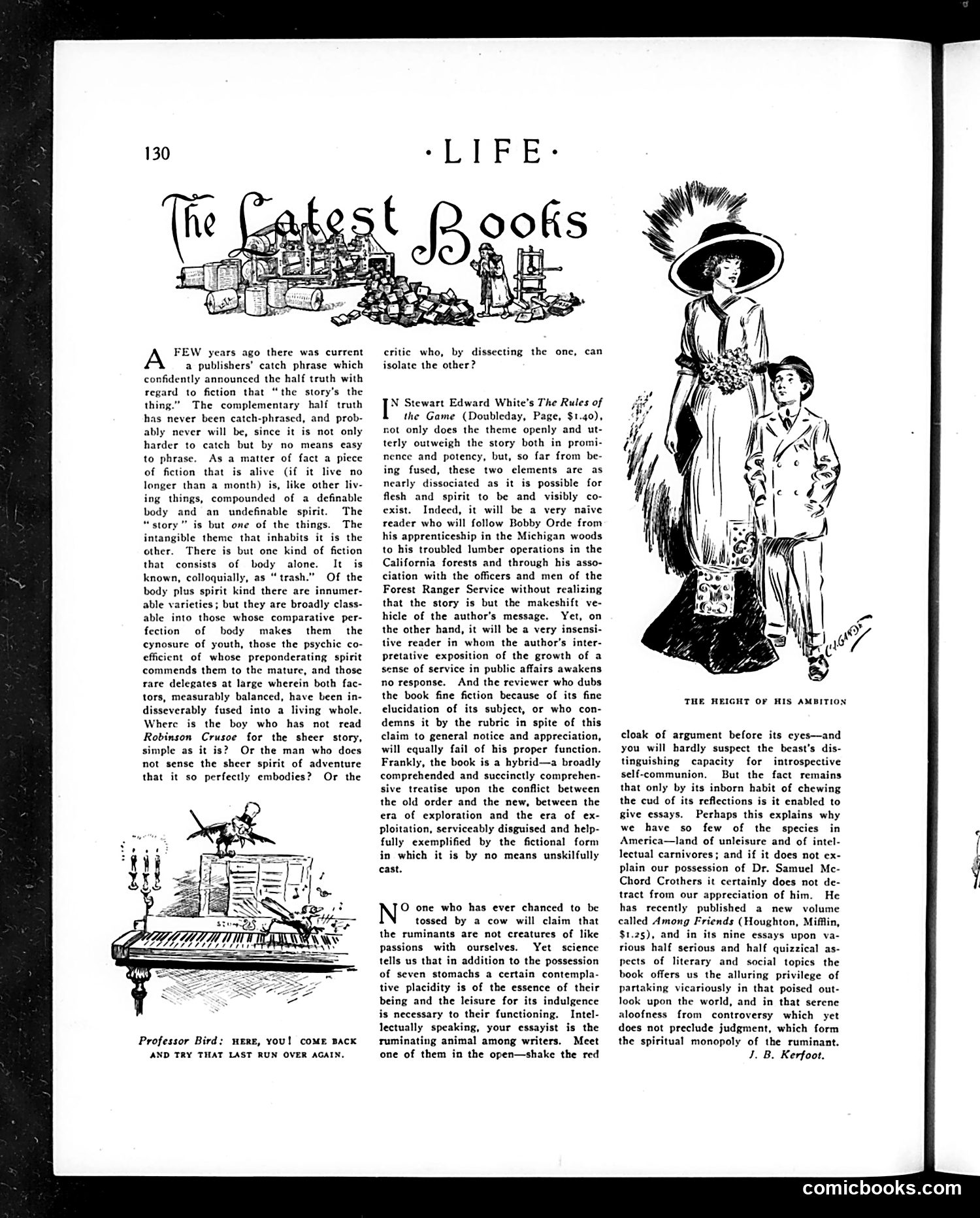
This is a literary criticism page reviewing Stewart Edward White's novel *The Rules of the Game*. The main article argues that successful fiction requires both "body" (plot/story) and "spirit" (theme/meaning) fused together as a living whole. The reviewer critiques White's book as a "hybrid"—one where theme overwhelmingly dominates story. While the narrative follows protagonist Bobby Orde through lumber camps and forest service work, it's primarily a treatise on the conflict between old and new orders of society, disguised as fiction rather than integrated with it. The small cartoon labeled "Professor Bird" depicts a bird at a piano, captioned "Here, you! Come back and try that last run over again"—a musical joke about practice and repetition, likely commenting on the craft of writing itself. The essay's closing analogy compares essayists to ruminating cattle—animals that chew their cud repeatedly—suggesting writers need contemplative habits for introspective thought. The tone is sophisticated literary criticism aimed at educated readers.
📄 Transcribed text from this page (OCR, searchable)
Machine-transcribed from the original scan — historical spelling and the odd misread are preserved.
A FEW years ago there was current a publishers’ catch phrase which confidently announced the half truth with regard to fiction that “the story’s the thing.” The complementary half truth has never been catch-phrased, and prob- ably never will be, since it is not only harder to catch but by no means easy to phrase. As a matter of fact a piece of fiction that is alive (if it live no longer than a month) is, like other liv- ing things, compounded of a definable dan undefinable spirit. The is but one of the things. The intangible theme that inhabits it is the other. that known, colloqui; There is but one kind of fiction consists of body alone. It is ly, as “ trash. Of the body plus spirit kind there are innumer- able varieties; but they are broadly class- able into those whose comparative per- fection of body makes them the cynosure of youth, those the psychic co- efficient of whose preponderating spirit commends them to the mature, and those rare delegates at large wherein both fac- tors, measurably balanced, have been in- disseverably fused into a living whole. Where is the boy who has not read Robinson Crusoe for the sheer story, simple as it is? Or the man who docs not sense the sheer spirit of adventure that it so perfectly embodies? Or the Professor Bird: were, you! COME BACK AND TRY THAT LAST RUN OVER AGAIN. critic who, by dissecting the one, can isolate the other? Stewart Edward White's The Rules of the Game (Doubleday, Page, $1.40), not only does the theme openly and ut- terly outweigh the story both in promi- nence and potency, but, so far from be- ing fused, these two elements are as nearly dissociated as it is possible for flesh and spirit to be and visibly co- exist. Indeed, it will be a very naive reader who will follow Bobby Orde from his apprenticeship in the Michigan woods to his troubled lumber operations in the California forests and through his asso- ciation with the officers and men of the Forest Ranger Service without realizing that the story is but the makeshift ve- hicle of the author's message. Yet, on the other hand, it will be a very insensi- tive reader in whom the author's inter- Pretative exposition of the growth of a sense of service in public affairs awakens no response. And the reviewer who dubs the book fine fiction because of its fine elucidation of its subject, or who con- demns it by the rubric in spite of this claim to general notice and appreciation, will equally fail of his proper function. Frankly, the book is a hybrid—a broadly comprehended and succinctly comprehen- sive treatise upon the conflict between the old order and the new, between the era of exploration and the era of ex- ploitation, serviceably disguised and help- fully exemplified by the fictional form in which it is by no means unskilfully cast. O one who has ever chanced to be tossed by a cow will claim that the ruminants are not creatures of like passions with ourselves. Yet science tells us that in addition to the possession of seven stomachs a certain contempla- tive placidity is of the essence of their being and the leisure for its indulgence is necessary to their functioning. Intel- lectually speaking, your essayist is the ruminating animal among writers. Meet one of them in the open—shake the red THE HEIGHT OF HIS AMBITION cloak of argument before its cyes—and you will hardly suspect the beast’s dis- tinguishing capacity for introspective self-communion, But the fact remains that only by its inborn habit of chewing the cud of its reflections is it enabled to give essays. Perhaps this explains why we have so few of the species in America—land of unleisure and of intel- lectual carnivores; and if it does not ex- plain our possession of Dr. Samuel Mc- Chord Crothers it certainly does not de- tract from our appreciation of him. He has recently published a new volume called Among Friends (Houghton, Mifflin, $1.25), and in its nine essays upon va- rious half serious and half quizzical as- pects of literary and social topics the book offers us the alluring privilege of partaking vicariously in that poised out- look upon the world, and in that serene aloofness from controversy which yet does not preclude judgment, which form the spiritual monopoly of the ruminant. J. B. Kerfoot. comicbooks.com