
Life, 1911-01-12 · page 15 of 44
Life — January 12, 1911 — page 15: what you’re looking at
What you’re looking at
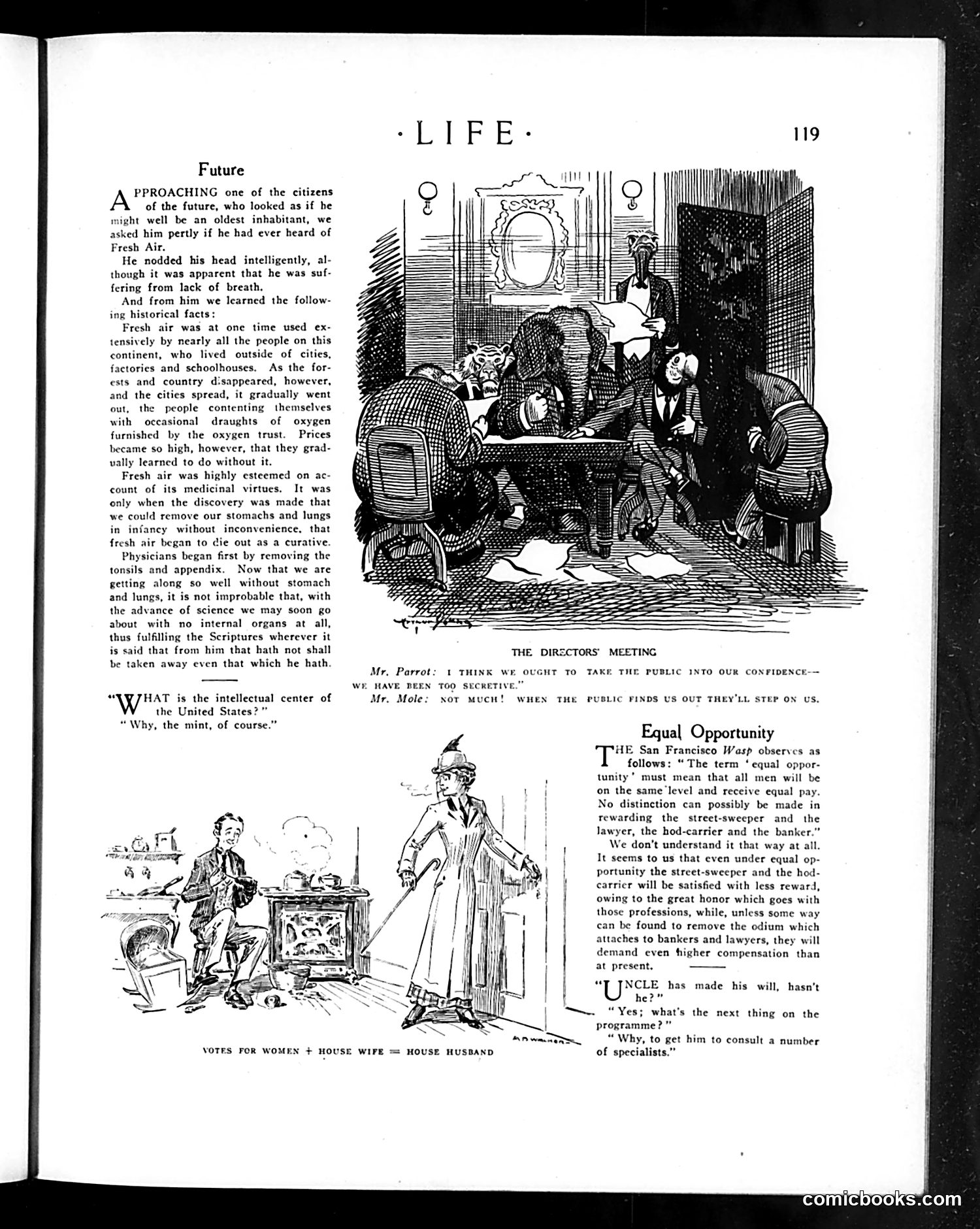
This page contains three satirical pieces mocking early 20th-century American society: **"Future"** imagines a dystopian world where corporations monopolize natural resources. The "oxygen trust" has made fresh air so expensive that people abandon it entirely. Scientists then remove citizens' internal organs (stomach, lungs) unnecessarily, reducing them to hollow shells—a critique of both monopoly capitalism and blind faith in medical "progress." **"The Directors' Meeting"** cartoon shows two businessmen (Parrot and Mole, likely representing corporate types) discussing secrecy. Mole warns that hiding from the public is pointless; "when the public finds us out they'll step on us"—satirizing corporate corruption and public inevitability of exposure. **"Equal Opportunity"** sardonically critiques the concept itself. While theoretically meaning equal pay for all work, Life argues that social prejudice means street-sweepers will accept lower wages due to "honor," while bankers demand higher pay because their profession carries "odium" (disgrace). The satire exposes how class systems persist despite egalitarian rhetoric.
📄 Transcribed text from this page (OCR, searchable)
Machine-transcribed from the original scan — historical spelling and the odd misread are preserved.
Future PPROACHING one of the citizens of the future, who looked as if he ght well be an oldest inhabitant, we asked him pertly if he had ever heard of Fresh Air. He nodded his head intelligently, al- though it was apparent that he was suf- fering from lack of breath. And from him we learned the follow- ing historical facts: Fresh air was at one time used ex- tensively by nearly all the people on this continent, who lived outside of cities, factories and schoolhouses, As the for- ests and country disappeared, however, and the cities spread, it gradually went out, the people contenting themselves with occasional draughts of oxygen furnished by the oxygen trust. Prices became so high, however, that they grad- vally learned to do without it. Fresh air was highly esteemed on ac- count of its medicinal virtues. It was only when the discovery was made that we could remove our stomachs and lungs in infancy without inconvenience, that began to die out as a curative. ians began first by removing the tonsils and appendix. Now that we are getting along so well without stomach and lungs, it is not improbable that, with the advance of science we may soon go about with no internal organs at all, thus fulfilling the Scriptures wherever it is said that from him that hath not shall be taken away even that which he hath. = HAT is the intellectual center of the United States?” “Why, the mint, of course.” + HOUSE WIFE = ‘LIP E- Mr, Parrot: THE DIRECTORS’ MEETING WE HAVE BEEN TOO SECRETIVE.” Mr, Mole: xot mucu! HOUSE HUSBAND WHEN THE L THINK WE OUGHT TO TAKE THE PUBLIC INTO OUR CONPIDENCE-~ PUBLIC FINDS US OUT THEY'LL STEP ON US, Equal Opportunity Tite, San Francisco Wasp observes as follows: “The term ‘equal oppor- tunity’ must mean that all men will be on the same'level and receive equal pay. No distinction can possibly be made in rewarding the street-sweeper and the lawyer, the hod-carrier and the banker.” We don’t understand it that way at all. It seems to us that even under equal op- portunity the street-sweeper and the hod- carrier will be satisfied with less reward, owing to the great honor which goes with those professions, while, unless some way can be found to remove the odium which attaches to bankers and lawyers, they will demand even higher compensation than at present, “7 [NCLE he?” “Yes; what's the next thing on the programme?” “Why, to get him to consult a number of specialists.” has made his will, hasn’t