
Life, 1911-01-12 · page 25 of 44
Life — January 12, 1911 — page 25: what you’re looking at
What you’re looking at
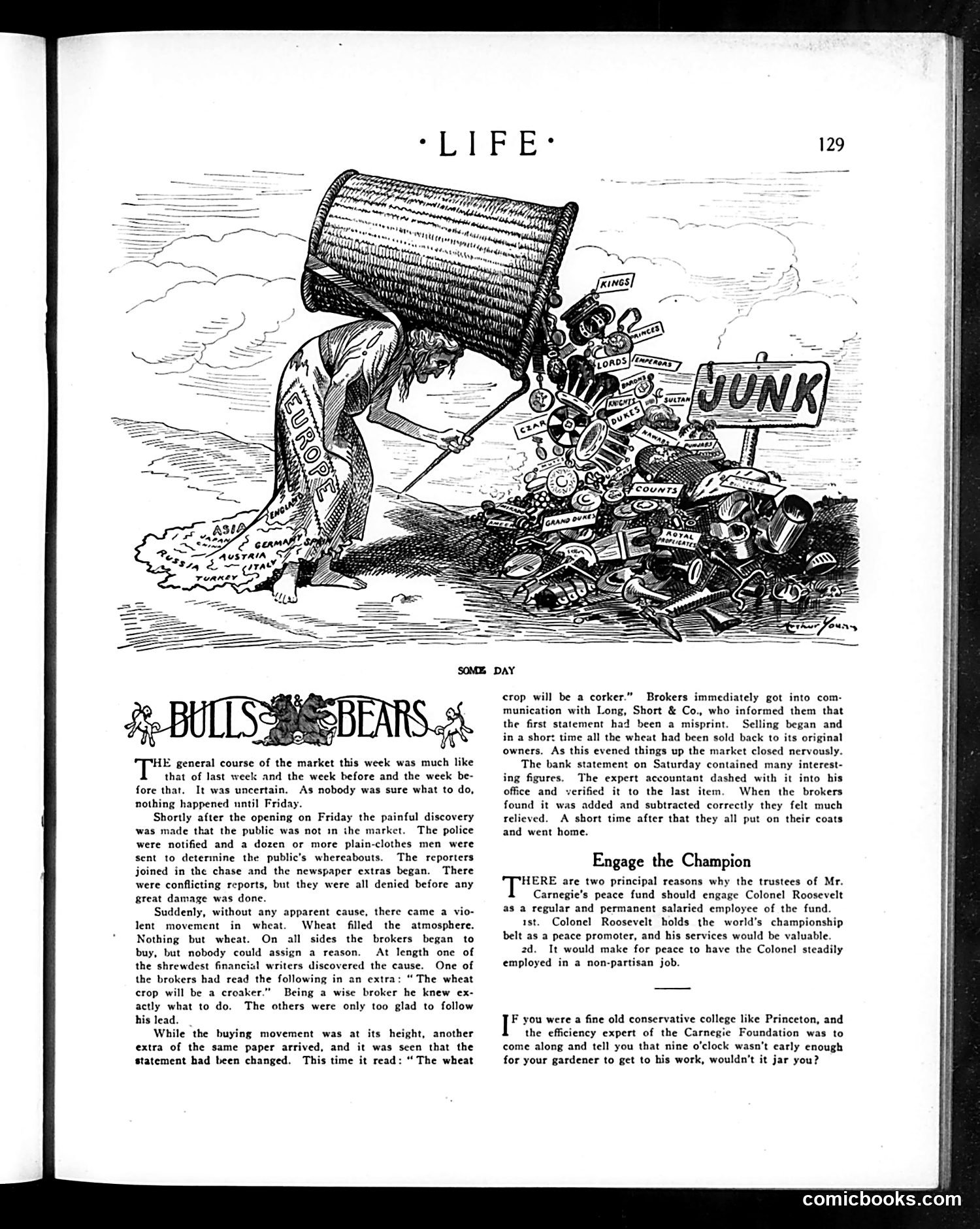
This page contains political satire about early 20th-century financial markets and public figures. **The Cartoon**: The illustration depicts a figure (representing the public or market) dumping garbage labeled "JUNK" while carrying a large basket on their head. This satirizes the chaotic, irrational wheat market described in the text below—where brokers buy and sell frantically based on contradictory newspaper reports ("croaker" vs. "corker"), treating the market like garbage rather than legitimate commerce. **"Bulls & Bears" Section**: The article mocks stock market volatility and herd mentality. A single misprint causes frenzy; when corrected, the opposite occurs. The satire highlights how brokers lack independent judgment, blindly following whoever acts first. **"Engage the Champion"**: This section satirizes Theodore Roosevelt as a "peace promoter," suggesting he should be employed by Carnegie's peace fund—implying Roosevelt is so combative that keeping him busy would paradoxically promote peace. The final paragraph mocks efficiency experts imposing rigid standards on traditional institutions like Princeton, criticizing intrusive "scientific management" trends of the era. The page exemplifies Life's role as social and political commentary.
📄 Transcribed text from this page (OCR, searchable)
Machine-transcribed from the original scan — historical spelling and the odd misread are preserved.
SOME DAY ‘HE general course of the market this week was much like that of last week and the week before and the week be- fore that. It was uncertain. As nobody was sure what to do, nothing happened until Friday. Shortly after the opening on Friday the painful discovery was made that the public was not im ihe market. The police were notified and a dozen or more plain-clothes men were sent to determine the public’s whereabouts. The reporters joined in the chase and the newspaper extras began. There were conflicting reports, but they were all denied before any great damage was done. Suddenly, without any apparent cause, there came a vio- lent movement in wheat. Wheat filled the atmosphere. Nothing but wheat. On all sides the brokers began to buy, but nobody could assign a reason. At length one of the shrewdest financial writers discovered the cause. One of the brokers had read the following in an extra: “ The wheat crop will be a croaker.” Being a wise broker he knew ex- actly what to do. The others were only too glad to follow his lead. While the buying movement was at its height, another extra of the same paper arrived, and it was seen that the statement had been changed. This time it read: “‘ The wheat crop will be a corker.” Brokers immediately got into com- munication with Long, Short & Co., who informed them that the first statement had been a misprint. Selling began and in a short time all the wheat had been sold back to its original owners. As this evened things up the market closed nervously. The bank statement on Saturday contained many interest- ing figures, The expert accountant dashed with it into his office and verified it to the last item. When the brokers found it was added and subtracted correctly they felt much relieved. A short time after that they all put on their coats and went home. Engage the Champion HERE are two principal reasons why the trustees of Mr. Carnegie’s peace fund should engage Colonel Roosevelt as a regular and permanent salaried employee of the fund. 1st. Colonel Roosevelt holds the world’s championship belt as a peace promoter, and his services would be valuable. 2d. It would make for peace to have the Colonel steadily employed in a non-partisan job. F you were a fine old conservative college like Princeton, and the efficiency expert of the Carnegie Foundation was to come along and tell you that nine o'clock wasn't early enough for your gardener to get to his work, wouldn't it jar you? comicbooks.com