
Life, 1911-01-12 · page 21 of 44
Life — January 12, 1911 — page 21: what you’re looking at
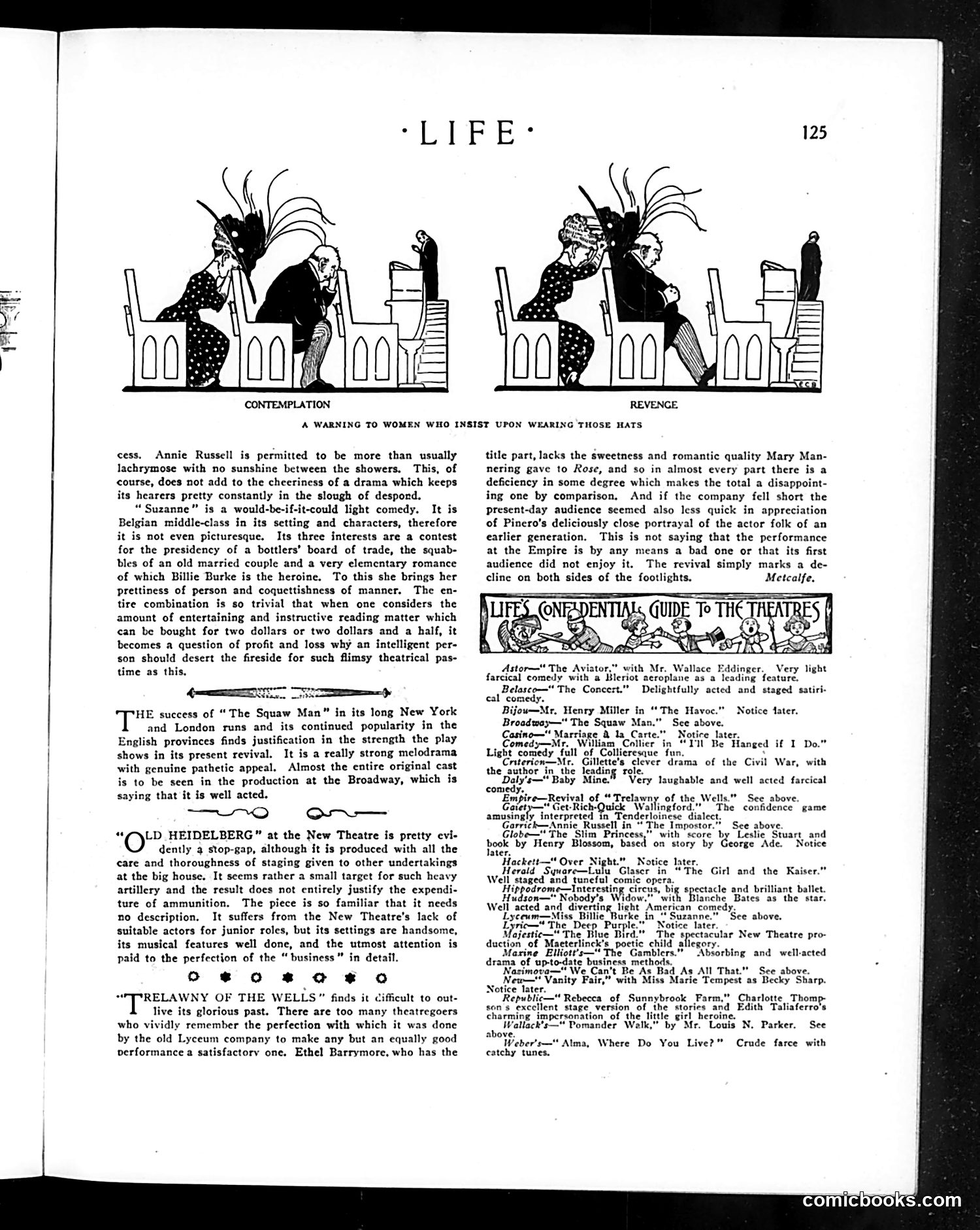
What you’re looking at
This page contains two related satirical cartoons titled "Contemplation" and "Revenge," accompanied by the subtitle "A Warning to Women Who Insist Upon Wearing Those Hats." The cartoons depict identical scenes of two women seated in a theater. In the first panel, they sit calmly; in the second, one woman's enormous feathered hat has grown so large it blocks the other woman's view entirely. The joke satirizes the early 20th-century fashion trend of oversized, elaborately plumed women's hats—particularly their notorious obstruction of theater-goers' sightlines. The "revenge" occurs when the offended woman appears to retaliate by wearing an even larger hat. The satire targets both the impracticality of fashionable millinery and women's competitive vanity regarding dress, presenting the situation as a humorous "arms race" of headwear. This reflects genuine contemporary complaints about theatrical etiquette and women's fashion excess documented in period literature.
📄 Transcribed text from this page (OCR, searchable)
Machine-transcribed from the original scan — historical spelling and the odd misread are preserved.
CONTEMPLATION REVENGE A WARNING TO WOMEN WHO INSIST UPON WEARING THOSE HATS cess. Annie Russell is permitted to be more than usually lachrymose with no sunshine between the showers, This, of course, does not add to the cheeriness of a drama which keeps its hearers pretty constantly in the slough of despord. “Suzanne” is a would-be-if-it-could light comedy. It is Belgian middle-class in its setting and characters, therefore it is not even picturesque. Its three interests are a contest for the presidency of a bottlers’ board of trade, the squab- bles of an old married couple and a very elementary romance of which Billie Burke is the heroine. To this she brings her prettiness of person and coquettishness of manner. The en- tire combination is so trivial that when one considers the amount of entertaining and instructive reading matter which can be bought for two dollars or two dollars and a half, it becomes a question of profit and loss why an intelligent per- son should desert the fireside for such flimsy theatrical pas- time as this, HE success of “The Squaw Man” in its long New York and London runs and its continued popularity in the English provinces finds justification in the strength the play shows in its present revival. It is a really strong melodrama with genuine pathetic appeal. Almost the entire original cast is to be seen in the production at the Broadway, which is saying that it is well acted. ewer OCS > LD HEIDELBERG” at the New Theatre is pretty cvi- dently 3 stop-gap, although it is produced with all the care and thoroughness of staging given to other undertakings at the big house. It scems rather a small target for such heavy artillery and the result does not entirely justify the expendi- ture of ammunition. The piece is so familiar that it needs no description. It suffers from the New Theatre’s lack of suitable actors for junior roles, but its settings are handsome, its musical features well done, and the utmost attention is paid to the perfection of the “ business” in detail. o #0 #8 @ € 0 RELAWNY OF THE WELLS” finds it cifficult to out- live its glorious past. There are too many theatregoers who vividly remember the perfection with which it was done by the old Lyceum company to make any but an equally good performance a satisfactory one. Ethel Barrymore, who has the title part, lacks the sweetness and romantic quality Mary Man- nering gave to Rose, and so in almost every part there is a deficiency in some degree which makes the total a disappoint- ing one by comparison, And if the company fell short the present-day audience seemed also less quick in appreciation of Pinero’s deliciously close portrayal of the actor folk of an earlier generation. This is not saying that the performance at the Empire is by any means a bad one or that its first audience did not enjoy it. The revival simply marks a de- cline on both sides of the footlights. Metcalfe. Astor—" The Aviator,” with Mr, Wallace Eddinger, Very light farcical comedy with a Bleriot aeroplane as a leading feature. Belasco—" The Concert.” Delightfully acted and staged satiri- cal comedy. Bijow—Mr, Henry Miller in “The Havoc." Notice tater. Broadwoy—" The Squaw Man.” See shove. Cosino—" Marriage & la Carte. Comedie Wiliam ‘Collice in Ti" Het ‘fianged if TD. Light comedy full of Collieresque fun. Criterion—Mr. Gillette's sever drama of the Civil War, with the author in the leading ro! Daly's—" Baby Mine, comedy. Empire—Revival of ORS a A of the Wells.” See above. Gate See Rich-Quick Wallingford.” The confidence game amusingly interpreted in Tenderloinese dialect, Garrich—Annie Russell in “ The Impostor.” See above. Globe—" The Slim Princess,” with score by Leslie Stuart and book by Henry Blossom, based on story by George Ade. Notice later. Hockett—" Over Night." Notice Inter. Herald Square—Lulu Glaser in “The Girl and the Kaiser.” Well staged and tuneful comic opera. Hippodrome Interesting circus, big spectacle and brilliant ballet. Hudson—" Nobody’s Widow,” erith anche Bates as the star. Well acted and divertion light ‘American comedy. Lyceum—Miss Billie Burke, in ‘* Suzanne.” ‘See above. Lyric—" The Deep Purple.” Notice later. Mojentic "The Blue Bird.” The spectacular New Theatre pro duction of Maeterlinck’s poetic child allegor; Marine Elliott’s— The Gamble: ‘Absorbing and well-acted drama of up-to-date business method: ‘Nasimova—" We Can't Be As Bad As All That." See above. New—"' Vanity Fair,” with Miss Marie Tempest as Becky Sharp. Notice late: epu “Rebecca of Sunnybrook Farm,” Charlotte Thom sons excellent stage version of the stories and Edith Taliaferro's charming impersonation of the little girl heroine. e Wallack’s—“ Pomander Welk," by Mr. Louis N, Parker. See above. Weber’s— Alma, Where Do You Live?" catchy tunes. Very laughable and well acted farcical Crude farce with