
Life, 1911-01-12 · page 11 of 44
Life — January 12, 1911 — page 11: what you’re looking at
What you’re looking at
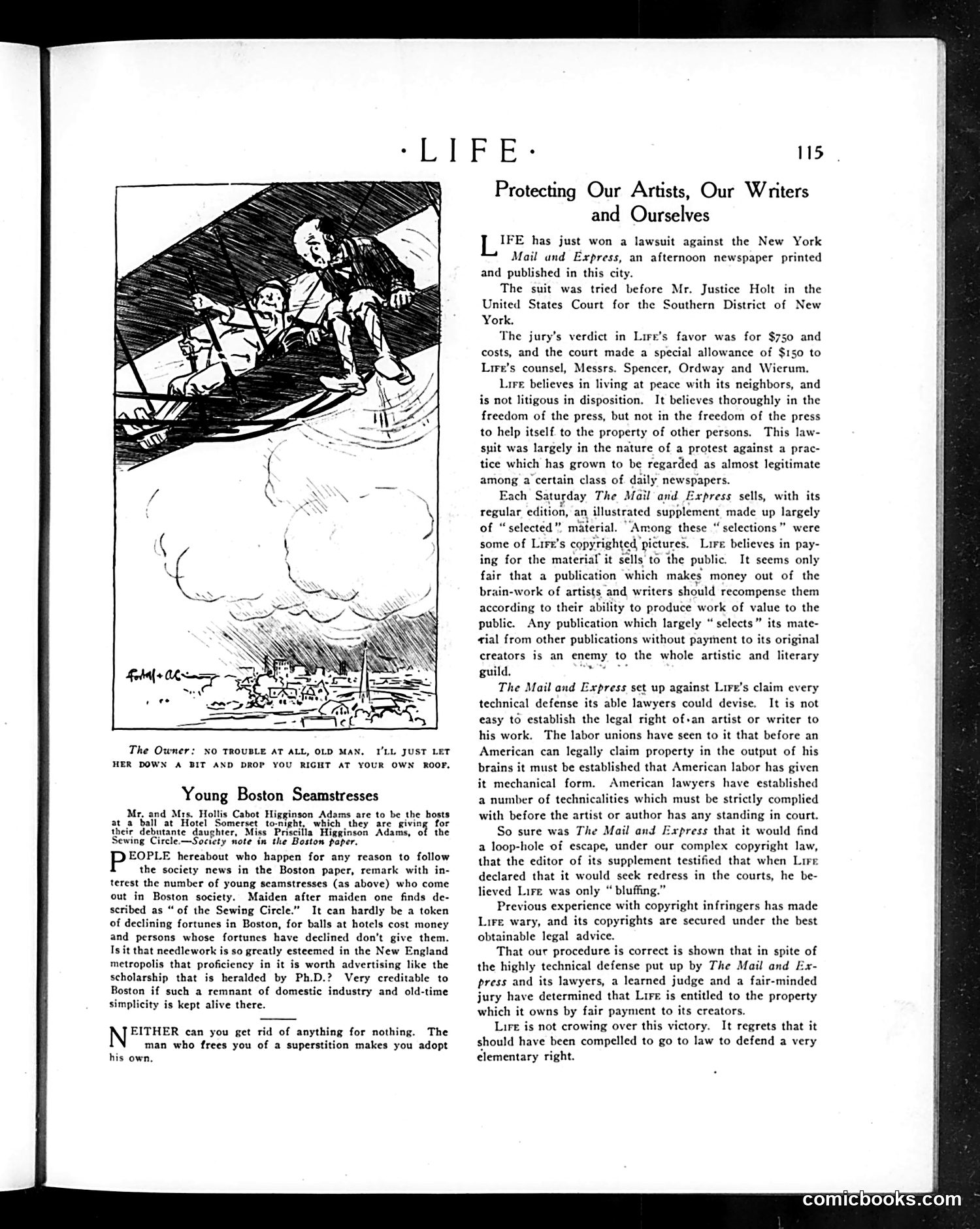
The cartoon depicts a wealthy man in a top hat sheltering poor people under an umbrella during a storm, with the caption: "No trouble at all, old man. I'll just let her down a bit and drop you right at your own roof." This is **class satire**. The "owner" (likely a landlord or wealthy businessman) condescendingly offers minimal assistance to working-poor tenants, suggesting he'll merely "drop" them at their modest homes rather than provide genuine aid. The imagery contrasts his comfort and authority (the umbrella, formal dress) with their vulnerability and dependence. The joke satirizes how the wealthy use performative charity—appearing generous while maintaining social hierarchy and control. The patronizing tone ("old man") emphasizes the power imbalance inherent in landlord-tenant relationships of the era.
📄 Transcribed text from this page (OCR, searchable)
Machine-transcribed from the original scan — historical spelling and the odd misread are preserved.
-LIFE- 115 The Owner; Xo TROUBLE AT ALL, OLD MAN, VLU JUST LET HER DOWN A BIT AND DROP YOU RIGHT AT YOUR OWN ROOF. Young Boston Seamstresses Mr, and Mrs. Hollis Cabot Higginson Adams are to be the hosts at a ball at Hotel Somerset to-night, which they are giving for their debutante daughter, Miss Priscilla Higginson Adams, of the Sewing Circle.—Soctety note in the Boston paper. EOPLE hereabout who happen for any reason to follow the society news in the Boston paper, remark with in- terest the number of young seamstresses (as above) who come out in Boston society. Maiden after maiden one finds de- scribed as “of the Sewing Circle.” It can hardly be a token of declining fortunes in Boston, for balls at hotels cost money and persons whose fortunes have declined don’t give them. Is it that needlework is so greatly esteemed in the New England metropolis that proficiency in it is worth advertising like the scholarship that is heralded by Ph.D.? Very creditable to Boston if such a remnant of domestic industry and old-time simplicity is kept alive there. EITHER can you get rid of anything for nothing. The man who frees you of a superstition makes you adopt his own, Protecting Our Artists, Our Writers and Ourselves L'= has just won a lawsuit against the New York Mail and Express, an afternoon newspaper printed and published in this city. The suit was tried before Mr. Justice Holt in the United States Court for the Southern District of New York, The jury’s verdict in Lire’s favor was for $750 and costs, and the court made a special allowance of $150 to Lire’s counsel, Messrs. Spencer, Ordway and Wierum. Lire believes in living at peace with its neighbors, and is not litigous in disposition. It believes thoroughly in the freedom of the press, but not in the freedom of the press to help itself. to the property of other persons. This law- spit was largely in the nature of a protest against a prac- tice which has grown to be regarded as almost legitimate among a‘certain class of daily newspapers. Each Saturday The Mail and Express sells, with its regular edition, an illustrated supplement made up largely of “selected” material. “Among these “selections” were some of Lire’s copyrighted ‘pictures. Lire believes in pay- ing for the material it sells to the public. It seems only fair that a publication which makes money out of the brain-work of artists and writers should recompense them according to their ability to produce work of value to the public. Any publication which largely “ selects” its mate- tial from other publications without payment to its original creators is an enemy to the whole artistic and literary guild. oN The Mail and Express set up against Lire’s claim every technical defense its able lawyers could devise. It is not easy to establish the legal right of-an artist or writer to his work. The labor unions have seen to it that before an American can legally claim property in the output of his brains it must be established that American labor has given it mechanical form. American lawyers have established a number of technicalities which must be strictly complied with before the artist or author has any standing in court. So sure was The Mail and Express that it would find a loop-hole of escape, under our complex copyright law, that the editor of its supplement testified that when Lire declared that it would seek redress in the courts, he be- lieved Lire was only “ bluffing.” Previous experience with copyright infringers has made Lire wary, and its copyrights are secured under the best obtainable legal advice. That our procedure is correct is shown that in spite of the highly technical defense put up by The Mail and Ex- press and its lawyers, a learned judge and a fair-minded jury have determined that Lire is entitled to the property which it owns by fair payment to its creators. Lire is not crowing over this victory. It regrets that it should have been compelled to go to law to defend a very elementary right. comicbooks.com