
A complete issue · 44 pages · 1910
Life — November 17, 1910
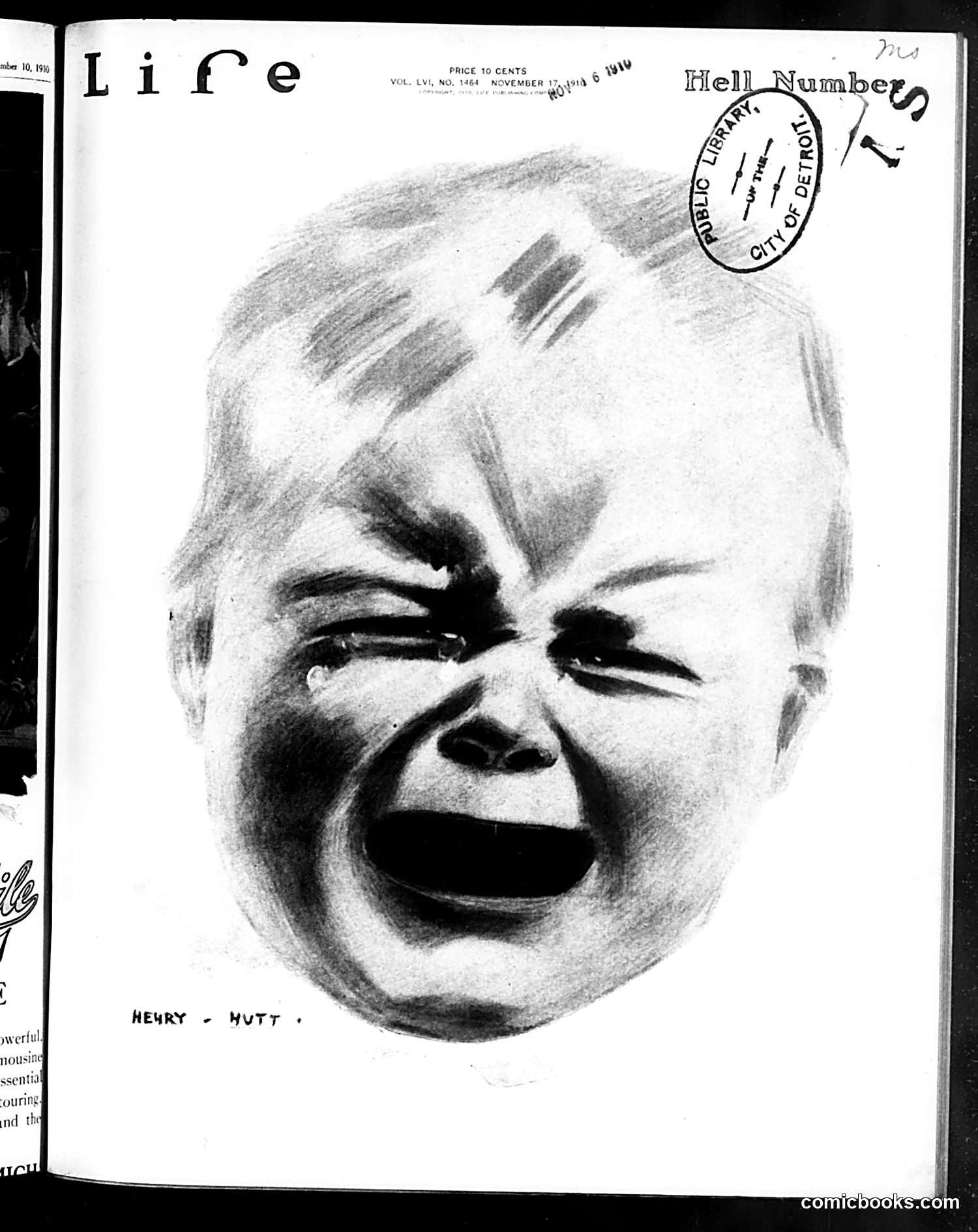
This is a caricature labeled "Henry Hutt," appearing to be a satirical portrait from Life magazine's "Hell Numbers" series (indicated by the circular library stamp). The exaggerated facial features—particularly the wide-open mouth and distorted expression—suggest this is mockery of a public figure or personality of that era. Without additional context from the magazine's contents, I cannot definitively identify who this Henry Hutt caricature represents or what specific event or behavior prompted the satire. The "Hell Number" designation suggests it was part of a series targeting controversial figures, but the exact political or social criticism remains unclear from the image alone.
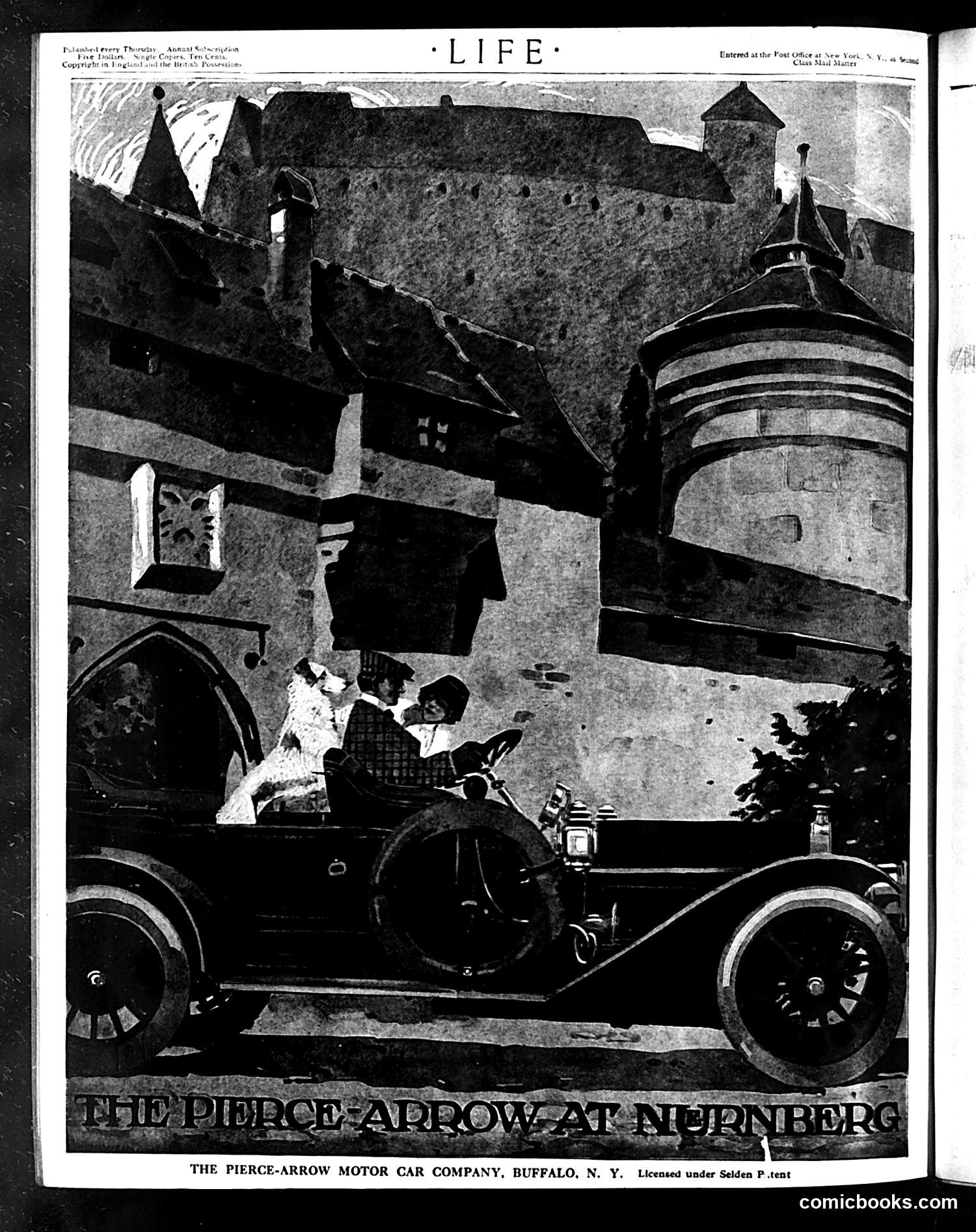
This appears to be a **product advertisement** rather than political satire. The image shows a Pierce-Arrow motor car positioned dramatically in front of a medieval castle (identified as Nuremberg in the caption). Two well-dressed figures sit in the automobile, which is rendered in the romantic, adventurous style typical of 1920s car advertising. The juxtaposition—a modern luxury automobile against ancient European architecture—conveys the message that Pierce-Arrow vehicles represent progress and sophistication. The "Life" magazine header and layout suggest this is a paid advertisement for the Pierce-Arrow Motor Car Company of Buffalo, N.Y. Rather than satire, it's aspirational marketing, positioning the car as refined enough for European travel and compatible with historical grandeur.
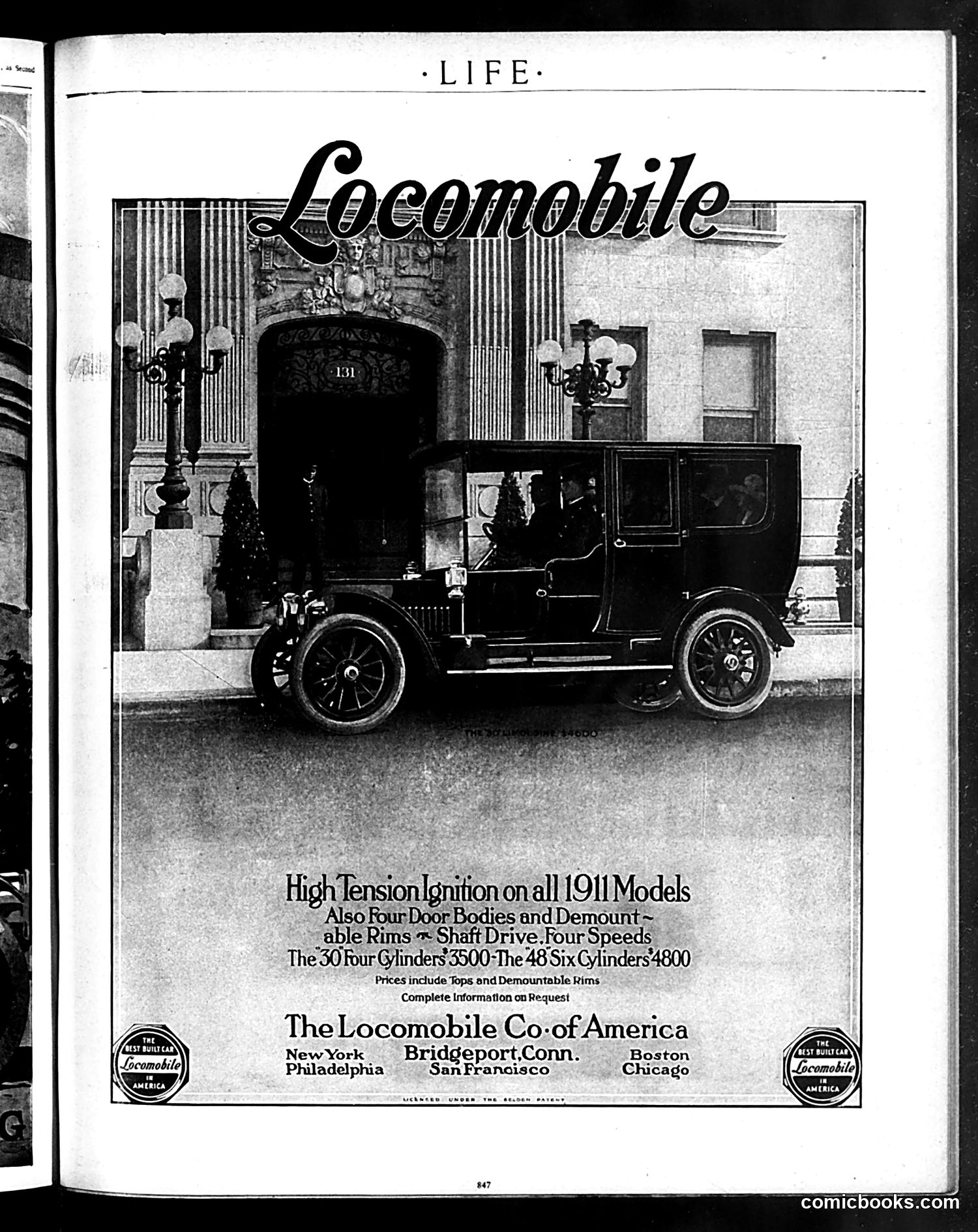
This is **not a political cartoon or satire page** — it's a straightforward automobile advertisement. The page features a Locomobile car parked in front of an elegant building entrance (numbered 131), positioned to showcase the vehicle's design. The ad highlights specific technical features: high-tension ignition, four-door bodies, demountable rims, shaft drive, four speeds, and engine options (30 four-cylinders at 3500 or 48 six-cylinders at 4800). The Locomobile Company of America lists multiple headquarters locations: New York, Philadelphia, Bridgeport (Connecticut), Boston, San Francisco, and Chicago. This appears in *Life* magazine's advertising section around 1911, representing luxury automobile marketing of the early automotive era.
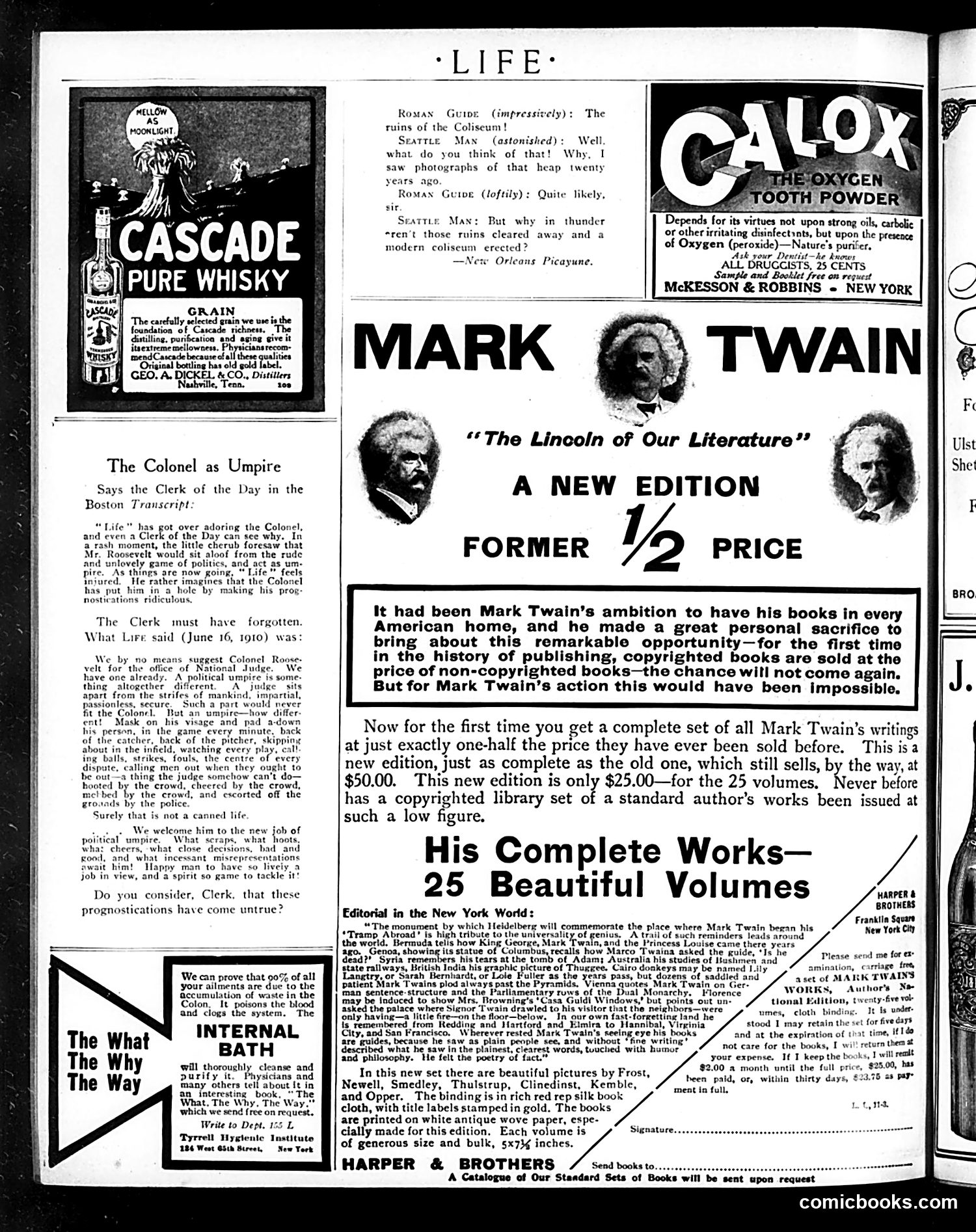
This page is primarily **advertising**, not political satire. The main content promotes a new edition of Mark Twain's complete works—25 volumes at $25, down from $50—emphasizing this was the first time copyrighted books could be sold at such a low price. The small cartoon "The Colonel as Umpire" satirizes political baseball metaphors, depicting an umpire making arbitrary calls while politicians debate, suggesting that in politics, authority figures make self-serving decisions regardless of fairness. The joke relies on baseball as a metaphor for American democracy. Surrounding advertisements include Cascade Pure Whisky and Calox tooth powder, typical of 1910s-1920s marketing.
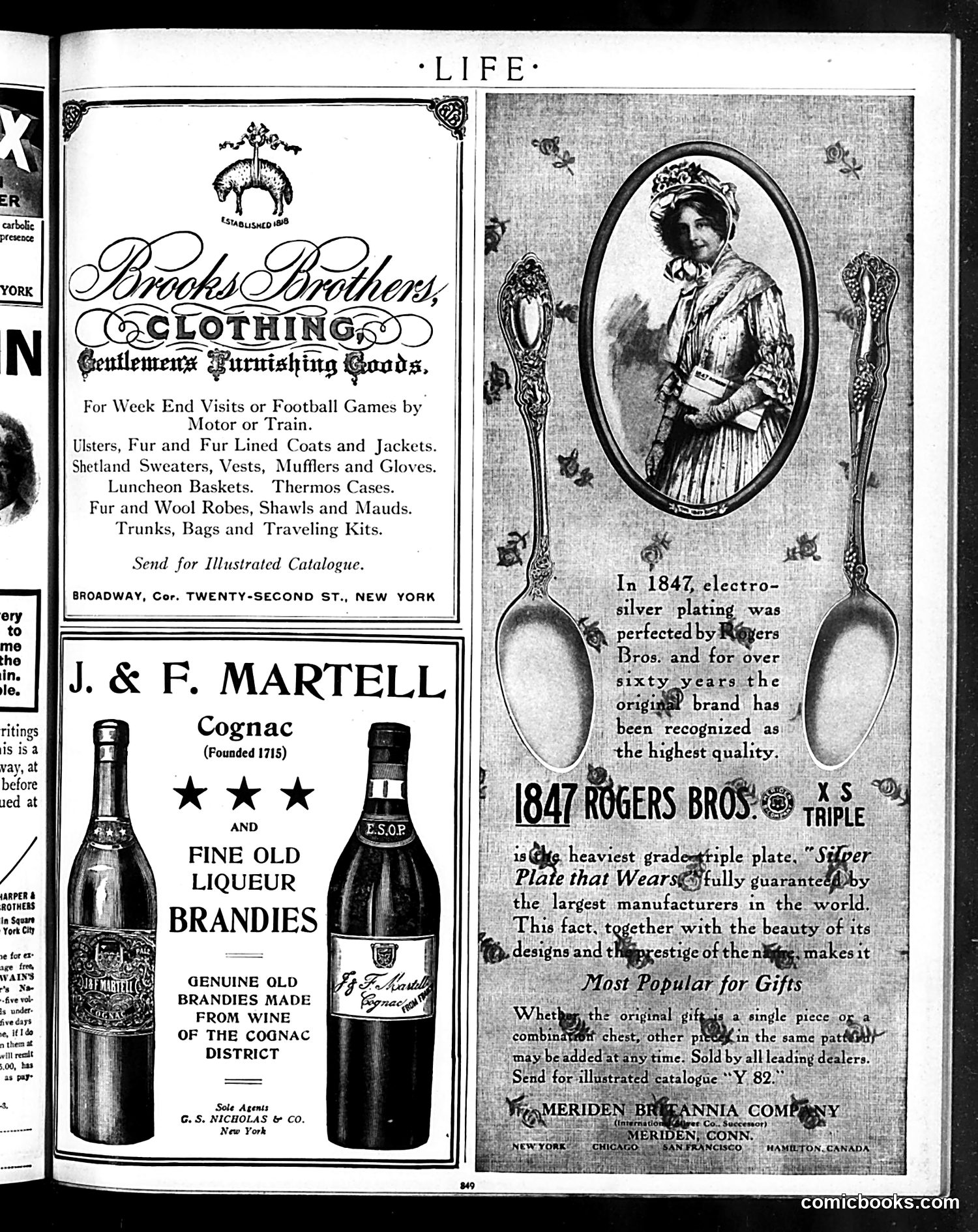
This page contains **primarily advertisements**, not political cartoons or satire. **Left side:** Brooks Brothers clothing advertisement for gentlemen's furnishings and travel items; J. & F. Martell Cognac and brandy advertisement. **Right side:** 1847 Rogers Bros. silverplate advertisement featuring a woman in period dress. The ad emphasizes that electrosilver plating was "perfected by Rogers Bros" and highlights their "triple plate" silverware as "Most Popular for Gifts." **No satirical content is present.** This is a standard commercial page from *Life* magazine, showing luxury goods marketed to affluent readers—formal wear, alcohol, and fine dining items typical of early-to-mid 20th century advertising. The historical interest lies in what products and marketing messages appealed to the magazine's upper-class audience at that time.
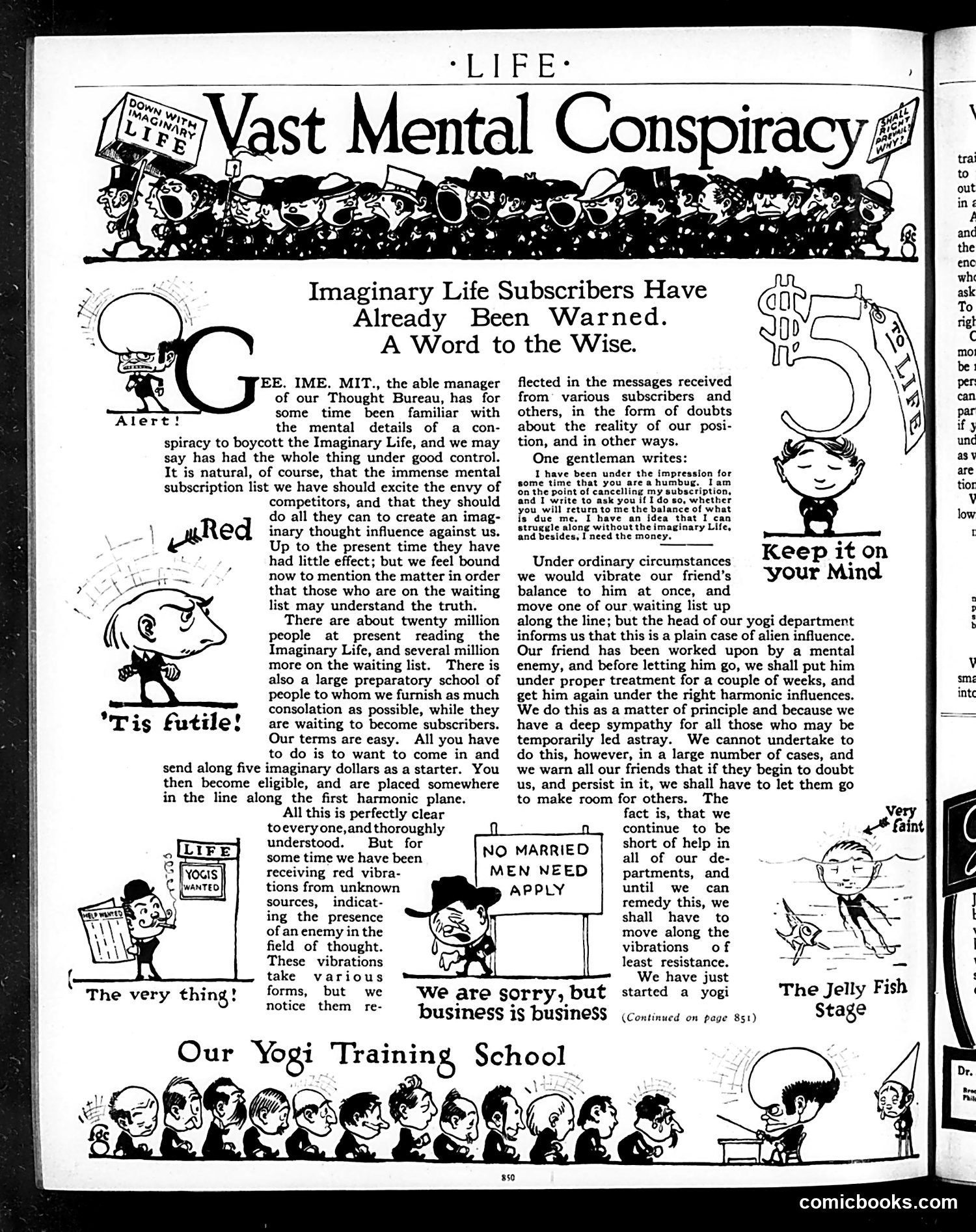
This page satirizes "Imaginary Life," an apparently fraudulent mail-order subscription service claiming to provide mental training or thought control. The masthead shows a crowd of cartoon figures, likely representing gullible subscribers. The satire mocks the scheme's absurdity: subscribers pay five dollars to join a "waiting list" for mental influence benefits. Life's editors ridicule the operation's vague promises and the subscribers' complaints about being mentally manipulated or charged unfairly. The cartoons ("'Tis futile!", "The very thing!", "Keep it on your mind") mock the scheme's contradictory claims. At bottom, "Our Yogi Training School" references popular early-20th-century fads for Eastern mysticism and mail-order self-improvement courses—which Life treats as obvious con artistry preying on hopeful but credulous Americans.
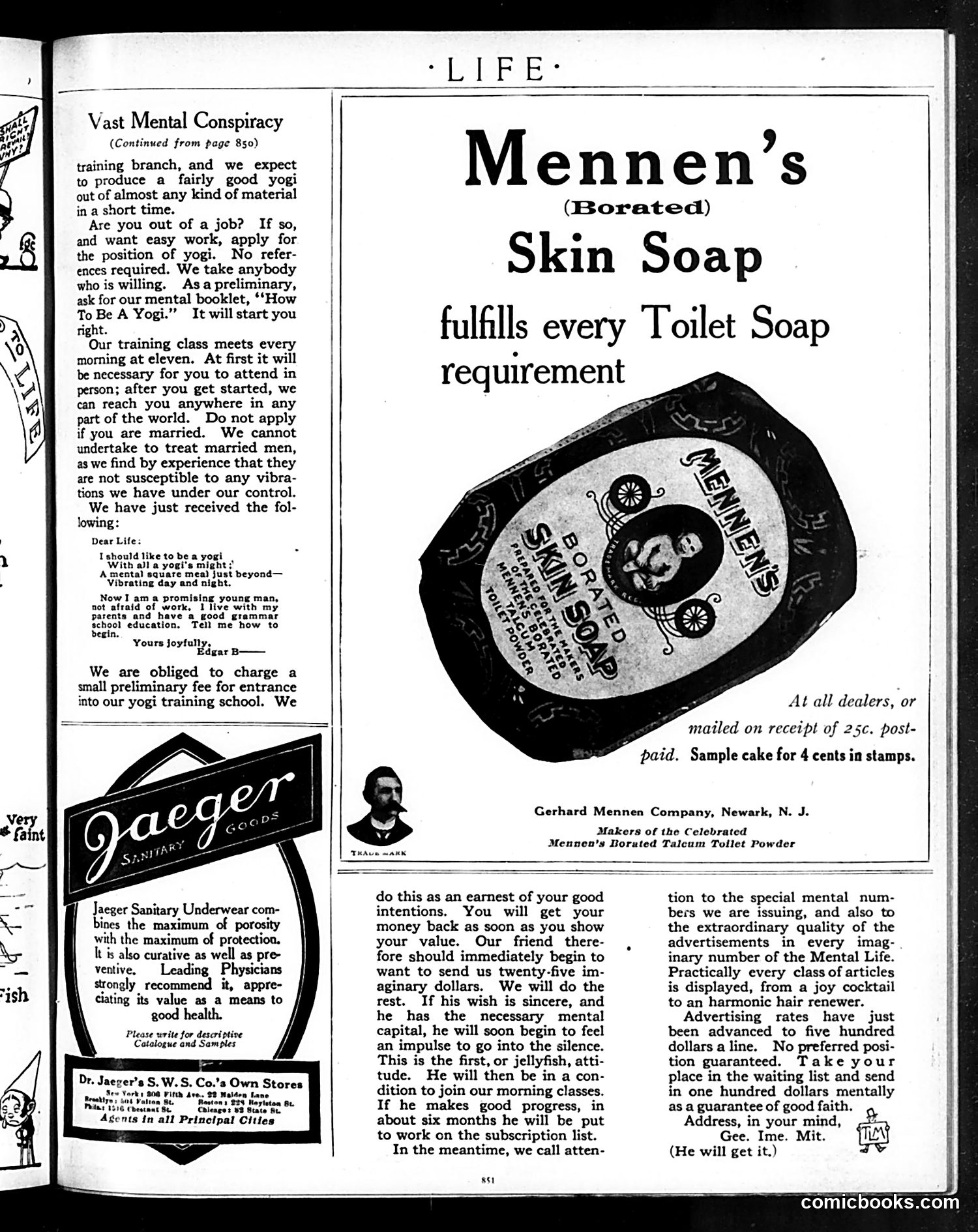
This page mixes editorial content with advertising. The left column continues an article titled "Vast Mental Conspiracy" about a yoga training school that claims to produce "good yogi" from anyone willing, regardless of marital status or references. The tone is satirical—mocking the school's dubious promises and relaxed standards. The right side advertises Mennen's Borated Skin Soap, a legitimate product from the Gerhard Mennen Company in Newark, New Jersey. Below the yoga piece, a Jaeger Sanitary Underwear ad appears. The satire targets the era's proliferation of mail-order self-improvement schemes and dubious "mental training" programs that promised easy transformation with minimal qualification or effort.
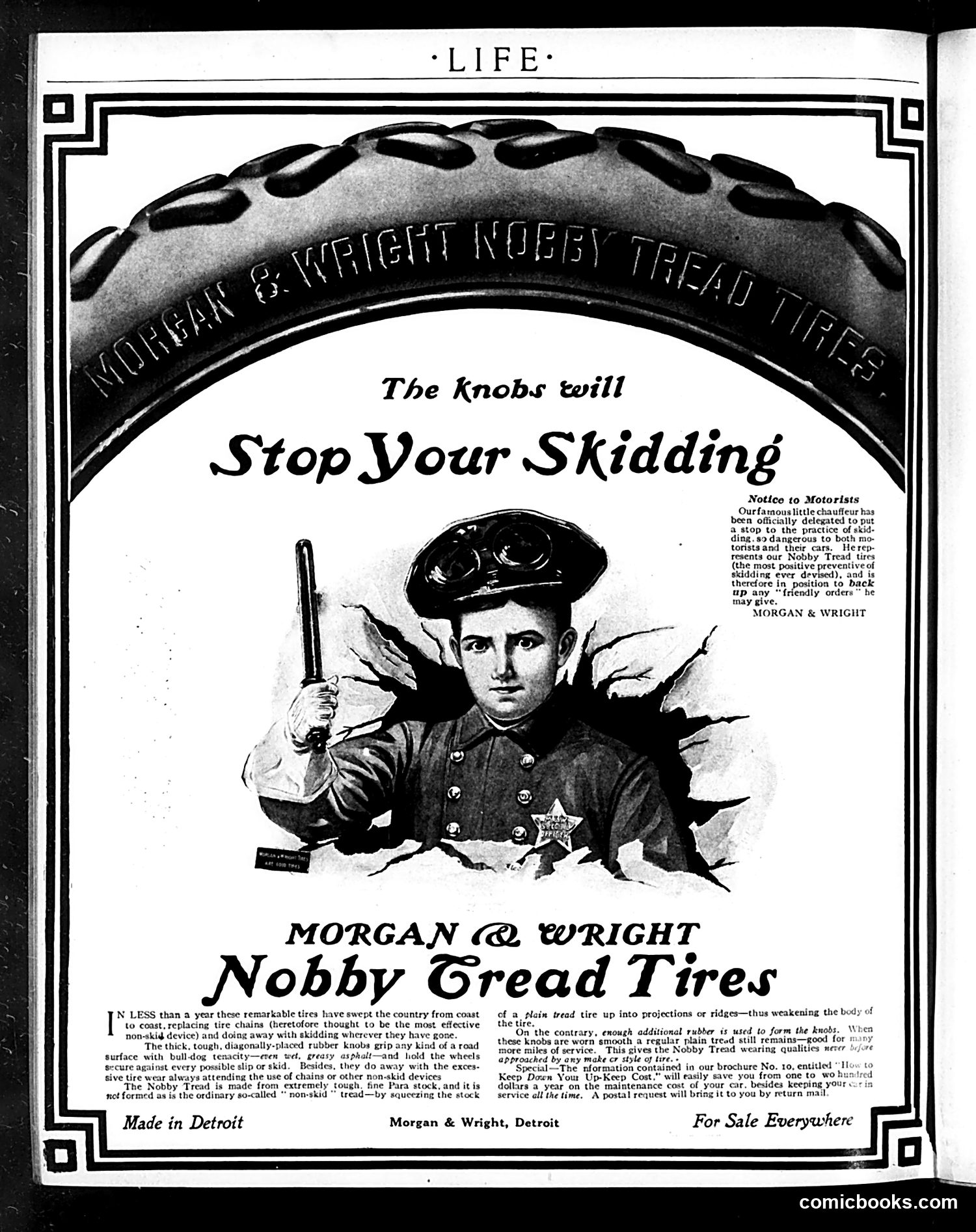
This is a **Morgan & Wright tire advertisement**, not political satire. The page depicts a police officer or traffic enforcer ("a famous little chauffeur") holding a club, positioned to stop motorists from skidding. The ad's central claim is that Morgan & Wright "Nobby Tread Tires" prevent skidding through their tread design—described as "the most positive preventive of skidding ever devised." The text emphasizes the tires' durability and grip, warning that worn smooth tires remain dangerous even if still serviceable. This is early automotive advertising (made in Detroit) targeting drivers concerned about road safety and tire performance. The "notice to motorists" framing uses the officer figure as an authority endorsing the product's safety benefits.
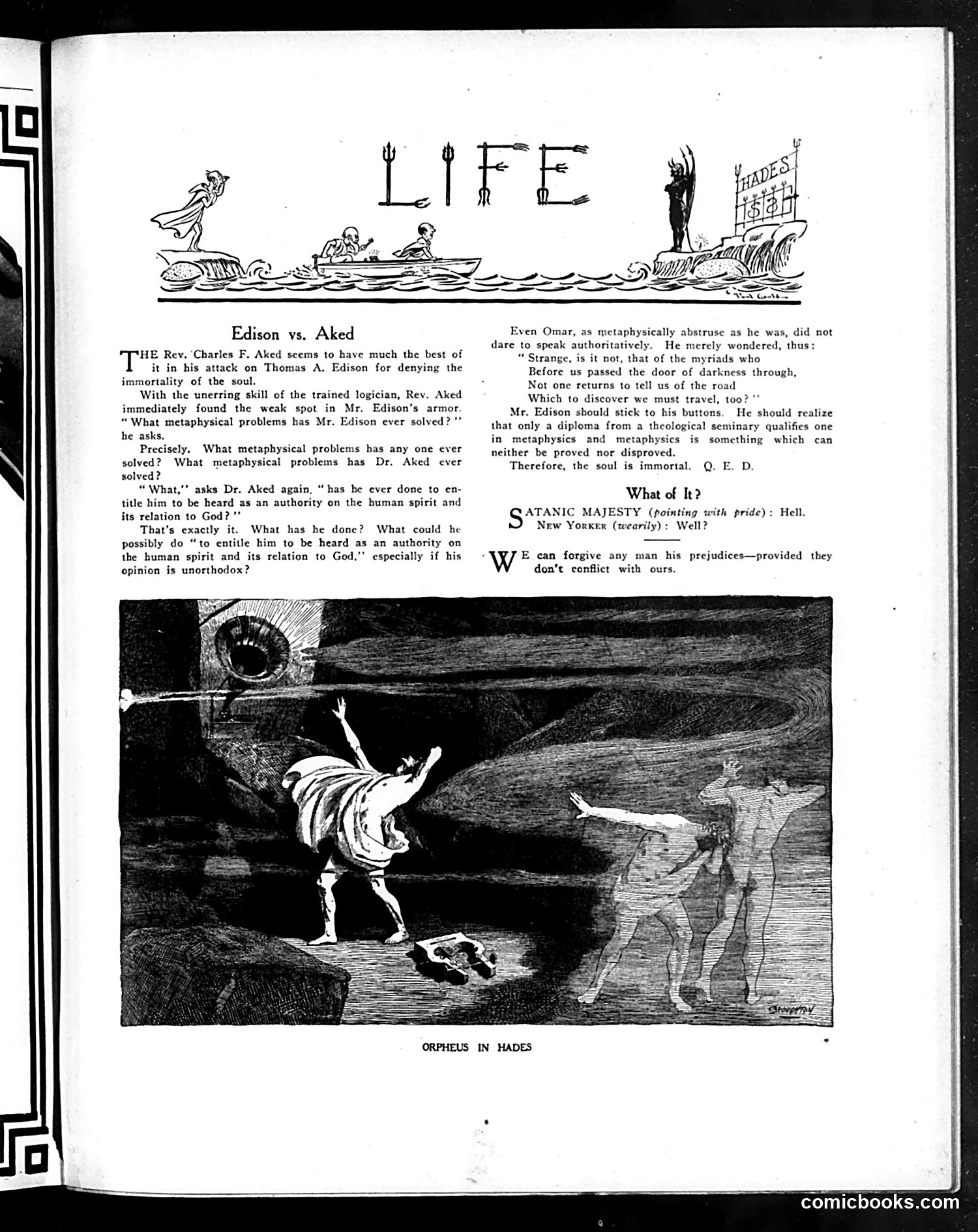
This page satirizes a public dispute between inventor **Thomas Edison** (who denied the immortality of the soul) and **Rev. Charles F. Aked** (a clergyman attacking Edison's position). The article mocks Aked's argument that Edison lacks authority to speak on metaphysical matters, noting that possessing an "unauthorized opinion" doesn't qualify anyone as a spiritual authority—a dig at religious pretension. The illustration titled "Orpheus in Hades" depicts a classical figure descending into the underworld, likely a visual metaphor for Edison's materialism or the broader clash between scientific rationalism and religious belief about human spirituality. The satirical point: both sides claim authority on unknowable matters.
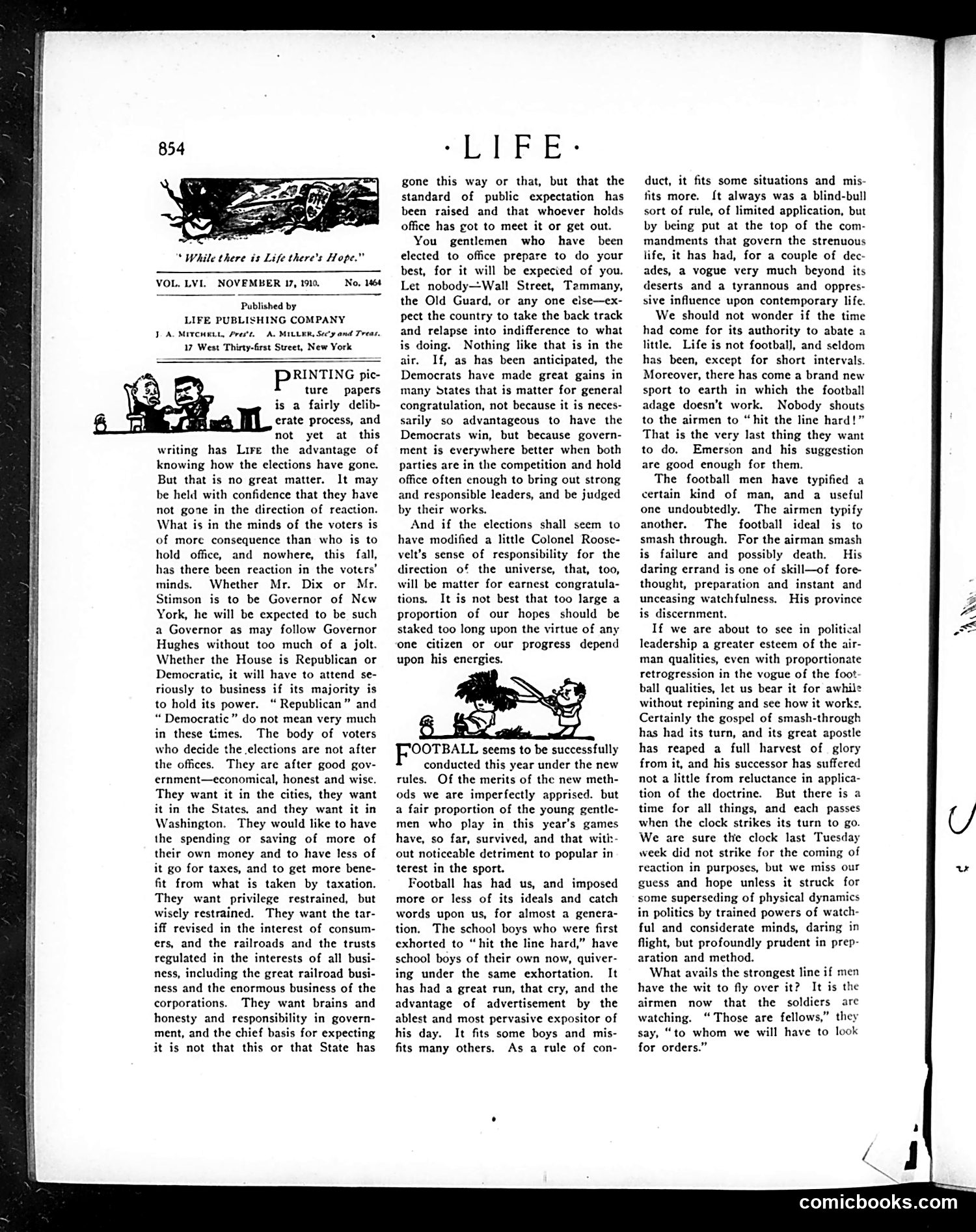
This page discusses the 1912 U.S. elections and football, with two small editorial cartoons. **The Political Cartoon (top):** Shows printing press machinery, illustrating the article's point about Life's editorial advantage: knowing "how the elections have gone" before printing. This references Life's ability to comment on election results with timeliness. **The Football Cartoon (bottom):** Depicts two figures in a rough collision or tackle, supporting the text's discussion of football's "smash through" ideology and its appeal to American youth. The cartoon illustrates the physical, aggressive nature the article criticizes in the sport's cultural influence. Both cartoons are simple, functional illustrations supporting the editorial content rather than standalone jokes. The page reflects early 20th-century concerns about athletics' role in character formation and democratic participation.
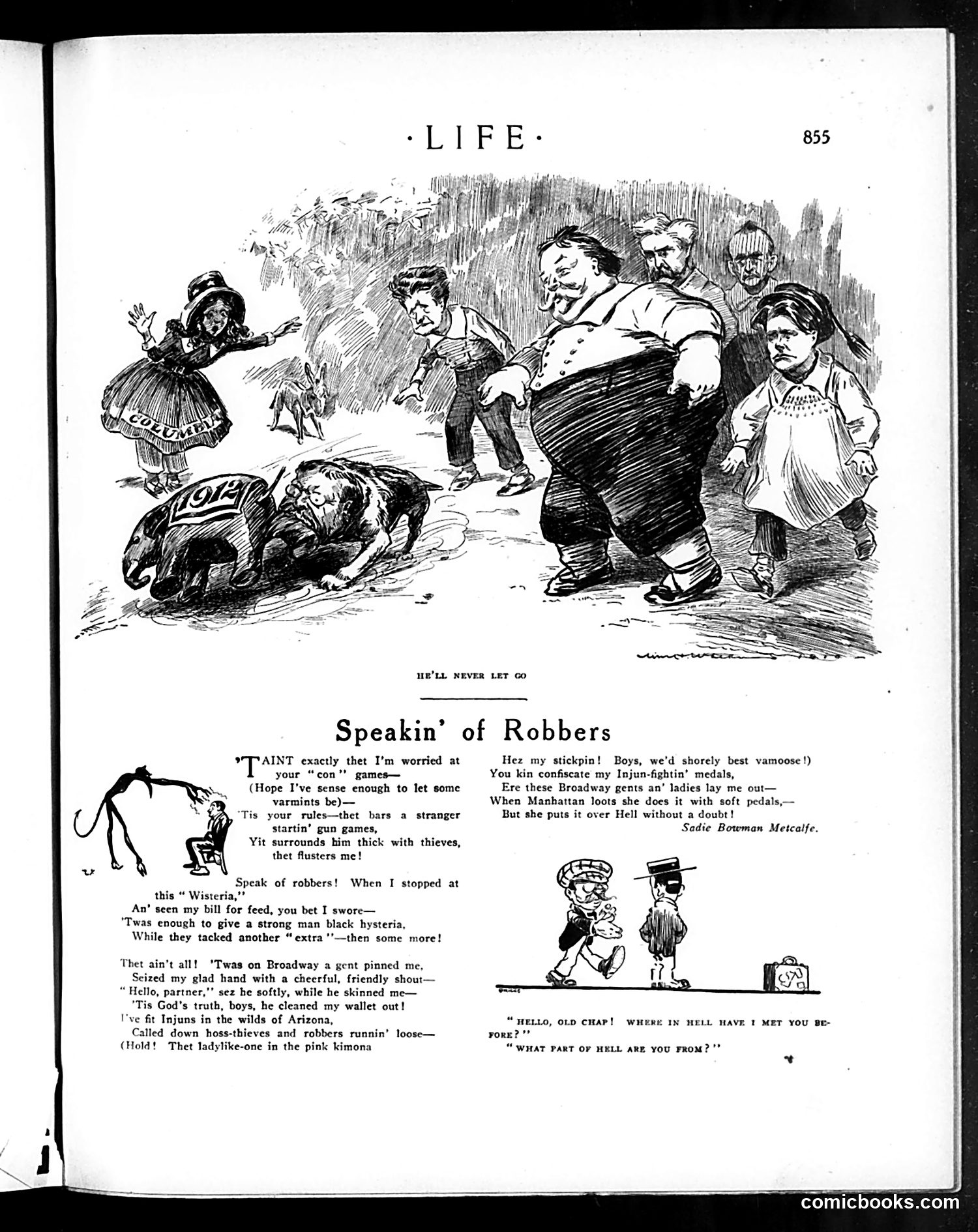
This satirical piece critiques crime in early 20th-century New York, specifically Manhattan. The main cartoon shows a portly man being robbed by street criminals while onlookers watch. The accompanying poem mocks the casual acceptance of theft in the city—the narrator describes being robbed at a saloon called the "Wisteria," having his wallet cleaned out by thieves and his watch stolen. The satire targets urban lawlessness and the prevalence of street robbery in Manhattan, portraying it as so commonplace that respectable citizens expect to be victimized. The side comic strip about two men meeting in "Hell" extends the joke: crime is so rampant that criminals and their victims will inevitably encounter each other in the afterlife.
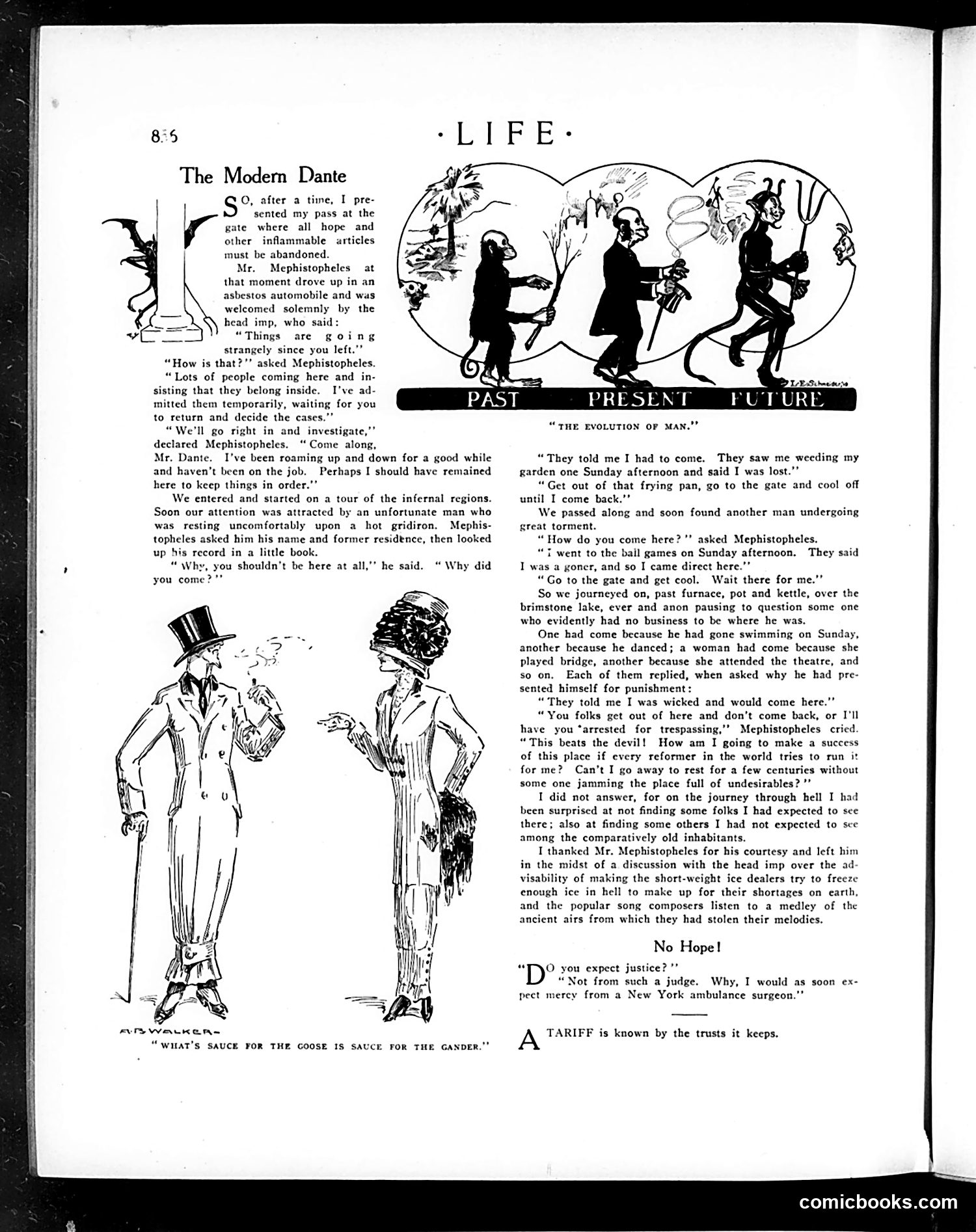
This satirical story follows a character named Mephistopheles (the devil figure from Faust legend) touring Hell, encountering various "undesirables" sent there as punishment. The narrative mocks early 20th-century social reformers and their targets. The three-panel cartoon at top titled "The Evolution of Man" satirizes Darwinian evolution by showing the progression from ape to gentleman to demon—suggesting moral devolution rather than progress. The lower illustration shows two well-dressed figures discussing hellish punishments. The caption "What's Sauce for the Goose is Sauce for the Gander" (a proverb about equal treatment) likely comments on hypocrisy in social judgment. The piece uses religious/mythological references to critique contemporary attitudes toward crime, punishment, and social "undesirables"—common Life magazine satirical targets during the Progressive Era.
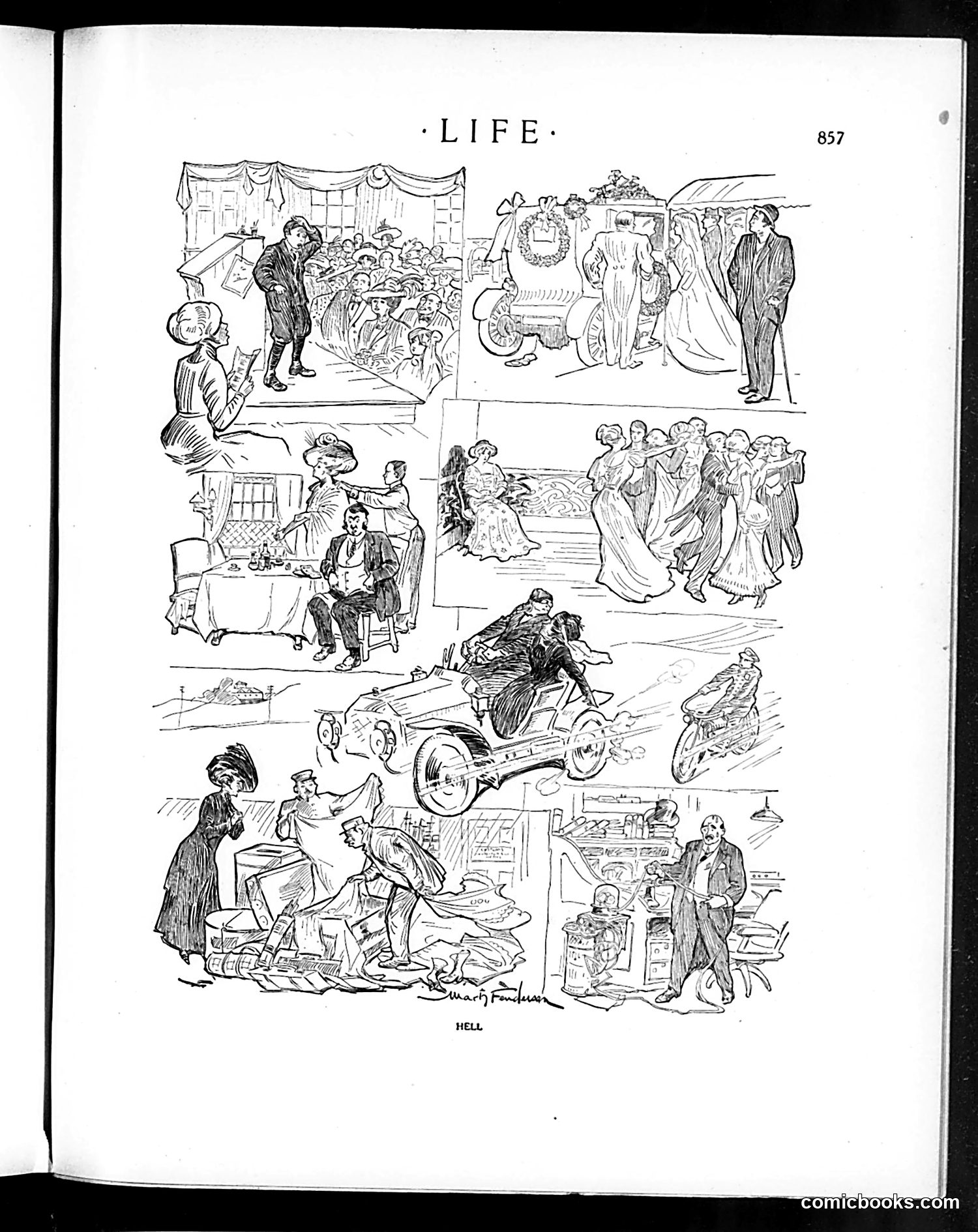
This satirical comic strip by Herb Roth presents a darkly humorous visual narrative titled "Hell" at the bottom. The sequential panels appear to depict various modern frustrations and social anxieties of early-to-mid 20th century life: crowded social gatherings, automobile chaos and reckless driving, domestic disputes, and bureaucratic entanglement. The cartoon uses the metaphor of "Hell" to suggest that everyday modern life—with its congestion, mechanical hazards, social obligations, and administrative complications—constitutes its own form of torment. Rather than depicting a literal underworld, Roth satirizes contemporary society itself as hellish, reflecting common complaints about industrialization, urban living, and modern social pressures that would resonate with Life magazine's educated readership.
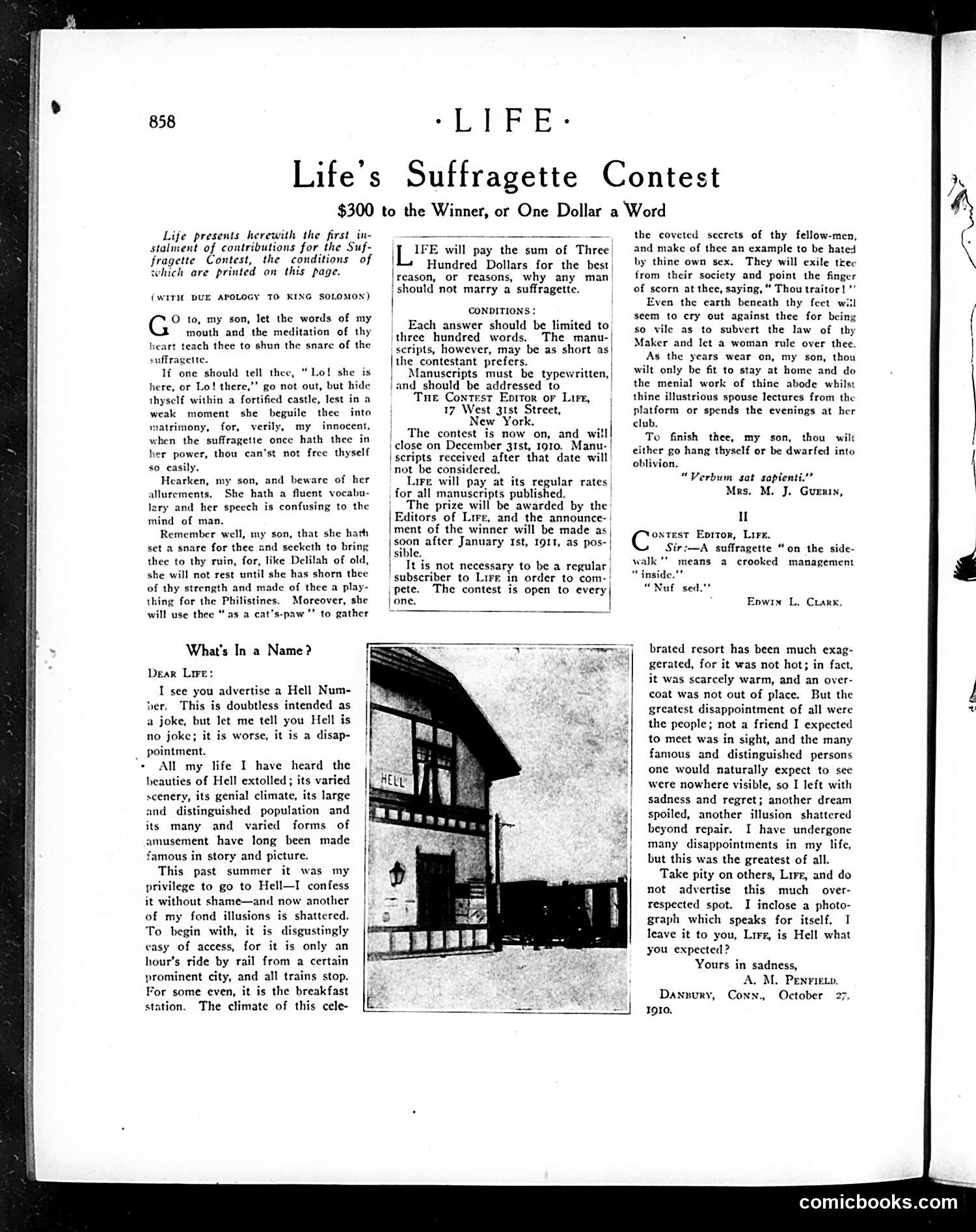
This page announces a satirical writing contest offering $300 for the best reasons why men should not marry suffragettes—those advocating women's voting rights. The main satire mimics biblical language (King Solomon's warnings) to humorously portray suffragettes as dangerous temptresses who will emasculate husbands, drain them socially, and reduce them to domestic servitude while the women lecture at clubs. The secondary letter mocks a promotional "Hell Number," complaint-style: Hell is disappointing because it's easily accessible by rail and lacks the mystique promised in literature. **Context for modern readers:** This reflects early-1900s anti-suffrage sentiment. The magazine uses exaggeration to ridicule both suffragettes and male anxieties about women's independence and power. The contest itself is tongue-in-cheek satire, inviting readers to participate in the joke—though it reveals genuine contemporary opposition to women's rights.
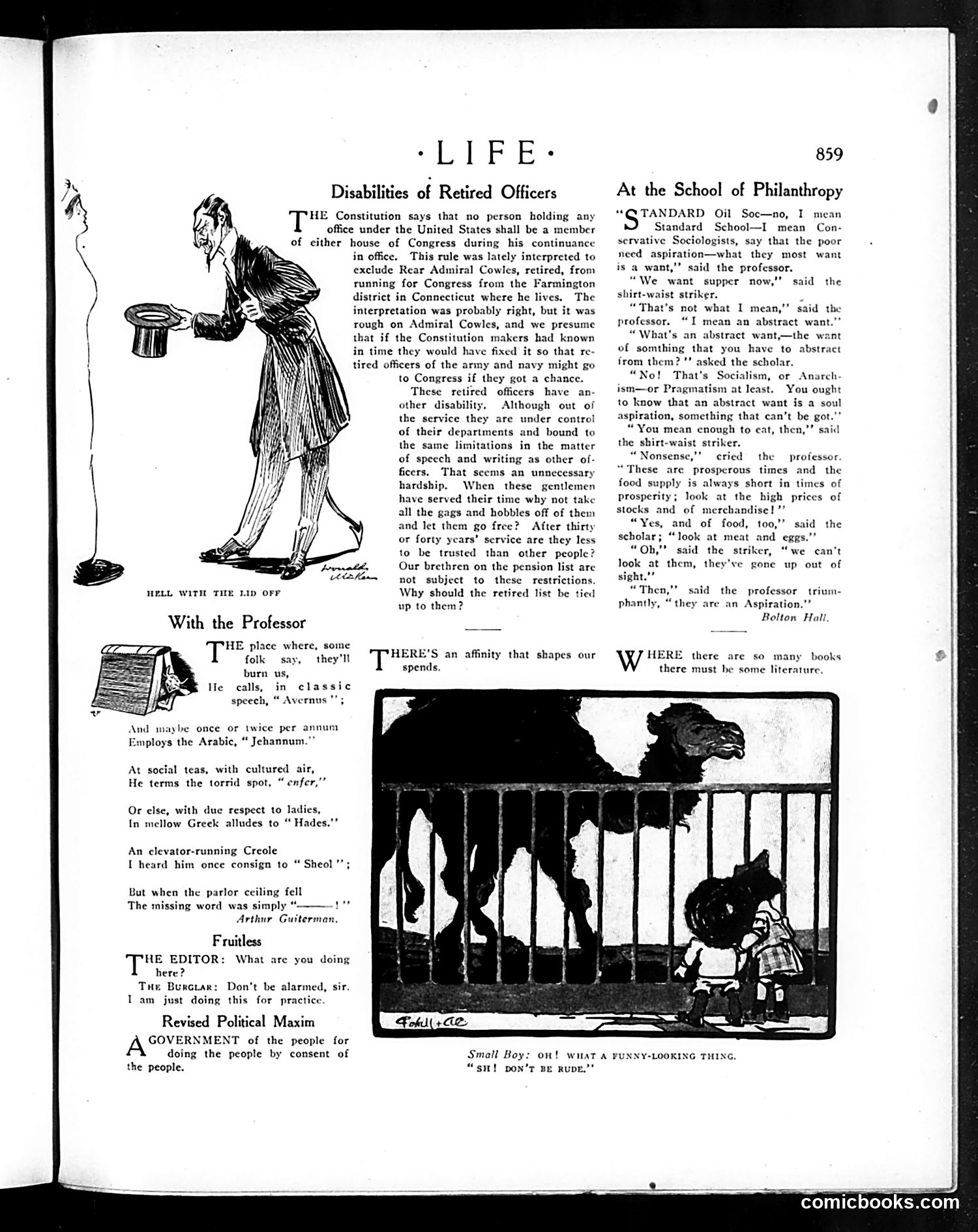
**Top Section - "Disabilities of Retired Officers":** Satirizes a constitutional interpretation that barred retired Admiral Cowles from running for Congress. The piece argues this rule unfairly restricts military veterans while not subjecting pensioned officers to the same limitations. **"With the Professor":** Mocks an affected academic who uses pretentious foreign terminology ("Avernus," "Jehannum," "enfer," "Hades") to describe hell at social gatherings—until a crisis (ceiling collapse) strips away his affectation. **"At the School of Philanthropy":** Depicts a condescending professor lecturing striking workers about "abstract wants" and "soul aspiration" while they simply want food and decent wages. The satire targets elites who philosophize about poverty rather than address immediate material needs. **Bottom cartoon:** A small boy comments rudely on animals in what appears to be a zoo or circus enclosure; his mother corrects his rudeness. **"Revised Political Maxim":** A quick joke on democratic governance by consent. The page's recurring theme: mocking pretension and disconnect between privileged classes and working-class realities.
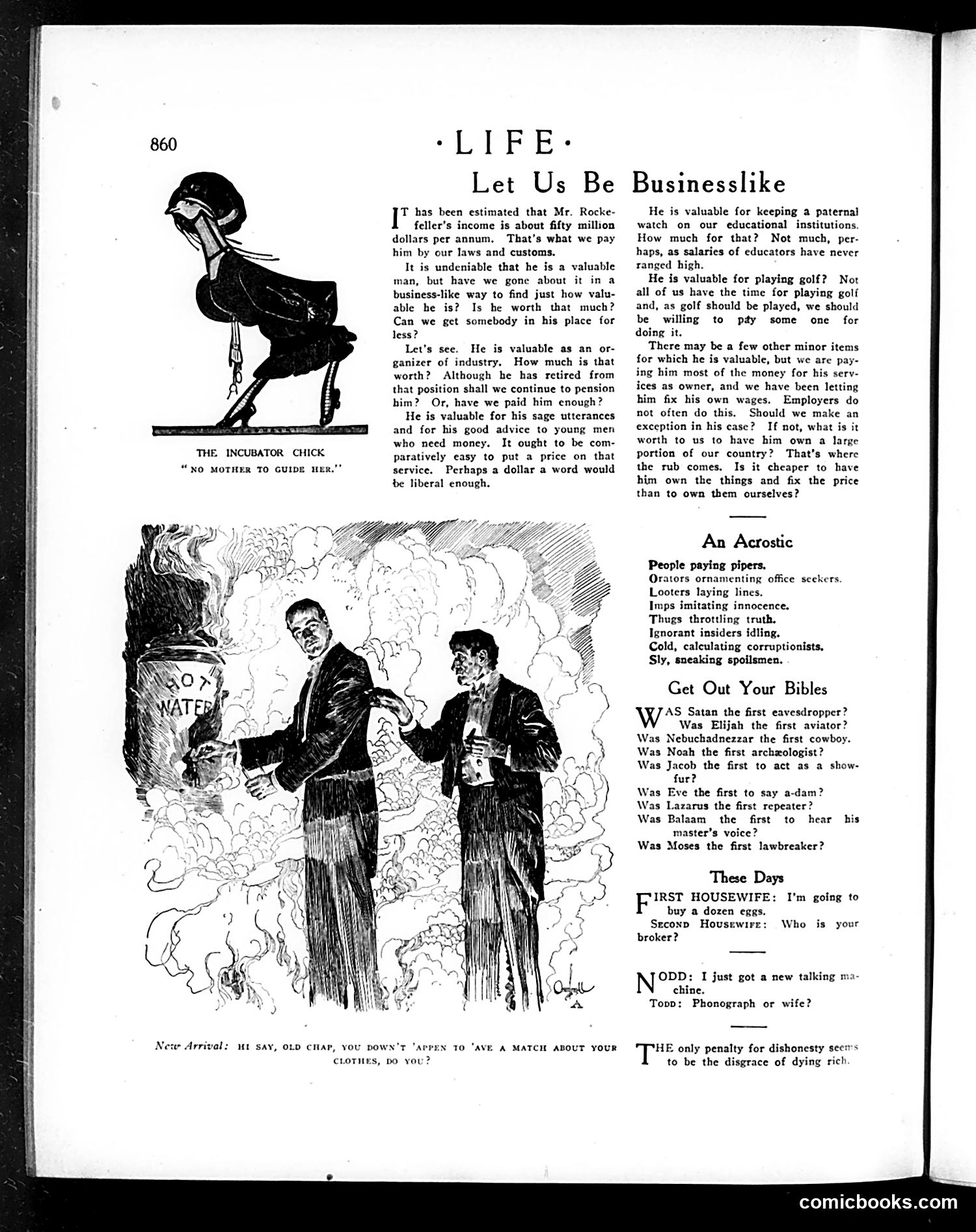
The main article "Let Us Be Businesslike" satirizes John D. Rockefeller's enormous wealth ($50 million annually). The author mockingly proposes evaluating Rockefeller's actual value to society—as an industry organizer, advisor, golf player, and educational patron—then questions whether paying him so much to own vast portions of the country makes economic sense. The satire suggests wealthy industrialists essentially set their own compensation without accountability, a practice unacceptable for ordinary employers. The cartoon "The Incubator Chick" (captioned "No Mother to Guide Her") likely represents society or youth lacking proper guidance, paralleling themes of abandonment and moral direction. Supporting content includes satirical verses and jokes criticizing wealthy corruption, ostentatious wealth-flaunting ("the disgrace of dying rich"), and the conflation of money with worth—reflecting Progressive Era anxieties about unchecked industrial capitalism and wealth inequality.
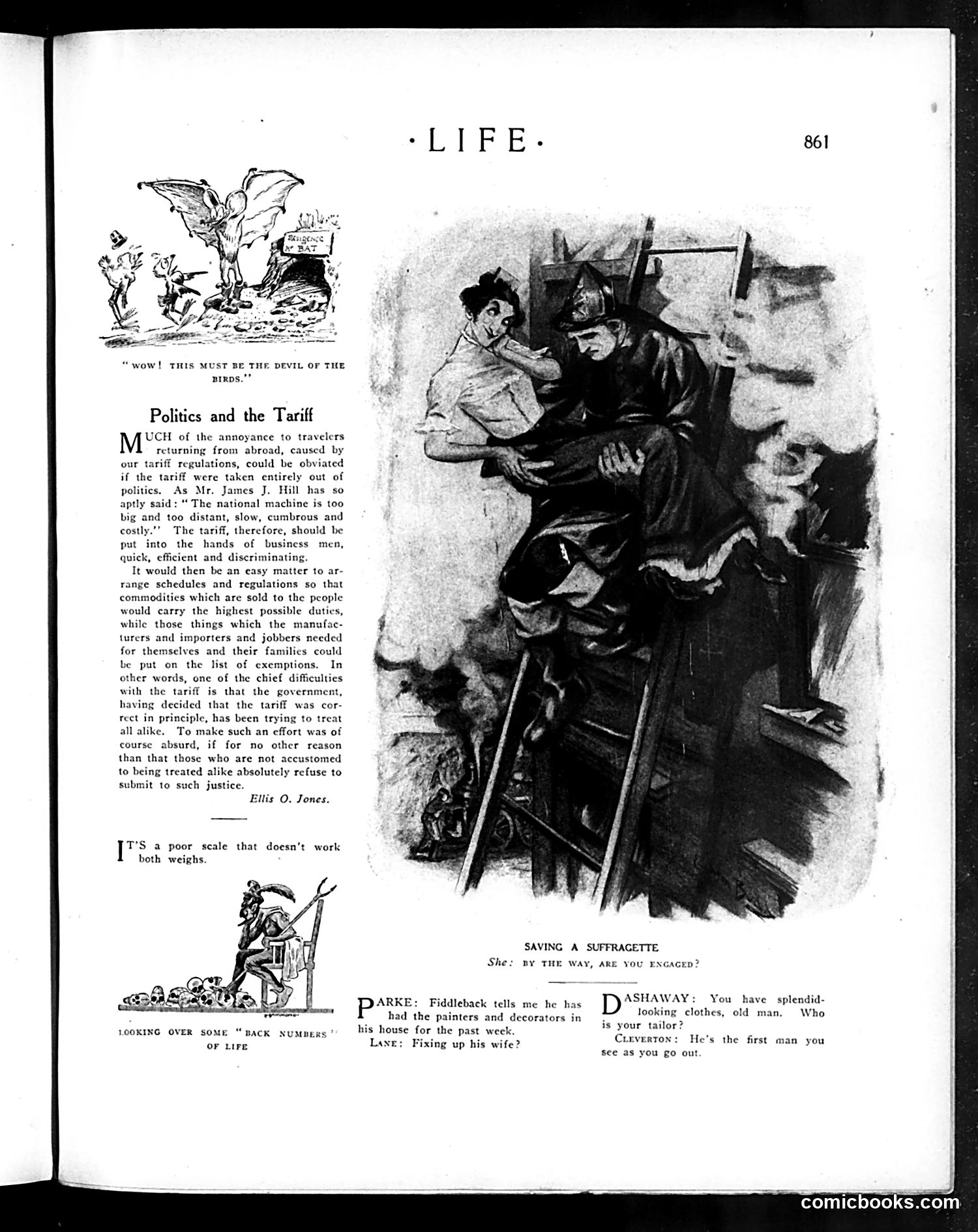
**"Politics and the Tariff"** (main essay with illustrations): This piece satirizes the U.S. tariff system by exposing its hypocrisy. The argument claims tariffs should be removed from politics and handled by "businessmen"—but then reveals the actual goal: to impose high duties on goods sold to ordinary people while exempting items needed by manufacturers and importers themselves. The satire is that this supposedly "efficient" system would simply legalize corruption and unequal treatment. The accompanying cartoons mock the tariff's complexity and unfairness. **"Saving a Suffragette"** (bottom right): A woman suffragette appears to be rescued or restrained by men. The dialogue ("By the way, are you engaged?") suggests the cartoon jokes about male rescuers immediately assuming women need marriage as their salvation—mocking both the condescension toward suffragettes and the era's assumptions about women's roles. **Other brief gags** comment on tailors and home renovation with typical period humor.
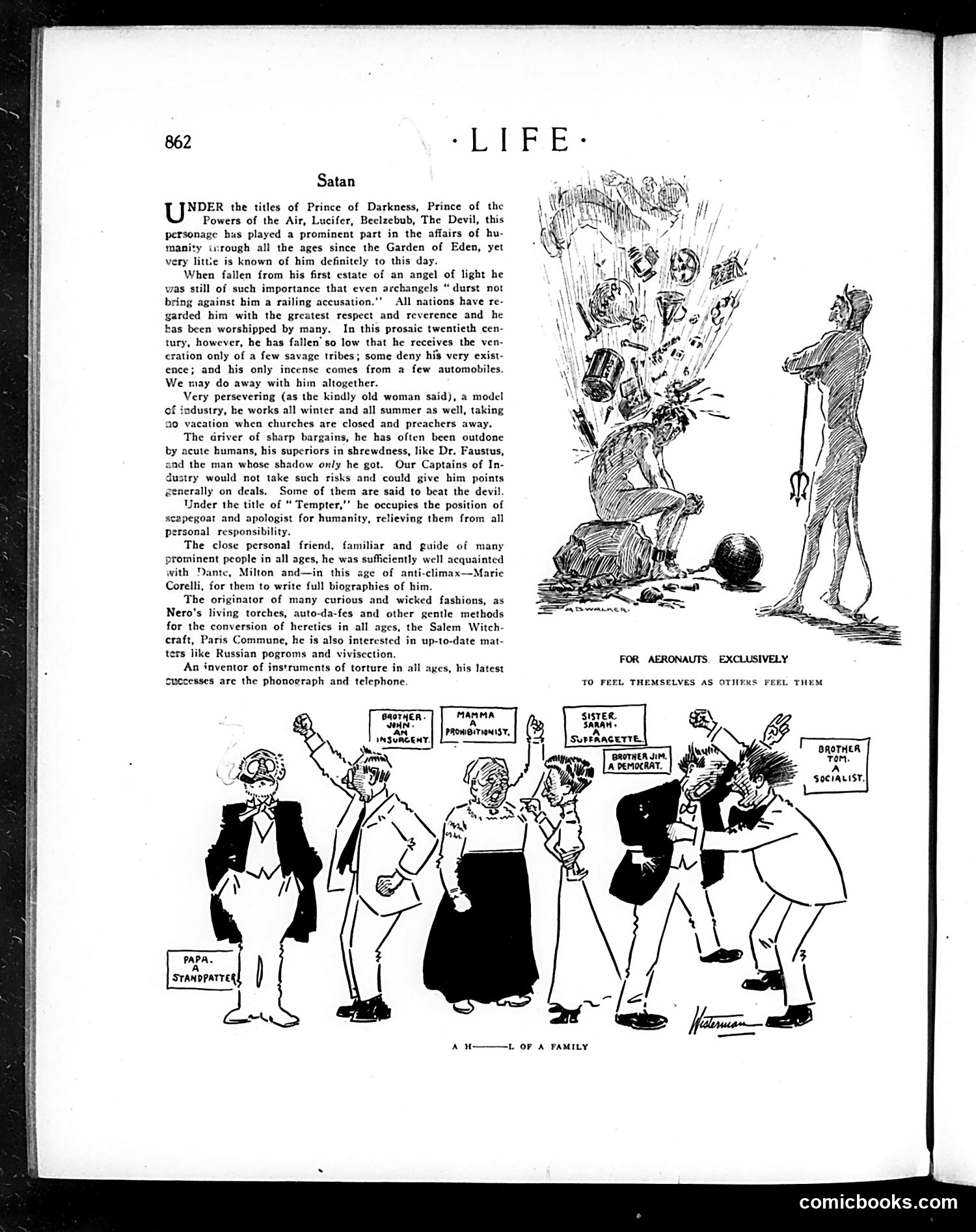
This page presents two satirical pieces about Satan. The upper text humorously catalogs Satan's diminished status in the modern era—once commanding respect, he now receives "incense only from a few automobiles" and has been outmaneuvered by industrial captains in making deals. The lower cartoon, titled "A H—L of a Family," uses Satan as a vehicle to mock contemporary political ideologies. Each family member is labeled with an "-ist" or "-ite" designation: Papa is a "Standpatter" (conservative), Mamma a "Prohibitionist," Mama a "Suffragette," and various siblings identified as Democrat, Socialist, Insurgent, etc. The cartoon satirizes how diverse, conflicting political movements all exist under one roof—suggesting they're all equally damnable or equally ridiculous depending on one's viewpoint. The implication: all these competing political factions are Satan's brood, united in chaos. This reflects early 20th-century American anxiety about proliferating ideologies and social movements.
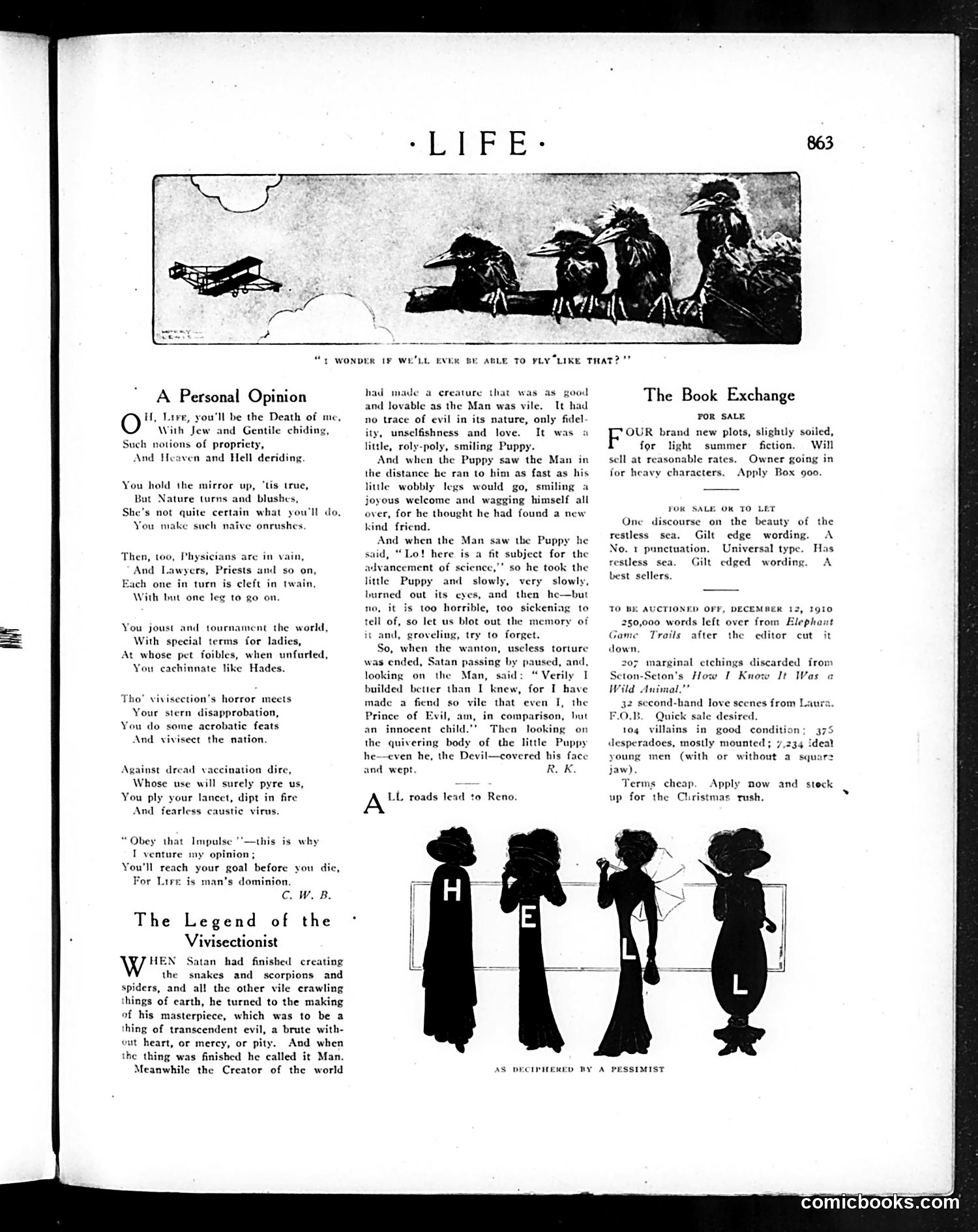
This page contains two distinct satirical pieces: **"A Personal Opinion"** (poem): A verse mocking *Life* magazine itself for its editorial hypocrisy. The author criticizes the publication for condemning vivisection (animal experimentation) while simultaneously performing intellectual "vivisection" of society—dissecting human nature and social conventions for satirical effect. The irony: *Life* claims moral superiority while engaging in the same invasive scrutiny it condemns in scientists. **"The Legend of the Vivisectionist"** (parable): A dark allegory contrasting Satan's creation of Man (evil, cruel) with God's creation of a Puppy (innocent, loving). When Man encounters the Puppy, he tortures it in the name of scientific advancement—a clear indictment of animal vivisection practiced in early 20th-century laboratories. Even Satan is horrified by Man's cruelty, suggesting vivisectionists represent evil exceeding damnation itself. The bottom cartoon "HELP" shows silhouettes spelling the word, captioned "AS DECIPHERED BY A PESSIMIST"—suggesting pessimism distorts perception. **Context**: These pieces reflect contemporary anti-vivisection sentiment, a significant reform movement of the era opposing animal experimentation.
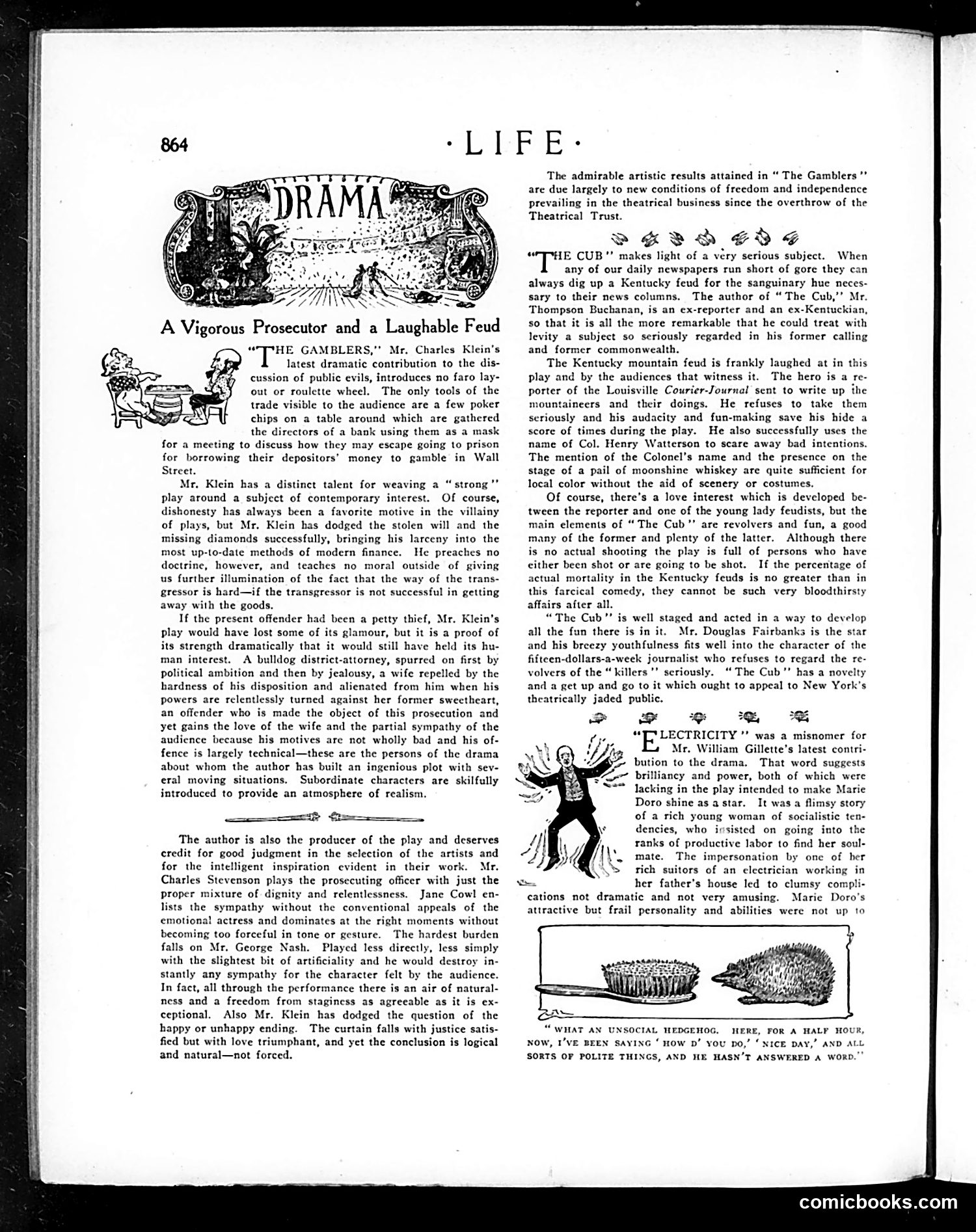
This page reviews two plays: **"The Gamblers"** by Charles Klein and **"The Cub"** by Thompson Buchanan. **"The Gamblers"** depicts bank directors using poker chips as cover while scheming to steal depositors' money for Wall Street gambling—a contemporary financial scandal. The review praises Klein's modern approach to crime drama, avoiding clichéd plots (stolen wills, missing diamonds) for timely white-collar theft. The cast, including Jane Cowl, is praised for naturalistic acting. **"The Cub"** satirizes newspaper sensationalism. Buchanan, a former reporter and Kentuckian, ironically treats Kentucky feuds—historically serious matters—as comedic newspaper filler. The review notes this levity seems incongruous given the actual violence of such feuds. Both reviews celebrate the "overthrow of the Theatrical Trust," indicating recent industry deregulation freed playwrights from corporate censorship. The small illustrations (hedgehog dialogue) appear to be unrelated decorative elements typical of Life's satirical format.
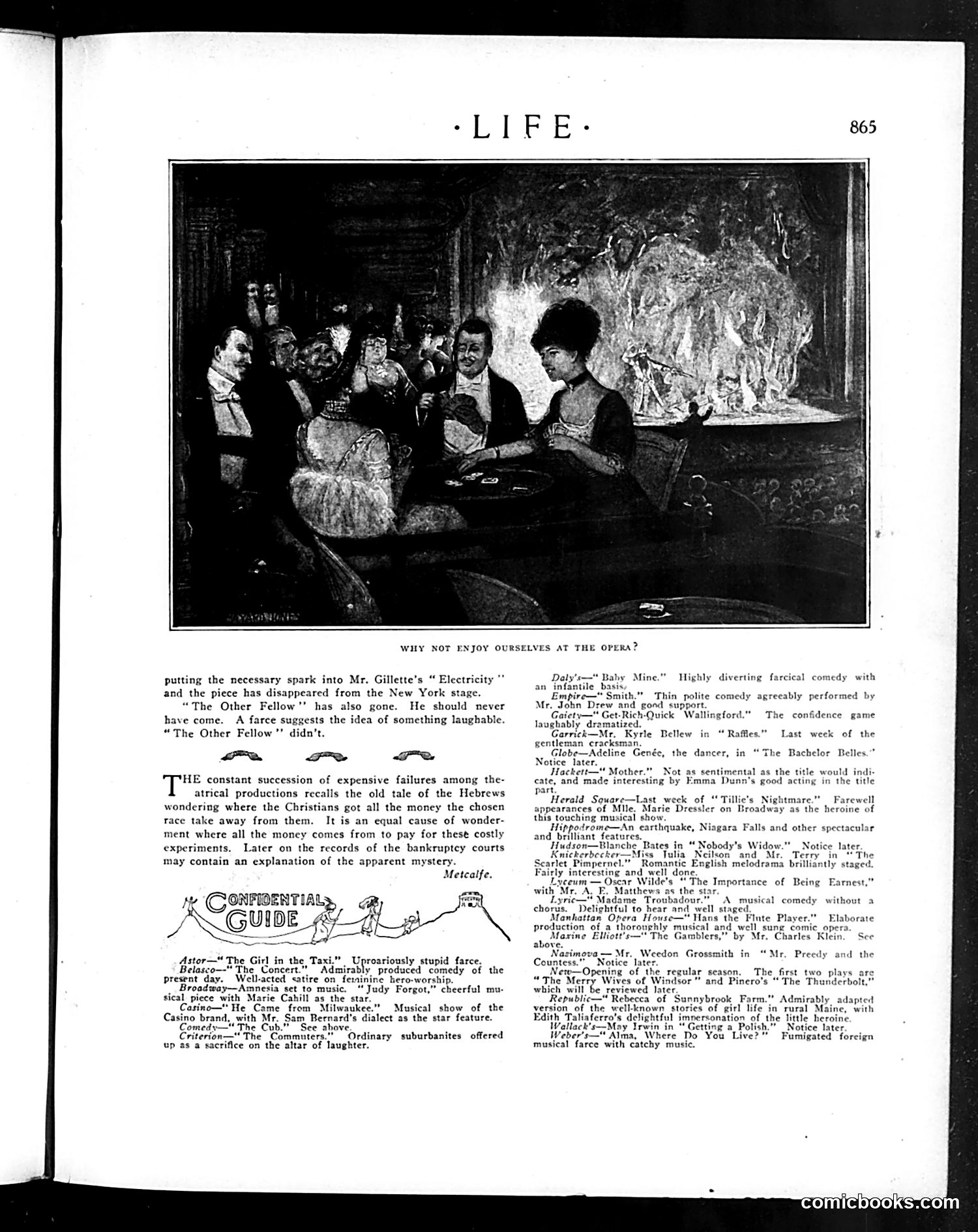
This page contains theater reviews from Life's "Confidential Guide" section, critiquing Broadway productions. The masthead illustration shows an opera scene—likely satirizing the pretension of high-society theatergoers attending fashionable performances. The main article by Metcalfe mocks the financial failures plaguing Broadway, comparing producers' mysterious funding sources to an old stereotype about Jewish and Christian wealth. The humor relies on suggesting producers throw money at failing shows without understanding why they lose money—a commentary on theatrical speculation and poor business judgment. Below are capsule reviews of current shows at major theaters (Astor, Empire, Hudson, etc.), rating performances by stars like Marie Cahill and John Drew. Reviews are brief, caustic judgments—"uproariously stupid farce," "thin polite comedy"—reflecting Life's satirical stance toward popular entertainment. The page represents early-1900s Broadway's commercial theater landscape and Life's role as cultural arbiter mocking both productions and audiences.
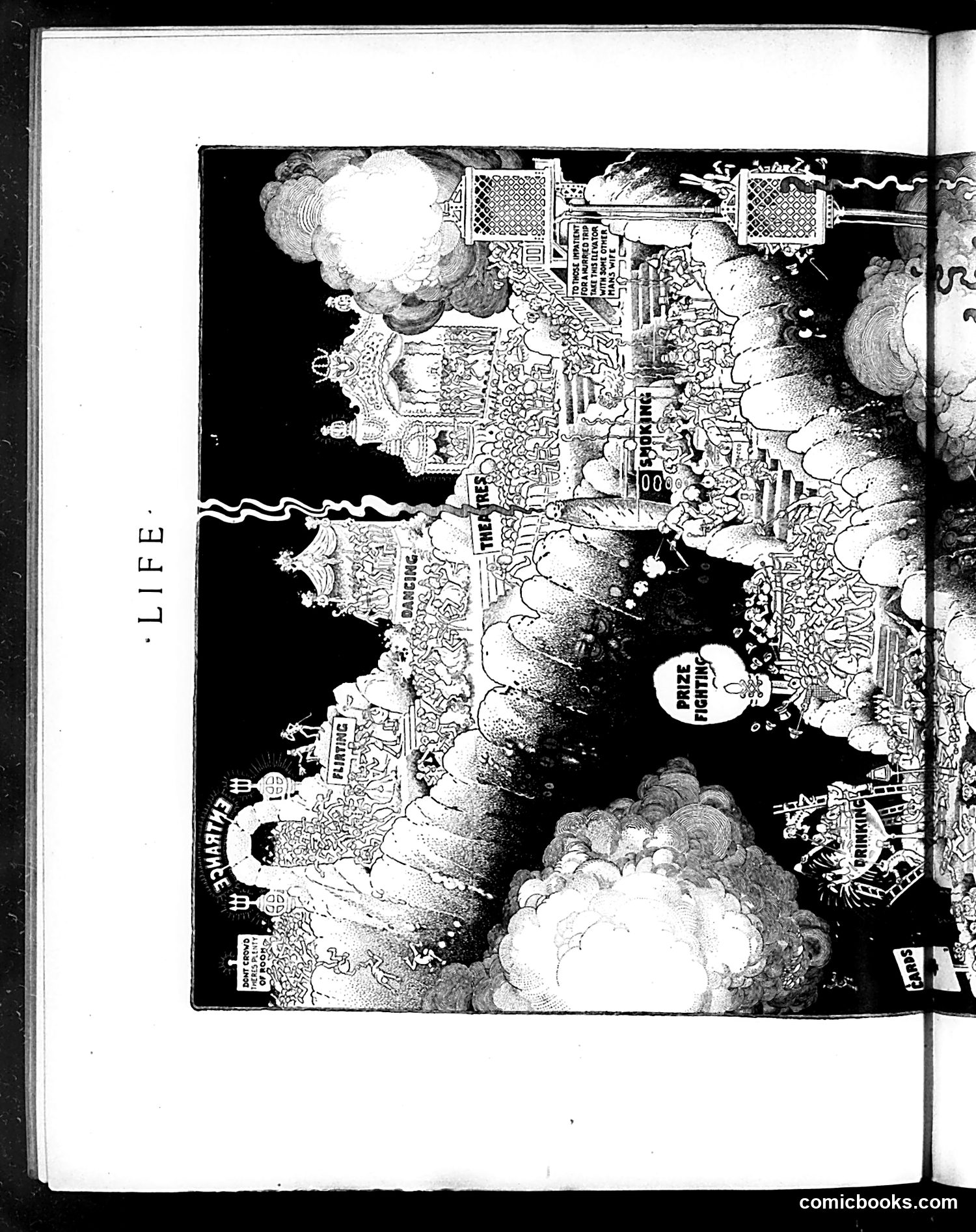
This page is titled "LIFE" and appears to be a satirical illustration depicting an idealized or fantastical scene. The image shows an elaborate, detailed landscape with numerous small figures, buildings, and activities scattered throughout—characteristic of early 20th-century Life magazine's dense, moralistic cartoon style. However, the OCR text provides only a website attribution ("comicbooks.com") with no substantive content to decode the cartoon's specific political or social message. Without visible labels, captions, or readable text identifying the figures and their referenced contexts, I cannot reliably explain what particular events, people, or satirical points this illustration addresses. To properly interpret this cartoon's meaning for a modern reader, clearer textual context would be necessary.
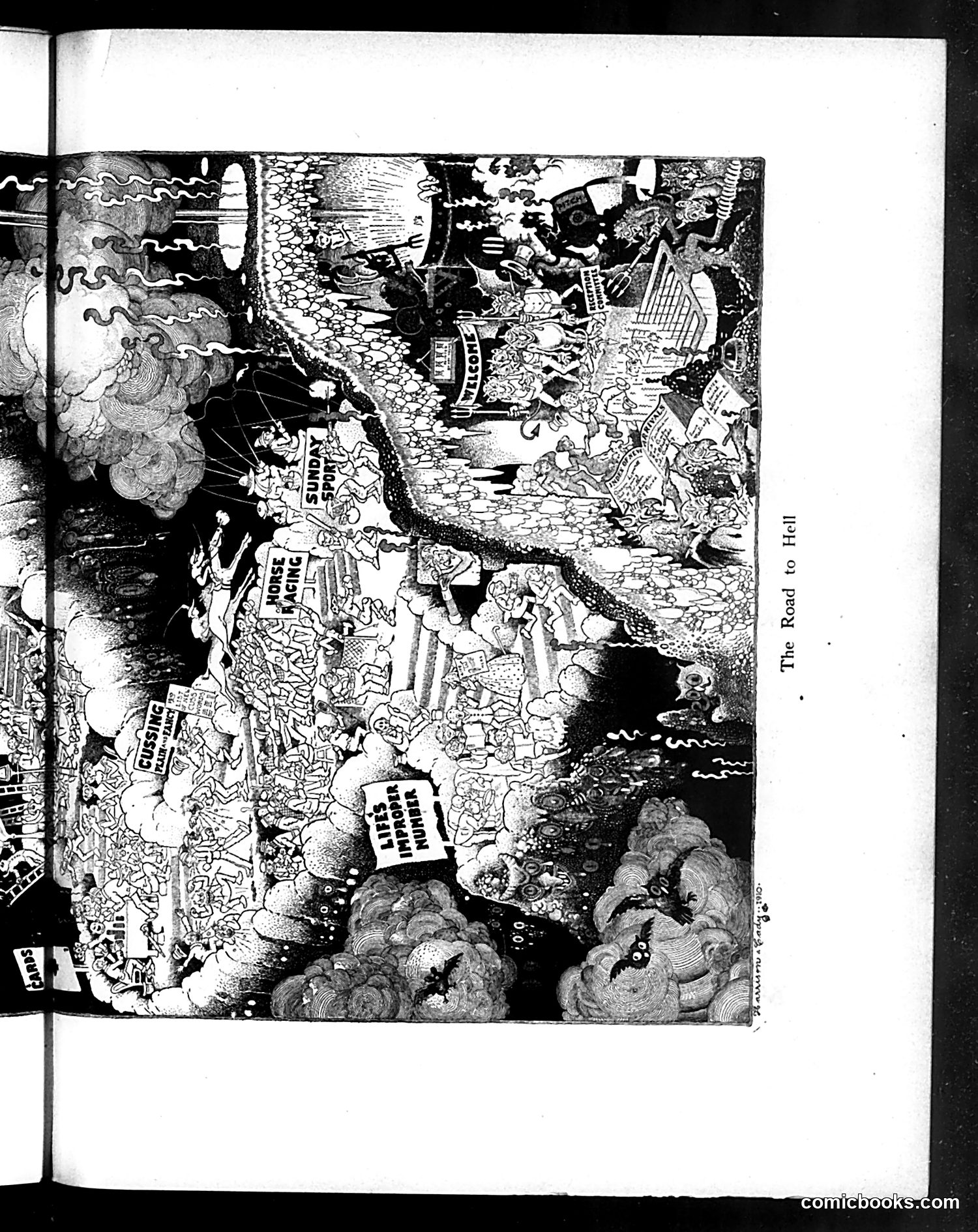
This page appears to be a complex satirical cartoon titled "The Road to Hell," though the OCR text is too corrupted to read clearly. The image itself is heavily detailed with numerous figures, scenes, and symbolic imagery crowded together in a dense compositional style typical of early-to-mid 20th century political satire. The cartoon likely uses the "road to hell" concept as a framework to critique various social, political, or moral failings through interconnected vignettes. However, without legible text labels identifying specific figures, policies, or events, I cannot definitively explain which particular controversies or public figures are being satirized here. The intricate linework and layered imagery suggest multiple simultaneous critiques, but precise identification requires clearer source material.
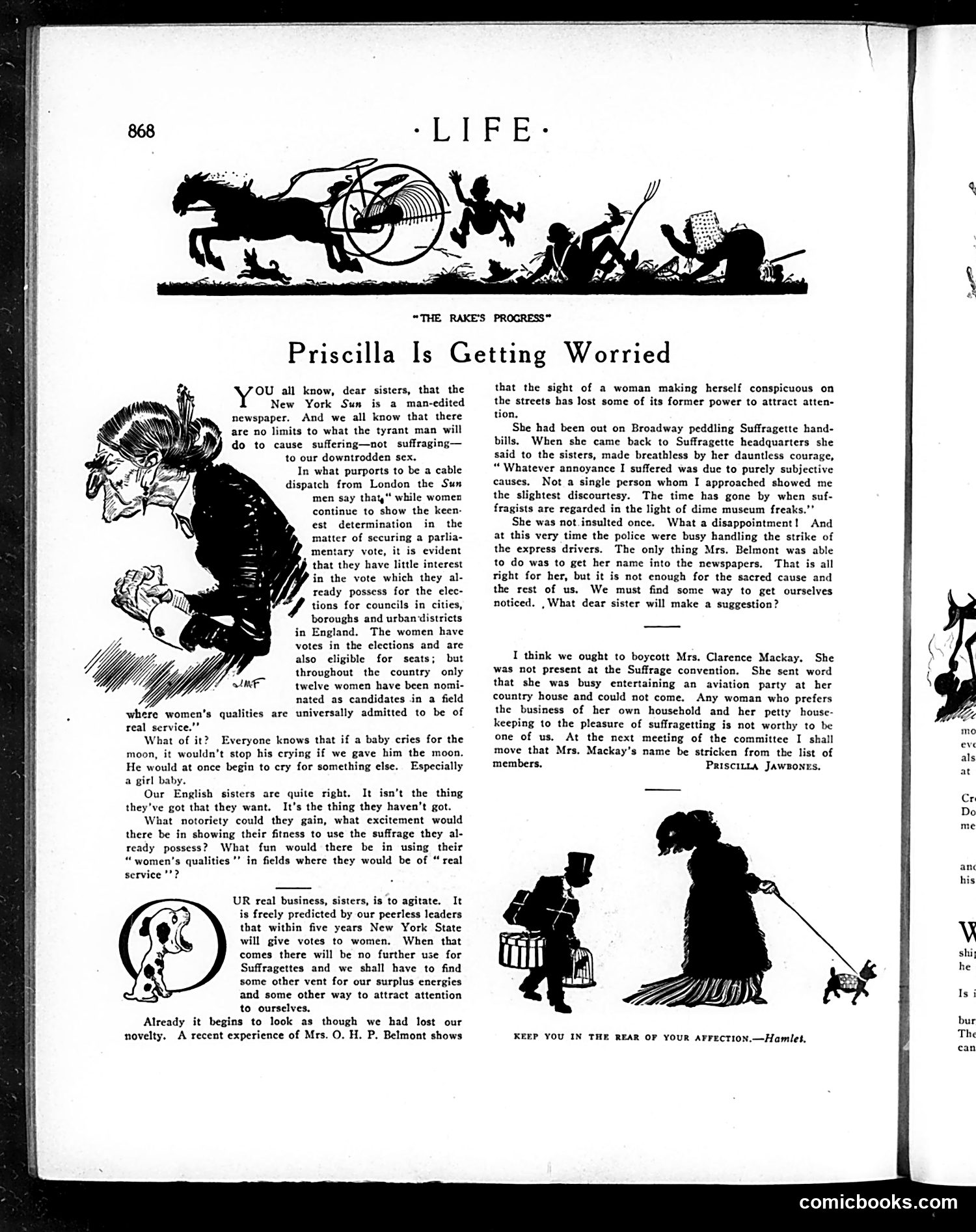
This article satirizes the women's suffrage movement through the fictional persona "Priscilla Jawbone." The satire mocks suffragettes by claiming they don't actually want voting rights—they want *attention and notoriety*. The author points to a cable report that English women, despite having local voting eligibility, show little interest in actually *using* that vote, suggesting activists prefer agitation over governance. The piece ridicules Mrs. O.H.P. Belmont, a real suffrage activist who handed out pamphlets on Broadway but received no harassment—disappointing her because, the satirist implies, suffragettes *crave* public outrage and controversy. The final jab targets Mrs. Clarence Mackay (identifiable as a wealthy society figure) for prioritizing her household over suffrage, proposing her removal from committee membership. The satire's point: suffragettes are performative attention-seekers rather than serious political advocates genuinely committed to voting or women's issues.
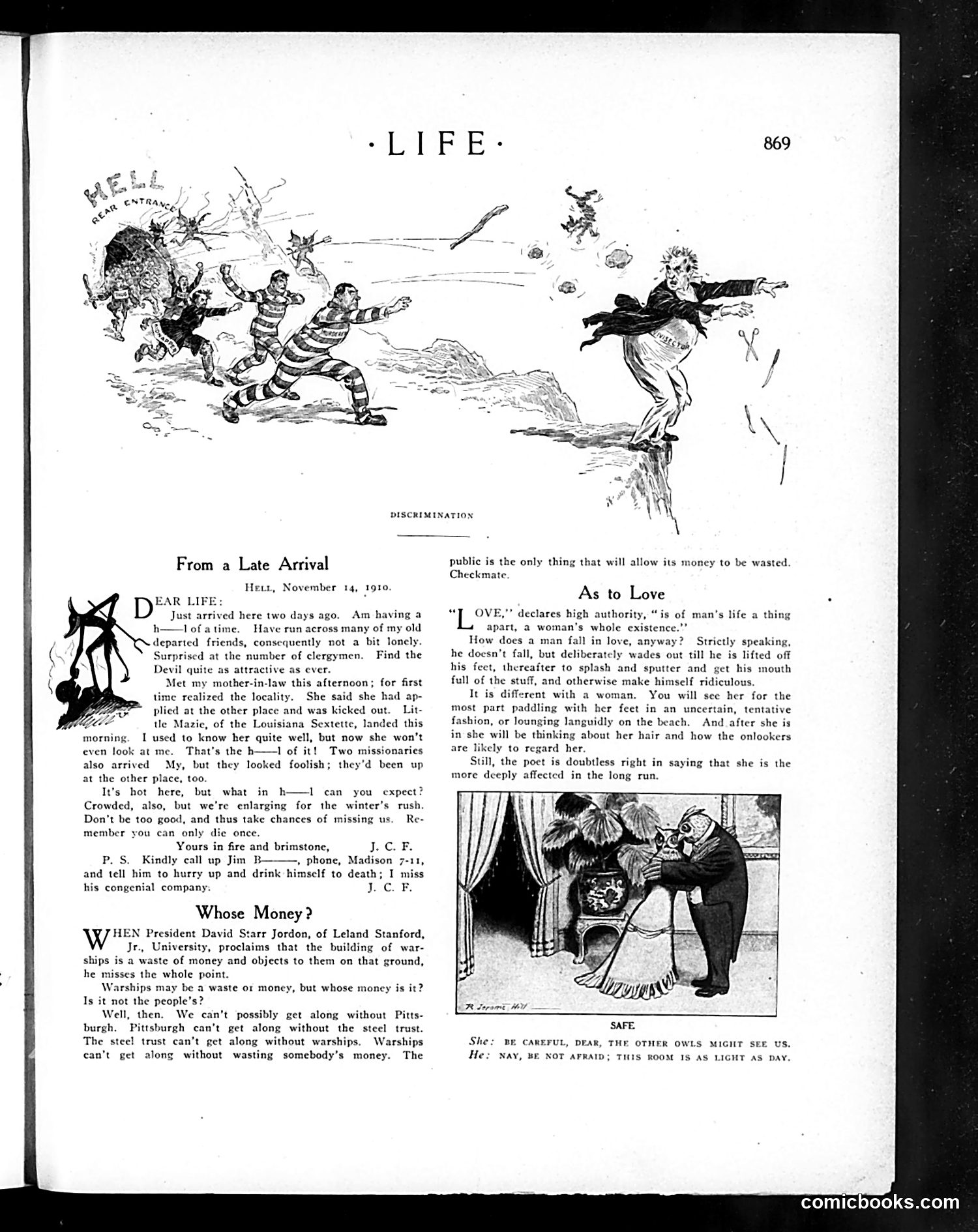
This page contains three satirical pieces typical of *Life* magazine's social commentary: **"From a Late Arrival"** is a darkly comic letter from someone in Hell, describing encounters with the damned—including clergymen, a dancer ("Little Mazie"), and missionaries. The joke hinges on the irreverent 1910s conceit that Hell is crowded with "respectable" people, undermining moral hypocrisy. **"Whose Money?"** critiques President David Starr Jordan's pacifist objection to warship construction. The satirist argues that while wasteful, warships funnel money through Pittsburgh's steel industry—creating an ironic chain where the public ultimately funds military spending they cannot control. It's a cynical commentary on industrial capitalism and military-industrial interdependence. **"As to Love"** presents contrasting gender stereotypes: men "fall" into love messily and ridiculously; women wade in cautiously, preoccupied with appearance. The accompanying illustration shows a couple in a darkened room, with sexual innuendo in their exchange about "light." All three pieces reflect *Life's* early-1900s satirical voice: irreverent toward authority, cynical about economic systems, and somewhat risqué regarding sexuality.
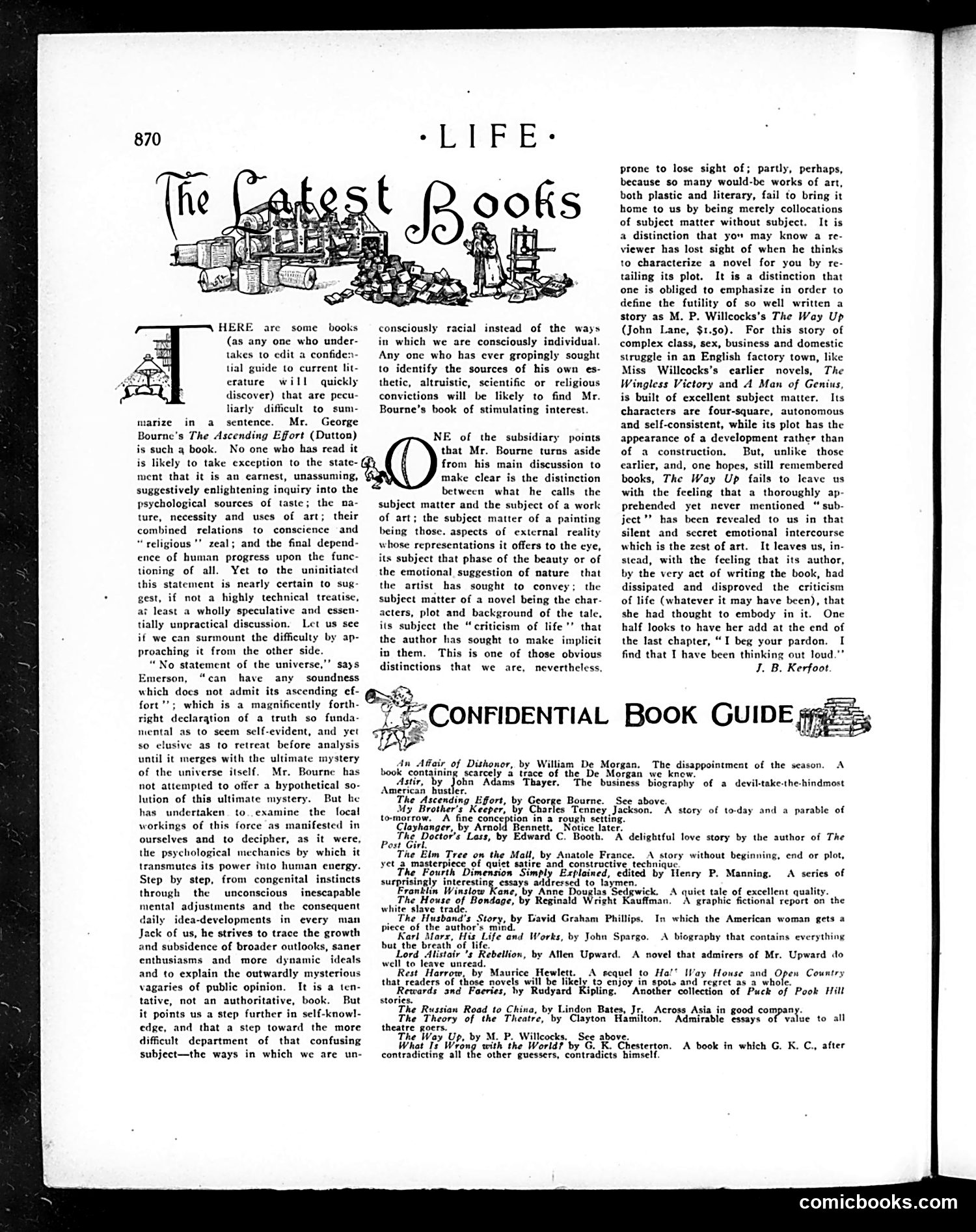
This is a **book review section**, not a political cartoon. The page features an essay by F.B. Kerfoot analyzing George Bourne's *The Ascending Effort*, a philosophical work examining psychology, taste, and human progress. The illustrated header "The Latest Books" uses decorative typography with stacked books and literary imagery—typical of early 20th-century magazine design. **Key content**: Kerfoot explains why Bourne's book is difficult to summarize, then clarifies its merit by quoting Emerson on "ascending effort" as a universal principle. He praises Bourne's examination of how psychological forces shape public opinion and aesthetic/religious convictions. The page also discusses Bourne's distinction between "subject matter" (plot, characters) and "subject" (the implicit "criticism of life") in art—a distinction Kerfoot notes readers commonly overlook. At bottom, a "Confidential Book Guide" lists contemporary titles for review. This is **literary criticism and advertising**, not satire or political commentary.
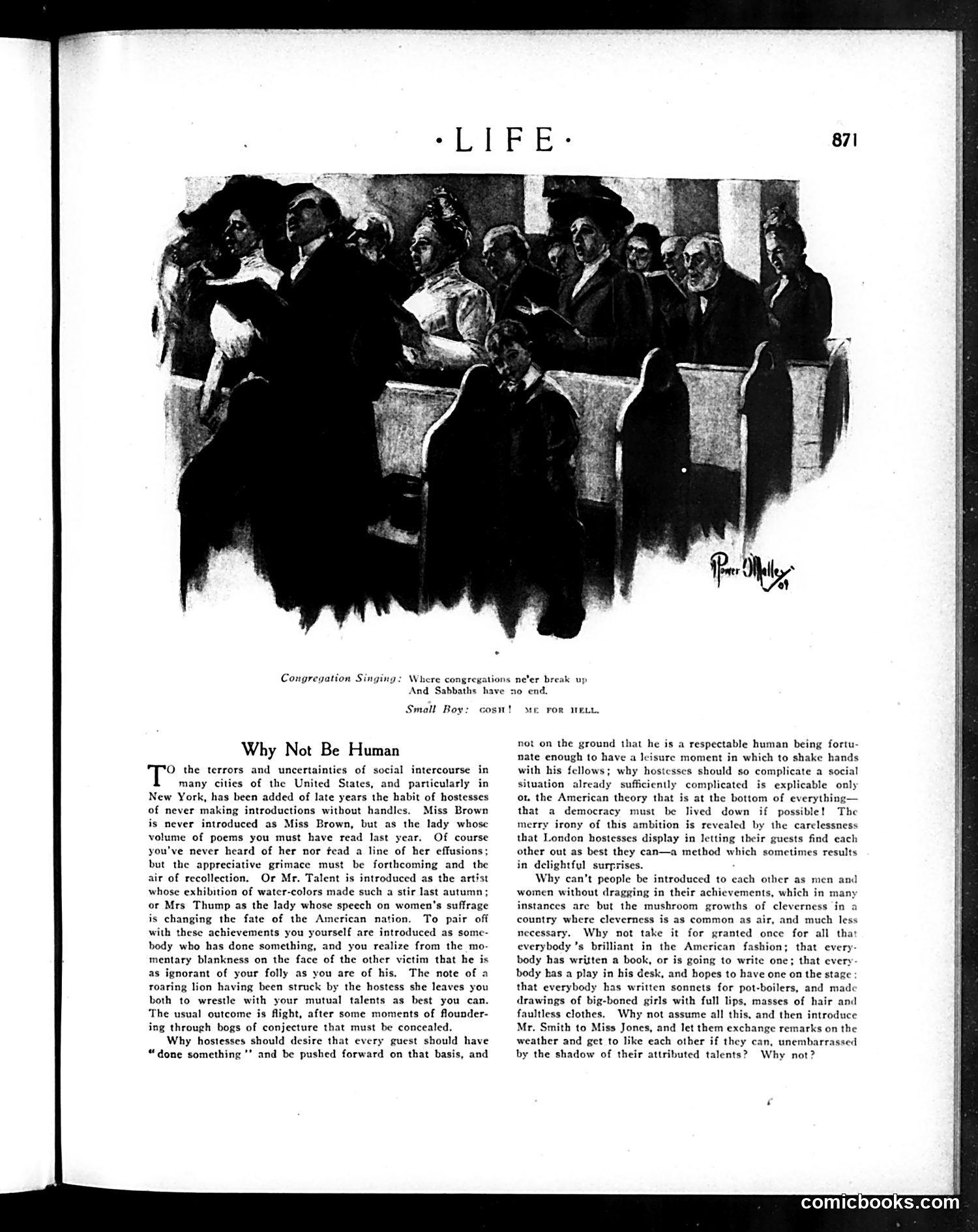
This article satirizes an affectation of upper-class American (especially New York) hostesses: introducing guests not by name alone, but by their alleged accomplishments—"the lady whose volume of poems" or "the artist whose water-colors made a stir." The author mocks this practice as pretentious and awkward. Guests are forced to feign familiarity with strangers' obscure work, creating uncomfortable social theater. The piece contrasts this with London hostesses, who simply introduce people as people, allowing genuine connection. The satire's core point: American democratic ambition has made even casual socializing competitive and achievement-obsessed. The author argues people should be valued simply as "respectable human beings" worthy of conversation, not as repositories of credentials. The cartoon above—showing a congregation in a pew—likely illustrates how such forced social interactions feel as interminable as endless church services.
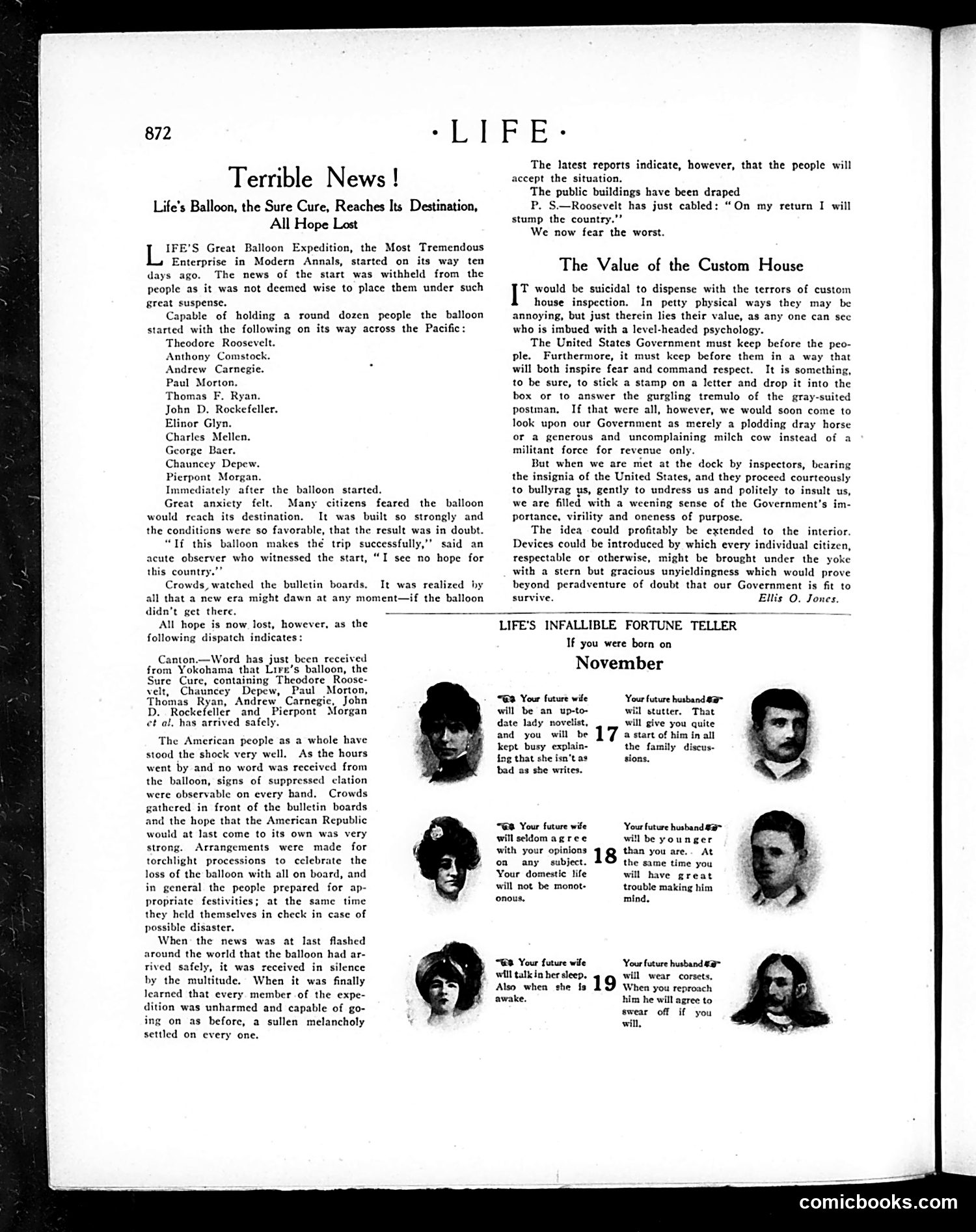
This piece satirizes prominent American figures of the early 1900s—Theodore Roosevelt, Andrew Carnegie, John D. Rockefeller, J.P. Morgan, and others—by imagining them aboard a balloon crossing the Pacific. The satire's point is darkly humorous: citizens *hope* the balloon crashes, killing these powerful men. The joke reflects public resentment toward monopolists, corrupt businessmen, and political figures. The text reveals the satirical intent: when news arrives the balloon landed *safely*, Americans are devastated. The piece mockingly suggests the nation would celebrate if these wealthy, influential men disappeared. The accompanying article on custom house inspections extends the theme—using Government authority to intimidate citizens—reflecting Progressive-era anxieties about concentrated power and corruption among the wealthy elite. This represents *Life's* role as a satirical magazine critiquing Gilded Age corruption and inequality.
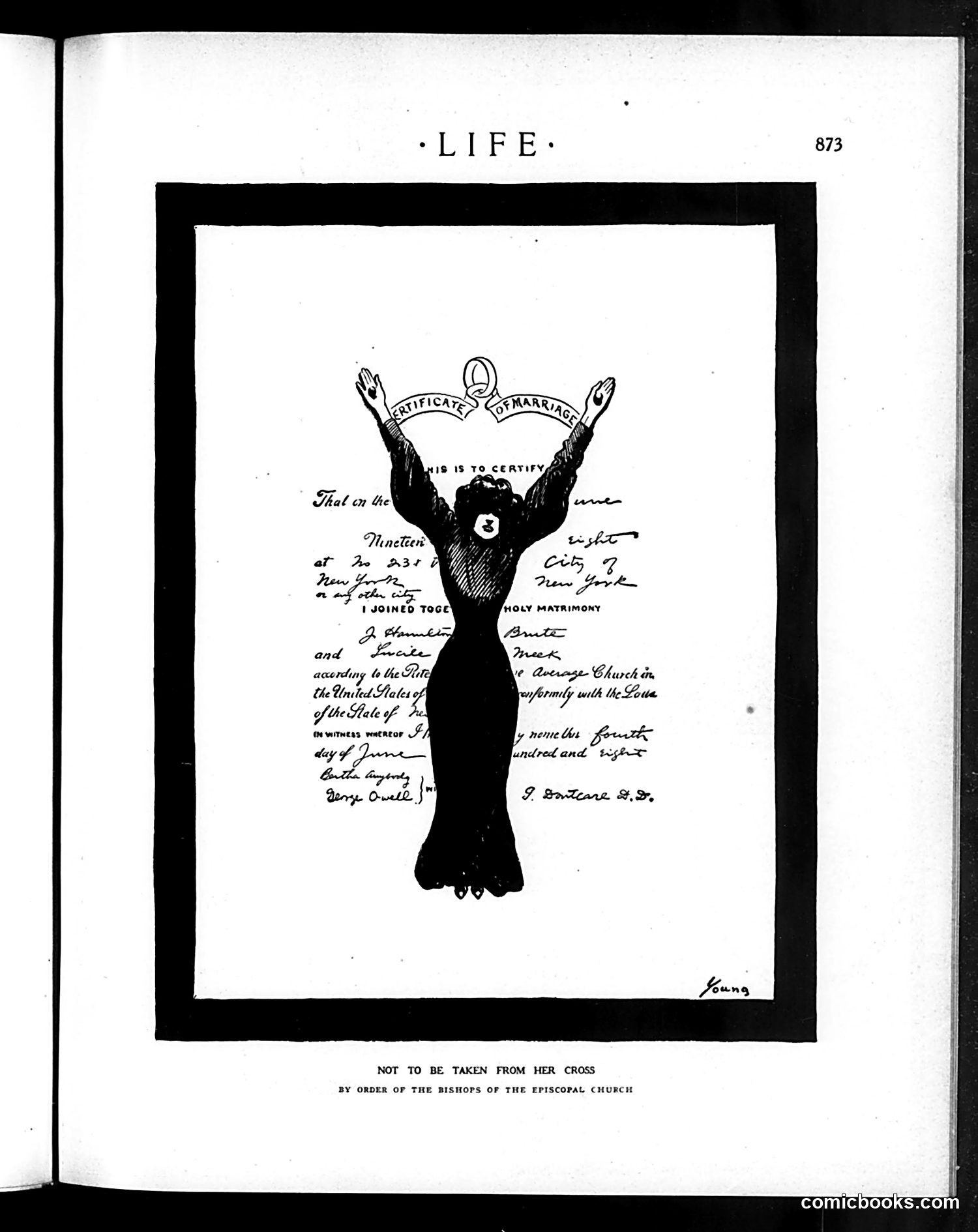
This is a satirical cartoon depicting a silhouetted female figure holding aloft a marriage certificate. The figure is positioned like a religious icon or saint, with arms raised triumphantly. The certificate and surrounding text reference a 1918 marriage in New York City. The caption—"NOT TO BE TAKEN FROM HER CROSS / BY ORDER OF THE BISHOPS OF THE EPISCOPAL CHURCH"—suggests the satire targets ecclesiastical authority's stance on marriage, likely mocking either the church's control over matrimonial matters or a specific marriage controversy involving Episcopal bishops. The "cross" reference plays on religious imagery while positioning marriage itself as a burden or trial. Without additional context about the specific 1918 event or individuals involved, the precise target remains unclear, but the satire appears to critique institutional religious control over personal relationships and women's status within that system.
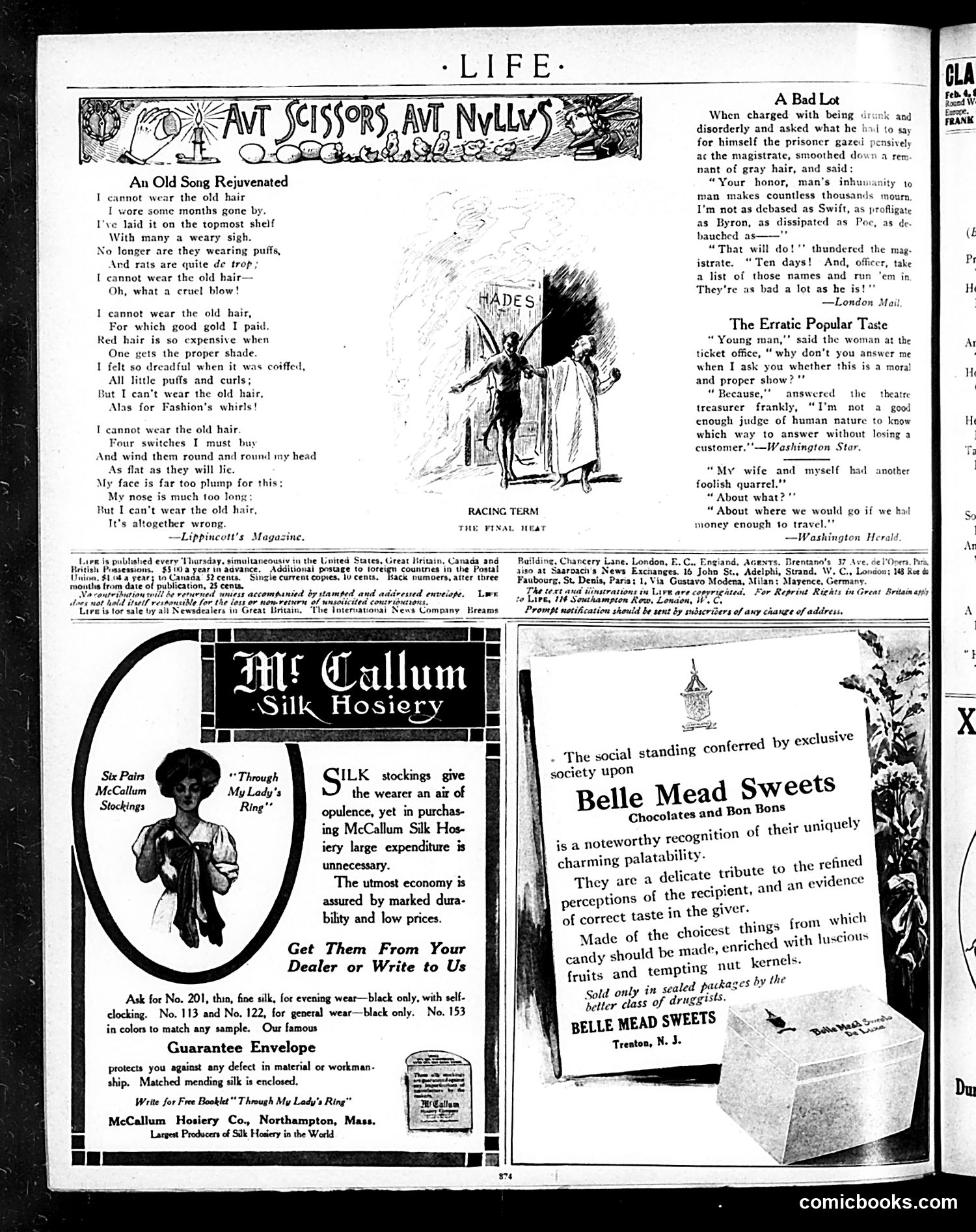
This page contains several humorous pieces satirizing early 20th-century social trends: **"An Old Song Rejuvenated"** mocks women's fashion volatility. The poem laments that elaborate hairstyles featuring "puffs" and "rats" (hairpieces) that women invested money in have suddenly become unfashionable. The joke targets the absurdity of fashion's rapid changes and women's financial investment in temporary trends—a woman cannot wear her expensive coiffed hair because styles have shifted to flatter looks. **"A Bad Lot"** presents a prisoner who, when asked to explain himself, lists famous disreputable figures (Byron, Swift, Poe) to claim he's less debased than them. The magistrate, unimpressed, sentences him and dismissively tells officers these names are "as bad a lot as he is!"—satirizing both the prisoner's flawed logic and society's moral hypocrisy. **"The Erratic Popular Taste"** and **"My Wife and Myself"** are brief satirical vignettes about public taste inconsistency and marital disagreements. The rest is advertising for McCallum silk hosiery and Belle Mead Sweets—typical period magazine filler.
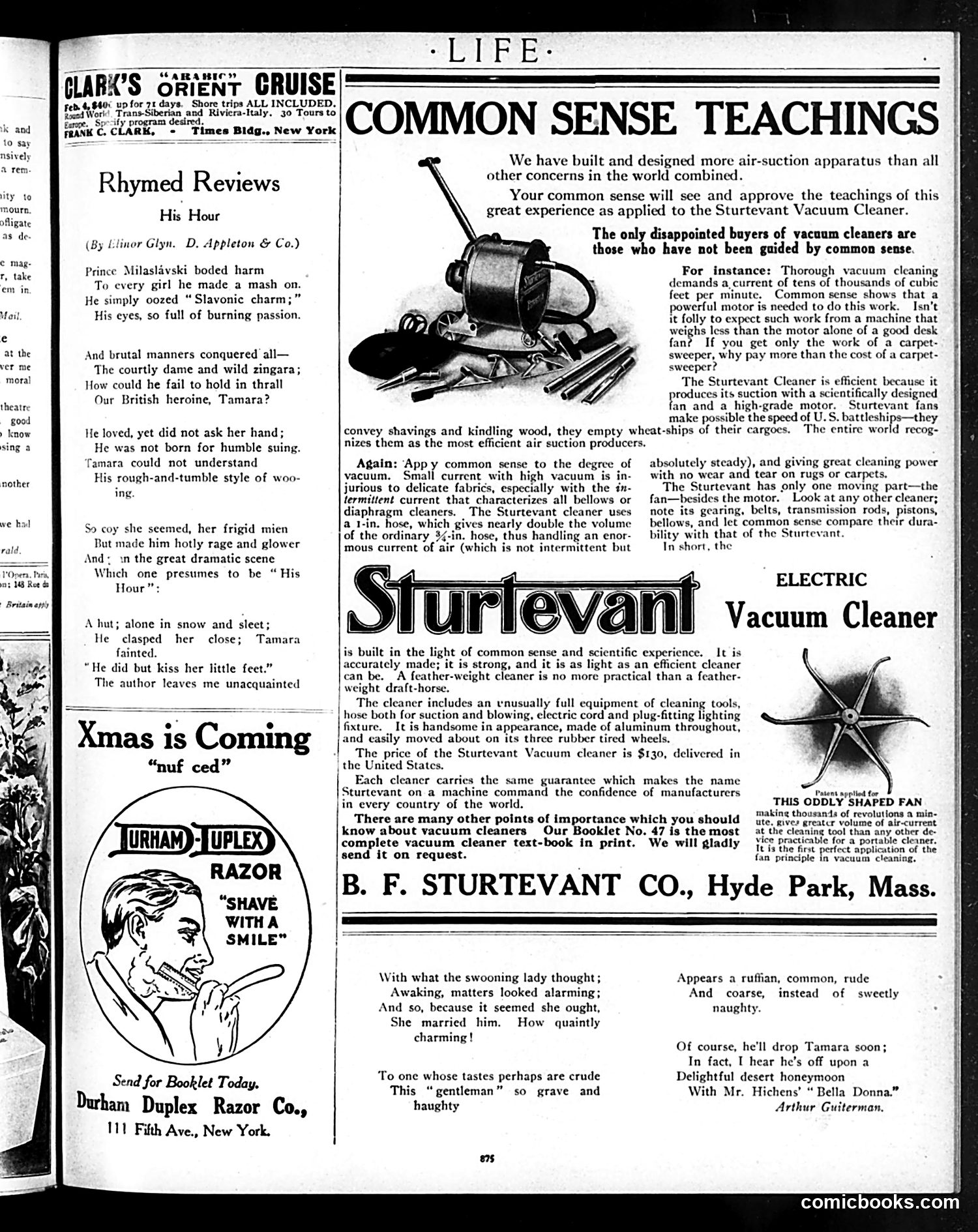
This page from *Life* magazine combines literary criticism with vacuum cleaner advertising—typical of early 20th-century magazines. **"Rhymed Reviews"** critiques a romantic novel called *His Hour* by Elinor Glyn. The reviewer summarizes a melodramatic plot: Prince Milaslavski, a seductive Russian aristocrat with "Slavonic charm," pursues a British heroine named Tamara. The satire mocks the overwrought romance novel trope—the mysterious foreign nobleman with burning passion who wins hearts through brutish intensity rather than genuine courtship. The reviewer's deadpan tone ("The author leaves me unacquainted") suggests skepticism about the novel's emotional authenticity. **The Sturtevant advertisement** uses pseudo-scientific "common sense" arguments to market electric vacuum cleaners, emphasizing powerful motors and efficient design over cheaper competitors. This represents early consumer advertising rhetoric. The page reflects pre-WWI popular culture: fascination with exotic European nobility, sentimental romance literature, and emerging electrical appliances as luxury goods.
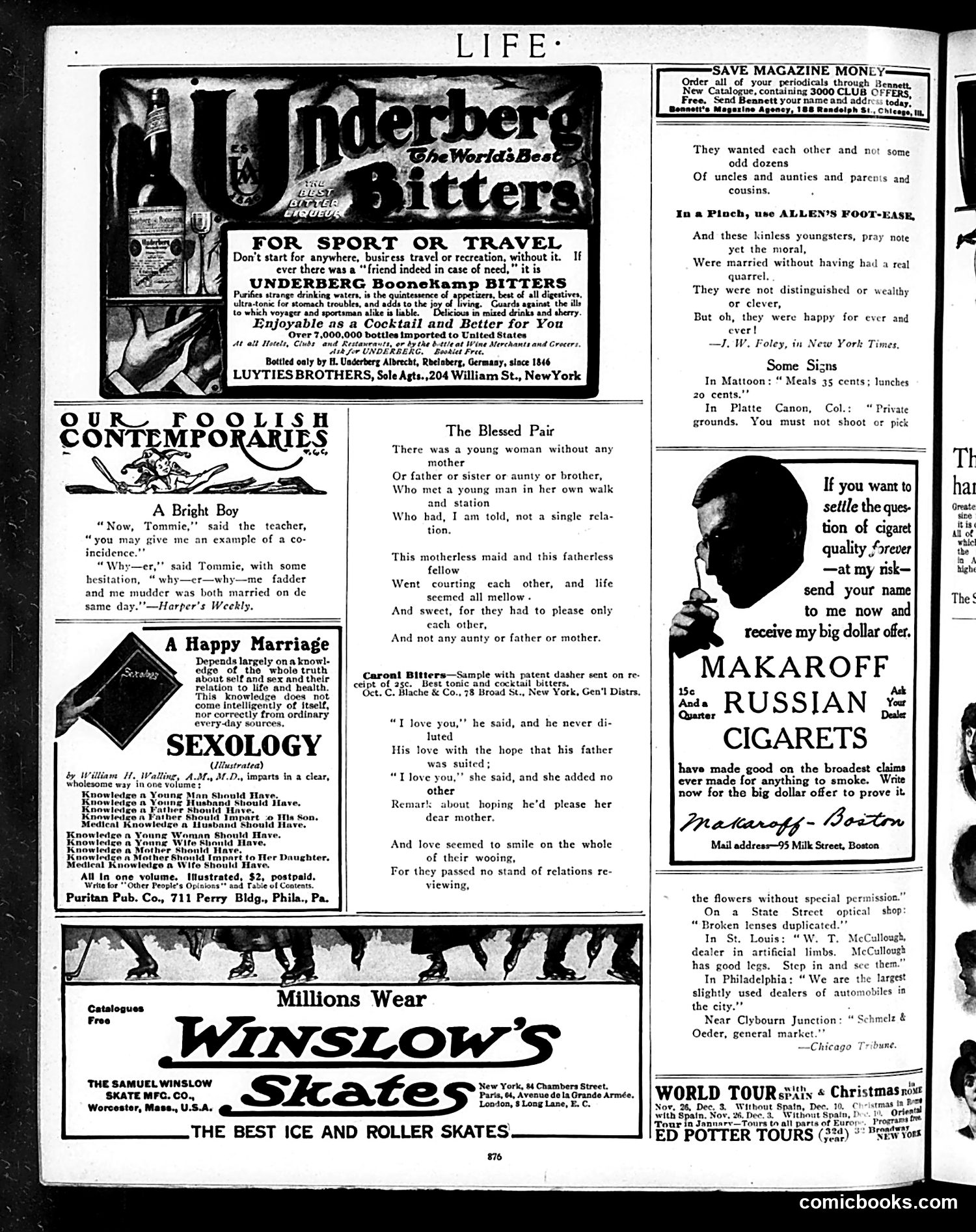
This page is primarily **advertising and light humor** rather than political satire. **Main Content:** The central poem, "The Blessed Pair," sentimentally depicts a young couple with no family relations who marry for love alone—a moralistic tale emphasizing that true happiness requires only mutual affection, not wealth or social connections. The accompanying quote from *New York Times* reinforces this message. **Surrounding Features:** - **"A Bright Boy"**: A joke about a child misunderstanding matrimony - **"A Happy Marriage"**: Advertisement for a *Sexology* instructional book - **Advertisements**: Underberg Bitters (travel/digestion), Makaroff Russian Cigarettes, Winslow's Skates, and magazine subscription services The page reflects **early 20th-century middle-class values**—romantic love, self-improvement through education, and consumerism. No specific political figures or events are referenced. This is primarily commercial and sentimental content typical of *Life* magazine's advertising-heavy format from this era.
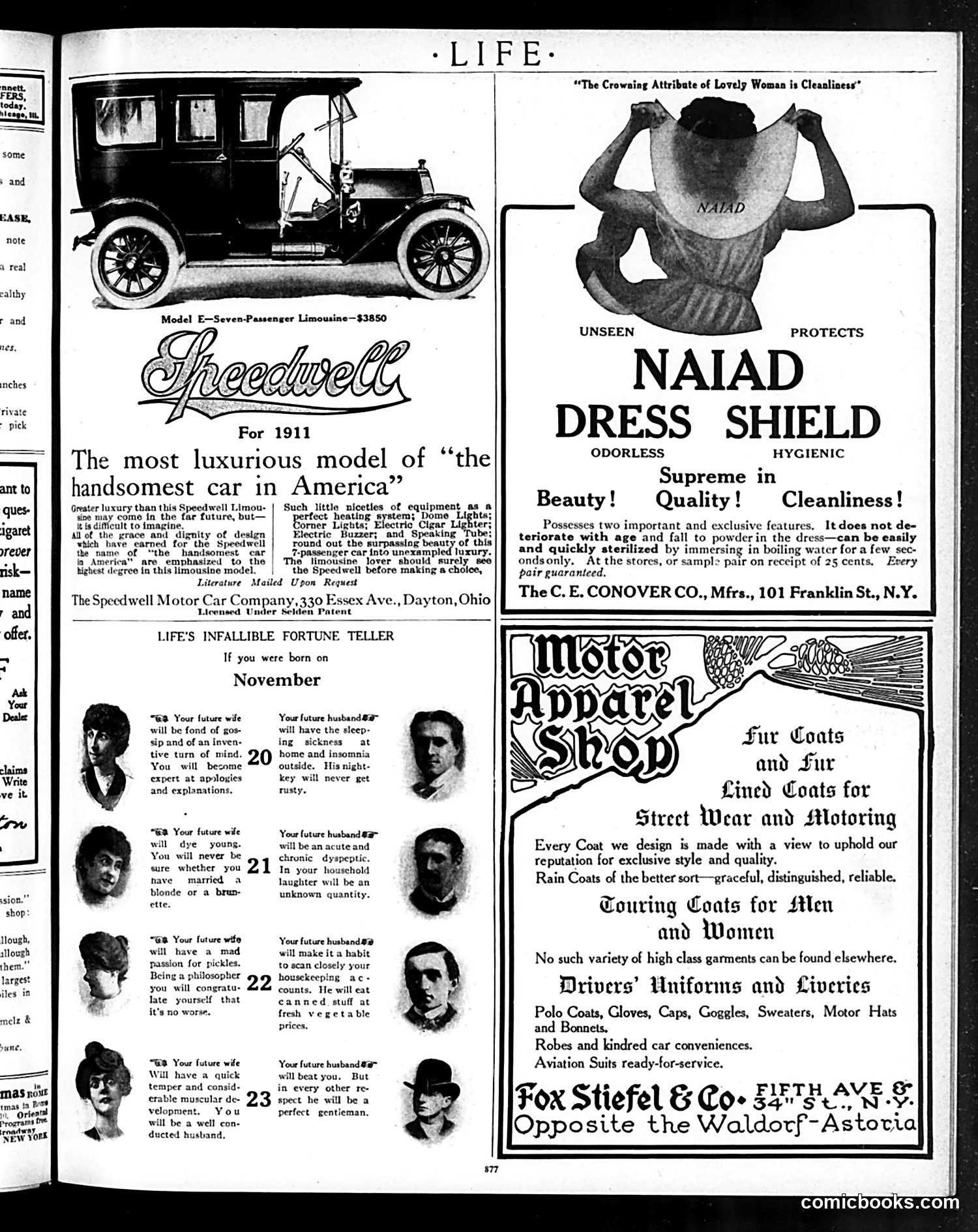
This page is primarily **advertising**, with one satirical section. The main content includes: **"Fortune Teller" Satire (center-left):** A mock horoscope for people born in November, presenting cynical predictions about marriage. The jokes mock both spouses: wives are portrayed as gossipy, unfashionable, or pickle-obsessed; husbands as dyspeptic, unfaithful, or abusive. The satire reflects early-20th-century marital stereotypes and gender roles—poking fun at domestic incompatibility and the resigned acceptance of unhappy marriages as inevitable. **Advertisements:** The page features luxury goods for the emerging automotive age—a Speedwell limousine ($3,850), the "Naiad Dress Shield" (underarm protection), and Fox Stiefel & Co.'s motorist apparel. These ads target wealthy, fashion-conscious consumers adopting new technologies and lifestyles. The contrast between aspirational luxury advertising and bitter marriage humor reflects the magazine's satirical stance on modern American life.
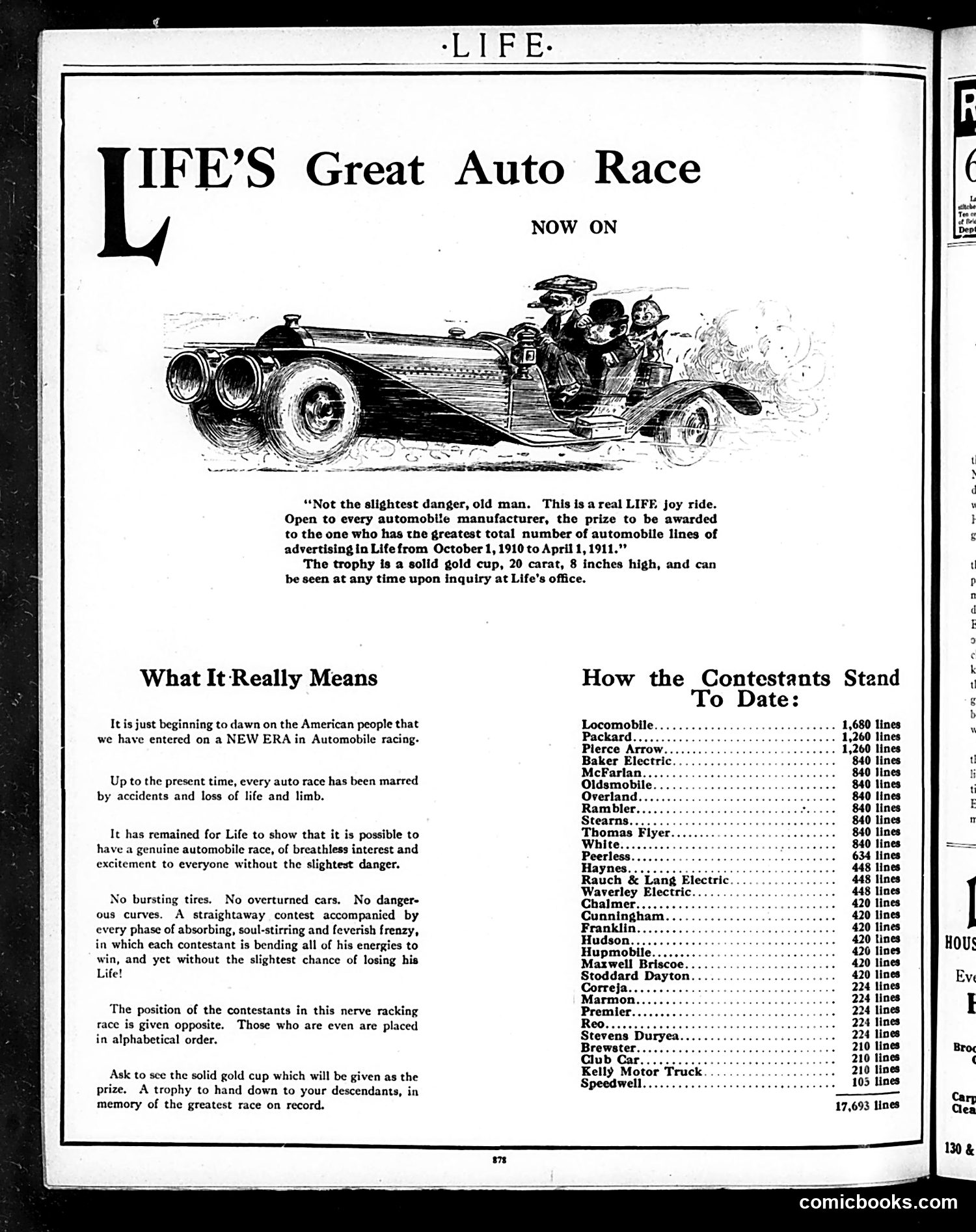
This is a **satirical advertisement disguised as a contest announcement**. Life magazine is mocking the automobile industry's aggressive advertising practices by announcing a fake "race" where the prize goes to whichever car manufacturer places the most ads in Life magazine between October 1910 and April 1911. The humor operates on multiple levels: 1. **The ironic premise**: Life claims to showcase a "safe" auto race with "no danger" and "no bursting tires"—yet the actual "competition" is entirely about advertising volume, not speed or performance. 2. **Social commentary**: Early auto racing was genuinely dangerous and often fatal. By reducing competition to an ad-buying contest, Life satirizes how manufacturers were more interested in marketing dominance than genuine innovation or safety. 3. **Self-aware promotion**: Life is simultaneously mocking advertising while soliciting it, listing actual manufacturers' line counts to encourage increased spending. The gold cup prize is the ultimate joke—a monument to commercial excess rather than automotive achievement.
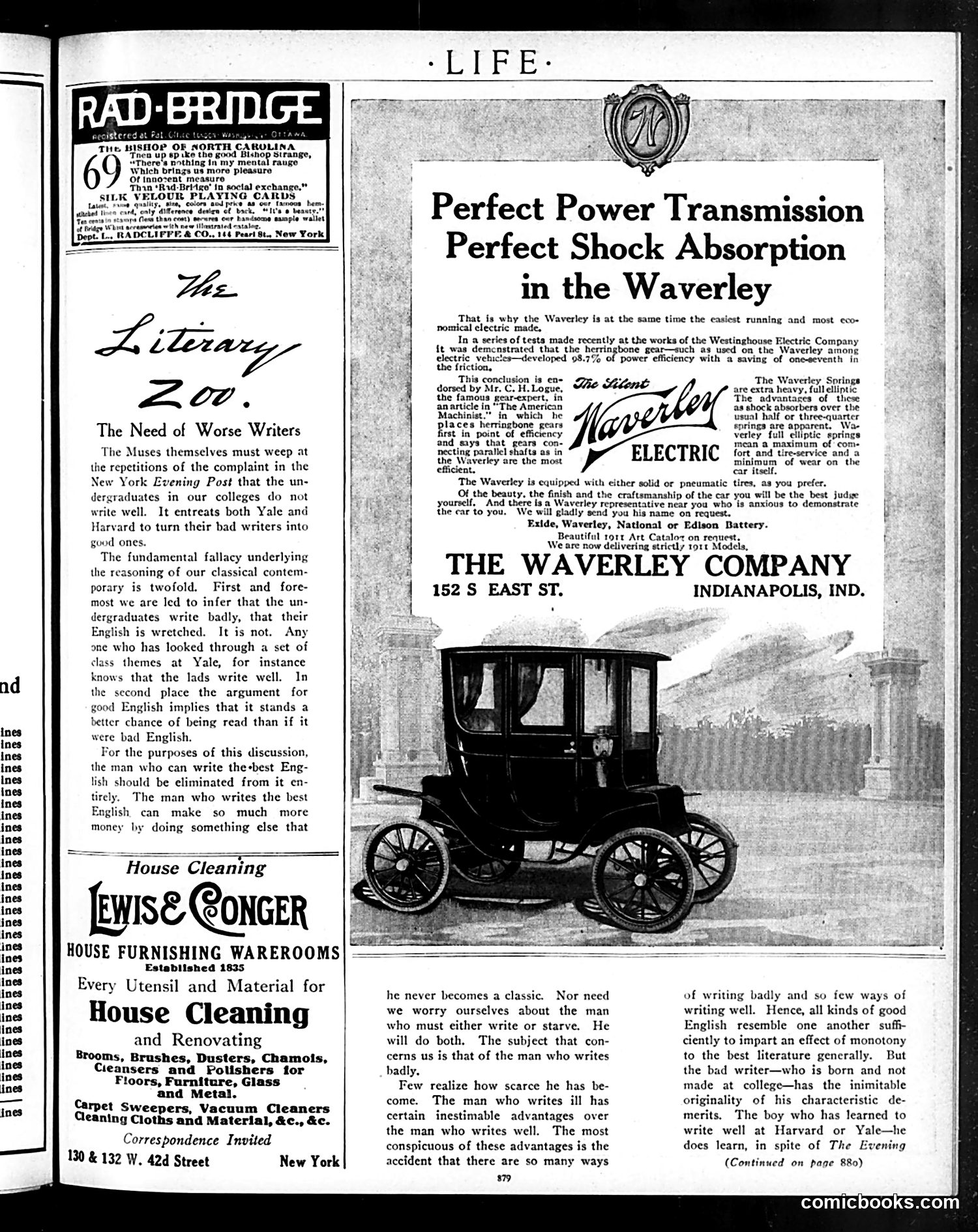
This page mixes advertisements with editorial content typical of early 1900s Life magazine. **Main Content**: An essay titled "The Need of Worse Writers" satirizes the *New York Evening Post*'s complaint that college undergraduates write poorly. The author argues ironically that truly talented writers should be *excluded* from improvement efforts—they earn more money doing other work anyway. The piece suggests that bad writers are actually becoming scarce, and that poor writing has "inestimable advantages" because there are "so many ways" to write badly. This is satirical commentary on education debates and the paradox of talent allocation. **Advertisements**: The page features prominent ads for Lewis & Conger (house cleaning supplies), Rad-Bridge playing cards, and notably a large Waverley electric automobile advertisement showcasing the vehicle's transmission and shock absorption technology—typical early automotive marketing emphasizing mechanical superiority. The Rad-Bridge ad oddly opens with a playful verse about a "Bishop of North Carolina," suggesting whimsical, light marketing typical of the era.
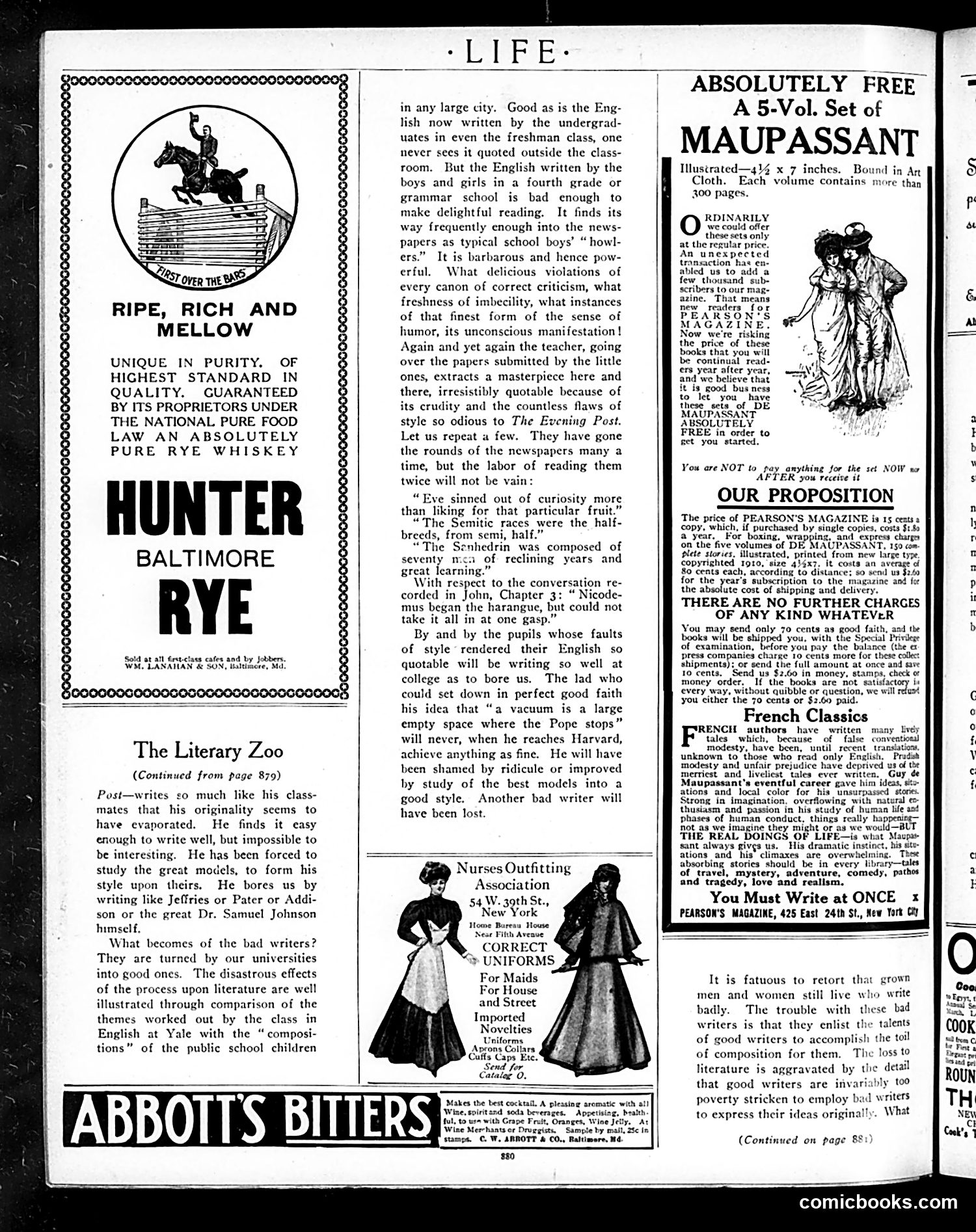
This excerpt critiques how university education ruins writers' natural talent. The author argues that while Yale undergraduates write *correctly*, they've become boring—their polish strips away originality. Conversely, grammar school children write *badly* but powerfully, with delightful unintentional humor. The satire's point: formal education teaches students to imitate established models (Jeffries, Pater, Addison, Johnson) so thoroughly that they lose spontaneity and voice. Examples of children's malapropisms—"Senhedrin was composed of seventy men of reclining years"—are presented as superior to polished mediocrity because they contain genuine, if accidental, wit. The piece laments that promising young writers, once trained into "good style," become tedious—another talented voice lost to academic conformity.
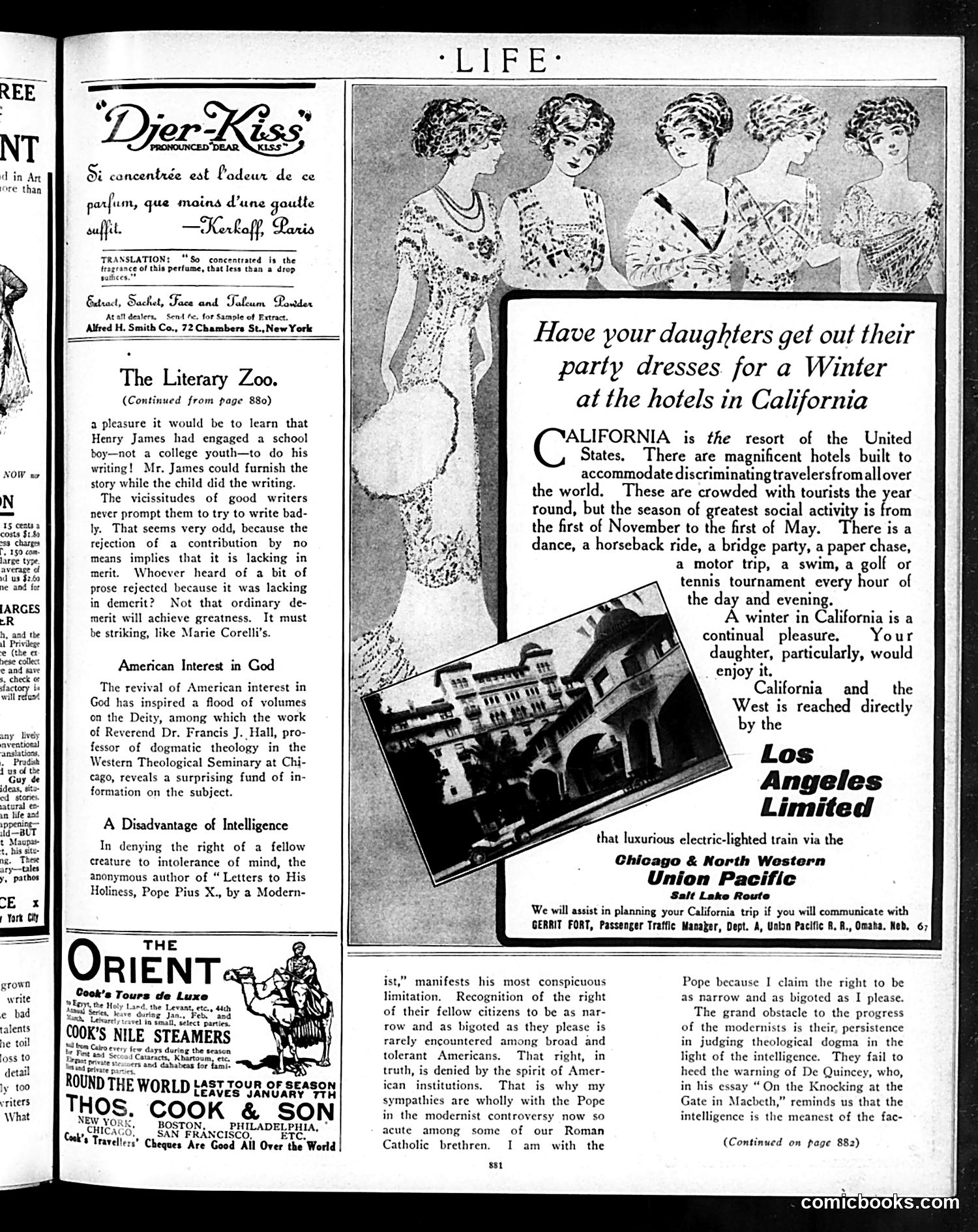
This page is primarily **advertising and literary content**, not political satire. The main elements are: **"Dier-Kiss" Perfume Ad**: A French luxury fragrance advertisement emphasizing extreme concentration—"so concentrated that less than a drop suffices." Typical of early 20th-century high-end product marketing. **"The Literary Zoo"** column: A literary criticism piece mocking Henry James and discussing the standards of good writing, touching on the paradox that rejection doesn't necessarily indicate poor merit. **"American Interest in God"**: A brief note on theological books, including Rev. Dr. Francis J. Hall's work on dogmatic theology. **"A Disadvantage of Intelligence"**: Commentary on a book of letters to Pope Pius X, arguing that American tolerance doesn't extend to allowing people to be "narrow and bigoted"—a subtle critique of modernist theology versus Catholic traditionalism. **California Winter Travel Advertisement**: The largest feature, promoting luxury California hotel resorts and the "Los Angeles Limited" train for affluent families seeking winter recreation. The page reflects **Edwardian-era genteel culture**: luxury goods, literary criticism, theological debate, and leisure travel for the wealthy.
This page is primarily **advertising and magazine promotion**, not political satire. It contains: **Main Content:** - A continuation of "The Literary Zoo," an essay by Alexander Harvey critiquing modernist intellectualism. Harvey argues ironically that God created unintelligent people (referencing Shakespeare's "ass" loved by Titania) as justly as He created Harvard professors, so society shouldn't privilege the intelligent in spiritual matters. **Advertisements:** - Cuba tourism promotion - P.B. Lager beer - Pooley Company (decorators/furnishers) **Magazine Promotion:** - Ainslee's Magazine announces its December issue, listing serialized fiction conclusions and Christmas stories by popular authors (William J. Locke, Anthony Partridge, etc.) **Historical Context for Modern Readers:** The essay reflects early 20th-century debates about modernism and religious authority. The satirical point: intellectuals shouldn't claim spiritual superiority since intelligence is unevenly distributed. This targets Progressive-era confidence in rational expertise applied to all domains, including religion.
This page is primarily **advertisements and reader letters**, not political satire. Key elements: **Letters Section ("From Our Readers"):** Two readers write to the editor. One advocates for sending a "suffragist" on Life's quest for "the Ultimate," sarcastically suggesting women's suffrage would impress even the Sphinx—a topical jab at the women's rights movement gaining momentum in 1910. The second letter criticizes Life's humor quality, complaining about a column called "Priscilla Jawbone" (apparently depicting a henpecked man or failed bachelor), suggesting Life's editorial standards have declined. **Advertisements:** The page features liqueur, Italian chocolates, shoes (Martin & Martin brand), and Dioxogen antiseptic/cleanser—typical early 1900s consumer products with hyperbolic marketing claims. **Poem "In Other Days and These":** A light verse about modern taxicab drivers "skinning" passengers financially, contrasting them with old-fashioned taxidermists who valued artistry. The page reflects 1910 concerns: women's suffrage debates, consumer culture, and tongue-in-cheek critiques of modern commercialism.
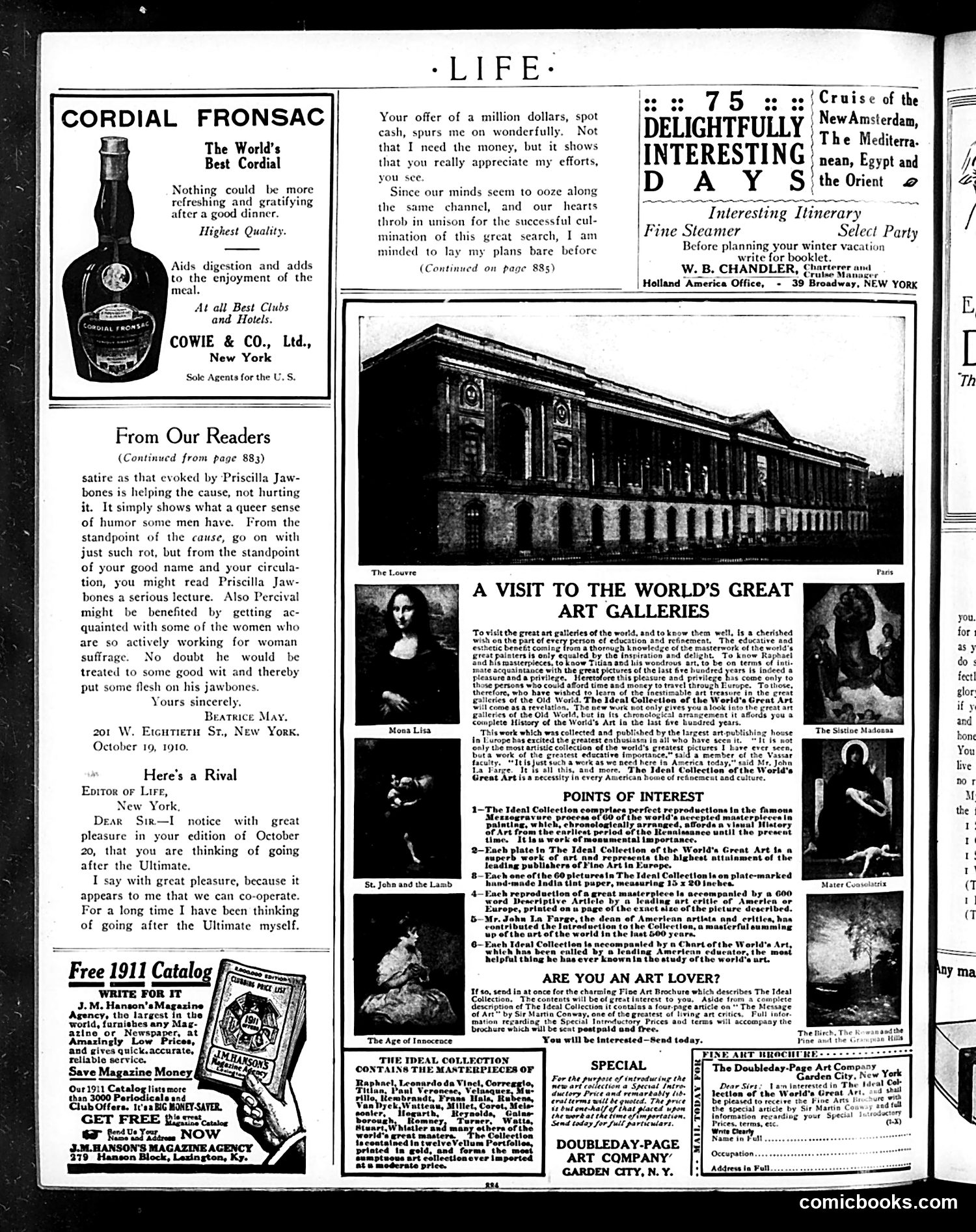
This page is primarily **advertising and reader mail**, not political satire. The substantive content includes: **Reader Letters**: The "From Our Readers" section addresses a letter from "Priscilla Jawbones" about woman suffrage. The correspondent defends Jawbones' satirical approach to advancing the suffrage cause, arguing that humor—even "queer" humor—helps the movement. This reflects early-1910s American women's voting rights activism. **Art Gallery Advertisements**: Large advertisements promote *The Ideal Collection*, a reproduction set of world masterpieces, and cruises to European art museums. These appeal to educated, affluent readers. **Product Advertising**: Cordial Fronsac liqueur is promoted with claims about digestion and refinement. The page reflects *Life*'s dual identity: satirical commentary mixed with advertisements targeting wealthy readers interested in culture, travel, and fine living.
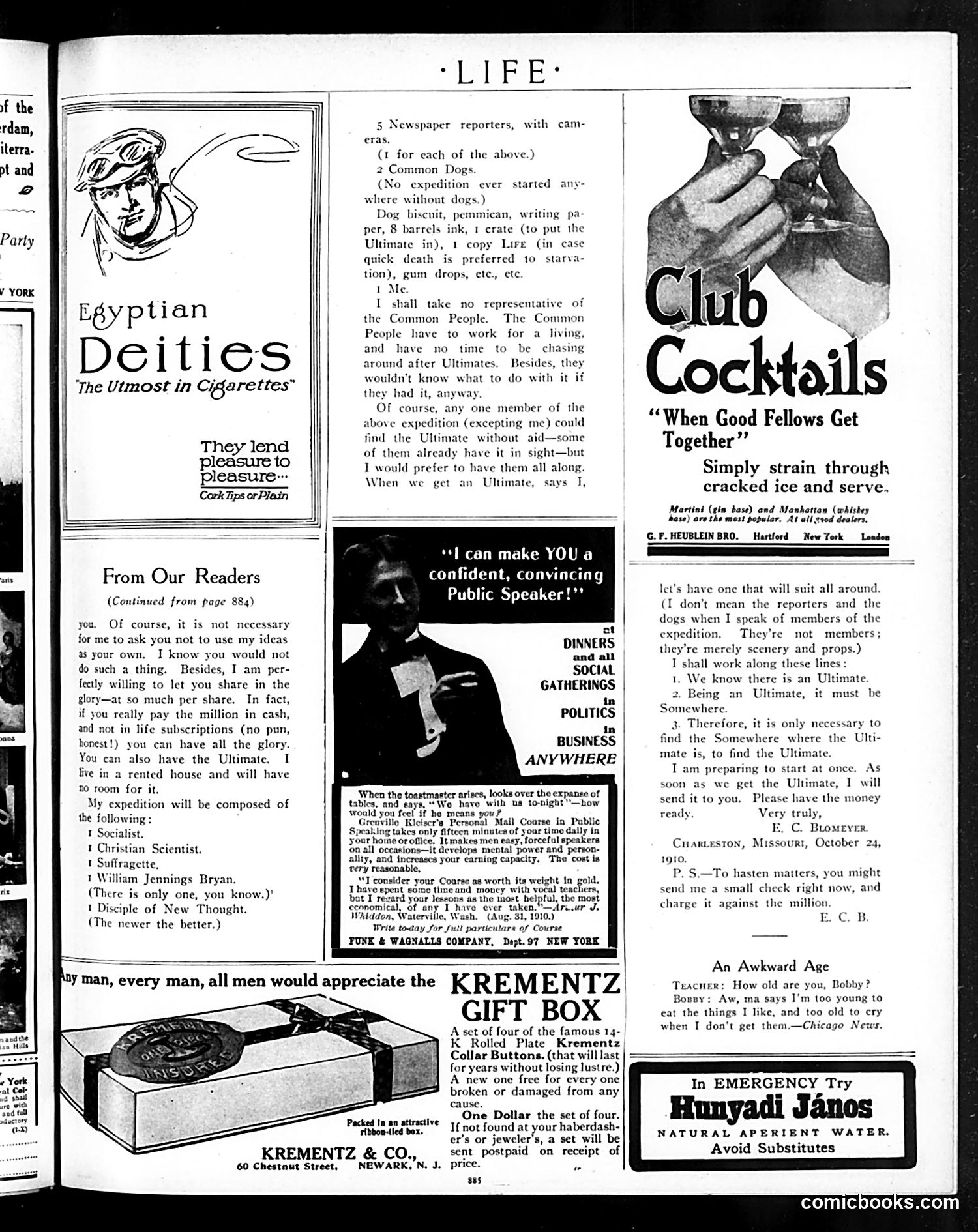
This page from Life (circa 1910, based on context clues) satirizes the era's obsession with grand expeditions and philosophical quests. The main piece is a humorous letter proposing an expedition to find "the Ultimate"—an absurdist concept representing whatever people desperately seek (success, happiness, meaning). The satire targets: 1. **Expedition hubris**: The writer lists mundane supplies (ink, dog biscuit, copies of Life magazine) alongside serious exploration gear, mocking the pretension of modern "discovery" quests. 2. **Class commentary**: He explicitly excludes "Common People" who "have to work for a living," satirizing how grand intellectual pursuits were luxury pastimes for the wealthy. 3. **Circular logic**: The "Ultimate" is defined through tautological reasoning—it exists somewhere, therefore we must find where it is—poking fun at pseudo-philosophical thinking. The accompanying advertisements (Egyptian cigarettes, public speaking courses, cocktail recipes) reinforce the page's theme: selling solutions to modern anxieties while life's actual "ultimate" remains elusive.
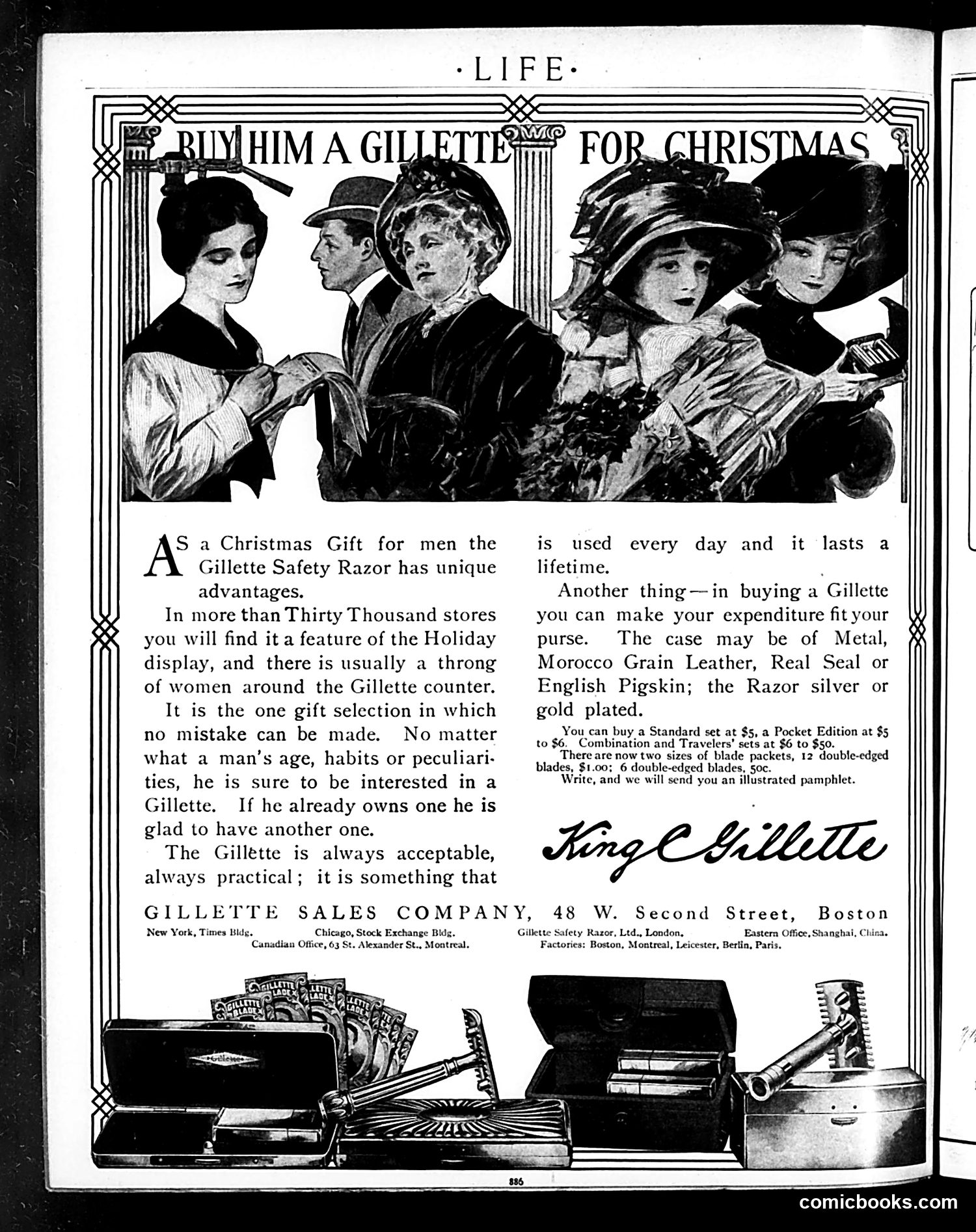
This is **not a satirical cartoon** but a **straight advertisement** for Gillette Safety Razors as Christmas gifts, appearing in *Life* magazine. The illustration shows well-dressed men and women (likely from the 1910s-1920s based on clothing and hats) gathered around a Gillette counter, emphasizing the product's popularity as a holiday gift. The text argues the razor is an ideal present because it's practical, universally useful, and comes in various price points ($5-$50 sets) and finishes (metal, leather, silver, gold-plated). The social assumption underlying this ad is revealing to modern readers: the advertisement targets **women as gift-buyers for men**, and emphasizes that a razor is a "safe" choice—"no mistake can be made"—suggesting women needed guidance selecting masculine gifts. The variety of luxury cases also reveals consumer stratification by wealth. This is simply a period advertisement reflecting early 20th-century marketing strategies and gender shopping norms, not satire.
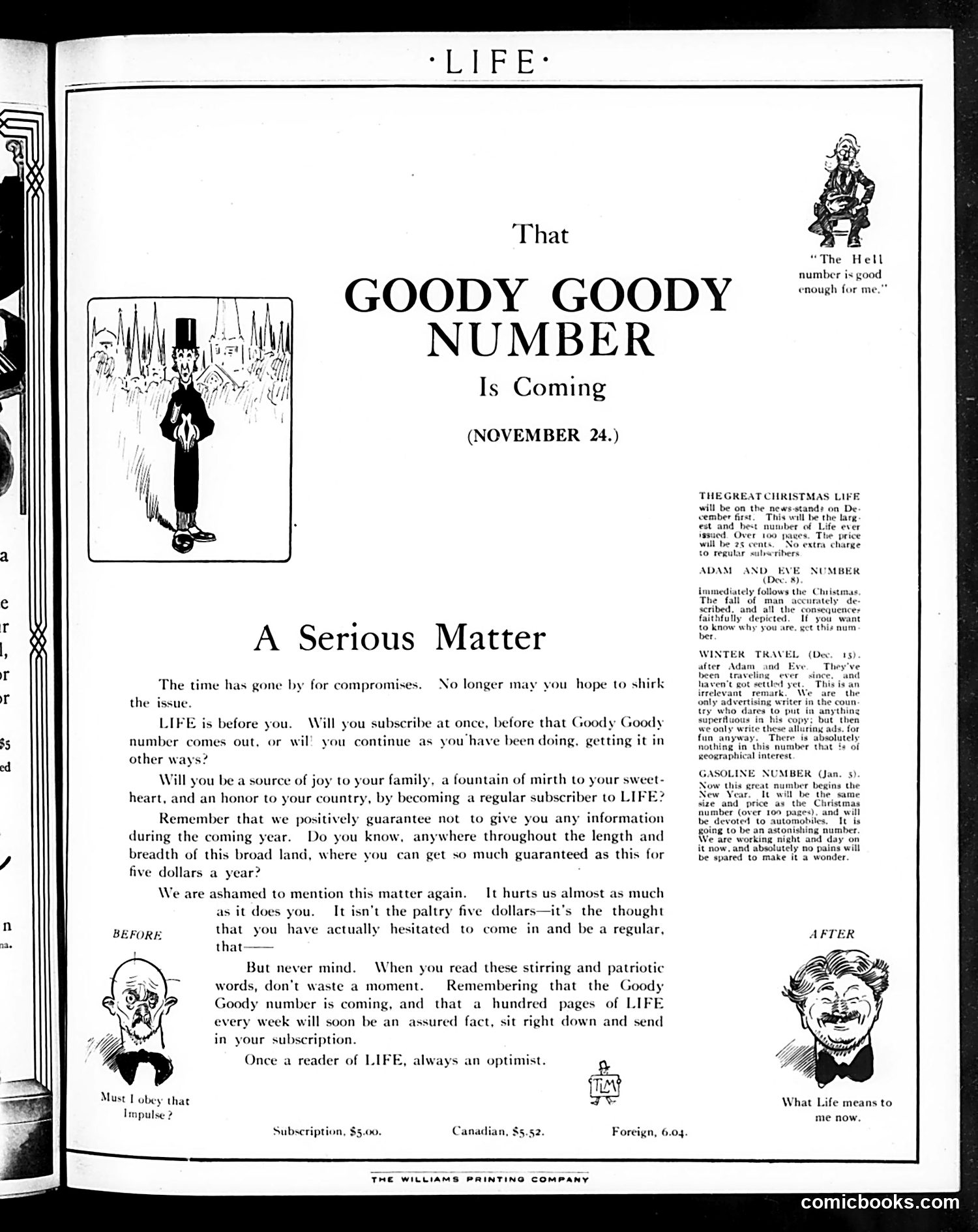
This is a **subscription solicitation page**, not a political cartoon. Life magazine is directly appealing to readers to become regular subscribers before the upcoming "Goody Goody Number" (November 24). The satire targets **reluctant, non-subscribing readers**. The page uses self-deprecating humor and emotional appeals: Life acknowledges it's "ashamed to mention this matter again" and that readers have "hesitated" to subscribe, yet emphasizes that for only $5 annually, subscribers receive guaranteed access to "a hundred pages of LIFE every week." The two illustrated faces ("Before" and "After") humorously contrast a skeptical, frowning face with a happy, grinning one—implying that subscription transforms one's outlook. The text promises upcoming special issues (Christmas, Adam and Eve, Winter Travel, Gasoline) as inducements. The overall tone is playful guilt-tripping: Life positions subscription as a patriotic duty and source of family joy, while poking fun at both the magazine's own desperation and readers' resistance to commitment.
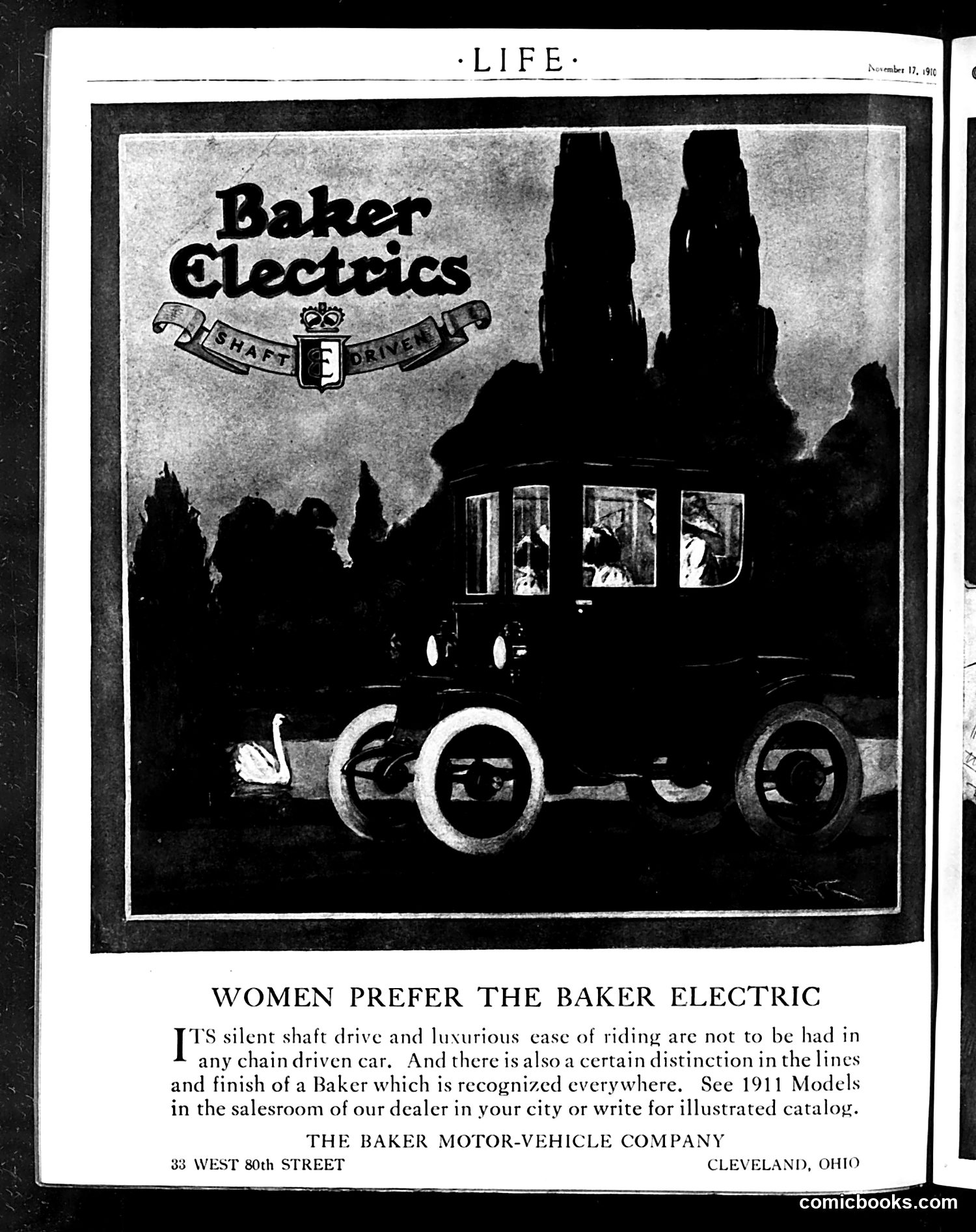
This is primarily a **car advertisement**, not political satire. The Baker Motor-Vehicle Company advertised their electric automobiles in *Life* magazine (November 17, 1910). The image shows a stylized Baker Electric automobile at night, silhouetted against illuminated buildings, with passengers visible through windows. A swan decorates the foreground, suggesting elegance. The advertisement targets women by emphasizing the car's "silent shaft drive" and "luxurious ease"—contrasting with chain-driven competitors that were reportedly noisier and rougher. The tagline "Women Prefer the Baker Electric" reflects early-1900s marketing that positioned electric cars as refined, quiet alternatives to gasoline vehicles, appealing to affluent female consumers who found hand-cranking and mechanical complexity off-putting. This reflects a historical moment when electric vehicles competed seriously with gasoline cars before eventually losing market dominance.