
Life, 1910-11-17 · page 26 of 44
Life — November 17, 1910 — page 26: what you’re looking at
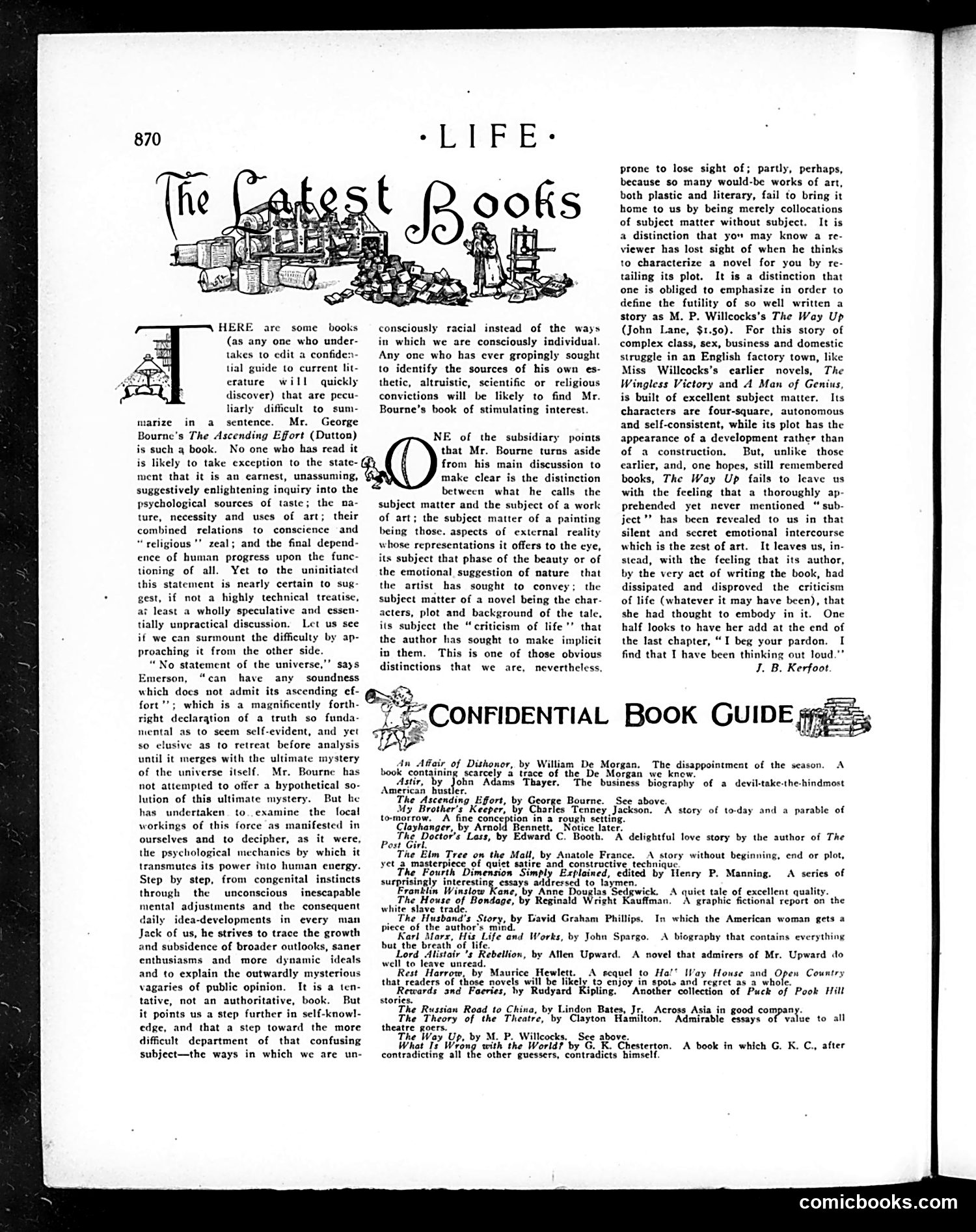
What you’re looking at
This is a **book review section**, not a political cartoon. The page features an essay by F.B. Kerfoot analyzing George Bourne's *The Ascending Effort*, a philosophical work examining psychology, taste, and human progress. The illustrated header "The Latest Books" uses decorative typography with stacked books and literary imagery—typical of early 20th-century magazine design. **Key content**: Kerfoot explains why Bourne's book is difficult to summarize, then clarifies its merit by quoting Emerson on "ascending effort" as a universal principle. He praises Bourne's examination of how psychological forces shape public opinion and aesthetic/religious convictions. The page also discusses Bourne's distinction between "subject matter" (plot, characters) and "subject" (the implicit "criticism of life") in art—a distinction Kerfoot notes readers commonly overlook. At bottom, a "Confidential Book Guide" lists contemporary titles for review. This is **literary criticism and advertising**, not satire or political commentary.
📄 Transcribed text from this page (OCR, searchable)
Machine-transcribed from the original scan — historical spelling and the odd misread are preserved.
HERE are some books (as any one who under- takes to edit a confiden- tial guide to current lit- erature will quickly discover) that are pecu- liarly difficult. to sum- marize in a sentence. Mr. George Bourne's The Ascending Effort (Dutton) is such a book. No one who has read it is likely to take exception to the state- ment that it is an earnest, unassuming, suggestively enlightening inquiry into the psychological sources of taste; the na- ture, necessity and uses of art; their combined relations to conscience and “ religious '’ zeal; and the final depend- ence of human progress upon the func- tioning of all. Yet to the uninitiated this statement is nearly certain to sug- gest, if not a highly technical treatise, least a wholly speculative and essen- tially unpractical discussion. Let us see if we can surmount the difficulty by ap- proaching it from the other side. No statement of the universe,’’ says Emerson, “can have any soundness which docs not admit its ascending ef- fort’; which is a magnificently forth- right declaration of a truth so funda- mental as to seem self-evident, and yet so ve as to retreat before analysis until it merges with the ultimate mystery of the universe itself, Mr. Bourne has not attempted to offer a hypothetical so- lution of this ultimate mystery. But he has undertaken to.examine the focal workings of this force as manifested in ourselves and to decipher, as it were, the psychological mechanics by which it transmutes its power into human energy. Step by step, from congenital instincts through the unconscious inescapable mental adjustments and the consequent idea-developments in every man Jack of us, he strives to trace the growth and subsidence of broader outlooks, saner enthusiasms and more dynamic ideals and to explain the outwardly mysterious vagaries of public opinion. It is a ten- tative, not an authoritative, book. But it points us a step further in self-know!- edge, and that a step toward the more difficult, department of that confusing subject—the ways in which we are un- consciously racial instead of the ways in which we are consciously individual. Any one who has ever gropingly sought to identify the sources of his own es- thetic, altruistic, scientific or religious convictions will be likely to find Mr. lating interest. Bourne’s book of st NE of the subsidiary points that Mr. Bourne turns aside from his main discussion to make clear is the distinction between what he calls the subject matter and the subject of a work of art; the subject matter of a painting being those. aspects of external reality whose representations it offers to the eye, its subject that phase of the beauty or of the emotional suggestion of nature that the artist has sought to conve; the subject matter of a novel being the char- acters, plot and background of the tale, its subject the “criticism of life’? that the author has sought to make implicit in them. This is one of those obvious distinctions that we are, nevertheless, oe. SS TE in Affair of Dishonor, by William De Morgan. book cont: Astir, by John Adams Thayer. American bustler. The Ascending Efort, by George Bourne. My Brother's Keeper, by Charles Tenney Jackson. ion in a rough setting. Notice later. A delightful love story by the author of The tomorrow. A fine conce Clayhanger, by Arnold Bennett. The Doctor's Lass, by Edward C. Booth. Post Girl. The Elm Tree on the Mall, by Anatole France. prone to lose sight of; partly, perhaps, because so many would-be works of art, both plastic and literary, fail to bring it home to us by being merely collocations of subject matter without subject. It is a distinction that yor may know a re- viewer has lost sight of when he thinks to characterize a novel for you by re- tailing its plot. It is a distinction that one is obliged to emphasize in order to define the futility of so well written a story as M. P. Willcocks’s The Way Up (John Lane, $1.50). For this story of complex class, sex, business and domestic struggle in an English factory town, like Miss Willcocks’s earlier novels, The Wingless Victory and A Man of Genius, is built of excellent subject matter. Its characters are four-square, autonomous and self-consistent, while its plot has the appearance of a development rather than of a construction, But, unlike those earlier, and, one hopes, still remembered books, The Way Up fails to leave us with the feeling that a thoroughly ap- prehended yet never mentioned “ sub- ject’? has been revealed to us in that silent and secret emotional intercourse which is the zest of art. It leaves us, in- stead, with the feeling that its author, by the very act of writing the book, had dissipated and disproved the criticism of life (whatever it may have been), that she had thought to embody in it. One half looks to have her add at the end of the last chapter, “I beg your pardon. I find that I have been thinking out loud."’ J. B. Kerfoot. &CONFIDENTIAL BOOK GUIDE ais, The disappointment of the season. A ining scarcely a trace of the De Morgan we know. ‘The business biography of a devil-take-the-hindmost See above. ‘A story of to-day and a parable of A story without beginning, end or plot, yet a masterpiece of quiet satire and constructive technique The Fourth Dimension Simpl; Franklin Winslow white slave trade, The Husband's Story, by Gavid Graham Phillips. piece of the author's mind. Karl Marz, His Life and Works, by John Spargo. but the breath’ of life. Lord Alistair ’s Rebellion, by Allen Upward. well to leave unread. Rest Harrow, by Maurice Hewlett. Rewards and Faeries, by Rudyard stories. The Russian Road to China, by Lindon Bates, Jr, The Theory of the Theatre, by Clayton Hamilton. See above. What Is Wrong with the World? by G. K. Chesterton. ¢ other guessers, contradicts himself. theatre goers. The Way Up, by M. P. Willcocks. contradicting all 1 h r Cn Explained, edited by Henry P. Manning. surprisingly interesting essays arldressed to laymen. ‘ane, by Anne Douglas Sedgwick. A The House of Bondage, by Reginald Wright A series of quiet tale of excellent quality. aufiman. A graphic fictional report on the In which the American woman gets a A biography that contains everything A novel that admirers of Mr. Upward do Hewlett. A sequel to Ha!’ Way House and Open Country that readers of those novels will be likely to enjoy in spots and Ripling. regret asa whole. Another collection of Puck of Pook Hill Across Asia in good company. ‘Admirable essays of value to all A book in which G. K. C., after comicbooks.com