
Life, 1910-11-17 · page 27 of 44
Life — November 17, 1910 — page 27: what you’re looking at
What you’re looking at
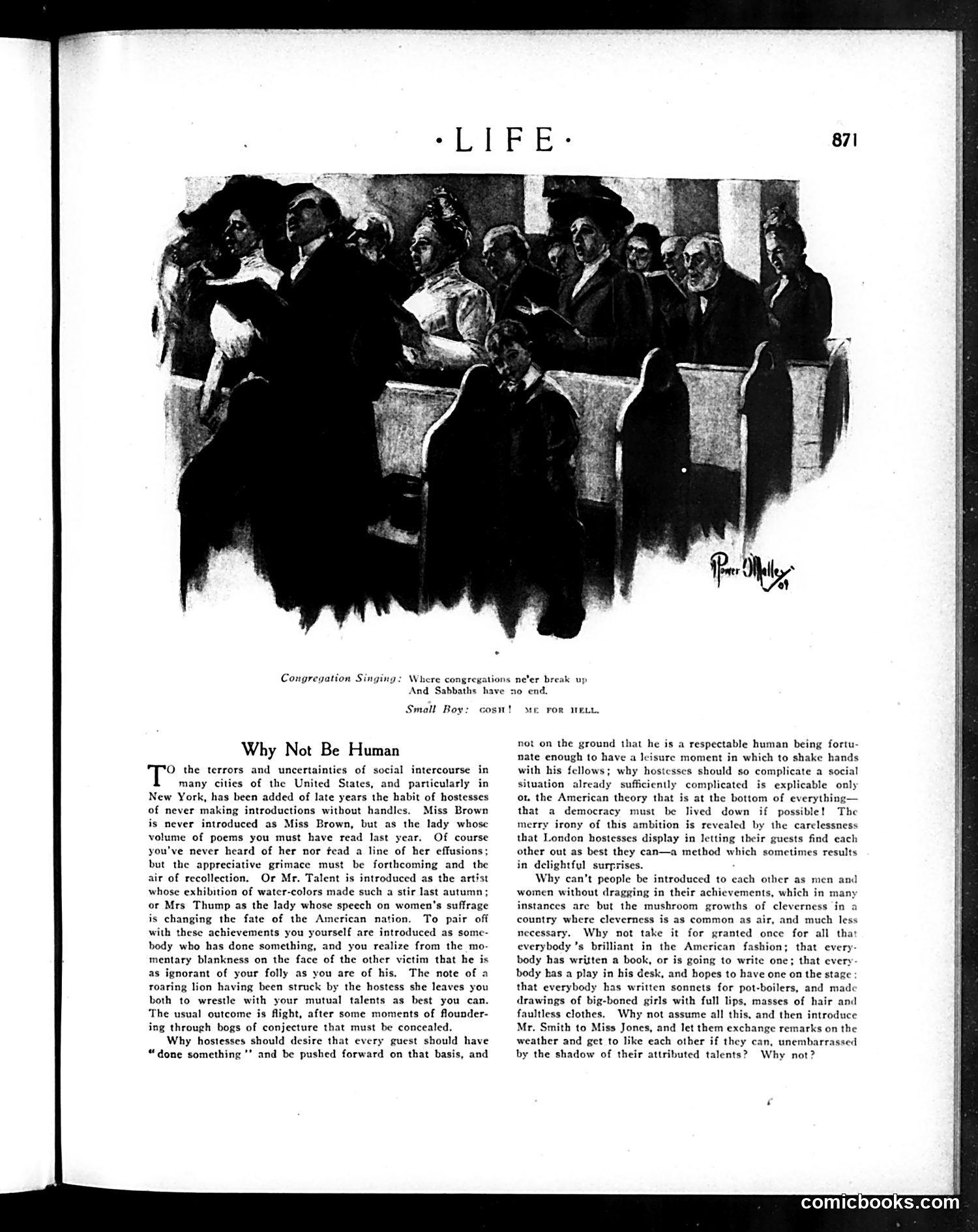
This article satirizes an affectation of upper-class American (especially New York) hostesses: introducing guests not by name alone, but by their alleged accomplishments—"the lady whose volume of poems" or "the artist whose water-colors made a stir." The author mocks this practice as pretentious and awkward. Guests are forced to feign familiarity with strangers' obscure work, creating uncomfortable social theater. The piece contrasts this with London hostesses, who simply introduce people as people, allowing genuine connection. The satire's core point: American democratic ambition has made even casual socializing competitive and achievement-obsessed. The author argues people should be valued simply as "respectable human beings" worthy of conversation, not as repositories of credentials. The cartoon above—showing a congregation in a pew—likely illustrates how such forced social interactions feel as interminable as endless church services.
📄 Transcribed text from this page (OCR, searchable)
Machine-transcribed from the original scan — historical spelling and the odd misread are preserved.
Congregation Singing: Where congregations ne'er break up And Sabbaths have no end. Small Boy: Why Not Be Human T° the terrors and uncertainties of social intercourse in many cities of the United States, and particularly in New York, has been added of late years the habit of hostesses of never making introductions without handles. Miss Brown is never introduced as Miss Brown, but as the lady whose volume of poems you must have read last year. Of course you've never heard of her nor fead a line of her effusions; but the appreciative grimace must be forthcoming and the air of recollection, Or Mr. Talent is introduced as the artist whose exhibition of water-colors made such a stir last autumn; or Mrs Thump as the lady whose speech on women's suffrage is changing the fate of the American nation. To pair off with these achievements you yourself are introduced as some- body who has done something, and you realize from the mo- mentary blankness on the face of the other victim that he is as ignorant of your folly as you are of his. The note of a roaring lion having been struck by the hostess she leaves you both to wrestle with your mutual talents as best you can. The usual outcome is Aight, after some moments of flounder- ing through bogs of conjecture that must be concealed. Why hostesses should desire that every guest should have “done something" and be pushed forward on that basis, and Me FOR WELL, not on the ground that he is a respectable human being fortu- nate enough to have a Icisure moment in which to shake hands with his {cllows; why hostesses should so complicate a social situation already sufficiently complicated is explicable only or. the American theory that is at the bottom of everything— that a democracy must be lived down if possible! The merry irony of this ambition is revealed by the carelessness that London hostesses display in letting their guests find each other out as best they can—a method which sometimes results in delightful surprises. Why can’t people be introduced to each other as men and women without dragging in their achievements, which in many instances are but the mushroom growths of cleverness in a country where cleverness is as common as air, and much less necessary. Why not take it for granted once for all that everybody ’s brilliant in the American fashion; that every body has written a book, or is going to write one; that every body has a play in his desk, and hopes to have one on the stage that everybody has written sonnets for pot-boilers, and madc drawings of big-boned girls with full lips, masses of hair and faultless clothes. Why not assume all this, and then introduce Mr. Smith to Miss Jones, and let them exchange remarks on the weather and get to like each other if they can, unembarrassed by the shadow of their attributed talents? Why not? comicbooks.com