
Life, 1910-11-17 · page 10 of 44
Life — November 17, 1910 — page 10: what you’re looking at
What you’re looking at
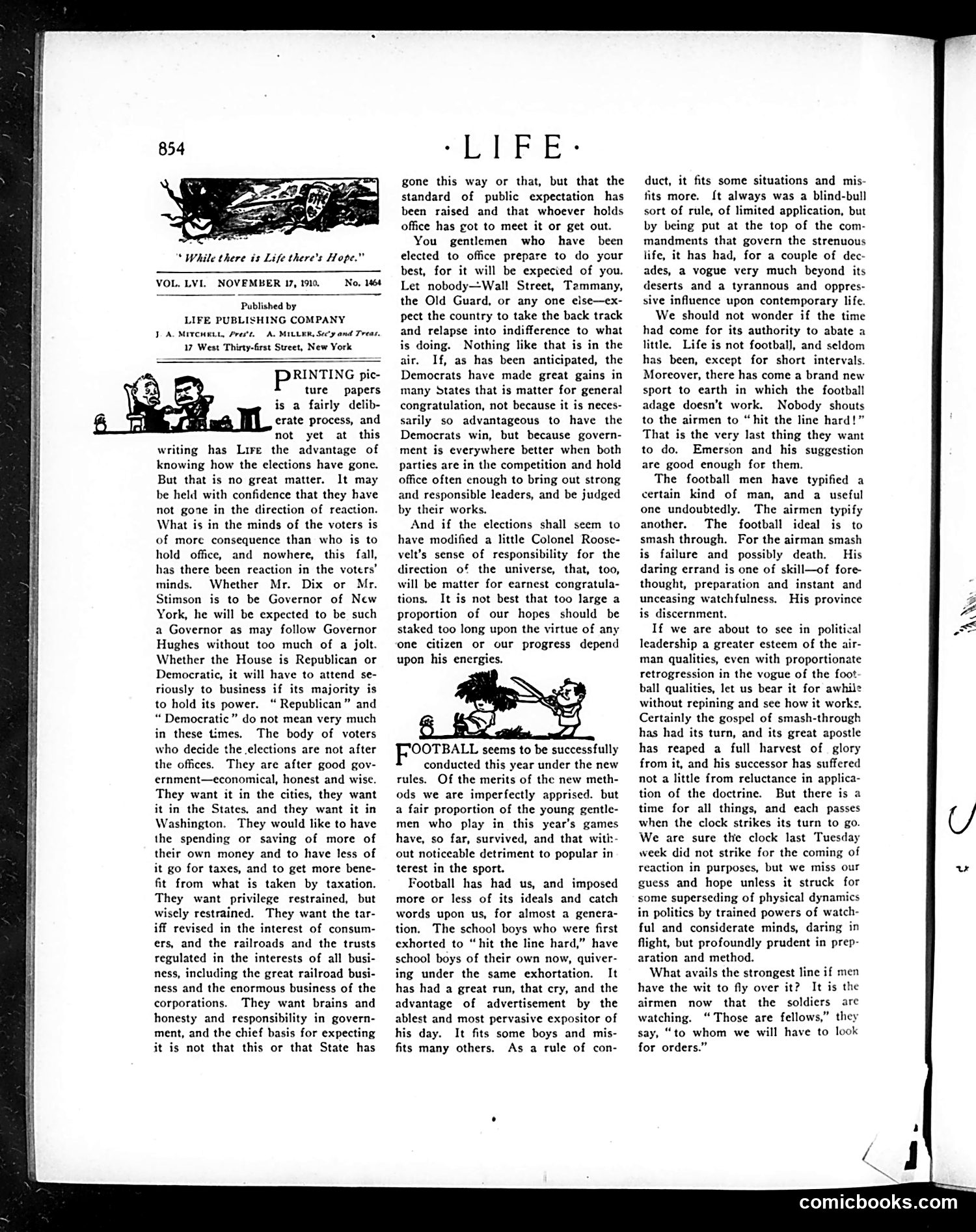
This page discusses the 1912 U.S. elections and football, with two small editorial cartoons. **The Political Cartoon (top):** Shows printing press machinery, illustrating the article's point about Life's editorial advantage: knowing "how the elections have gone" before printing. This references Life's ability to comment on election results with timeliness. **The Football Cartoon (bottom):** Depicts two figures in a rough collision or tackle, supporting the text's discussion of football's "smash through" ideology and its appeal to American youth. The cartoon illustrates the physical, aggressive nature the article criticizes in the sport's cultural influence. Both cartoons are simple, functional illustrations supporting the editorial content rather than standalone jokes. The page reflects early 20th-century concerns about athletics' role in character formation and democratic participation.
📄 Transcribed text from this page (OCR, searchable)
Machine-transcribed from the original scan — historical spelling and the odd misread are preserved.
* While there is Life there's Hope.” VOL, LVI. NOVEMBER 17,1910. No, 1464 Published by LIFE PUBLISHING COMPANY JA MITCHELL, Press. A. MILLER, See’y and Treas. 17 West Thirty-first Street, New York RINTING pic- ture papers is a fairly delib- erate process, and not yet at this writing has Lire the advantage of knowing how the elections have gone. But that is no great matter. It may be held with confidence that they have not gone in the direction of reaction. What is in the minds of the voters is of more consequence than who is to hold office, and nowhere, this fall, has there been reaction in the voters’ minds. Whether Mr. Dix or Mr. Stimson is to be Governor of New York, he will be expected to be such a Governor as may follow Governor Hughes without too much of a jolt. Whether the House is Republican or Democratic, it will have to attend se- riously to business if its majority is to hold its power. “ Republican” and “ Democratic” do not mean very much in these times. The body of voters who decide the elections are not after the offices. They are after good gov- ernment—economical, honest and wise. They want it in the cities, they want it in the States, and they want it in Washington. They would like to have the spending or saving of more of their own money and to have less of it go for taxes, and to get more bene- fit from what is taken by taxation. They want privilege restrained, but wisely restrained. They want the tar- iff revised in the interest of consum- ers, and the railroads and the trusts regulated in the interests of all busi- ness, including the great railroad busi- ness and the enormous business of the corporations. They want brains and honesty and responsibility in govern- ment, and the chief basis for expecting it is not that this or that State has fe Pak * gone this way or that, but that the standard of public expectation has been raised and that whoever holds office has got to meet it or get out. You gentlemen who have been elected to office prepare to do your best, for it will be expecied of you. Let nobody—Wall Street, Tammany, the Old Guard, or any one else—ex- pect the country to take the back track and relapse into indifference to what is doing. Nothing like that is in the air. If, as has been anticipated, the Democrats have made great gains in many States that is matter for general congratulation, not because it is neces- sarily so advantageous to have the Democrats win, but because govern- ment is everywhere better when both parties are in the competition and hold office often enough to bring out strong and responsible leaders, and be judged by their works. And if the elections shall seem to have modified a little Colonel Roose- velt’s sense of responsibility for the direction of the universe, that, too, will be matter for earnest congratula- tions. It is not best that too large a proportion of our hopes should be staked too long upon the virtue of any one citizen or our progress depend upon his energies. PeOOEBALE seems to be successfully conducted this year under the new tules. Of the merits of the new meth- ods we are imperfectly apprised. but a fair proportion of the young gentle- men who play in this year’s games have, so far, survived, and that with:- out noticeable detriment to popular in terest in the sport. Football has had us, and imposed more or less of its ideals and catch words upon us, for almost a genera- tion. The school boys who were first exhorted to “hit the line hard,” have school boys of their own now, quiver- ing under the same exhortation. It has had a great run, that cry, and the advantage of advertisement by the ablest and most pervasive expositor of his day. It fits some boys and mis- fits many others. As a rule of con- duct, it fits some situations and mis- fits more. {t always was a blind-bull sort of rule, of limited application, but by being put at the top of the com- mandments that govern the strenuous life, it has had, for a couple of dec- ades, a vogue very much beyond its deserts and a tyrannous and oppres- sive influence upon contemporary life. We should not wonder if the time had come for its authority to abate a little. Life is not football, and seldom has been, except for short intervals. Moreover, there has come a brand new sport to earth in which the football adage doesn’t work. Nobody shouts to the airmen to “hit the line hard!” That is the very last thing they want to do. Emerson and his suggestion are good enough for them. The football men have typified a certain kind of man, and a useful one undoubtedly. The airmen typify another. The football ideal is to smash through. For the airman smash is failure and possibly death. His daring errand is one of skill—of fore- thought, preparation and instant and unceasing watchfulness. His province is discernment. If we are about to see in political leadership a greater esteem of the air- man qualities, even with proportionate retrogression in the vogue of the foot ball qualities, let us bear it for awhil without repining and see how it works. Certainly the gospel of smash-through has had its turn, and its great apostle has reaped a full harvest of glory from it, and his successor has suffered not a little from reluctance in applica- tion of the doctrine. But there is a time for all things, and each passes when the clock strikes its turn to go. We are sure the clock last Tuesday week did not strike for the coming of reaction in purposes, but we miss our guess and hope unless it struck for some superseding of physical dynamics in politics by trained powers of watch- ful and considerate minds, daring in flight, but profoundly prudent in prep- aration and method. What avails the strongest line if men have the wit to fly over it? It is the airmen now that the soldiers are watching. “Those are fellows,” they say, “to whom we will have to look for orders.” u comicbooks.com