
Life, 1910-11-17 · page 20 of 44
Life — November 17, 1910 — page 20: what you’re looking at
What you’re looking at
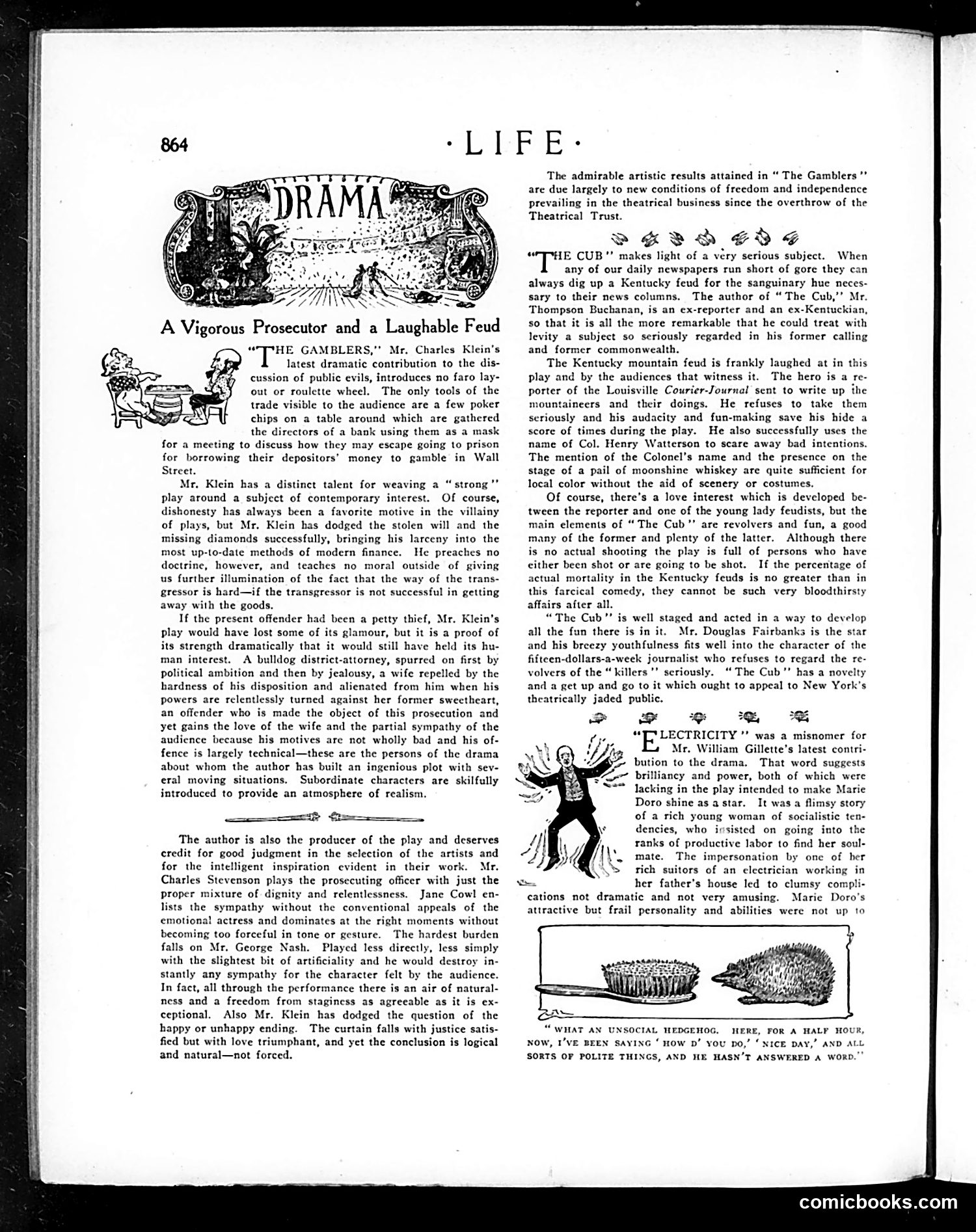
This page reviews two plays: **"The Gamblers"** by Charles Klein and **"The Cub"** by Thompson Buchanan. **"The Gamblers"** depicts bank directors using poker chips as cover while scheming to steal depositors' money for Wall Street gambling—a contemporary financial scandal. The review praises Klein's modern approach to crime drama, avoiding clichéd plots (stolen wills, missing diamonds) for timely white-collar theft. The cast, including Jane Cowl, is praised for naturalistic acting. **"The Cub"** satirizes newspaper sensationalism. Buchanan, a former reporter and Kentuckian, ironically treats Kentucky feuds—historically serious matters—as comedic newspaper filler. The review notes this levity seems incongruous given the actual violence of such feuds. Both reviews celebrate the "overthrow of the Theatrical Trust," indicating recent industry deregulation freed playwrights from corporate censorship. The small illustrations (hedgehog dialogue) appear to be unrelated decorative elements typical of Life's satirical format.
📄 Transcribed text from this page (OCR, searchable)
Machine-transcribed from the original scan — historical spelling and the odd misread are preserved.
LEEE A Vigorous preeoae and a Laughable Feud HE GAMBLERS," Mr. Charles Klein's latest dramatic contribution to the dis- cussion of public evils, introduces no faro lay- out or roulette wheel. The only tools of the trade visible to the audience are a few poker chips on a table around which are gathered the directors of a bank using them as a mask for a meeting to discuss how they may escape going to prison for borrowing their depositors’ money to gamble in Wall Street. Mr. Klein has a distinct talent for weaving a “ strong ’’ play around a subject of contemporary interest. Of course, dishonesty has always been a favorite motive in the villainy of plays, but Mr, Klein has dodged the stolen will and the missing diamonds successfully, bringing his larceny into the most up-to-date methods of modern finance. He preaches no doctrine, however, and teaches no moral outside of giving us further illumination of the fact that the way of the trans- gressor is hard—if the transgressor is not successful in getting away with the goods. If the present offender had been a petty thief, Mr. Klein’s play would have lost some of its glamour, but it is a proof of its strength dramatically that it would still have held its hu- man interest. A bulldog district-attorney, spurred on first by political ambition and then by jealousy, a wife repelled by the hardness of his disposition and alienated from him when his powers are relentlessly turned against her former sweetheart, an offender who is made the object of this prosecution and yet gains the love of the wife and the partial sympathy of the audience because his motives are not wholly bad and his of- fence is largely technical—these are the persons of the drama about whom the author has built an ingenious plot with sev- eral moving situations, Subordinate characters are skilfully introduced to provide an atmosphere of realism. eee OS The author is also the producer of the play and deserves credit for good judgment in the selection of the artists and for the intelligent inspiration evident in their work. Mr. Charles Stevenson plays the prosecuting officer with just the proper mixture of dignity and relentlessness. Jane Cowl en- lists the sympathy without the conventional appeals of the emotional actress and dominates at the right moments without becoming too forceful in tone or gesture. The hardest burden falls on Mr. George Nash. Played less directly, less simply with the slightest bit of artificiality and he would destroy in- stantly any sympathy for the character felt by the audience. In fact, all through the performance there is an air of natural- ness and a freedom from stagincss as agreeable as it is ex- ceptional. Also Mr. Klein has dodged the question of the happy or unhappy ending. The curtain falls with justice satis- fied but with love triumphant, and yet the conclusion is logical and natural—not forced. The admirable artistic results attained in “‘ The Gamblers ”’ are due largely to new conditions of freedom and independence prevailing in the theatrical business since the overthrow of the Theatrical Trust. 2 &ZBZAd EY 1E CUB" makes light of a véry serious subject. When any of our daily newspapers run short of gore they can always dig up a Kentucky feud for the sanguinary hue neces- sary to their news columns. The author of “The Cub,’’ Mr. Thompson Buchanan, is an ex-reporter and an ex-Kentuckian, so that it is all the more remarkable that he could treat with levity a subject so seriously regarded in his former calling and former commonwealth, The Kentucky mountain feud is frankly laughed at in this play and by the audiences that witness it. The hero is a re- porter of the Louisville Courier-Journal sent to write up the mountaineers and their doings. He refuses to take them seriously and his audacity and fun-making save his hide a score of times during the play. He also successfully uses the name of Col. Henry Watterson to scare away bad intentions. The mention of the Colonel’s name and the presence on the stage of a pail of moonshine whiskey are quite sufficient for local color without the aid of scenery or costumes. Of course, there’s a love interest which is developed be- tween the reporter and one of the young lady feudists, but the main elements of “ The Cub’? are revolvers and fun, a good many of the former and plenty of the latter. Although there is no actual shooting the play is full of persons who have cither been shot or are going to be shot. If the percentage of actual mortality in the Kentucky feuds is no greater than in this farcical comedy, they cannot be such very bloodthirsty affairs after all. “The Cub’’ is well staged and acted in a way to develop all the fun there is in it. Mr. Douglas Fairbanks is the star and his breezy youthfulness fits well into the character of the fifteen-dollars-a-week journalist who refuses to regard the re- volvers of the “killers ’’ scriously. ‘‘ The Cub’ has a novelty and a get up and go to it which ought to appeal to New York's theatrically jaded public. LECTRICITY "’ was a misnomer for Mr. William Gillette's latest contri- bution to the drama. That word suggests brilliancy and power, both of which were lacking in the play intended to make Marie Doro shine as a star. It was a flimsy story of a rich young woman of socialistic ten- dencies, who insisted on going into the ranks of productive labor to find her soul- mate. The impersonation by one of her rich suitors of an electrician working in we her father’s house led to clum! cations not dramatic and not very amusing. Marie Doro’s attractive but frail personality and abilities were not up to s HEDGEHOG. MERE, FOR A HALF HOUR, NOW, I/VE BEEN SAYING ‘ HOW D’ YoU DO,’ ‘NICE DAY,’ AND ALL SORTS OP POLITE THINGS, AND HE HASN’T ANSWERED A WORD.” comicbooks.com