
Life, 1910-11-17 · page 25 of 44
Life — November 17, 1910 — page 25: what you’re looking at
What you’re looking at
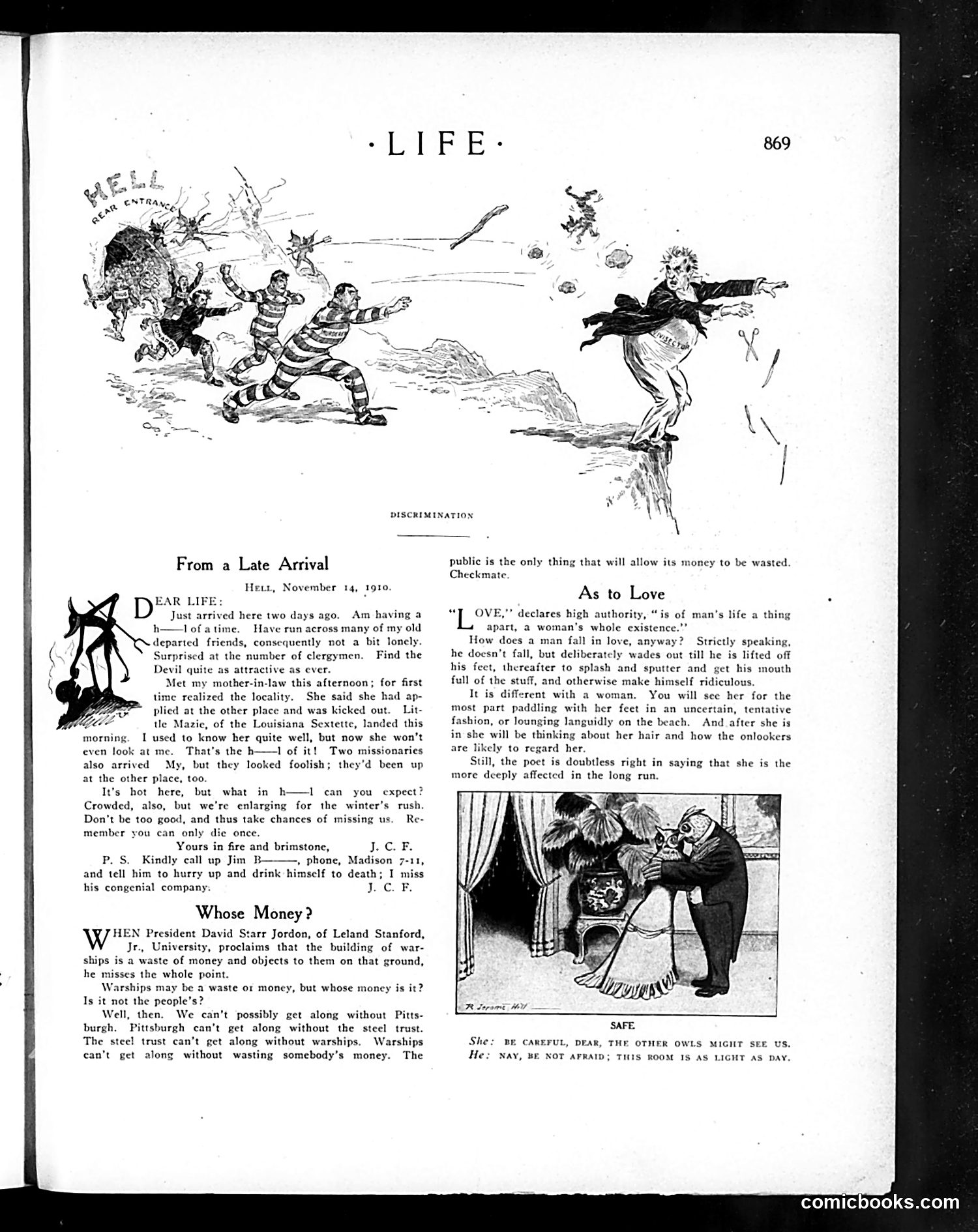
This page contains three satirical pieces typical of *Life* magazine's social commentary: **"From a Late Arrival"** is a darkly comic letter from someone in Hell, describing encounters with the damned—including clergymen, a dancer ("Little Mazie"), and missionaries. The joke hinges on the irreverent 1910s conceit that Hell is crowded with "respectable" people, undermining moral hypocrisy. **"Whose Money?"** critiques President David Starr Jordan's pacifist objection to warship construction. The satirist argues that while wasteful, warships funnel money through Pittsburgh's steel industry—creating an ironic chain where the public ultimately funds military spending they cannot control. It's a cynical commentary on industrial capitalism and military-industrial interdependence. **"As to Love"** presents contrasting gender stereotypes: men "fall" into love messily and ridiculously; women wade in cautiously, preoccupied with appearance. The accompanying illustration shows a couple in a darkened room, with sexual innuendo in their exchange about "light." All three pieces reflect *Life's* early-1900s satirical voice: irreverent toward authority, cynical about economic systems, and somewhat risqué regarding sexuality.
📄 Transcribed text from this page (OCR, searchable)
Machine-transcribed from the original scan — historical spelling and the odd misread are preserved.
DISCRIMINATION From a Late Arrival Heit, November 14, 1910. EAR LIF . Just arrived here two days ago. h—1 of atime. Am having a Have run across many of my old departed friends, consequently not a bit lonely. Surpri: at the number of clergymen. Find the Devil quite as attractive as ever. Met my mother-in-law this afternoon; for first time realized the locality. She said she had ap- plied at the other place and was kicked out. Lit- tle Mazie, of the Louisiana Sextette, landed this morning. I used to know her quite well, but now she won’t even look at me. That's the h——1 of it! Two missionaries also arrived My, but they looked foolish; they'd been up at the other place, too. It’s hot here, but what in h—l can you expect? Crowded, also, but we're enlarging for the winter's rush. Don't be too good, and thus take chances of missing us. Re- member you can only die once. Your: fire and brimstone, J.C F. P. S. Kindly call up Jim B——, phone, Madison 7-11, and tell him to hurry up and drink himself to death; I miss his congenial company: Sc: Whose Money ? HEN President David Starr Jordon, of Leland Stanford, Jr., University, proclaims that the building of war- ships is a waste of money and objects to them on that ground, he misses the whole point. Warships may be a waste or money, but whose moncy is it? Is it not the people's? Well, then. We can't possibly get along without Pitts- burgh. Pittsburgh can’t get along without the steel trust. The steel trust can’t get along without warships. Warships can't get along without wasting somebody’s money. The public is the only thing that will allow its money to be wasted. Checkmate As to Love “] OVE,” declares high authority, “is of man’s life a thing apart, a woman's whole existence.”” How does a man fall in love, anyway? Strictly speaking, he doesn't fall, but deliberately wades out till he is lifted off his feet, thereafter to splash and sputter and get his mouth full of the stuff, and otherwise make himself ridiculous. It is different with a woman. You will see her for the most part paddling with her feet in an uncertain, tentative fashion, or lounging languidly on the beach. And after she is in she will be thinking about her hair and how the onlookers are likely to regard her. Still, the poet is doubtless right in saying that she is the more deeply affected in the long run. PR Lepsm® HY She: He: BE CAREFUL, DEAR, THE OTHER OWLS MIGHT SEE US. NAY, BE NOT AFRAID; THIS ROOM IS AS LIGHT AS DAY. comicbooks.com