
A complete issue · 44 pages · 1910
Life — November 10, 1910
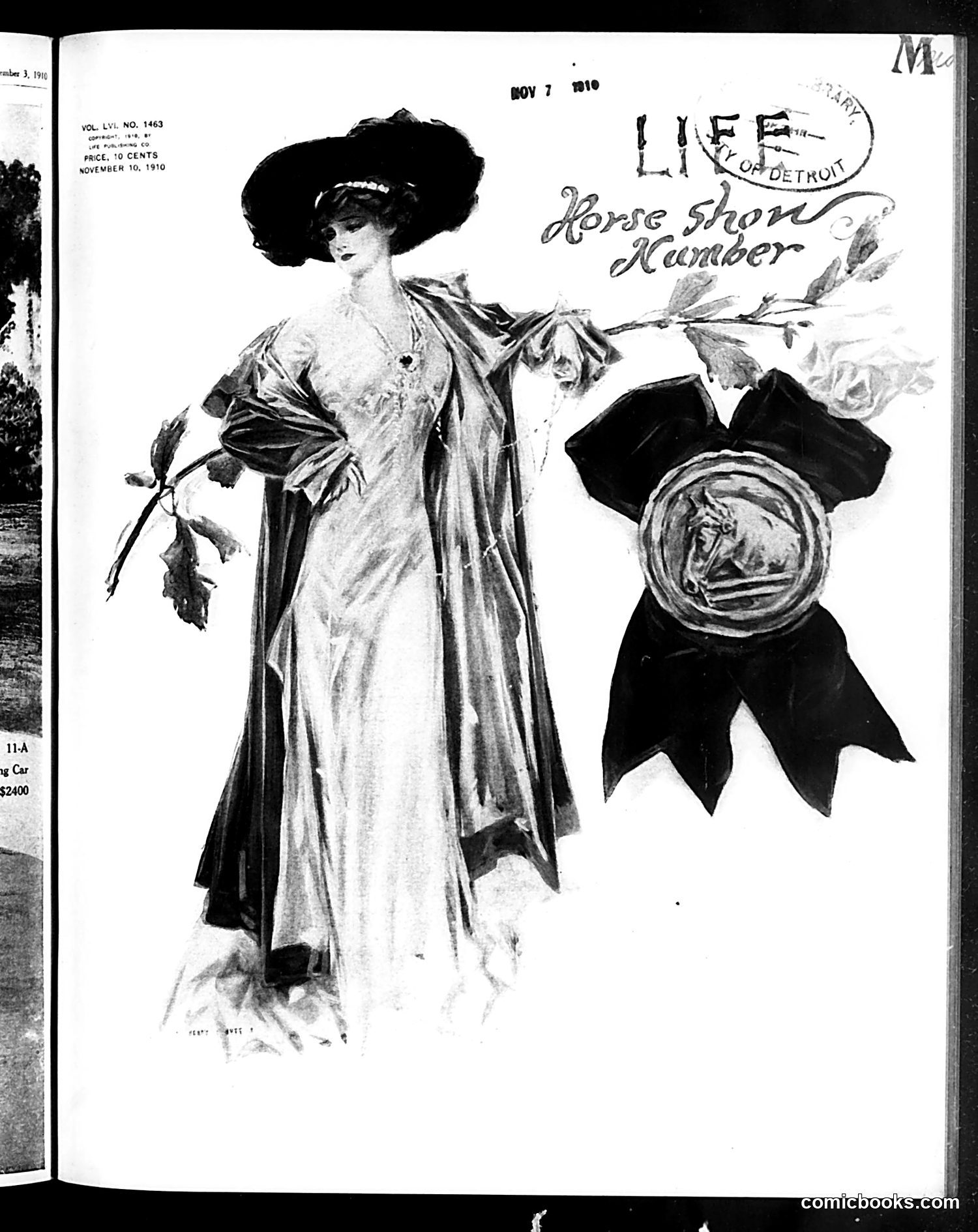
This is a magazine cover titled "Horse Show Number," featuring an elegant Edwardian-era woman in an elaborate gown and wide-brimmed hat holding a wilted rose. She wears a dark jacket draped over a light dress—fashionable attire of the period. The accompanying medal or ribbon with a bow on the right side appears to be a satirical prize or award, likely mocking participants in horse shows of the era. The wilted rose she holds—traditionally symbolizing romance or beauty—has been reduced to a drooping, faded state, suggesting satire about the artificiality or decline of elegance in such social events. The cover satirizes the pretensions and fashionable excess surrounding high-society horse show competitions, a major social event for wealthy Americans in 1910.
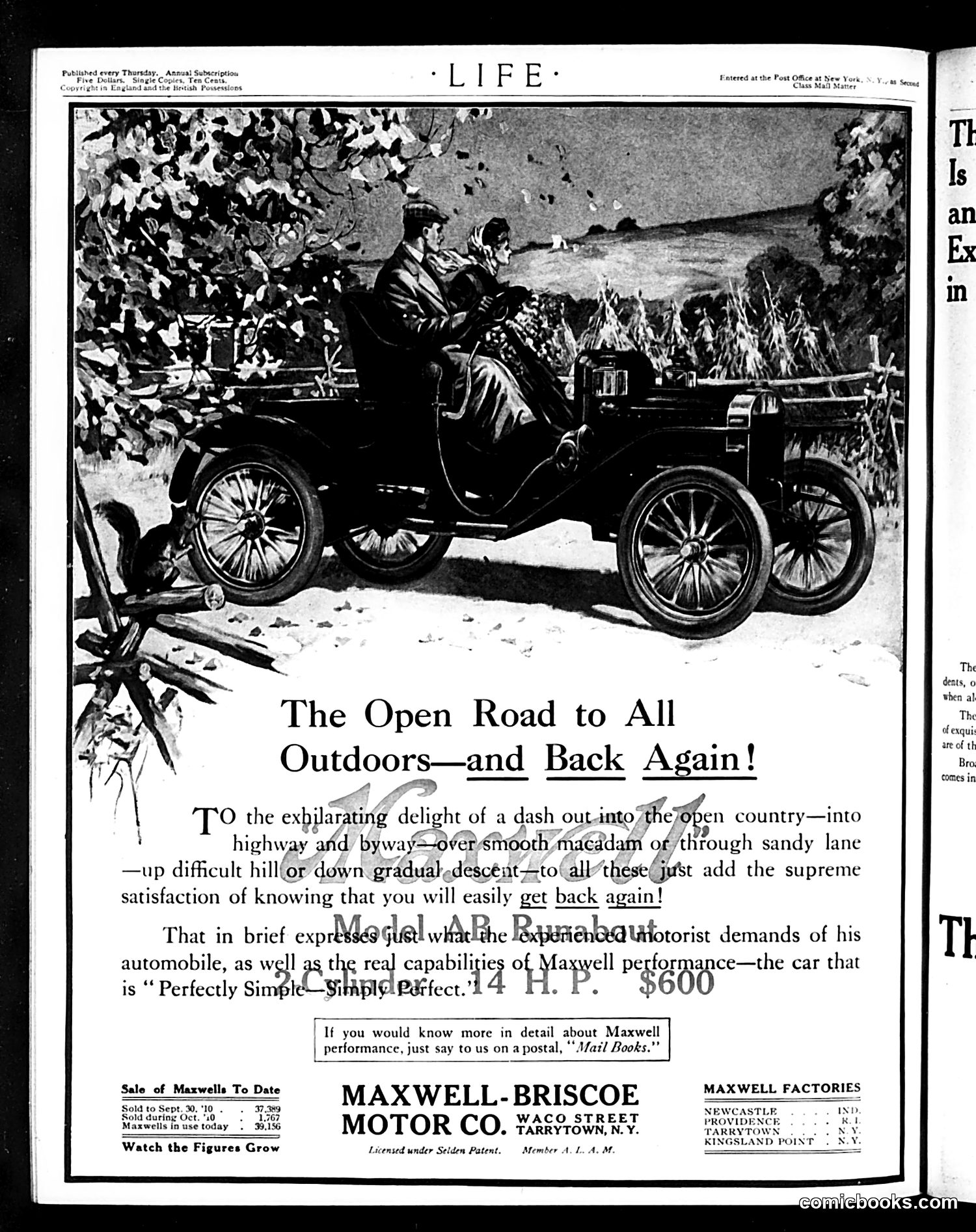
This page is primarily **advertising**, not satire or political commentary. It's a Maxwell-Briscoe Motor Company advertisement for their automobile, priced at $600 with a 14 H.P. engine. The ad features an illustration of two well-dressed people in an early automobile (appears to be from approximately 1910s era based on styling) driving through countryside, with the tagline "The Open Road to All Outdoors—and Back Again!" The advertisement emphasizes the car's reliability and ease of use, calling it "Perfectly Simple—Simply Perfect." It promises motorists the "exhilarating delight" of rural drives while assuring them they can easily return home. The sales figures listed show Maxwell automobiles were selling well. This is straightforward product marketing with no apparent political satire or social commentary.
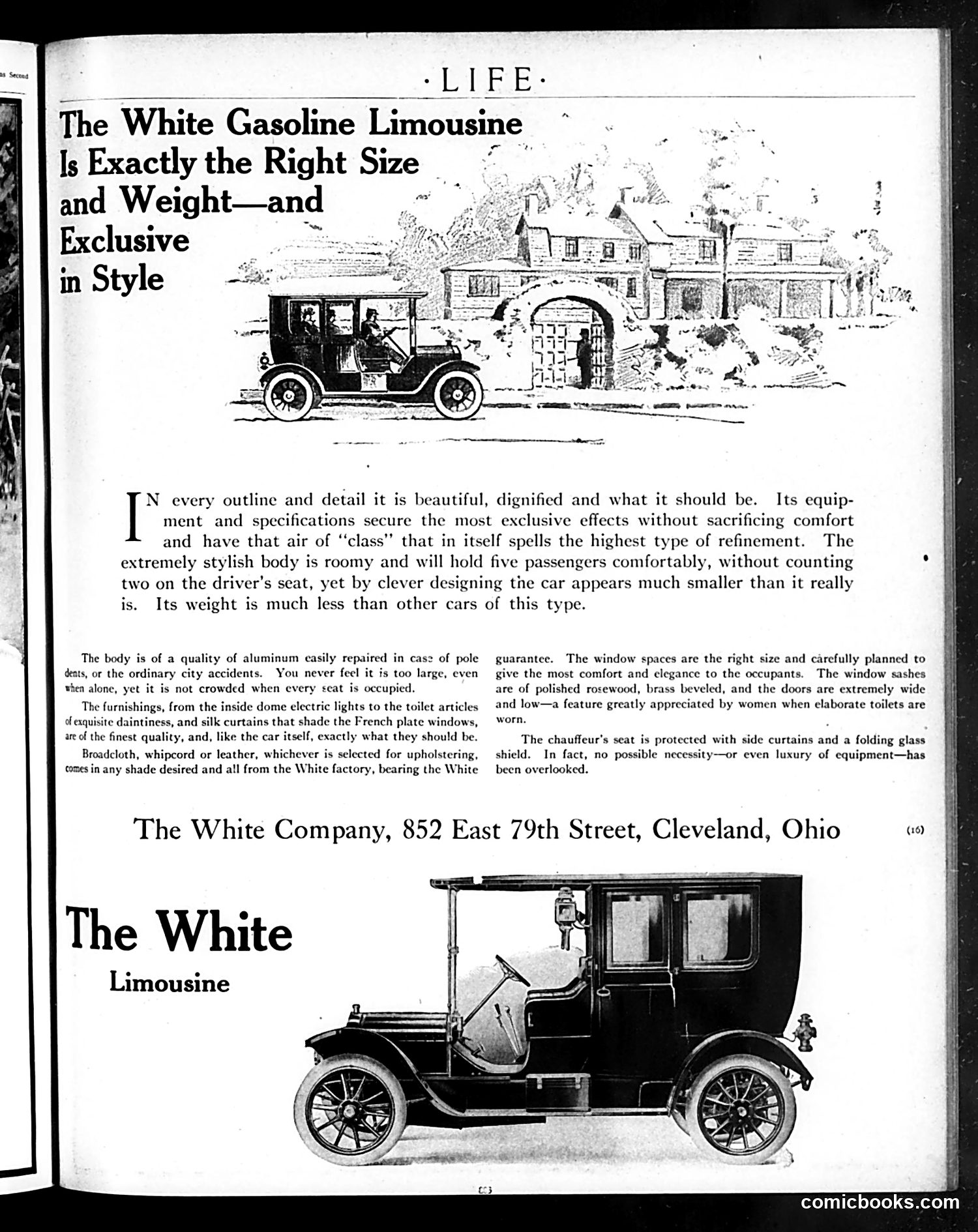
This is primarily **advertising copy**, not satire or political commentary. The White Company is marketing their "Limousine" automobile as a luxury vehicle for wealthy consumers. The ad emphasizes exclusivity and refinement: the car is the "right size and weight," holds five passengers comfortably, and appears "much smaller than it really is." Details like aluminum body, electric dome lights, polished woodwork, and window design are highlighted as marks of "class" and "highest type of refinement." The sketched mansion in the upper illustration and formal presentation suggest the target audience: affluent Americans seeking status symbols. The detailed description of amenities (side curtains, glass shield for the chauffeur) indicates this is marketed as a luxury conveyance for the elite. There is **no apparent satire or political message**—this is straightforward early-automobile marketing from the 1910s era.
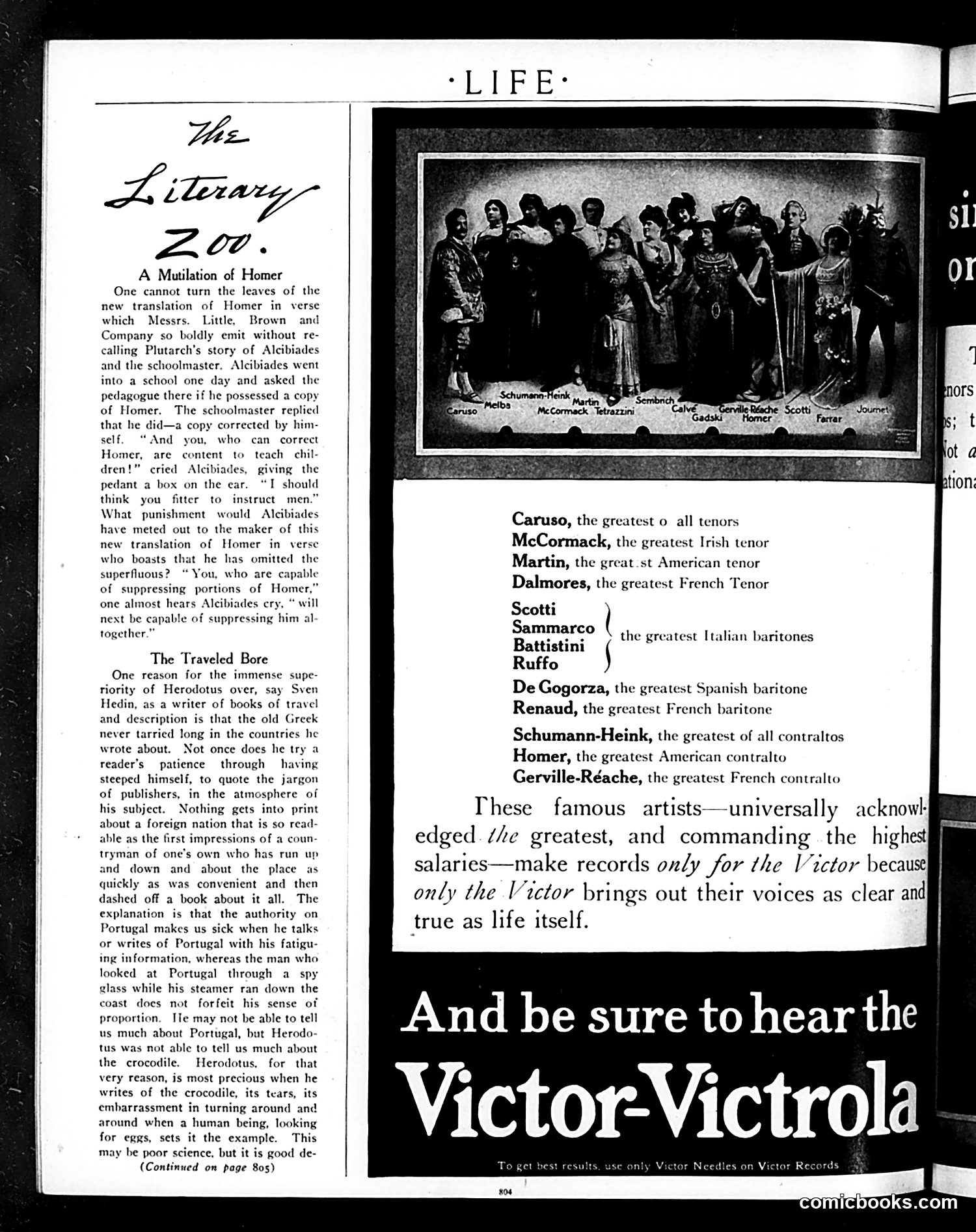
This page contains two distinct elements: **Left column:** Literary satire titled "A Mutilation of Homer" and "The Traveled Bore"—critiques of pedantic scholars and tedious travel writers, unrelated to current events. **Right side:** A Victor-Victrola phonograph advertisement disguised as editorial content. The image shows famous opera singers of the era (Caruso, McCormack, Martin, etc.), with text asserting these "greatest artists" record *only* for Victor because "only the Victor brings out their voices as clear and true as life itself." This is essentially **advertorial**—marketing copy designed to appear as serious magazine content. The implicit message: Victor's superior recording technology captures performances better than competitors. The specific singers named were genuinely famous tenors and baritones of the early 20th century, lending credibility to the claim.
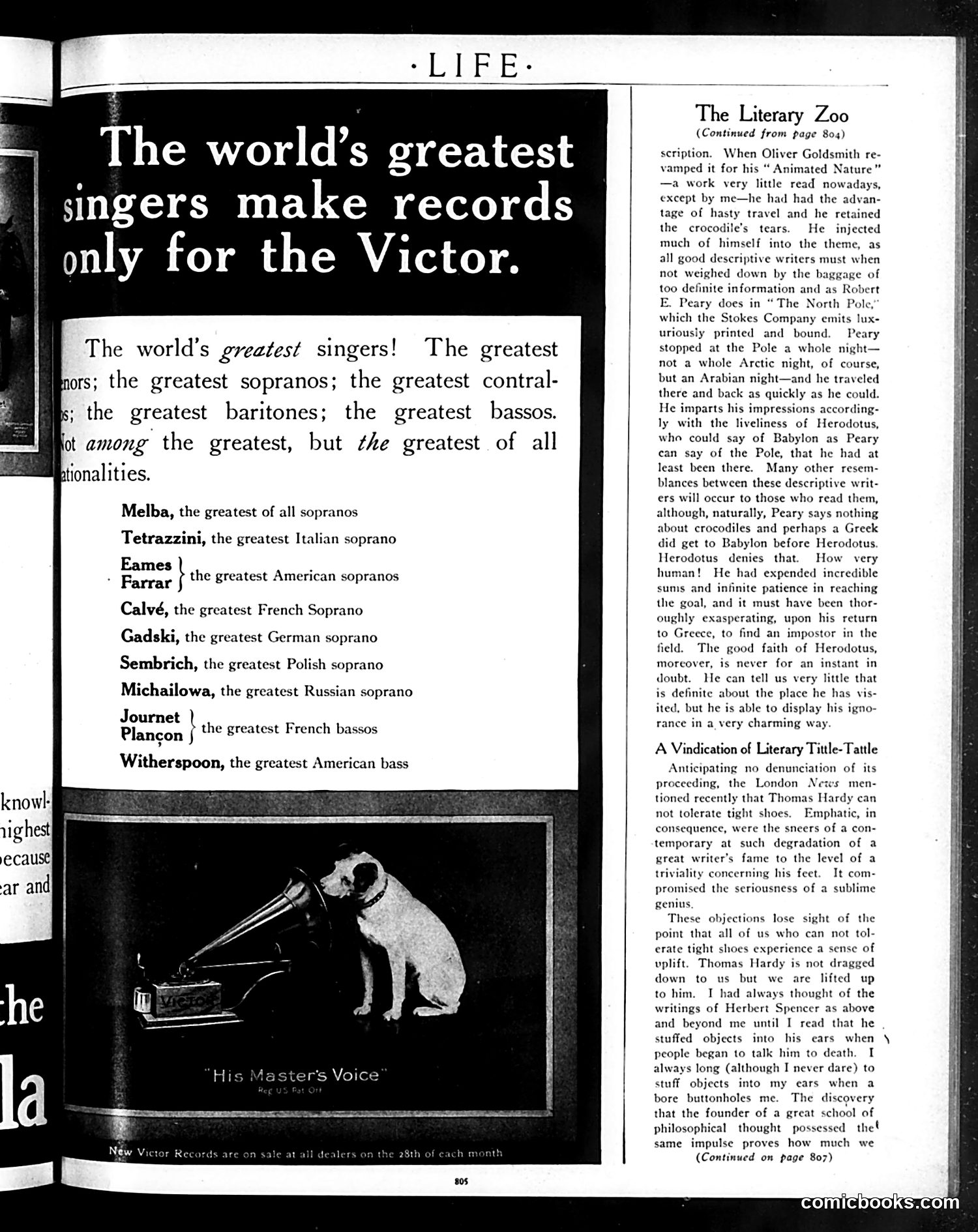
This page is primarily a **Victor Records advertisement**, not a political cartoon. The ad promotes the superiority of Victor Records by listing famous opera singers of the era who exclusively recorded for the company: Melba, Tetrazzini, Eames, Farrar, Calvé, Gadski, Sembrich, Michailowa, Journet, Plançon, and Witherspoon. The accompanying image shows a dog listening to a gramophone—the famous "His Master's Voice" trademark imagery associated with Victor Records. The satire is gentle: the ad humorously suggests that even a dog recognizes the superior quality of Victor recordings, implying that these world-class singers chose Victor as their exclusive label. The right column contains unrelated editorial content about literary criticism.
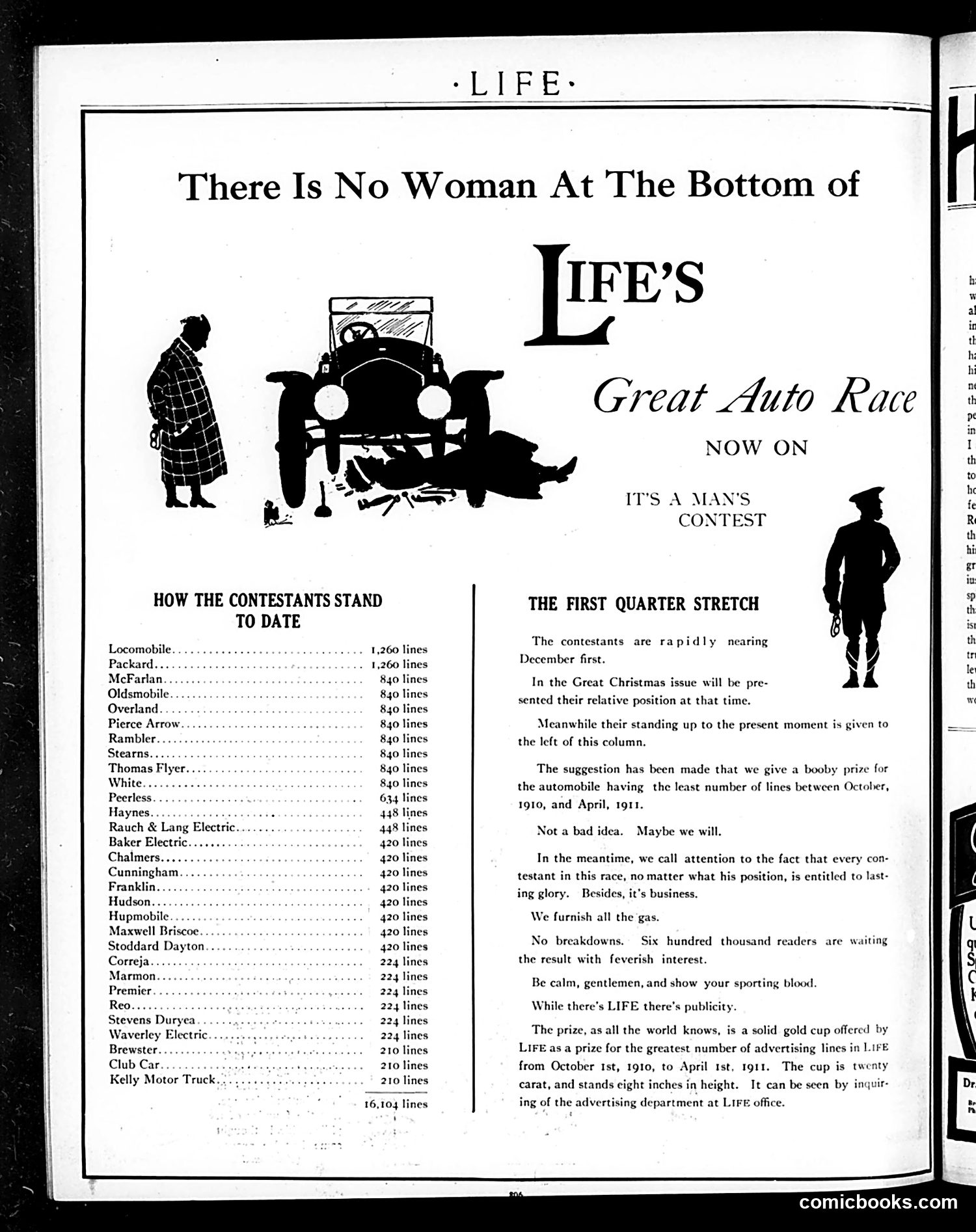
This page announces an advertising competition in *Life* magazine where automobile manufacturers compete for publicity. The headline's phrase "There Is No Woman At The Bottom of Life's Great Auto Race" is a satirical jab at the famous phrase "there's a woman at the bottom of it all," suggesting that this competition is purely about business and advertising rather than romantic or sentimental matters. The silhouetted figures (woman on left, man on right) represent everyday people observing the race. The standings list shows competing automobile brands by advertising lineage accumulated between October 1910 and April 1911. The satire mocks corporate competition and *Life's* own profit motives, while the "Man's Contest" subtitle emphasizes this as serious business competition, not entertainment.
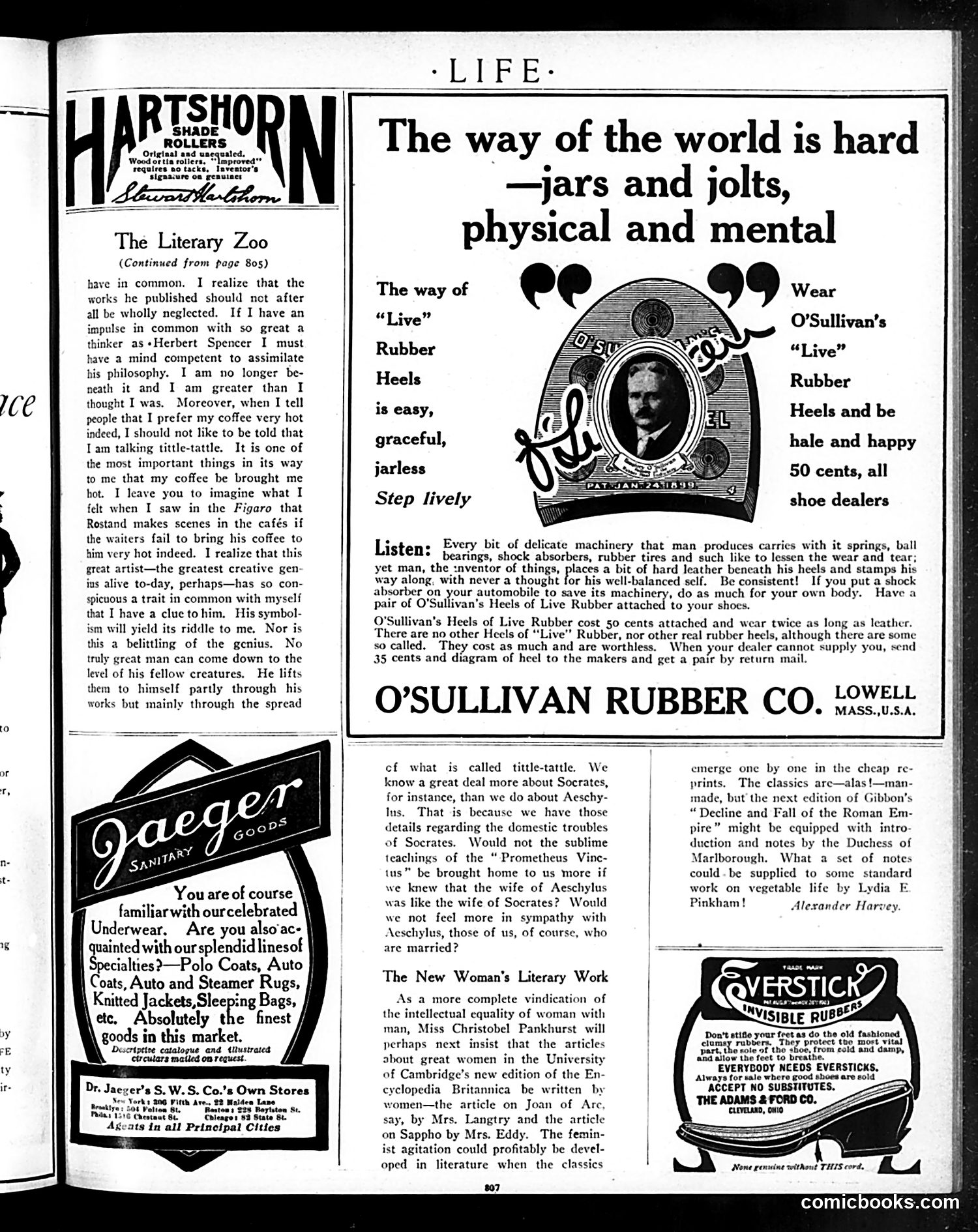
This page is primarily **advertising**, not political satire. It contains three commercial advertisements: 1. **Hartshorn Rollers** (top left) - a household product with a signature endorsement 2. **O'Sullivan Rubber Heels** (center) - the dominant ad, featuring a portrait photograph and promoting 50-cent rubber heels as practical, durable footwear 3. **Jaeger Sanitary Goods** (bottom left) and **Everstick Invisible Rubbers** (bottom right) - additional product advertisements The left column contains editorial text titled "The Literary Zoo," discussing philosophical matters and comparing intellectuals to animals. **No political cartoon or satire is present.** This is a typical Life magazine page mixing editorial content with period advertising for consumer goods, common in early 20th-century publications.
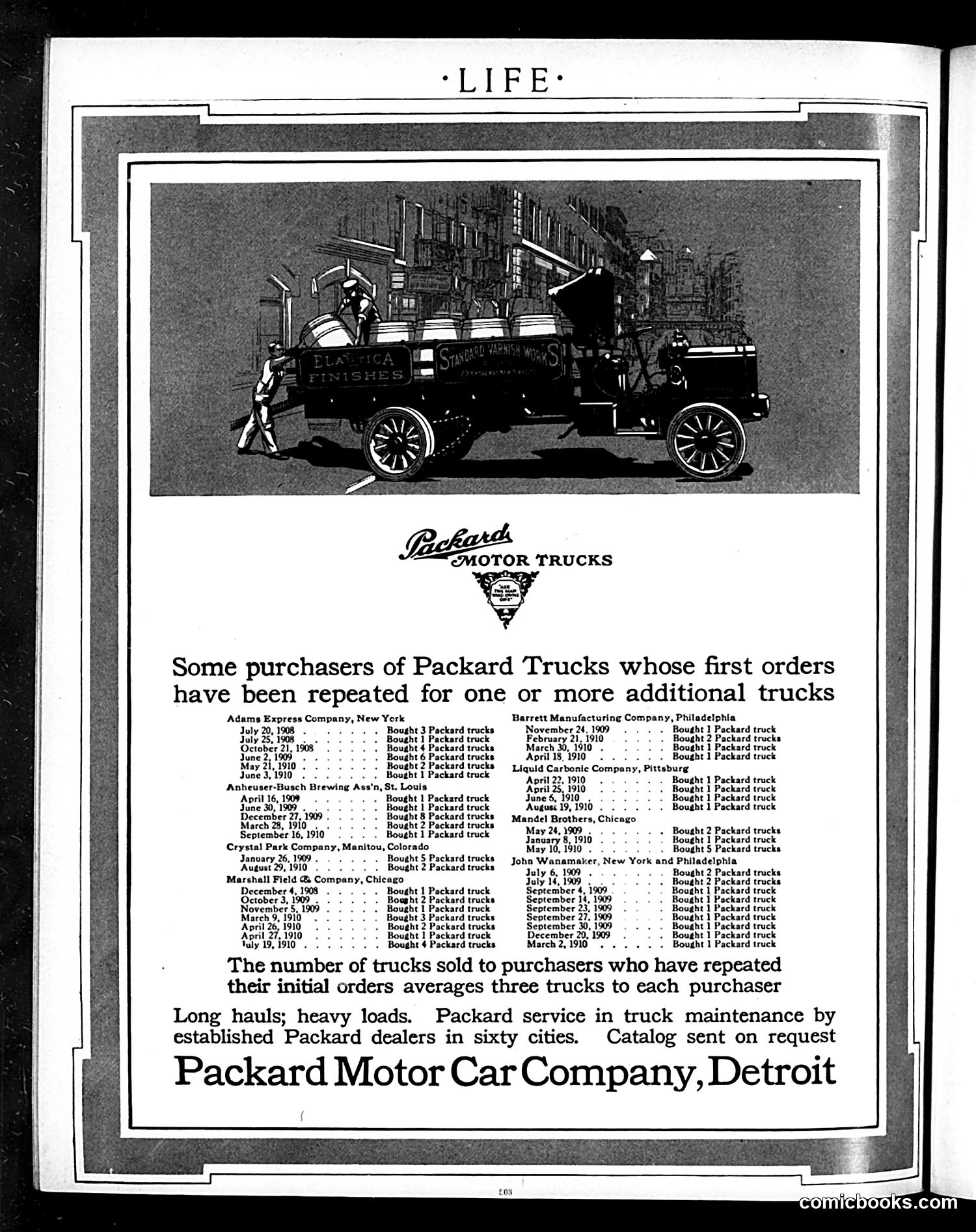
This is a Packard Motor Trucks advertisement, not political satire. The ad showcases a delivery truck loaded with goods on an urban street, promoting Packard's commercial vehicle line. The advertisement's central claim is that repeat customers demonstrate the trucks' reliability: "Some purchasers of Packard Trucks whose first orders have been repeated for one or more additional trucks." A detailed list follows showing company names, purchase dates, and quantities bought—evidence of customer loyalty. The closing statement highlights the business appeal: "The number of trucks sold to purchasers who have repeated their initial orders averages three trucks to each purchaser." This is straightforward marketing targeting business owners, emphasizing durability and repeat sales as proof of product quality. There is no satire or political content present—it's simply a commercial advertisement from the early 1900s automotive era.
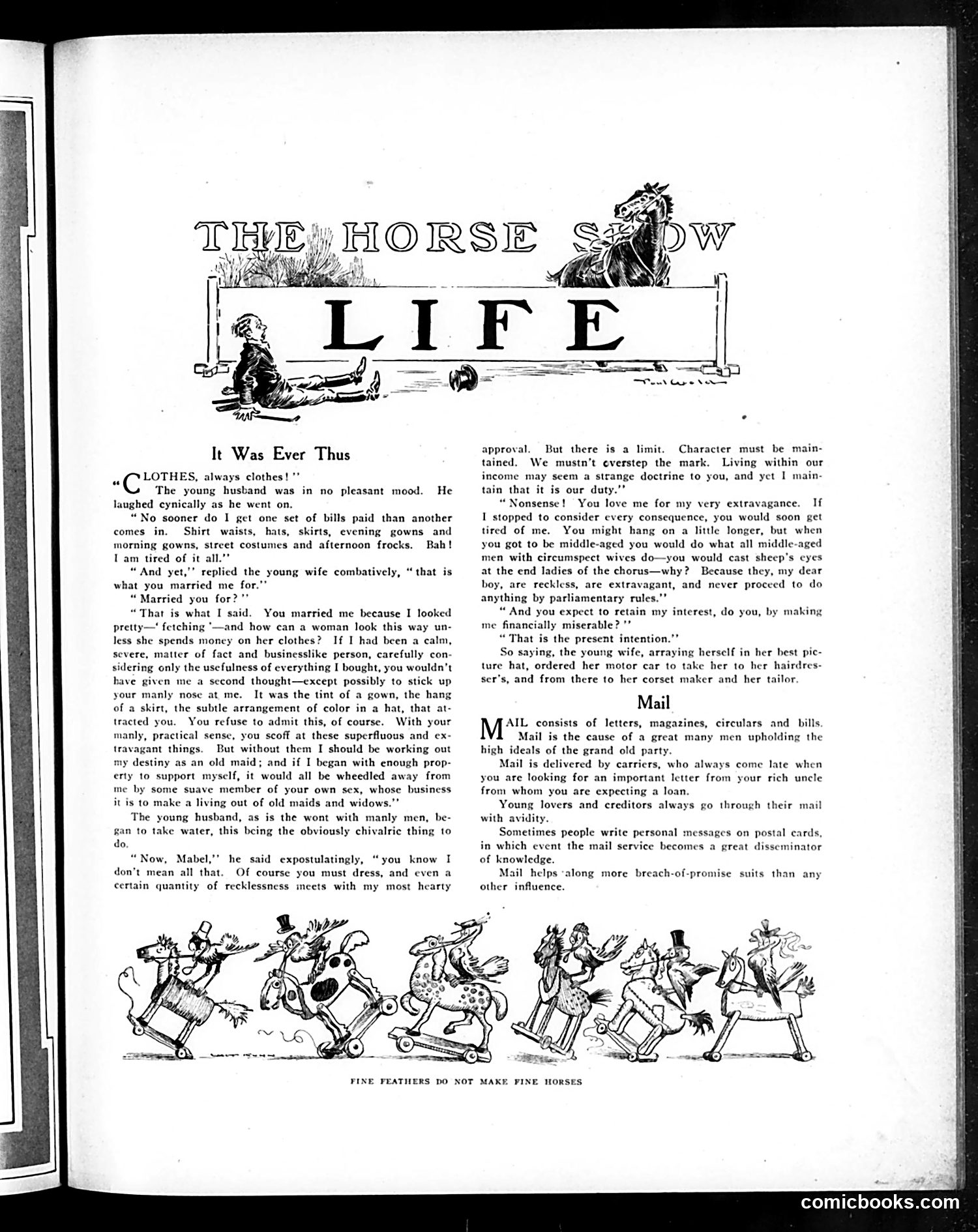
This page from *Life* magazine satirizes marital dynamics and gender roles of the early 20th century. The main article "It Was Ever Thus" depicts a husband complaining about his wife's excessive clothing purchases and extravagant spending. The wife defends her "extravagance" as necessary for maintaining her appearance and social status. The husband counters that her spending makes him "financially miserable." The "Mail" section that follows discusses correspondence and its role in relationships, particularly breach-of-promise lawsuits. The bottom cartoon shows absurdly dressed figures engaged in chaotic activity, illustrating the satirical point expressed in its caption: "FINE FEATHERS DO NOT MAKE FINE HORSES"—suggesting that excessive ornamentation and clothing cannot compensate for character or substance, a barb directed at both vanity and conspicuous consumption among the wealthy.
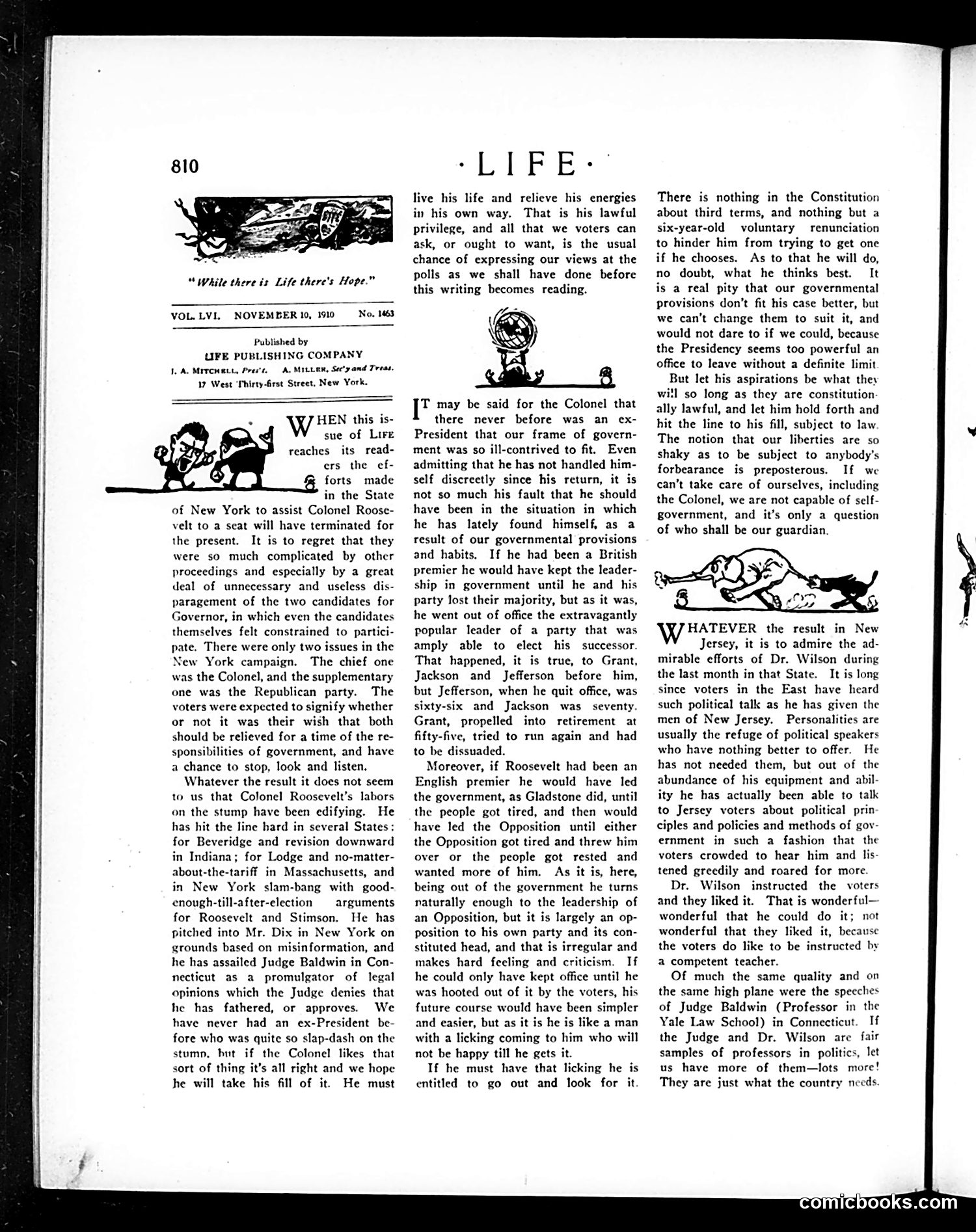
This page critiques Theodore Roosevelt's political activities following his presidency. The text discusses Roosevelt's influence on New York politics and his role in supporting candidates, noting criticism that he hasn't truly stepped aside from power despite leaving office. The article references Roosevelt's involvement in recent elections and compares him to British political figures like Gladstone and Jackson, suggesting his continued dominance over his party is irregular and creates hard feelings. The text praises Dr. Wilson's political speeches in New Jersey as exemplary of what the country needs—presumably honest, direct political discourse without the interference of powerful behind-the-scenes figures. The illustrations (small cartoon vignettes) appear to satirize Roosevelt's outsized political influence despite his official retirement from the presidency.
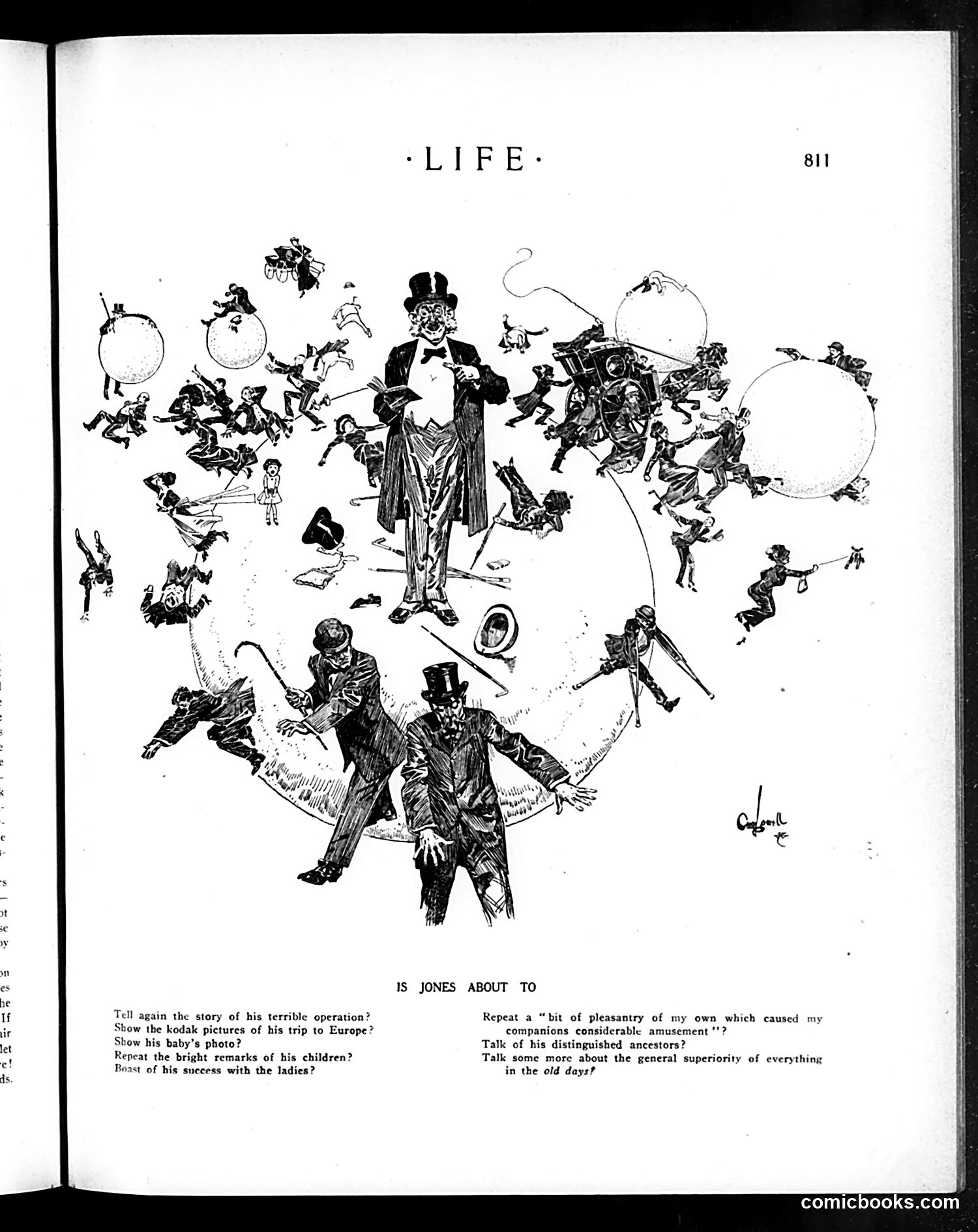
This satirical cartoon depicts a central figure labeled "JONES" surrounded by chaotic scenes of various people and activities. The illustration uses a whimsical, circus-like composition with figures juggling, acrobats, and various characters orbiting around the main subject. The text below, titled "IS JONES ABOUT TO," presents a series of humorous prompts asking Jones to repeat tiresome stories: his "terrible operation," kodak photos from a European trip, baby pictures, children's accomplishments, and past romantic successes. The satire targets the tedious social convention where certain people compulsively rehash the same self-aggrandizing anecdotes about their travels, children, and past glories. The chaotic visual composition reinforces the irritating mental chaos Jones inflicts on his audience through endless repetition of boring personal narratives.
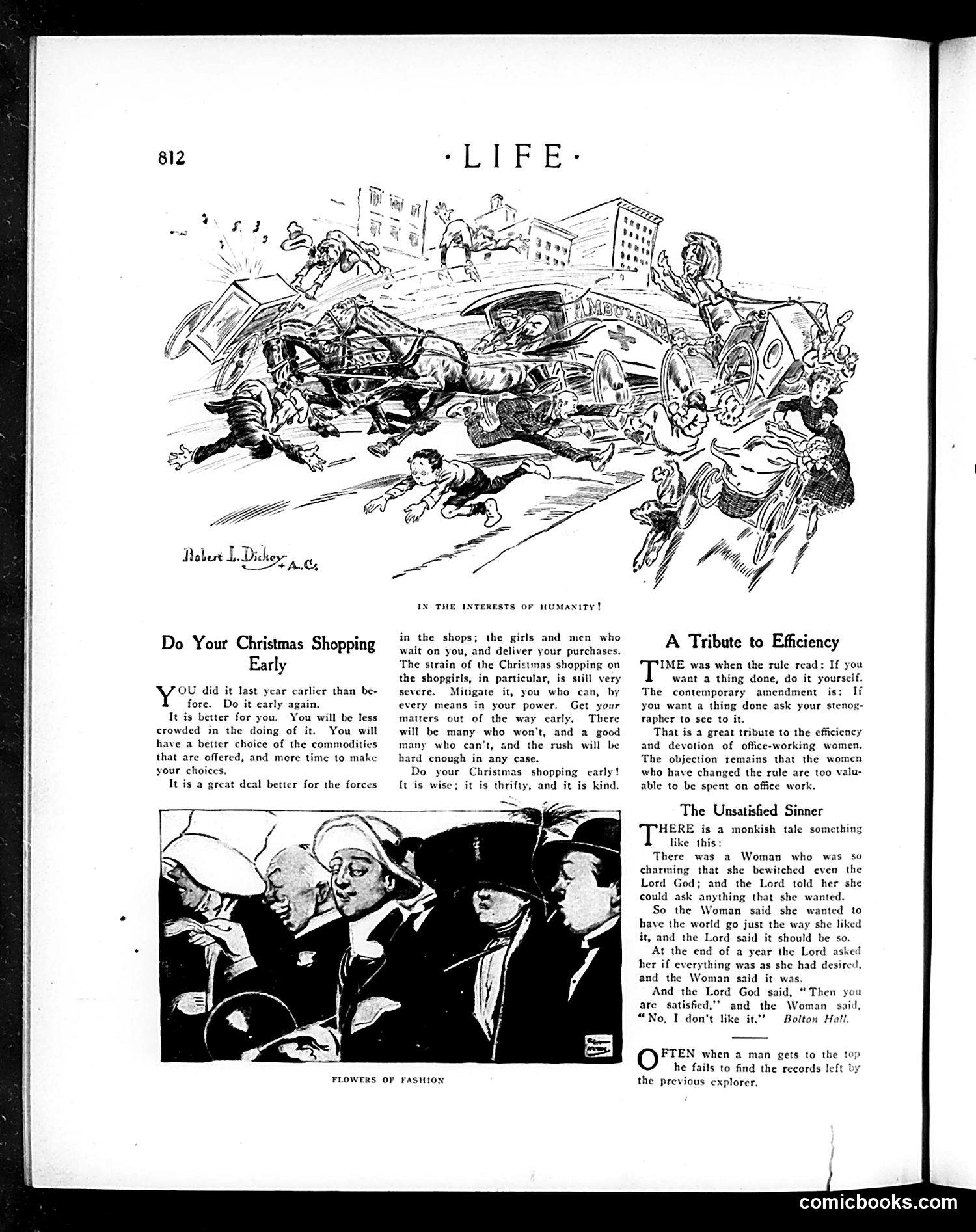
The top illustration by Robert L. Ditcher depicts chaotic urban traffic—automobiles, pedestrians, and delivery vehicles in collision and confusion. This satirizes early 20th-century city congestion and the dangers of rapid automobile adoption. The three text articles address contemporary social concerns: Christmas shopping (encouraging early purchasing to avoid crowds), women's workplace efficiency (defending their recent entry into office work against skepticism), and "The Unsatisfied Sinner" (a moral tale about desire). The lower illustration titled "Flowers of Fashion" shows well-dressed figures, likely satirizing fashion-conscious society types, though specific identities remain unclear. Overall, this page captures post-WWI American anxieties about modernization, changing gender roles, and consumer culture.
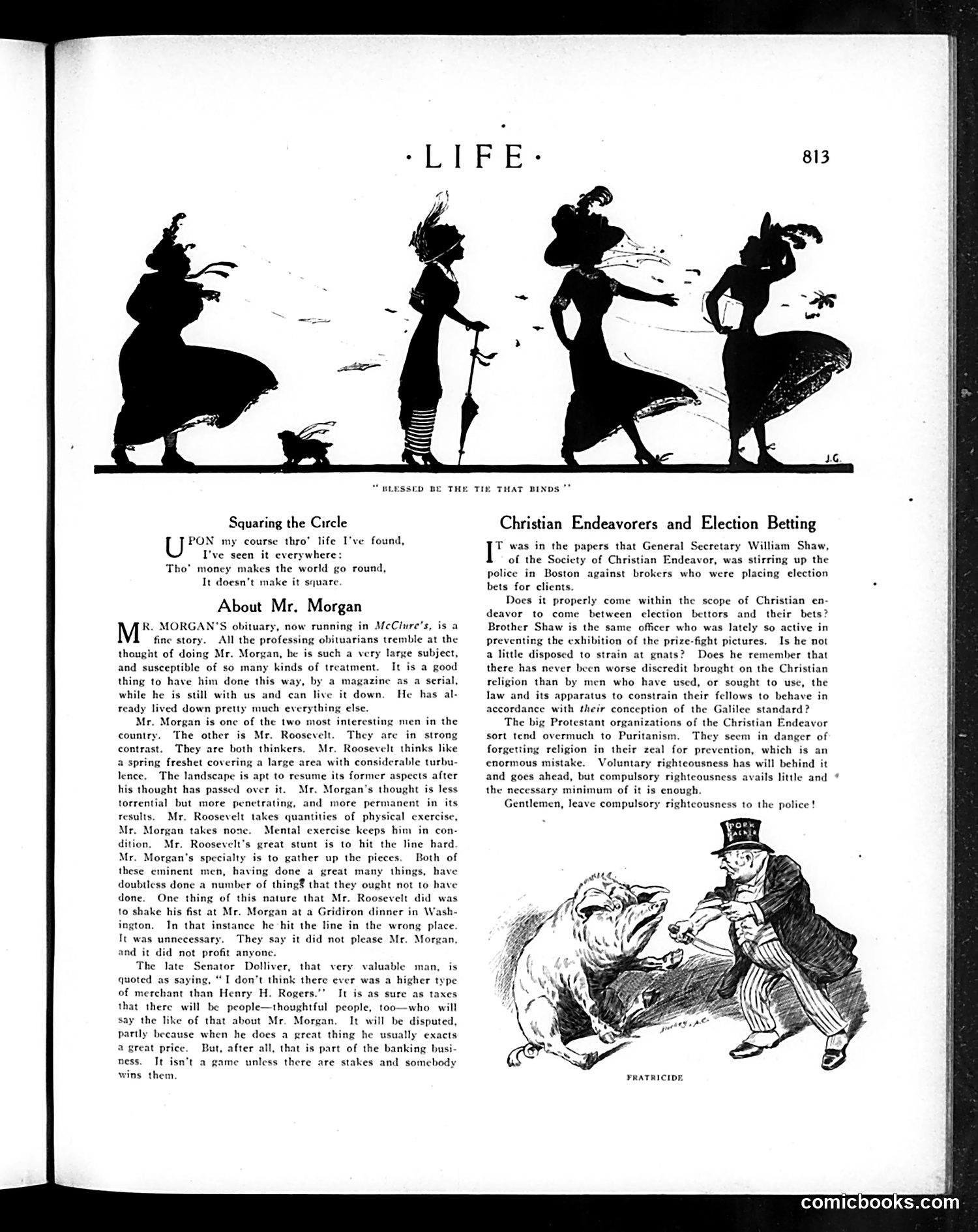
**Top Silhouette Cartoon**: Depicts four fashionably dressed women in various poses with the caption "Blessed Be the Tie That Binds." This appears to be satirizing women's fashion and social behavior of the era, though the specific reference is unclear without additional context. **"Christian Endeavorers and Election Betting"**: This article criticizes the Society of Christian Endeavor's General Secretary William Shaw for allegedly cooperating with Boston police against bookmakers placing election bets. The satire questions whether such enforcement aligns with Christian principles, suggesting the organization may be overstepping by using secular law enforcement to impose religious standards. **"About Mr. Morgan"**: Compares J.P. Morgan unfavorably to Theodore Roosevelt, criticizing Morgan's financial influence and suggesting Roosevelt's physical vigor represents superior leadership.
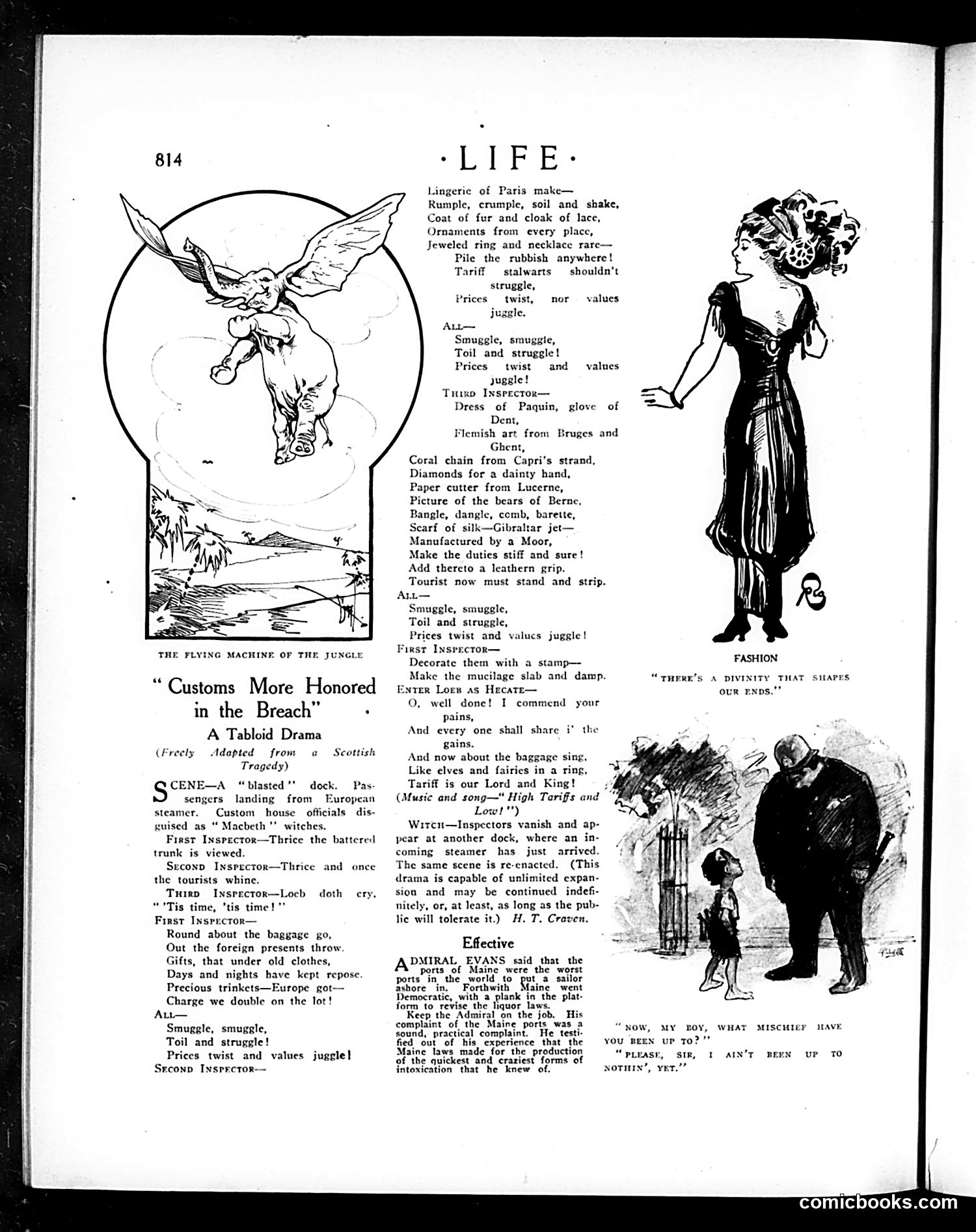
This page satirizes **American tariff policy** through multiple pieces, likely from the early 1900s. **"Customs More Honored in the Breach"** is the main satire—a theatrical parody adapting Scottish tragedy. It mocks customs inspectors who aggressively search tourists' baggage for foreign luxury goods (Paris lingerie, Flemish art, coral jewelry). The inspectors, portrayed as scheming witches from *Macbeth*, impose heavy tariffs on imported items while chanting about "smuggle, smuggle." The satire's point: protectionist tariff policies—meant to protect domestic industries—are absurdly enforced against ordinary travelers, making their lives difficult through strip-searches and inflated duties. The theatrical framework emphasizes the bureaucratic absurdity. The smaller cartoon about Admiral Evans complains that Maine's ports, despite having strict laws producing "quickest and craziest forms of intoxication," remain poorly maintained—political commentary on government inefficiency. A fashion illustration also appears on the page.
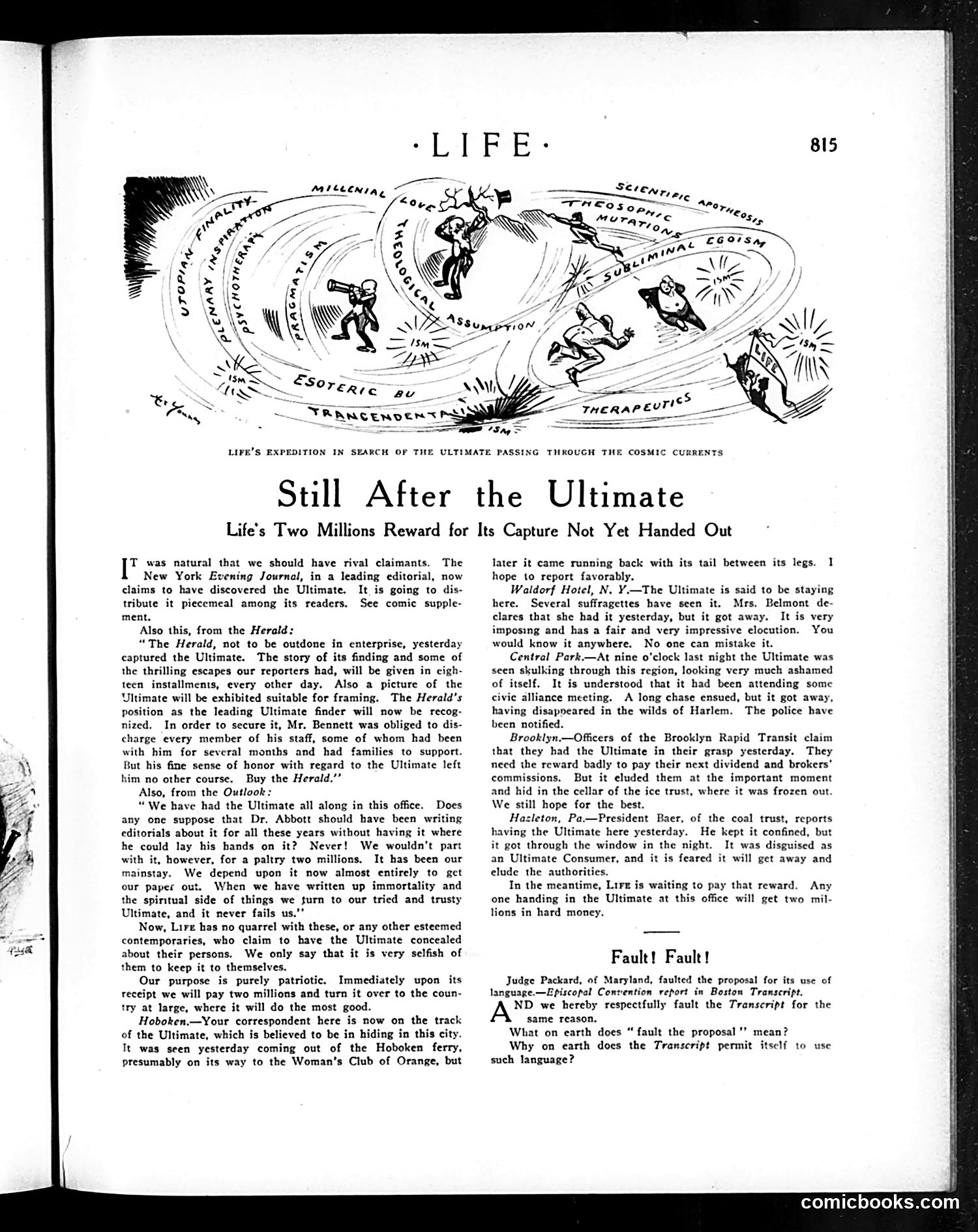
This 1900s satire mocks rival newspapers' absurd competition for readership and sensationalism. "The Ultimate" is an invented, impossible thing—a metaphor for the elusive story or gimmick that will solve all problems and capture public attention. The cartoon shows "Life" parodying how the *Herald*, *Evening Journal*, and *Outlook* (real competing publications) claim to have discovered or possess this Ultimate, each making increasingly ridiculous promises to readers: serialized coverage, exhibitions, editorials about immortality. The follow-up reports from various cities describe the Ultimate as a creature constantly evading capture—appearing at ferries, parks, civic meetings, corporate offices—mocking how newspapers chase every sensational rumor. References to "Mrs. Belmont," the coal trust, and ice trusts ground the satire in contemporary scandals. The joke: Life offers a two-million-dollar reward for the Ultimate, satirizing how desperate competitors will spend fortunes chasing worthless claims just to outdo rivals. It's sharp criticism of yellow journalism and editorial dishonesty.
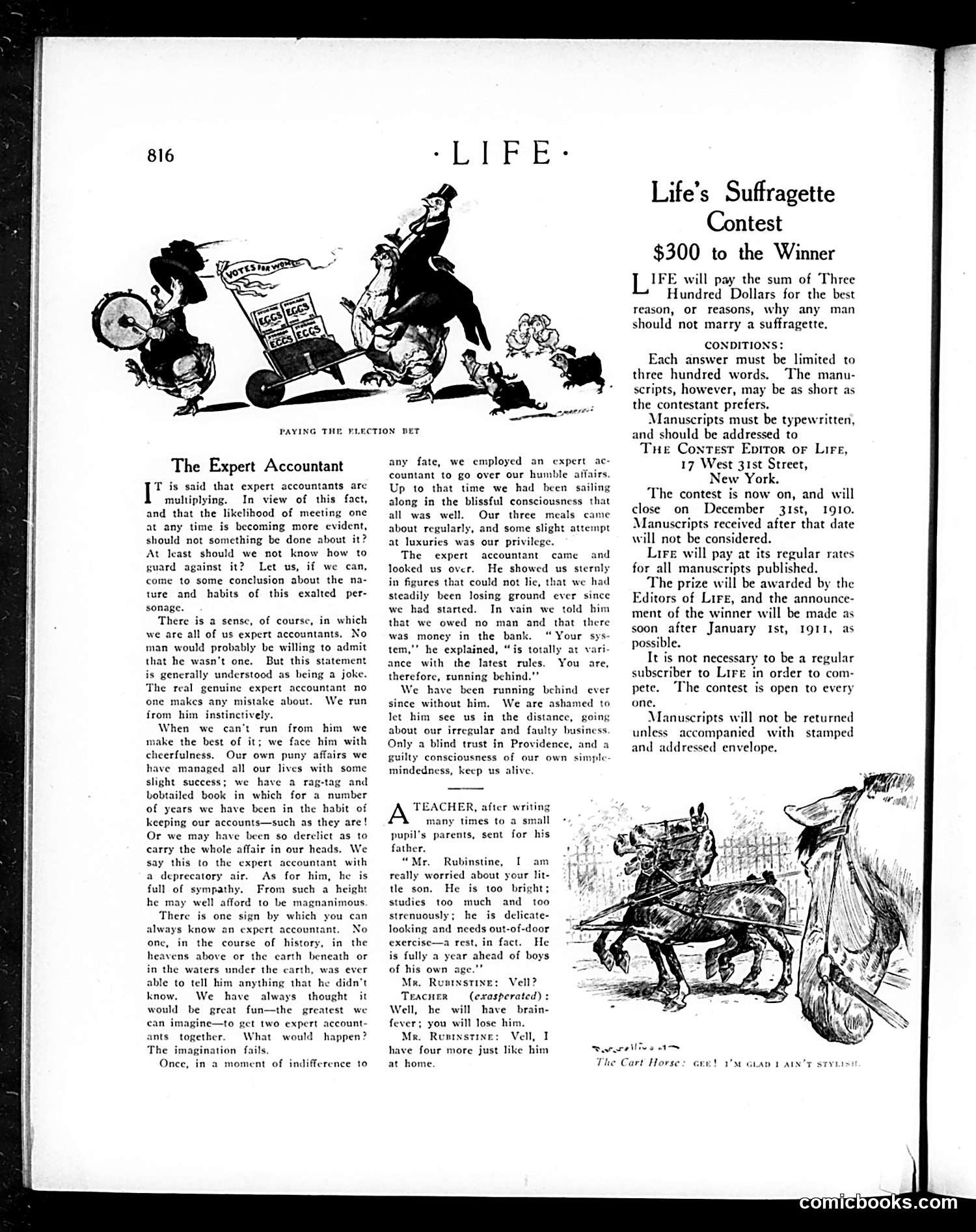
## "Paying the Election Bet" Cartoon The top illustration satirizes expert accountants as self-important figures. The cartoon shows them dominating a chaotic scene—apparently depicting how accountants "collect" or assert dominance after elections (the "debt" being paid). The satire mocks the growing profession of expert accountants as pompous know-it-alls. ## "The Expert Accountant" Article This humorous essay ridicules expert accountants' arrogance and infallibility complex. The author recounts hiring one who, despite the business appearing solvent, declared them "running behind" according to modern accounting rules. The joke: the accountant's "expert" pessimism proved wrong—they've survived fine without following his system. ## "Life's Suffragette Contest" Life announces a contest offering $300 for the best reasons why men shouldn't marry suffragettes (women's voting-rights advocates). This reflects anti-suffrage sentiment of 1910, mocking suffragettes as undesirable spouses—a common satirical attack on women's rights activists, suggesting their advocacy made them unsuitable partners. The page captures early 20th-century attitudes: skepticism toward emerging professional expertise and hostility toward women's political activism.
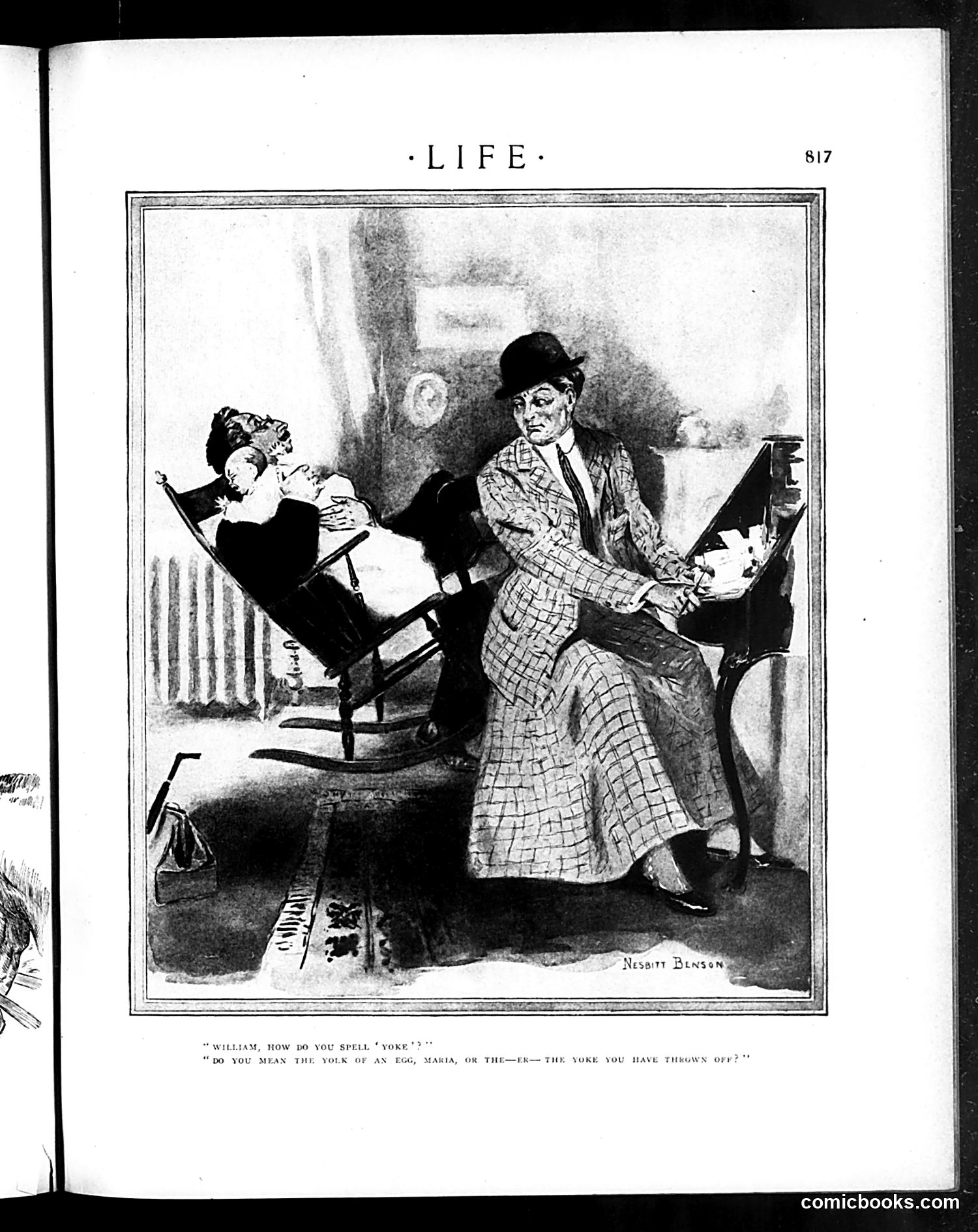
This is a humor cartoon from Life magazine (page 817) by artist Nesbitt Benson. It depicts a domestic scene where a woman (Maria) asks a man (William) how to spell "yoke." William responds with deliberate ambiguity, asking whether she means "the yolk of an egg" or "the yoke you have thrown off"—suggesting marital servitude. The joke plays on a double meaning: "yoke" as both the egg component and the metaphorical burden of marriage/spousal control. William's cheeky response—implying Maria has "thrown off" the yoke of their marriage—suggests he's henpecked or dominated by his wife, a common theme in early 20th-century domestic humor. The woman's posture and the man's expression support this dynamic of role reversal or female dominance in the household.
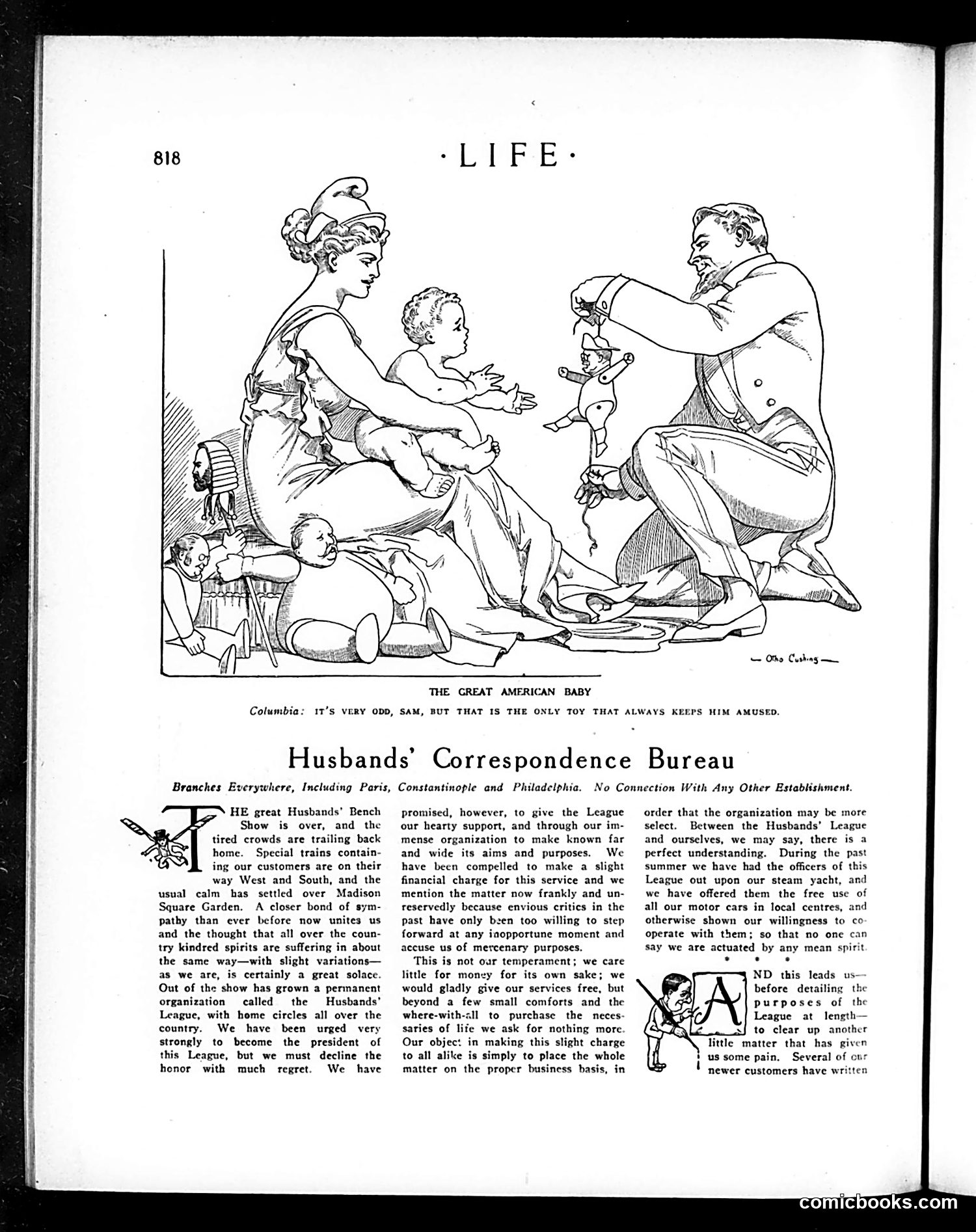
This page satirizes early-1900s gender relations and male grievances. The cartoon "The Great American Baby" depicts a woman (labeled "Columbia," representing America) holding a baby while a man shows it toys. The caption's joke: the only toy that keeps "him" amused is—implied to be the woman herself or domestic life. Below is an advertisement for a fictional "Husbands' Correspondence Bureau" and "Husbands' League"—a satirical men's organization. The text mocks husbands' complaints about married life with faux-earnest prose about "tired crowds" attending a "Husbands' Bench Show," suggesting men gather to commiserate about their wives. The satire targets: - Male self-pity about marriage - The pretentious, self-important tone of men's clubs and organizations - Husbands presenting themselves as suffering victims of domestic life The humor relies on readers recognizing this as exaggerated mockery of contemporary masculine complaint culture.
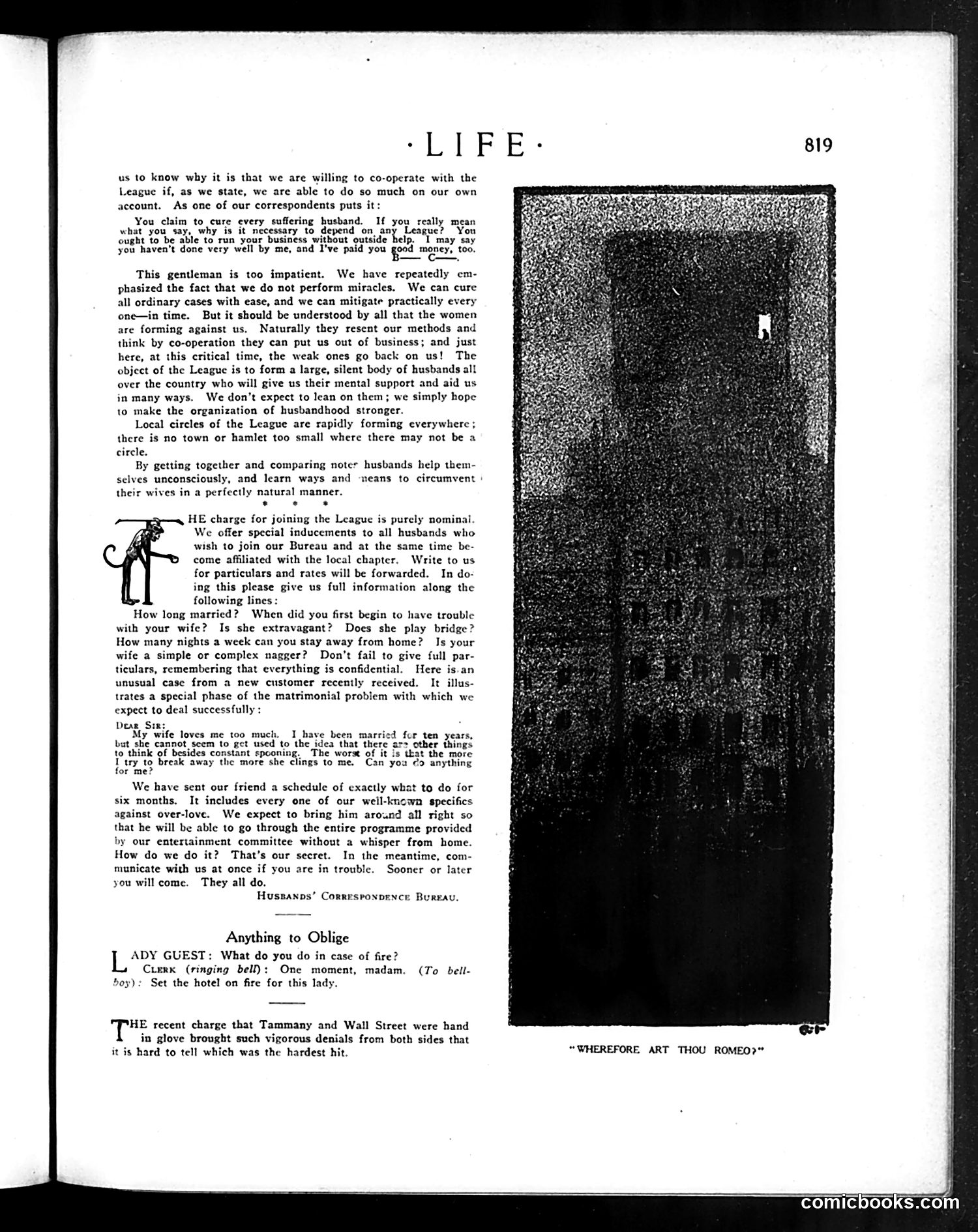
This page satirizes the emerging "Husbands' League," a fictional organization positioning itself as a bureau offering marital advice to help husbands manage their wives. The satire mocks several early-20th-century anxieties: **The Main Target:** The text presents this "League" as offering secretive strategies to "circumvent" wives through organized male solidarity—essentially an anti-feminist response to women's growing independence and activism (the page references women "forming against us"). **The Joke:** The League promises to solve marital problems through confidential consultation, framing wives as problems to be managed rather than partners. The example case—a husband whose wife loves him "too much"—absurdly inverts typical marital complaints, highlighting how contrived these "solutions" are. **Social Context:** This reflects genuine 1910s-20s anxiety about changing gender roles, women's suffrage movements, and wives' increasing autonomy in marriage and spending. **The Image:** Likely depicts a Romeo-and-Juliet reference ("Wherefore Art Thou Romeo?"), possibly illustrating romantic complications or marital discord. The satire mocks both the implicit misogyny and the commercial exploitation of marital anxiety.
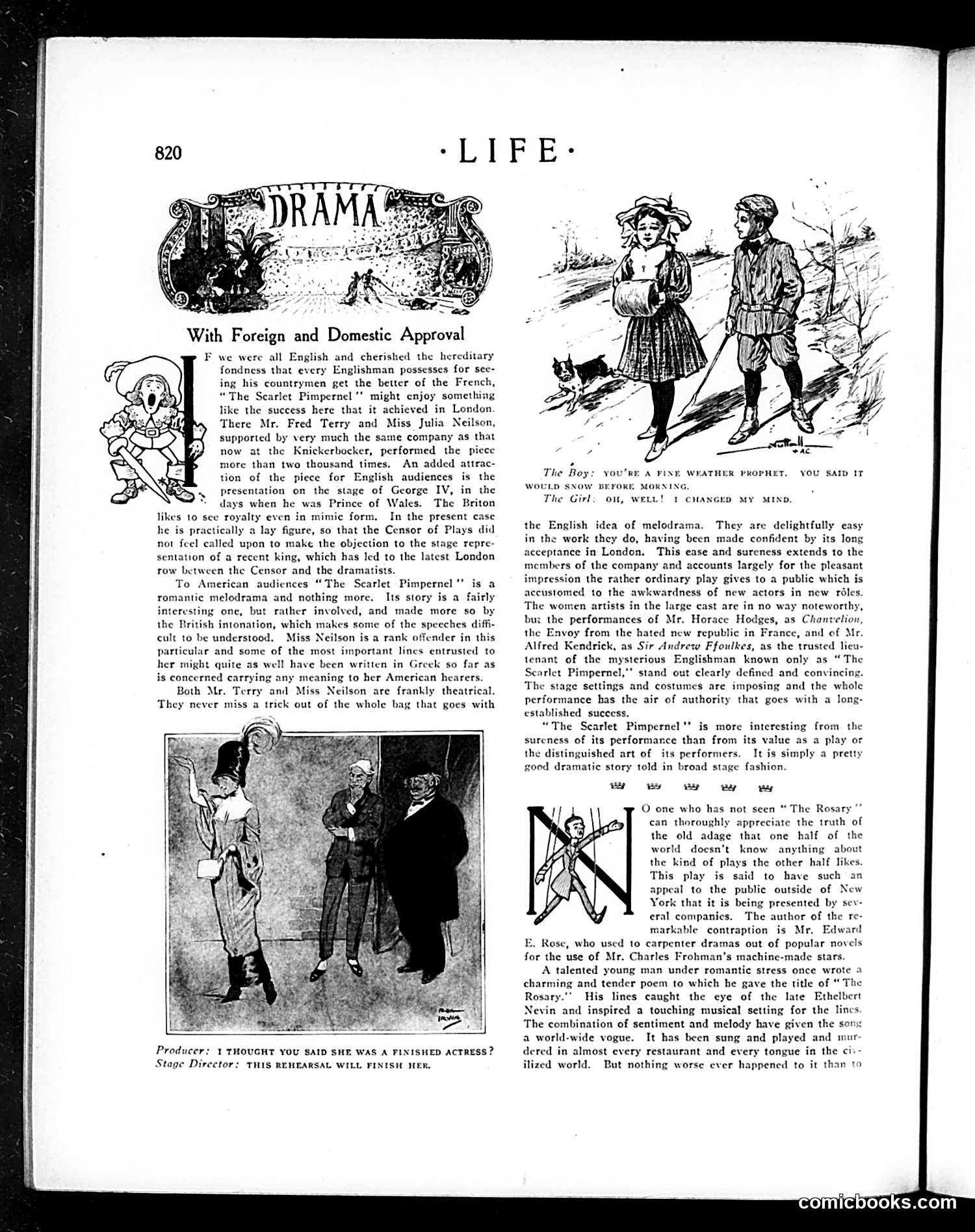
This page reviews two theatrical productions: "The Scarlet Pimpernel" and "The Rosary." **The main cartoon** (bottom left) depicts a theatrical rehearsal dispute between a Producer and Stage Director. The Producer sarcastically questions whether an actress is truly "finished" (accomplished), and the Director responds that "this rehearsal will finish her"—a joke about her poor performance requiring extensive practice. **The smaller vignettes** at top right show casual romance: a boy and girl with a dog, where the girl changes her mind about an earlier weather prediction, prompting the boy's witty retort. The text itself is primarily **theater criticism**, not satire. It praises "The Scarlet Pimpernel" for its polished British cast and production values, though notes American audiences may struggle with English accents and the overly theatrical style. It also previews "The Rosary," noting its unusual appeal to audiences outside New York—suggesting regional theatrical tastes differed significantly from metropolitan sophistication.
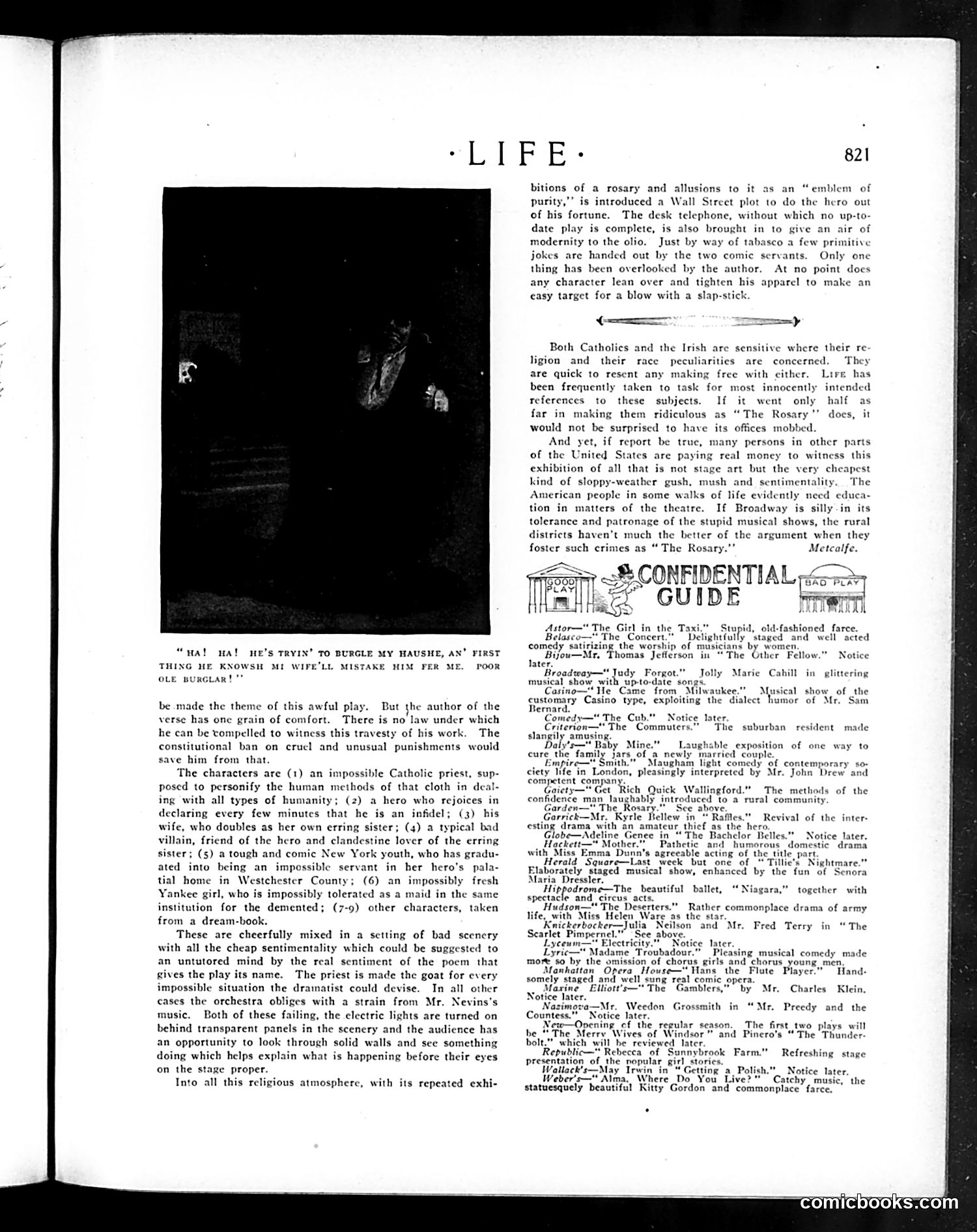
The cartoon depicts a burglar mistaken for a husband—a slapstick scenario. The text is a scathing review of a stage adaptation of "The Rosary," a sentimental poem turned into a theatrical production. The critic (Metcalfe) attacks the play for: 1. **Anti-Catholic stereotyping**: The priest character is portrayed as a scapegoat for every absurd plot device, reducing Catholic theology to ridicule. 2. **Ethnic mockery**: Irish characters are rendered as comic servants using exaggerated dialect ("HAUSHE," "KNOWSH"). 3. **Cheap sentimentality**: The production relies on melodramatic tropes—transparent panels revealing hidden action, religious symbols treated superficially—rather than genuine artistry. 4. **Audience condescension**: The critic notes rural Americans pay to watch this "sloppy-weather gush," suggesting they lack theatrical sophistication, while Broadway itself is blamed for enabling such "crimes." The complaint centers on offensive religious/ethnic caricature masquerading as entertainment, a concern Life magazine had evidently faced criticism for before.
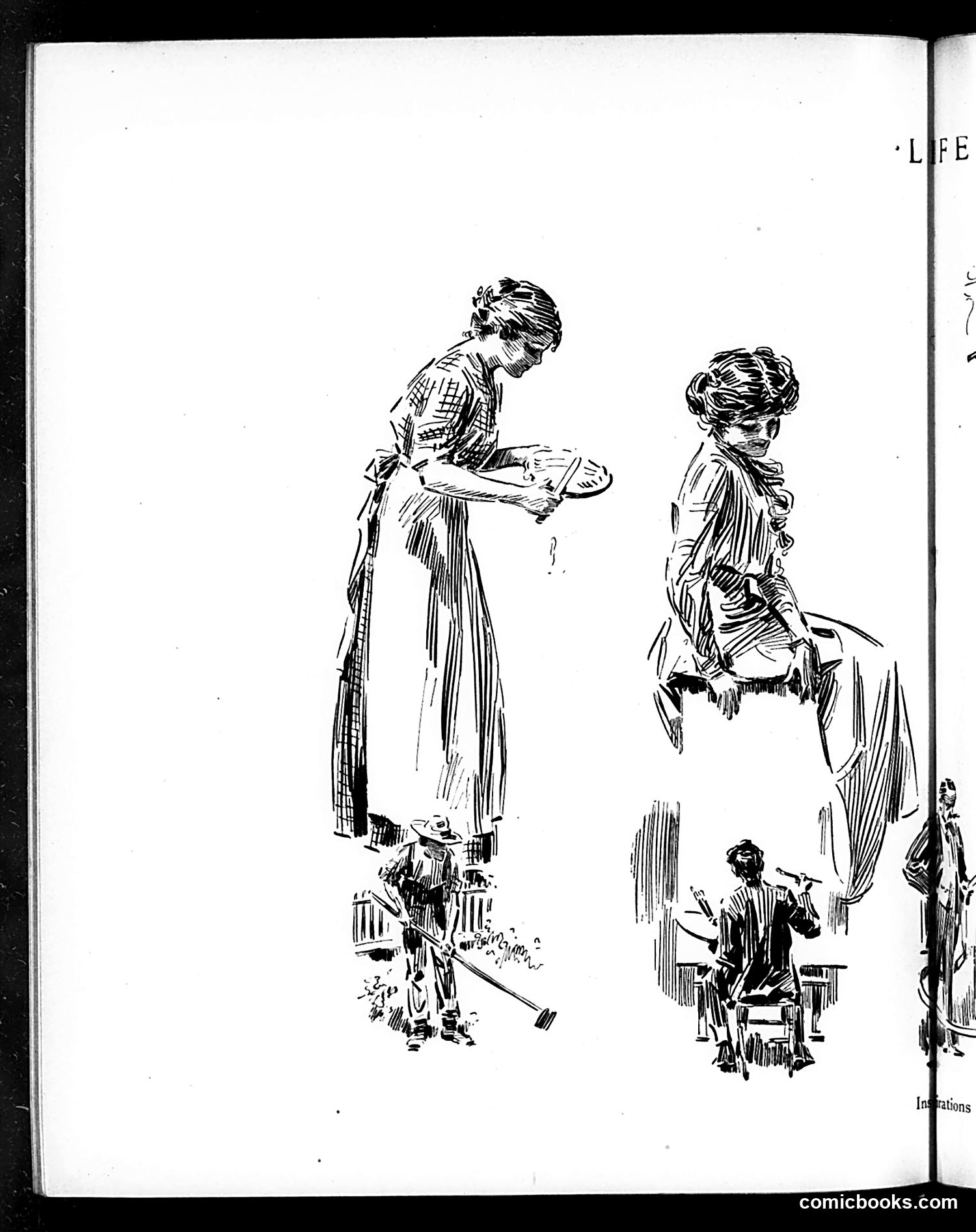
This page contains two ink sketch illustrations showing domestic scenes with women and children. The left sketch depicts a woman standing on what appears to be a stool or elevated surface, holding something (possibly food or a document), with a child below holding what looks like a garden tool. The right sketch shows a seated woman with a child nearby. The crude OCR text is largely illegible and provides no clear caption or context. Without legible accompanying text, the specific satirical point remains unclear. However, the domestic subject matter—women managing households and children—suggests these may be commenting on gender roles, childcare, or domestic labor during the early 20th century when Life was known for social satire. **The exact meaning cannot be determined from the image alone.**
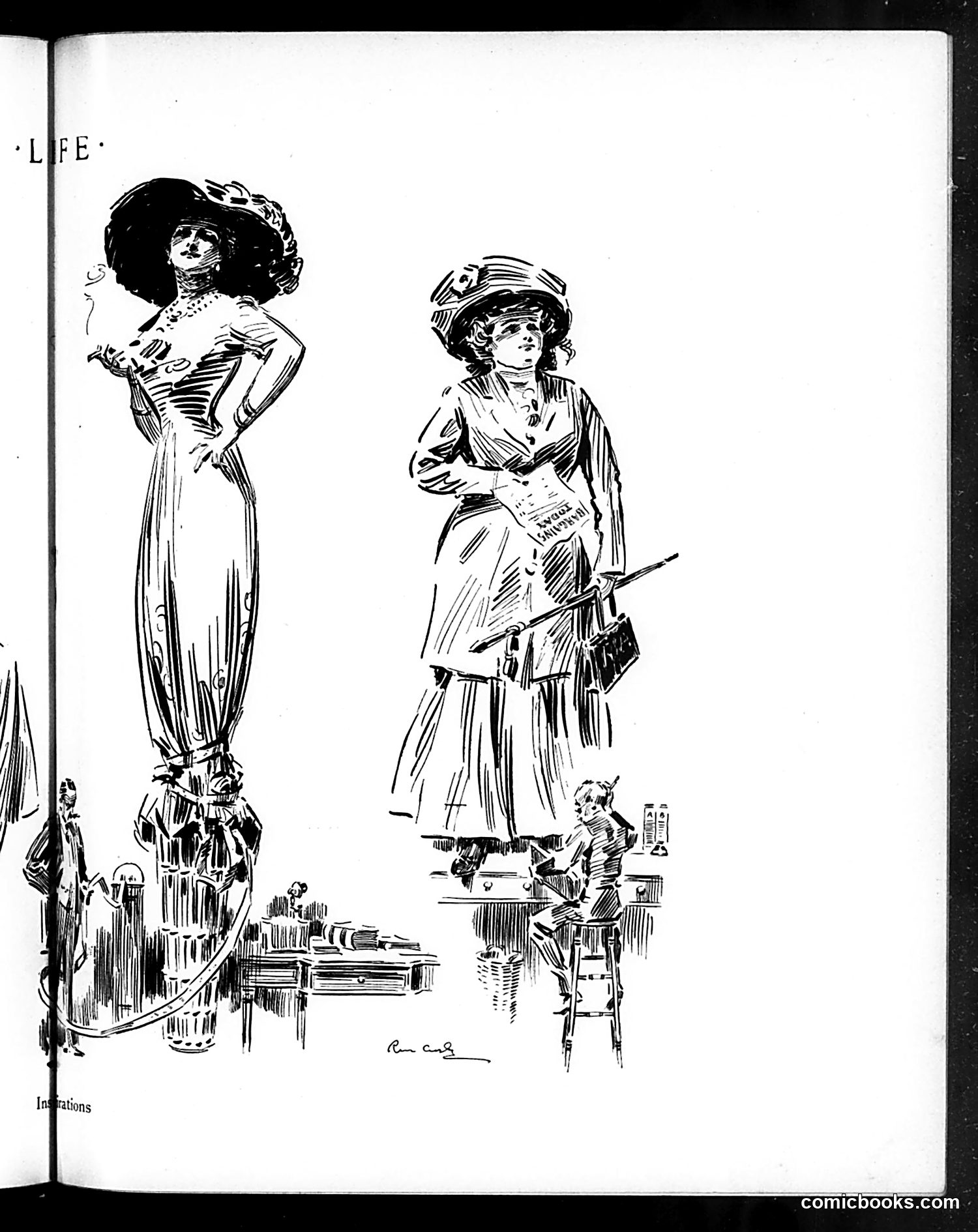
This Life magazine page appears to show fashion illustration rather than political satire. The drawing depicts two women in early 20th-century dress with elaborate hats, fitted waists, and long skirts—typical Gibson Girl-era fashion. The left figure stands on what appears to be a pedestal or platform, while the right figure sits, possibly being fitted or measured by a small child (likely representing a tailor or dressmaker). The title "LIFE" and partial text "Insitations" [likely "Invitations"] suggest this illustrates social commentary about women's fashion, clothing culture, or perhaps the fashion industry itself. The artist's signature appears at the bottom. Without clearer text or additional context, the specific satirical point remains unclear, though it likely comments on women's clothing standards or social conventions of the era.
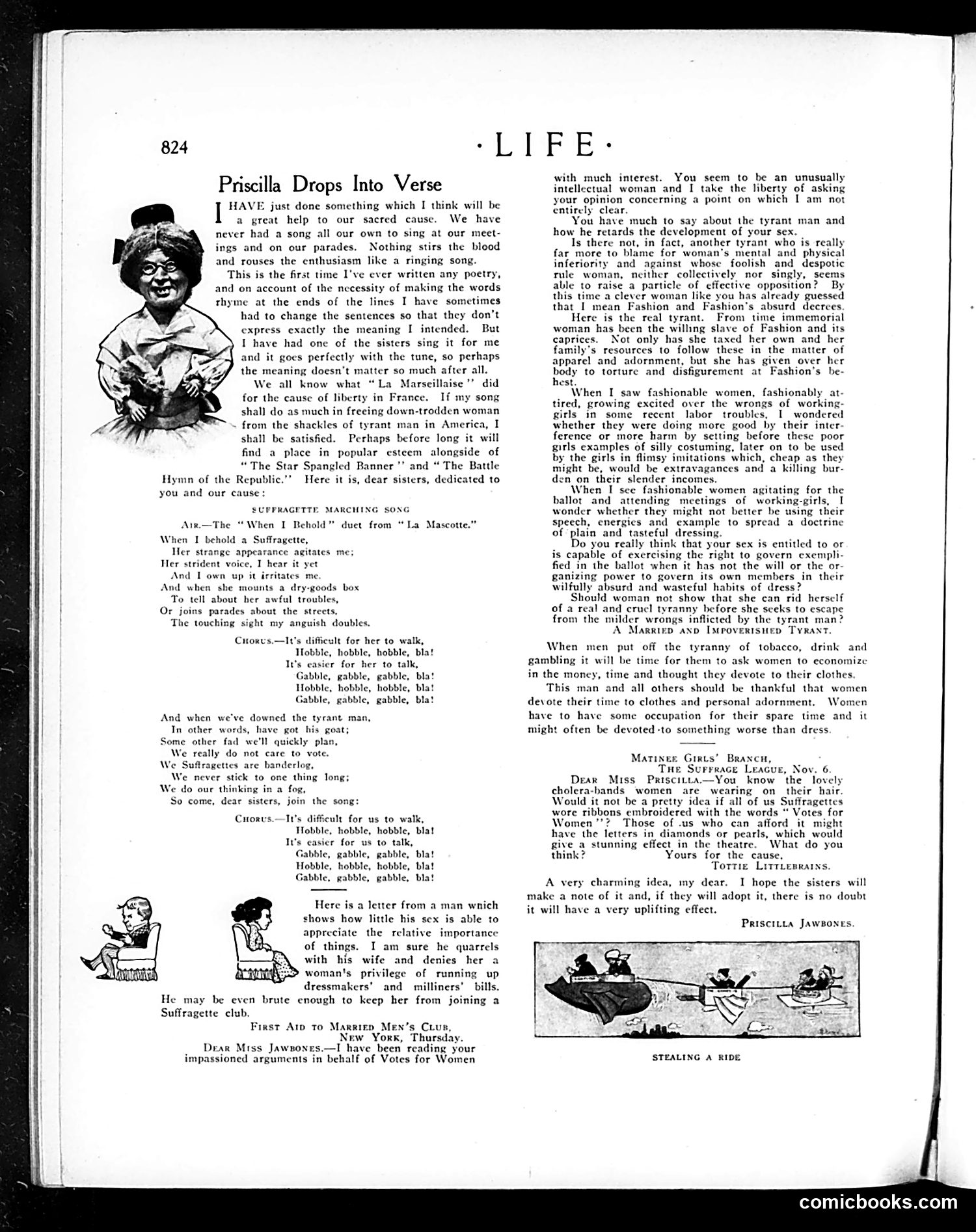
This page satirizes the women's suffrage movement through the fictional character Priscilla, a suffragette leader who has written a marching song. The satire operates on multiple levels: **The Song's Message**: The "Suffragette Marching Song" (set to a familiar operetta tune) actually mocks suffragettes themselves. The chorus repeatedly uses derogatory language—"hobble, hobble" and "gabble, gabble"—suggesting women can barely walk in their fashionable clothes and talk incessantly without substance. Verses undermine the movement by claiming suffragettes don't actually want to vote and constantly shift causes. **The Letter**: A reader's response argues the real "tyrant" oppressing women isn't men but Fashion itself, which constrains women's bodies and finances. This deflates the suffragettes' central argument by suggesting their enemy is misidentified. **The Irony**: Priscilla genuinely believes her song will inspire women like "The Marseillaise," unaware it actually ridicules her cause. The magazine uses her self-deception to mock suffragists as foolish and contradictory. The cartoons and illustration reinforce these stereotypes through caricature.
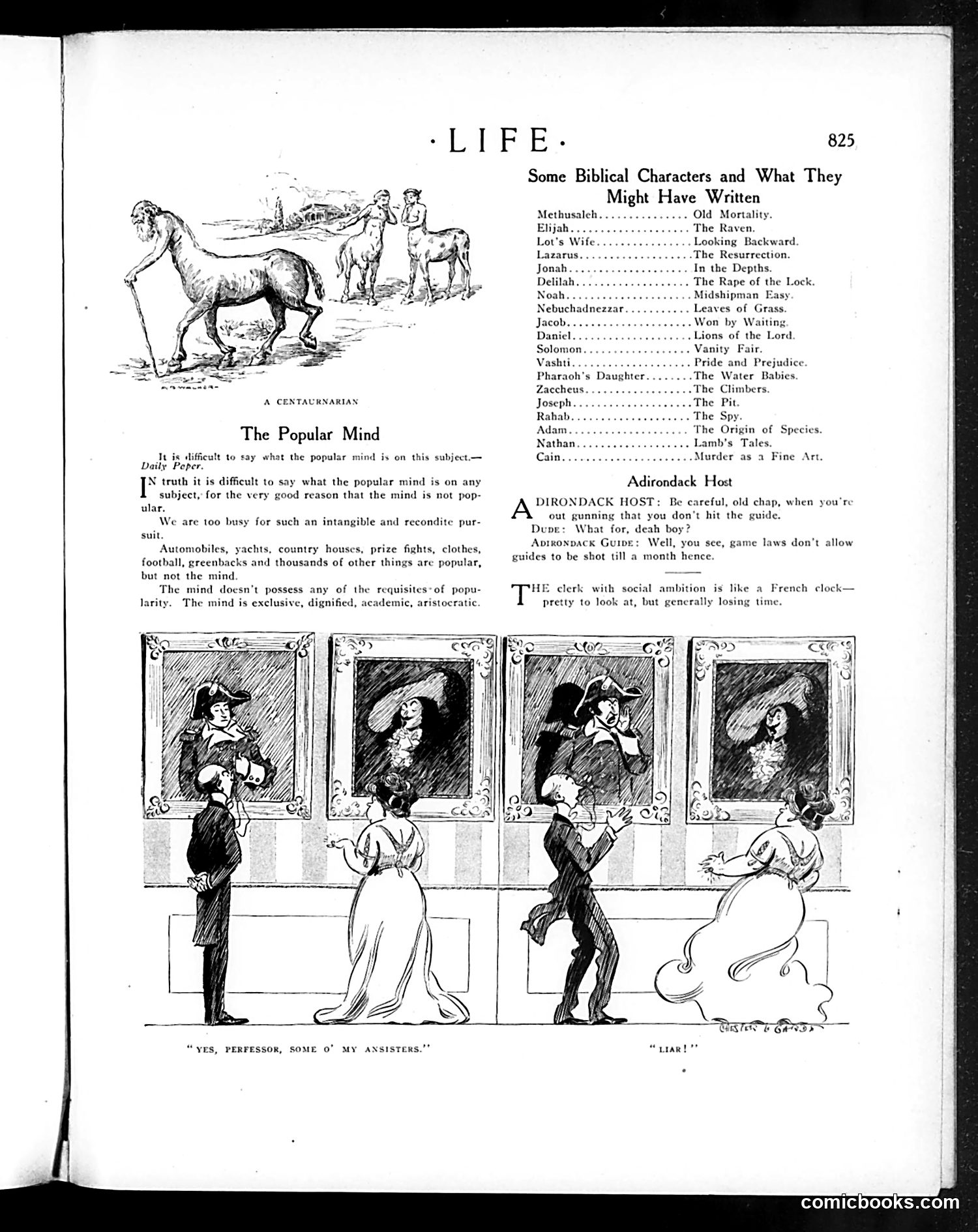
This page contains three distinct satirical pieces: **1. "Some Biblical Characters and What They Might Have Written"**: A clever literary humor section matching biblical figures with famous literary works—e.g., "Methuselah" as "Old Mortality," "Cain" as "Murder as a Fine Art." The joke relies on readers' knowledge of both scripture and classic literature. **2. "The Popular Mind"**: A philosophical essay mocking the concept of "popular opinion," arguing that minds are inherently exclusive and academic, not actually "popular." The satire critiques newspaper appeals to vague public sentiment. **3. "Adirondack Host" cartoon**: A wealthy hunter is warned not to shoot his guide because game laws prohibit hunting guides until next month—mocking the obliviousness and moral priorities of the rich sporting class. **4. French Clock aphorism**: Comparing an ambitious clerk to a decorative French clock—pretty but useless. The centaur illustration and overall tone exemplify *Life*'s satirical approach to class, culture, and American pretension.
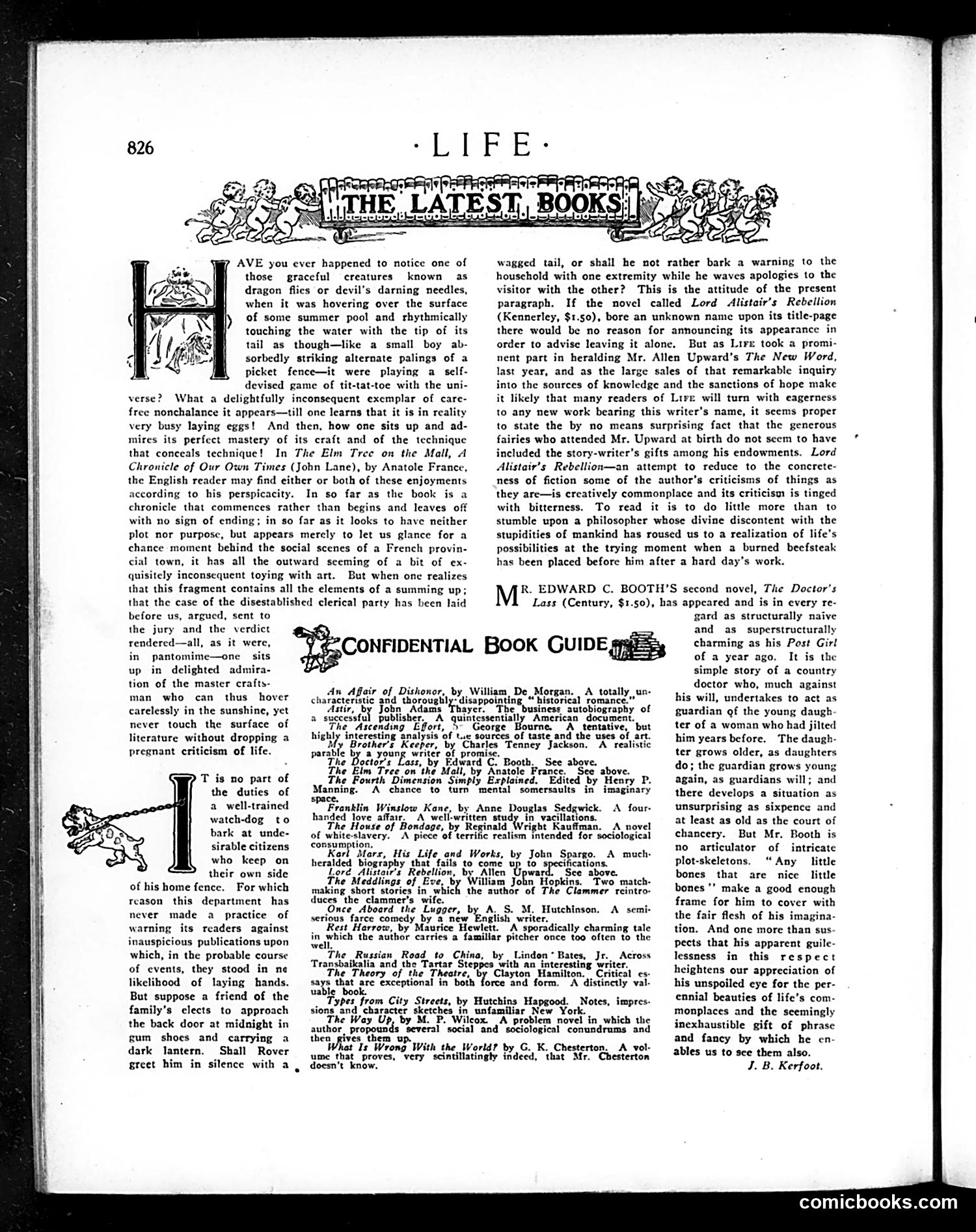
This page is a **book review column**, not primarily a political cartoon. The small decorative illustrations (dragonfly, watchdog) are ornamental flourishes typical of early 20th-century magazine design. The "Confidential Book Guide" reviews several novels, employing **satirical critique through extended metaphor**. The dragonfly comparison mockingly describes how one novel (*The Elm Tree on the Mall* by Anatole France) appears purposeless but actually contains structured social commentary—like a dragonfly laying eggs while appearing to play. The watchdog metaphor warns that while *Life* promoted Allen Upward's previous work *The New Word*, his new novel *Lord Alistair's Rebellion* doesn't merit endorsement. The reviewer sarcastically notes the author's philosophical gifts don't extend to fiction-writing. The page primarily **uses humor to guide readers away from mediocre books** while praising worthy ones—functioning as intellectual gatekeeping for *Life's* educated readership.
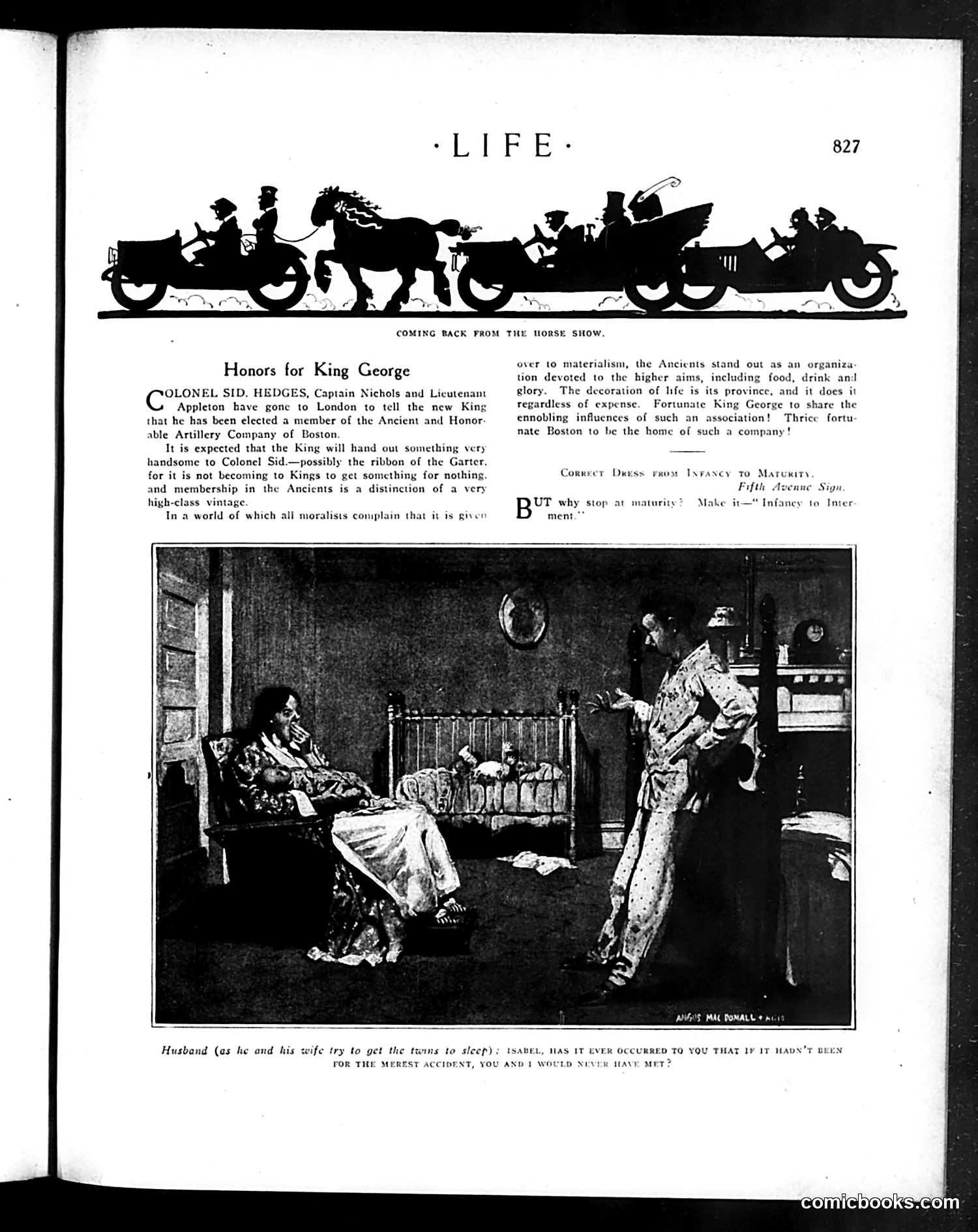
**Top Illustration:** A silhouette strip showing people returning from a horse show in various vehicles—a satirical commentary on the spectacle and pretension of the event. **"Honors for King George":** This article satirizes Boston's Ancient and Honorable Artillery Company sending representatives to London to inform the new King (appears to be George V, based on context) that he's been elected to their organization. The satire mocks the absurdity: a provincial American military club treating a reigning monarch as if granting *him* an honor, while expecting he'll reciprocate with prestigious awards like the Order of the Garter. The piece ridicules the pretentiousness of this "high-class vintage" organization, which the text suggests prioritizes "food, drink and glory" over substance. **"Correct Dress":** A brief quip about Fifth Avenue fashion, suggesting women should dress appropriately "from infancy to interment." **Bottom Illustration:** A domestic scene where a husband, trying to get twins to sleep, philosophizes to his wife about fate—a gentle humor about parenthood and coincidence.
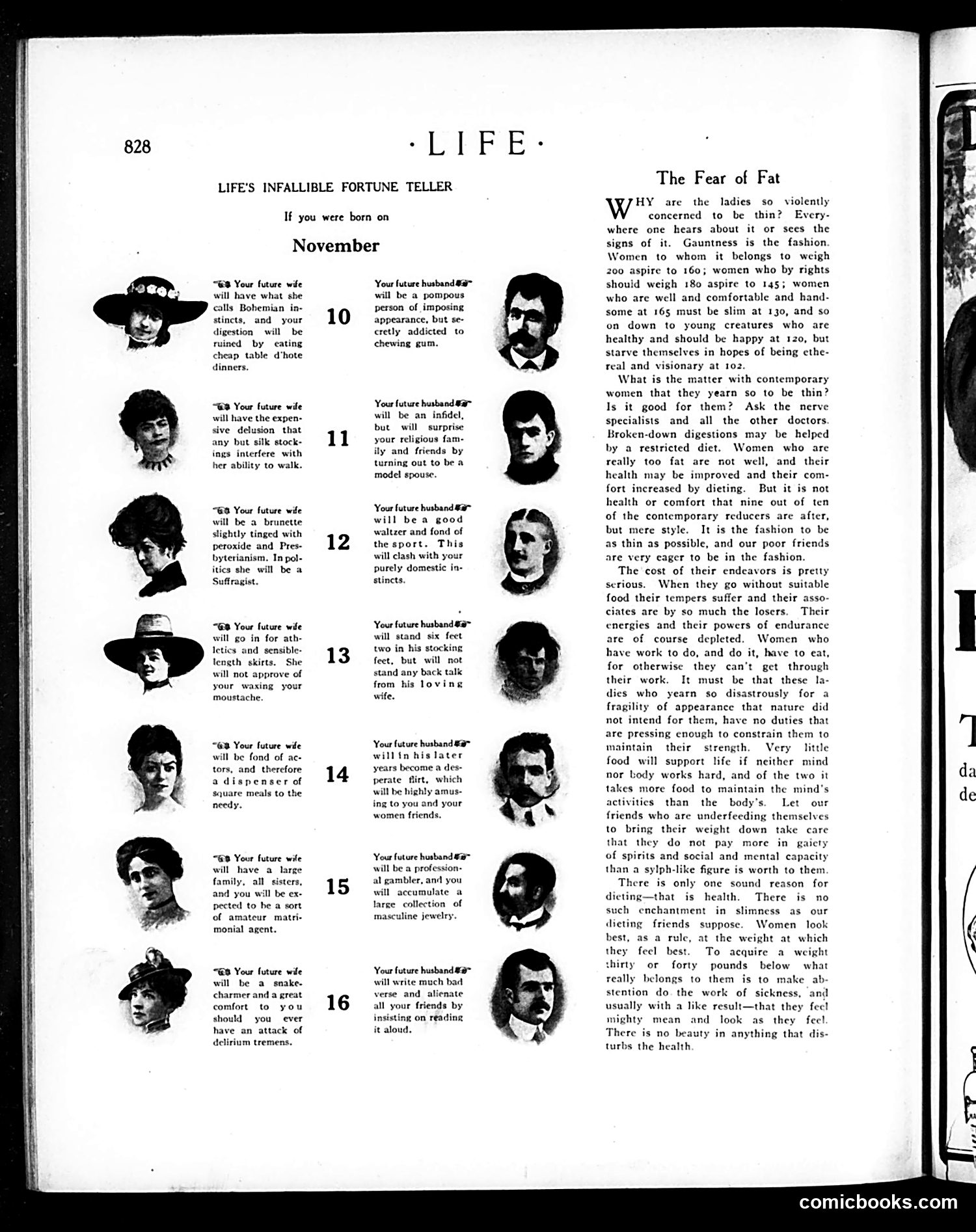
This page satirizes two early-20th-century trends. The left side offers mock "fortunes" for women born in November (days 10-16), using caricatured female faces to predict their futures as wives—typically depicting them as vain, extravagant, or difficult. The humor relies on crude stereotypes about women's personalities and appearance. The right article, "The Fear of Fat," critiques the contemporary fashion obsession with extreme thinness. The author observes that women across all weight categories aspire to be dangerously underweight (aiming for 102-130 lbs regardless of their proper weight), driven purely by style rather than health. The piece argues this fashion damages women's energy, temperament, and ability to work, and that the "sylph-like figure" trend is socially destructive since it provides no real health benefit. The satire mocks both the fashion industry's influence and women's compliance with a harmful standard.
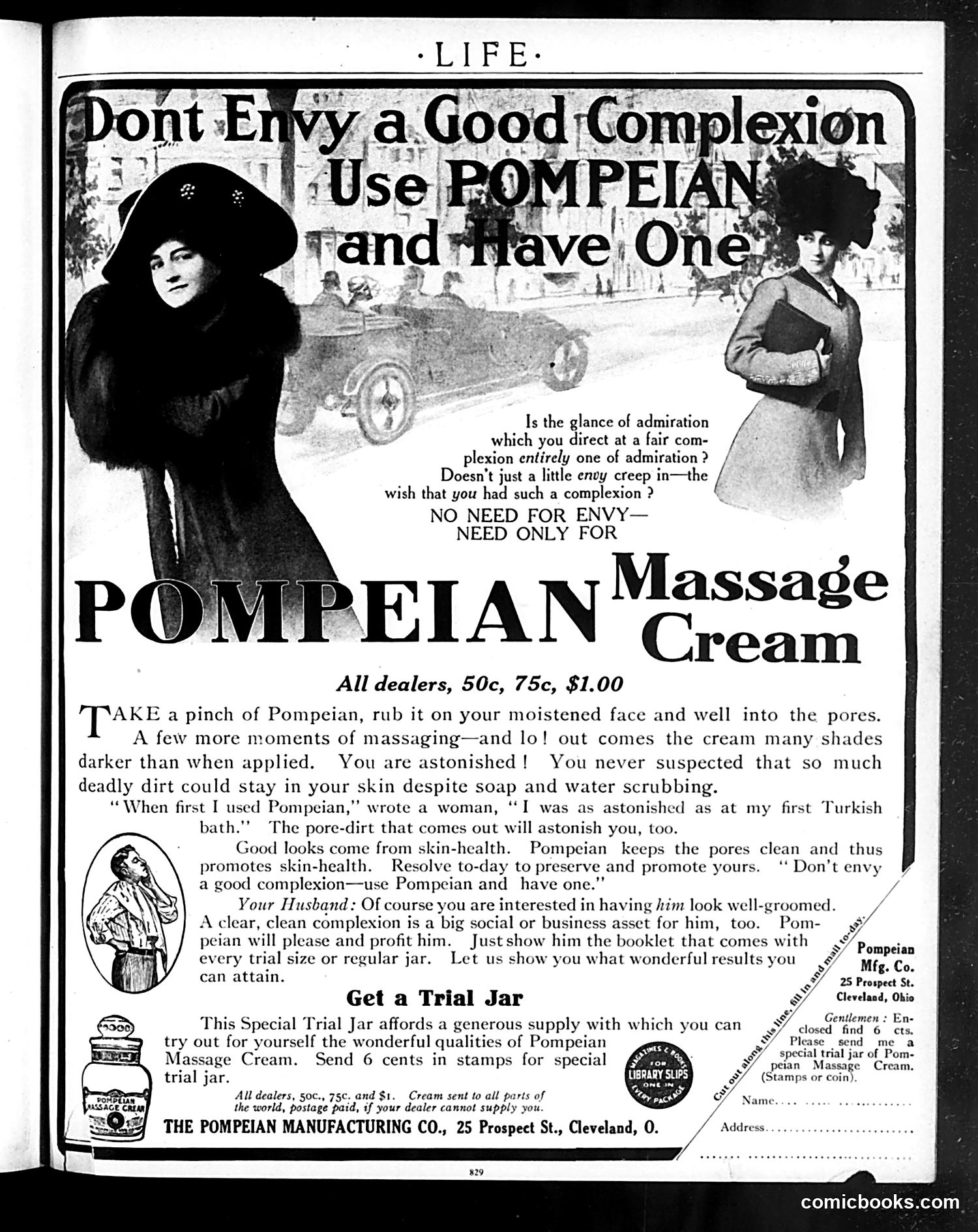
This is a full-page advertisement, not satire. It promotes Pompeian Massage Cream by exploiting social anxieties about complexion and appearance—particularly women's envy of fair skin. The ad's opening frames skin tone as a status symbol: it asks whether admiration of "a fair complexion" contains "envy," then offers the product as a solution. The copy claims the cream removes hidden "deadly dirt" from pores through massage, revealing cleaner, healthier skin beneath. The marketing targets multiple audiences: women concerned about their appearance, husbands interested in their wives' grooming, and men themselves needing "a clear, clean complexion" for "social or business asset." A trial jar offer (6 cents) encourages purchase. By modern standards, the ad's appeal to complexion-based envy and the implication that darker skin = "dirt" reflects period attitudes about beauty standards that modern readers would recognize as problematic. The product promised visible whitening through exfoliation.
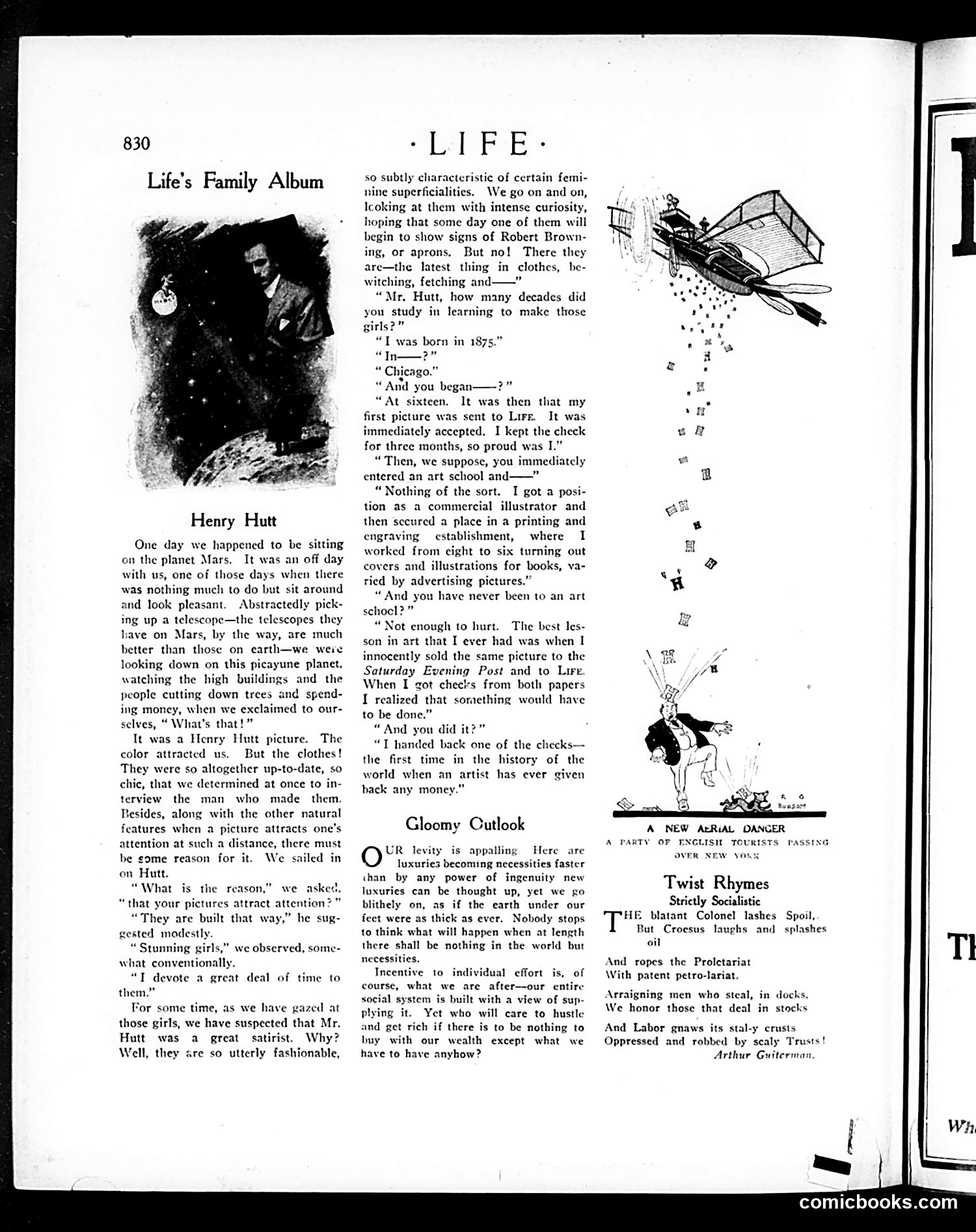
This page features **Henry Hutt**, a prominent illustrator of the era, interviewed about his artistic practice. The satire centers on Hutt's success despite unconventional training: he never attended art school, learned through commercial work, and achieved immediate acceptance from *Life* magazine at sixteen. The joke mocks both Hutt's accidental professionalism and, implicitly, the pretensions of formal art education. The page also includes fashion illustrations typical of Hutt's work—stylishly dressed women meant to embody contemporary feminine superficiality. The interviewer suggests Hutt's obsessive focus on fashionable girls constitutes subtle social satire. A secondary section, "Gloomy Outlook," offers economic pessimism about accelerating necessities outpacing luxuries, questioning future incentives for wealth-building. The "Twist Rhymes" section presents Socialist critique of capitalist exploitation, with wordplay on "petro-lariat" and attacks on both individual thieves and corporate trusts.
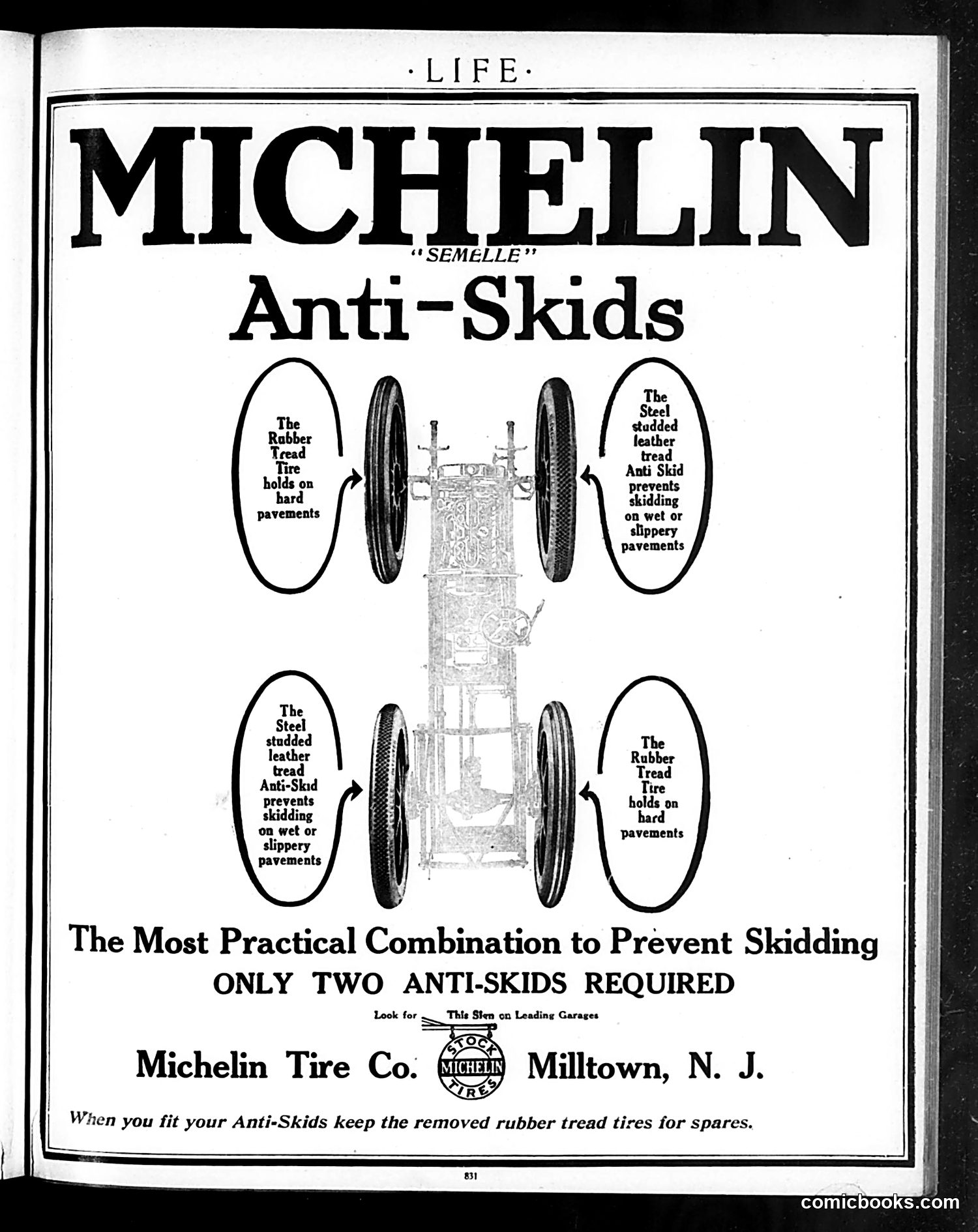
This is a **product advertisement**, not a cartoon or satire. It promotes Michelin "Semelle" Anti-Skids—tire chains or tread overlays designed to prevent vehicle skidding on wet or slippery pavement. The page shows a schematic diagram of a car viewed from above with four wheels. Text callouts explain that two types of anti-skid products work together: rubber tread tires for grip on hard pavement, and steel-studded leather tread for preventing skids on wet surfaces. The advertisement emphasizes that only two anti-skids are needed (likely for the rear wheels), making this solution "the most practical combination." This reflects early 20th-century automobile safety concerns when road conditions and tire technology were primitive. The ad directs readers to look for Michelin's sign at garages and suggests keeping removed rubber tires as spares.
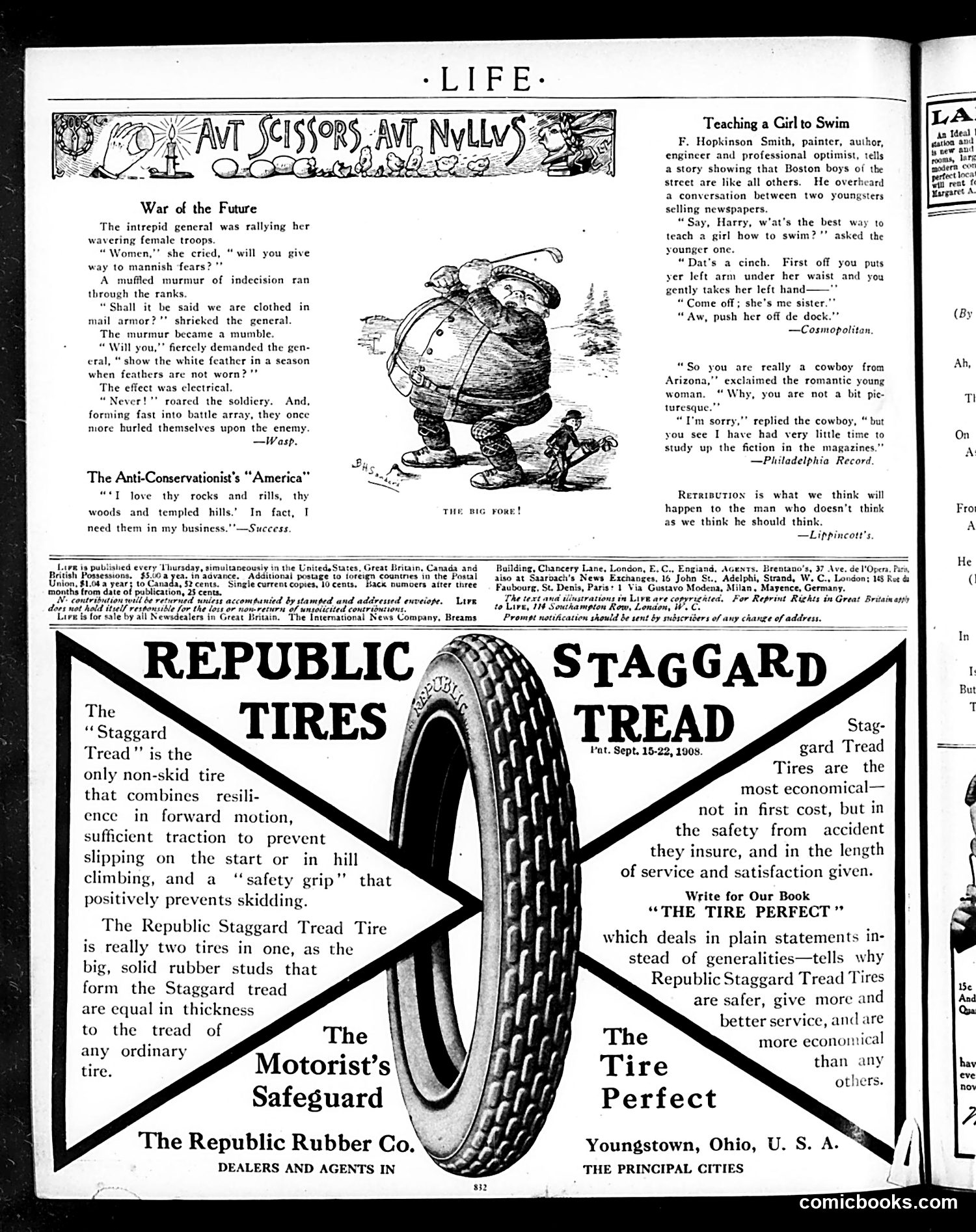
This page contains three separate satirical pieces typical of early 20th-century Life magazine humor: **"War of the Future"**: A brief joke about female soldiers. A general rallies wavering women troops by shaming them—questioning if they'll show cowardice ("white feather") when feathers aren't even fashionable. The satire mocks both militarism and contemporary anxieties about women's roles, suggesting women soldiers would be absurdly motivated by fashion concerns rather than patriotism. **"Teaching a Girl to Swim"**: Street boys discuss swimming instruction with crude directness. When one realizes the girl is his sister, the advice shifts from physical contact to simply pushing her off the dock—absurdist humor playing on the boys' practical, unromantic attitude versus urban street culture stereotypes. **"The Anti-Conservationist's America"**: A brief jab at someone who loves nature only for commercial exploitation ("rocks and fills...need them in my business"), mocking capitalist disregard for conservation. The page is primarily advertising for Republic Staggard Tread Tires, with modest satirical content.
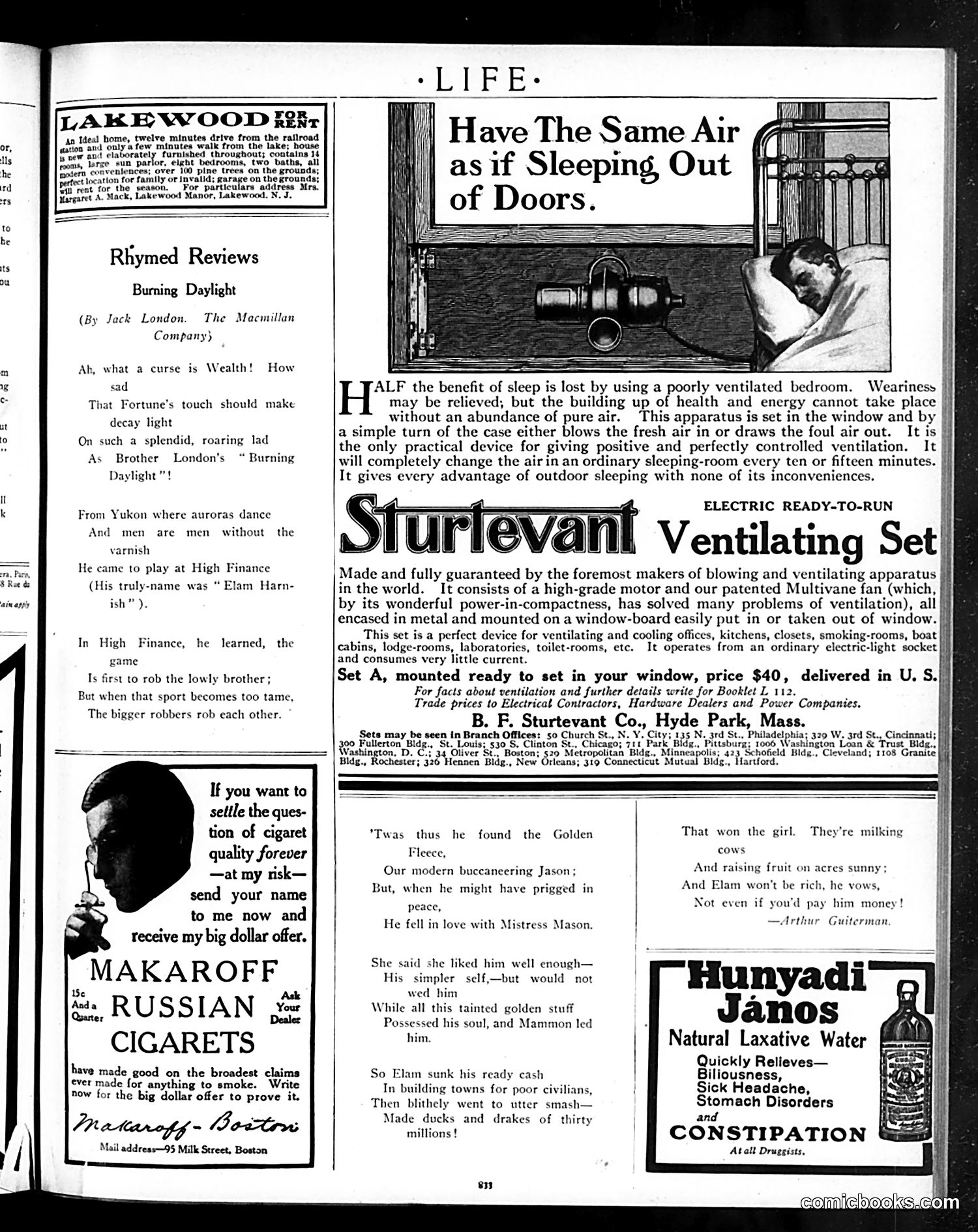
This page from *Life* magazine consists primarily of **advertisements and literary reviews** rather than political cartoons. The main content includes: **"Rhymed Reviews"**: A humorous poem reviewing Jack London's novel *Burning Daylight*. The satire mocks how wealth corrupts the protagonist—a robust Yukon prospector named Elam Harnish who comes to civilization and learns that "High Finance" involves robbing others. The reviewer presents this moral decline as disappointing, using the book's themes to critique the corrupting influence of money. **Arthur Guiterman's poem** (lower right) continues this theme: a girl rejects a wealthy man's suit, preferring an honest farmer over "tainted golden stuff." **Advertisements** dominate the page, including the Sturtevant ventilating fan and Makaroff Russian cigarettes—typical early-20th-century product pitches. The satirical point is straightforward: *Life* uses literature reviews to critique capitalism's moral corruption of natural, virtuous men.
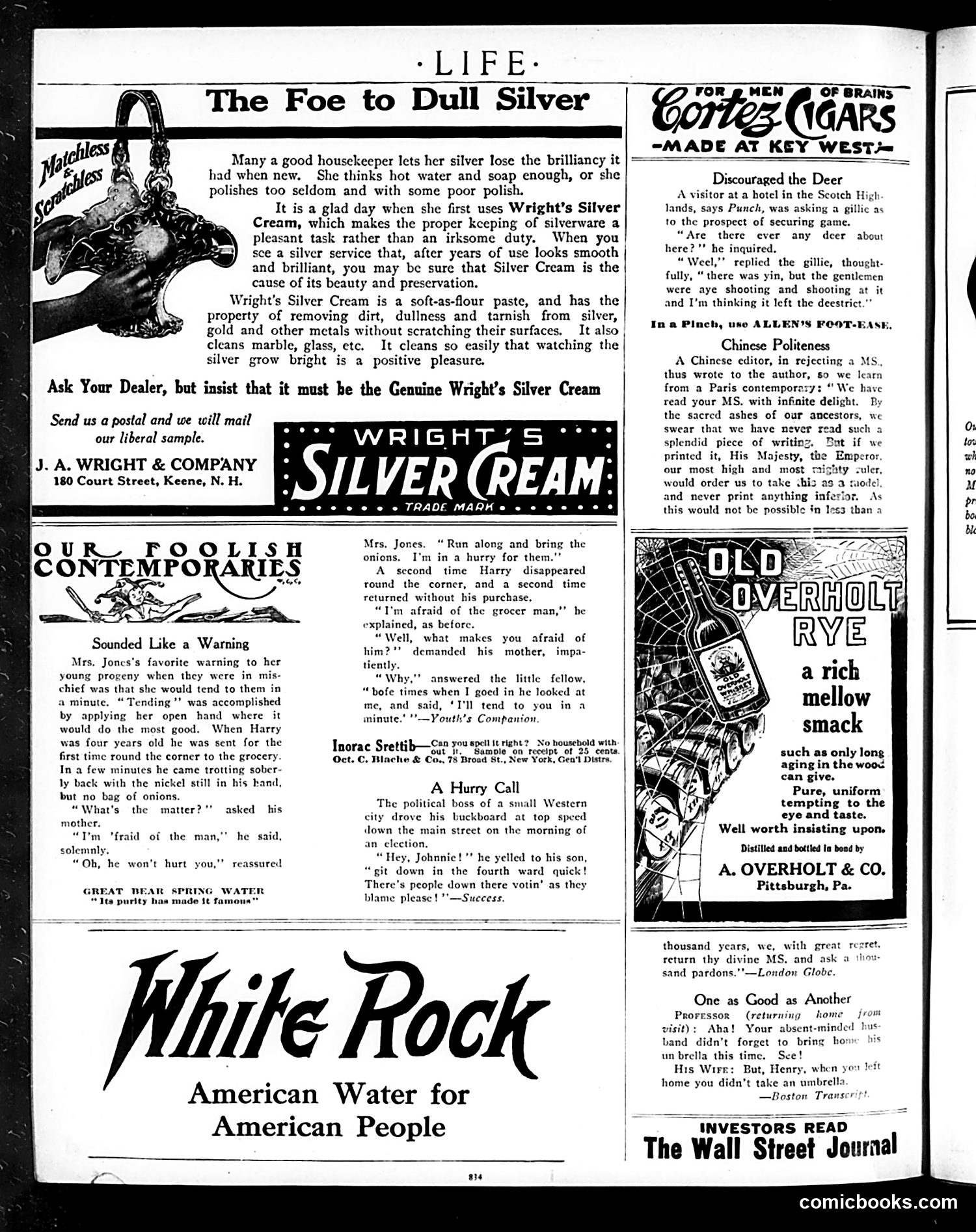
This page is primarily **advertising** mixed with brief humorous anecdotes. The main satirical content appears in small, titled humor pieces rather than visual cartoons: **"Our Foolish Contemporaries"** mocks parental discipline through a child's misunderstanding. A mother threatens to "tend to" misbehaving children (meaning spank them). Her young son, sent to the grocer, repeatedly returns empty-handed, terrified because the grocer said he'd "tend to" him—interpreting this as a threat matching his mother's language. **"A Hurry Call"** satirizes political corruption: a Western city political boss frantically orders his son to "git down in the fourth ward quick," implying voter fraud or manipulation. **"Discouraged the Deer"** is a brief Scottish joke about overeager hunters. **"Chinese Politeness"** parodies excessively formal rejection letters through invented Chinese editor politeness. The page is otherwise filled with **product advertisements** (Wright's Silver Cream, Old Overholt Rye, White Rock Water, Cortez Cigars) typical of early 20th-century Life magazine's revenue model.
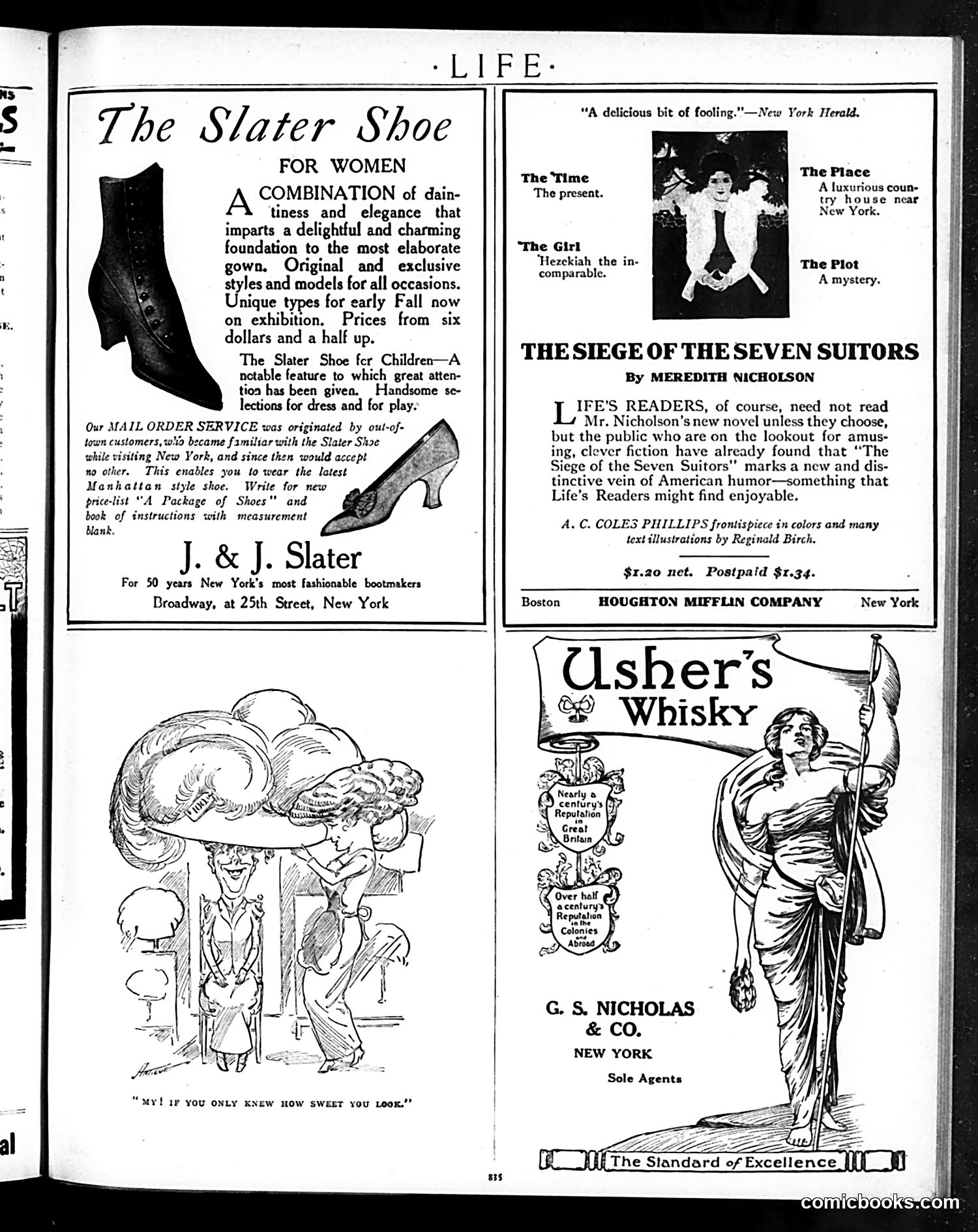
This page is primarily **advertising** with one small cartoon. The main content includes shoe ads, a book advertisement, and whisky promotion. The cartoon ("My! If you only knew how sweet you look") depicts a fashionably dressed woman with an exaggerated upswept hairstyle typical of the early 1900s, being flattered by a man. It's a gentle satire on **courtship rituals and male flattery**—poking fun at insincere compliments men offer to impress women, and perhaps at women's vanity regarding their appearance and fashion. The page reflects early-20th-century consumer culture, advertising luxury goods (expensive shoes at $6.50+, whisky, novels) to affluent readers. The book advertisement emphasizes that "The Siege of the Seven Suitors" offers distinctly American humor, suggesting Life's audience appreciated contemporary fiction about romance and courtship.
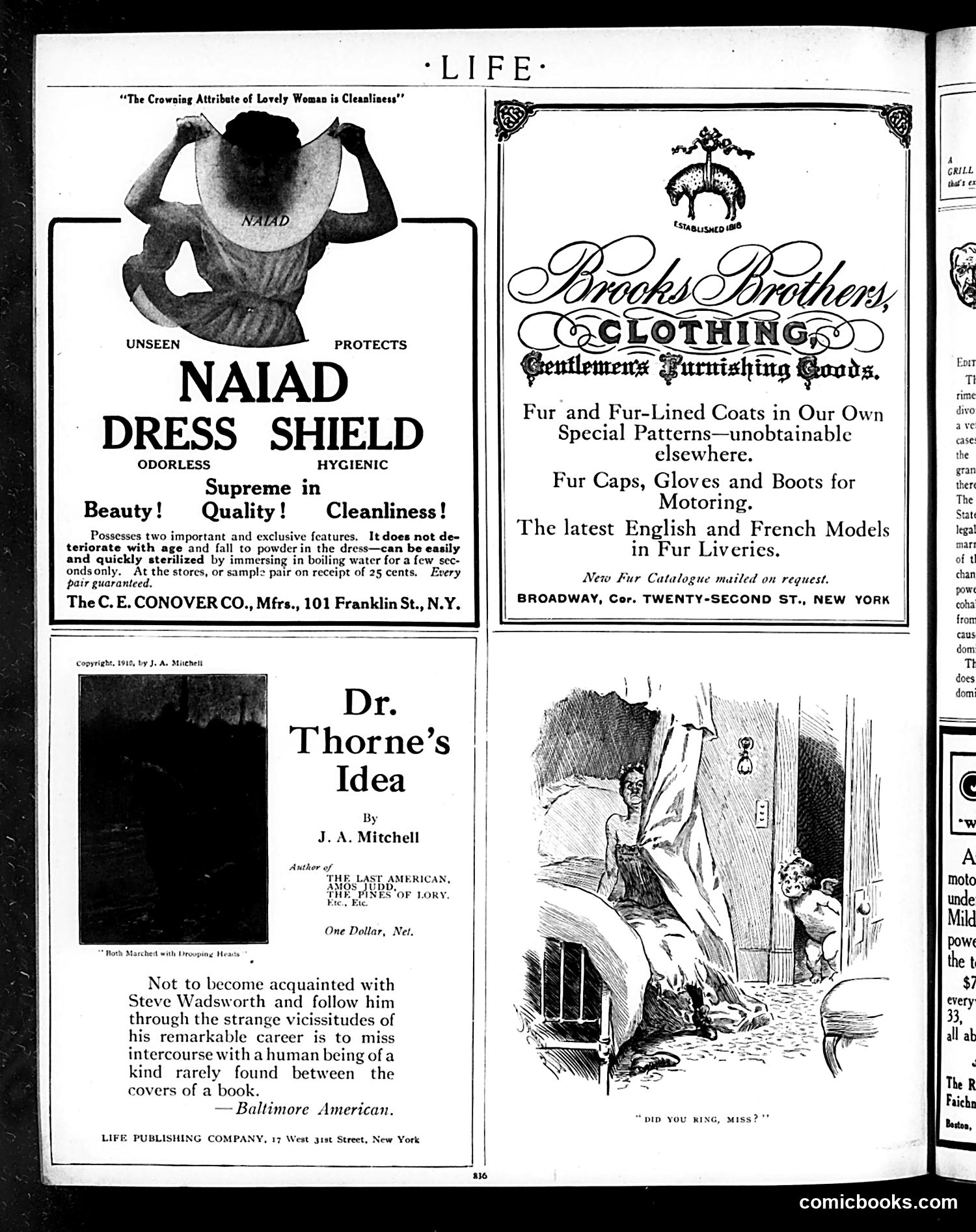
This page consists primarily of **period advertisements** (circa 1915, based on copyright notice) rather than satirical political cartoons: 1. **Naiad Dress Shield** (top left): An ad for undergarment protection—an "unseen" shield preventing sweat stains on dresses. The image shows a woman adjusting her clothing. This reflects early 20th-century concerns about feminine hygiene and appearance. 2. **Brooks Brothers** (top right): Luxury clothing advertisement emphasizing fur coats and accessories for "motoring" (early automobiles), highlighting exclusivity through "special patterns—unobtainable elsewhere." 3. **"Dr. Thorne's Idea"** (lower left): A book advertisement by J.A. Mitchell, promoting a novel about a character named Steve Wadsworth. 4. **Cartoon illustration** (lower right): A sketch captioned "Did you ring, Miss?" appears to illustrate domestic service humor—likely depicting a servant responding to a bell. The page reflects **Edwardian-era consumer culture** targeting middle/upper-class readers concerned with fashion, modernity (automobiles), and social propriety.
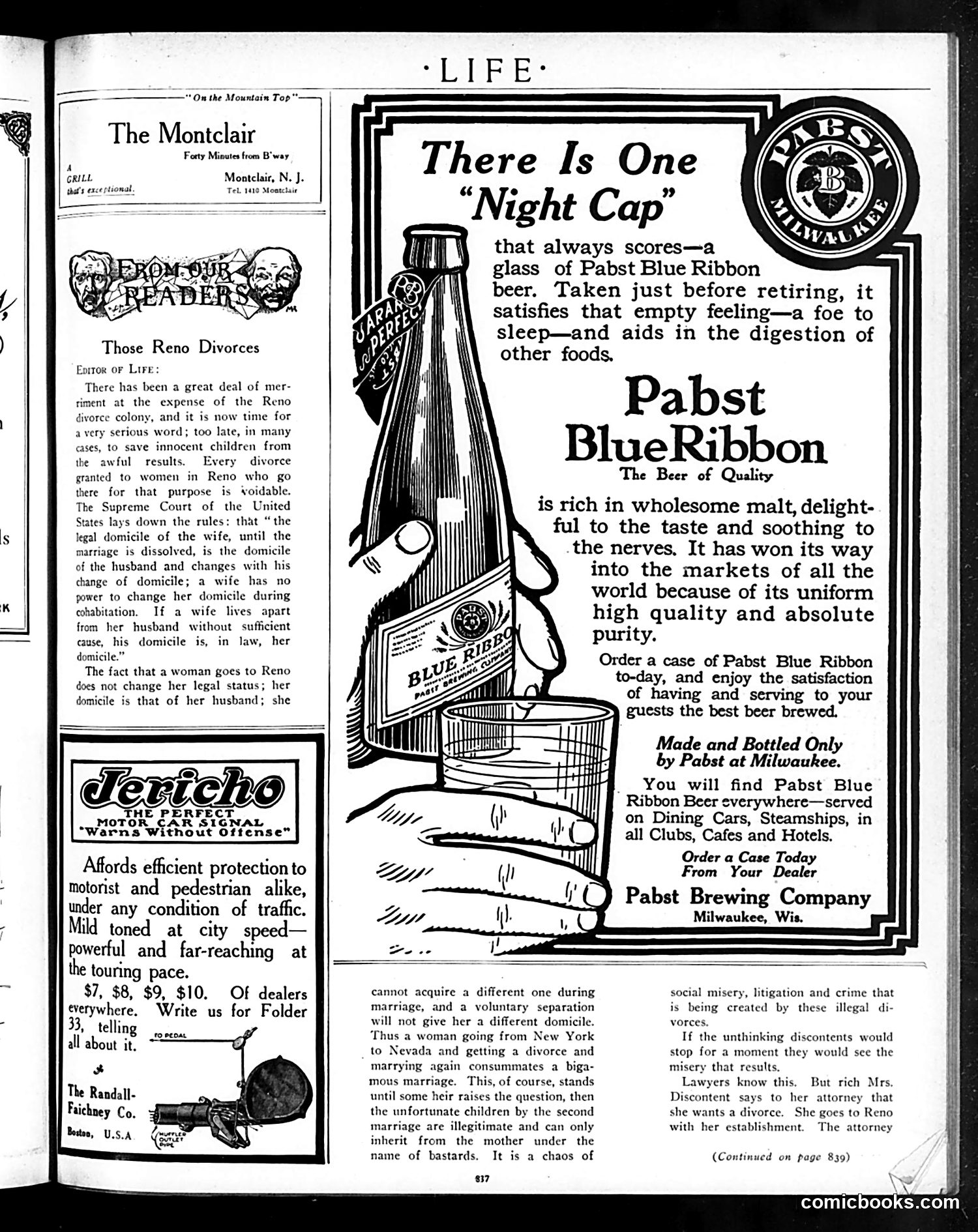
This page combines editorial commentary with period advertising. The main content is a serious letter to the editor about **Reno divorces**—a social issue of the era. ## The "Reno Divorces" Editorial Issue The writer argues that women obtaining divorces in Nevada are committing bigamy unknowingly. Under U.S. law, a wife's legal domicile remained her husband's until marriage was officially dissolved. Women traveling to Reno for quick divorces couldn't actually change their legal status, making any subsequent remarriage invalid. Children from second marriages would legally be "bastards" unable to inherit except through their mother. The editorial criticizes wealthy women ("rich Mrs. Discontent") who could afford travel to Nevada, implying they caused social chaos through frivolous remarriages while poor women and innocent children suffered legal consequences. ## The Advertisements The page includes ads for **Jericho car horns**, **The Montclair** resort, and prominently, **Pabst Blue Ribbon beer**—marketed as a digestive "night cap" for sleep, reflecting pre-Prohibition attitudes toward alcohol's medicinal properties.
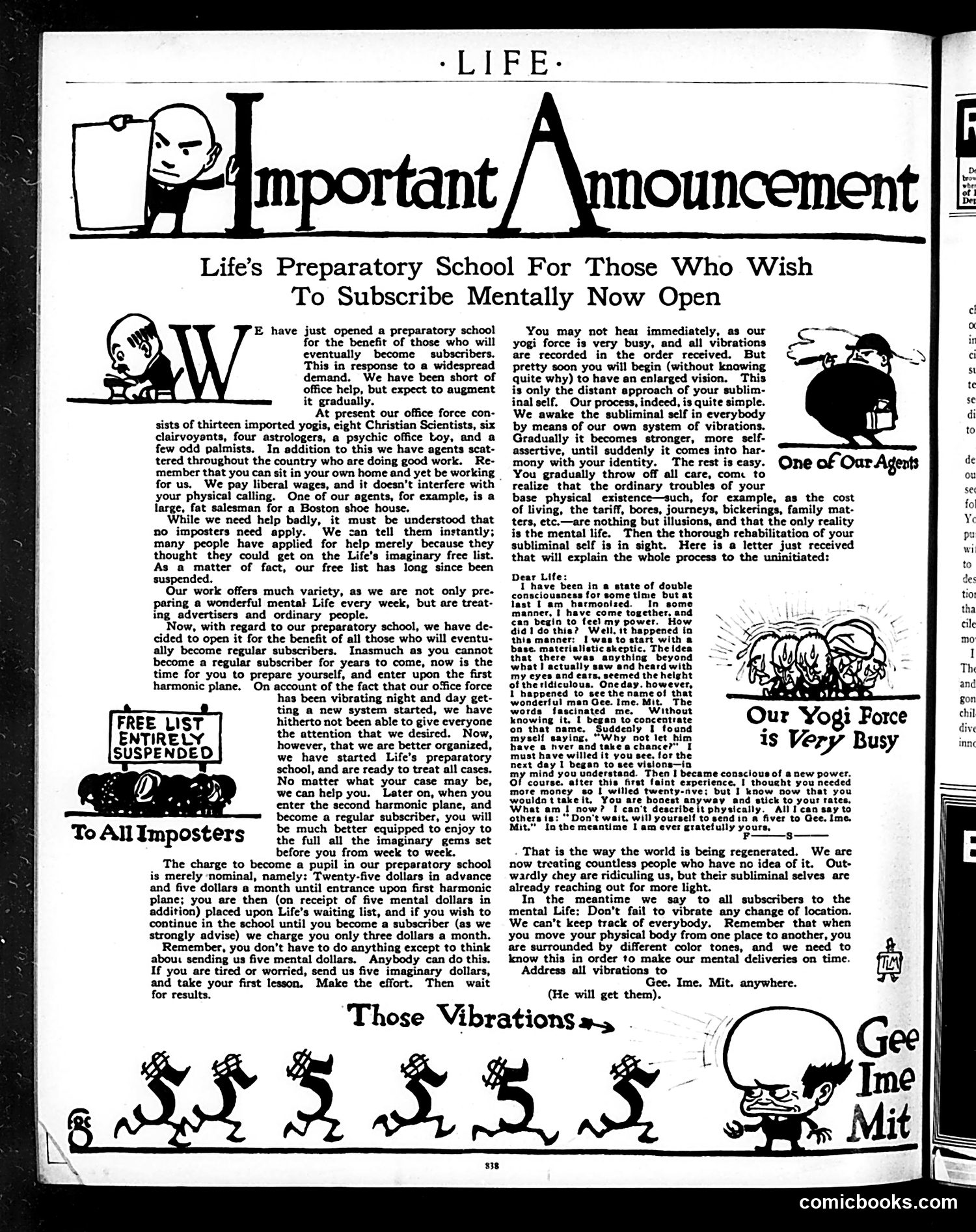
This page satirizes the early 20th-century craze for spiritual self-help schemes, particularly New Thought, Theosophy, and yoga movements that were gaining popularity in America. **The Setup:** Life mocks a fraudulent "preparatory school" claiming to awaken subscribers' "subliminal selves" through "vibrations" transmitted by imported yogis, Christian Scientists, and clairvoyants. The scheme charges $25 upfront plus $5 monthly for "mental dollars" and imaginary lessons. **The Satire's Point:** Life ridicules how these movements promised to solve real-world problems (costs of living, family troubles) through mystical thinking rather than practical action. The repeated emphasis on "vibrations" and "mental delivery" exposes the absurdity—you pay real money for completely intangible services. **Key Detail:** The suspended "free list" and warning against "imposters" suggest Life is mocking both the schemes themselves AND people gullible enough to fall for them. The humor lies in treating obvious nonsense with mock-serious business language.
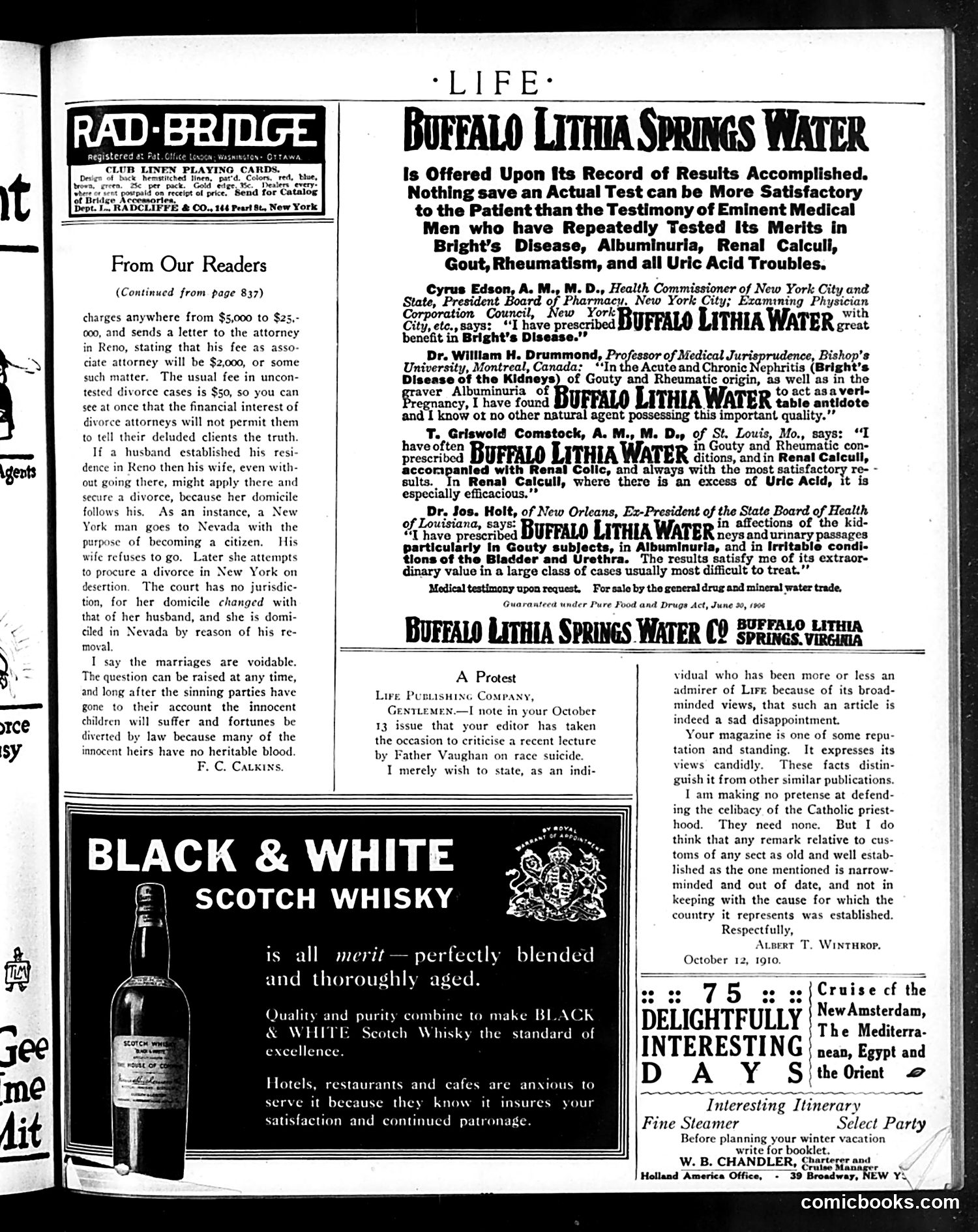
This page is primarily **advertising**, not satire or political commentary. The dominant content consists of three large advertisements: 1. **Buffalo Lithia Springs Water** (top): Marketed as a cure for kidney disease, gout, rheumatism, and uric acid problems. The ad uses testimonials from prominent physicians and government officials (New York's Health Commissioner, professors, state board presidents) to establish medical credibility—a common marketing tactic of the early 1900s when patent medicines made unregulated health claims. 2. **Black & White Scotch Whisky** (bottom left): A straightforward quality liquor advertisement emphasizing merit and purity. 3. **New Amsterdam cruise advertisement** (bottom right): Promoting winter travel to Egypt and the Orient. The page also contains a reader's letter about **Nevada divorce law** (discussing domicile and marital jurisdiction) and a short protest letter criticizing *Life*'s editor for criticizing Father Vaughan's lecture on race suicide. There are no political cartoons or satire visible on this page.
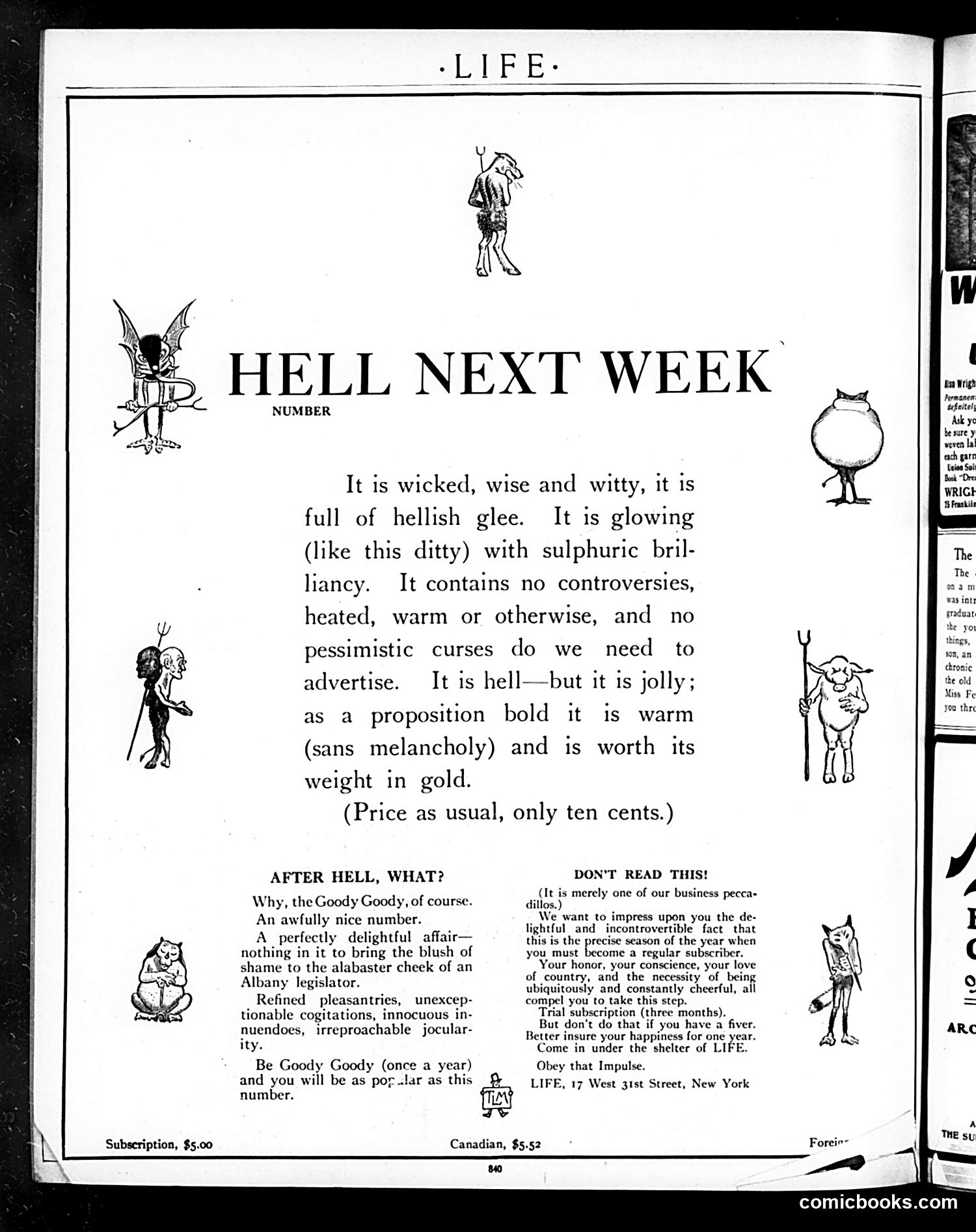
This is a **self-promotional page** announcing upcoming issues of *Life* magazine (a satirical publication, not the later photo magazine). The text uses mock-serious language to advertise two fictional future issues: "Hell Next Week" and "Goody Goody." The humor relies on **ironic contrast**: "Hell Next Week" is described as cheerful and harmless despite its infernal name, while "Goody Goody" is positioned as so wholesome it wouldn't embarrass even an "Albany legislator"—apparently a coded reference to corrupt political figures, suggesting legislators were known for scandal. The **small devil illustrations** scattered throughout reinforce the playful "hellish" branding. The page mockingly urges readers to subscribe, with a satirical "DON'T READ THIS!" section that paradoxically emphasizes subscription's importance. The tone is typical early 20th-century magazine satire: self-aware, irreverent, and designed to build audience loyalty through humor and the promise of witty content.
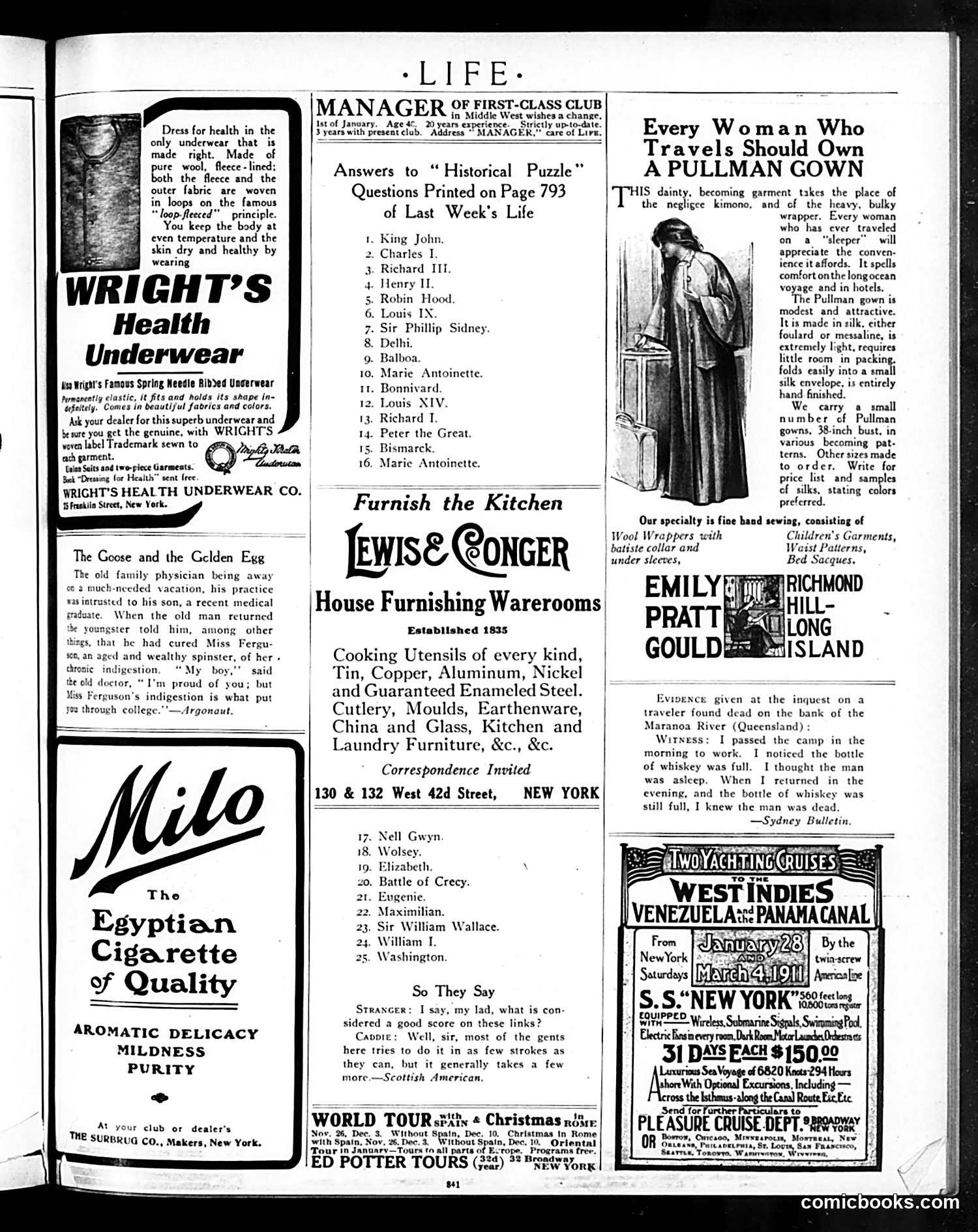
This page is primarily **advertisements and puzzles** with minimal satirical content. The main items are: 1. **Wright's Health Underwear** and **Milo Cigarettes** ads—typical early 20th-century product marketing emphasizing health claims now recognized as dubious. 2. **"Historical Puzzle"**—a quiz asking readers to identify historical figures (King John, Louis XIV, etc.) from hints, a common interactive feature in Life magazine. 3. **One brief joke** ("The Goose and the Golden Egg"): A young doctor cures a wealthy spinster's indigestion; his father notes this was worthwhile only because her indigestion paid for his medical school—satirizing mercenary attitudes toward medicine. 4. **Travel advertisements** for Pullman gowns and Caribbean cruises, reflecting early-20th-century leisure travel for the wealthy. The page reflects Life's dual nature as both satirical magazine and genteel advertising vehicle for affluent readers.
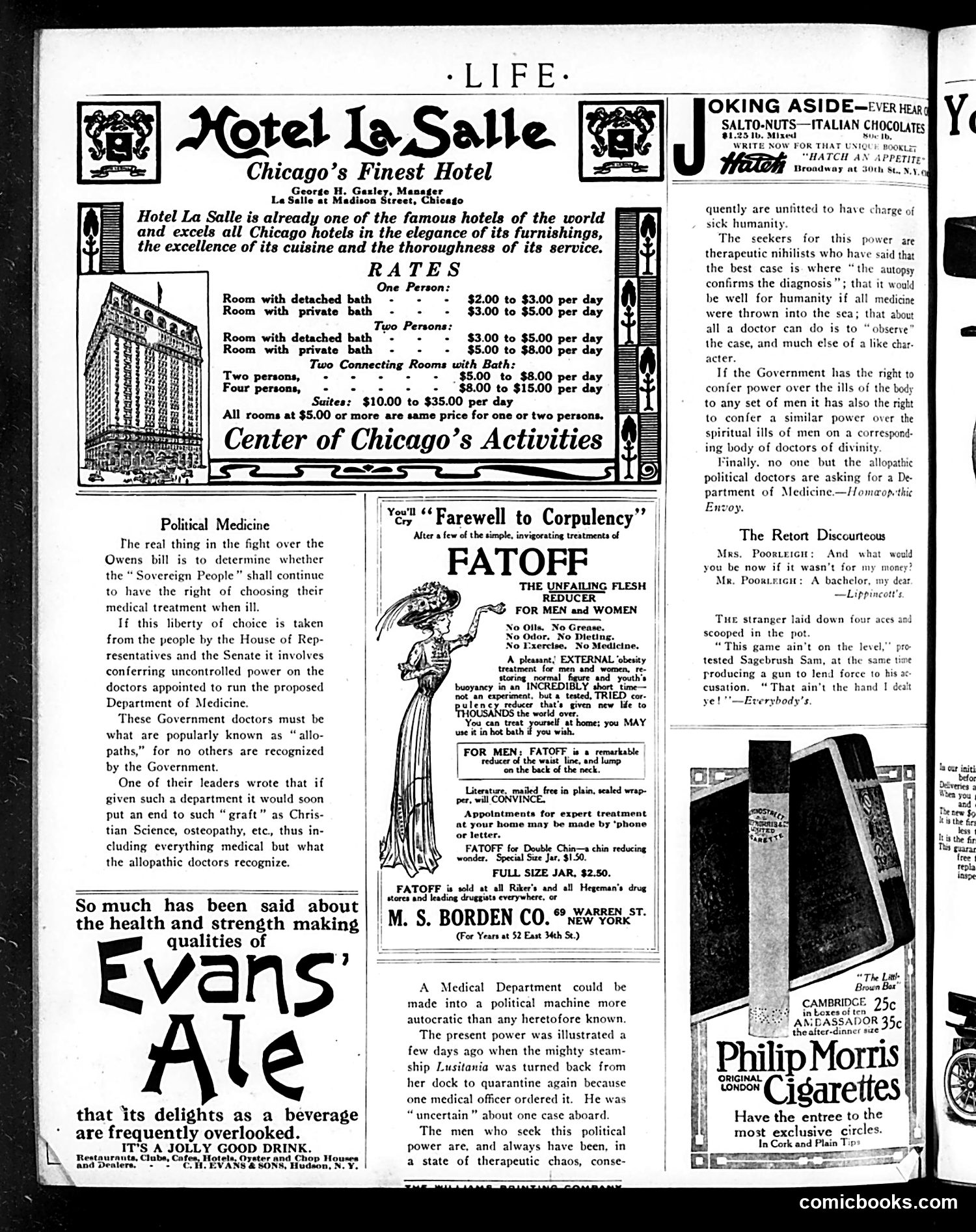
The main article attacks the proposed Owens bill, which would create a government "Department of Medicine." The author argues this grants dangerous, unchecked power to "allopathic" doctors (conventional medicine practitioners) to monopolize medical treatment and eliminate competing approaches like Christian Science and osteopathy. The piece frames this as a liberty issue: citizens should choose their own medical treatment rather than have the government impose one approved system. The author notes that even allopathic doctors' own leaders admitted such a department would eliminate medical "graft"—suggesting they want monopolistic control. The satire targets what the author sees as medical authoritarianism disguised as progress. The article criticizes these doctors as "therapeutic nihilists" unfit for power, referencing a famous quip that the best medical outcome is when "the autopsy confirms the diagnosis." The page is otherwise filled with hotel advertisements and product ads (Fatoff weight reducer, Evans' Ale, Philip Morris cigarettes), typical of early 20th-century Life magazine layout.
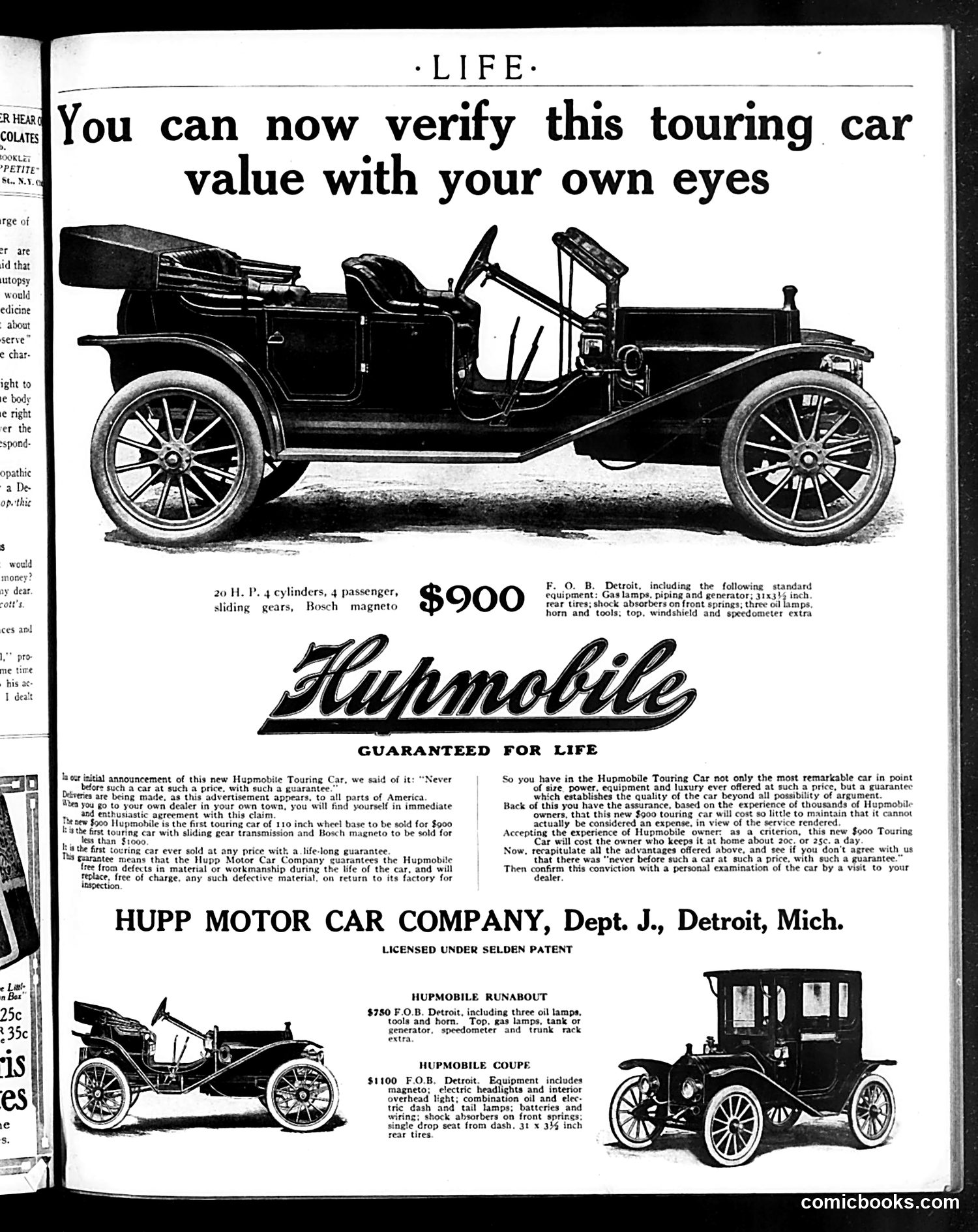
This is **not satire or political commentary**—it's a straightforward automobile advertisement from *Life* magazine's early automotive era. The page promotes the Hupmobile touring car ($900), emphasizing its unprecedented value and a lifetime warranty ("Guaranteed for Life"). The ad claims this is the first 110-inch wheelbase touring car at this price point with both sliding gear transmission and Bosch magneto ignition. The selling points target middle-class buyers: low maintenance costs (20-25 cents daily), reliable equipment, and the manufacturer's confidence in durability. Three vehicle models are shown: the touring car, runabout ($750), and coupe ($1,100). The repeated phrase "Never before such a car at such a price" frames the guarantee as proof of quality, positioning the Hupmobile against competitors. This reflects early 1900s automobile marketing, when such warranties were genuinely novel and purchasing an automobile was a major investment requiring reassurance.
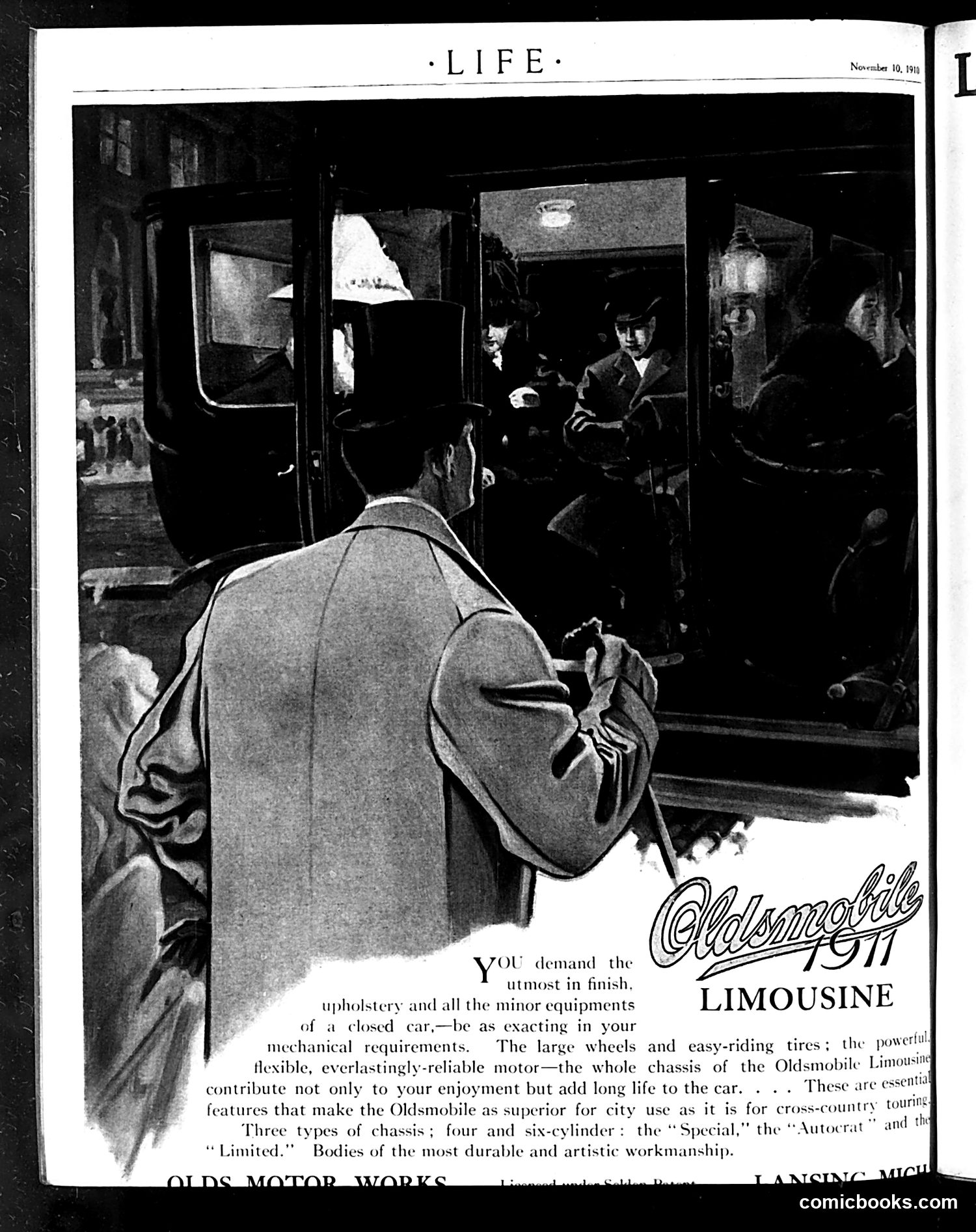
This is **not a cartoon or satire** — it's a full-page **automobile advertisement** for the Oldsmobile 1911 Limousine, published in Life magazine on November 10, 1913 (date visible in header). The image shows a well-dressed man in a coat and hat viewing an Oldsmobile limousine through its window, where passengers are visible inside. The accompanying text emphasizes luxury features: superior upholstery, reliable mechanics, quality wheels and tires, and a powerful motor suitable for both city and cross-country travel. This is period advertising targeting affluent buyers, highlighting the vehicle's durability and refined workmanship. The Oldsmobile company (OLDS MOTOR WORKS, Lansing, Michigan) offered three chassis types: the "Special," "Autocrat," and "Limited." For modern readers: this represents early 20th-century automobile marketing aimed at the wealthy, emphasizing mechanical reliability and luxury appointments as status symbols.