
Life, 1910-11-10 · page 5 of 44
Life — November 10, 1910 — page 5: what you’re looking at
What you’re looking at
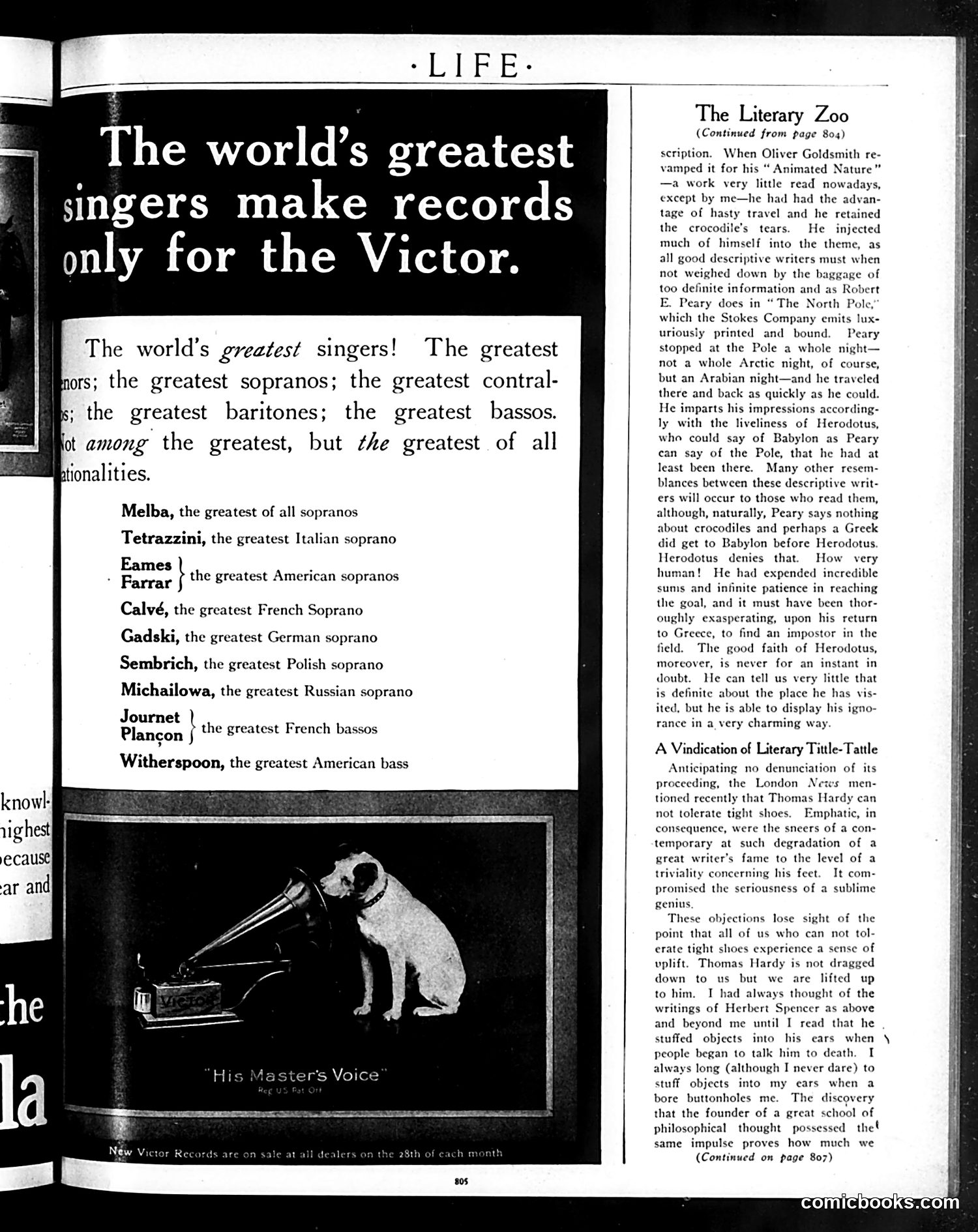
This page is primarily a **Victor Records advertisement**, not a political cartoon. The ad promotes the superiority of Victor Records by listing famous opera singers of the era who exclusively recorded for the company: Melba, Tetrazzini, Eames, Farrar, Calvé, Gadski, Sembrich, Michailowa, Journet, Plançon, and Witherspoon. The accompanying image shows a dog listening to a gramophone—the famous "His Master's Voice" trademark imagery associated with Victor Records. The satire is gentle: the ad humorously suggests that even a dog recognizes the superior quality of Victor recordings, implying that these world-class singers chose Victor as their exclusive label. The right column contains unrelated editorial content about literary criticism.
📄 Transcribed text from this page (OCR, searchable)
Machine-transcribed from the original scan — historical spelling and the odd misread are preserved.
knowl The world’s greatest singers make records only for the Victor. The world’s greatest singers! The greatest iors; the greatest sopranos; the greatest contral- is; the greatest baritones; the greatest bassos. ot among the greatest, but ¢he greatest of all ptionalities. Melba, the greatest of all sopranos Tetrazzini, the greatest Italian soprano Eames Farrar Calvé, the greatest French Soprano ; the greatest American sopranos Gadski, the greatest German soprano Sembrich, the greatest Polish soprano Michailowa, the greatest Russian soprano Journet | Plancon f the greatest French bassos Witherspoon, the greatest American bass The Literary Zoo (Continued from page 804) scription. When Oliver Goldsmith re- vamped it for his “ Animated Nature” —a work very little read now y except by me—he had had the advan- tage of hasty travel and he the crocodile’s tears. He injected much of himself into the theme, as all good descriptive writers must when not weighed down by the baggage of too definite information and as Robert E. Peary does in “ The North Pole, which the Stokes Company emits lux- uriously printed and bound. Peary stopped at the Pole a whole night— not a whole Arctic night, of course, but an Arabian night—and he traveled there and back as quickly as he could. He imparts his impressions according- ly with the liveliness of Herodotus, who could say of Babylon as Peary can say of the Pole, that he had at least been there. Many other resem- blances between these descriptive writ- ers will occur to those who read them, although, naturally, Peary says nothing about crocodiles and perhaps a Greek did get to Babylon before Herodotus. Herodotus denies that. How very human! He had expended incredible sums and infinite patience in reaching the goal, and it must have been thor- oughly exasperating, upon his return to Greece, to find an impostor in the field. The good faith of Herodotus, moreover, is never for an instant in doubt. He can tell us very little that is definite about the place he has vis- ited, but he is able to display his igno- rance in a very charming way. A Vindication of Literary Tittle-Tattle Anticipating no denunciation of its proceeding, the London News men- tioned recently that Thomas Hardy can not tolerate tight shoes. Emphatic, in consequence, were the sneers of a con- temporary at such degradation of a great writer’s fame to the level of a triviality concerning his feet. It com- promised the seriousness of a sublime genius These objections lose sight of the point that all of us who can not tol- erate tight shoes experience a sense of uplift. Thomas Hardy is not dragged down to us but we are lifted up to him. I had always thought of the writings of Herbert Spencer as above and beyond me until I read that he stuffed objects into his ears when people began to talk him to death. I always long (although I never dare) to stuff objects into my ears when a bore buttonholes me. The discovery that the founder of a great school of philosophical thought possessed thet same impulse proves how much we (Continued on page 807)