
Life, 1910-11-10 · page 4 of 44
Life — November 10, 1910 — page 4: what you’re looking at
What you’re looking at
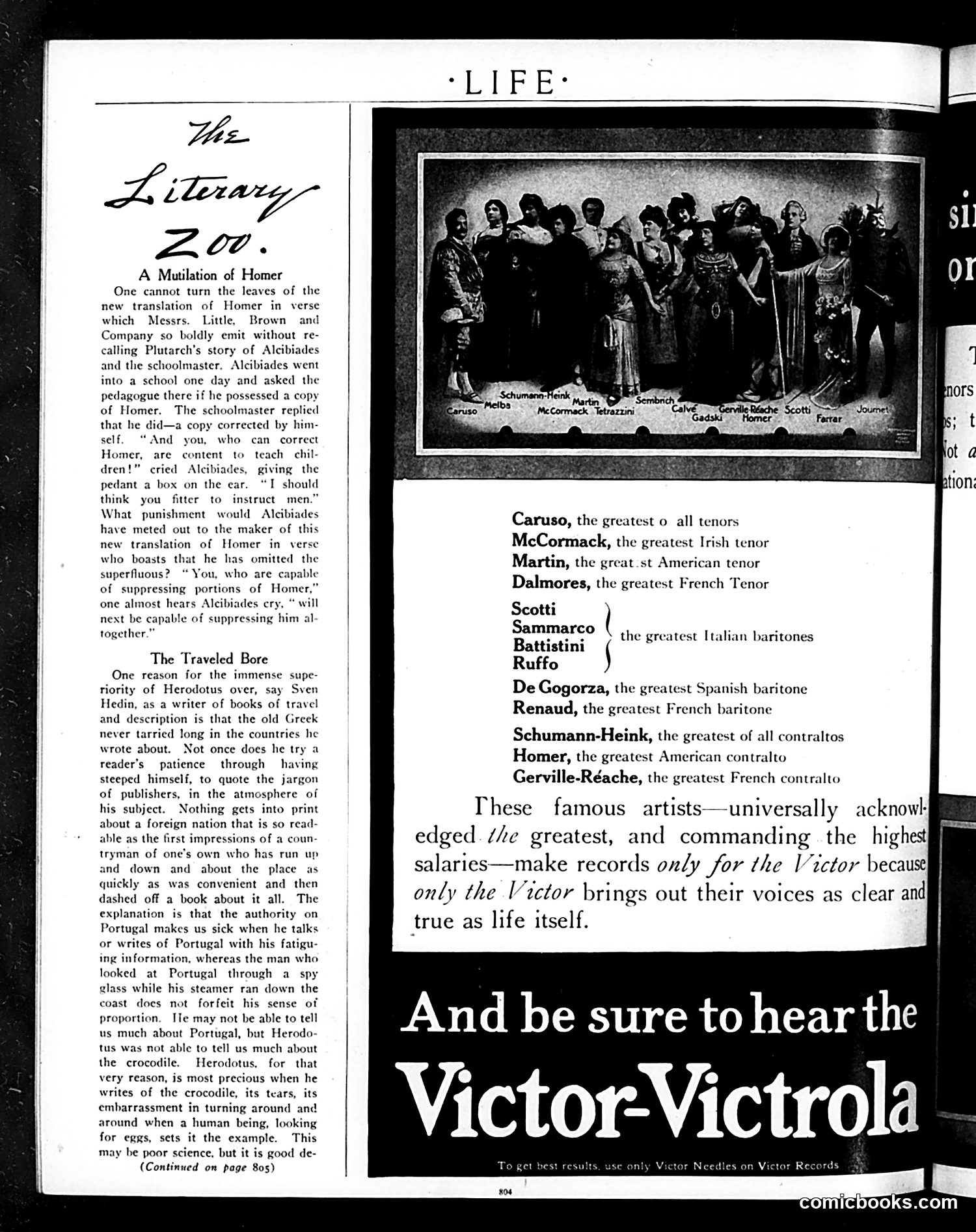
This page contains two distinct elements: **Left column:** Literary satire titled "A Mutilation of Homer" and "The Traveled Bore"—critiques of pedantic scholars and tedious travel writers, unrelated to current events. **Right side:** A Victor-Victrola phonograph advertisement disguised as editorial content. The image shows famous opera singers of the era (Caruso, McCormack, Martin, etc.), with text asserting these "greatest artists" record *only* for Victor because "only the Victor brings out their voices as clear and true as life itself." This is essentially **advertorial**—marketing copy designed to appear as serious magazine content. The implicit message: Victor's superior recording technology captures performances better than competitors. The specific singers named were genuinely famous tenors and baritones of the early 20th century, lending credibility to the claim.
📄 Transcribed text from this page (OCR, searchable)
Machine-transcribed from the original scan — historical spelling and the odd misread are preserved.
Zo. A Mutilation of Homer One cannot turn the leaves of the new translation of Homer in verse which Messrs. Little, Brown and Company so boldly emit without re- calling Plutarch’s story of Alcibiades and the schoolmaster. Alcibiades went into a school one day and asked the pedagogue there if he possessed a copy of Homer. The schoolmaster replied that he did—a copy corrected by him- self. “And you, who can correct Homer, are content to teach chil- dren!” cried Alcibiades, giving the pedant a box on the ear. “I should think you fitter to instruct men.” What punishment would Alcibiades have meted out to the maker of this new translation of Homer in verse who boasts t' he has omitted the superfluous? You, who are capable of suppressing portions of Homer,” one almost hears Alcibiades cry, “ will next be capable of suppressing him al together.” The Traveled Bore One reason for the immense supe- riority of Herodotus over, say Sven Hedin, as a writer of books of travel and description is that the old Greek never tarried long in the countries he wrote about. Not once does he try a reader’s patience through having steeped himself, to quote the of publishers, in the atmosphere of his subject. Nothing gets into print about a foreign nation that is so read- able as the first impressions of a coun- tryman of one’s own who has run up and down and about the place as quickly as was convenient and then dashed off a book about it all. The explanation is that the authority on | makes us sick when he talks or writes of Portugal with his fatigu- ing information, whereas the man who looked at Portugal through a spy glass while his steamer ran down the coast does not forfeit his sense of proportion. ITe may not be able to tell us much about Portugal, but Herodo- tus was not able to tell us much about the crocodile. Herodotus, for that very reason, is most precious when he writes of the crocodile, its tears, its embarrassment in turning around and around when a human being, looking for eggs, sets it the example. This may be poor science, but it is good de- (Continued on page 805) Caruso, the greatest o all tenors McCormack, the greatest Irish tenor Martin, the great-st American tenor Dalmores, the greatest French Tenor Scotti Sammarco l Battistini f the greatest Italian baritones Ruffo De Gogorza, the greatest Spanish baritone Renaud, the greatest French baritone Schumann-Heink, the greatest of all contraltos Homer, the greatest American contralto Gerville-Réache, the greatest French contralto These famous artists—universally acknowl edged. ¢he greatest, and commanding the highest salaries—make records only for the Victor because only the Victor brings out their voices as clear and true as life itself. And be sure to hear the Victor-Victrola To get best resu only Victor Net Victor Records micbooks.com