
Life, 1910-11-10 · page 20 of 44
Life — November 10, 1910 — page 20: what you’re looking at
What you’re looking at
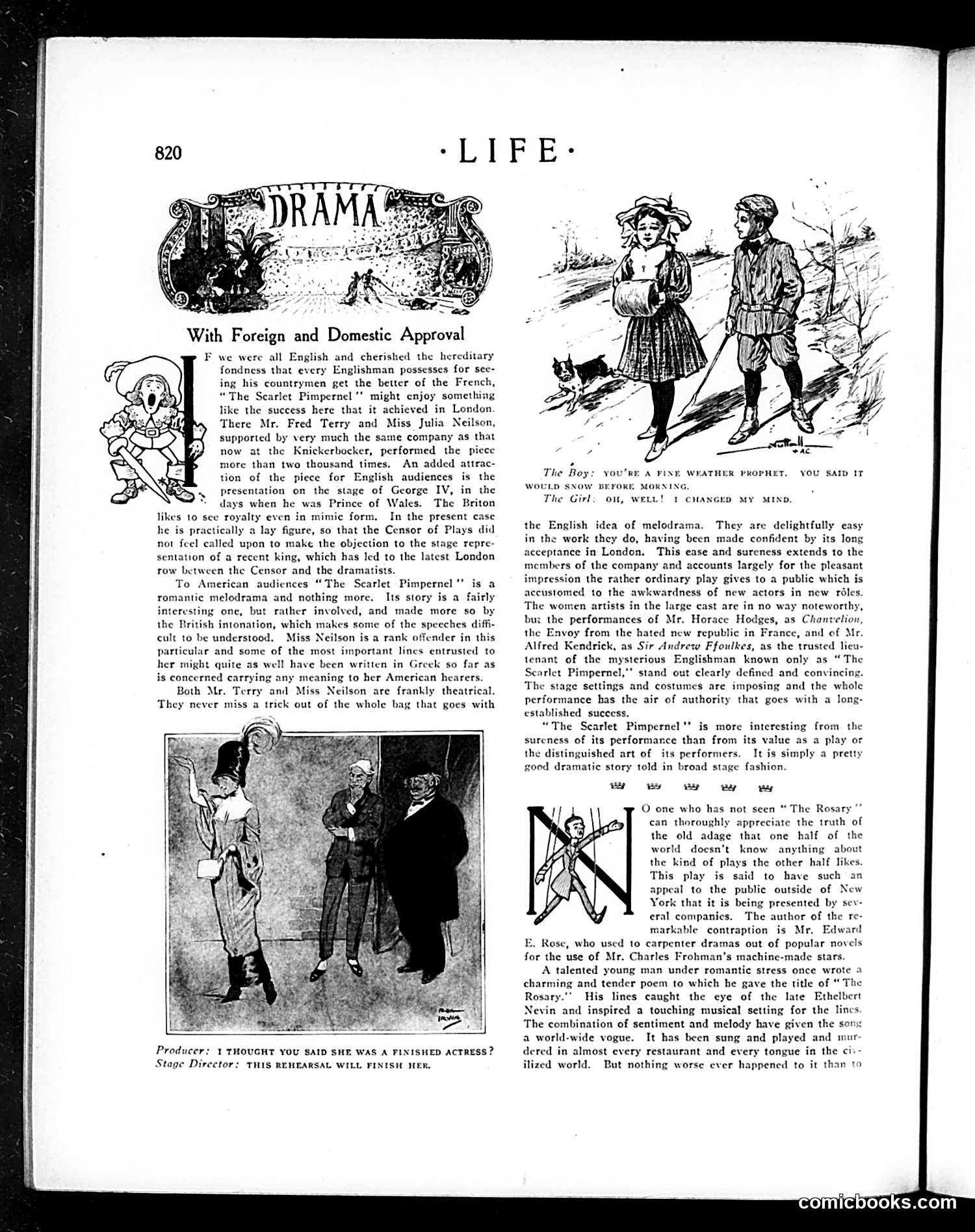
This page reviews two theatrical productions: "The Scarlet Pimpernel" and "The Rosary." **The main cartoon** (bottom left) depicts a theatrical rehearsal dispute between a Producer and Stage Director. The Producer sarcastically questions whether an actress is truly "finished" (accomplished), and the Director responds that "this rehearsal will finish her"—a joke about her poor performance requiring extensive practice. **The smaller vignettes** at top right show casual romance: a boy and girl with a dog, where the girl changes her mind about an earlier weather prediction, prompting the boy's witty retort. The text itself is primarily **theater criticism**, not satire. It praises "The Scarlet Pimpernel" for its polished British cast and production values, though notes American audiences may struggle with English accents and the overly theatrical style. It also previews "The Rosary," noting its unusual appeal to audiences outside New York—suggesting regional theatrical tastes differed significantly from metropolitan sophistication.
📄 Transcribed text from this page (OCR, searchable)
Machine-transcribed from the original scan — historical spelling and the odd misread are preserved.
With Foreign and Domestic Approval F we were all English and cherished the hereditary fondness that every Englishman possesses for see- ing his countrymen get the better of the French, “The Scarlet Pimpernel’ might enjoy something like the success here that it achieved in London. There Mr. Fred Terry and Miss Julia Neilson, supported by very much the same company as that now at the Knickerbocker, performed the piece more than two thousand times, An added attrac- tion of the piece for English audiences is the presentation on the stage of George IV, in the days when he was Prince of Wales. The Briton royalty even in mimic form, In the present case he is practically a lay figure, so that the Censor of Plays did not {cel called upon to make the objection to the stage repre- sentation of a recent king, which has led to the latest London row between the Censor and the dramatists. To American audiences “The Scarlet Pimpernel '" romantic melodrama and nothing more. Its story is a fa interesting one, but rather involved, and made more so by the British intonation, which n s some of the speeches diffi- cult to be understood. Miss Neilson is a rank offender in this particular and some of the most important lines entrusted to her might quite as well have been written in Greek so far as is concerned carrying any meaning to her American hearers. Both Mr. Terry and Miss Neilson are frankly theatrical. They never miss a trick out of the whole bag that goes with Producer: 1 THOUGHT YOU SAID SHE WAS A FINISHED ACTRESS? Stage Director: THIS REHEARSAL WILL FINISIC IER, The Boy: you're 4 FINE WRATHER PROPHET, YOU SAID IT WOULD SNOW BEFORE MORNING The Girl: ou, Wet! 1 CHANGED MY MIND. the English idea of melodrama. They are delightfully easy in the work they do, having been made confident by its long acceptance in London. This ease and sureness extends to the members of the company and accounts largely for the pleasant impression the rather ordinary play gives to a public which is accustomed to the awkwardness of new actors in new roles. The women artists in the large cast are in no way noteworth: bu: the performances of Mr. Horace Hodges, as Chanvelion, the Envoy from the hated new republic in France, and of Mr. Alfred Kendrick, as Sir Andrew Ffoulkes, as the trusted lieu- tenant of the mysterious Englishman known only as “The Scarlet Pimpernel,”’ stand out clearly defined and convincing. The stage settings and costumes are imposing and the whole performance has the air of authority that goes with a long- established sucecss. “The Scarlet Pimpernel’? is more interesting from the surcness of its performance than from its value as a play or the distinguished art of its performers. It is simply a pretty good dramatic story told in broad stage fashion. a a a od O one who has not seen “ The Rosar: can thoroughly appreciate the truth of the old adage that one half of the world doesn’t know anything about the kind of plays the other half likes. This play is said to have such an appeal to the public outside of New York that it is being presented by sev- eral companies. The author of the re- markable contraption is Mr. E. Rose, who used to carpenter dramas out of popular novels for the use of Mr. Charles Frohman’s machine-made stars. A talented young man under romantic stress once wrote a charming and tender poem to which he gave the title of “ The Rosar; His lines caught the eye of the late Ethelbert Nevin and inspired a touching musical setting for the lines. The combination of sentiment and melody have given the son a world-wide vogue. It has been sung and played and mur- dered in almost every restaurant and every tongue in the cis- ilized world. But nothing worse ever happened to it than to Edward Comicbooks.com