
Life, 1910-11-10 · page 26 of 44
Life — November 10, 1910 — page 26: what you’re looking at
What you’re looking at
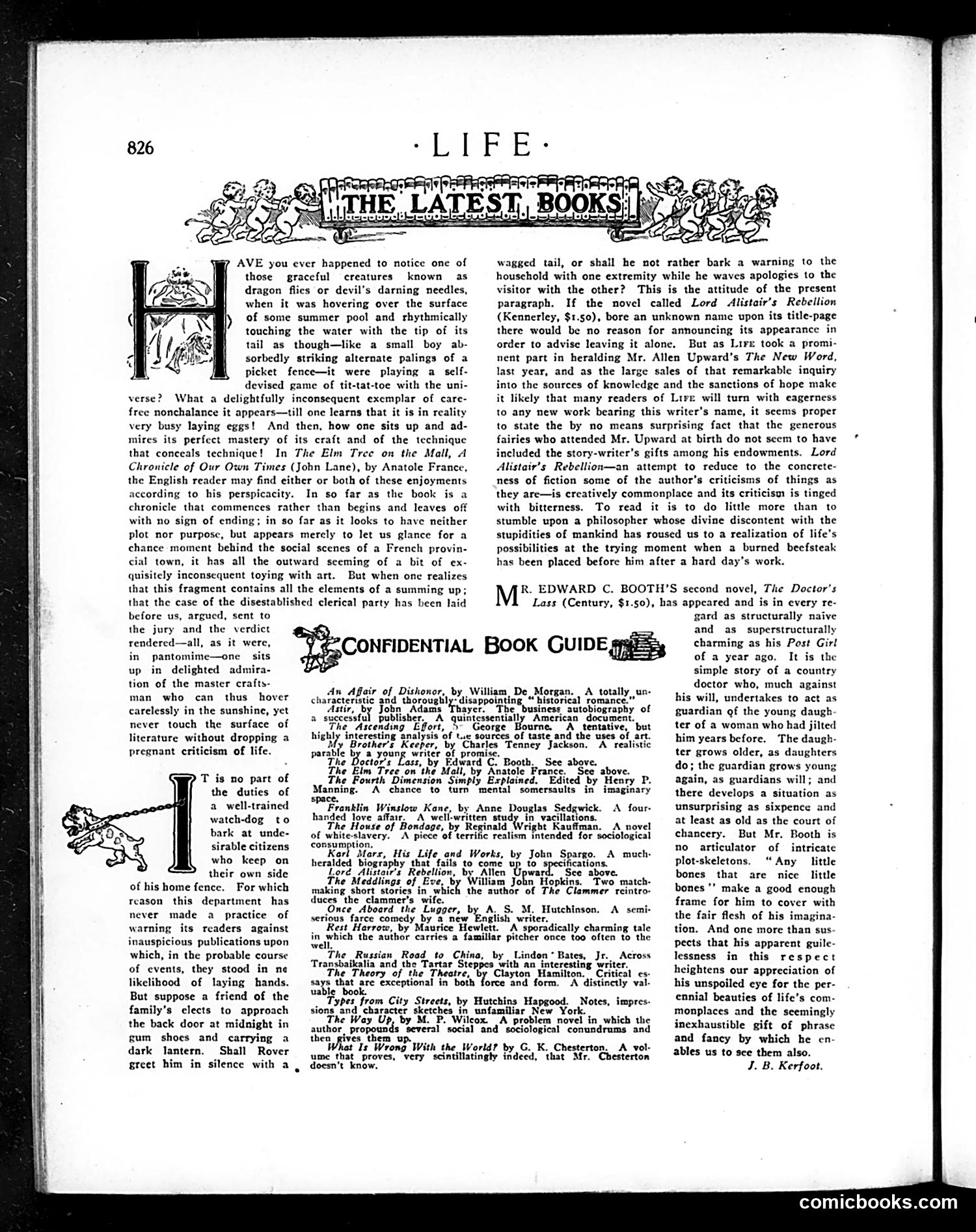
This page is a **book review column**, not primarily a political cartoon. The small decorative illustrations (dragonfly, watchdog) are ornamental flourishes typical of early 20th-century magazine design. The "Confidential Book Guide" reviews several novels, employing **satirical critique through extended metaphor**. The dragonfly comparison mockingly describes how one novel (*The Elm Tree on the Mall* by Anatole France) appears purposeless but actually contains structured social commentary—like a dragonfly laying eggs while appearing to play. The watchdog metaphor warns that while *Life* promoted Allen Upward's previous work *The New Word*, his new novel *Lord Alistair's Rebellion* doesn't merit endorsement. The reviewer sarcastically notes the author's philosophical gifts don't extend to fiction-writing. The page primarily **uses humor to guide readers away from mediocre books** while praising worthy ones—functioning as intellectual gatekeeping for *Life's* educated readership.
📄 Transcribed text from this page (OCR, searchable)
Machine-transcribed from the original scan — historical spelling and the odd misread are preserved.
AVE you ever happened to notice one of those graceful creatures known as dragon flics or devil's darning needles, when it was hovering over the surface of some summer pool and rhythmically touching the water with the tip of its tail as though—like a small boy ab- sorbedly striking alternate palings of a picket fence—it were playing a self- devised game of tit-tat-toe with the uni- verse? What a delightfully inconsequent exemplar of care- free nonchalance it appears—till one learns that it is in reality very busy laying eggs! And then, how one sits up and ad- mires its perfect mastery of its craft and of the technique that conceals technique! In The Elm Tree on the Mall, A Chronicle of Our Own Times (John Lane), by Anatole France, the English reader may find either or both of these enjoyments according to his perspicacity. In so far as the book is a chronicle that commences rather than begins and leaves off with no sign of ending; in so far as it looks to have neither plot nor purpose, but appears merely to let us glance for a chance moment behind the social scenes of a French provin- cial town, it has all the outward seeming of a bit of ex- quisitely inconsequent toying with art. But when one realizes that this fragment contains all the elements of a summing up; that the case of the disestablished clerical party has been laid before us, argued, sent to the jury and the verdict rendered—all, as it were, in pantomime—one sits up in delighted admira- tion of the master crafts- “Pgs CONFIDENTIAL Book GUIDE gts, wagged tail, or shall he not rather bark a warning to the household with one extremity while he waves apologies to the visitor with the other? This is the attitude of the present paragraph. If the novel called Lord Alistair’s Rebellion (Kennerley, $1.50), bore an unknown name upon its title-page there would be no reason for announcing its appearance in order to advise leaving it alone. But as Lire took a promi- nent part in heralding Mr. Allen Upward’s The New Word, last year, and as the large sales of that remarkable inquiry into the sources of knowledge and the sanctions of hope make it likely that many readers of Lire will turn with eagerness to any new work bearing this writer's name, it seems proper to state the by no means surprising fact that the generous fairies who attended Mr. Upward at birth do not secm to have included the story-writer’s gifts among his endowments. Lord Alistair’s Rebellion—an attempt to reduce to the concrete- ness of fiction some of the author's criticisms of things as they are—is creatively commonplace and its criticism is tinged with bitterness. To read it is to do little more than to stumble upon a philosopher whose divine discontent with the stupidities of mankind has roused us to a realization of life’s possibilities at the trying moment when a burned becfsteak has been placed before him after a hard day’s work. R. EDWARD C. BOOTH’S second novel, The Doctor's Lass (Century, $1.50), has appeared and is in every re- gard as structurally naive and as superstructurally charming as his Post Girt of a year ago. It is the simple story of a country doctor who, much against man who can thus hover carelessly in the sunshine, yet never touch the surface of literature without dropping a pregnant criticism of life. T is no part of the duties of a_ well-trained watch-dog to bark at unde- sirable citizens who keep on their own side of his home fence. For which reason this department has never made a practice of warning its readers against inauspicious publications upon which, in the probable course of events, they stood in ne likelihood of laying hands. But suppose a friend of the family’s clects to approach the back door at midnight in gum shoes and carrying a dark lantern. Shall Rover greet him in silence with a. An Affair of Dishonor, by William, De,Morgan. A totally,,un- charaetgriste and thoroughly“ disappeinting, “historical romance.” x Tobe Adams Thayer’ The business autobiography of a successful publisher, A quintessentiaily American document, The Ascending Effort, >” George Bourne. A. tentative, but Dighly inferesting analysis of tue sources of taste and the uses of art y ‘Brother's Keeper, ‘oy Charles Tenney Jackson, “A realistic parable by'a young writer of promise The Doctor's Lass, by Edward C. Booth. See above. The Elm Tree on the Mall, by Koatole France. See above. The Fourth Dimension Simply Explained. Edited by Henry P. Mesaine: A chance to turn mental somersaults in imaginary “PEranklin Winslow Kone, by Anne Douglas Sedgwick. handed love affair. A well-written study in vacillations. The House of Bondage, by Reginald Wright Kaatimnan. A. novel of white-slavery. A piece of terrific realism intended for sociological consumption. Karl Mars, His Life and Works, by John Spargo. A much- heralded biography that fails to come uy ifications. Lore Abstavr's Rete ion. By The Meddlings of Eve, b making short stories in. whic duces the clammer’s wife. Once, Aboard the Lugger, by A. S. M. Hutchinson. serious farce comedy by a new Engiish writer. Rest Harrow, by Maurice Hewlett. A sporadically charming tale in _ the author carries a familiar pitcher once too often to the wel A four- A semi- he Russian Road to China, by Lindon’ Bates, Jr. Across Trapani and the Tartar Steppes with an interesting writer. ¢ Theory of the Theatre, Ci Clayton Hamilton. Critical es- says that are exceptional in both force and form. A distinctly val- uable book. Types from City Streets, by Hutchins Hapgood. Notes, impres- sions and Sos, sketches in unfamiliar New Yor The Way Up, by Fr Wilcox. A problem novel in which the satice, propoune social and sociological conundrums and then giv as rae With the World? by G. K. Chesterton. A vol- ume that proves, very scintillatingly indeed, that Mr. Chesterton doesn't know. several his will, undertakes to act as guardian of the young daugh ter of a woman who had jilted him years before. The daugh- ter grows older, as daughters do; the guardian grows young again, as guardians will; and there develops a situation as unsurprising as sixpence and at least as old as the court of chancery. But Mr. Booth is no articulator of intricate plot-skeletons. “Any little bones that are nice little bones’? make a good enough frame for him to cover with the fair flesh of his imagina- tion. And one more than sus- pects that his apparent guile- lessness in this respect heightens our appreciation of his unspoiled eye for the per- ennial beauties of life’s com- monplaces and the seemingly inexhaustible gift of phrase and fancy by which he en- ables us to sce them also. J. B. Kerfoot. comicbooks.com