
Life, 1910-11-10 · page 9 of 44
Life — November 10, 1910 — page 9: what you’re looking at
What you’re looking at
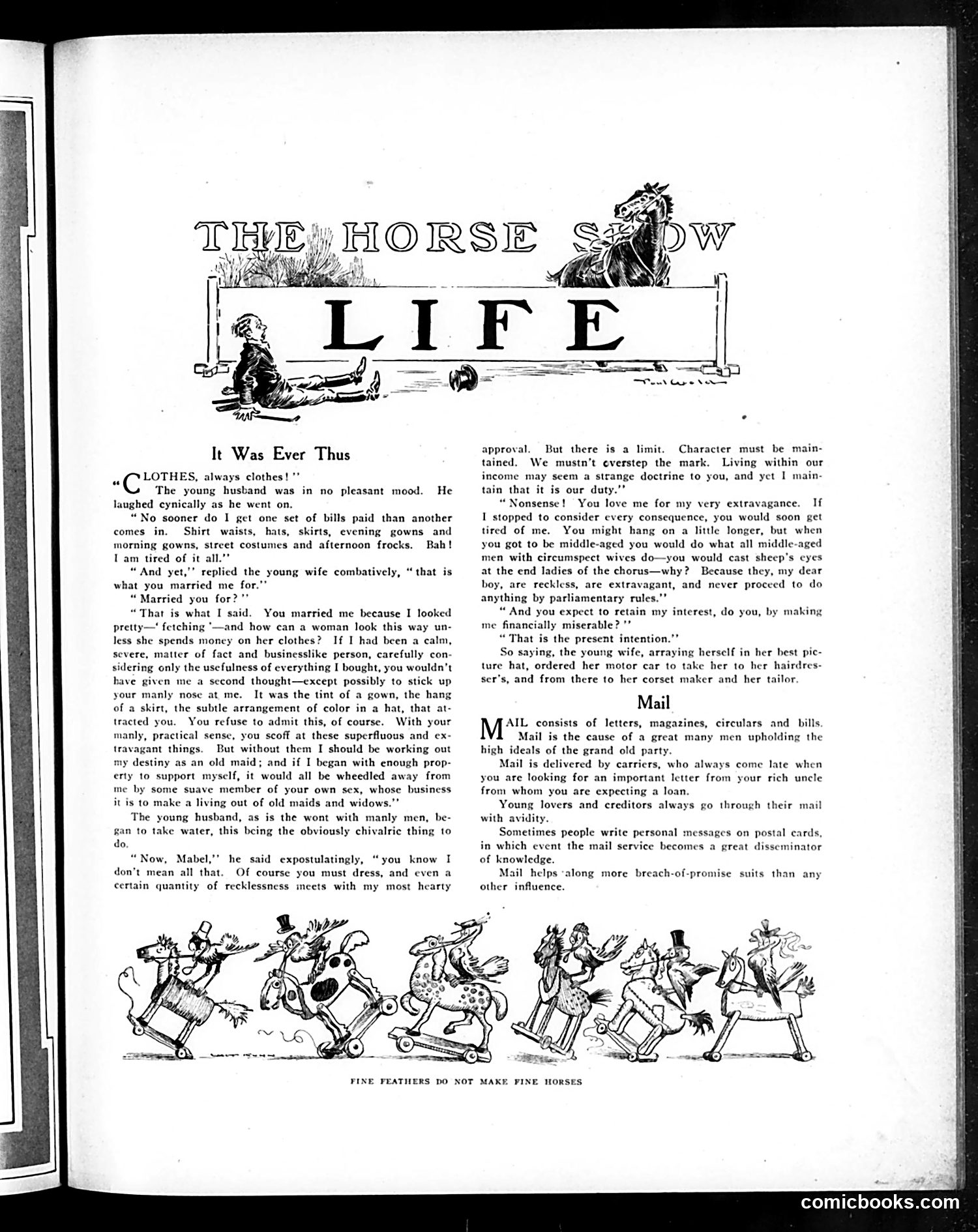
This page from *Life* magazine satirizes marital dynamics and gender roles of the early 20th century. The main article "It Was Ever Thus" depicts a husband complaining about his wife's excessive clothing purchases and extravagant spending. The wife defends her "extravagance" as necessary for maintaining her appearance and social status. The husband counters that her spending makes him "financially miserable." The "Mail" section that follows discusses correspondence and its role in relationships, particularly breach-of-promise lawsuits. The bottom cartoon shows absurdly dressed figures engaged in chaotic activity, illustrating the satirical point expressed in its caption: "FINE FEATHERS DO NOT MAKE FINE HORSES"—suggesting that excessive ornamentation and clothing cannot compensate for character or substance, a barb directed at both vanity and conspicuous consumption among the wealthy.
📄 Transcribed text from this page (OCR, searchable)
Machine-transcribed from the original scan — historical spelling and the odd misread are preserved.
It Was Ever Thus LOTHES, always clothes! '’ The young husband was in no pleasant mood. He laughed cynically as he went on. “No sooner do I get one set of bills paid than another comes in. Shirt waists, hats, skirts, evening gowns and morning gowns, street costumes and afternoon frocks. Bah! I am tired of it all.” “And yet,’ replied the young wife combatively, “that is what you married me for."* “Married you for?" “That is what I said. You married me because I looked pretty—' fetching "—and how can a woman look this way un- less she spends money on her clothes? If I had been a calm, severe, matter of fact and businesslike person, carefully con- sidering only the usefulness of everything I bought, you wouldn't have given me a second thought—except possibly to stick up your manly nose at me. It was the tint of a gown, the hang of a skirt, the subtle arrangement of color in a hat, that at- tracted you. You refuse to admit this, of course. With your manly, practical sense, you scoff at these superfluous and ex- travagant things. But without them I should be working out my destiny as an old maid; and if I began with enough prop- erty to support myself, it would all be wheedled away from me by some suave member of your own sex, whose business it is to make a living out of old maids and widows.”’ The young husband, as is the wont with manly men, be- gan to take water, this being the obviously chivalric thing to do. “Now, Mabel,’? he said expostulatingly, “you know I don’t mean all that. Of course you must dress, and even a certain quantity of recklessness meets with my most hearty But there is a limit. Character must be main- tained, We mustn't everstep the mark. Living within our income r seem a strange doctrine to you, and yet I main- tain that it is our duty.’’ ‘onsense! You love me for my very extravagance. If I stopped to consider every consequence, you would soon get tired of me. You might hang on a little longer, but when you got to be middle-aged you would do what all middle-aged men with circumspect wives do—you would cast sheep's eyes at the end ladies of the chorus—why? Because they, my dear boy, are reckless, are extravagant, and never proceed to do anything by parliamentary rules. “ And you expect to retain my interest, do you, by making me financially miserable? '’ “That is the present intention.” So saying, the young wife, arraying herself in her best pic- ture hat, ordered her motor car to take her to her hairdres- ser’s, and from there to her corset maker and her tailor. Mail AIL consists of letters, magazines, circulars and_ bills. Mail is the cause of a great many men upholding the high ideals of the grand old party. Mail is delivered by carriers, who always come late when you are looking for an important letter from your rich uncle from whom you are expecting a loan. Young lovers and creditors always go through their mail with avidity. Sometimes people write personal messages on postal cards, in which event the mail service becomes a great disseminator of knowledge. Mail helps along more breach-of-promise suits than any other influence. approval. FINE FEATHERS DO NOT MAKE PINE HORSES comicbooks.com