
Life, 1910-11-10 · page 21 of 44
Life — November 10, 1910 — page 21: what you’re looking at
What you’re looking at
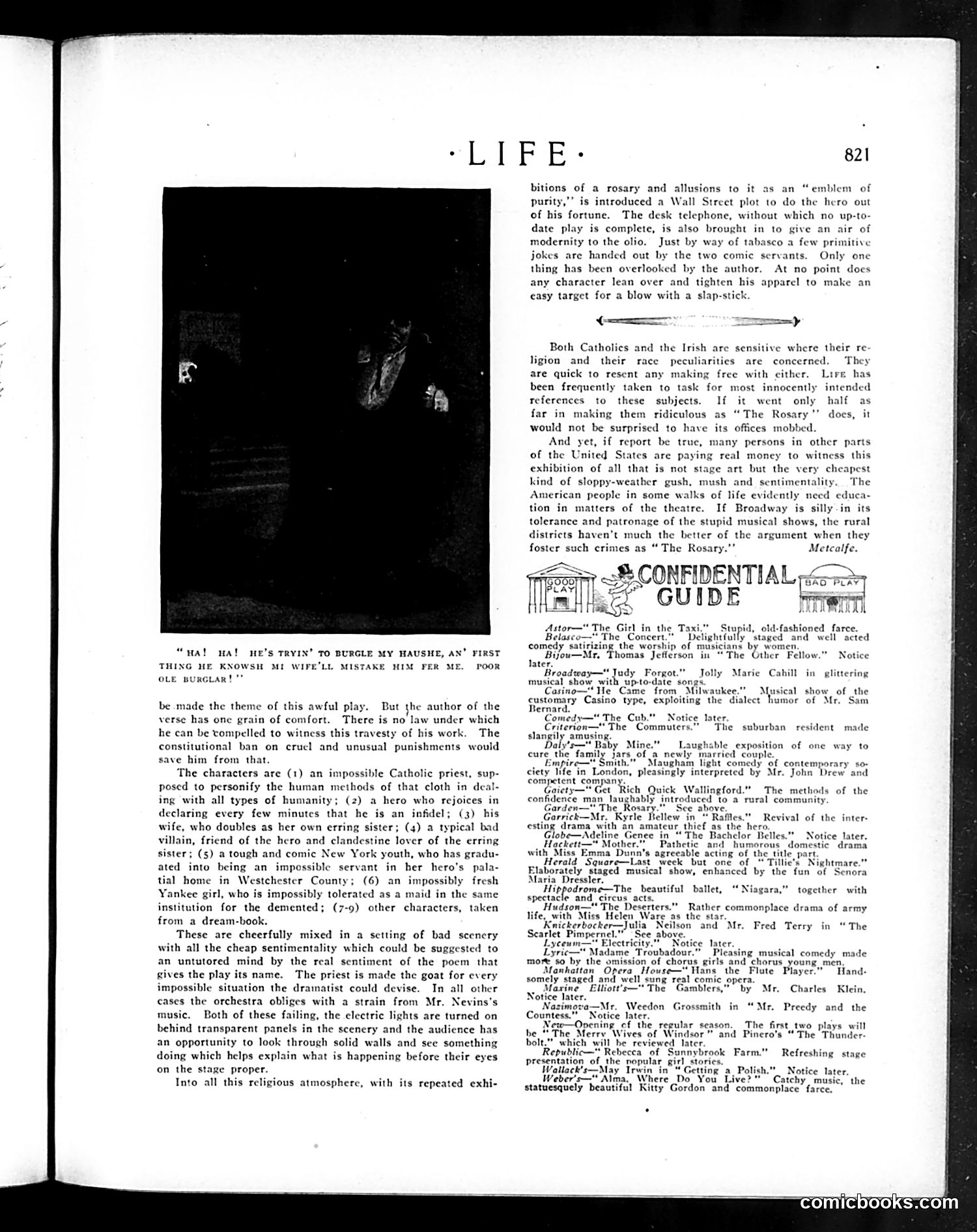
The cartoon depicts a burglar mistaken for a husband—a slapstick scenario. The text is a scathing review of a stage adaptation of "The Rosary," a sentimental poem turned into a theatrical production. The critic (Metcalfe) attacks the play for: 1. **Anti-Catholic stereotyping**: The priest character is portrayed as a scapegoat for every absurd plot device, reducing Catholic theology to ridicule. 2. **Ethnic mockery**: Irish characters are rendered as comic servants using exaggerated dialect ("HAUSHE," "KNOWSH"). 3. **Cheap sentimentality**: The production relies on melodramatic tropes—transparent panels revealing hidden action, religious symbols treated superficially—rather than genuine artistry. 4. **Audience condescension**: The critic notes rural Americans pay to watch this "sloppy-weather gush," suggesting they lack theatrical sophistication, while Broadway itself is blamed for enabling such "crimes." The complaint centers on offensive religious/ethnic caricature masquerading as entertainment, a concern Life magazine had evidently faced criticism for before.
📄 Transcribed text from this page (OCR, searchable)
Machine-transcribed from the original scan — historical spelling and the odd misread are preserved.
LIFE: 2I “Hal ua! He's TRYIN’ TO BURGLE MY HAUSHE, AN’ FIRST THING ME KNOWSH MI WIFE’LL MISTAKE MIM PER ME. POOR OLE BURGLAR!" be made the theme of this awful play. But the author of the verse has one grain of comfort. There is no law under which he can be tompelled to witness this travesty of his work. The constitutional ban on crucl and unusual punishments would save him from that. The characters are (1) an impossible Catholic priest, sup- posed to personify the human methods of that cloth in deal ing with all types of humanity; (2) a hero who rejoices in declaring every few minutes that he is an infidel; (3) his wife, who doubles as her own erring sister; (4) a typical bad villain, friend of the hero and clandestine lover of the erring sister; (5) a tough and comic New York youth, who has gradu- ated into being an impossible servant in her hero's pala- tial home in Westchester County; (6) an impossibly fre Yankee girl, who is impossibly tolerated as a maid in the san institution for the demented; (7-9) other characters, taken from a dream-book. These are cheerfully mixed in a setting of bad scenery with all the cheap sentimentality which could be suggested to an untutored mind by the real sentiment of the poem that gives the play its name. The priest is made the goat for every impossible situation the dramatist could devise. In all other cases the orchestra obliges with a strain from Mr. Nevins’s music. Both of these failing, the electric lights are turned on behind transparent panels in the scenery and the audience has an opportunity to look through solid walls and see something doing which helps explain what is happening before their eyes on the stage proper. Into all this religious atmosphere, with its repeated exhi- bitions of a rosary and allusions to it as an “emblem of purity,"’ is introduced a Wall Street plot to do the hero out of his fortune. The desk telephone, without which no up-to- date play is complete, is also brought in to give an air of modernity to the olio. Just by way of tabasco a few primitive jokes are handed out by the two comic servants. Only one thing has been overlooked by the author, At no point does any character lean over and tighten his apparel to make an easy target for a blow with a slap-stick —=_= Both Catholics and the Irish are sensitive where their re ligion and their race peculiarities are concerned. T! are quick to resent any making free with either. Lire has been frequently taken to task for most innocently intended references to these subjects. If it went only half as far in making them ridiculous as “The Rosary" does, it would not be surprised to have its offices mobbed. And yet, if report be true, many persons in other parts of the United States are paying real money to witness this exhibition of all that is not stage art but the very cheapest kind of sloppy-weather gush, mush and sentimentality. The American people in some walks of life evidently need educa- tion in matters of the theatre. If Broadway is silly.in its tolerance and patronage of the stupid musical shows, the rural districts haven't much the better of the argument when they foster such crimes as “ The Rosary. Metcalfe. CONFIDENTIAL Te GUIDE Astor—" wie G Girl in the, Taxi." Stupid, old-fashioned farce. Belasco—" The Concert.” Delightfully ‘staged and well acted comedy satirizing the worship of musicians by women. Bijou—Mr, Thomas Jefferson in “The Other Fellow.” later. Broadway—" Judy Forgot.” Jolly Marie Cahill in glittering musical show with up-to-date songs Casino—"*He Came from Milwaukee.” Musical show of the gemomary Casino type, exploiting the dialect humor of Mr. ernard. Comedy—" The Cub." Notice later. Criterion—" The Commuters." The slangily amusing. Daly's" Baby Mine.” Laughsb le exposition of one way to cure the family jars of a newly m puple. Empire—" Smith." Maugham light comedy of contemporary so- ciety life in London, pleasingly interpreted by Mr. John Drew and competent company. Get Rich Quick Wallingford.” The methods of the ¢ man laughably introduced to a rural community * The Rosary.” Sce above. Garrick—Mr, Kyrle Hellew in" Rafles.” Revival of the inter: esting drama with an amateur thief as the hero. Globe—Adeline Genee in “The Bachelor Belles.” Notice later. Hackett—" Mother.” Pathetic and humorous domestic drama with Miss Emma Dunn's agreeable acting of the title, part Herald Square—Last week but one of “ Tillic's Nightmare.” Elaborately staged musical show, enhanced by the fun of Senora Maria Dressler. Hippodrome—The beautiful ballet, spectacle and circus acts, Hudson—" The Deserters.” Rather commonplace drama of army fe, with Miss Helen Ware as the star Knickerbocker—Julia_ Neilson and Mr. Fred Terry in “The Scarlet Pimpernel.” See above. Lyceum—" Electricity." Notice tater. Lyric—" Madame Troubadour.” Pleasing musical comedy mort so by the omission of chorus girls and chorus young men. Manhattan Opera House—" Hans the Flute Play Hand- somely staged and well sung real comic opera. Maxine Elliott's—"The Gamblers,” by Mr. Charles Klein, Notice late Nazimova—Mr. Weedon Grossmith in “Mr. Preedy and the Countess." Notice later. New—Opening ef the regular season. The first two plays will be “The Merry Wives of Windsor” and Pinero’s “The Thunder bolt.” which will he reviewed later. Republio—" Rebecca of Sunnybrook Farm.” presentation of the nopular girl stories. Wellack’s—May Irwin in“ Getting a Polish." Notice later. Weber's—" Al Where Do You Live?" "Catchy music, the statuesquely beautiful Kitty Gordon and commonplace farce. Notice suburban resident’ made “Niagara,” together with Refreshing sta