
Life, 1910-11-10 · page 10 of 44
Life — November 10, 1910 — page 10: what you’re looking at
What you’re looking at
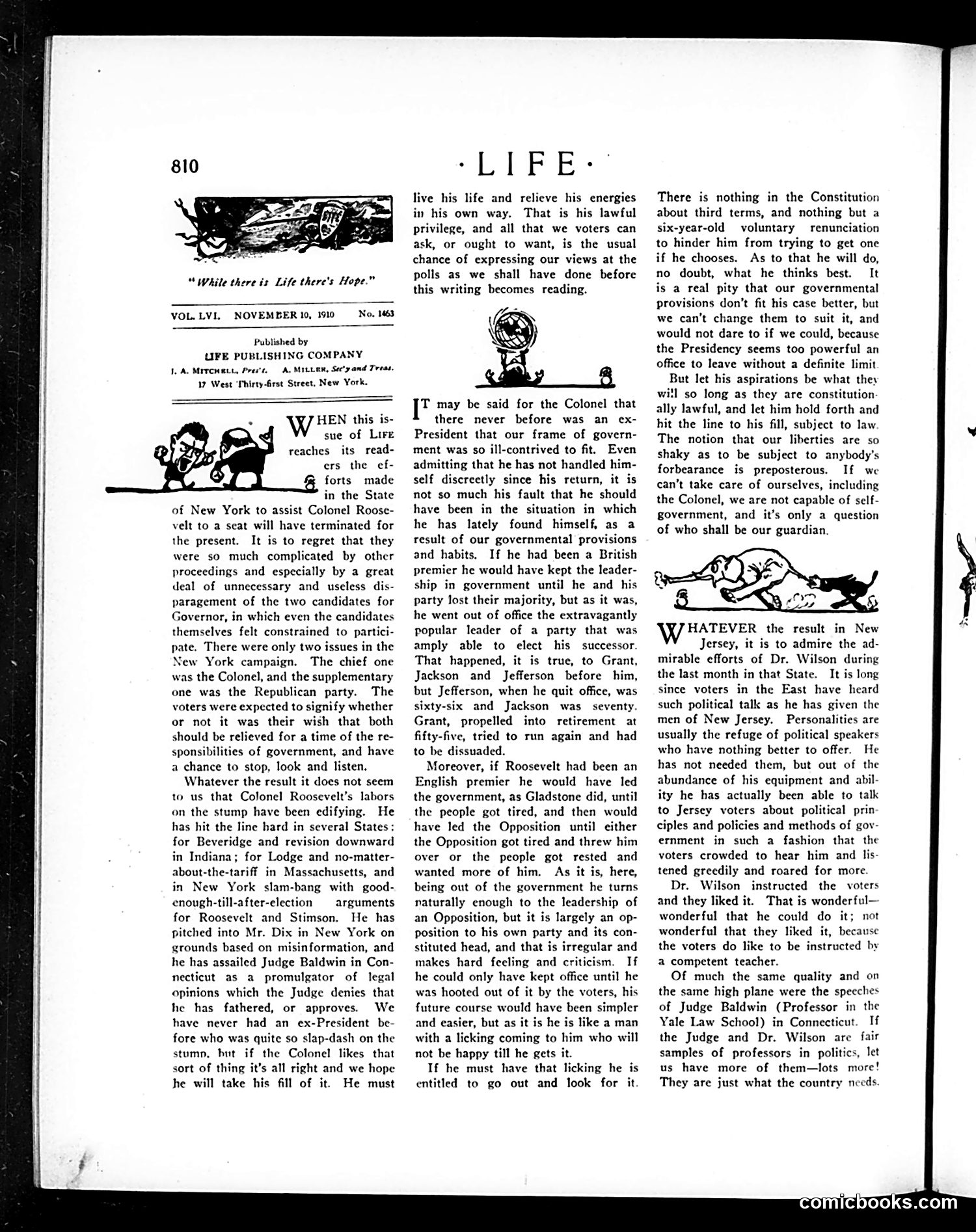
This page critiques Theodore Roosevelt's political activities following his presidency. The text discusses Roosevelt's influence on New York politics and his role in supporting candidates, noting criticism that he hasn't truly stepped aside from power despite leaving office. The article references Roosevelt's involvement in recent elections and compares him to British political figures like Gladstone and Jackson, suggesting his continued dominance over his party is irregular and creates hard feelings. The text praises Dr. Wilson's political speeches in New Jersey as exemplary of what the country needs—presumably honest, direct political discourse without the interference of powerful behind-the-scenes figures. The illustrations (small cartoon vignettes) appear to satirize Roosevelt's outsized political influence despite his official retirement from the presidency.
📄 Transcribed text from this page (OCR, searchable)
Machine-transcribed from the original scan — historical spelling and the odd misread are preserved.
“While there is Life there's Hope.” No. 1463 VOL. LVI, NOVEMBER 10, 1910 Published by UFE PUBLISHING COMPANY IAL MITONRLL, Prevt, A. MILLER, Sec'y and Treas, 17 West ‘Thirty-frst Street. New York. HEN this is- sue of Lire reaches its read- crs the ef- forts made in the State of New York to assist Colonel Roose- velt to a seat will have terminated for the present. It is to regret that they were so much complicated by other proceedings and especially by a great deal of unnecessary and useless dis- paragement of the two candidates for Governor, in which even the candidates themselves felt constrained to partici- pate. There were only two issues in the New York campaign. The chief one was the Colonel, and the supplementary one was the Republican party. The voters were expected to signify whether or not it was their wish that both should be relieved for a time of the re- sponsibilities of government, and have a chance to stop, look and listen, Whatever the result it docs not seem to us that Colonel Roosevelt’s labors on the stump have been edifying. He has hit the line hard in several States: for Beveridge and revision downward in Indiana; for Lodge and no-matter- about-the-tariff_ in Massachusetts, and in New York slam-bang with good- enough-till-after-election arguments for Roosevelt and Stimson. He has pitched into Mr. Dix in New York on grounds based on misinformation, and he has assailed Judge Baldwin in Con- necticut as a promulgator of legal opinions which the Judge denies that he has fathered, or approves. We have never had an ex-President be- fore who was quite so slap-dash on the stump, but if the Colonel likes that sort of thing it’s all right and we hope he will take his fill of it. He must “LIFE-° live his life and relieve his energies in his own way. That is his lawful privilege, and all that we voters can ask, or ought to want, is the usual chance of expressing our views at the polls as we shall have done before this writing becomes reading. T may be said for the Colonel that there never before was an ex- President that our frame of govern- ment was so ill-contrived to fit. Even admitting that he has not handled him- self discreetly since his return, it is not so much his fault that he should have been in the situation in which he has lately found himself, as a result of our governmental provisions and habits. If he had been a British premier he would have kept the leader- ship in government until he and his party lost their majority, but as it was, he went out of office the extravagantly popular leader of a party that was amply able to elect his successor. That happened, it is true, to Grant, Jackson and Jefferson before him, but Jefferson, when he quit office, was sixty-six and Jackson was seventy. Grant, propelled into retirement at fifty-five, tried to run again and had to be dissuaded. Moreover, if Roosevelt had been an English premier he would have led the government, as Gladstone did, until the people got tired, and then would have led the Opposition until either the Opposition got tired and threw him over or the people got rested and wanted more of him. As it is, here, being out of the government he turns naturally enough to the leadership of an Opposition, but it is largely an op- position to his own party and its con- stituted head, and that is irregular and makes hard feeling and criticism. If he could only have kept office until he was hooted out of it by the voters, his future course would have been simpler and easier, but as it is he is like a man with a licking coming to him who will not be happy till he gets it. If he must have that licking he is entitled to go out and look for it There is nothing in the Constitution about third terms, and nothing but a six-year-old voluntary renunciation to hinder him from trying to get one if he chooses. As to that he will do, no doubt, what he thinks best. It is a real pity that our governmental provisions don’t fit his case better, but we can’t change them to suit it, and would not dare to if we could, because the Presidency seems too powerful an office to leave without a definite limit But let his aspirations be what they witl so long as they are constitution- ally lawful, and let him hold forth and hit the line to his fill, subject to law. The notion that our liberties are so shaky as to be subject to anybody's forbearance is preposterous. If we can’t take care of ourselves, including the Colonel, we are not capable of self- government, and it’s only a question of who shall be our guardian. HATEVER the result in New Jersey, it is to admire the ad- mirable efforts of Dr. Wilson during the last month in that State. It is long since voters in the East have heard such political talk as he has given the men of New Jersey. Personalities are usually the refuge of political speakers who have nothing better to offer. He has not needed them, but out of the abundance of his equipment and abil- ity he has actually been able to talk to Jersey voters about political prin ciples and policies and methods of gov- ernment in such a fashion that the voters crowded to hear him and lis- tened greedily and roared for more. Dr. Wilson instructed the voters and they liked it. That is wonderful— wonderful that he could do it; not wonderful that they liked it, because the voters do like to be instructed by a competent teacher. Of much the same quality and on the same high plane were the speeches of Judge Baldwin (Professor in the Yale Law School) in Connecticut. If the Judge and Dr. Wilson are fair samples of professors in politics, let us have more of them—lots more! They are just what the country needs. Comicbooks.com