
Life, 1910-11-10 · page 30 of 44
Life — November 10, 1910 — page 30: what you’re looking at
What you’re looking at
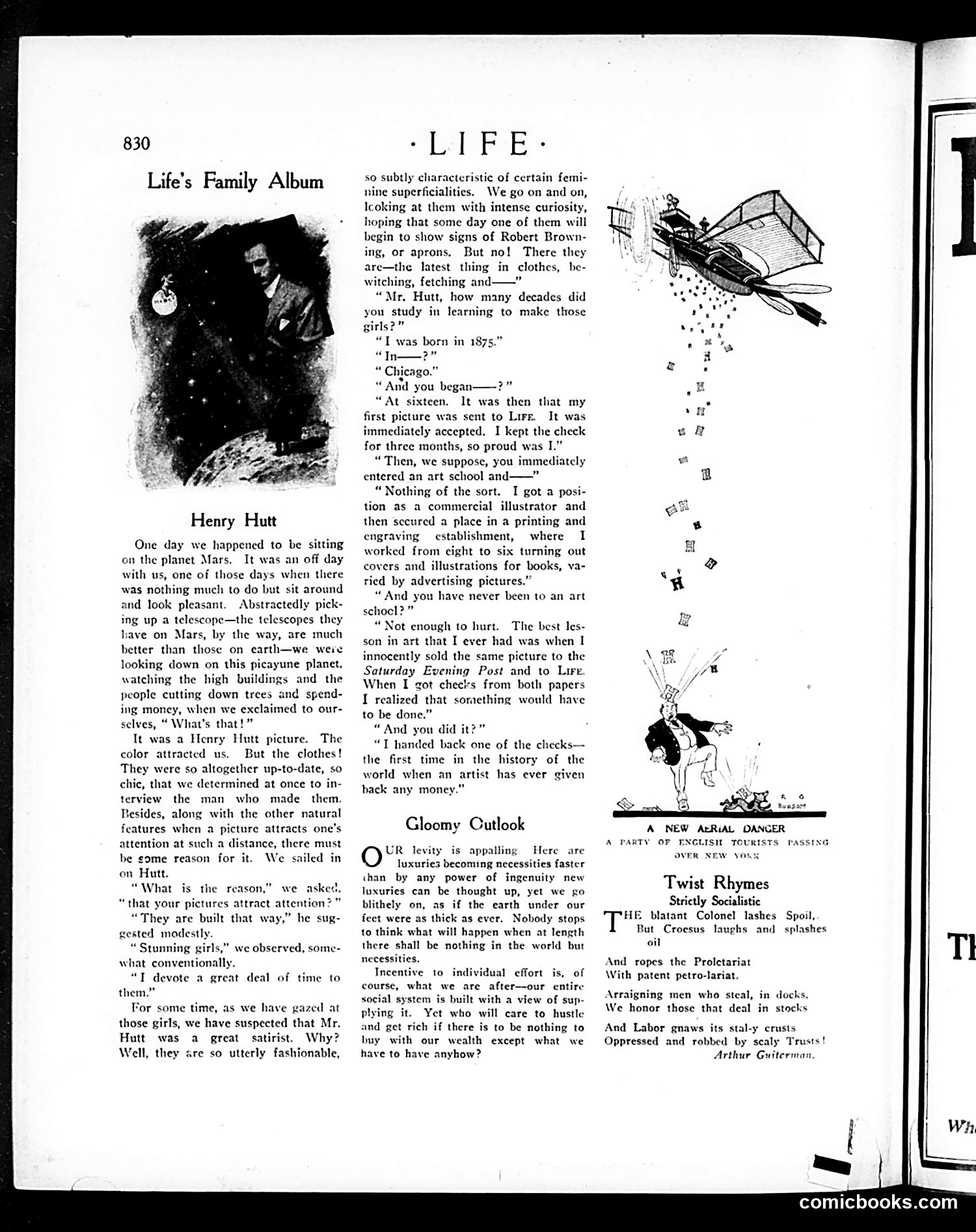
This page features **Henry Hutt**, a prominent illustrator of the era, interviewed about his artistic practice. The satire centers on Hutt's success despite unconventional training: he never attended art school, learned through commercial work, and achieved immediate acceptance from *Life* magazine at sixteen. The joke mocks both Hutt's accidental professionalism and, implicitly, the pretensions of formal art education. The page also includes fashion illustrations typical of Hutt's work—stylishly dressed women meant to embody contemporary feminine superficiality. The interviewer suggests Hutt's obsessive focus on fashionable girls constitutes subtle social satire. A secondary section, "Gloomy Outlook," offers economic pessimism about accelerating necessities outpacing luxuries, questioning future incentives for wealth-building. The "Twist Rhymes" section presents Socialist critique of capitalist exploitation, with wordplay on "petro-lariat" and attacks on both individual thieves and corporate trusts.
📄 Transcribed text from this page (OCR, searchable)
Machine-transcribed from the original scan — historical spelling and the odd misread are preserved.
830 Life’s Family Album One day we happened to be sitting on the planet Mars. It was an off day with us, one of those days when there was nothing much to do but sit around and look pleasant. Abstractedly pick- ing up a telescope—the telescopes they have on Mars, by the way, are much better than those on earth—we were looking down on this picayune planet. watching the high buildings and the people cutting down trees and spend- ing money, when we exclaimed to our- selves, “ What's that!” It was a Henry Hutt picture. The color attracted us. But the clothes! They were so altogether up-to-date, so chic, that we determined at once to in- terview the man who made them. Resides, along with the other natural features when a picture attracts one’s attention at such a distance, there must be some reason for it. We sailed in on Hutt. What is the reason,” we aske “that your pictures attract attention “They are built that way,” he sug- gested modest “Stunning girls,” we observed, some- what conventionally. “T devote a great deal of time to them.” For some time, as we have gazed at those girls, we have suspected that Mr. Hutt was a great satirist. Why? Well, they are so utterly fashionable, “LD FE + so subtly characteristic of certain femi- nine superficialities. We go on and on, Icoking at them with intense curiosity, hoping that some day one of them will begin to show signs of Robert Brown- ing, or aprons, But no! There they are—the latest thing in clothes, be- witching, fetching and——” “Mr. Hutt, how many decades did you study in learning to make those girls?” “T was born in 18; “In——?” “ Chicago. “And you began—? “At sixteen. It was then that my first picture was sent to Lirr. It was immediately accepted. I kept the check for three months, so proud was I.” “Then, we suppose, you immediately entered an art school and——” “Nothing of the sort. I got a pos tion as a commercial illustrator and then sccured a place in a printing and engraving establishment, where I worked from eight to six turning out covers and illustrations for books, va- ried by advertising picture: “ And you have never been to an art schocl?” ‘ot enough to hurt. The best les- son in art that I ever had was when I innocently sold the same picture to the Saturday Evening Post and to Lire. When I got checl:s from both papers I realized that something would have to be done.” “And you did it?” “T handed back one of the checks— the first time in the history of the world when an artist has ever given back any money Gloomy Cutlook is appalling Here are becoming necessities faster chan by any power of ingenuity new luxuries can be thought up, yet we go blithely on, as if the earth under our feet were as thick as ever. Nobody stops to think what will happen when at length there shall be nothing in the world but necessities Incentive to individual effort is, of course, what we are after—our entire social system is built with a view of sup- plying it. Yet who will care to hustle and get rich if there is to be nothing to buy with our wealth except what we have to have anyhow? A NEW ArRiAL DANCER TOURISTS A PARTY OF ENGLISIE OVER NEW Yo! Twist Rhymes Strictly Socialistic HE blatant Colonel lashes Spoil, But oil Croesus laughs and And ropes the Proletariat With patent petro-lariat. Arraigning men who steal, in We honor those that deal in And Labor gnaws its stal-y er Oppressed and robbed by scaly Trusts! Arthur G PASSIN splashes docks, stocks uUsts terma comicbooks.com