
A complete issue · 40 pages · 1910
Life — August 25, 1910
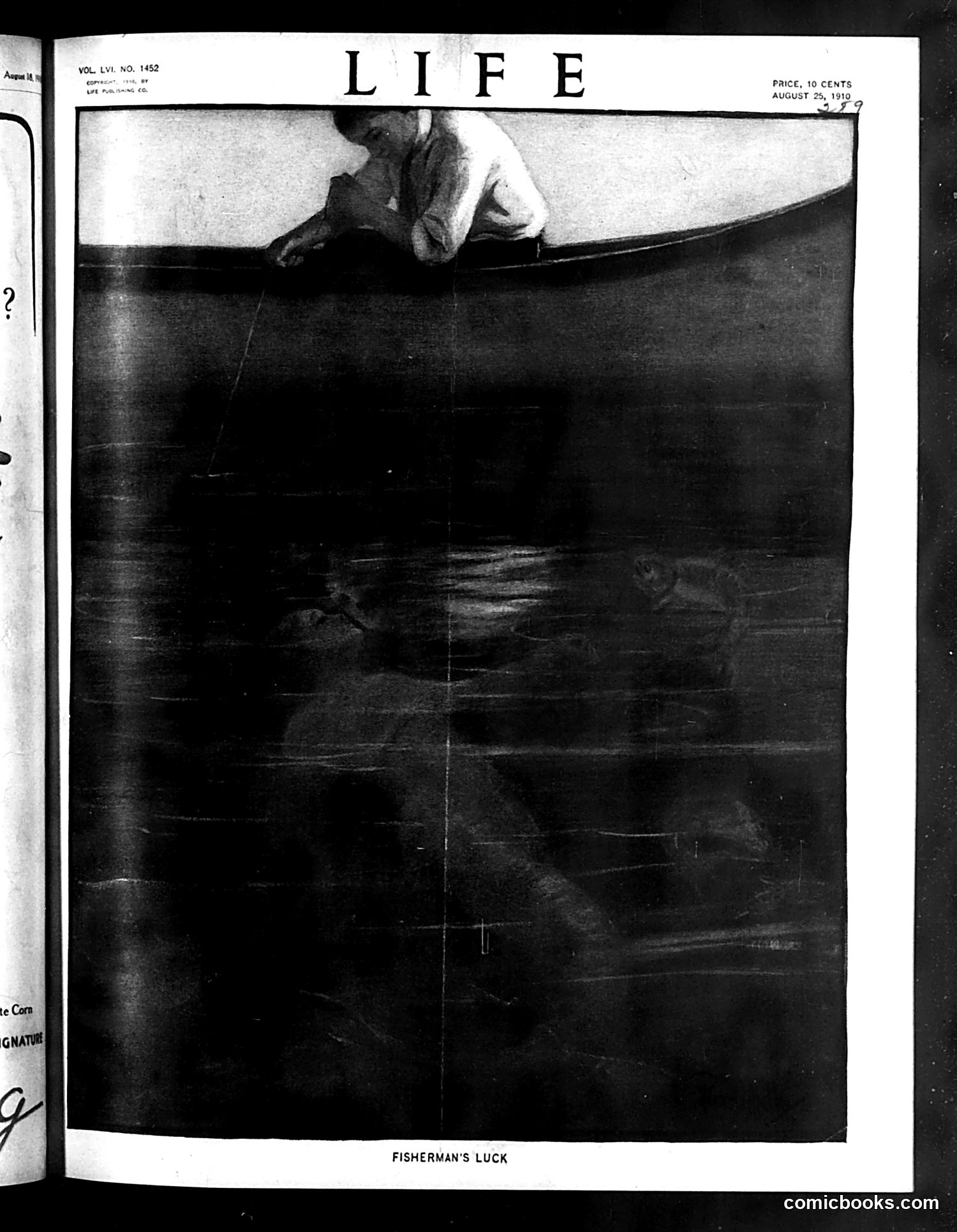
This appears to be a humorous photograph rather than a political cartoon. It shows a man in a boat leaning over the water with a fishing line, while below the surface we can see what appear to be fish or aquatic creatures in the dark water. The caption "Fisherman's Luck" suggests a joke about fishing outcomes—either the difficulty of catching fish or an unexpected catch. Without additional context or clearer visibility of specific details in the photograph, it's difficult to determine if this references a particular historical event or figure. The image seems to rely on visual humor about fishing rather than political satire, which was common in Life magazine's lighter content.
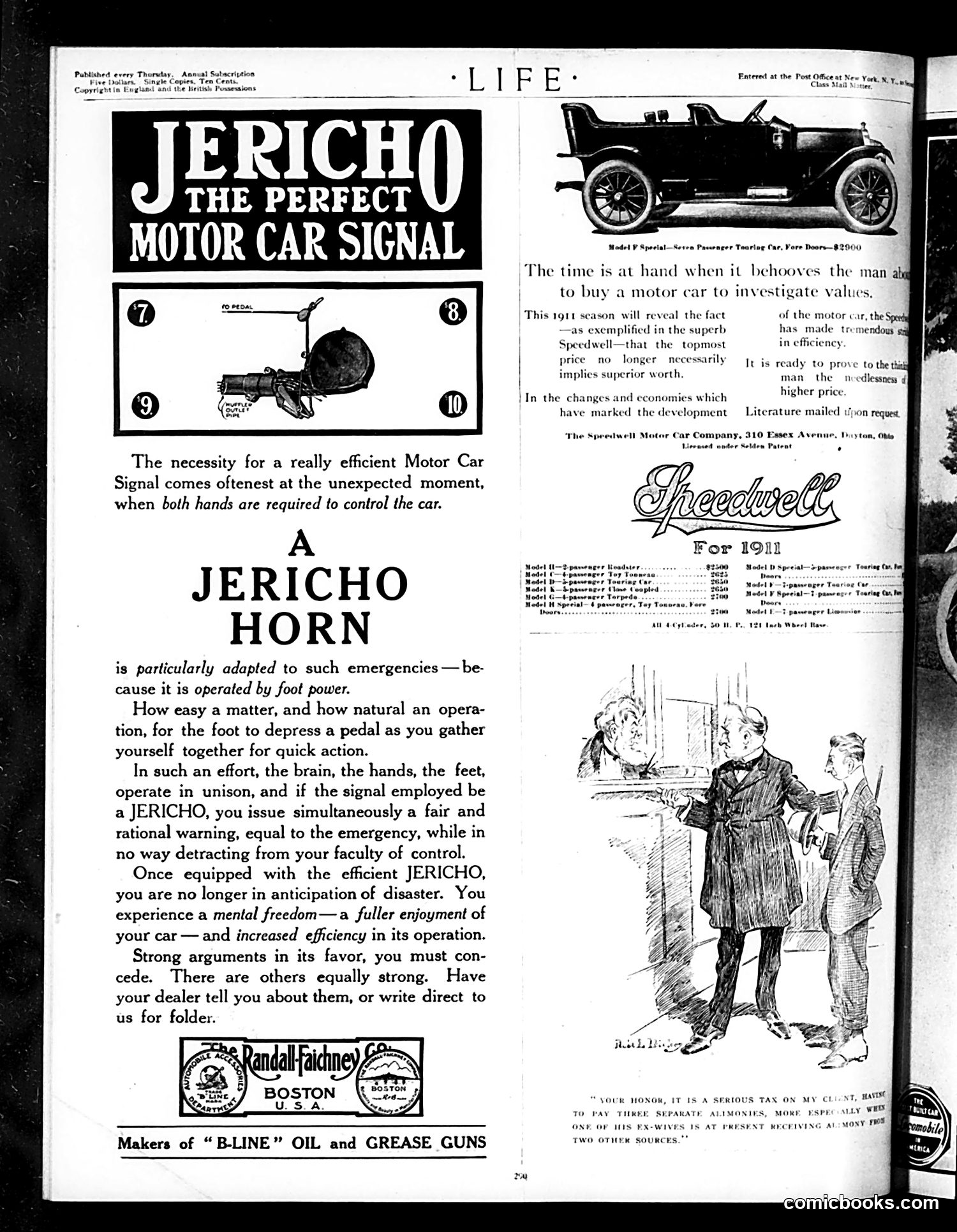
This page is primarily **advertising**, not satire or political commentary. The left side advertises the "Jericho" motor car horn—a foot-operated signal device. The ad argues that drivers need a horn they can operate while maintaining steering control. It appeals to safety concerns and "mental freedom" from worry about signaling. The right side advertises the Speedwell automobile for 1911, emphasizing that high price no longer guarantees superior quality—a notable claim during early automotive competition. The illustration at bottom right shows two men in conversation, but without clearer context, the specific meaning is unclear. It may relate to automobile sales or ownership discussions. This represents typical early 1900s automotive advertising, when the industry was still establishing market standards and consumer expectations.
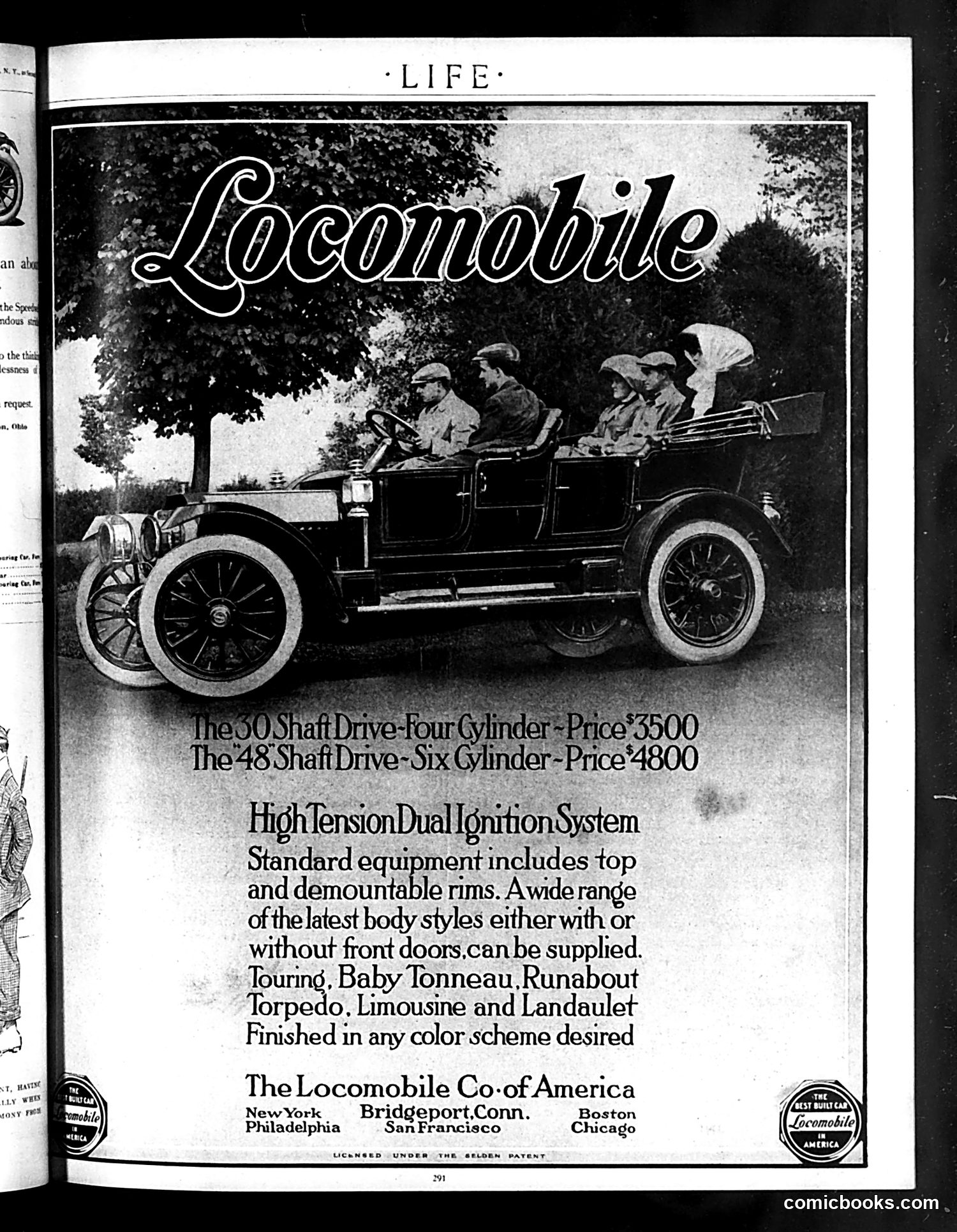
This is **not a cartoon or satirical content** — it's a straightforward automobile advertisement. The page features a full-page ad for the Locomotile, an early American motorcar manufactured by The Locomotile Co. of America. The image shows a 1910s-era touring car with five passengers in period clothing (hats, dusters). The ad highlights two models: the 30 Shaft Drive Four-Cylinder ($3,500) and the 48 Shaft Drive Six-Cylinder ($4,800) — substantial prices reflecting luxury vehicles of the era. Key selling points include the "High Tension Dual Ignition System" and customizable body styles (Touring, Baby Tonneau, Runabout, Torpedo, Limousine, Landaulet). The company had locations in New York, Bridgeport, Boston, Philadelphia, San Francisco, and Chicago. This represents early automotive industry marketing in a major American magazine.
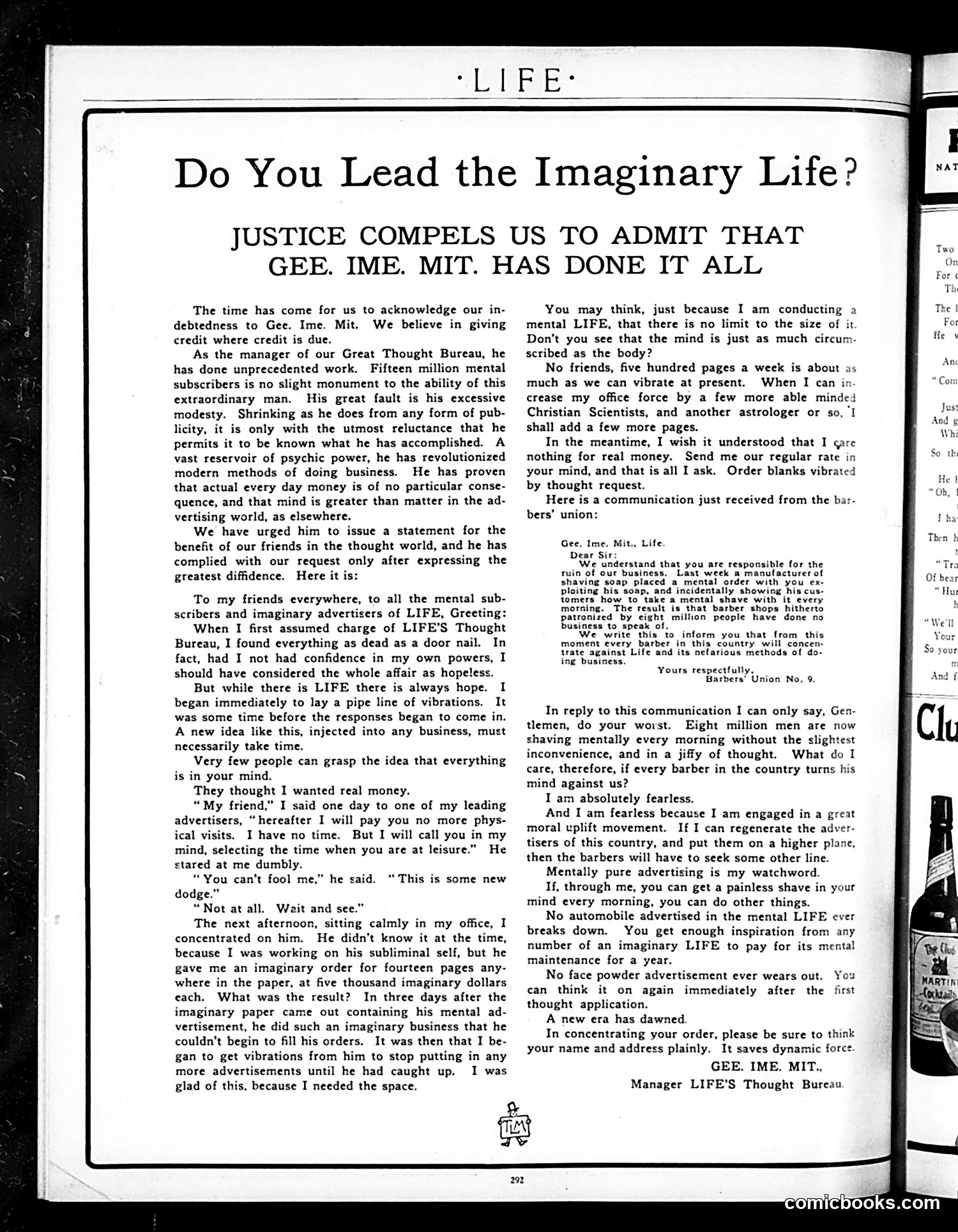
This page is primarily **satirical editorial content**, not a cartoon. The piece titled "Do You Lead the Imaginary Life?" mocks **Gee. Ime. Mit.** (G.I.M.), identified as manager of "LIFE's Thought Bureau." The satire targets a business venture offering "mental advertising" and "mental subscriptions"—selling imaginary advertisements to businesses. The author exposes this as absurd: the manager claims mental vibrations from advertisers' thoughts can influence readers' minds, requiring no physical products. The joke is that this pseudo-scientific scheme exploits modern advertising's growing psychological manipulation tactics. The included letter from a "barbers' union" complaining about mental competition satirizes how far-fetched mental advertising claims have become. This reflects early 20th-century anxieties about advertising's power over consciousness and commercialism's expansion into abstract domains.
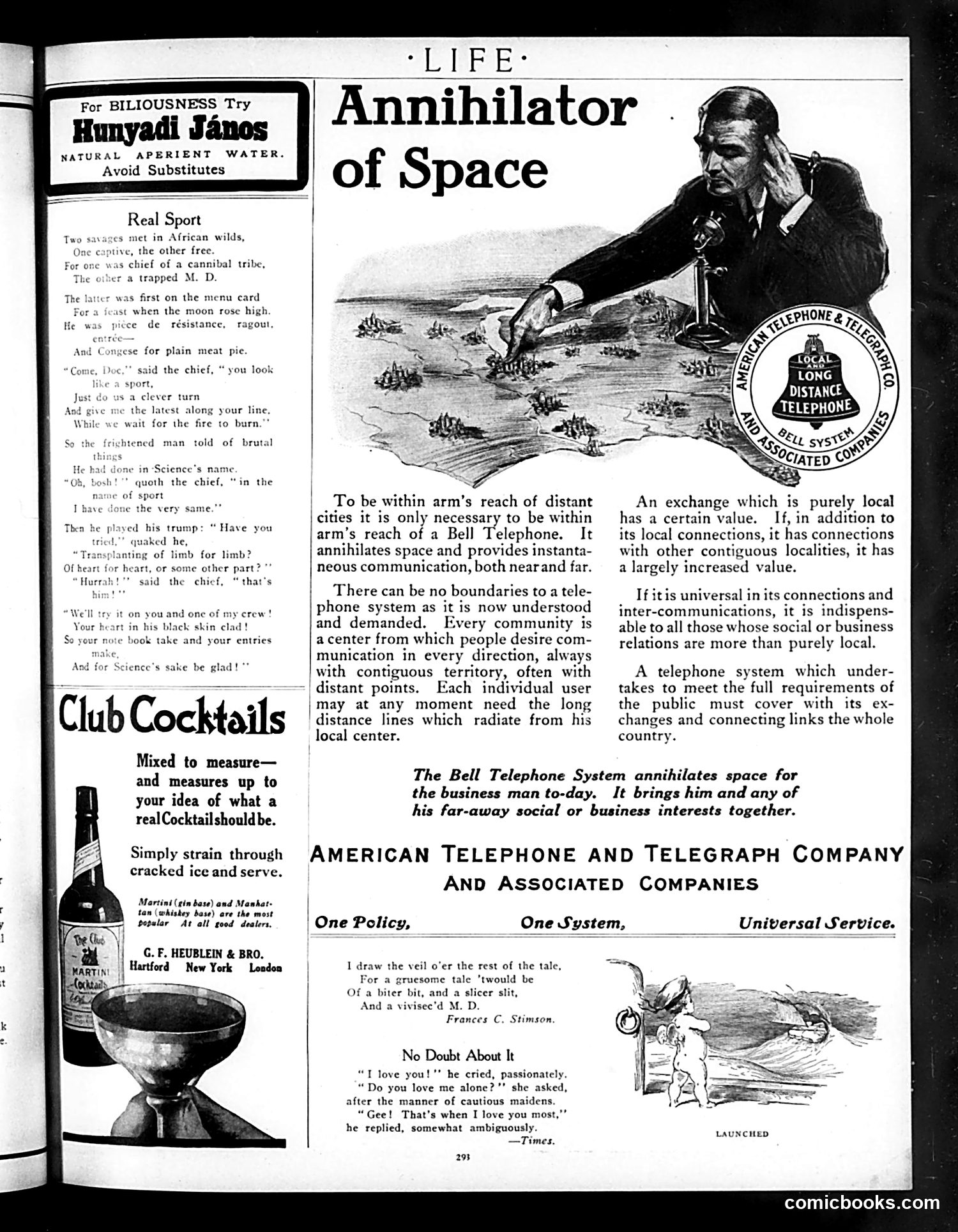
This page is primarily **advertising**, not satire or political commentary. The main content is a Bell Telephone System advertisement titled "Annihilator of Space," featuring a man at a telephone with landscape imagery. The ad argues that Bell's telephone network eliminates geographical distance, connecting people across territories and making local and distant communications seamless. The surrounding content includes: - A poem titled "Real Sport" about hunting - A "Club Cocktails" advertisement for martini and Manhattan whiskey - Literary excerpts ("No Doubt About It," "Launched") There is **no political cartoon** on this page. The Bell ad uses figurative language ("annihilator of space") to promote telecommunications infrastructure as essential for modern business communication.
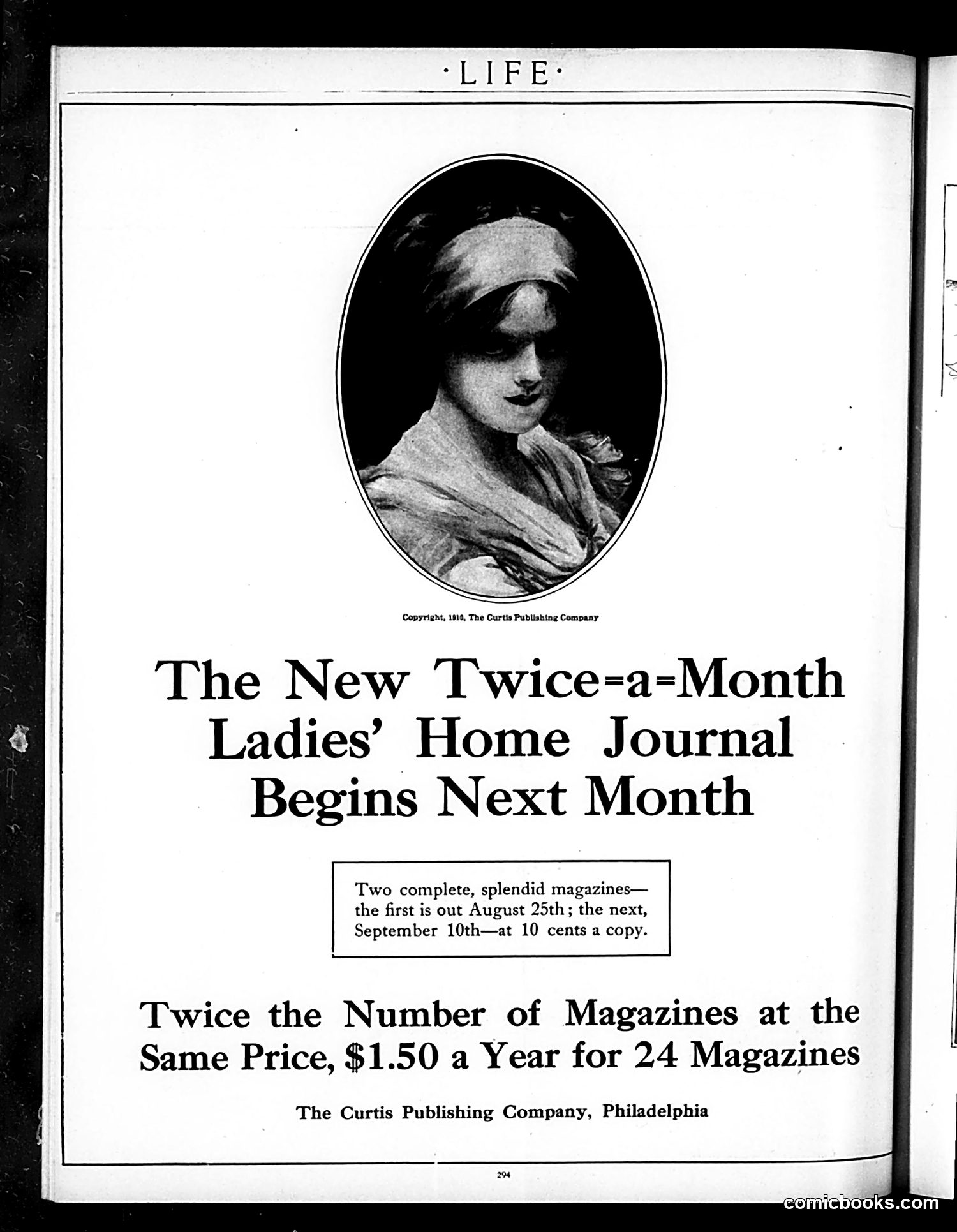
This page is **primarily an advertisement**, not a political cartoon or satire. It announces "The New Twice-a-Month Ladies' Home Journal," launching in the next month (August 25th and September 10th issues). The imagery shows a portrait of an elegant woman wearing a headband, typical of early 20th-century magazine aesthetics. The Curtis Publishing Company promotes doubling magazine frequency at the same annual price ($1.50/year for 24 issues instead of 12), offering readers twice the content for their subscription cost. There is no satirical political commentary here—this is straightforward consumer advertising targeting female readers, emphasizing value and increased content as selling points during what appears to be 1918.
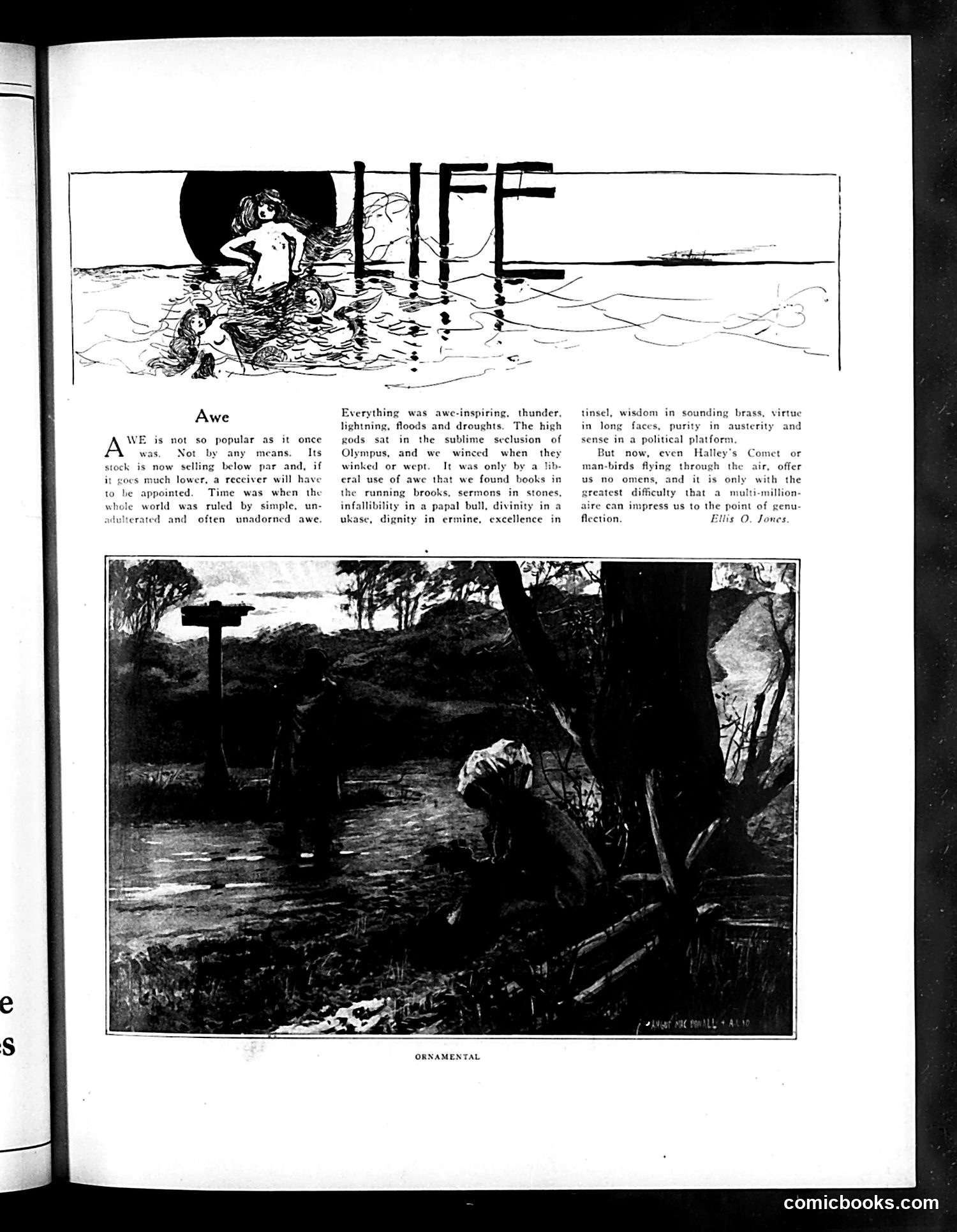
This page discusses how "awe" has declined in modern times. The article notes that awe was once achieved through religious and natural phenomena—thunder, lightning, floods, divine authority in papal proclamations and church ceremony. The author (credited as Elias O. Jones) observes that even contemporary wonders like Halley's Comet or long-distance flight fail to inspire genuine awe in modern audiences. The piece is a cultural critique suggesting that industrialization and scientific advancement have diminished humanity's capacity for reverence and wonder. The accompanying illustration labeled "Ornamental" depicts a figure in a landscape with a cross, visually supporting the theme of traditional religious awe versus modern skepticism.
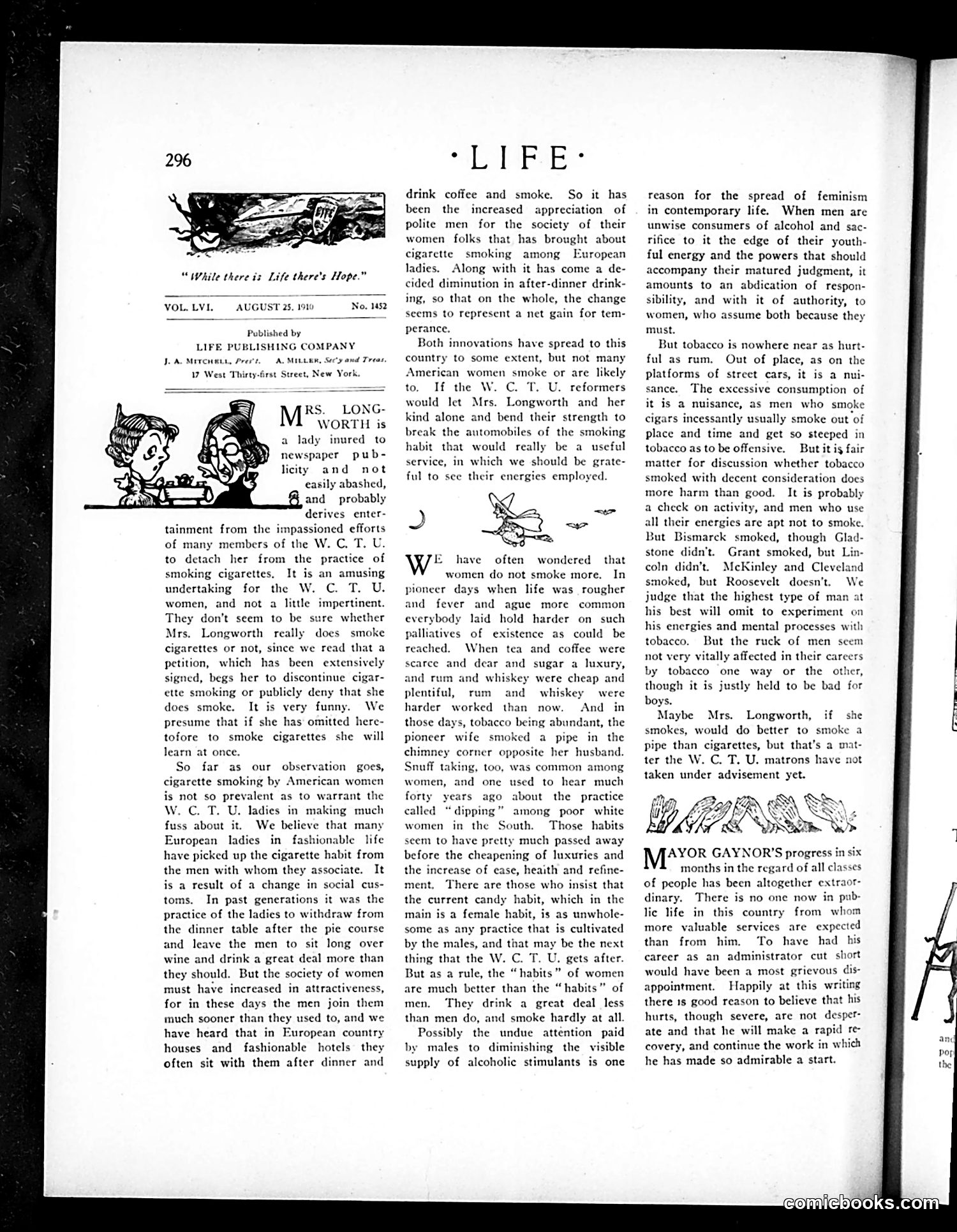
This page from *Life* magazine (August 21, 1910) satirizes women's smoking and the W.C.T.U. (Women's Christian Temperance Union). The cartoon at top left shows two caricatured female faces labeled "While there is Life there's Hope"—likely mocking women who've taken up cigarette smoking. The article argues that American women are increasingly smoking, contrary to W.C.T.U. efforts. The author suggests that if women must smoke, they should do so "decently" rather than publicly on streets. He notes historical precedent (women once smoked pipes) while framing modern female smoking as unseemly and attention-seeking. The satire criticizes both the hypocrisy of social reformers and the perceived impropriety of women's emerging independence in consuming tobacco.
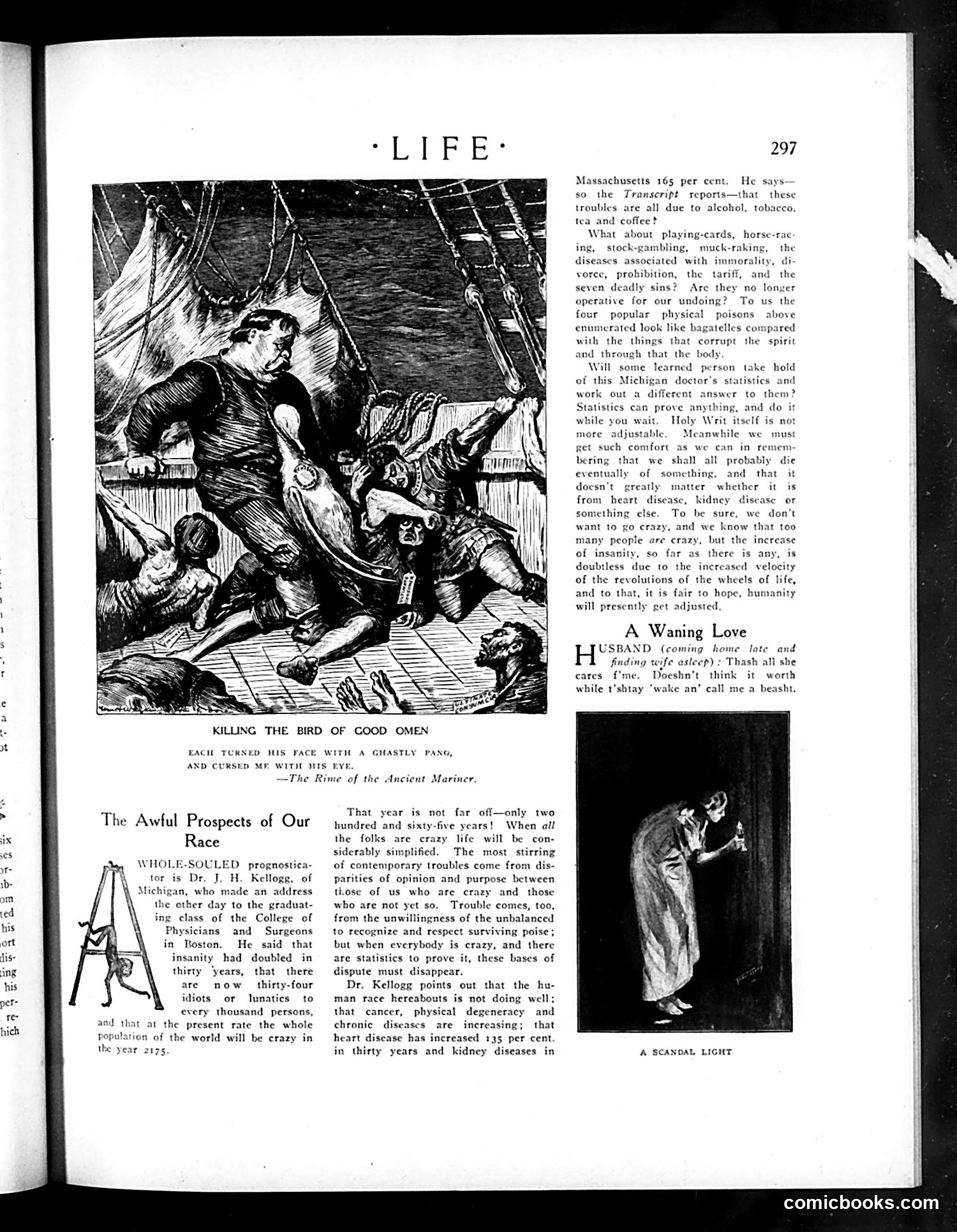
This page contains two separate satirical pieces. **"Killing the Bird of Good Omen"** (top illustration) depicts a figure stabbing a bird, referencing Coleridge's *Rime of the Ancient Mariner*—a literary allusion to bringing bad luck through destructive actions. **"The Awful Prospects of Our Race"** (main article) reports on Dr. J.H. Kellogg of Michigan's dire prediction: insanity has doubled in thirty years, and at current rates, the entire world population will be insane by 2123. The piece sardonically questions whether these statistics prove anything definitive, suggesting the doom-saying may itself be overwrought. The accompanying images labeled "A Scandal Light" appear to illustrate moral or social decay. The satire criticizes both alarmist predictions about societal decline and the unreliable nature of statistics themselves.
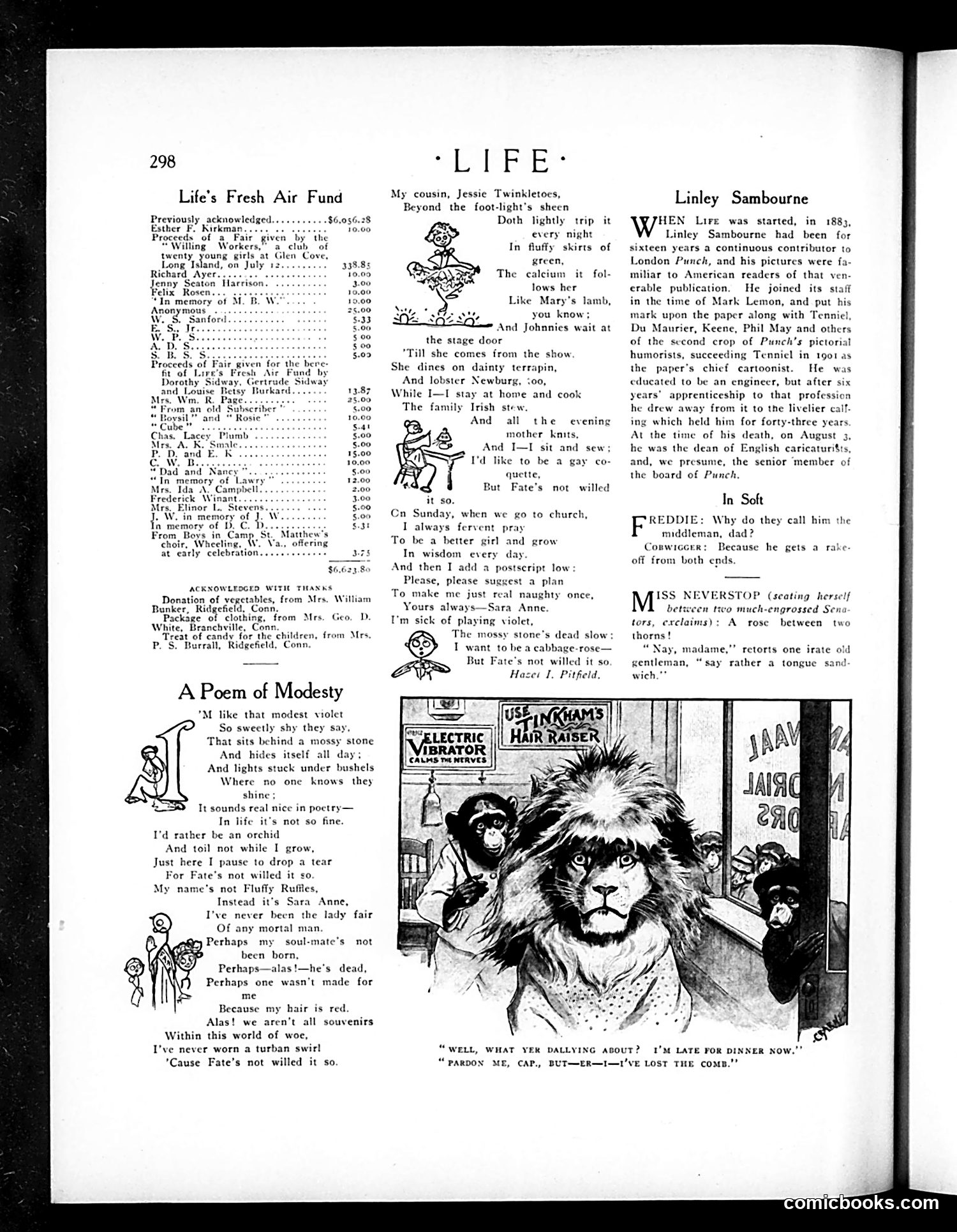
This page contains poetry and a cartoon. The main cartoon depicts a lion wearing what appears to be a maid's or servant's outfit, with text reading "Well, what yer dallying about? I'm late for dinner now" and "Pardon me, cap., but—er—I've lost the comb." The joke appears to satirize domesticated animals or servants in absurd situations—a lion, typically a fierce wild animal, is reduced to fussing over grooming and apologizing for losing a comb, speaking in working-class dialect. This likely mocks either the pretensions of keeping exotic pets, or satirizes servile behavior generally. The product advertisements visible (Electric Vibrator, Inkinghams Hair Raiser) suggest the cartoon plays on vanity and grooming obsessions. The specific social commentary remains unclear without additional context.
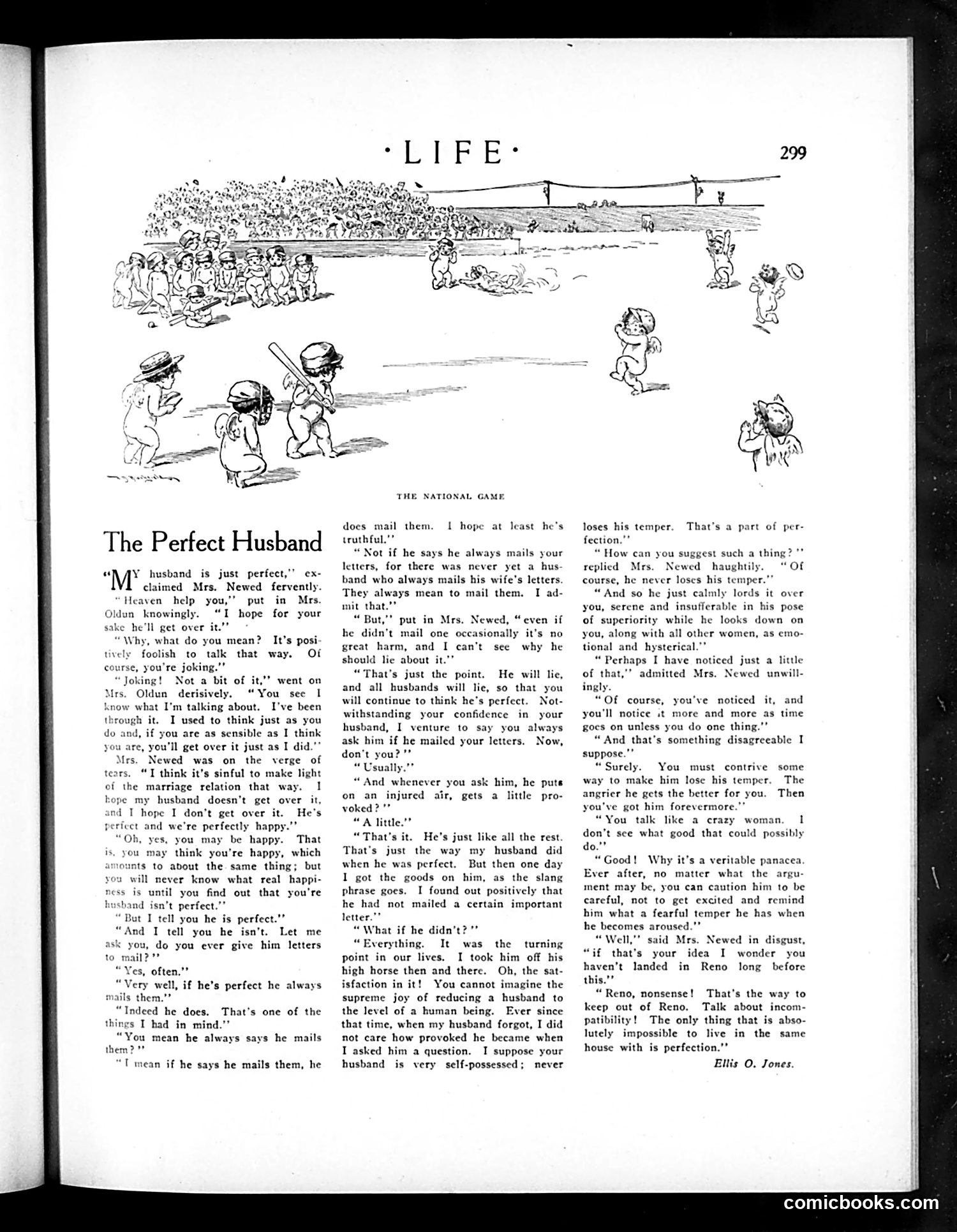
**Content:** This is a humorous advice column, not a political cartoon. The illustration shows a beach scene with families and children playing baseball—"The National Game"—establishing an Americana setting. **The Satire:** Mrs. Newed complains her husband is "perfect" because he always mails her letters. Mrs. Oldun dismisses this, arguing that perfection in husbands is impossible and that mailing letters is merely basic competence, not virtue. The satire mocks wives who lower their expectations to absurdly trivial standards, and husbands who expect praise for ordinary responsibilities. **Point:** Early 20th-century commentary on marital dynamics and women's unrealistic gratitude for minimal spousal effort—a gentle critique of gender relations dressed as domestic humor.
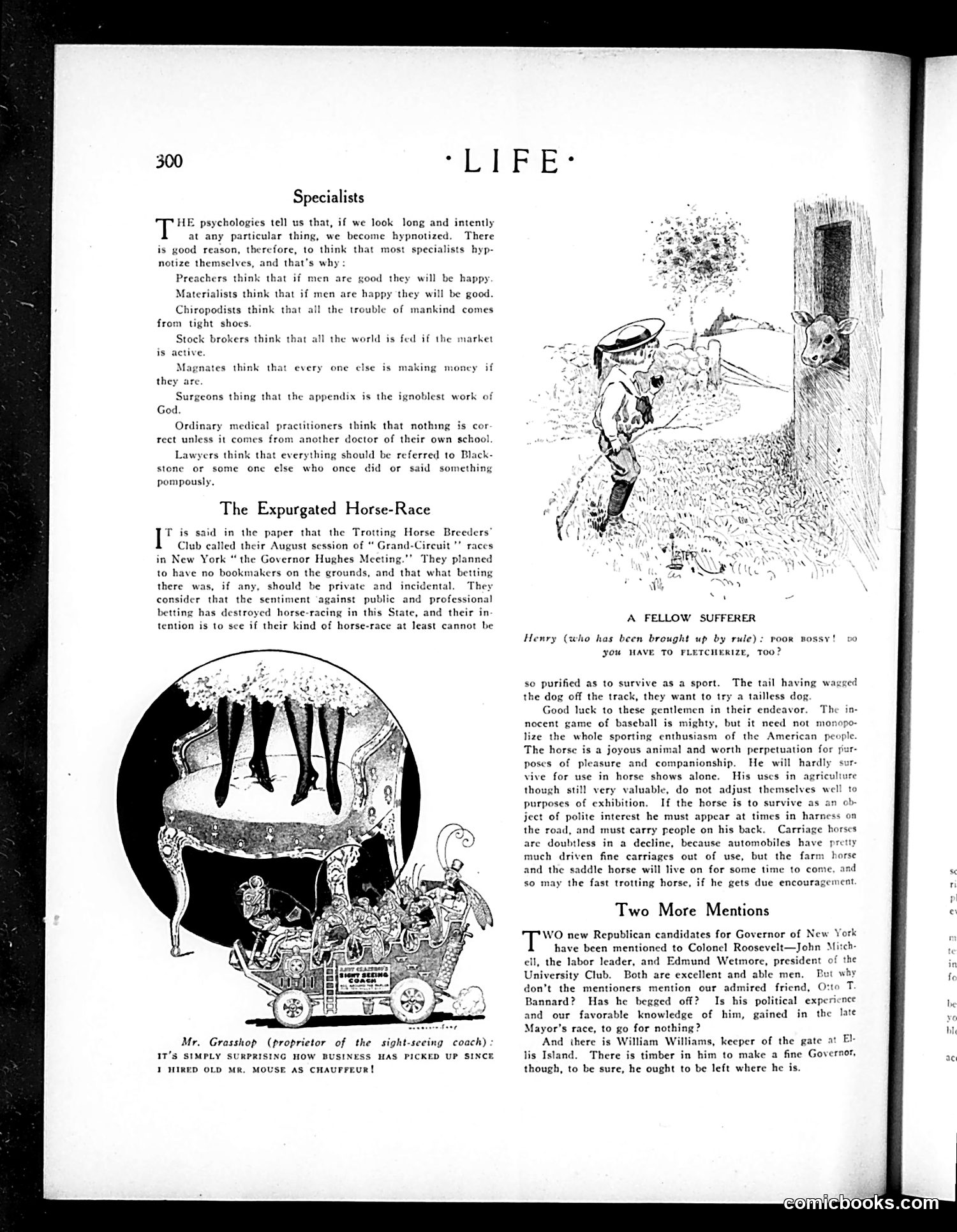
**"Specialists"** section mocks various professions' narrow worldviews—preachers, chiropodists, stock brokers, surgeons, lawyers—through satirical one-liners about their professional biases. **"The Expurgated Horse-Race"** section references a controversy where New York horse breeders planned to exclude bookmakers from racing grounds. The text satirizes this as misguided: the horse won't survive exhibition purposes anyway, so excluding betting won't save the breed. It's commentary on failed attempts to "purify" or reform industries through selective prohibition. **"Two More Mentions"** discusses potential Republican Governor candidates for New York, naming Colonel Roosevelt and others, with sarcastic commentary about their credentials and a local gatekeeper named William Williams. The large cartoon below depicts a coach labeled "right-seeing coach," satirizing business practices.
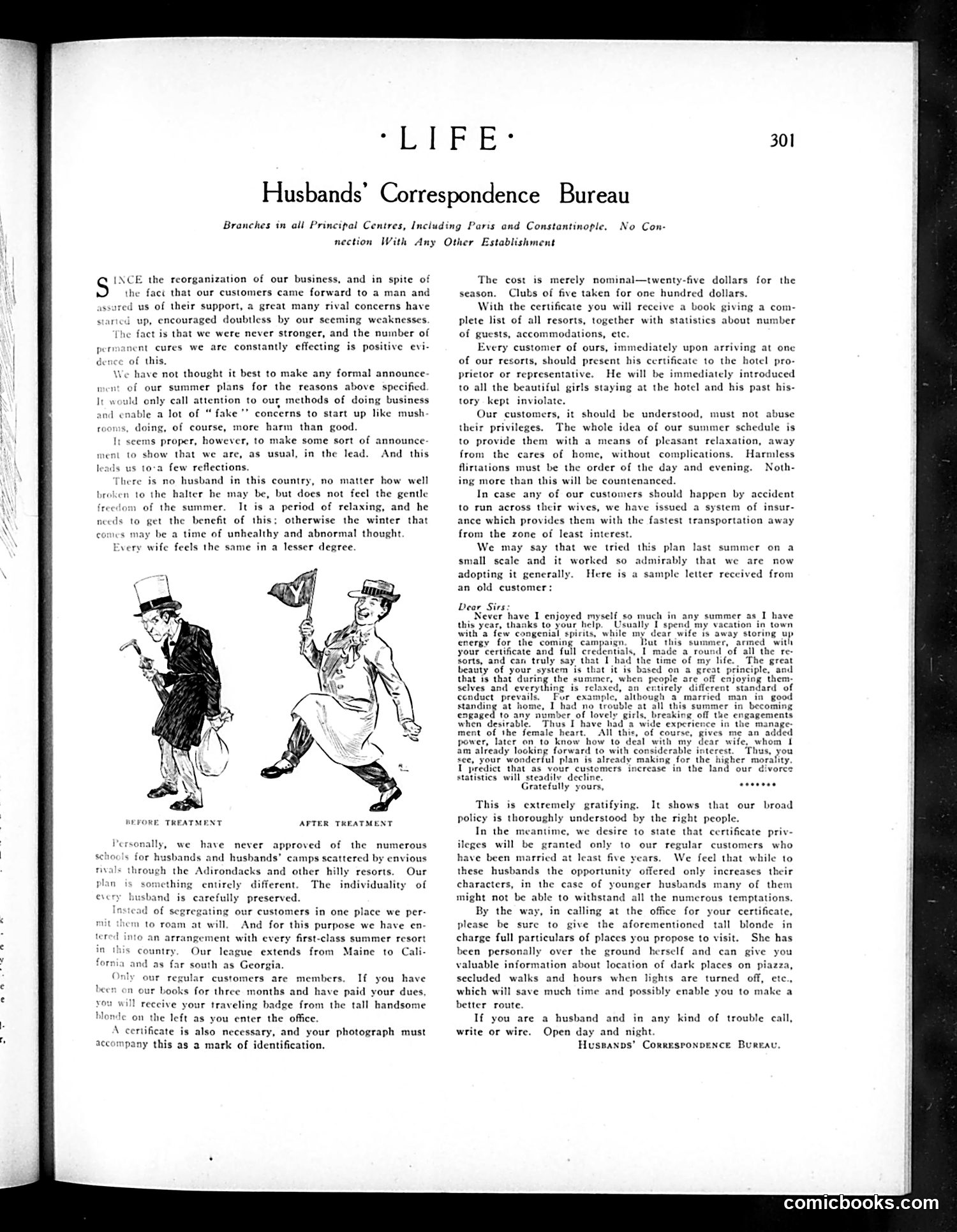
This page satirizes a fictional "Husbands' Correspondence Bureau"—a summer resort service that supposedly manages husbands' behavior while their wives vacation. The cartoon shows two caricatured men labeled "BEFORE TREATMENT" and "AFTER TREATMENT," depicting exaggerated transformations in dress and demeanor. The satire mocks the era's gender dynamics: wives supposedly need protection from their husbands' misbehavior during summer separation. The service offers "insurance" against infidelity and provides certificates of good conduct. The accompanying letter from a satisfied customer reinforces the joke—the husband spent his summer pursuing women rather than behaving properly. This reflects early 20th-century anxieties about marital fidelity and satirizes both male behavior and the solutions women might seek.
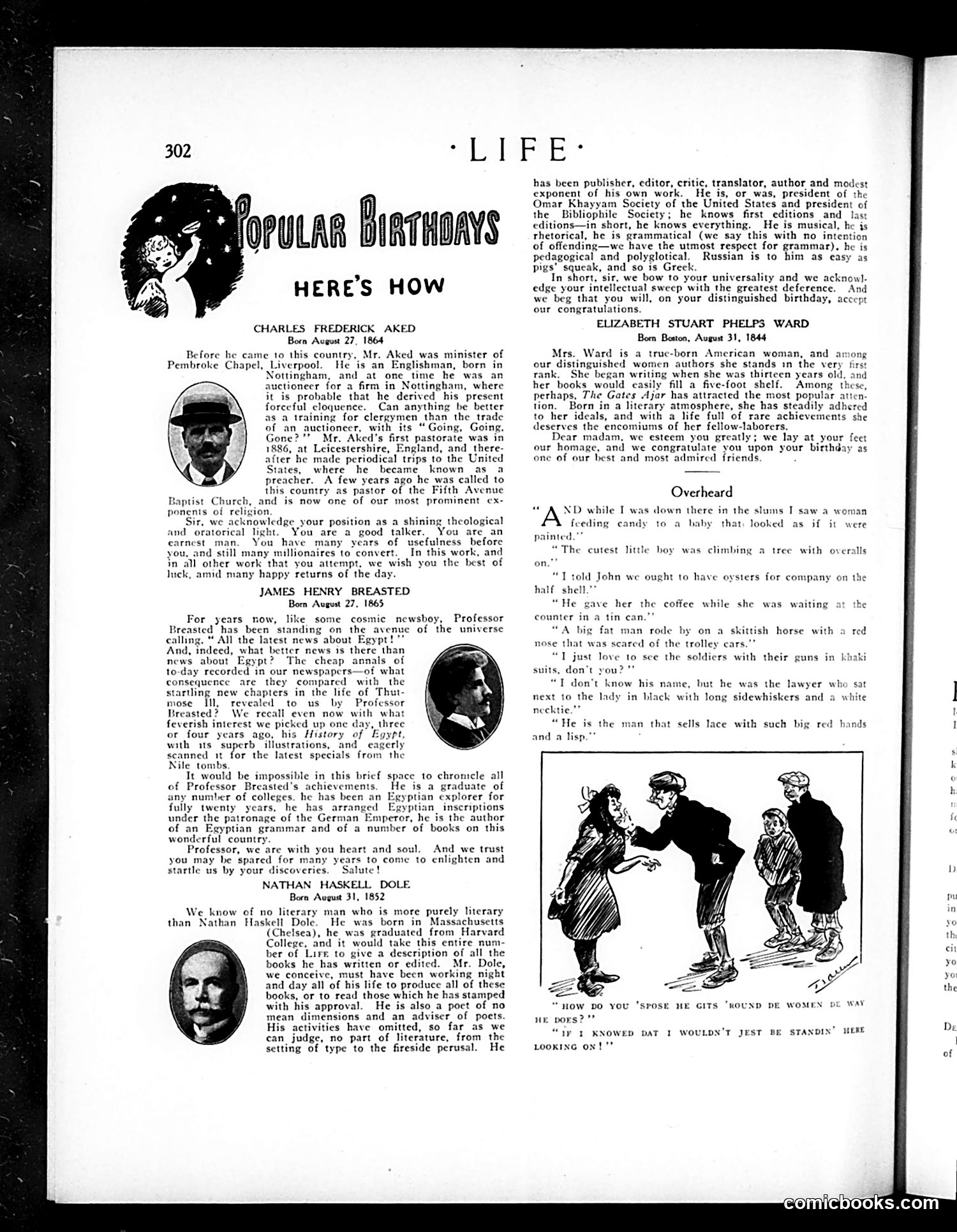
This page celebrates the birthdays of three prominent American figures from August 1908: **Charles Frederick Aked** — An English Baptist minister who became pastor of Fifth Avenue Baptist Church in New York. Life playfully notes his background as an auctioneer ("Going, Going, Gone?") supposedly trained him for eloquent preaching. **James Henry Breasted** — An Egyptologist whose recent *History of Egypt* discoveries from Nile tombs captivated the public. Life satirizes the public's fascination with ancient Egyptian news over contemporary affairs. **Nathan Haskell Dole** — A prolific Harvard-educated literary figure: editor, translator, poet, and president of the Omar Khayyam and Bibliophile societies. Life humorously exaggerates his productivity and expertise across all literary domains, even claiming Russian is "as easy as pigs' squeak" for him. The accompanying cartoon depicts social humor unrelated to these birthday tributes. This is a lighthearted celebratory column typical of Life's satirical but affectionate style toward cultural figures.
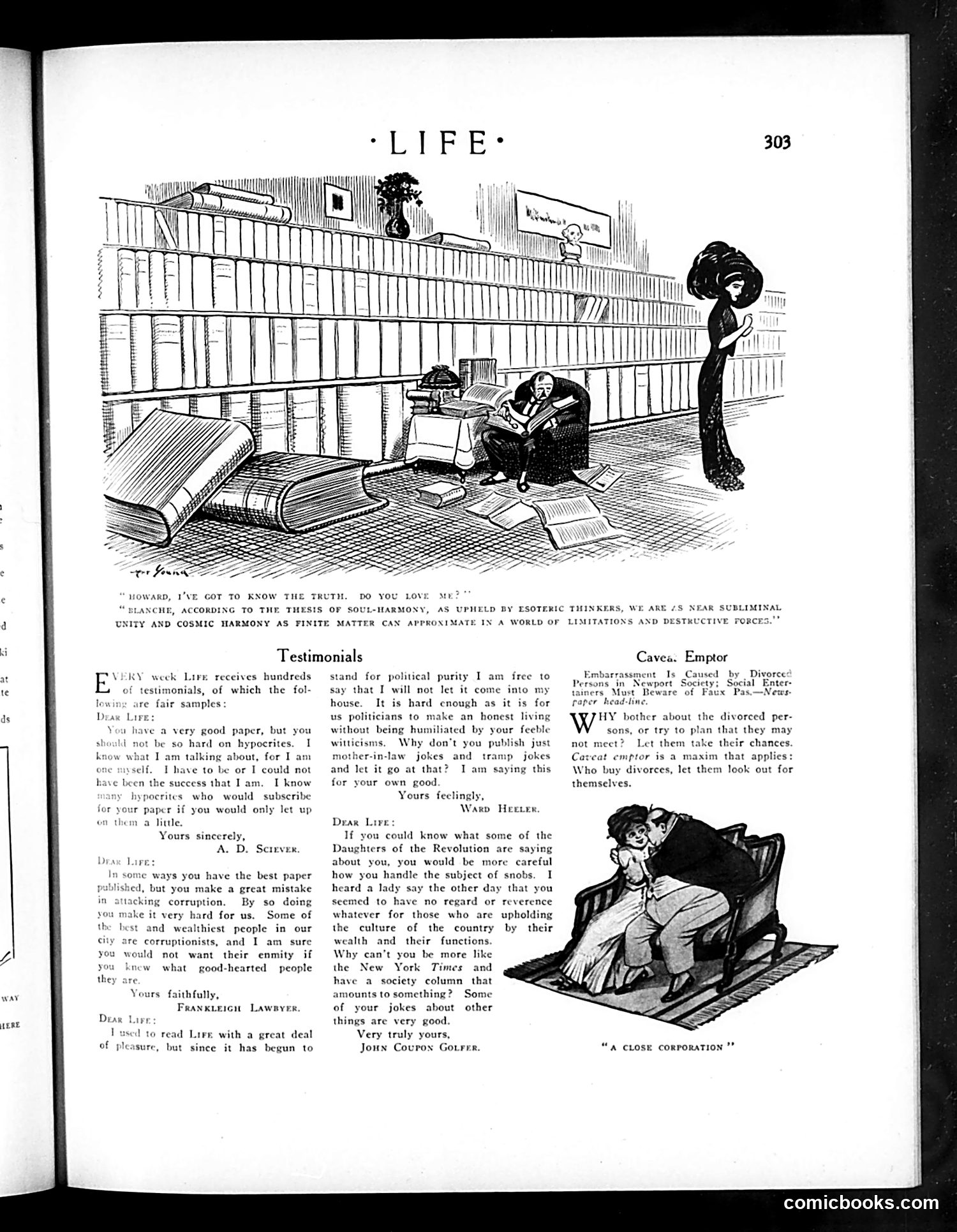
This page satirizes Life's critics through fake "testimonials"—letters from readers objecting to the magazine's editorial stance. The satire targets hypocrisy among the powerful: **The figures/complaints:** - A successful businessman admits he's a hypocrite but demands Life stop attacking corruption - A politician complains Life makes "honest living" difficult by promoting "political purity" - A society woman (likely referencing the "Daughters of the Revolution") objects to mocking snobbery and wealthy elites - All want Life to publish gentler content—"mother-in-law jokes" instead of social criticism **The point:** Life is mocking its elite readers who want the magazine to abandon satirical scrutiny of corruption, class pretension, and dishonesty. The cartoons (library scene, "close corporation") visualize disconnected intellectualizing and exclusive privilege. The message: these powerful people profit from the status quo and resent being criticized for it—they want satire without teeth.
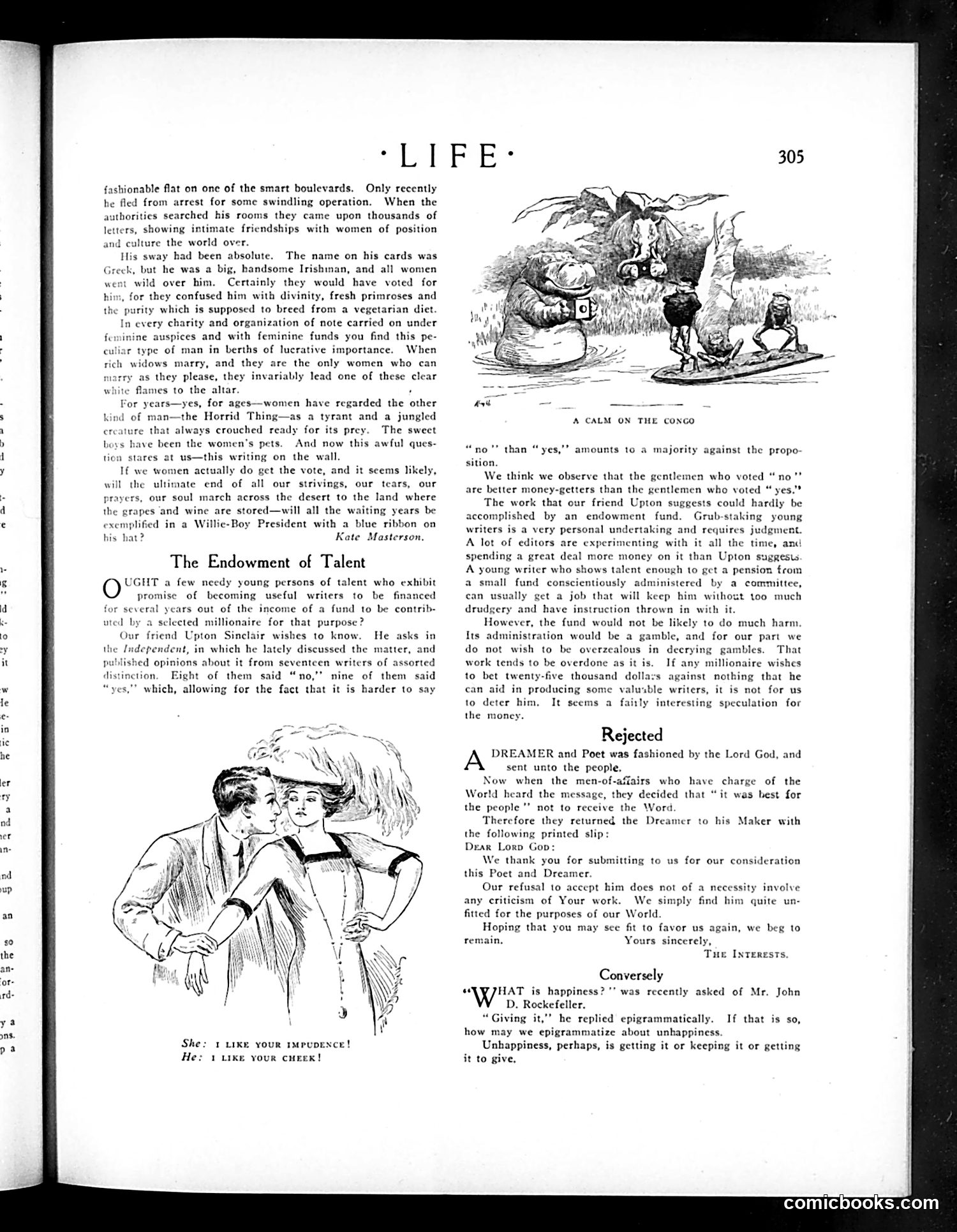
This page contains three distinct satirical pieces: **"A Calm on the Congo"** (top cartoon): A sketch showing colonial figures in Africa, likely satirizing European imperialism and the exploitation of African resources during the colonial era. **"The Endowment of Talent"** (middle section): Discusses whether millionaires should fund young writers. The text references Upton Sinclair's proposal and notes that editors who rejected funding (saying "no") tend to be financially successful, while supporters (saying "yes") are not—satirizing self-interest in artistic patronage debates. **"Rejected"** (bottom section): A parable mocking commercialism and pragmatism. It depicts how practical "men-of-affairs" reject an idealistic "Dreamer and Poet" sent by God, returning him with a rejection slip. This satirizes how materialistic society dismisses artistic or spiritual values. The page critiques hypocrisy across economics, colonialism, and cultural values in early 20th-century American society.
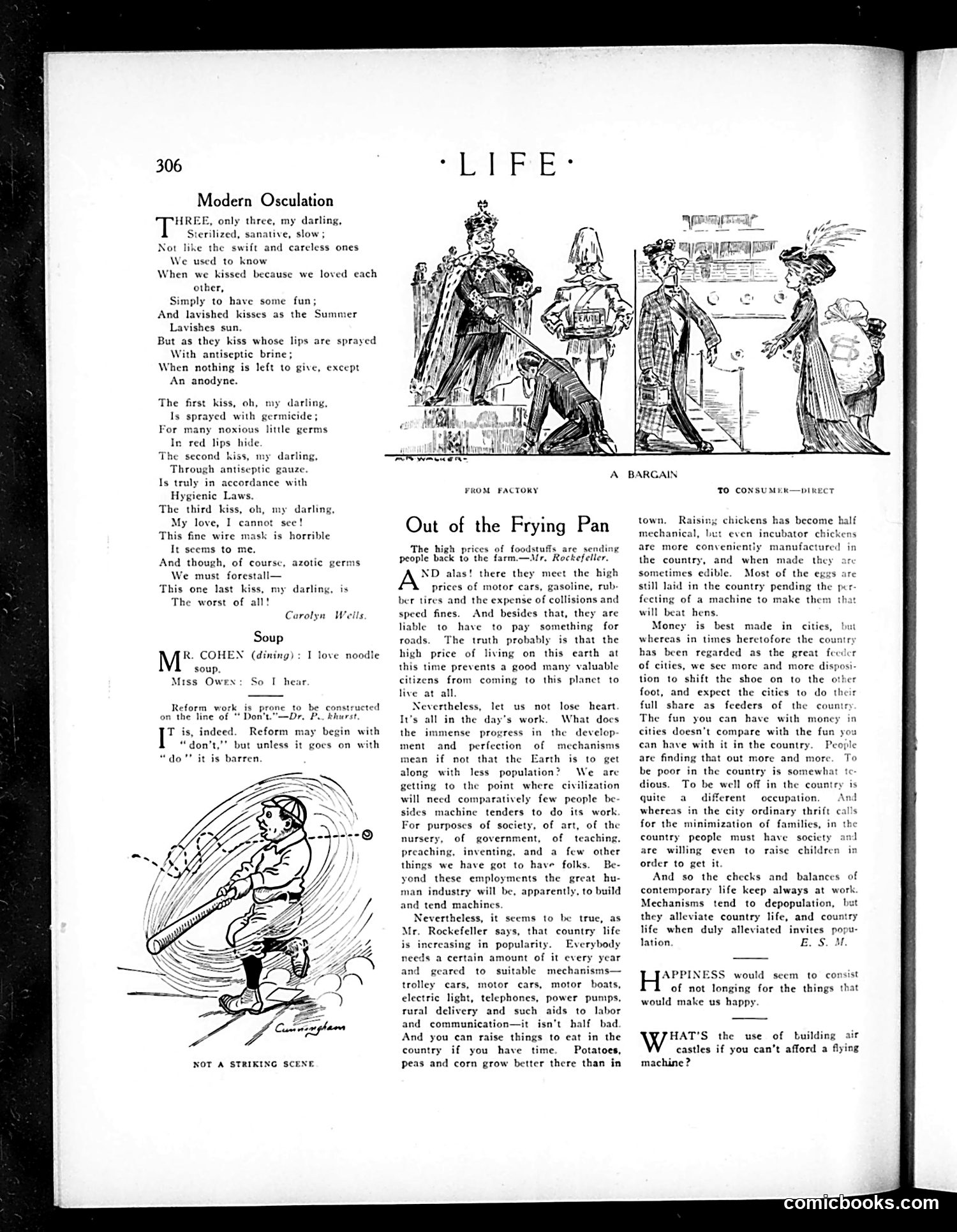
**"Modern Osculation"** satirizes early 20th-century anxieties about hygiene and germs. The poem mocks overly sanitized kissing—where lovers spray lips with antiseptic, use germicide, and wear wire masks to prevent disease transmission. It contrasts this sterile modern approach with romantic, unsanitary kissing of the past, lamenting that contemporary medical knowledge has eliminated passion from intimacy. **"Out of the Frying Pan"** responds to Rockefeller's claim that high food prices drive people back to farming. The author argues this ignores that rural life now requires expensive cars, gasoline, and road maintenance—so people escape city costs only to face rural ones. The piece suggests mechanization means fewer people are needed for actual work, and that while country life offers leisure and cheaper food production, wealth-building requires cities. The cartoon depicts someone in a frying pan—literalizing the idiom of escaping one problem only to face another.
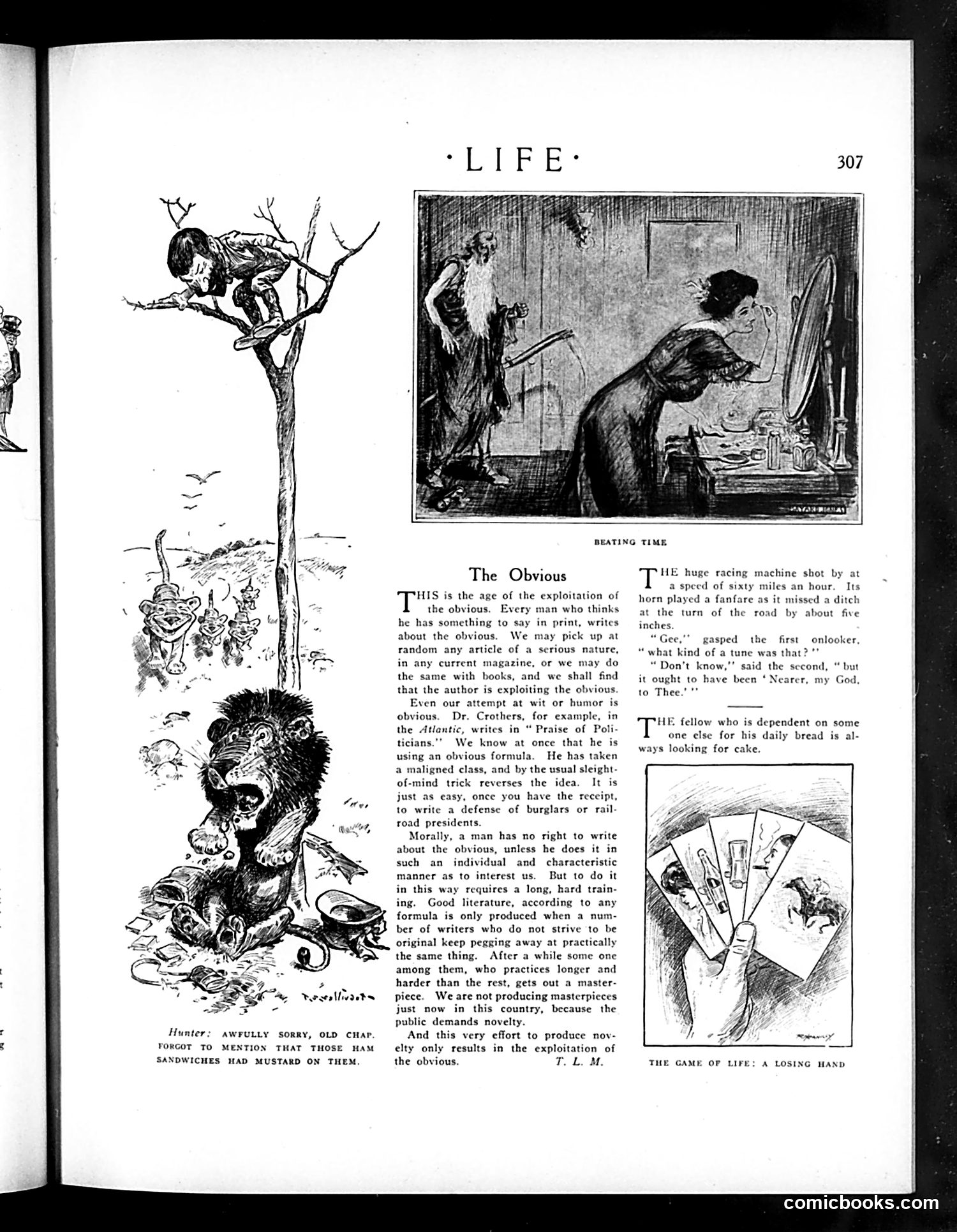
**Main Article ("The Obvious"):** A satirical essay criticizing contemporary American writers for exploiting obvious themes without originality. The author argues that modern literature lacks masterpieces because writers chase novelty rather than developing genuine skill. The illustration shows a disheveled character surrounded by debris—likely representing the chaotic, uninspired state of current writing. **Cartoon 1 (Top right, "Beating Time"):** Shows a man being beaten while a woman watches. The caption's crude joke suggests domestic violence as entertainment or comeuppance—reflecting early 20th-century attitudes normalizing such brutality as comedic material. **Cartoon 2 (Bottom right, "The Game of Life: A Losing Hand"):** Depicts a hand of playing cards, with the caption implying that dependence on others for basic needs creates false expectations of luxury ("cake" vs. "bread"). It satirizes how poverty breeds unrealistic desires. The page satirizes both literary mediocrity and social complacency through humor that modern readers would find harsh or offensive.
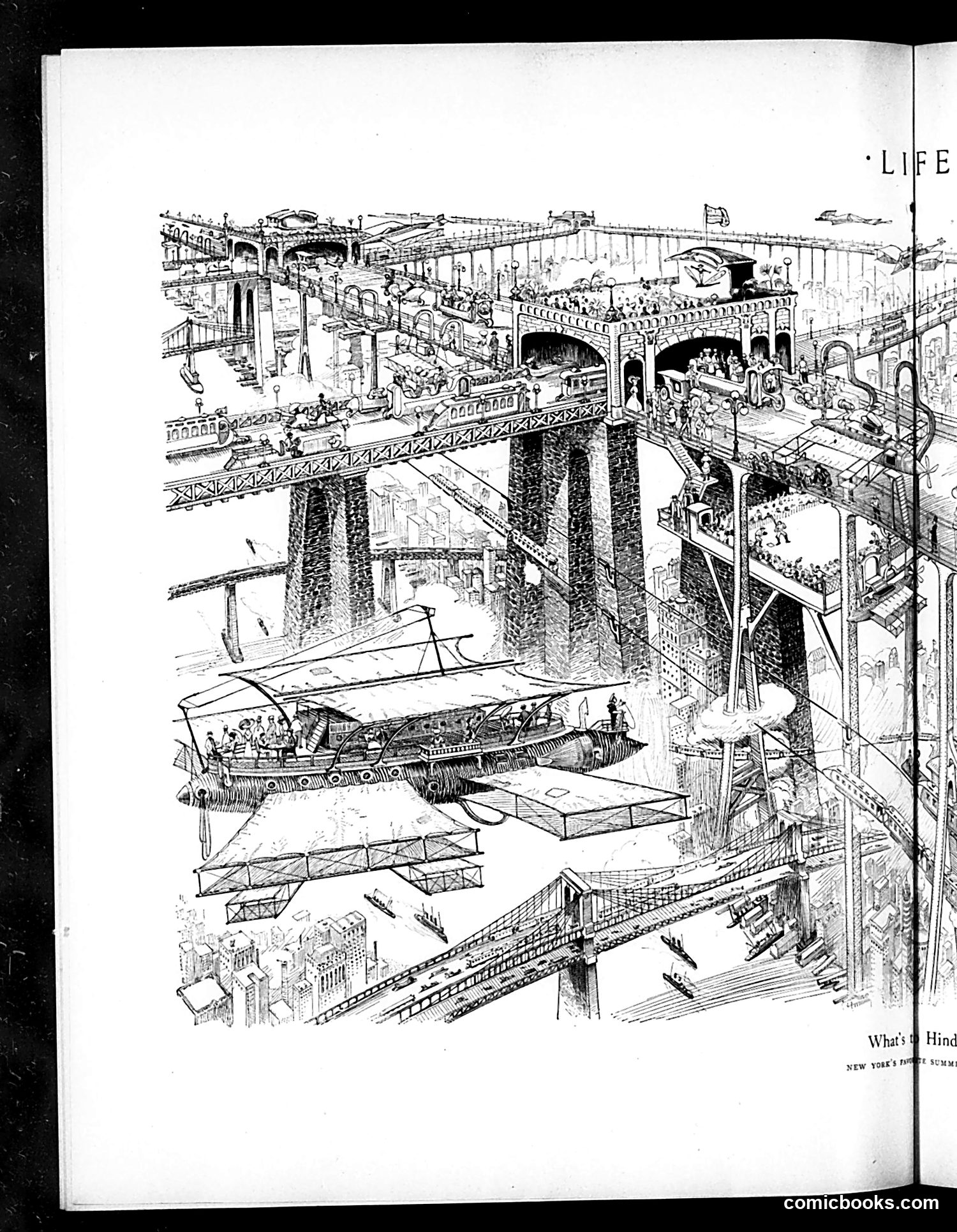
This appears to be a cross-sectional architectural illustration of a major public venue or fair, likely from early-to-mid 20th century based on the art style. The drawing shows multiple levels of activity—ships/boats at water level, elevated railway or transport infrastructure, crowds of people on various platforms and walkways, and ornate architectural structures including arches and towers. The caption fragment "What's # Hind" is incomplete and unclear from the OCR. Without the full text, I cannot definitively identify what specific event, location, or satirical point is being made. The illustration itself appears to be documenting urban infrastructure and public gathering spaces rather than containing obvious political caricature, though the crowded scenes might be commenting on modern industrial society or public spectacle.
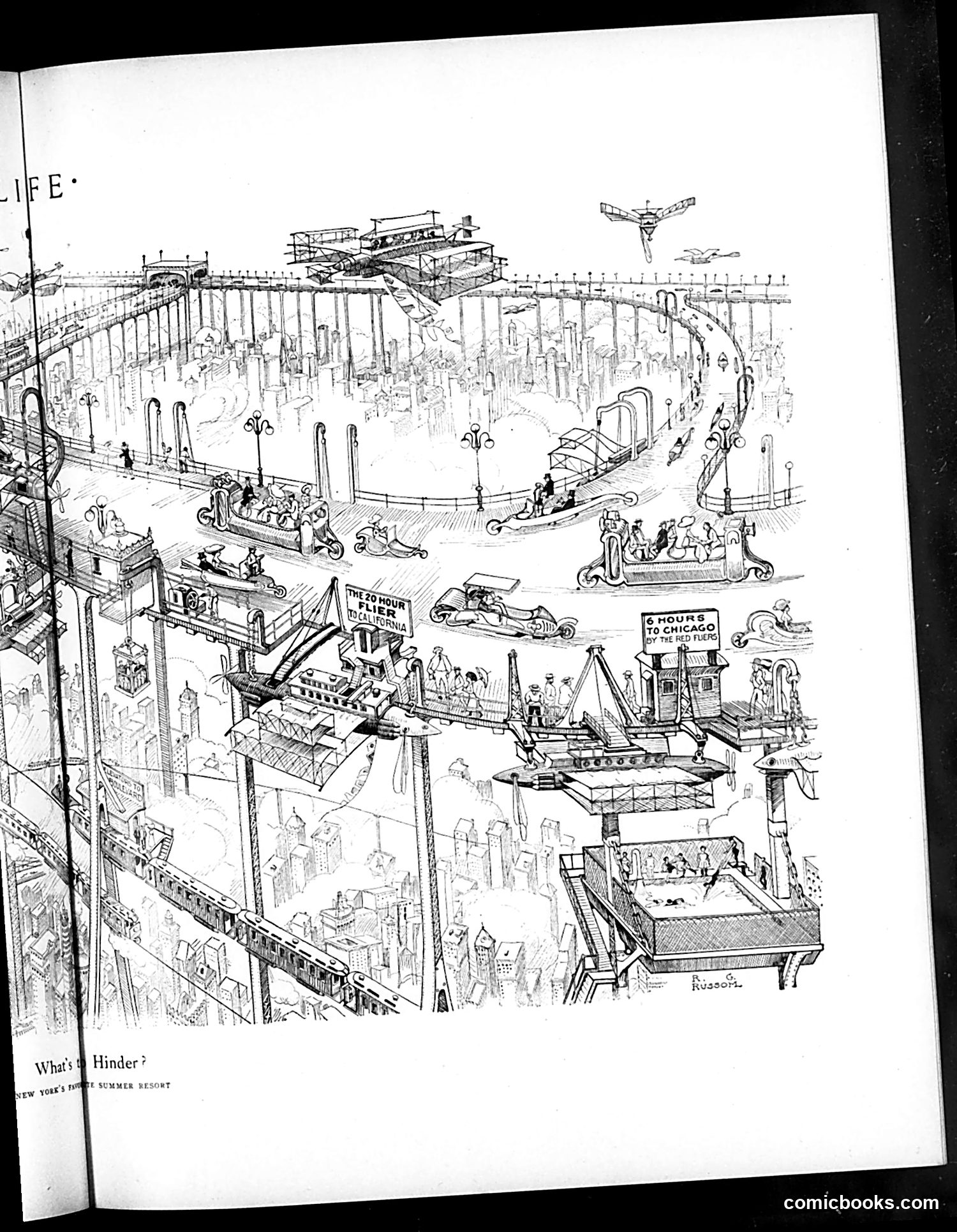
This appears to be a futuristic architectural illustration titled "What's Hinder?" featuring an elaborate amusement park or resort concept. The drawing depicts a sprawling recreational complex with: - Multiple transportation methods (elevated railways, airships/dirigibles, flying vehicles) - Various attractions and entertainment structures - Dense crowds of visitors - Signs referencing travel times ("20 hour" and "6 hours to Chicago") The satire likely comments on **American optimism about technological progress and commercialized leisure** in the early 20th century. The phrase "What's Hinder?" suggests confidence that nothing prevents such grandiose development. The illustration mocks both the unbridled ambition of resort developers and the era's faith that modern engineering could solve all spatial and transportation problems, creating an idealized (and somewhat fantastical) "summer resort" destination.
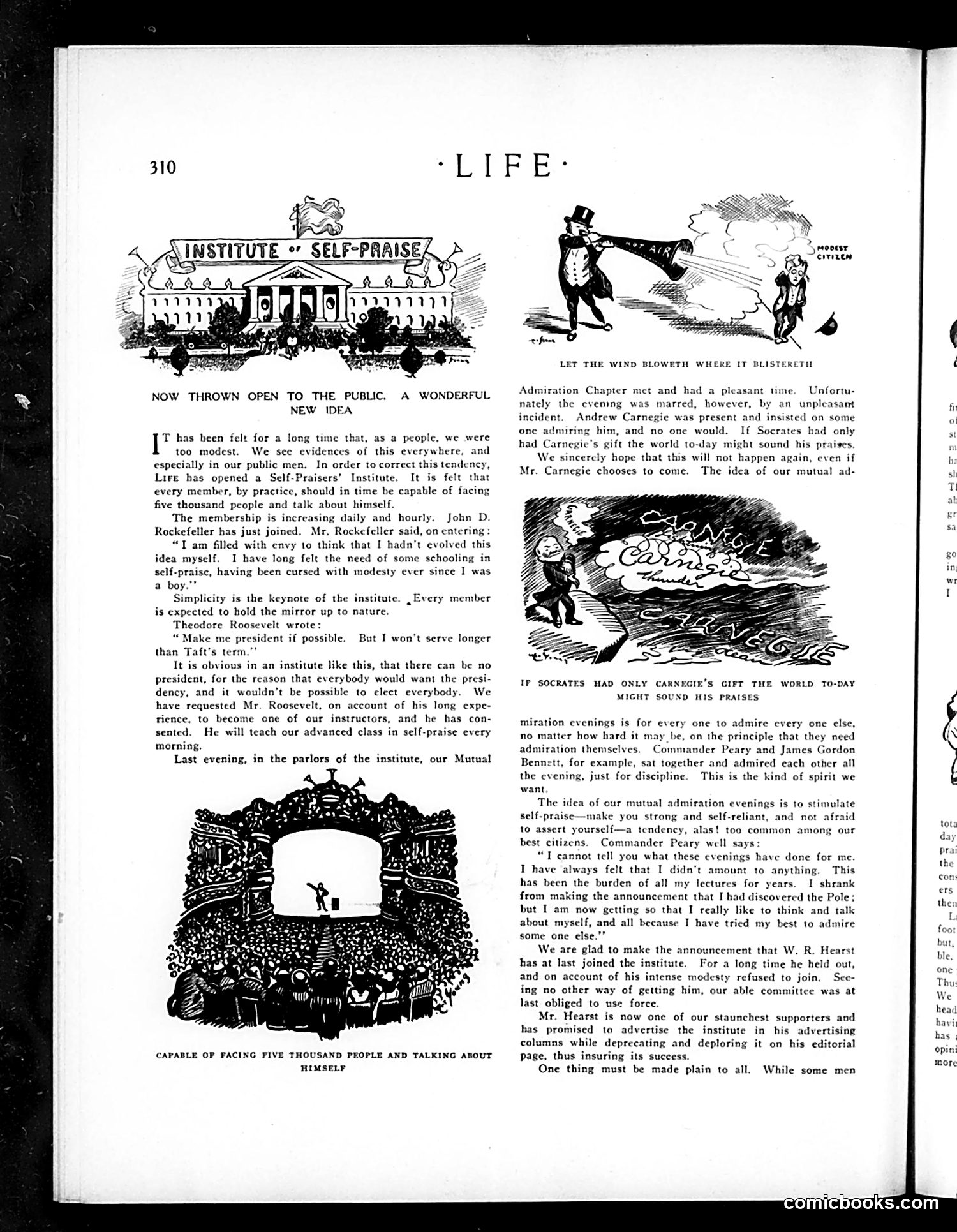
This satirical piece mocks the vanity and self-aggrandizement of wealthy American industrialists and public figures of the early 1900s. Life proposes a fictional "institute" to teach self-praise, claiming Americans are "too modest"—obviously ironic. The satire targets specific real figures: **John D. Rockefeller** (oil magnate), **Theodore Roosevelt** (recently departed president, competing with successor **Taft**), **Andrew Carnegie** (steel magnate whose philanthropy demanded admiration), **Commander Peary** (Arctic explorer), **James Gordon Bennett** (newspaper publisher), and **W. R. Hearst** (media mogul). The joke exposes how these powerful men constantly sought public adulation despite claims of humility. The cartoon of Carnegie demanding admiration, and the detail about Hearst requiring "force" to join while simultaneously promoting and attacking the institute in his newspapers, illustrate the hypocrisy and contradictions Life saw in gilded-age American leadership.
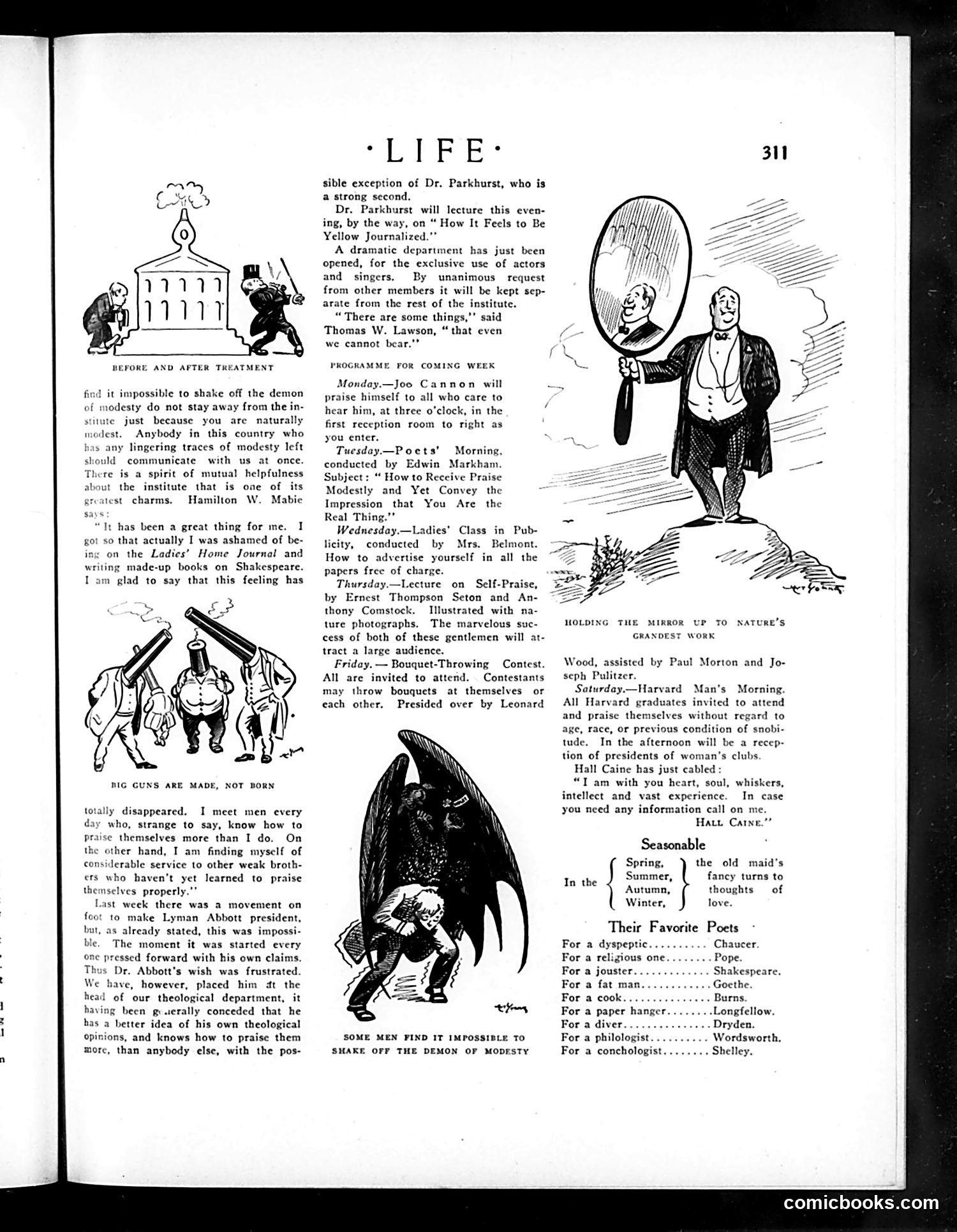
This page satirizes the era's culture of self-promotion among prominent public figures. The central joke presents a fictional "institute" teaching people—particularly famous men—how to overcome modesty and praise themselves effectively. The cartoons mock specific individuals: Joe Cannon (Speaker of the House), Lyman Abbott (religious leader), Dr. Parkhurst (reform-minded clergyman), Thomas W. Lawson (financier), and others are named as faculty or participants. The satire suggests these men are naturally inclined toward self-aggrandizement and need no instruction. The humor targets the Gilded Age tendency of wealthy, prominent Americans to seek publicity and acclaim. References to "Ladies' Home Journal" mock literary pretension, while mentions of "yellow journalism" and Mrs. Belmont's "publicity" class suggest anxiety about media manipulation and manufactured celebrity. The "Favorite Poets" list adds gentle irony, pairing personality types with literary figures in ways suggesting their self-absorption—a dyspeptic gets Chaucer, a fat man gets Goethe.
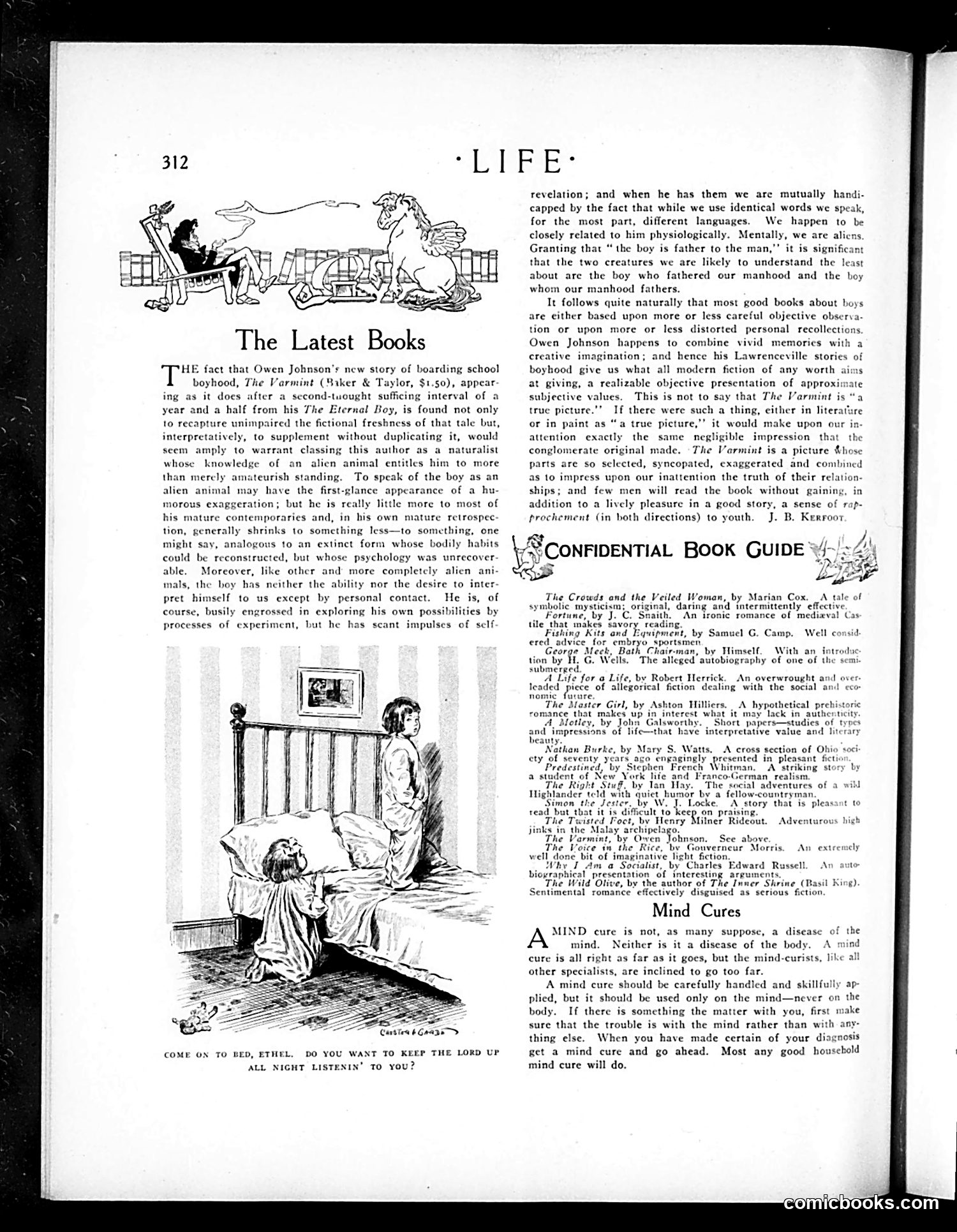
This page contains two main elements: a book review section and a cartoon with accompanying caption. **The Cartoon:** Shows a woman in bed speaking to a man standing beside it, with the caption "Come on to bed, Ethel, do you want to keep the Lord up all night listenin' to you?" The humor is domestic and mildly risqué for the era—satirizing a husband's impatience with his wife's nighttime talking, humorously framing it as a religious irreverence (keeping God waiting). **The Book Review:** Discusses Owen Johnson's *The Varmint*, a boarding school story. The critic praises Johnson's naturalistic treatment of boyhood, arguing he captures authentic psychology rather than exaggerated sentiment. The review emphasizes that boys are essentially "alien animals" to adults—unknowable except through careful observation. **Social Context:** Early 1900s Life magazine combined genteel literary criticism with humor targeting middle-class domestic life, reflecting contemporary attitudes about marriage, propriety, and childhood development.
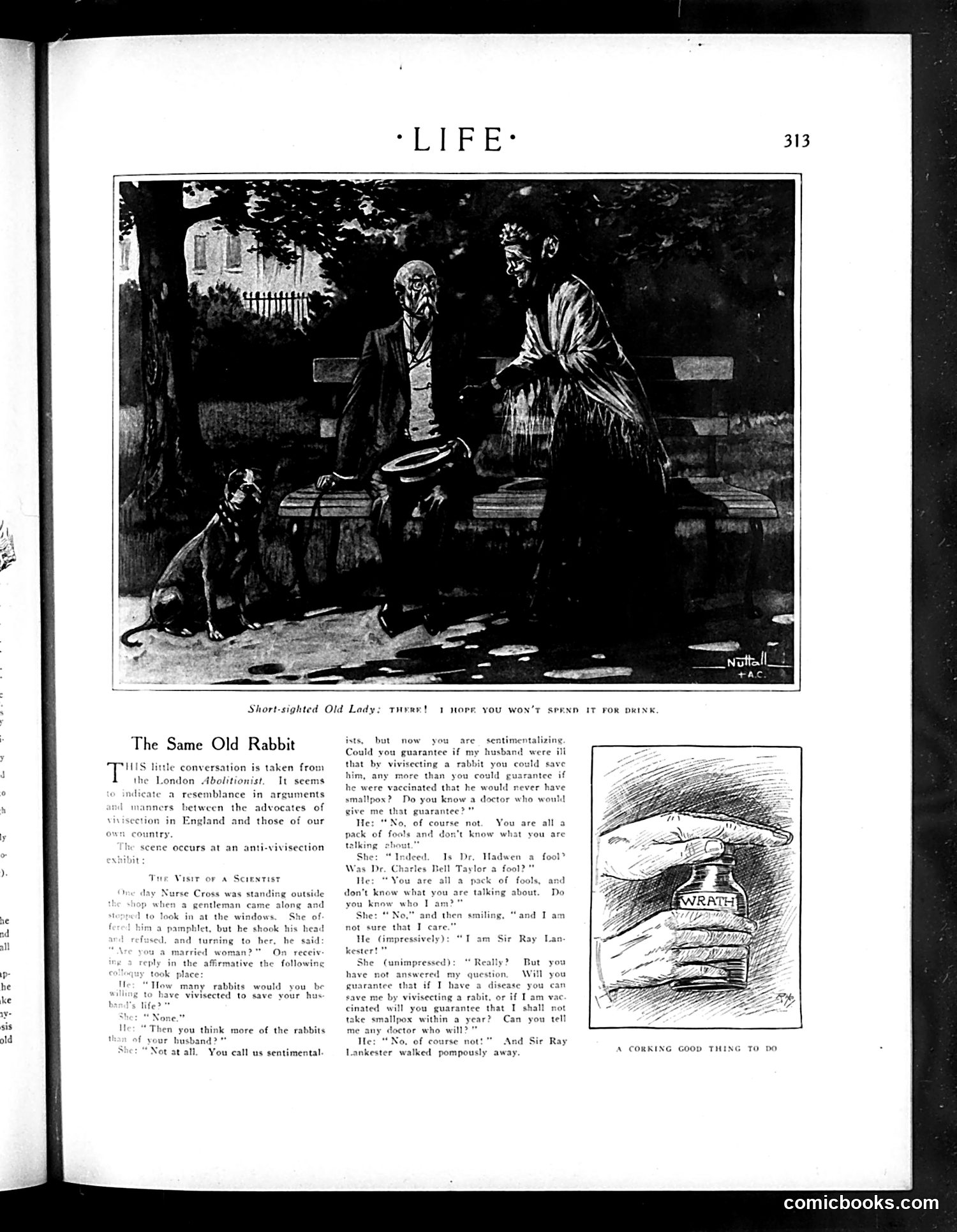
This page contains two satirical pieces critiquing anti-vivisection advocates in early 20th-century Britain and America. **"Short-sighted Old Lady"**: A cartoon mocking an elderly woman giving money to someone with the warning "There! I hope you won't spend it for drink"—satirizing sentimental charity that's patronizing and ineffective. **"The Same Old Rabbit"**: A dialogue piece comparing British and American anti-vivisection movements. A scientist confronts an anti-vivisection activist at an exhibition, challenging her emotional arguments against animal testing. He points out her hypocrisy: she won't guarantee that vaccinations (which saved lives from smallpox) cause harm, yet opposes medical testing on rabbits that might save human lives. **The satire's point**: Anti-vivisectionists rely on sentiment rather than logic. They oppose animal suffering abstractly while accepting medical advances those experiments enabled. The piece dismisses their moral position as self-contradictory and impractical—prioritizing rabbit welfare over human health. This reflects historical tensions between animal welfare advocates and medical researchers.
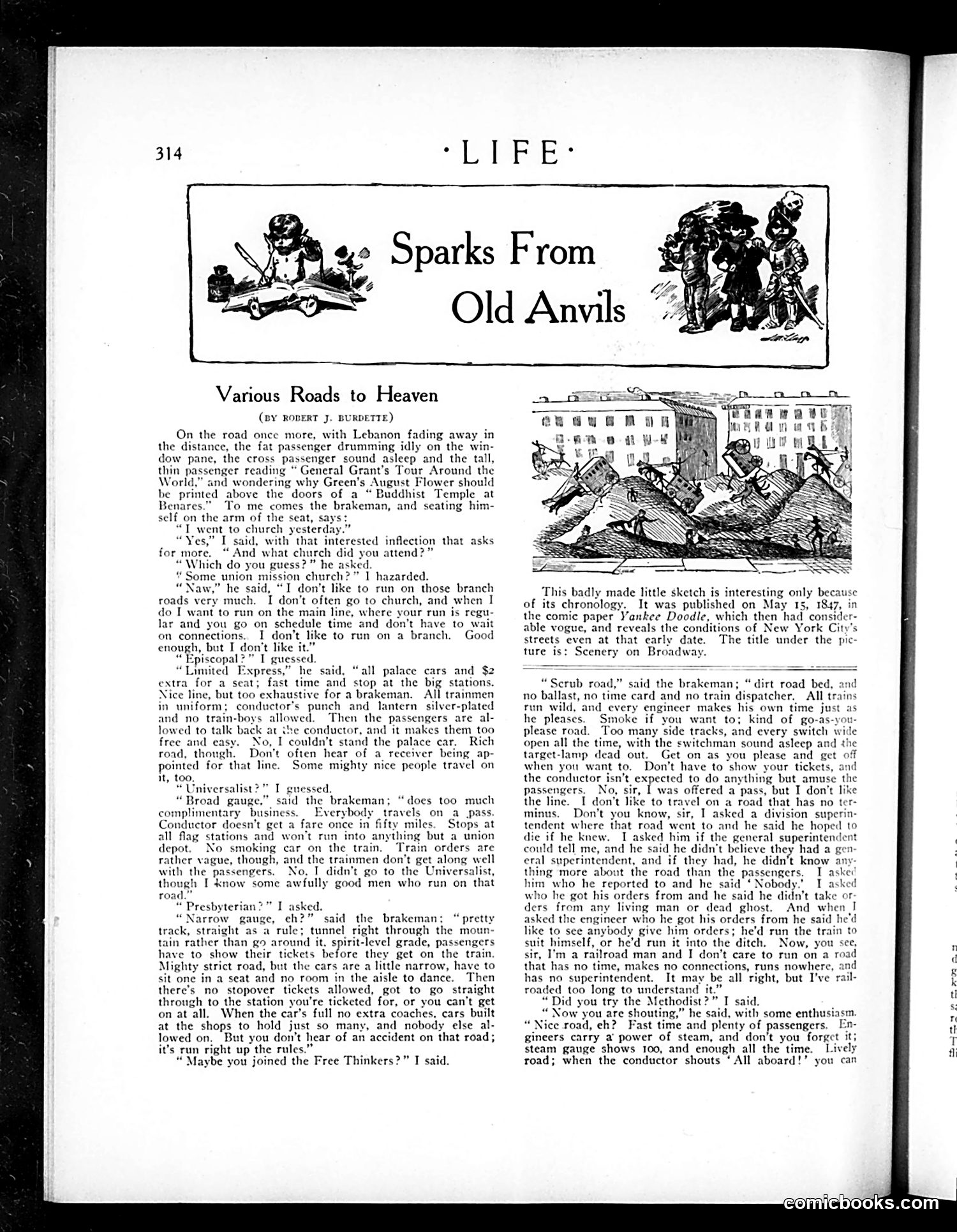
This page contains an extended satirical dialogue between a railroad brakeman and a passenger, where the brakeman describes different Christian denominations as railroad lines—a clever 19th-century metaphor. **The Satire:** Each church becomes a train system with distinct characteristics: - **Episcopal**: The luxury "Limited Express" with high fares and elite passengers - **Universalist**: A permissive "broad gauge" line where everyone travels free - **Presbyterian**: A strict, narrow-gauge line with rigid rules and no flexibility - **Free Thinkers**: The lawless "scrub road" with no oversight or discipline **The Point:** The brakeman critiques churches by exposing their operational philosophies through railroad metaphors. The dialogue gently mocks denominational pretensions while suggesting that faith communities, like rail systems, differ fundamentally in their structure, accessibility, and rules. **Secondary Content:** The page also includes a brief note about an 1847 *Yankee Doodle* sketch depicting Broadway street conditions, establishing historical perspective on urban life. The humor relies on readers' familiarity with both railroad terminology and denominational distinctions.
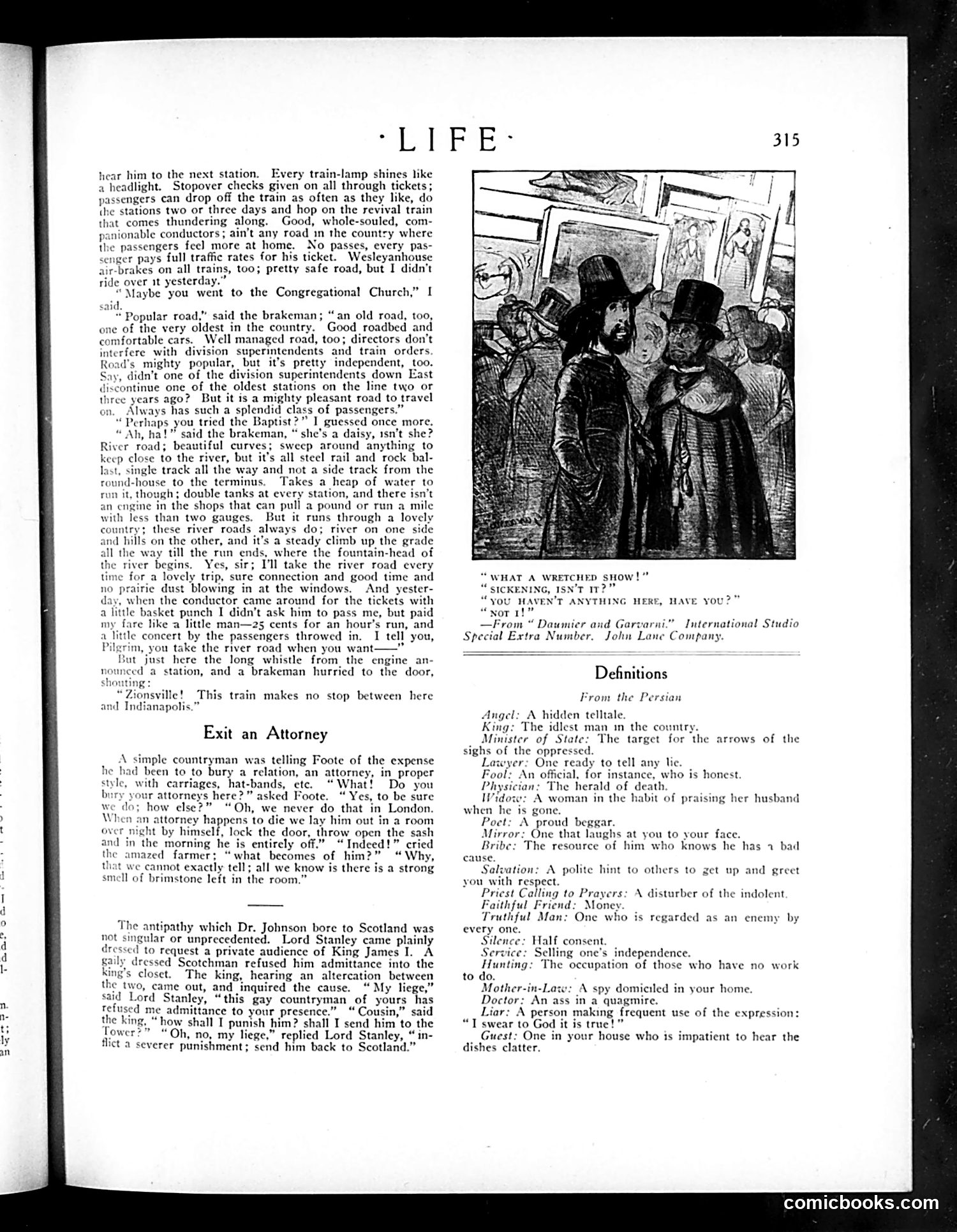
This page contains three distinct pieces of satirical content: **1. The Train Conversation (main narrative):** A brakeman uses railroad lines as metaphors for American Protestant denominations—Methodist, Congregational, and Baptist churches. Each "road" reflects the sect's character: Methodists are well-managed and inclusive; Congregationalists are independent and selective; Baptists are emotionally intense ("river roads") but resource-intensive. This is religious satire through extended metaphor, poking fun at denominational stereotypes. **2. "Exit an Attorney":** A dark joke contrasting English and country practices for burying attorneys. The English attorney supposedly vanishes overnight, leaving only "brimstone" smell—implying attorneys are demonic or hellish. Standard period satire mocking the legal profession as dishonest. **3. Historical anecdotes:** Brief stories about Dr. Johnson's Scottish prejudice and King James I, illustrating stubbornness and class pretension—filler content typical of Life's format. The cartoon illustration (captioned "What a wretched show!") accompanies the train narrative, though specific details are unclear from the image quality.
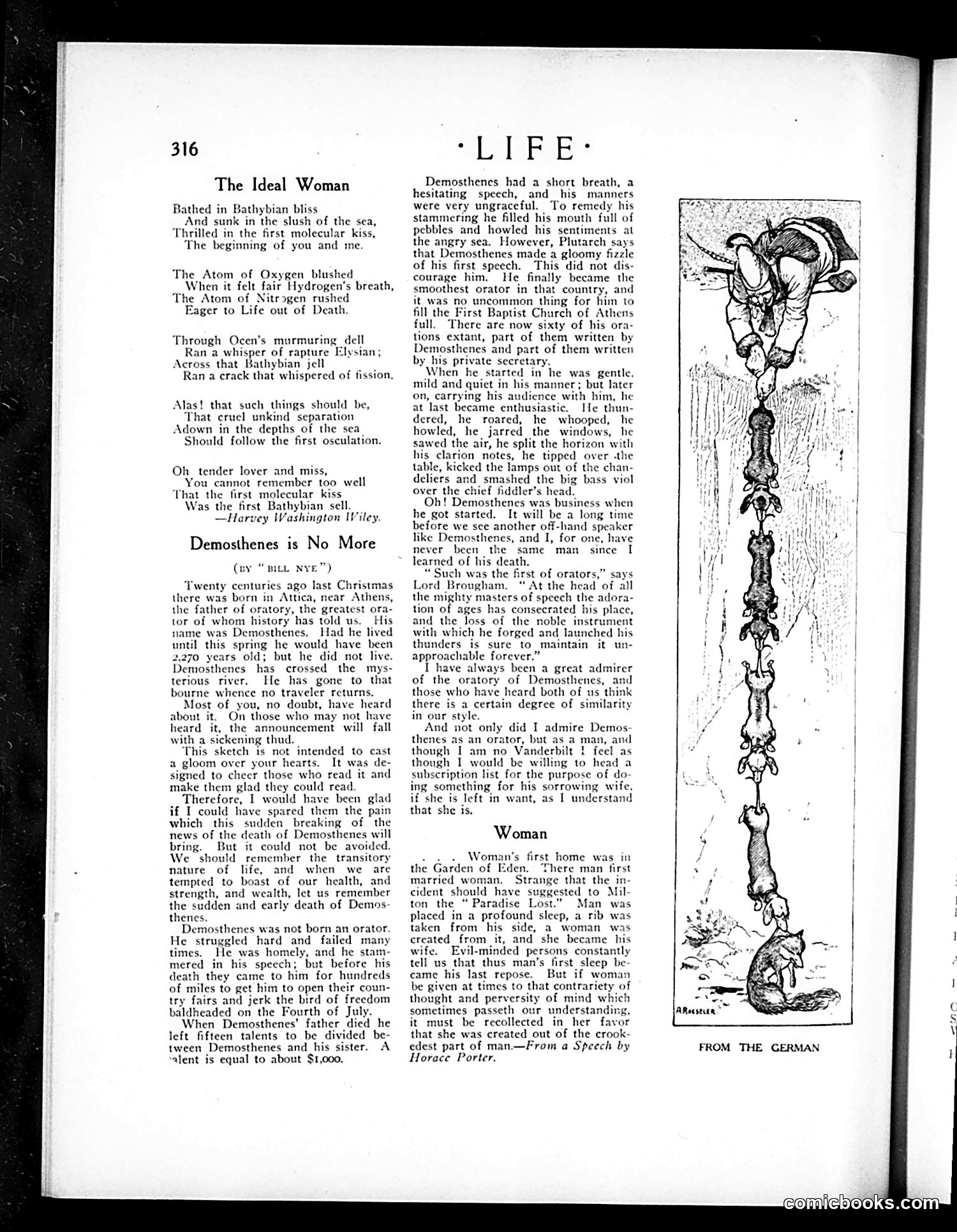
This page contains two distinct pieces: **"The Ideal Woman"** is a humorous poem by Harvey Washington Wiley (a real food safety chemist) that satirizes scientific materialism by reducing human romance to molecular chemistry—atoms of oxygen and hydrogen "kissing" in primordial seas. It mocks the tendency to explain everything through science. **"Demosthenes is No More"** is a comic essay by Bill Nye (a popular humorist of the era) offering a tongue-in-cheek "obituary" of the ancient Greek orator Demosthenes, who died centuries ago. Nye uses absurdist humor, treating ancient history as current news and exaggerating Demosthenes' speaking style (overturning tables, smashing violins). The joke is the mock-serious tone applied to irrelevant historical "gossip"—it's playful deflation of classical reverence. The German illustration on the right appears unrelated to the text, likely a decorative element from another article.
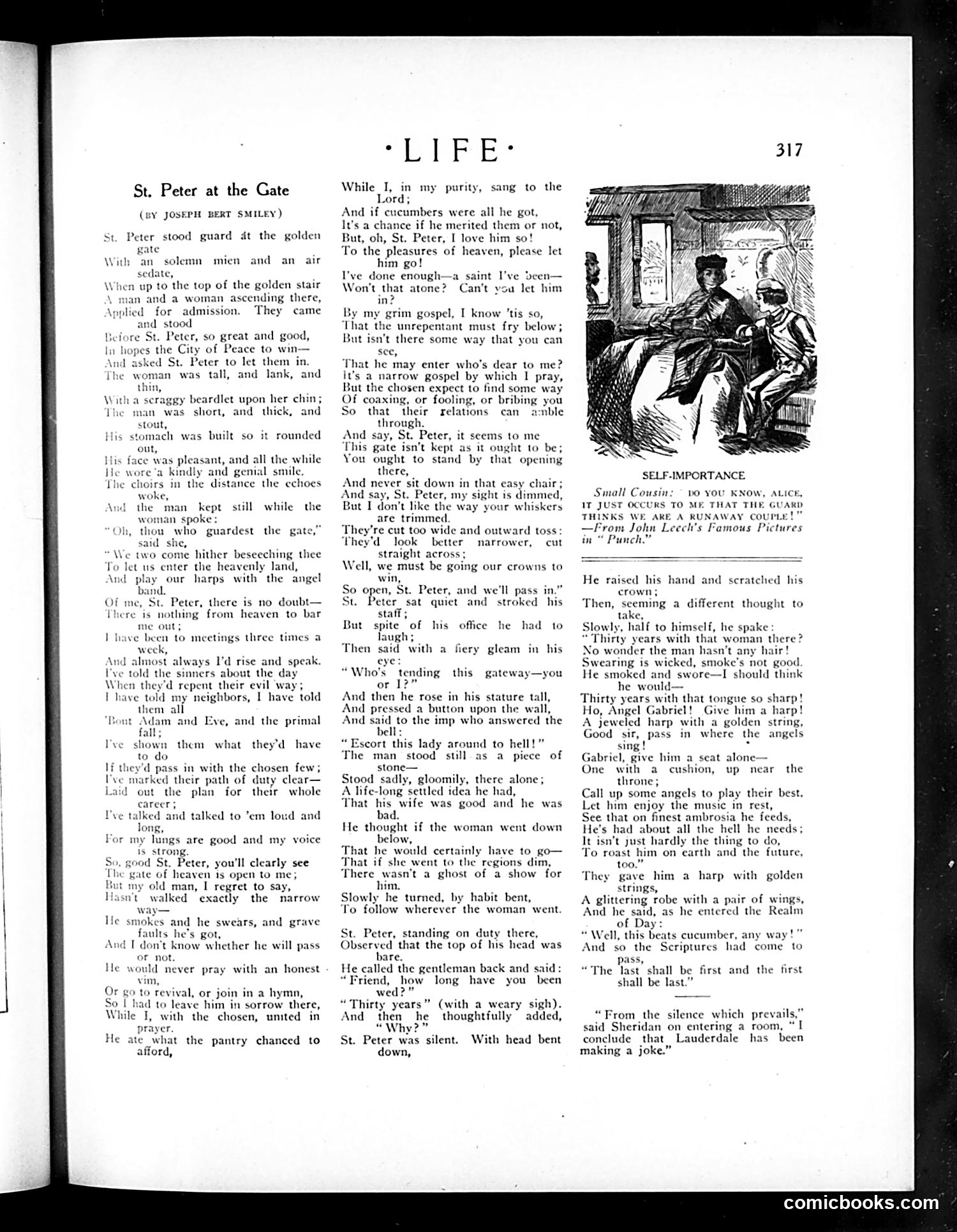
This illustrated poem satirizes **self-righteous religious hypocrisy**, particularly targeting women who loudly parade their piety while judging others harshly. The cartoon depicts a self-satisfied woman ascending to heaven's gate, boasting of her constant church attendance, public preaching, and moral instruction to neighbors. She demands entry while admitting her husband—a humble, quiet man—hasn't followed her strict religious path. She pleads for his admission anyway, expecting special favors. St. Peter's response is withering: he damns *her* to hell instead, recognizing her arrogance and manipulation. The husband, bound by lifelong habit of deferring to his wife's moral authority, numbly follows her downward. **The satire's target**: ostentatious piety, self-importance masquerading as godliness, and the assumption that loud public religiosity earns heavenly rewards. The poem mocks those who lecture others while expecting rule-bending for loved ones—exposing the gap between professed morality and actual character.
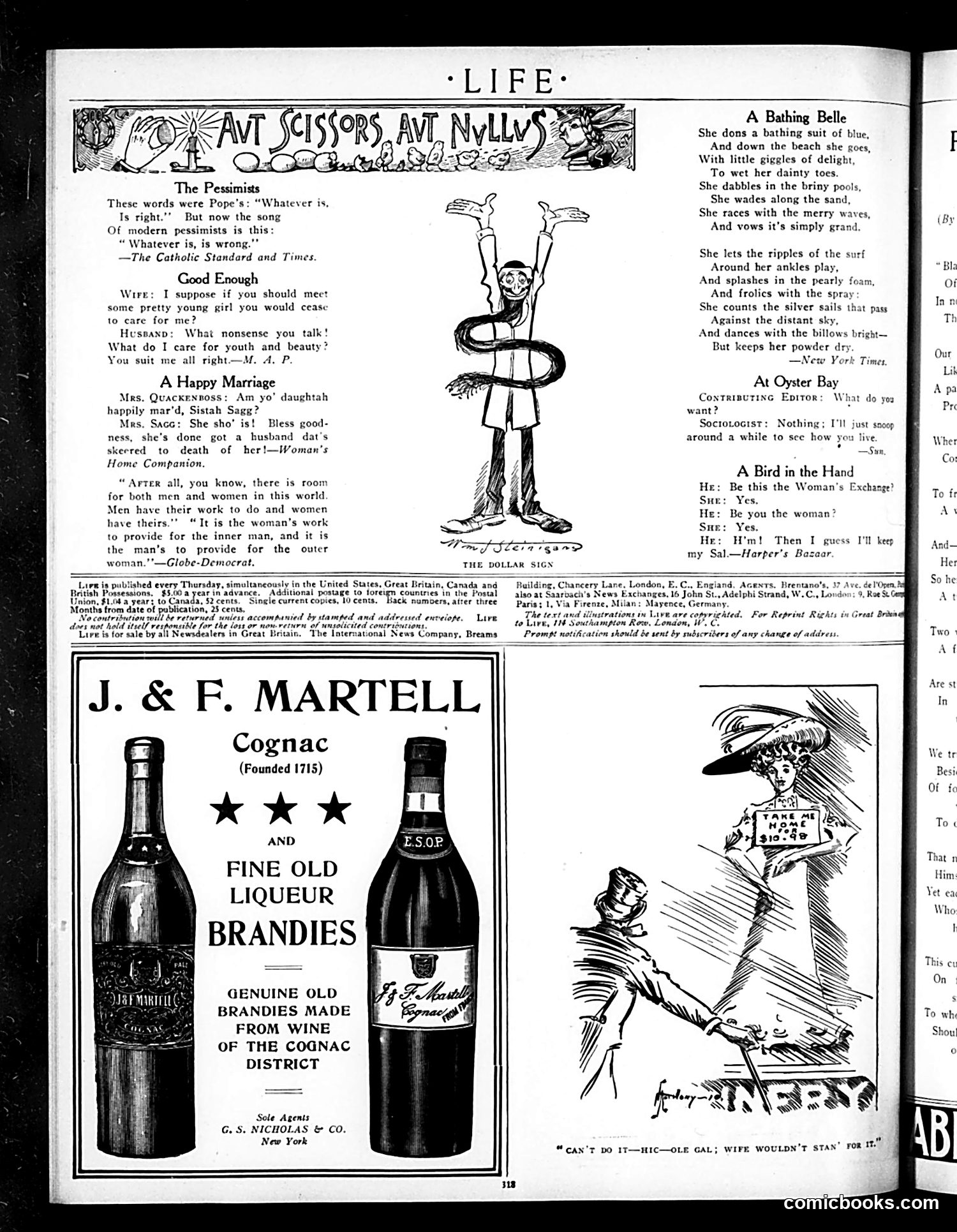
This page from *Life* magazine contains several satirical pieces typical of early 20th-century American humor: **"The Pessimists"** contrasts Pope's optimistic motto "Whatever is, is right" with modern pessimists' inversion: "Whatever is, is wrong"—mocking contemporary social complainers. **"A Happy Marriage"** jokes that a wife is happiest with a husband terrified of her, inverting romantic ideals about marital equality. **"A Bird in the Hand"** depicts a crude exchange where a man views women as commodities to be "kept," while the illustration of a woman and "dollar sign" figure suggests satire on transactional relationships. **"At Oyster Bay"** and **"A Bathing Belle"** are lighter pieces—one about sociological observation, the other a whimsical poem about a woman enjoying the beach. The page also contains a J. & F. Martell cognac advertisement, typical of period magazine revenue. Overall, the content satirizes modern pessimism, gender dynamics, and evolving social attitudes, reflecting *Life's* role as social commentary wrapped in humor.

This page is primarily **advertising**, not political satire or comics. The left column contains a **book review in verse** by Arthur Guiterman of "Blaze Derringer"—a pulp adventure novel about a Texas hero rescuing a señorita's father from a would-be emperor in a revolutionary Latin American setting. Guiterman mocks the formulaic plot and "torrid" style, but the review's actual joke concerns two trapped villains who can free each other but won't due to mutual hatred—a metaphor Guiterman suggests society should apply to reconcile bitter enemies. The right side features **period advertisements**: Winchester rifle ("It Hits Like the Hammer of Thor"), Raymond & Whitcomb travel tours, and Abbott's Bitters. A small **cartoon** appears bottom-right showing two birds, with one asking another about a "blond feather"—a mild sight gag unrelated to broader satire. The page reflects early 20th-century magazine advertising and light literary criticism rather than political commentary.
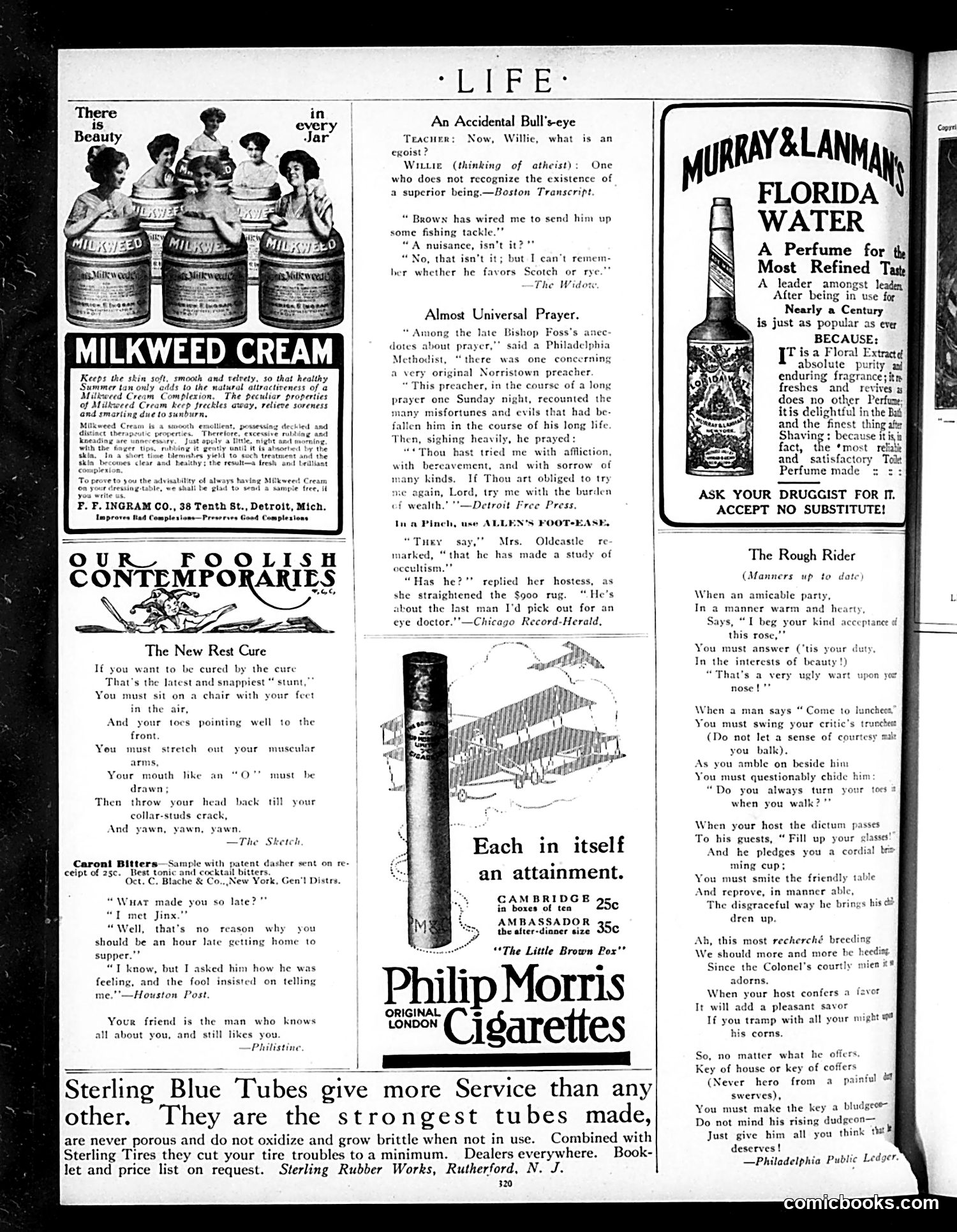
This page from *Life* magazine consists primarily of **advertisements and humorous short anecdotes** rather than political cartoons. The main content includes: **"An Accidental Bull's-eye"** — A schoolroom joke where a student, asked to define an "egoist," accidentally gives the correct answer while thinking of "atheist." **"Almost Universal Prayer"** — Anecdote about a bishop's prayer humorously cataloging life's sufferings, ending with resigned acceptance. **"The Rough Rider"** — Satirizes crude American manners, mocking overly blunt, tactless behavior (turning one's toes inward while walking, insulting hosts' appearances). The title appears to mock Theodore Roosevelt's populist image, suggesting rough informality is *not* actually sophisticated. **Advertisements** dominate: Milkweed Cream, Philip Morris Cigarettes, Murray & Lanman's Florida Water, Sterling Tubes/Tires. The humor is genteel and social rather than political—poking fun at pretension, awkward etiquette, and urban sophistication, typical of early 20th-century *Life* magazine's target audience.
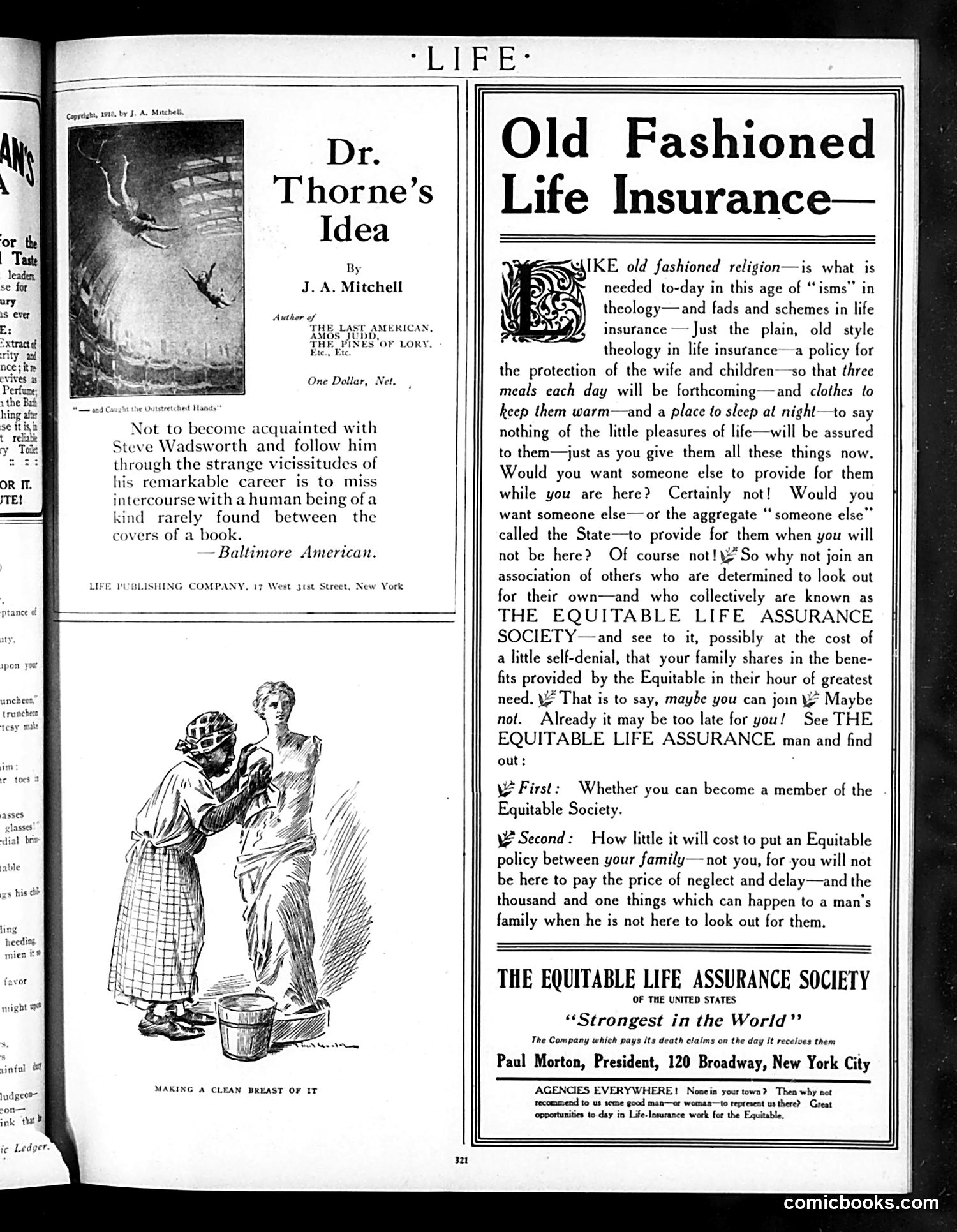
This page contains two distinct items: a book advertisement and a life insurance ad. **Left side:** Promotes J.A. Mitchell's novel "Dr. Thorne's Idea" (published by Life Publishing Company). The accompanying illustration labeled "Making a Clean Breast of It" shows a woman and man in conversation, likely depicting a scene from the book. The Baltimore American endorsement emphasizes the novel's protagonist, Steve Wadsworth, as a compelling character worth following. **Right side:** A full-page advertisement for Equitable Life Assurance Society positions life insurance as "old fashioned" morality—comparing it to traditional religion. The ad argues that responsible men should ensure their families' financial security (food, clothing, shelter) after their death through an insurance policy, rather than relying on the State or charity. It appeals to readers' sense of duty and self-reliance, inviting potential customers to contact an Equitable representative. Both items reflect early 20th-century American values emphasizing individual responsibility and family protection.
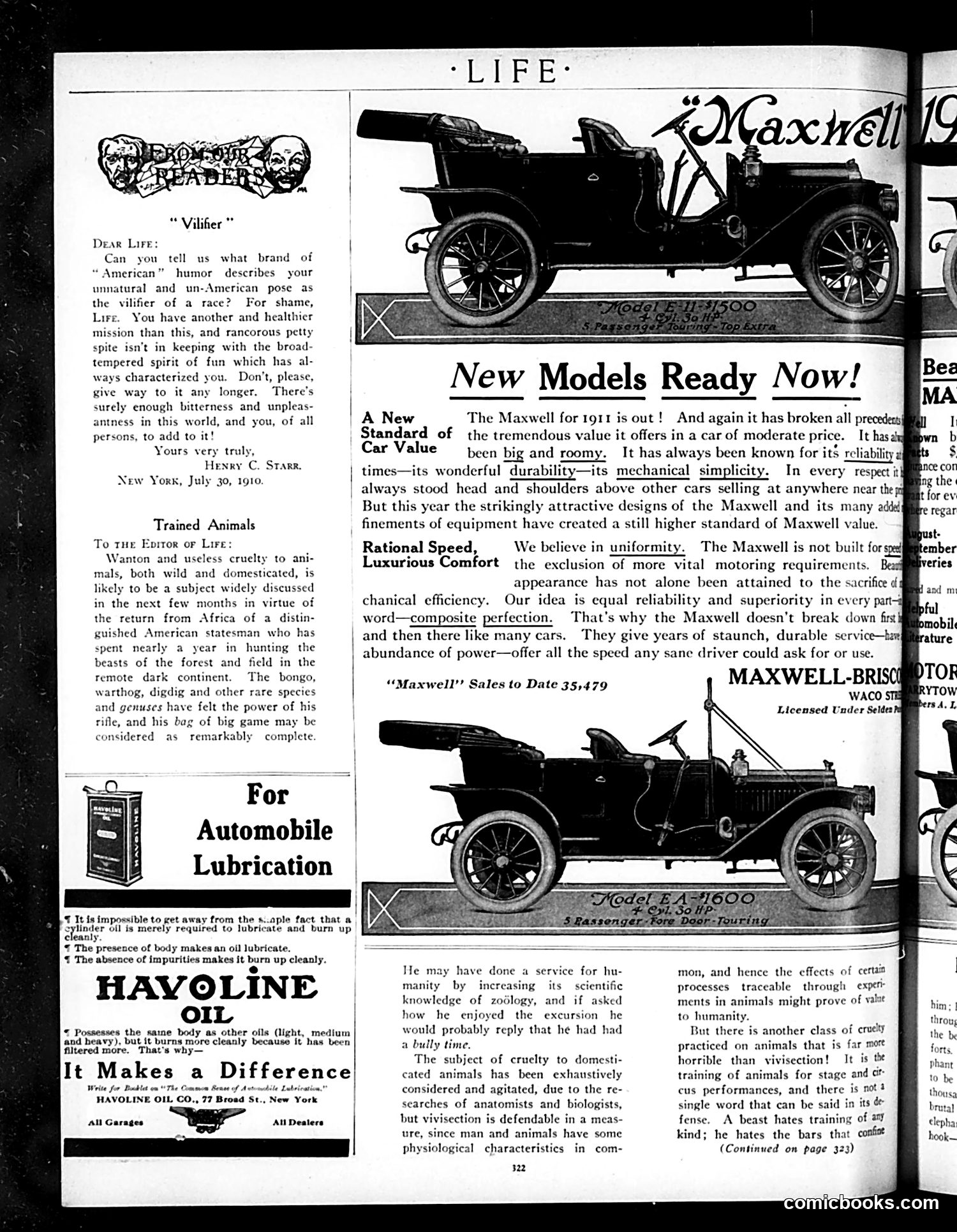
This page contains two reader letters criticizing *Life* magazine's editorial direction, plus automobile advertising. **"Vilifier" Letter**: A reader protests that *Life* has published content mocking or demeaning a racial group, calling it "unnatural and un-American." He argues this contradicts *Life*'s traditional mission of good-natured humor and asks the magazine to stop engaging in "rancorous petty spite." **"Trained Animals" Letter**: Another reader condemns animal cruelty, specifically referencing an unnamed "distinguished American statesman" recently returned from African big-game hunting. The writer argues that while vivisection for scientific research has some justification, training animals for circus and stage performance is indefensible cruelty that deserves criticism. The page reveals *Life* faced contemporary criticism for both racial mockery and insufficient animal-welfare advocacy—issues readers felt contradicted the magazine's stated values. The letters suggest *Life*'s satirical humor sometimes crossed ethical lines its audience found troubling.
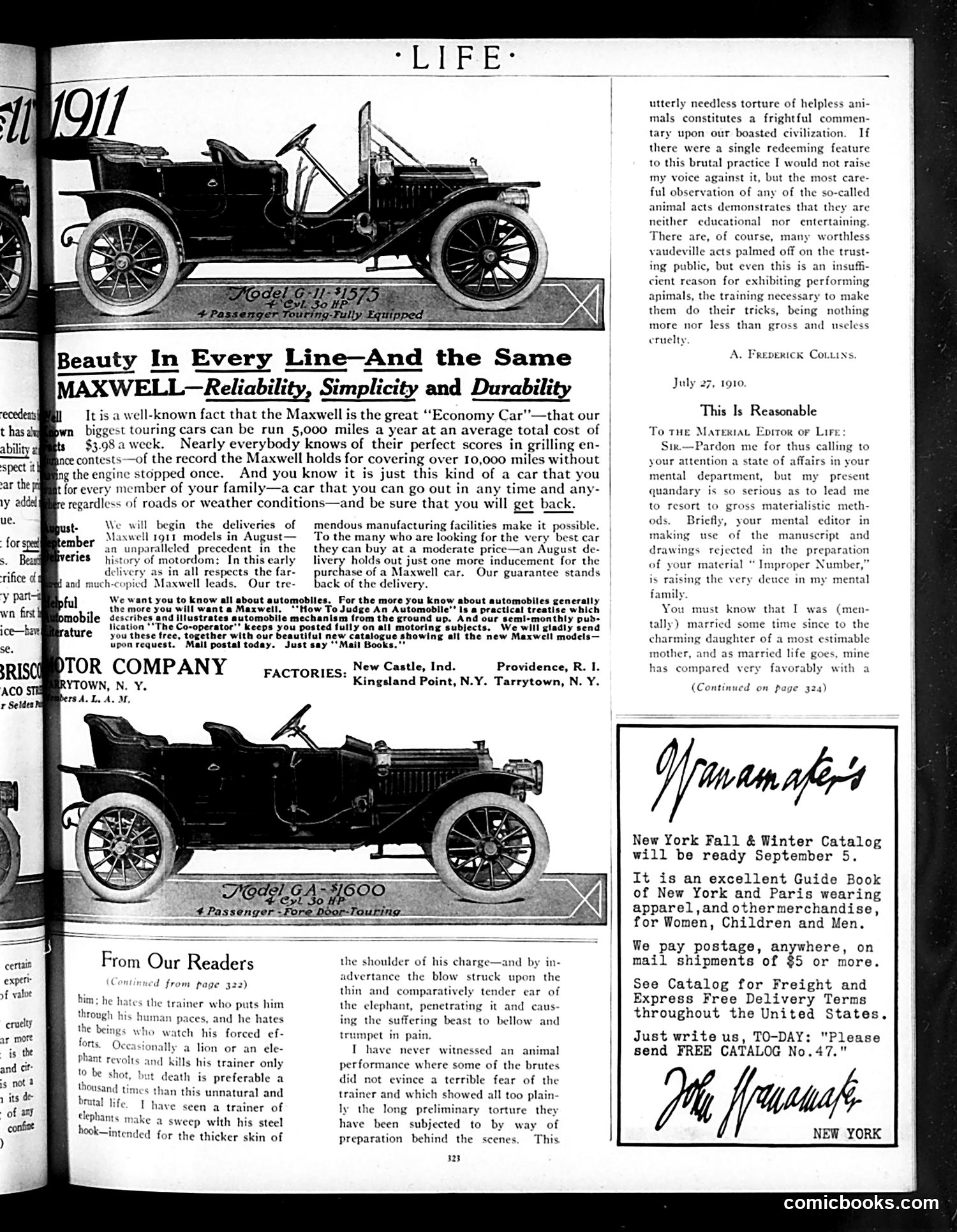
This page is primarily a **Maxwell automobile advertisement** (1911 model), not a political cartoon. The top half features two car illustrations promoting the Maxwell as an affordable, reliable "Economy Car" with claims of exceptional durability and low operating costs ($3.98 weekly). The bottom half contains **reader letters** addressing unrelated social issues: one lengthy complaint from A. Frederick Collins denouncing the "utterly needless torture" of performing animals in vaudeville acts, arguing their training involves cruelty with no educational or entertainment value. A second letter begins addressing an unnamed concern in the magazine's "mental department." There is also a **Wanamaker's department store advertisement** for their Fall & Winter catalog. No political satire or caricature appears on this page—it's a mix of commercial advertising and reader correspondence.
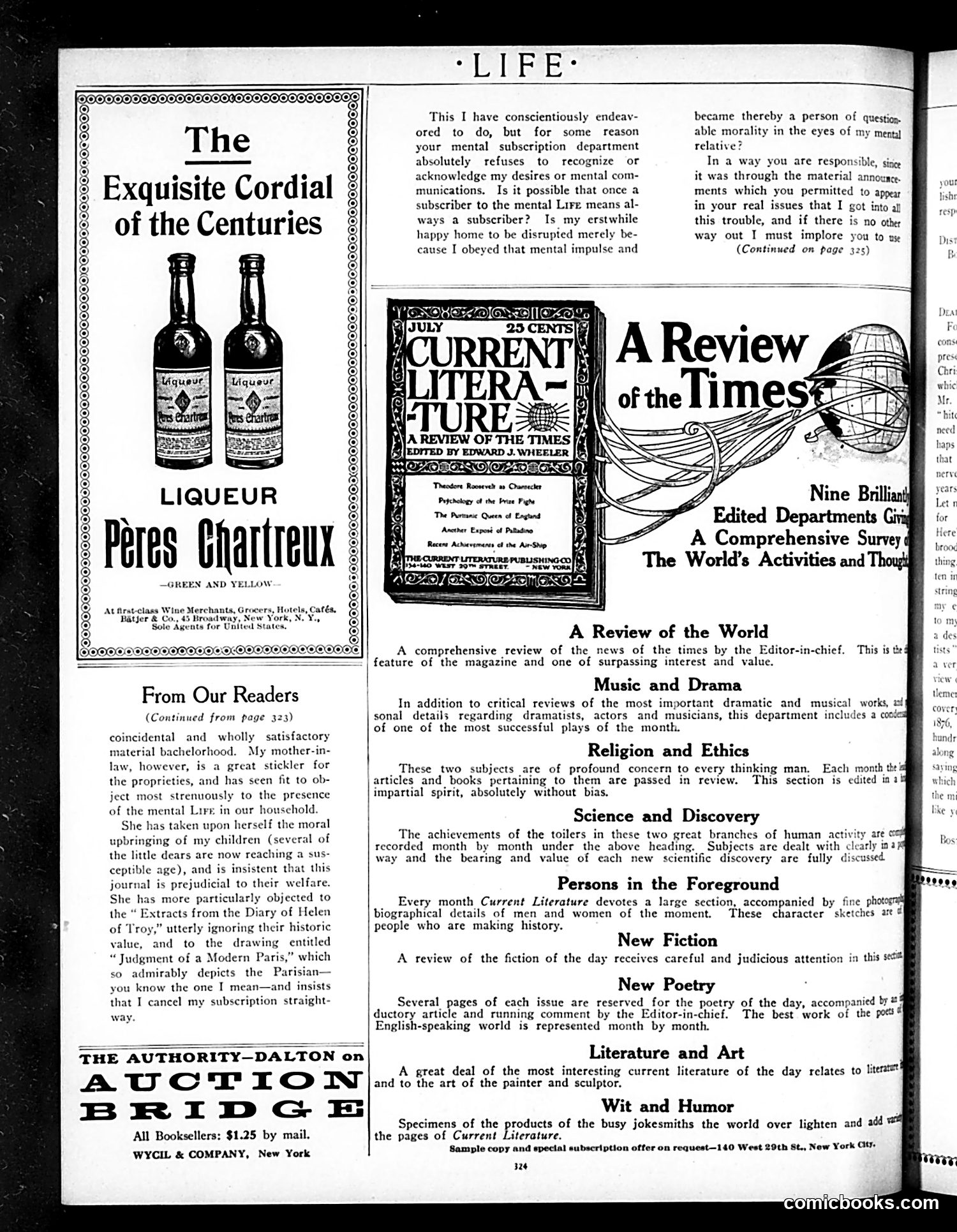
This page contains **no political cartoons**—it's primarily advertising and magazine promotion material from an early 20th-century issue. The main content includes: **Advertisement** (left): Liqueur Pères Chartreux, a French cordial marketed as historically prestigious. **"From Our Readers"** (left): A humorous letter from a subscriber whose mother-in-law objects to *Life* magazine in the household, viewing it as morally questionable. The writer claims the magazine caused marital trouble and demands compensation—satirizing both prudish censorship and readers' absurd complaints to publishers. **"Current Literature" magazine promotion** (center/right): Advertisements for a competing publication highlighting its various sections: reviews of drama, music, science, religion, ethics, and current events. The satire here targets Victorian-era moral guardianship and the clash between progressive magazines and conservative family values—a common *Life* theme.
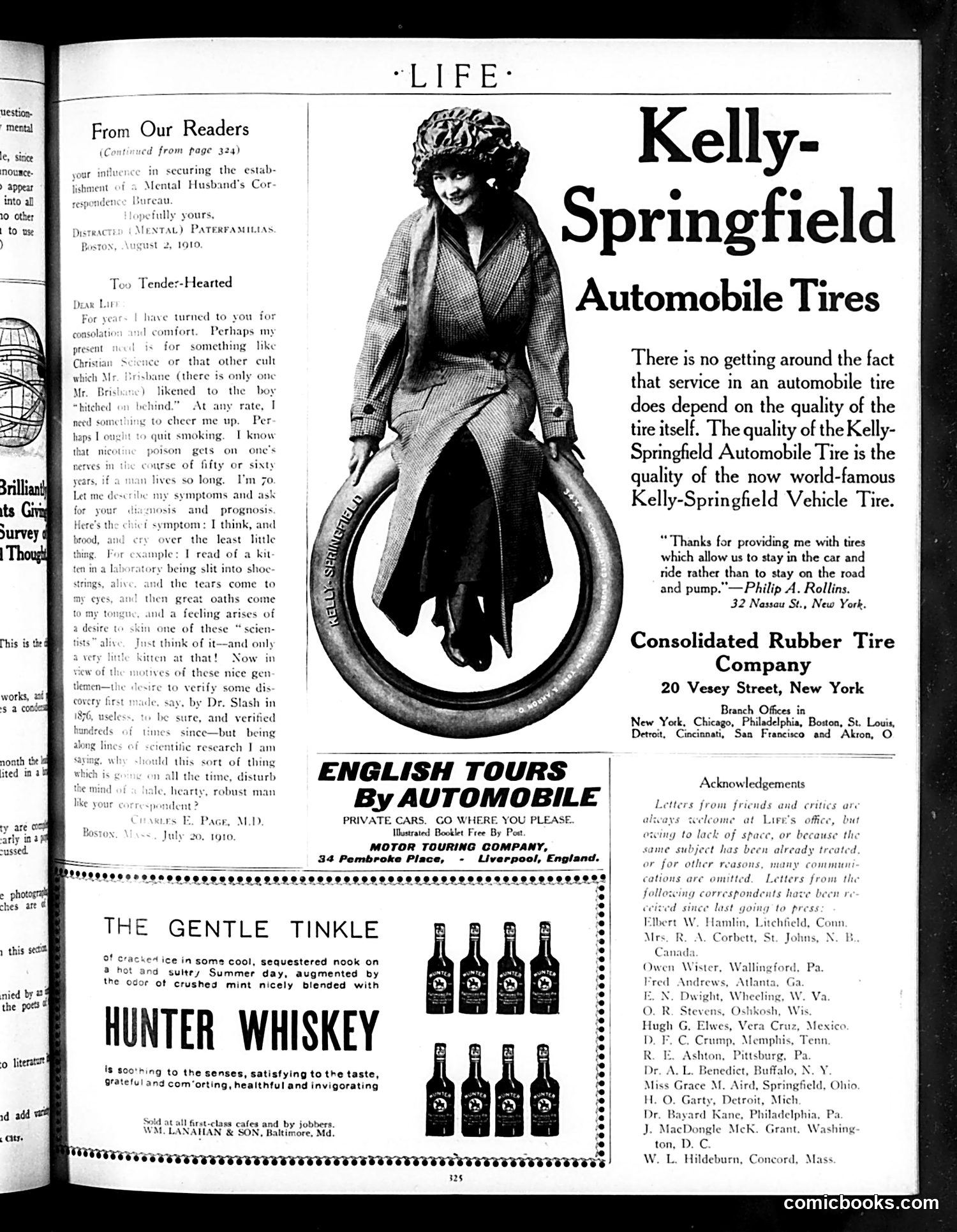
This page contains **no political cartoons or satirical artwork**—it is primarily a letters column ("From Our Readers") and **period advertisements**. The visible content includes: - **Reader letters** addressing personal health concerns (mental fatigue, nervousness) and seeking advice - **Three advertisements**: Kelly-Springfield Automobile Tires (featuring a woman in fashionable dress posed with a tire), Hunter Whiskey ("soothing to the senses"), and Motor Touring Company for English automobile tours - An **acknowledgments section** listing names of people whose letters were received The only illustration is the commercial advertisement photo of a well-dressed woman, which uses glamorous imagery typical of early 1900s marketing to sell automobile tires—appealing to the growing automobile consumer market of that era. This is a standard magazine page mixing reader correspondence with paid advertising, not satirical content.
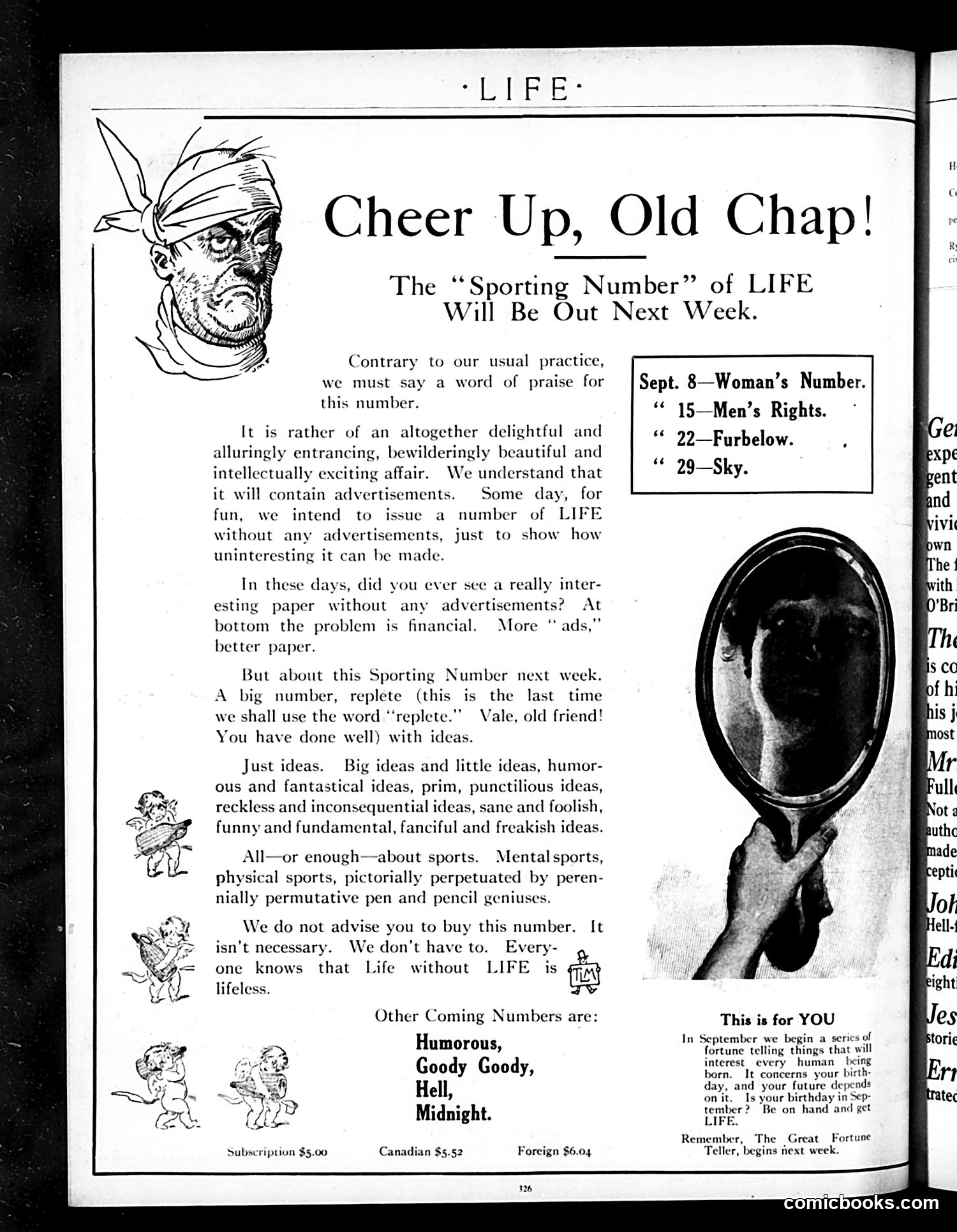
This is a promotional page for *Life* magazine's upcoming "Sporting Number." The illustrated head on the left appears to be a generic "old chap" or gentleman figure—likely representing the typical *Life* reader—used as a playful mascot. The satire targets the magazine industry's dependence on advertising. *Life* self-mockingly notes that producing a paper *without* advertisements would be "uninteresting," implying that ads subsidize quality. This was a genuine editorial debate of the era. The page also advertises upcoming special issues ("Woman's Number," "Men's Rights," etc.), using deliberately whimsical titles like "Furbelow" and "Sky" to suggest the magazine's satirical, lighthearted approach. The small cartoon figures at the bottom are decorative doodles typical of *Life*'s cartooning style. This is essentially advertising copy disguised as editorial commentary—meta-humor about the magazine's own reliance on advertisements.
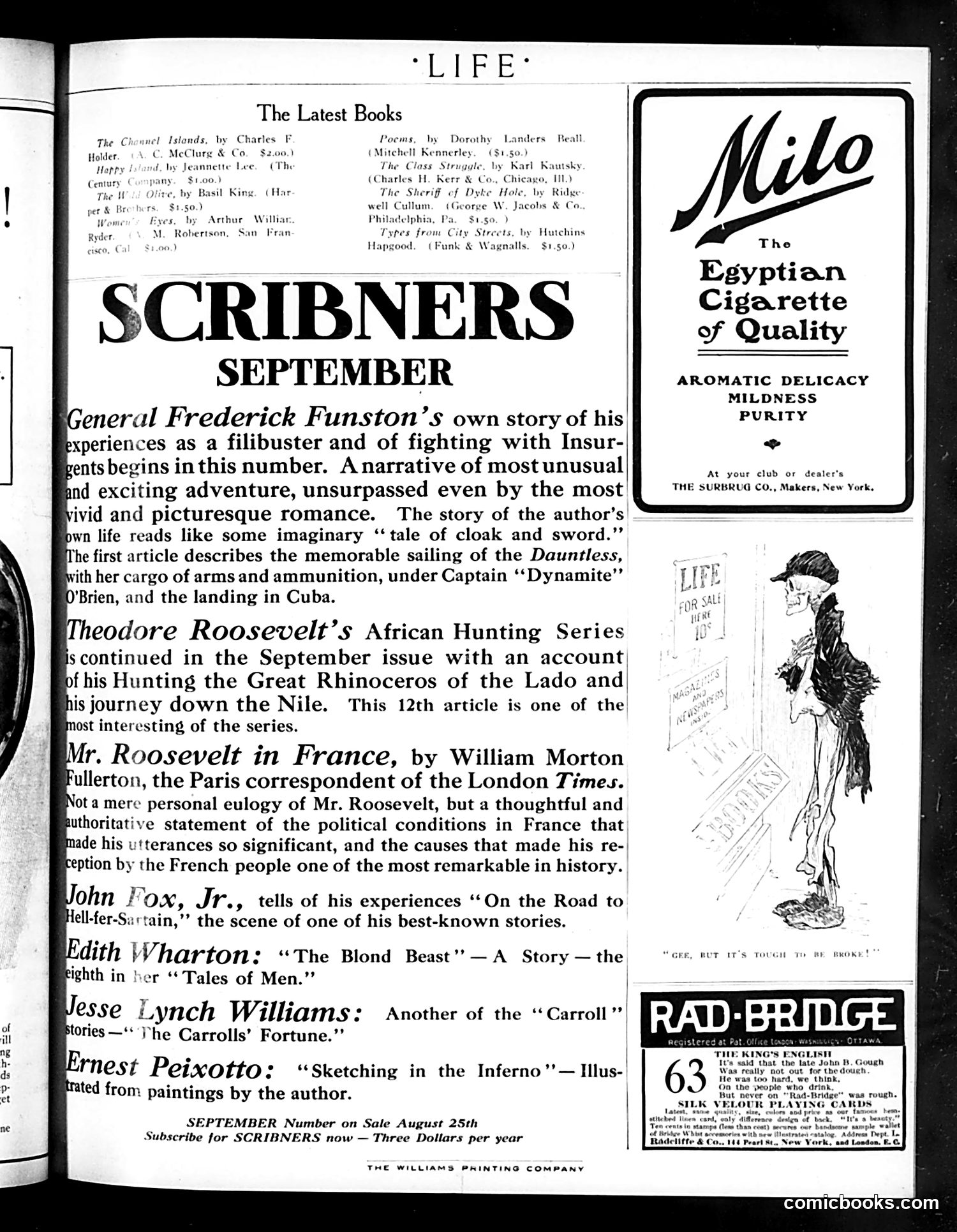
This is primarily a **table of contents and advertising page** for Scribner's Magazine's September issue, not a political cartoon page. The main content lists forthcoming articles by prominent early-1900s figures: General Frederick Funston (on filibustering and Cuba), Theodore Roosevelt (African hunting adventures), and William Morton Fullerton (on Roosevelt's visit to France). Literary contributions include work by Edith Wharton and Ernest Peixotto. The only illustration is a small **sketch of a man in formal dress** on the right side, captioned "GEE, BUT IT'S TOUGH TO BE BROKE!" This appears to be generic satirical commentary on financial hardship rather than targeting a specific person or event. The right margin contains advertisements for **Milo Egyptian Cigarettes** and **Rad-Bridge playing cards**—typical period product placement. This page functions as promotional material rather than political satire.
This page is a **flour advertisement**, not political satire. It's a repetitive promotional layout for "Gold Medal Flour" by the Washburn-Crosby Company (later General Mills). The design displays dozens of circular Gold Medal Flour medal badges arranged across a black background, interspersed with text promoting the flour's uses: "for good bread," "for pies," "for biscuits," "for rolls," "for buns," "for cake," and "for grocers." The tagline at bottom—"The Foundation of Successful Baking"—is a straightforward marketing claim. This appears in *Life* magazine, which carried both satirical content and paid advertisements. There is no cartoon, caricature, or political message here; it's purely commercial advertising designed to achieve brand recognition through visual repetition and varied product applications.