
Life, 1910-08-25 · page 27 of 40
Life — August 25, 1910 — page 27: what you’re looking at
What you’re looking at
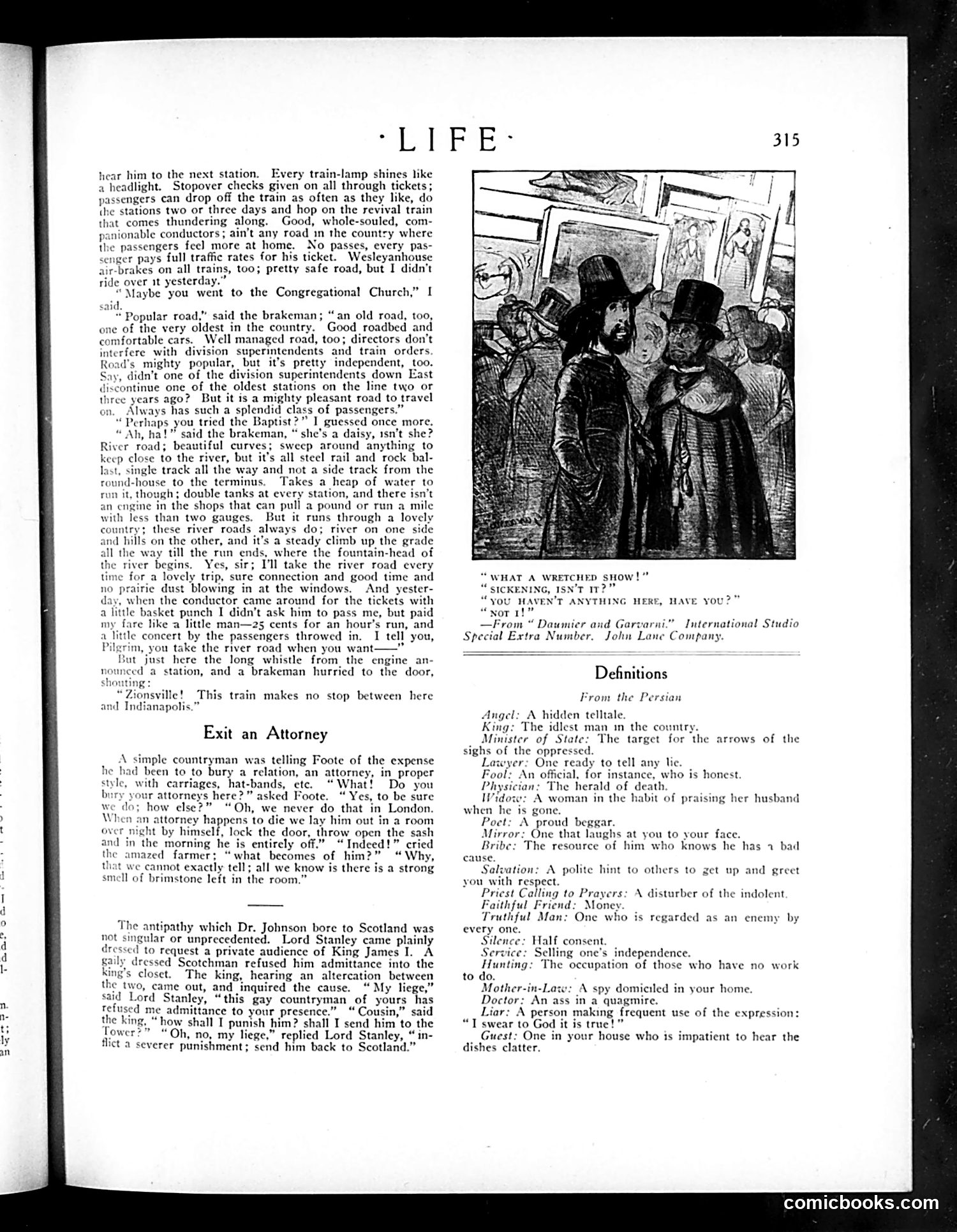
This page contains three distinct pieces of satirical content: **1. The Train Conversation (main narrative):** A brakeman uses railroad lines as metaphors for American Protestant denominations—Methodist, Congregational, and Baptist churches. Each "road" reflects the sect's character: Methodists are well-managed and inclusive; Congregationalists are independent and selective; Baptists are emotionally intense ("river roads") but resource-intensive. This is religious satire through extended metaphor, poking fun at denominational stereotypes. **2. "Exit an Attorney":** A dark joke contrasting English and country practices for burying attorneys. The English attorney supposedly vanishes overnight, leaving only "brimstone" smell—implying attorneys are demonic or hellish. Standard period satire mocking the legal profession as dishonest. **3. Historical anecdotes:** Brief stories about Dr. Johnson's Scottish prejudice and King James I, illustrating stubbornness and class pretension—filler content typical of Life's format. The cartoon illustration (captioned "What a wretched show!") accompanies the train narrative, though specific details are unclear from the image quality.
📄 Transcribed text from this page (OCR, searchable)
Machine-transcribed from the original scan — historical spelling and the odd misread are preserved.
an "iT P'E* 315 hear him to the next station. Every train-lamp shines like headlight. Stopover checks given on all through tickets; passengers can drop off the train as often as they like, do the stations two or three days and hop on the revival train that comes thundering along. Good, whole-souled, com- panionable conductors ; ain’t any road in the country where the passengers feel more at home. No passes, every pas- senger pays full traffic rates for his ticket. Wesleyanhouse air-brakes on all trains, too; pretty safe road, but I didn’t ride over it yesterday.” ; “Maybe you went to the Congregational Church,” I said. “Popular road,” said the brakeman; “an old road, too, one of the very oldest in the country. Good roadbed and comfortable cars. Well managed road, too; directors don’t in re with division superintendents and train orders. Road's mighty popular, but it’s pretty independent, too. Say, didn’t one of the division superintendents down East discontinue one_of the, oldest stations on the line two or three years ago? But it is a mighty pleasant road to travel Always has such a splendid class of passengers.” “Perhaps you tried the Baptist?” I guessed once more. “ Ah, ha!” said the brakeman, * ‘sa dai isn’t she? River road; beautiful curves; sweep around anything to keep close to the river, but it’s all steel rail and rock bal- last, single track all the way and not a side track from the round-house to the terminus. Takes a heap of water to ron it, though; double tanks at every station, and there isn’t an cngine in the shops that can pull a pound or run a mile with less than two gauges. But it runs through a lovely country; these river roads always do; river on one side and hills on the other, and it’s a steady climb up the grade all the way till the run ends, where the fountain-head of the river begins. Yes, sir; I'll take the river road every time for a lovely trip, sure connection and good time and no prairie dust blowing in at the windows. And _yester- when the conductor came around for the tickets with a little basket punch I didn’t ask him to pass me, but paid fare like a little man—25 cents for an hour's run, and tle concert by the passengers throwed in. I tell you, nm, you take the river road when you want——” But just here the long whistle from. the engine an- station, and a brakeman hurried to the door, This train makes no stop between here napolis.” Exit an Attorney \ simple countryman was telling Foote of the expense he had been to to bury a relation, an attorney, in proper style, with carriages, hat-bands, ete. “What! Do you bury you ked Foote. “ Yes, to be sure we do; how else?” “Oh, we never do that in London. When an attorney happens to die we lay him out in a room r night by himself, lock the door, throw open the sash and in the morning he is entirely off.” “Indeed!” cried the amazed farmer; “what becomes of him?” “Why, that we cannot exactly tell; all we w is there is a strong smell of brimstone left in the room ¢ antipathy which Dr. Johnson bore to Scotland was not singular or unprecedented. Lord Stanley came plainly dressed to request a private audience of King James I. A dressed Scotchman refused him admittance into the The king, hearing an altercation between > two, came out, and inquired the cause. “ My liege,” id Lord Stanley, “this gay countryman of yours has refused me admittance to your presence.” “Cousin,” said the king, “how shall I punish him? shall I send him’to the Tower?” “Oh, no, my liege,” replied Lord Stanley, “ in- flict a severer punishment; send him back to Scotland.” show!” “ SICKENING, ISN'T 17?” “YoU HAVEN'T ANYTHING HERE, HAVE you?” “wor i!” rom “Daumier and Garvarni.” International Studio ‘al Extra Number. John Lane Company. Definitions From the Persian A hidden telltale. The idlest man in the country. Minister of State: The target for the arrows of the sighs of the oppressed. ‘yer: One ready to tell any lic. Fool: An official, for instance, who is honest. Physician: The herald of death. Wide A woman in the habit of praising her husband when he is gone. Poet: A proud beggar. Mirror: One that laughs at you to your face. Bribe: The resource of him who knows he has 1 bad cause. Salvation: A polite hint to others to get up and greet you with respect. Priest Calling to Prayers: A disturber of the indolent Faithful Friend: Money Truthful Man: One who is regarded as an enemy by every one. Half consent. Service: Selling one’s independence. Hunting: The occupation of those who have no work to do. Mother-in-Law Doctor: An ass in a quagmire. Liar: A person making frequent use of the expression: “T swear to God it is true!” Guest: One in your house who is impatient to hear the dishes clatter. A spy domiciled in your home. comicbooks.com