
Life, 1910-08-25 · page 8 of 40
Life — August 25, 1910 — page 8: what you’re looking at
What you’re looking at
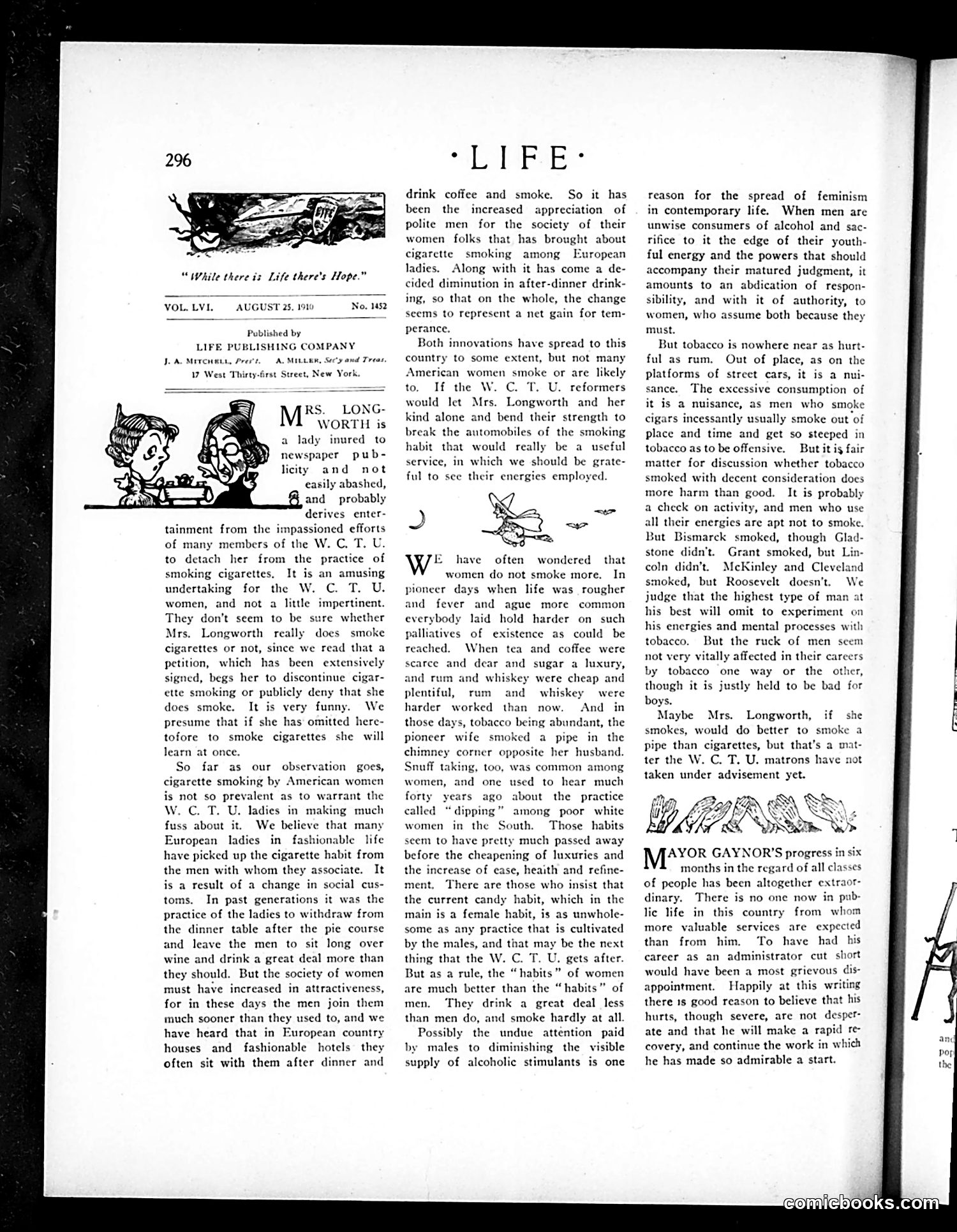
This page from *Life* magazine (August 21, 1910) satirizes women's smoking and the W.C.T.U. (Women's Christian Temperance Union). The cartoon at top left shows two caricatured female faces labeled "While there is Life there's Hope"—likely mocking women who've taken up cigarette smoking. The article argues that American women are increasingly smoking, contrary to W.C.T.U. efforts. The author suggests that if women must smoke, they should do so "decently" rather than publicly on streets. He notes historical precedent (women once smoked pipes) while framing modern female smoking as unseemly and attention-seeking. The satire criticizes both the hypocrisy of social reformers and the perceived impropriety of women's emerging independence in consuming tobacco.
📄 Transcribed text from this page (OCR, searchable)
Machine-transcribed from the original scan — historical spelling and the odd misread are preserved.
VOL. LVI. AUGU! Published by LIFE PUBLISHING COMPANY JA MITOHMLL, Prose, AL MILLER, Sec’y and Treas, 1 West Thirty-first Street, New York. RS. LONG- WORTH is a lady inured to newspaper pub- licity and not easily abashed, @ and probably derives enter- tainment from the impassioned efforts of many members of the W. C. T. U. to detach her from the practice of smoking cigarettes, It is an amusing undertaking for the W. C. T. U. women, and not a little impertinent. They don’t seem to be sure whether Mrs. Longworth really docs smoke cigarettes or not, since we read that a petition, which has been extensively signed, begs her to discontinue cigar- ette smoking or publicly deny that she does smoke. It is very funny. We presume that if she has omitted here- tofore to smoke cigarettes she will learn at once. So far as our observation goes, cigarette smoking by American women is not so prevalent as to warrant the W. C. T. U. Iadies in making much fuss about it. We believe that many European ladies in fashionable life have picked up the cigarette habit from the men with whom they associate. It is a result of a change in social cus- toms. In past generations it was the practice of the ladies to withdraw from the dinner table after the pie course and leave the men to sit long over wine and drink a great deal more than they should. But the society of women must have increased in attractiveness, for in these days the men join them much sooner than they used to, and we have heard that in European country houses and fashionable hotels they often sit with them after dinner and iE IESE drink coffee and smoke. So it has been the increased appreciation of polite men for the society of their women folks that has brought about cigarette smoking among ropean ladies. Along with it has come a de- cided diminution in after-dinner drink- ing, so that on the whole, the change seems to represent a net gain for tem- perance. Both innovations have spread to this country to some extent, but not many American women smoke or are likely to. If the W. C. T. U. reformers would Iet Mrs. Longworth and her kind alone and bend their strength to break the automobiles of the smoking habit that would really be a useful service, in which we should be grate- ful to see their energies employed. Wt have often wondered that women do not smoke more, In pioneer days when life was rougher and fever and ague more common everybody laid hold harder on such palliatives of existence as could be reached. When tea scarce and dear and sugar a luxury, and rum and whiskey were cheap and plentiful, rum and whiskey were harder worked than now. And in those days, tobacco being abundant, the pioneer wife smoked a pipe in the chimney corner opposite her husband. Snuff taking, too, was common among women, and one used to hear much y s ago about the practice called “dipping” among poor white women in the South. Those habits seem to have pretty much passed away before the cheapening of luxuries and the increase of ease, heaith and refine- ment, There are those who insist that the current candy habit, which in the main is a female habit, is as unwhole- some as any practice that is cultivated by the males, and that may be the next thing that the W. C. T. U. gets after. But as a rule, the “habits” of women are much better than the “habits” of men. They drink a great deal less than men do, and smoke hardly at all. Possibly the undue attention paid by males to diminishing the visible supply of alcoholic stimulants is one and coffee were reason for the spread of feminism in contemporary life. When men are unwise consumers of alcohol and sac- rifice to it the edge of their youth- ful energy and the powers that should accompany their matured judgment, it amounts to an abdication of respon- sibility, and with it of authority, to women, who assume both because they must. But tobacco is nowhere near as hurt- ful as rum. Out of place, as on the platforms of street cars, it is a nui- sance. The excessive consumption of it is a nuisance, as men who smoke cigars incessantly usually smoke out ‘of place and time and get so steeped in tobacco as to be offensive. But it ig fair matter for discussion whether tobacco smoked with decent consideration does more harm than good. It is probably a check on activity, and men who use all their energies are apt not to smoke. But Bismarck smoked, though Glad- stone didn’t. Grant smoked, but Lin- coln didn’t. McKinley and Cleveland smoked, but Roosevelt doesn't. We judge that the highest type of man at his best will omit to experiment on his energies and mental processes with tobacco. But the ruck of men seem not very vitally affected in their careers by tobacco one way or the other, though it is justly held to be bad for boys. Maybe Mrs. Longworth, if she smokes, would do better to smoke a pipe than cigarettes, but that’s a mat- ter the W. C. T, U. matrons ha taken under advisement yet. AYOR GAYNOR'S progress in six months in the regard of all cla of people has been altogether extra dinary. There is no one now in lic life in this country from whom more valuable services are expected than from him. To have had his career as an administrator cut short would have been a most grievous dis- appointment. Happily at this writing there 1s good reason to believe that his hurts, though severe, are not desper- ate and that he will make a rapid re- covery, and continue the work in which he has made so admirable a start.