
Life, 1910-08-25 · page 28 of 40
Life — August 25, 1910 — page 28: what you’re looking at
What you’re looking at
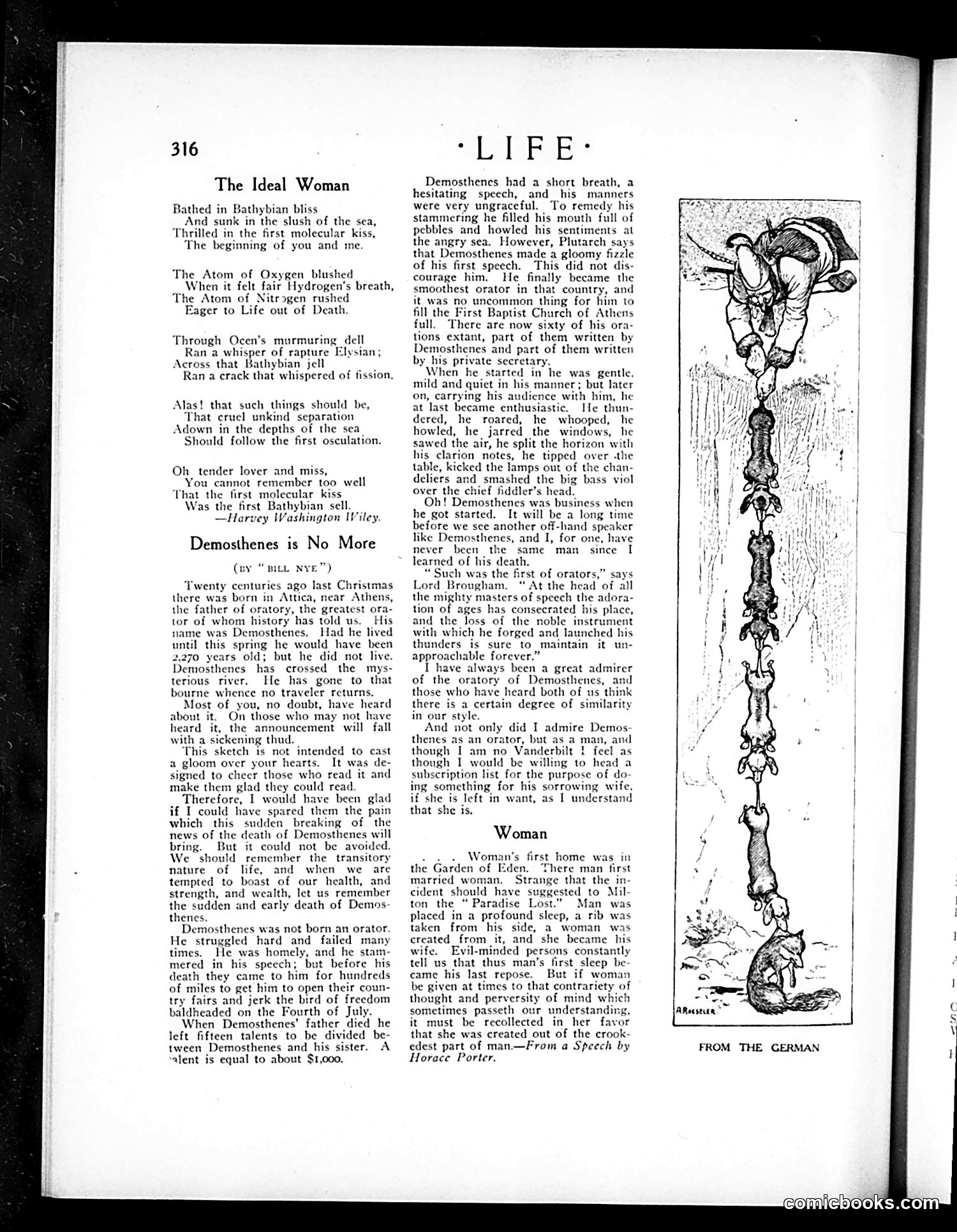
This page contains two distinct pieces: **"The Ideal Woman"** is a humorous poem by Harvey Washington Wiley (a real food safety chemist) that satirizes scientific materialism by reducing human romance to molecular chemistry—atoms of oxygen and hydrogen "kissing" in primordial seas. It mocks the tendency to explain everything through science. **"Demosthenes is No More"** is a comic essay by Bill Nye (a popular humorist of the era) offering a tongue-in-cheek "obituary" of the ancient Greek orator Demosthenes, who died centuries ago. Nye uses absurdist humor, treating ancient history as current news and exaggerating Demosthenes' speaking style (overturning tables, smashing violins). The joke is the mock-serious tone applied to irrelevant historical "gossip"—it's playful deflation of classical reverence. The German illustration on the right appears unrelated to the text, likely a decorative element from another article.
📄 Transcribed text from this page (OCR, searchable)
Machine-transcribed from the original scan — historical spelling and the odd misread are preserved.
316 The Ideal Woman Bathed in Bathybian bliss And sunk in the slush of the sea, Thrilled in the first molecular kiss, The beginning of you and me. The Atom of Oxygen blushed When it felt fair Hydrogen’s breath, The Atom of Nitrogen rushed Eager to Life out of Death. Through Ocen’s murmuring dell Ran a whisper of rapture Elysi Across that Bathybian jell Ran a crack that whispered of fission. Alas! that such things should be, That cruel unkind separation Adown in the depths of the sea Should follow the first osculation. Oh_ tender lover and miss, You cannot remember too well That the first molecular kiss Was the first Bathybian sell. —Harvey Washington Wiley. Demosthenes is No More (ny “BILL NYE”) ‘Twenty centuries ago last Christmas there was born in Attica, near Athens the father of oratory, the greatest ora- tor of whom history has told us. His name was Demosthenes. Had he live: until this spring he would have been 70 years old; but he did not liv Demosthenes has crossed the my terious river. He has gone to t bourne whence no traveler returns, Most of you, no doubt, have heard about it, On those who may not heard it, the announcement will fall with a sickening thud. This sketch is not intended to cast a gloom over your hearts. It was de- signed to cheer those who read it and make them glad they could read. Therefore, I would have been glad if I could have spared them the pain which this sudden breaking of the news of the death of Demosthenes will bring. But it could not be avoided. We should remember the transitory nature of life, and when we are tempted to boast of our health, and strength, and wealth, let us remember the sudden and early death of Demos thenes. Demosthenes was not born an orator, He struggled hard and failed many times. He was homely, and he stam- mered in his speech; but before his death they came to him for hundreds of miles to get him to open their coun- try fairs and jerk the bird of freedom baldheaded on the Fourth of July. When Demosthenes’ father died he left fifteen talents to be divided be- tween Demosthenes and his sister. A alent is equal to about $1,000. “EERE Demosthenes had a short breath, a hesitating speech, and his manners were very ungraceful. To remedy his stammering he filled his mouth full of pebbles and howled his sentiments at the angry sea. However, Plutarch s: that Demosthenes made a gloomy fizzle of his first speech. This did not dis- courage him. He finally became the smoothest orator in that country, and it was no uncommon thing for him to fill the First Baptist Church of Athens full. There are now sixty of his ora- tions extant, part of them written by Demosthenes and part of them written by his private secretary. When he started in he was gentle, mild and quict in his manner; but later on, carrying his audience with him, he at last became enthusiastic. He thun- dered, he roared, he whooped, he howled, he jarred the windows, he sawed the air, he split the horizon with his clarion notes, he tipped over -the table, kicked the lamps out of the chan- deliers and smashed the big bass viol over the chief fiddler’s head. Oh! Demosthenes was business when he got started. It will be a long time before we sce another off-hand speaker like Demosthenes, and I, for one, have never been the same man since I learned of his death, “Such was the first of orators,” says Lord Brougham. “ At the head of all the mighty masters of speech the adora- tion of ages has consecrated his place, and the loss of the noble instrument with which he forged and launched his thunders is sure to maintain it un- approachable forever.” I have always been a great admirer of the oratory of Demosth and those who have heard both of us think there is a certain degree of similarity in our style. And not only did I admire Demos- thenes as an orator, but as a man, and though I am no Vanderbilt [ feel as though I would be willing to head a subscription list for the purpose of do ing something for his sorrowing wife, if she is left in want, as I understand that she is. Woman «= . +. Woman's first home was in the Garden of Eden. There man first married woman. Strange that the in- cident should have suggested to Mil ton the “ Paradise Lost.” Man was placed in a profound sleep, a rib was taken from his side, a woman was created from it, and she became his wife, Evil-minded persons constantly tell us that thus man’s first sleep be came his last repose. But if wom: be given at times to that contrariety of thought and perversity of mind which sometimes passeth our understanding, it must be recollected in her favor that she was created out of the crook- edest part of man.—From a Speech by Horace Porter. FROM THE GERMAN