
Life, 1910-08-25 · page 26 of 40
Life — August 25, 1910 — page 26: what you’re looking at
What you’re looking at
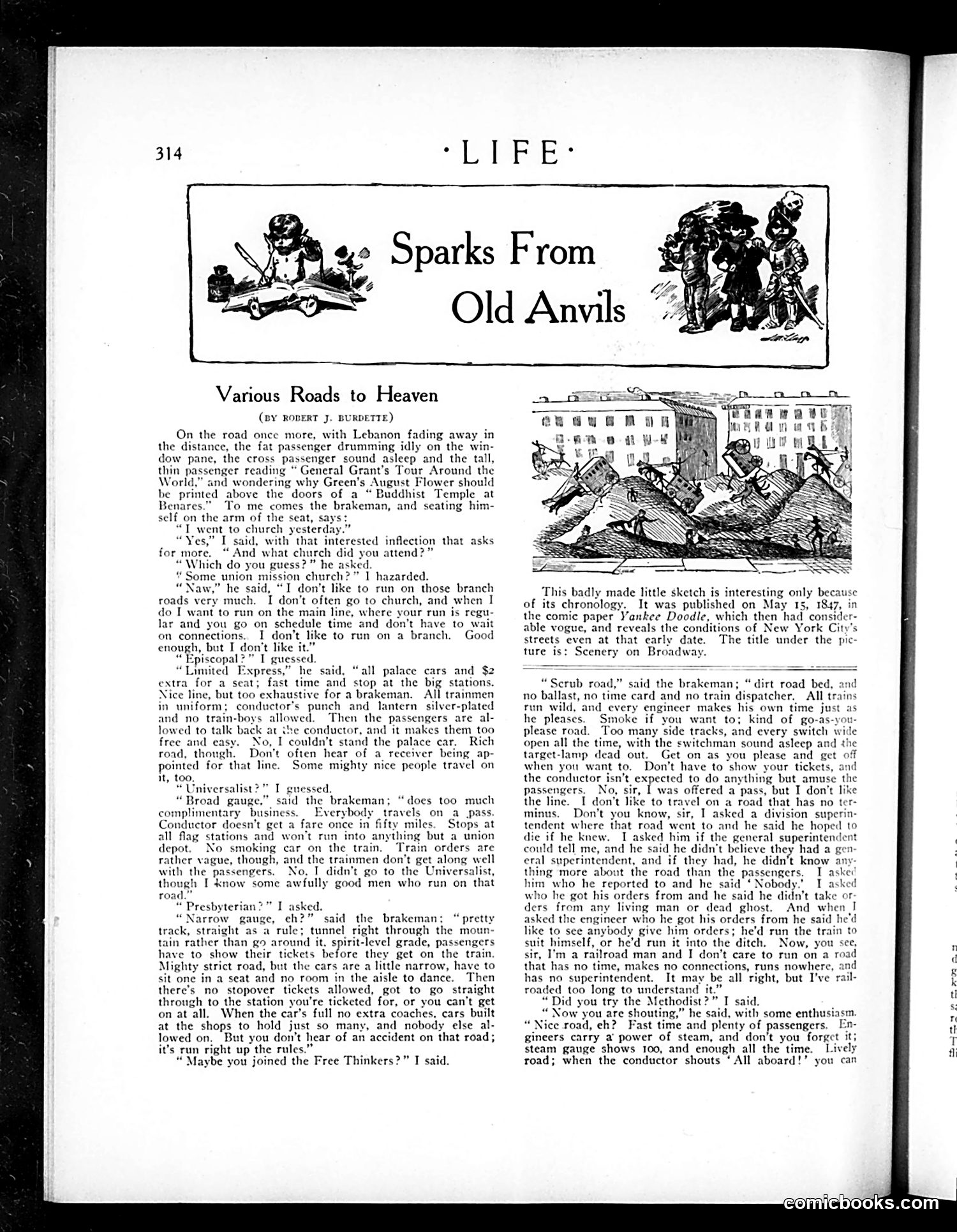
This page contains an extended satirical dialogue between a railroad brakeman and a passenger, where the brakeman describes different Christian denominations as railroad lines—a clever 19th-century metaphor. **The Satire:** Each church becomes a train system with distinct characteristics: - **Episcopal**: The luxury "Limited Express" with high fares and elite passengers - **Universalist**: A permissive "broad gauge" line where everyone travels free - **Presbyterian**: A strict, narrow-gauge line with rigid rules and no flexibility - **Free Thinkers**: The lawless "scrub road" with no oversight or discipline **The Point:** The brakeman critiques churches by exposing their operational philosophies through railroad metaphors. The dialogue gently mocks denominational pretensions while suggesting that faith communities, like rail systems, differ fundamentally in their structure, accessibility, and rules. **Secondary Content:** The page also includes a brief note about an 1847 *Yankee Doodle* sketch depicting Broadway street conditions, establishing historical perspective on urban life. The humor relies on readers' familiarity with both railroad terminology and denominational distinctions.
📄 Transcribed text from this page (OCR, searchable)
Machine-transcribed from the original scan — historical spelling and the odd misread are preserved.
“SRE? Various Roads to Heaven (bY ROBERT J. BURDETTE) On the road once more, with Lebanon fading away in the distance, the fat passenger drumming idly on the win- dow pane, the cross passenger sound asleep and the tall, thin passenger reading “ General Grant’s Tour Around the World,” and wondering why Green's August Flower should be printed above the doors of a “ Buddhist Temple at Benares To me comes the brakeman, and seating him- self on the arm of the seat, says: “T went to church yesterday.” “Yes,” I said, with that interested inflection that asks for more. “ And what church did you attend?” “Which do you guess?” he asked. “Some union mission church?” I hazarded. y much. I don’t often go to church, and when I do I want to run on the main line, where your run is regu- lar and you go on schedule time and don’t have to wait on connections. I don’t like to run on a branch. Good enough, but I don't like it.” “Episcopal?” I guessed. “Limited Express,” he said, “all palace cars and $2 extra for a se fast time and stop at the big stations. Nice line, but too exhaustive for a brakeman. All trainmen in uniform; conductor's punch and lantern. silver-plated and no train-boys allowed. Then the passengers are al- lowed to talk bai the conductor, and it makes them too free and easy. No, I couldn't stand the palace car. Rich road, though. Don't often hear of a receiver being ap- pointed for that line. Some mighty nice people travel on it, too, “Universalist?” I guessed. “Broad gauge,” said the brakeman; “does too much complimentary business. Everybody travels on a pass. Conductor doesn’t get a fare once in fifty miles. Stops at all flag stations and won't run into anything but a union depot. No smoking car on the train. Train orders are rather vague, though, and the trainmen don't get along well with the passengers. No, I didn’t go to the Universalist, though I know some awfully good men who run on that road.” “ Presbyterian?” I asked. “Narrow gauge, eh?” said the brakeman: “pretty track, straight as a rule; tunnel right through the moun- tain rather than go around it, spirit-level grade, passengers have to show their tickets before they get on the train. Mighty strict road, but the rea little narrow, have to sit one in a seat and no room in the aisle to dance. Then there’s no stopover tickets allowed, got to go straight through to the station you're ticketed for, or you can’t get on at all. When the car’s full no extra coaches, cars built at the shops to hold just so many, and nobody else al- lowed on, But you don’t hear of an accident on that road; it’s run right up the rules.” “ Maybe you joined the Free Thinkers?” I said. Old Anvils * This badly made little sketch is interesting only because of its chronology. It was published on May 15, 1847, the comic paper Yankee Doodle, which then had consider- able vogue, and reveals the conditions of New York City’s streets even at that early date. The title under the pic- ture is: Scenery on Broadwa “Scrub road,” said the brakeman; “dirt road bed. no ballast, no time card and no train dispatcher. All trains run wild, and_every engineer makes his own time just as he pleases. Smoke if you want to; kind of go-as-you please road. Too many ‘side tracks, and every switch wi open all the time, with the switchman sound asleep and target-lamp dead out, Get on as you please when you want to. Don’t have to show your tickets, the conductor isn’t expected to do anything but amuse the passengers. No, sir, | was offered a pass, but I don’t like the line. I don’t like to travel_on a road that has no ter- minus. Don’t you know, sir, I asked a division supe’ tendent where that road went to and he said he hoped to die if he knew. I asked him if the general superintendent could tell me, and he said he didn’t believe they had a gen: eral superintendent, and if they had, he didn’t know any thing more about the road than the passengers. I asker him who he reported to and he said ‘ Nobod: a who he got his orders from and he said he didn’t tak ders from any living man or dead ghost. And when | asked the engineer who he got his orders from he said he'd like to see anybody give him orders; he'd run the train to suit himself, or he'd run it into the ditch. Now, you sir, I'm a railroad man and I don't care to run on ar that has no time, makes no connections, runs nowhere, has no superintendent. It may be all right, but I’ve rail- roaded too long to understand it.” “Did you try the Methodist?” T said. “ Now you are shouting,” he said, with some enthusiasm. “Nice road, eh? Fast time and plenty of passengers. gineers carry a power of steam, and don’t you forget it; steam gauge shows 100, and enough all the time. Livel road; when the conductor shouts ‘All aboard!’ you ca cbooks.com