
Life, 1910-08-25 · page 17 of 40
Life — August 25, 1910 — page 17: what you’re looking at
What you’re looking at
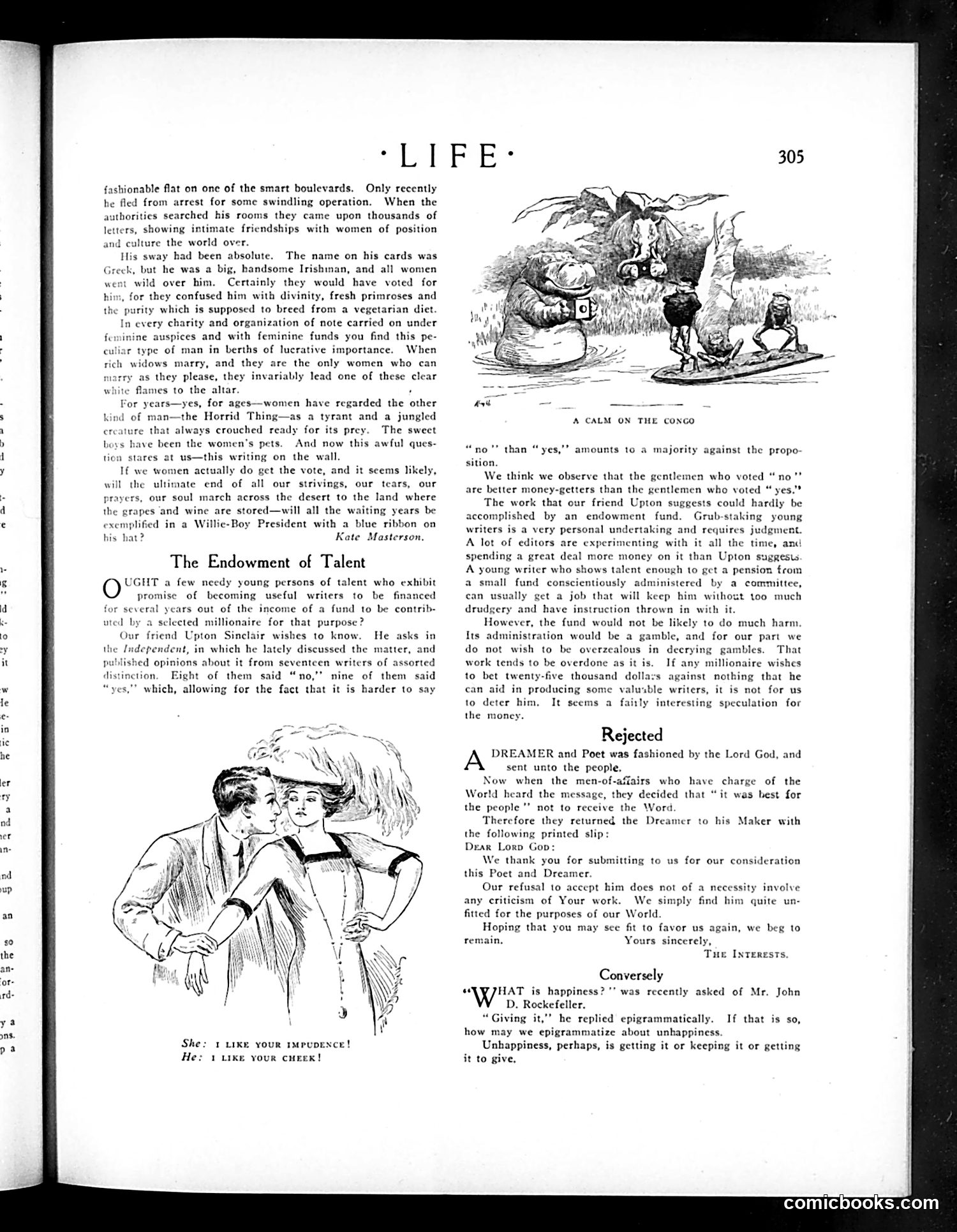
This page contains three distinct satirical pieces: **"A Calm on the Congo"** (top cartoon): A sketch showing colonial figures in Africa, likely satirizing European imperialism and the exploitation of African resources during the colonial era. **"The Endowment of Talent"** (middle section): Discusses whether millionaires should fund young writers. The text references Upton Sinclair's proposal and notes that editors who rejected funding (saying "no") tend to be financially successful, while supporters (saying "yes") are not—satirizing self-interest in artistic patronage debates. **"Rejected"** (bottom section): A parable mocking commercialism and pragmatism. It depicts how practical "men-of-affairs" reject an idealistic "Dreamer and Poet" sent by God, returning him with a rejection slip. This satirizes how materialistic society dismisses artistic or spiritual values. The page critiques hypocrisy across economics, colonialism, and cultural values in early 20th-century American society.
📄 Transcribed text from this page (OCR, searchable)
Machine-transcribed from the original scan — historical spelling and the odd misread are preserved.
‘LIFE fashionable flat on one of the smart boulevards. Only recently he fled from arrest for some swindling operation. When the authorities searched his rooms they came upon thousands of letters, showing intimate friendships with women of position and culture the world over. Ilis sway had been absolute. The name on his cards was Greck, but he was a big, handsome Irishinan, and all women went wild over him. Certainly they would have voted for , for they confused him with divinity, fresh primroses and the purity which is supposed to breed from a vegetarian diet. In every charity and organization of note carried on under feminine auspices and with feminine funds you find this pe- culiar t of man in berths of lucrative importance. When rich widows marry, and they are the only women who can niarry as they please, they invariably lead one of these clear For years—yes, for ages—women have regarded the other Kind of man—the Horrid Thing—as a tyrant and a jungled : that always crouched ready for its prey. The sweet ve been the women’s pets. And now this awful ques- tion stares at us—this writing on the wall. If we women actually do get the vote, and it seems likely, will the ultimate end of all our strivings, our tears, our , our soul march across the desert to the land where the grapes and wine are stored—will all the waiting years be exemplified in a Willie-Boy President with a blue ribbon on his hat? Kate Masterson. The Endowment of Talent O! GHT a few needy young persons of talent who exhibit promise of becoming useful writers to be financed prayer for several years out of the income of a fund to be contrib- uted by a selected millionaire for that purpose? Our friend Upton Sinclair wishes to know. He asks in the Independent, in which he lately discussed the matter, and published opinions about it from seventeen writers of assorted distinction, Eight of them said “no,’” nine of them said * which, allowing for the fact that it is harder to say She: 1 .ixe your mpupence! He: 1 11Ke your cureK! A CALM ON THE CoNcO no"? than sition. We think we observe that the gentlemen who voted “no are better money-getters than the gentlemen who voted “5 The work that our friend Upton suggests could hardly be accomplished by an endowment fund. Grub-staking young writers is a very personal undertaking and requires judgment. A lot of editors are experimenting with it all the time, ant ending a great deal more money on it than Upton suggests A young writer who shows talent enough to get a pension from a small fund conscientiously administered by a committee, can usually get a job that will keep him withoxt too much drudgery and have instruction thrown in with it. However, the fund would not be likely to do much harm Its administration would be a gamble, and for our part we do not wish to be overzealous in decrying gambles. That work tends to be overdone as it is. If any millionaire wishes to bet twenty-five thousand dollazs against nothing that he can aid in producing some valuible writers, it is not for us to deter him, It seems a faitly interesting speculation for the money. “ yes,’" amounts to a majority against the propo- Rejected DREAMER and Poet was fashioned by the Lord God, and sent unto the people. Now when the men-of-affairs who hav World heard the message, they decided that the people" not to receive the Word Therefore they returned the Dreamer to his Maker with the following printed slip: Dear Lorp Gop: We thank you for submitting to us for our consideration this Poet and Dreamer. Our refusal to accept him does not of a necessity involve any criticism of Your work. We simply find him quite un- fitted for the purposes of our World Hoping that you may see fit to favor us again, we beg to Yours sincerely, Tue Interests. charge of the it was best for remain, Conversely HAT is happiness?’ was recently asked of Mr. John D. Rockefeller. “Giving it,’’ he replied epigrammatically. how may we epigrammatize about unhappiness. Unhappiness, perhaps, is getting it or keeping it or getting it to giv If that is so, comicbooks.com