
Life, 1910-08-25 · page 29 of 40
Life — August 25, 1910 — page 29: what you’re looking at
What you’re looking at
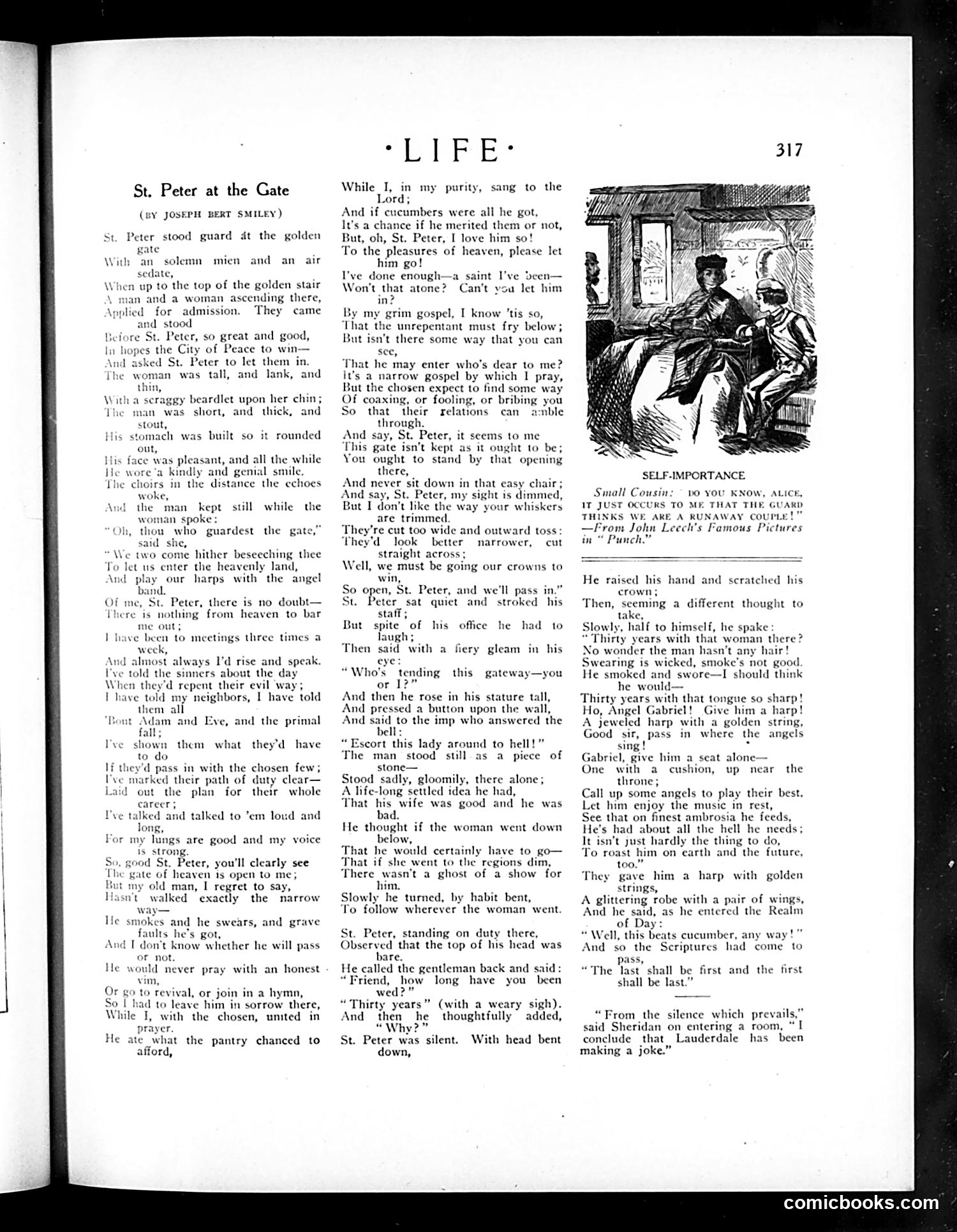
This illustrated poem satirizes **self-righteous religious hypocrisy**, particularly targeting women who loudly parade their piety while judging others harshly. The cartoon depicts a self-satisfied woman ascending to heaven's gate, boasting of her constant church attendance, public preaching, and moral instruction to neighbors. She demands entry while admitting her husband—a humble, quiet man—hasn't followed her strict religious path. She pleads for his admission anyway, expecting special favors. St. Peter's response is withering: he damns *her* to hell instead, recognizing her arrogance and manipulation. The husband, bound by lifelong habit of deferring to his wife's moral authority, numbly follows her downward. **The satire's target**: ostentatious piety, self-importance masquerading as godliness, and the assumption that loud public religiosity earns heavenly rewards. The poem mocks those who lecture others while expecting rule-bending for loved ones—exposing the gap between professed morality and actual character.
📄 Transcribed text from this page (OCR, searchable)
Machine-transcribed from the original scan — historical spelling and the odd misread are preserved.
St. Peter at the Gate (ey JOSEPH BERT SMILEY ) Peter stood guard dt the golden gate an solemn sedate, up to the top of the golden stair n and a woman ascending there, Applied for admission. They came and stood Before St. Peter, so great and good, nl s the City of Peace to win— \nd asked St. Peter to let them in. The woman was tall, and lank, and thin, With a scraggy beardlet upon her chin; Ihe man was short, and thick, and stout, stomach was built so it out, ¢ was pleasant, and all the while re‘a kindly and genial smile. The choirs in the distance the echoes wok: the man kept woman spoke: Oh, thou who guardest the gate,” said she, We two come hither beseeching thee To let us enter the heavenly land, And play our harps with the angel band. Of me, St. Peter, there is no doubt— Ihere is nothing’ from heaven to bar ¢ out; been to meetings three times a week, almost always I’d rise and speak. I've told the sinners about the day When they'd repent their evil way; I have told my neighbors, | have told them all Adam and Eve, and the prim: fall; I've shown to do If they'd pass in with the chosen few; I've marked their path of duty clear— Laid out the plan for their whole career; I've talked and talked to ’em loud and long, For my lungs are good and my voice is strong s vod St. Peter, you'll clearly see The gate of heaven ts open to me; But my old man, I regret to say, Has ked exactly the narrow way— okes and he swears, faults he’s got, And [ don't know whether he will pass oF not. He would never pray with an honest im, fevival, or join in a hymn, «1 to leave him in sorrow there, I, with the chosen, umted in prayer. what the pantry chanced to afford, mien and an air rounded still while the Bout them what they'd have and grave LIFE While I, in my Lord; And if cucumbers were all he got, It's a chance if he merited them or not, But, oh, St. Peter, I love him so! To the pleasures of heaven, please let him go! I've done enough: Won't that atone? in yy grim gospel, I know ‘tis so, That the unrepentant must fry below; But isn’t there some way that you can see, That he may enter who's d it’s a narrow gospel by which I pra But the chosen expect to find some way Of coaxing, or fooling, or bribing you So that their relations can amble through, And say, St. Peter, it seems to me his gate isn’t kept as it ought to be; You ought to stand by that opening there, And never sit down in that easy chair; And say, St. Peter, my sight is dimmed, But I don't like the way your whiskers are trimmed They’re cut too wide and outward toss: ‘They'd look better narrower, cut straight across; Well, we must be going our crowns to win, So open, St. Peter, and we'll pass in.” St. Peter sat quict and. stroked his staff ; But spite of his augh ; Then said with a fiery gleam in his eye: “Who's tending or 1?” And then he rose in his stature tall, And pressed a button upon the wall, And said to the imp who answered the bell: cort this lady around to hell!” man stood still as a piece of stone— Stood sadly, gloomily, there alone; A life-long settled idea he had, That his wife was good and he was bad. He thought if the woman went down below, That he would certainly have to go— That if she went to the regions dim, There wasn't a ghost of a show for him. Slowly he turned, by habit bent, To follow wherever the woman went. purity, sang to a saint I've deen— Can't you let him office he had to this gateway—you The St. Peter, standing on duty there, Observed that the top of his head was bare. He called the gentleman back and said: “Friend, how long have you been wed?" “Thirty years” And then he “Why?” St. Peter was silent. down, (with a weary sigh). thoughtfully added, With head bent SELF-IMPORTANCE Small Cousin: vo you KNow, Avice, 1T JUST OCCURS TO ME THAT THE GUARD THINKS WE ARE A RUNAWAY CourLe! —From John Leech’s Famous Picture in “* Punch.” He raised his hand and scratched his crown; seeming a different thought to take, wliy, half to himself, he spake : Thirty years with that woman there? No wonder the man hasn’t any hair! Swearing is wicked, smoke’s not good He smoked and swore—I should think he would— Thirty years with that tongue so sharp! Ho, Angel Gabriel! Give him a harp! A jeweled harp with a golden string, Good sir, pass in where the angels sing! . Gabriel, give him a seat alone One with a cushion, up near the throne; Call up some angels to play their best, Let him enjoy the music in rest, See that on finest ambrosia he feeds, He's had about all the hell he needs; It isn’t just hardly the thing to do, To roast him on earth and the future, too.” gave him a harp with golden strings, A glittering robe with a pair of wings, And he said, as he entered the Realm of Day “Well, this beats cucumber, And so the Scriptures ha¢ pass, “The last shall be shall be last.” Then, They first and the first “From the silence which prevails,” said Sheridan on entering a room, “I conclude that Lauderdale has been making a joke.” comicbooks.com