
Life, 1910-08-25 · page 24 of 40
Life — August 25, 1910 — page 24: what you’re looking at
What you’re looking at
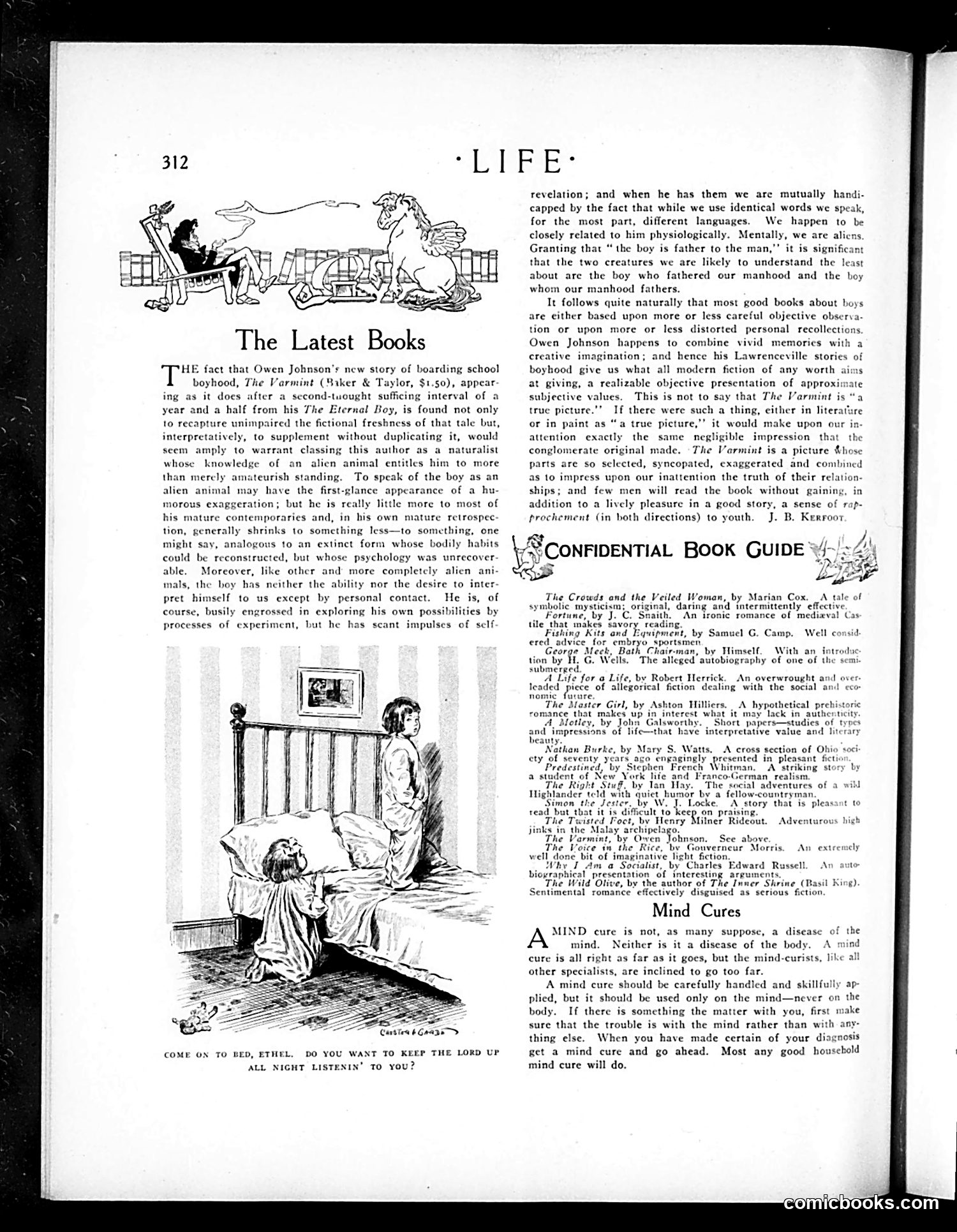
This page contains two main elements: a book review section and a cartoon with accompanying caption. **The Cartoon:** Shows a woman in bed speaking to a man standing beside it, with the caption "Come on to bed, Ethel, do you want to keep the Lord up all night listenin' to you?" The humor is domestic and mildly risqué for the era—satirizing a husband's impatience with his wife's nighttime talking, humorously framing it as a religious irreverence (keeping God waiting). **The Book Review:** Discusses Owen Johnson's *The Varmint*, a boarding school story. The critic praises Johnson's naturalistic treatment of boyhood, arguing he captures authentic psychology rather than exaggerated sentiment. The review emphasizes that boys are essentially "alien animals" to adults—unknowable except through careful observation. **Social Context:** Early 1900s Life magazine combined genteel literary criticism with humor targeting middle-class domestic life, reflecting contemporary attitudes about marriage, propriety, and childhood development.
📄 Transcribed text from this page (OCR, searchable)
Machine-transcribed from the original scan — historical spelling and the odd misread are preserved.
LE RE The Latest Books HE fact that Owen Johnson's new story of boarding school boyhood, The Varmint (Biker & Taylor, $1.50), appear ing as it does after a second-tuought sufficing interval of a year and a half from his The Eternal Boy, is found not only to recapture unimpaired the fictional freshness of that tale but, interpretatively, to supplement without duplicating it, would seem amply to warrant classing this author as a naturalist whose knowledge of an alien animal entitles him to more than merely amateurish standing. To speak of the boy as an y have the first-glance appearance of a hu- morous exaggeration; but he is really little more to most of his mature contemporaries and, in his own mature retrospec tion, generally shrinks to something less—to something, one might say, analogous to an extinct form whose bodily habits could be reconstructed, but whose psychology was unrecover able. Moreover, like other and more completely alien ani- mals, the boy has neither the ability nor the desire to inter- pret himself to us except by personal contact. He is, of course, busily engrossed in exploring his own possibilities by processes of experiment, but he has scant impulses of self alien animal r COME ON TO BED, ETHEL, DO YOU WANT TO KEEP THE LORD UP ALL NIGHT LISTENIN’ TO You? revelation; and when he has them we are mutually handi- capped by the fact that while we use identical words we speak, for the most part, different languages. We happen to be closely related to him physiologically. Mentally, we are aliens. Granting that “the boy is father to the man,” it is significa that the two creatures we are likely to understand the least about are the boy who fathered our manhood and the boy whom our manhood fathers. It follows quite naturally that most good books about boys are either based upon more or less careful objective observa- tion or upon more or less distorted personal recollections. Owen Johnson happens to combine vivid memories with a creative imagination; and hence his Lawrenceville stories of boyhood give us what all modern fiction of any worth aims at giving, a realizable objective presentation of approximate subjective values. This is not to say that The Varmint is true picture."’ If there were such a thing, either in literature or in paint as “a true picture,”’ it would make upon our in- attention exactly the same negligible impression that the conglomerate original made. The Varmint is a picture &hose parts are so selected, syncopated, exaggerated and combined as to impress upon our inattention the truth of their relation- ships; and few men will read the book without gaining, in addition to a lively pleasure in a good story, a sense of rap- prochement (in hoth directions) to youth. J. B. Kerroor $ CONFIDENTIAL BOOK GUIDE § The Crowds and the Veiled Woman, by Marian Cox. A tale of symbolic mysticism; original, daring and intermittently. effective Fortune, by J. C. Snaith. An ironic romance of medixval Cas tile that makes Savory readin Fishing Kits and Equipment, by Samuel G. Camp. Well consid ered_advice for embryo sportsmen George Meck, Bath Chair-man, by Himself. With an_introdo tion by H, G. Wells. The alleged autobiography of one of the sem submerge A Life for a Life, by Robert Herrick. An overwrought and over: leaded piece of allegorical fiction dealing with the social an! cco The Master Girl, by Ashton Hilliers. A hypothetical prehistoric romance that makes up in interest what it may lack in authenticity A Motley, by John Galsworthy. Short papers—studies of types dl impressions of life—that have interpretative value and literary auty Nathan Burke, by Mary S. Watts, A cross section of Ohi ety of seventy, years. ace engagingly presented in pleasant fic Predestined, by Stephen F Whitman, A 'stri a student of New York hie and Fr: jerman. reali _ The Right Stuf, by Tan Hay. ‘The social adventures of nder told with quiet | umor by a fellow-countryman Simon the Jes tory that is pleas read but that it is difficult to Keeg on praising. The T Foct, by Henry Milner Rideout. Adv jinks in the Malay archipelago. The Varmint, by Owen Johnson. Sce above. The Voice in the Rice, by Gouverneur Morris. well done bit of imaginative light fiction Why I Am a Socialist, by Charles Edward Russell. An cal presentation of interesting arguments ‘ld Olive, by the author of The Inner Shrine (Tasil King). Sentimental romance effectively disguised as serious fiction Mind Cures HIND cure is not, as many suppose, a disease of the mind. Neither is it a disease of the body. A mind cure is all right as far as it goes, but the mind-curists, like a other specialists, are inclined to go too far. A mind cure should be carefully handled and skillfully ap- plied, but it should be used only on the mind—never on the body. If there is something the matter with you, first make sure that the trouble is with the mind rather than with any- thing else. When you have made certain of your diagnosis get a mind cure and go ahead. Most any good housebold mind cure will do. An extremely