
Life, 1910-08-25 · page 19 of 40
Life — August 25, 1910 — page 19: what you’re looking at
What you’re looking at
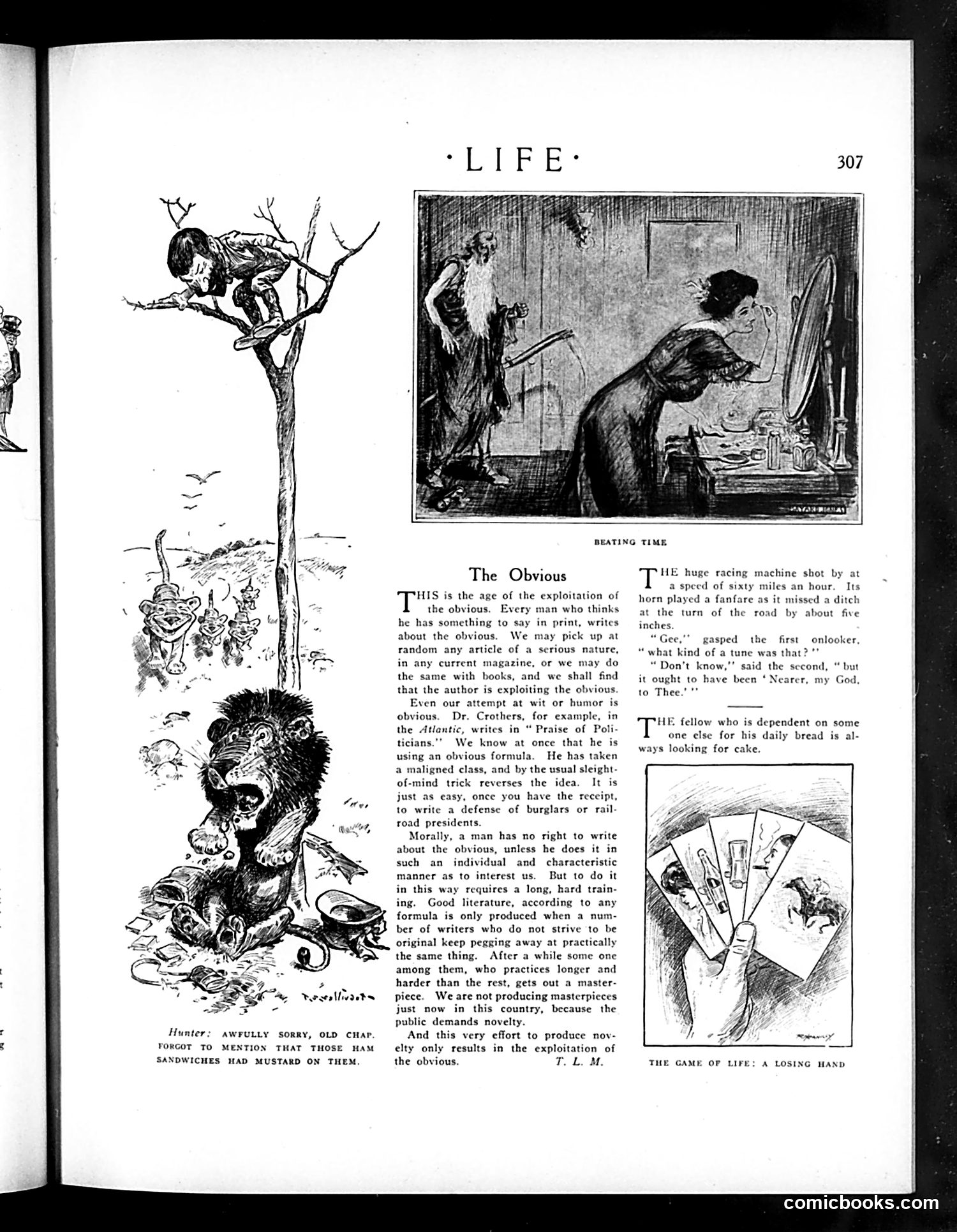
**Main Article ("The Obvious"):** A satirical essay criticizing contemporary American writers for exploiting obvious themes without originality. The author argues that modern literature lacks masterpieces because writers chase novelty rather than developing genuine skill. The illustration shows a disheveled character surrounded by debris—likely representing the chaotic, uninspired state of current writing. **Cartoon 1 (Top right, "Beating Time"):** Shows a man being beaten while a woman watches. The caption's crude joke suggests domestic violence as entertainment or comeuppance—reflecting early 20th-century attitudes normalizing such brutality as comedic material. **Cartoon 2 (Bottom right, "The Game of Life: A Losing Hand"):** Depicts a hand of playing cards, with the caption implying that dependence on others for basic needs creates false expectations of luxury ("cake" vs. "bread"). It satirizes how poverty breeds unrealistic desires. The page satirizes both literary mediocrity and social complacency through humor that modern readers would find harsh or offensive.
📄 Transcribed text from this page (OCR, searchable)
Machine-transcribed from the original scan — historical spelling and the odd misread are preserved.
Deeserllevaets Hunter: AWPULLY SORRY, OLD CHAP. FORGOT TO MENTION THAT THOSE HaM SANDWICHES HAD MUSTARD ON THEM. BEATING The Obvious HIS is the age of the exploitation of the obvious. Every man who thinks he has something to say in print, writes about the obvious. We may pick up at random any article of a scrious nature, in any current magazine, or we may do the same with books, and we shall find that the author is exploiting the obvious Even our attempt at wit or humor is obvious. Dr. Crothers, for example, in the Atlantic, writes in “ Praise of Poli- ticians."" We know at once that he is using an obvious formula. He has taken a maligned class, and by the usual sleight- of-mind trick reverses the idea. It is just as easy, once you have the receipt, to write a defense of burglars or rail- road presidents. Morally, a man has no right to write about the obvious, unless he does it in such an individual and characteristic manner as to interest us. But to do it in this way requires a long, hard train- ing. Good literature, according to an formula is only produced when a num- ber of writers who do not strive to be original keep pegging away at practically the same thing. After a while some one among them, who practices longer and harder than the rest, gets out a master- piece. We are not producing masterpieces just now in this country, because the public demands novelty. And this very effort to produce nov- elty only results in the exploitation of the obvious. T. L. M. TIME HE huge racing machine shot by at a speed of sixty miles an hour. Its horn played a fanfare as it missed a ditch at the turn of the road by inches. “Gee,” gasped the first onlooker, “what kind of a tune was that? ’’ “Don't know," said the sccond, “ but it ought to have been ‘Nearer, my God, to Thee.’ "* about five HE. fellow who is dependent on some one else for his daily bread is al- ways looking for cake. THE GAME OF LIFE: A LOSING HAND comicbooks.com