
Life, 1910-08-25 · page 22 of 40
Life — August 25, 1910 — page 22: what you’re looking at
What you’re looking at
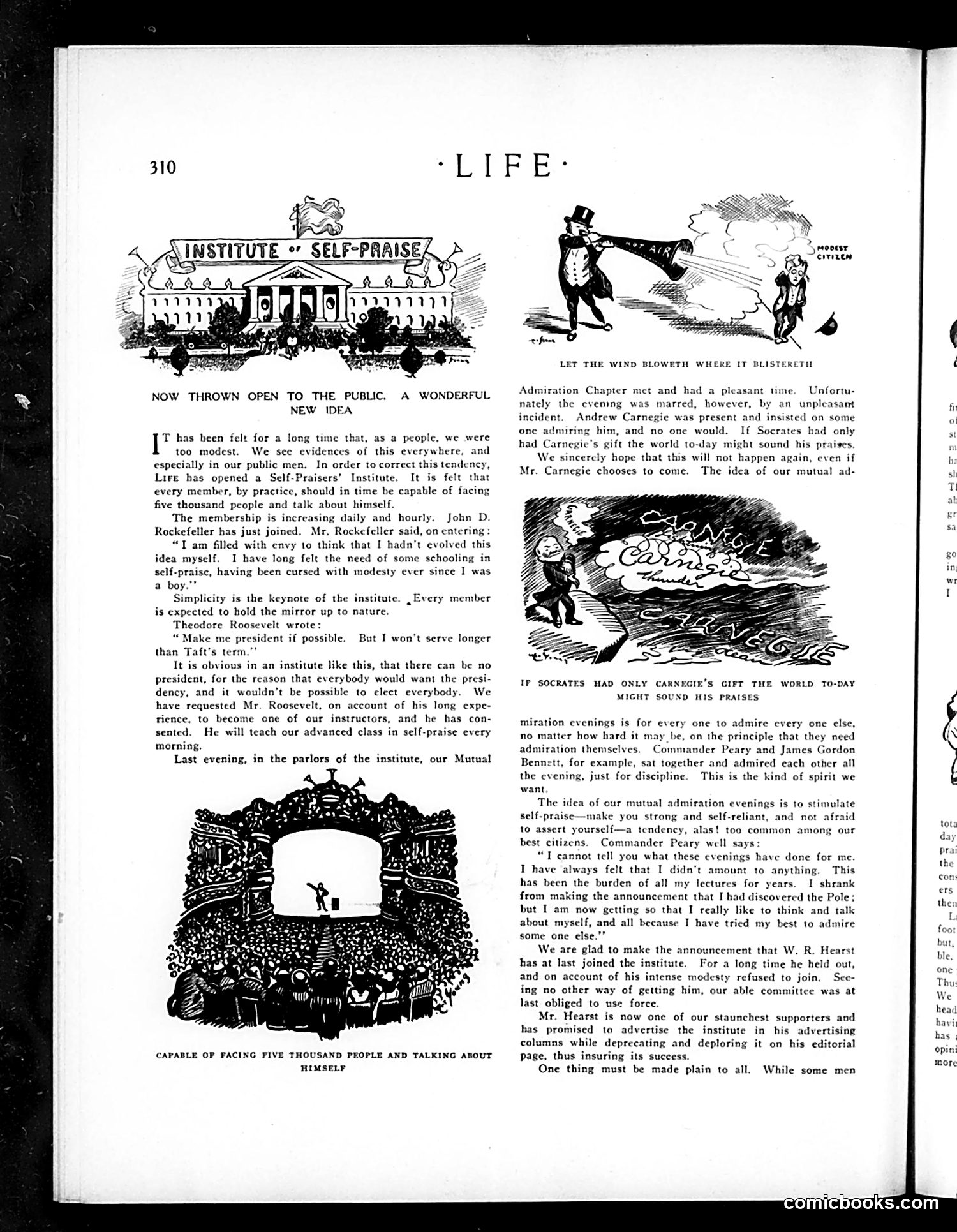
This satirical piece mocks the vanity and self-aggrandizement of wealthy American industrialists and public figures of the early 1900s. Life proposes a fictional "institute" to teach self-praise, claiming Americans are "too modest"—obviously ironic. The satire targets specific real figures: **John D. Rockefeller** (oil magnate), **Theodore Roosevelt** (recently departed president, competing with successor **Taft**), **Andrew Carnegie** (steel magnate whose philanthropy demanded admiration), **Commander Peary** (Arctic explorer), **James Gordon Bennett** (newspaper publisher), and **W. R. Hearst** (media mogul). The joke exposes how these powerful men constantly sought public adulation despite claims of humility. The cartoon of Carnegie demanding admiration, and the detail about Hearst requiring "force" to join while simultaneously promoting and attacking the institute in his newspapers, illustrate the hypocrisy and contradictions Life saw in gilded-age American leadership.
📄 Transcribed text from this page (OCR, searchable)
Machine-transcribed from the original scan — historical spelling and the odd misread are preserved.
NOW THROWN OPEN TO THE PUBLIC. NEW IDEA A WONDERFUL T has been felt for a long time that, as a people, we were too modest. We see evidences of this everywhere, and especially in our public men. In order to correct this tendency, Lire has opened a Self-Praisers’ Institute, It is felt that every member, by practice, should in time be capable of facing five thousand people and talk about himself. The membership is increasing daily and hourly. John D. Rockefeller has just joined. Mr. Rockefeller said, on entering: “Tam filled with envy to think that I hadn't evolved this idea myself. I have long felt the need of some schooling in self-praise, having been cursed with modesty ever since I was a boy.”’ Simplicity is the keynote of the institute. [Every member is expected to hold the mirror up to nature. Theodore Roosevelt wrote: “Make me president if possible. than Taft's term. It is obvious in an institute like this, that there can be no president, for the reason that everybody would want the presi- dency, and it wouldn't be possible to elect everybody. We have requested Mr. Roosevelt, on account of his long expe- rience, to become one of our instructors, and he has con- sented. He will teach our advanced class in self-praise every morning. Last evening, in the parlors of the institute, our Mutual But I won't serve longer CAPABLE OP PACING FIVE THOUSAND PEOPLE AND TALKING ABOUT HIMSELF LET THE WIND BLOWETH WHERE IT BLISTERETIE Admiration Chapter met and had a pleasant time. Unfortu- nately the evening was marred, however, by an unpleasant incident. Andrew Carnegie was present and insisted on some one admiring him, and no one would. If Socrates bad only had Carnegic’s gift the world to-day might sound his praises. We sincerely hope that this will not happen again, even if ‘arnegie chooses to come. The idea of our mutual ad- IF SOCRATES HAD ONLY CARNEGIE’S GIFT THE WORLD TO-DAY MIGHT SOUND IIS PRAISES miration evenings is for every one to admire every one else, no matter how hard it may be, on the principle that they need admiration themselves. Commander Peary and James Gordon Bennett, for example, sat together and admired each other all the evening, just for discipline. This is the kind of spirit we want The idea of our mutual admiration evenings is to stimulate self-praise—make you strong and self-reliant, and not afraid to assert yourself—a tendency, alas! too common among our best citizens. mmander Peary well say: “T cannot tell you what these evenings have done for me. I have always felt that I didn’t amount to anything. This has been the burden of all my lectures for years. I shrank from making the announcement that I had discovered the Pole; but I am now getting so that I really like to think and talk about myself, and all because I have tried my best to admire some one else.’’ We are glad to make the announcement that W. R. Hearst has at last joined the institute. For a long time he held out, and on account of his intense modesty refused to join. See- ing no other way of getting him, our able committee was at last obliged to use force. Mr. Hearst is now one of our staunchest supporters and has promised to advertise the institute in his advertising columns while deprecating and deploring it on his editorial page, thus insuring its success. One thing must be made plain to all. While some men Comicbooks.com