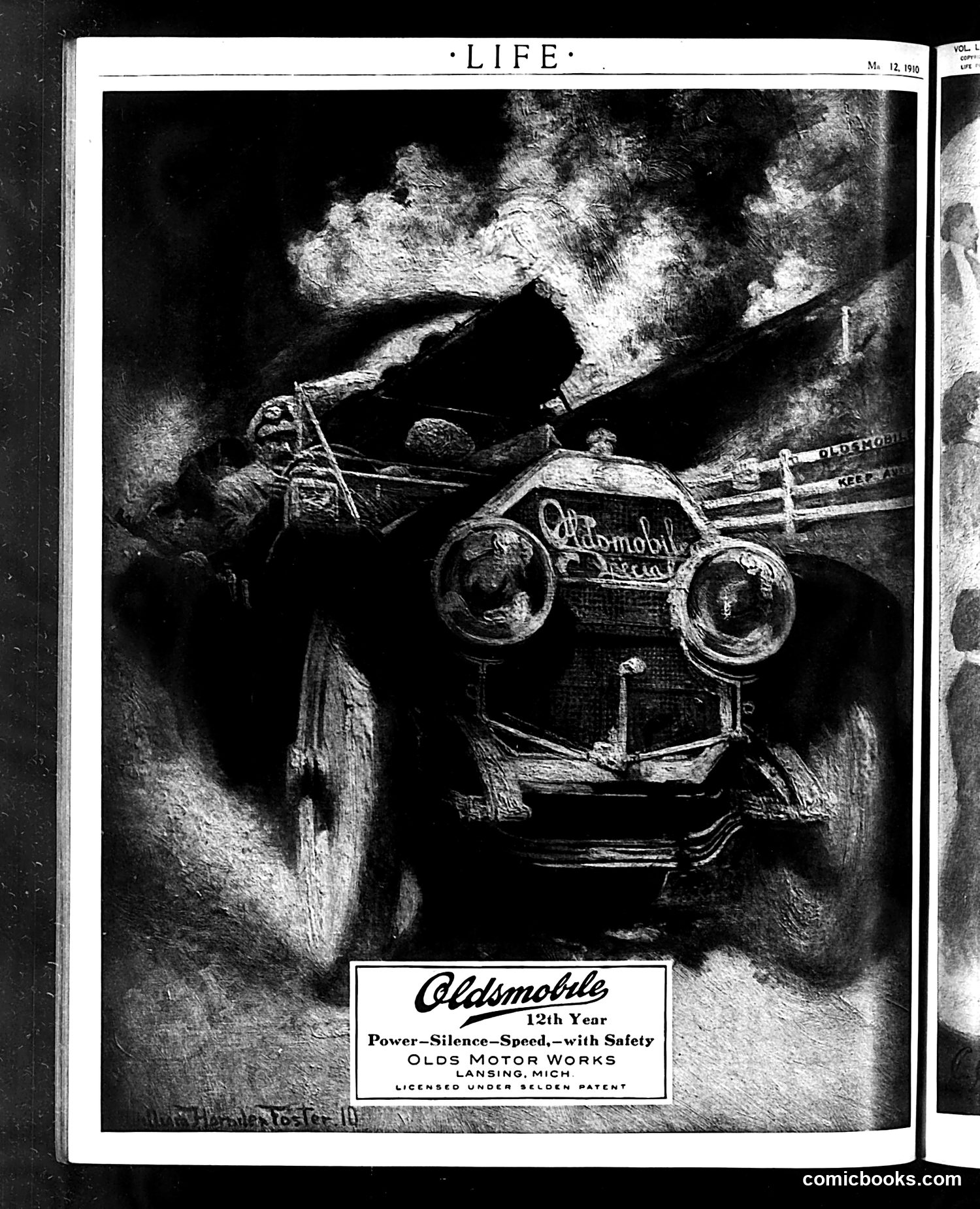
A complete issue · 44 pages · 1910
Life — May 12, 1910
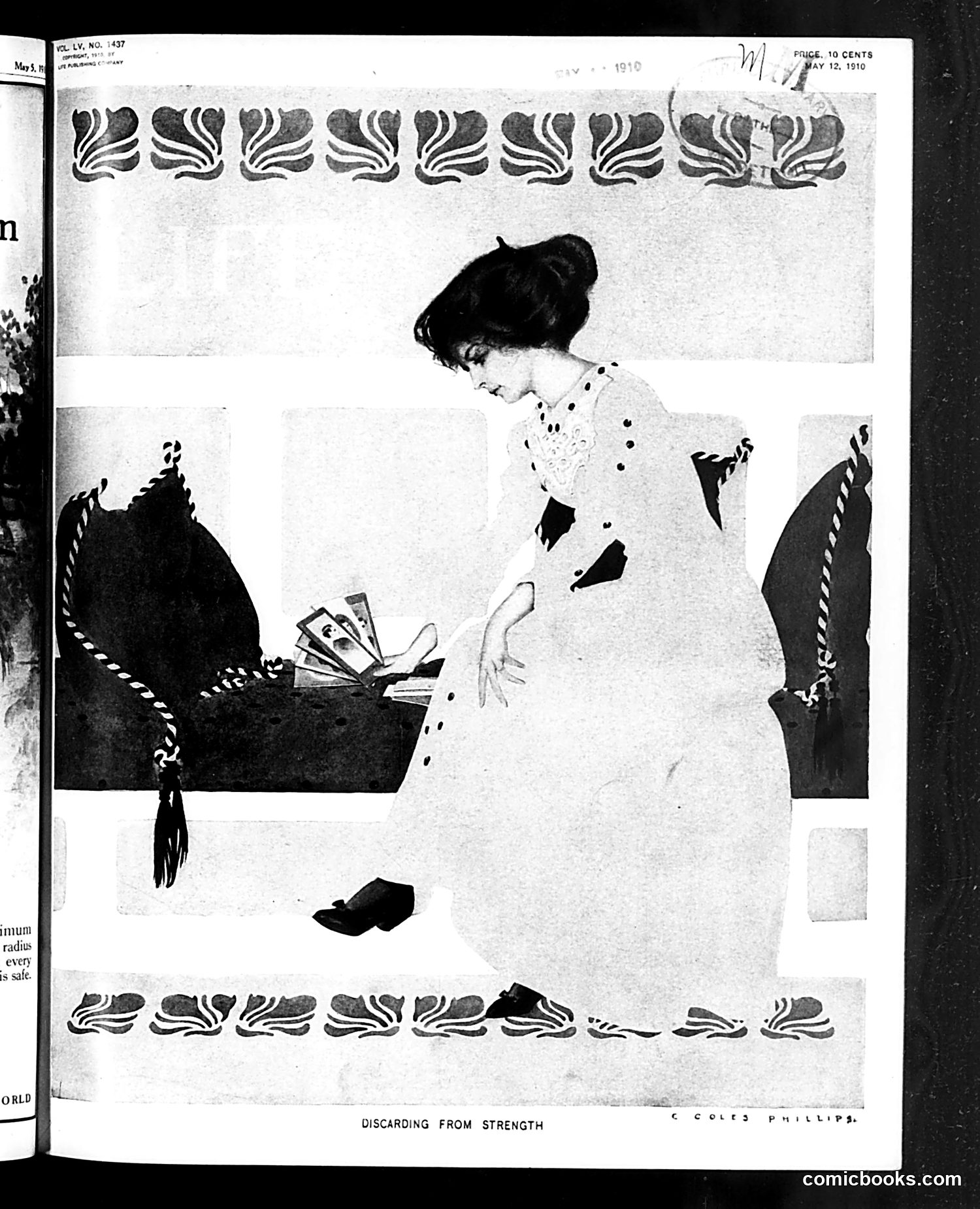
This 1910 Life magazine cartoon satirizes a wealthy woman carelessly discarding money from an ornate purse. The illustration shows her in fashionable dress, dropping cash beside expensive items (shoes visible on the floor), suggesting wasteful extravagance. The title "Discarding from Strength" appears to mock the idea that the wealthy can afford to be recklessly profligate. The decorative borders featuring stylized designs frame what is essentially social commentary on class inequality and conspicuous consumption during the Gilded Age. The cartoon likely critiques the disconnect between the affluent's casual waste and the financial struggles of ordinary Americans—a theme Life magazine frequently explored through satirical imagery and humor during this era.
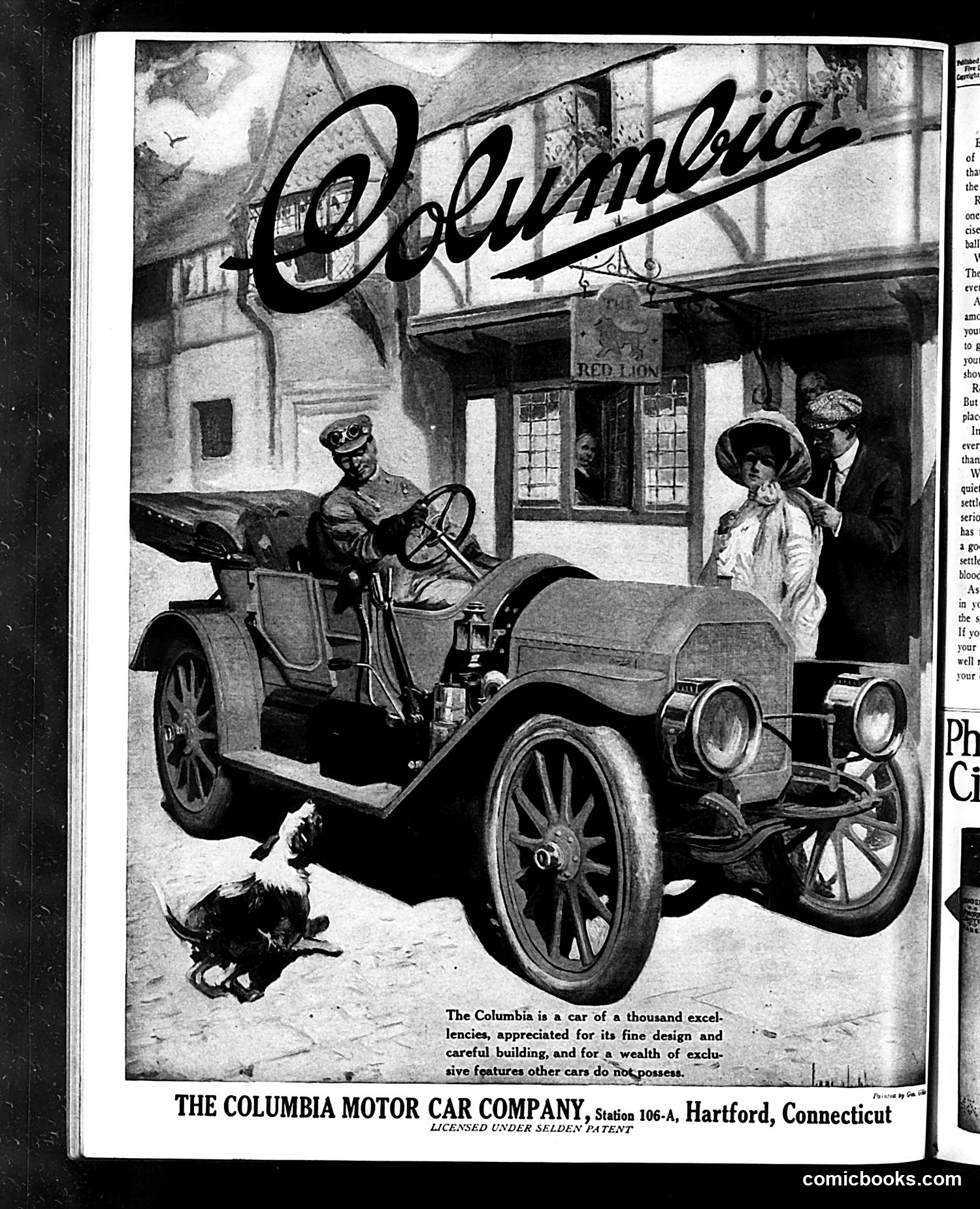
This is primarily a **Columbia Motor Car Company advertisement**, not satire. The page features a glamorous early-automobile marketing image showing a well-dressed couple and driver with a Columbia motor car parked on a European street (note the "Red Lion" pub sign). The accompanying text emphasizes the car's "thousand excellencies," fine design, careful construction, and exclusive features competitors lack—typical luxury automobile advertising rhetoric of the early 1900s. The decorative "Columbia" script header and romanticized scene (including a small dog) appeal to wealthy consumers by associating the vehicle with sophistication and leisure travel. This reflects the era when automobiles were exclusive luxury goods marketed to the affluent.
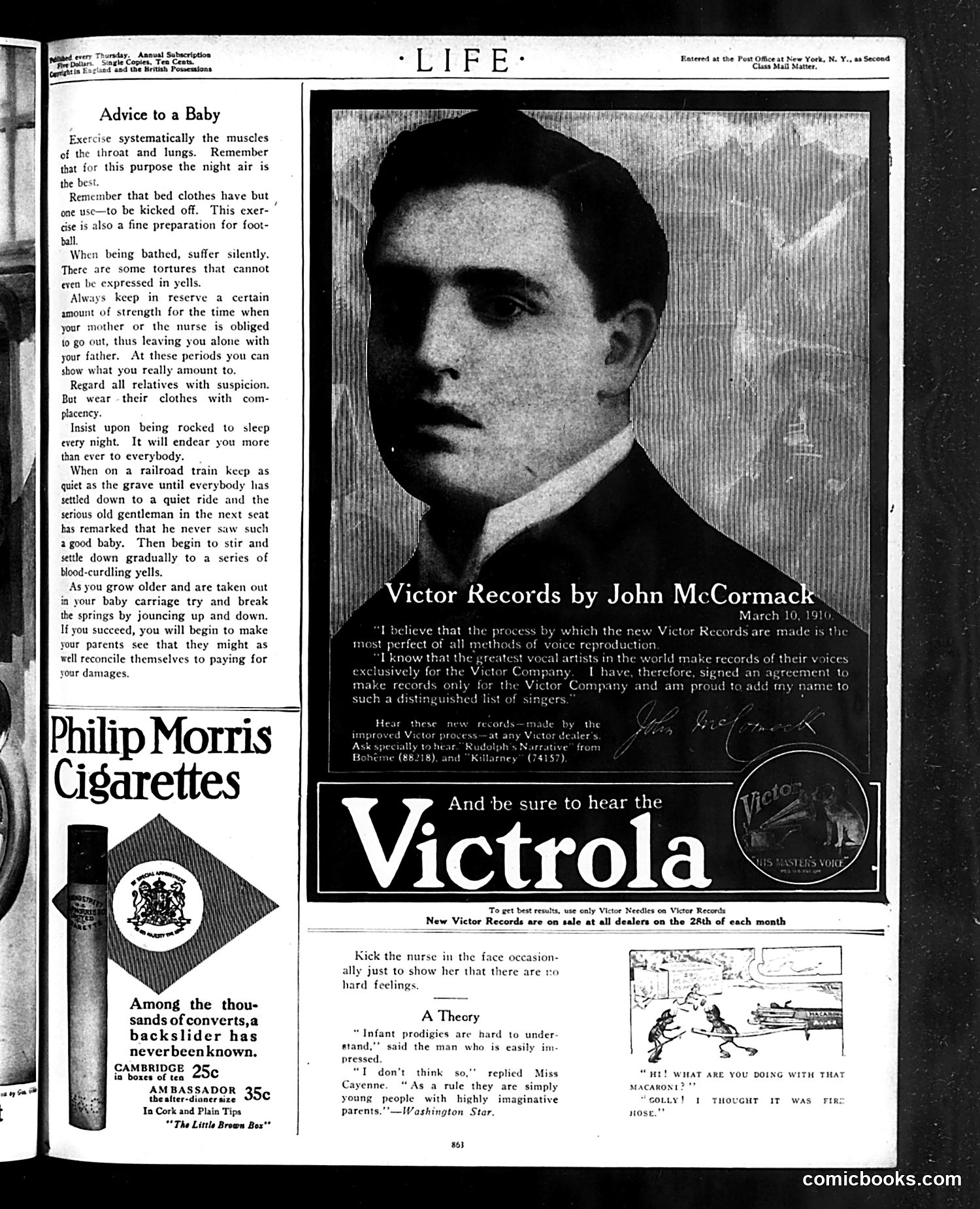
This page is primarily **advertising and advice content** rather than satirical cartoons. The left side features an "Advice to a Baby" column with parenting tips (exercise, bathing, railroad etiquette) and a Philip Morris Cigarettes advertisement. The dominant feature is a **Victor Records advertisement** (March 10, 1911) promoting John McCormack's recorded vocal performances on the Victrola phonograph. McCormack, a famous tenor of the era, endorses the technology as superior for voice reproduction. Below is a brief comic titled "A Theory" about lodge members struggling to understand young people's imaginative nature—mild social commentary on generational gaps. The page reflects early 20th-century consumer culture: phonograph technology, cigarette marketing, and mass-produced advice literature.
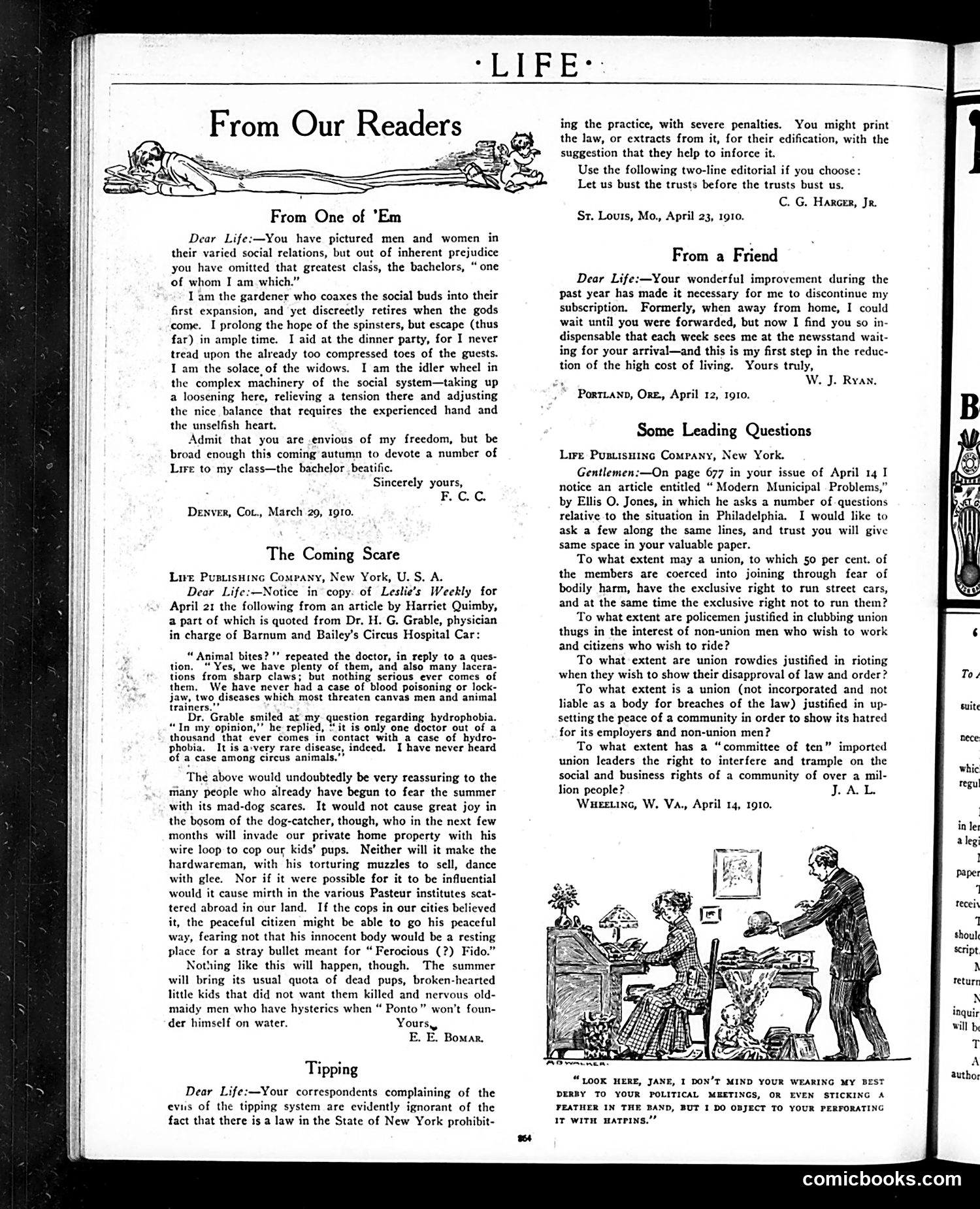
The cartoon at the bottom depicts a domestic scene where a woman (Jane) is leaving for a political meeting while a man objects to her wearing his best derby hat and inserting a feather in the band. His complaint—"I do object to you perforating it with hapins"—satirizes the women's suffrage movement of the era. The joke targets the emerging "New Woman" who demanded voting rights and political participation. The man's concern about his hat being damaged reflects anxieties about women entering public/political life, while the woman's casual disregard for his property suggests feminist indifference to traditional male authority. This reflects early 1910s debates over women's political activism and changing gender roles in America.
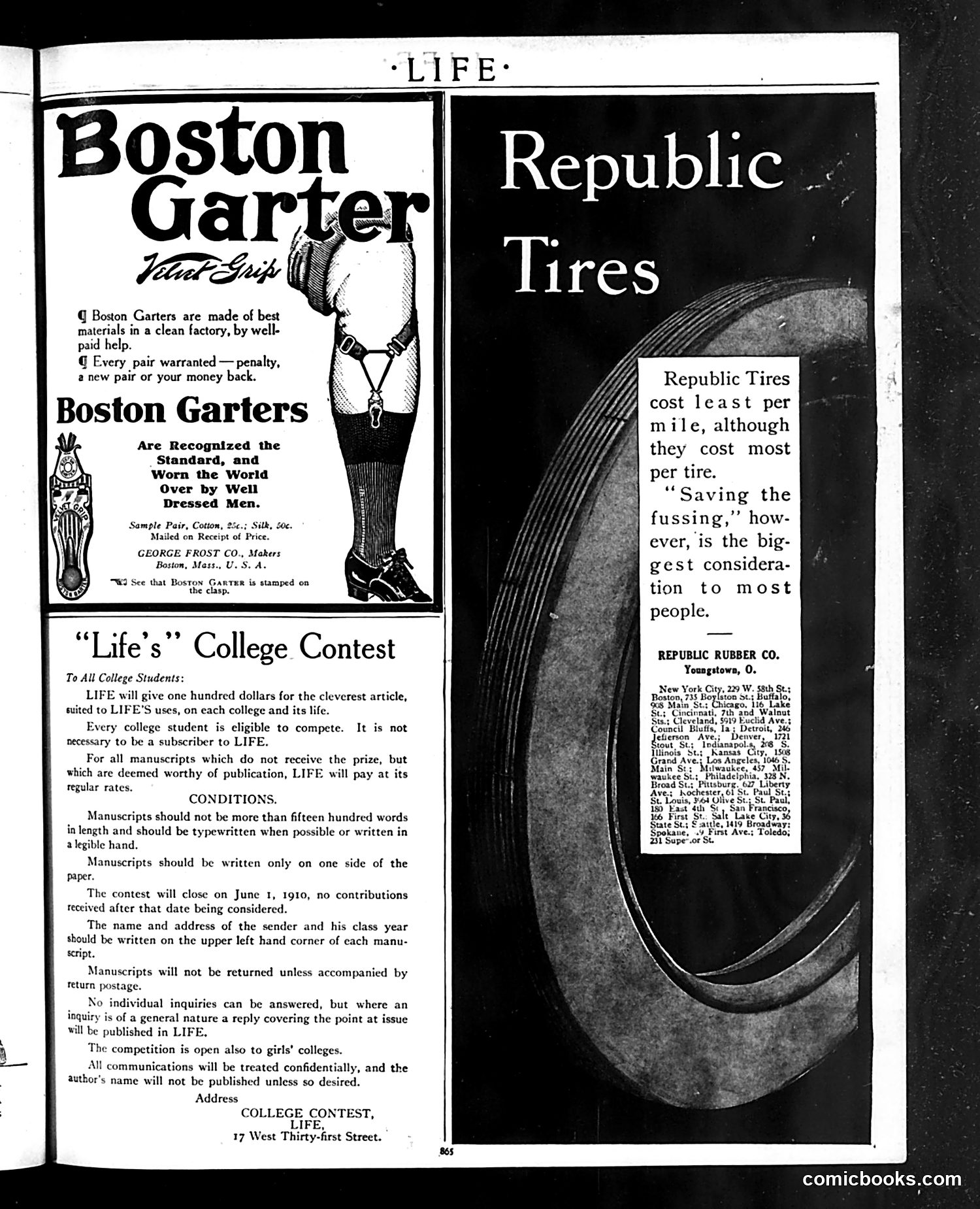
This page contains **three advertisements, not satire or political cartoons**. The **Boston Garters** ad (left) shows a well-dressed man's legs, promoting garters as "the standard, and worn the world over by well dressed men." The company guarantees quality and satisfaction. The **Republic Tires** ad (right) features a large tire image, emphasizing cost-efficiency and durability as key selling points for consumers concerned about value. The **"Life's" College Contest** announcement (center-bottom) invites college students to submit articles about college life for a $100 prize. Submissions must be under 1,500 words, typewritten, and received by June 1, 1910. The page is entirely commercial/promotional rather than satirical content.
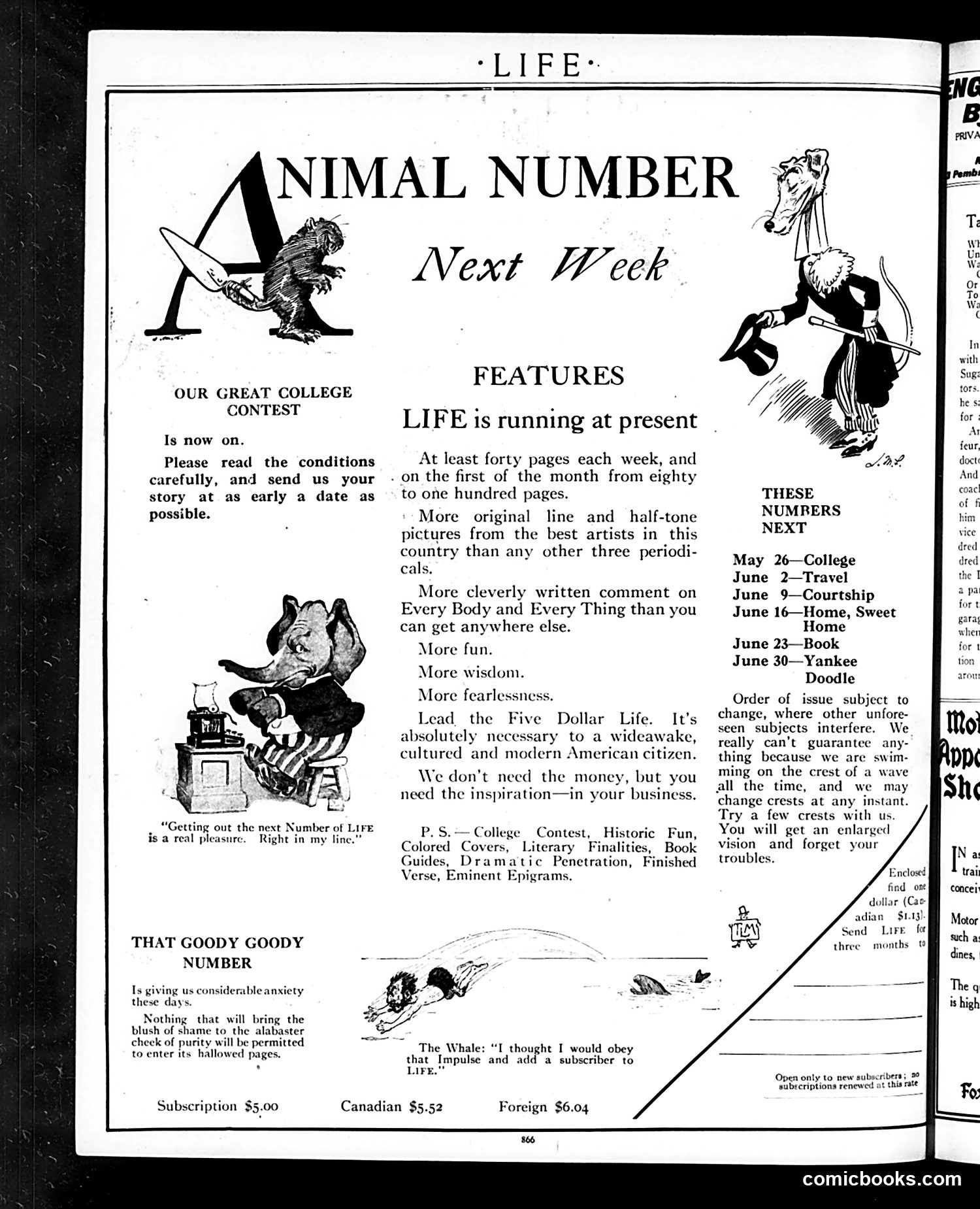
This page announces Life magazine's "Animal Number" for the following week. The central satire appears in the whale cartoon at bottom: the whale claims it "thought I would obey that Impulse and add a subscriber to LIFE." The humor exploits the absurdity of a whale—an animal incapable of reading or subscribing—considering a magazine subscription. This plays on Life's ongoing college contest promoting subscriptions among young readers (mentioned in the left column). The decorative animal illustrations (a lizard, a goat-like figure, and the whale) serve as thematic decoration for the animal-themed issue announcement. The page primarily functions as promotional content for the magazine itself, highlighting its features: original artwork, commentary on current events, and humor aimed at educated readers.
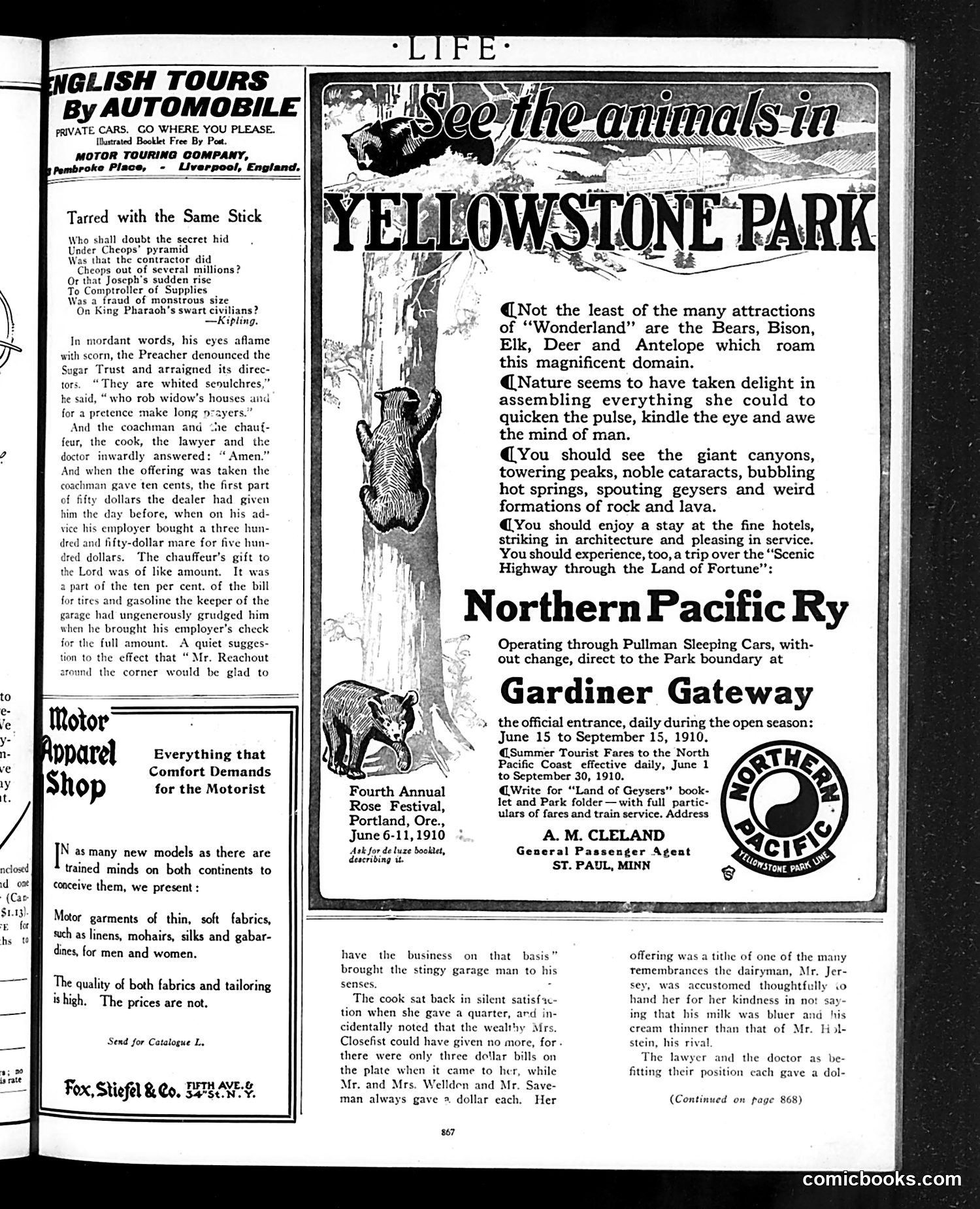
This page is primarily **advertising and travel promotion**, not political satire. The main content features: **Yellowstone Park Advertisement**: Promotes visiting Yellowstone's animals (bears, elk, deer, antelope) and natural features (canyons, geysers, hot springs). The illustration shows bears climbing a tree. **Northern Pacific Railway Ad**: Advertises train service to Yellowstone via Pullman sleeping cars, emphasizing the "Gardiner Gateway" entrance (open June 15-September 15, 1910). **Motor Apparel Shop Ad**: Promotes clothing for motorists—linens, mohairs, silks, and gabardines for men and women. **"Tarred with the Same Stick"**: A narrative story (left column) about financial corruption involving a Sugar Trust scandal and a chauffeur's bribery—social commentary on wealthy privilege, not visual satire. The page reflects early 20th-century commercial interests: automobile travel, railway tourism, and contemporary corruption scandals.
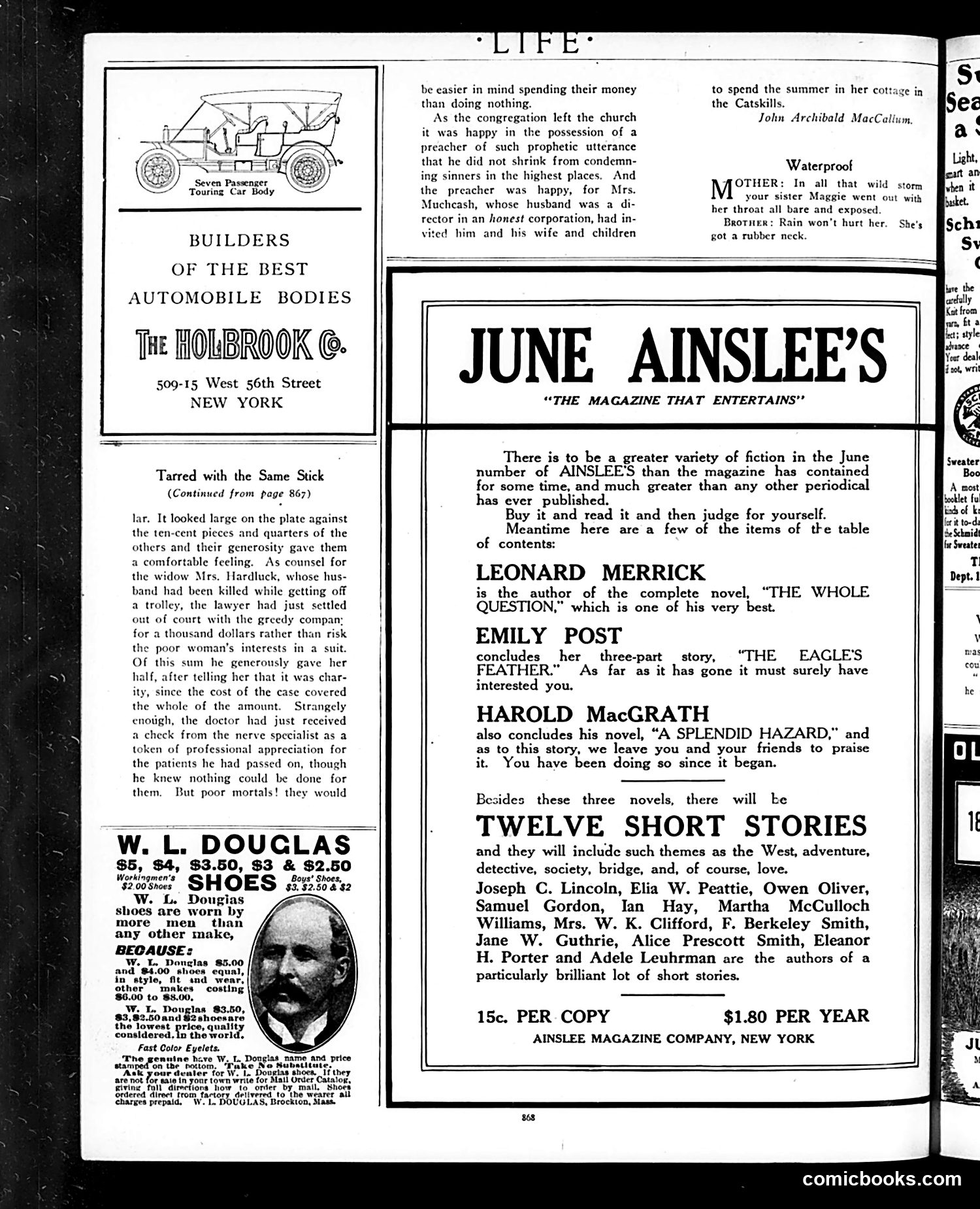
This page is primarily **advertising and magazine promotion** rather than satirical content. The left side contains ads for **The Holbrook Co.** (automobile bodies) and **W.L. Douglas Shoes**, featuring a portrait photograph of Douglas himself promoting his $3 and $4 shoes. The right side is a full-page advertisement for **June Ainslee's Magazine**, promoting its fiction content. It lists three complete novels by Leonard Merrick, Emily Post, and Harold McGrath, plus twelve short stories by various authors including Joseph C. Lincoln and Martha McCulloch Williams. The magazine cost 15 cents per copy or $1.80 annually. At the top right is a brief humor item titled "Waterproof" about a sister getting caught in a storm. This is essentially a **table of contents/subscription pitch**, not political satire.
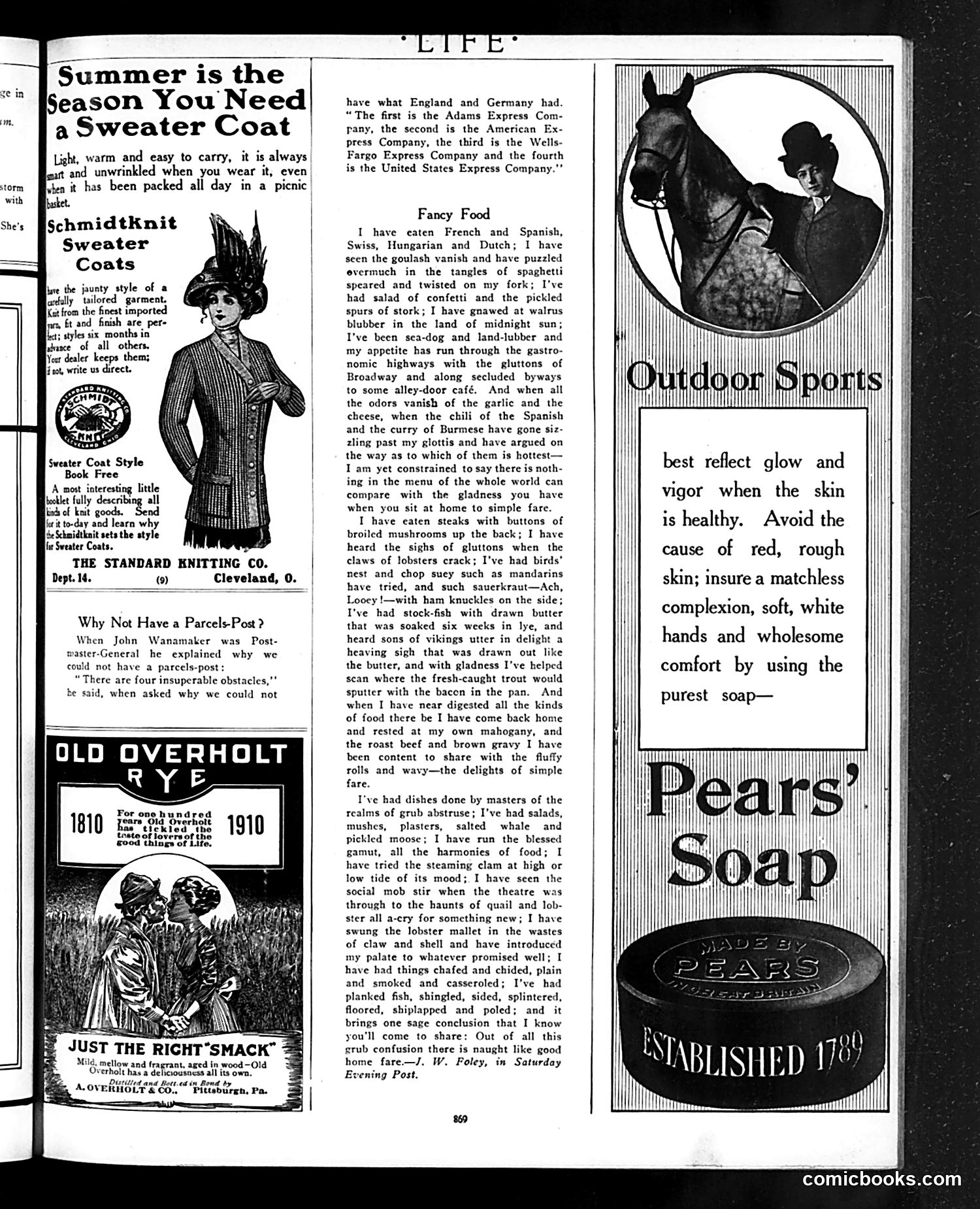
This page is primarily **advertising content** from Life magazine, circa 1910. It contains four separate ads: 1. **Schmidtknit Sweater Coats** - promotes lightweight summer coats for women 2. **Parcels-Post explanation** - discusses why the U.S. postal system couldn't implement parcel delivery (mentions four "insuperable obstacles") 3. **Old Overholt Rye whiskey** - a 100-year anniversary ad (1810-1910) 4. **Pears' Soap** - emphasizes healthy skin and complexion The center column features a lengthy article titled "Fancy Food" by J.W. Foley discussing international cuisine and dining experiences—not satire or political commentary. **No political cartoons or satirical content** appear on this page. It's a straightforward commercial issue mixing product advertisements with lifestyle editorial content typical of early 20th-century Life magazine.
This is a **full-page advertisement** for The Gorham Company, a New York silversmith, not a political cartoon or satirical content. The ad uses ornate decorative imagery—urns, garlands, and classical motifs—to evoke luxury and artistic tradition. The text employs romantic historical framing, comparing the silversmith's craft to ancient artisans and positioning Gorham silverware alongside great sculptors and painters. The advertisement claims Gorham's products represent the "Revival of the Silver Age," emphasizing beauty of design and superior quality. The decorative border and classical references are meant to suggest timeless elegance and justify premium pricing ("It costs no more than wares of less merit"). This represents typical early-20th-century luxury advertising strategy: associating consumer goods with high art and historical prestige.
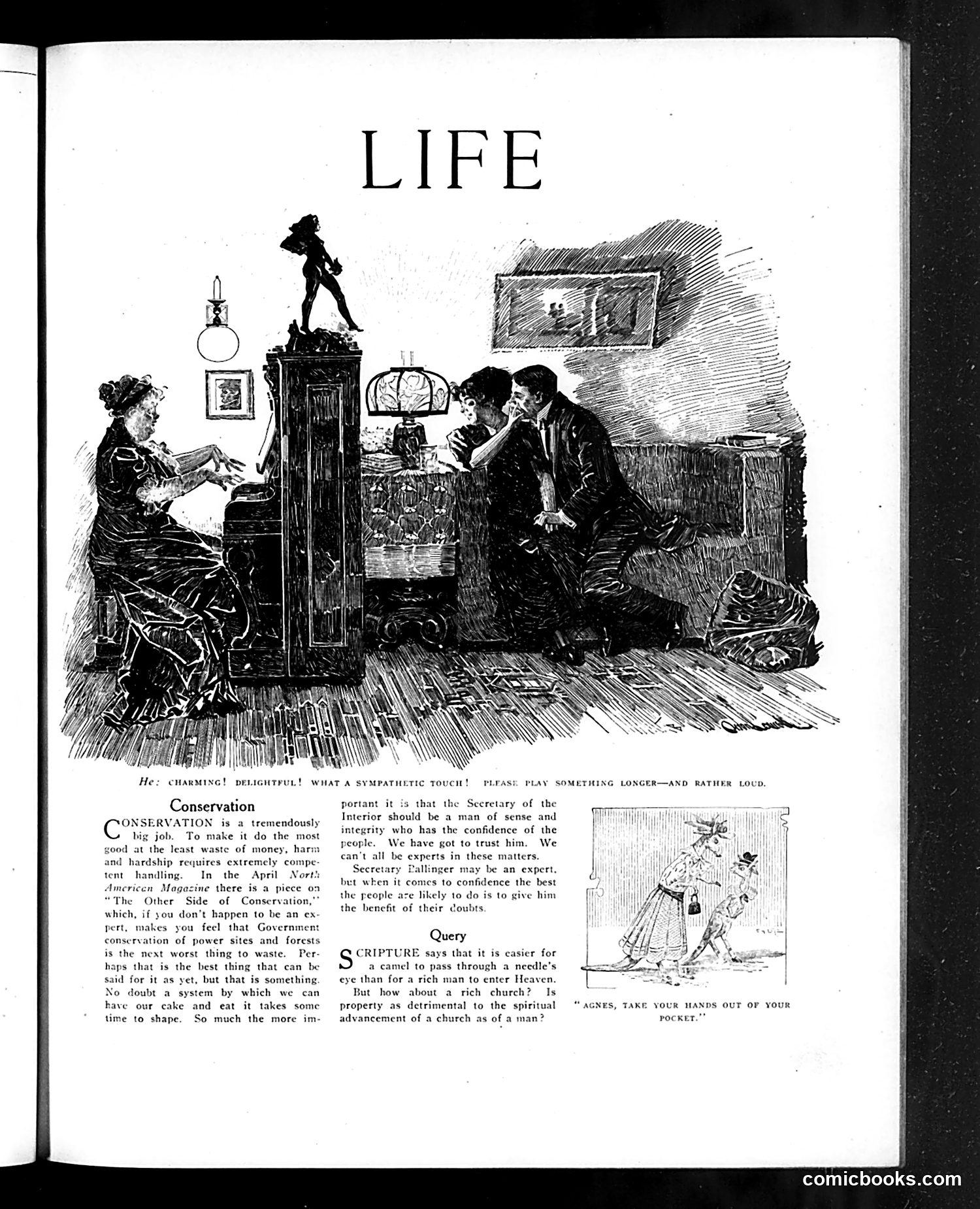
This page satirizes conservation policy and government waste. The main illustration shows a woman playing piano while three men listen—a scene labeled as "charming" but "rather loud," critiquing wasteful government spending on interior decoration. The accompanying article discusses Secretary of the Interior's management, arguing the position requires someone trustworthy rather than merely expert. It references an April *North's American Magazine* piece titled "The Other Side of Conservation," suggesting government conservation efforts paradoxically waste resources. The smaller cartoon ("Agnes, take your hands out of your pocket") appears to mock bureaucratic inefficiency or petty theft. The overall message: government conservation programs may themselves be wasteful, requiring better oversight and trustworthy leadership rather than mere technical expertise.
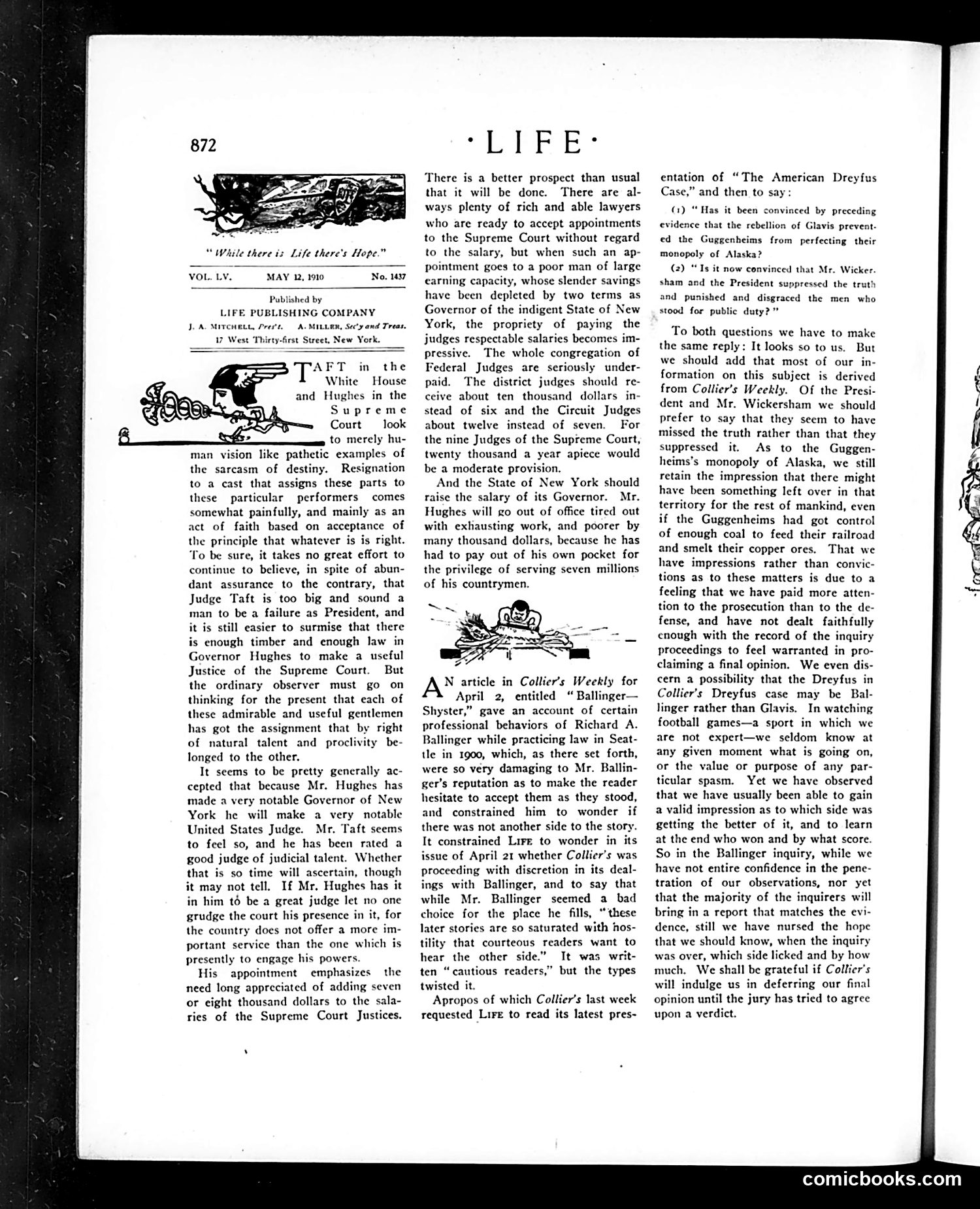
This page discusses **judicial salary reform**, specifically advocating for increased compensation for federal judges. The editorial argues that judges—particularly those on the Supreme Court and Circuit Courts—earn inadequate salaries (around $6,000-$20,000 annually) compared to successful private lawyers. The text criticizes **Governor Hughes of New York** (likely William Hughes), suggesting his departure for higher-paying private work illustrates the problem. The piece also references **Judge Taft** (William Howard Taft, then President), describing him as "too big and sound a man" for the presidency, implying talent is wasted in political office. The cartoons (small decorative illustrations) appear to support this satirical critique of governmental underpayment driving away talented administrators.
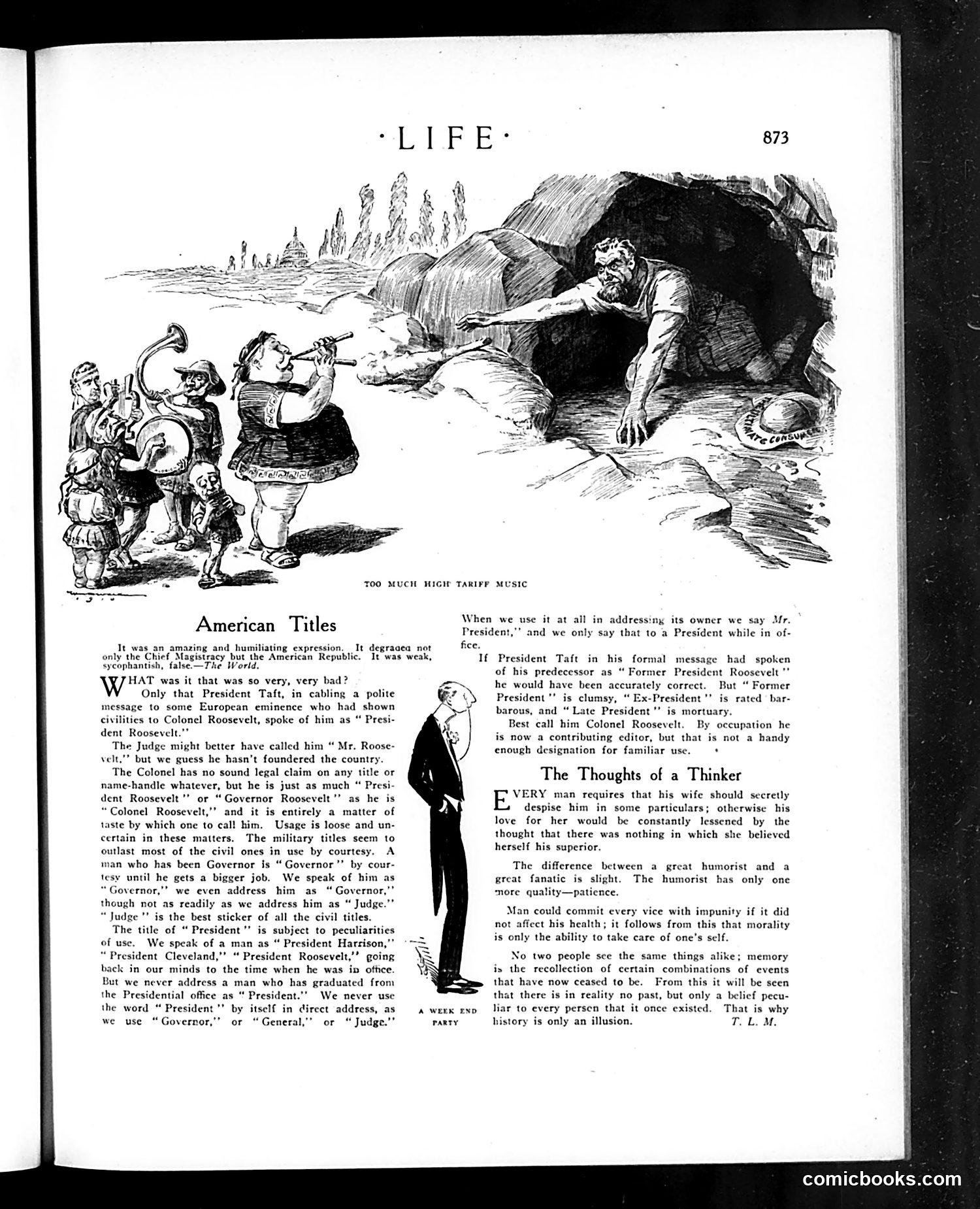
The main cartoon depicts a figure emerging from a cave, appearing distressed or exasperated, while musicians outside play instruments loudly. The caption "Too Much High Tariff Music" references debates over U.S. tariff policy—likely from the early 20th century when tariff disputes were contentious political issues. The figure in the cave appears to represent someone (possibly a political figure or the common citizen) driven to retreat by aggressive tariff-related rhetoric or policy. The "music" metaphor suggests constant, unwanted political messaging about tariffs. The surrounding text discusses presidential titles and addressing conventions, including references to Roosevelt, suggesting this addresses early 1900s political discourse. The satire criticizes what Life viewed as excessive or bothersome tariff advocacy in public debate.
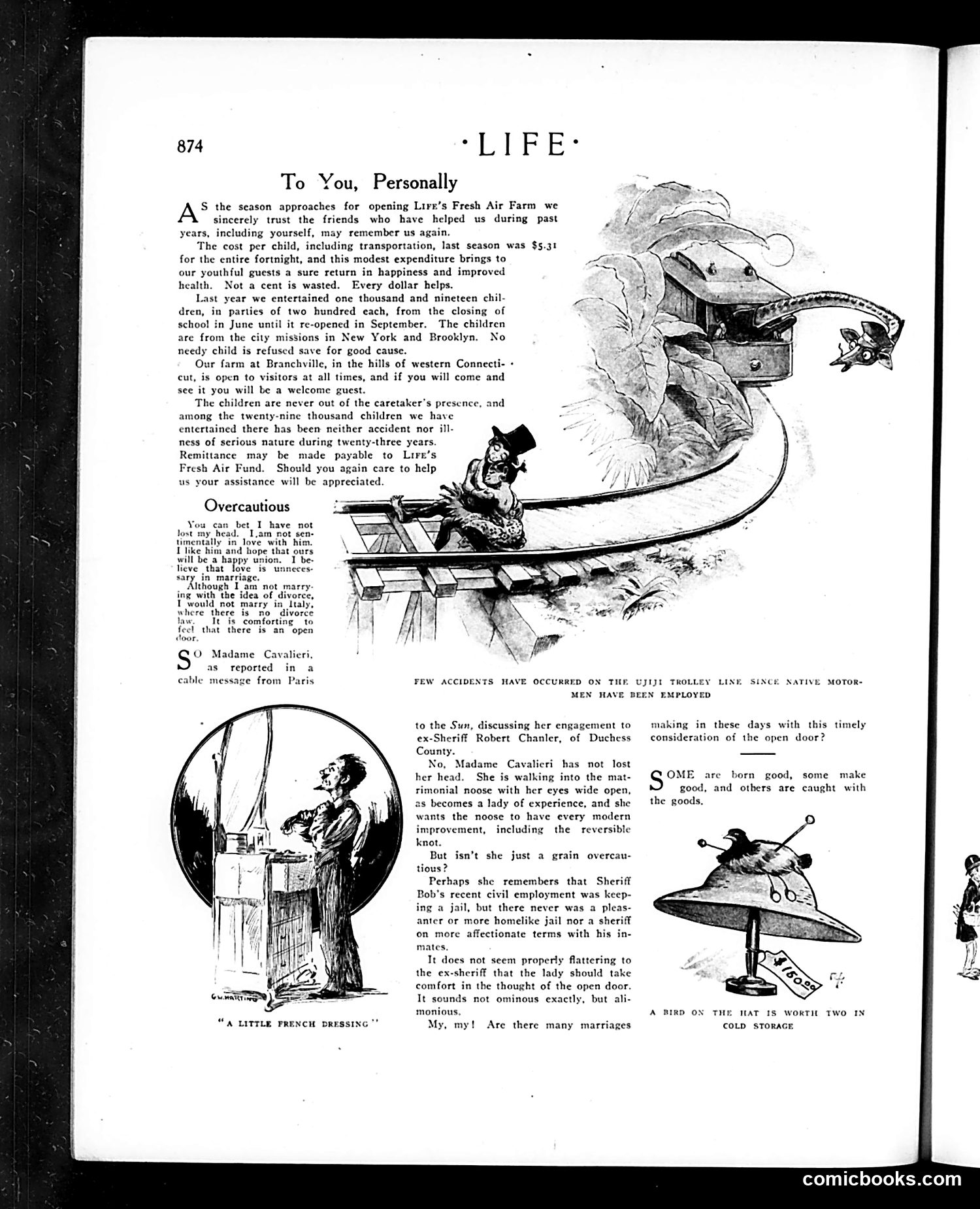
This page contains **two distinct satirical pieces**: 1. **"To You, Personally"** (top): A fundraising appeal for Life magazine's Fresh Air Farm, a charitable program providing summer breaks for 1,000+ underprivileged children from New York and Brooklyn missions annually. The text emphasizes safety and modest cost ($5.31 per child), soliciting donations. 2. **"Overcautious"** (bottom): Satirizes Madame Cavalieri's engagement to ex-Sheriff Robert Chanler. The joke mocks her pragmatic (rather than romantic) approach to marriage—she explicitly states she doesn't love him but sees marriage as "necessary," and crucially, she's marrying in New York (not Italy) because New York permits divorce. The satire ridicules her coldly calculating attitude, viewing marriage as a reversible contract rather than a romantic commitment. The caption about the trolley line and aphorisms about morality add cynical commentary on modern relationships.
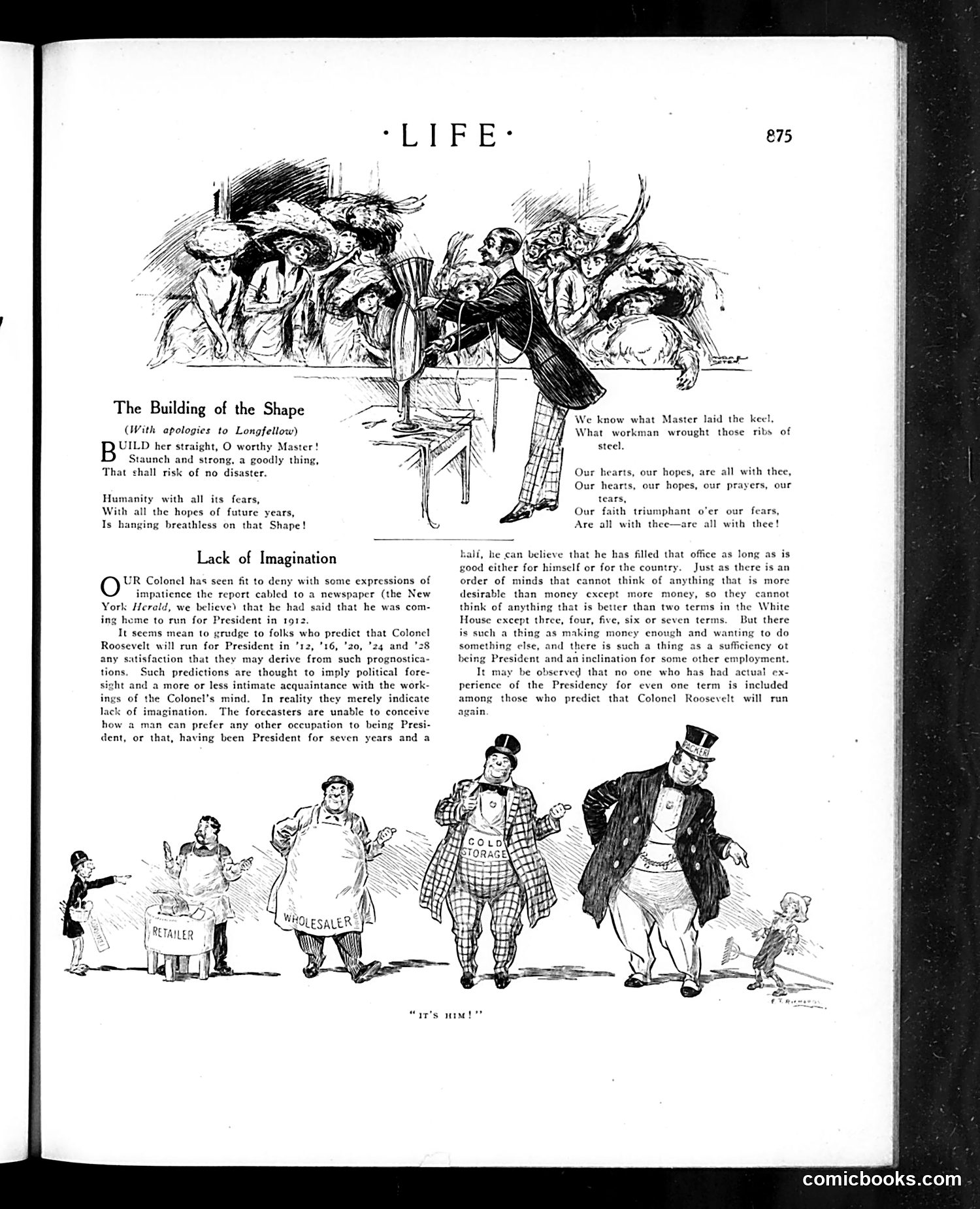
This Life magazine page contains two satirical pieces about Theodore Roosevelt circa 1912. **"The Building of the Shape"** (top) is a patriotic poem with accompanying illustration showing politicians and businessmen constructing something, likely referencing Roosevelt's political influence and legacy-building. The poetic language ironically elevates what is essentially political maneuvering. **"Lack of Imagination"** (main article) mocks those predicting Roosevelt will run for President in 1912, 1916, 1920, and beyond. The satire argues that people making such predictions simply lack imagination—they cannot conceive that anyone would *not_ want to be President repeatedly. The author suggests there's a psychological type (like those obsessed with making money) who cannot imagine preferring anything to high office. **The bottom cartoon** ("It's him!") shows a progression of figures labeled "Retailer," "Wholesaler," and "Gold Storage," suggesting Roosevelt's political influence permeates all levels of commerce and society. The overall message: Roosevelt's ambitions and potential future candidacies dominate political discourse, revealing both his outsized influence and the limited imagination of those analyzing his intentions.
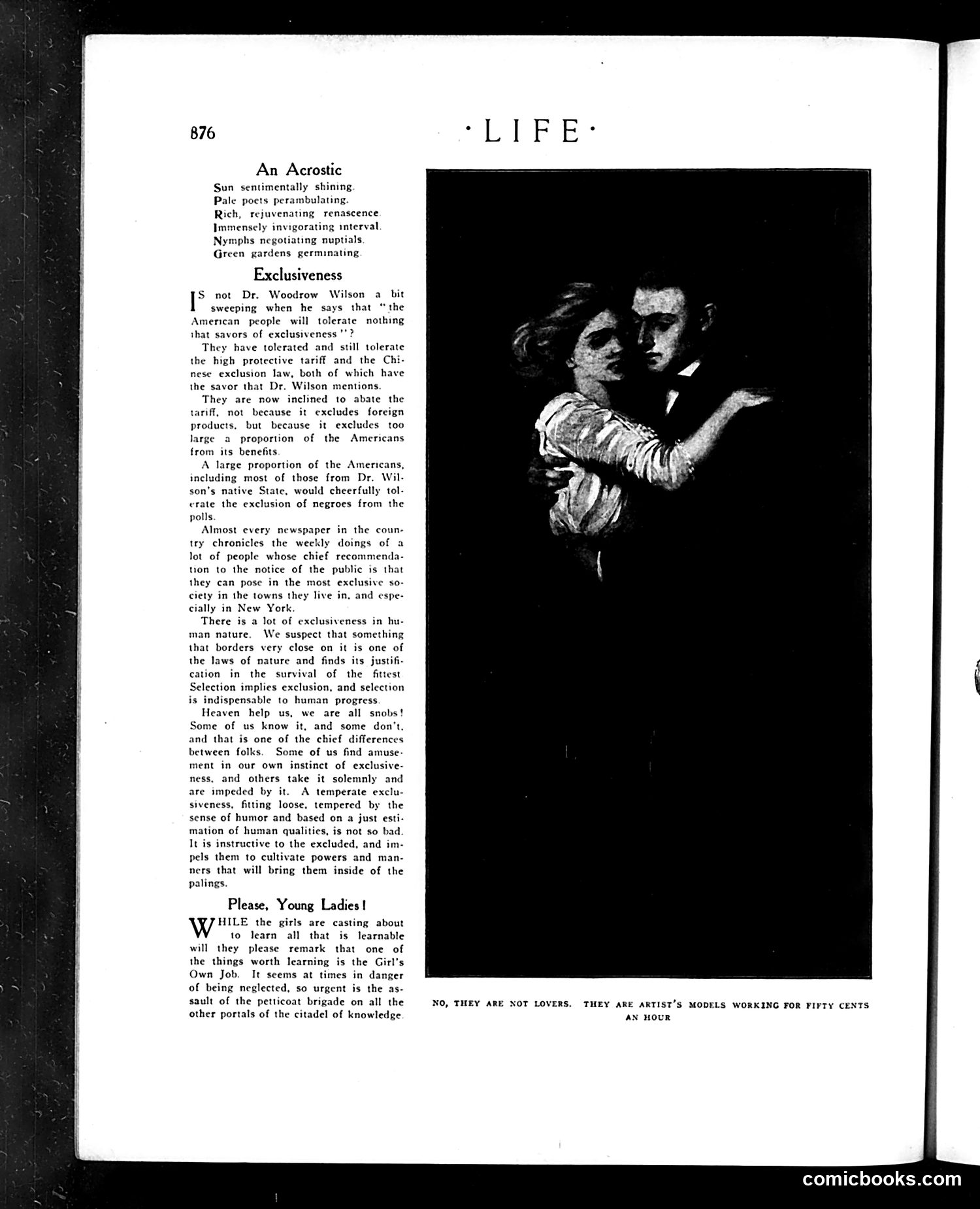
This page critiques American hypocrisy regarding exclusion. The main article attacks President Woodrow Wilson's claim that Americans reject exclusiveness, pointing out contradictions: the country tolerates protective tariffs and the Chinese Exclusion Law while many (particularly from Wilson's home state) support excluding Black voters from polls. The piece argues exclusiveness is human nature, even universal—"we are all snobs"—but advocates temperate exclusiveness tempered by humor. The accompanying photograph shows young women posing as artist's models, earning fifty cents per hour. The caption's defensive tone ("NO, THEY ARE NOT LOVERS") suggests contemporary anxiety about women's employment and public visibility. The "Please, Young Ladies!" section warns girls not to neglect domestic skills while pursuing other knowledge—a conservative plea against women's expanding ambitions beyond traditional "Girl's Own Job" roles.
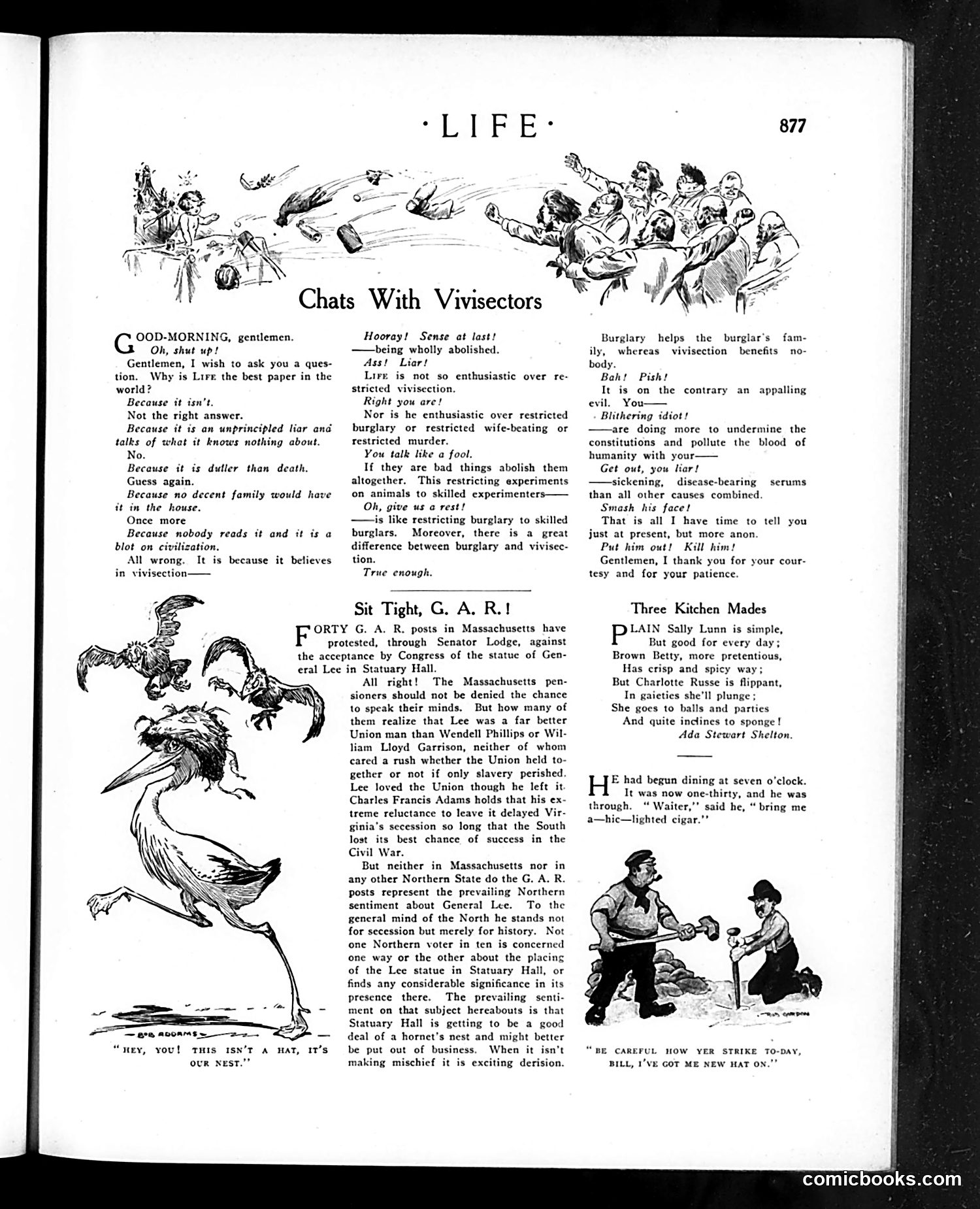
This page contains three distinct pieces of satire: **"Chats With Vivisectors"** (top): A mock dialogue ridiculing *Life* magazine itself while debating animal experimentation. The speaker argues that restricting vivisection to skilled experimenters is absurd—equivalent to restricting burglary or wife-beating to "skilled" practitioners. The piece advocates for complete abolition of animal testing, using deliberately provocative comparisons to highlight what the author sees as the practice's fundamental wrongness. **"Sit Tight, G.A.R.!"** (center): Commentary on Massachusetts Civil War veterans' groups protesting a General Lee statue in Statuary Hall. The author argues Northern public opinion doesn't actually care about the statue's placement—that Lee represents history, not secession—and that Statuary Hall itself has become a troublesome "hornet's nest." **"Three Kitchen Maids"** and the dinner cartoon (bottom): Light domestic humor involving cooking and evening dining etiquette, unrelated to political content. The page exemplifies *Life*'s mix of pointed social criticism and genteel humor typical of early 20th-century American satire.
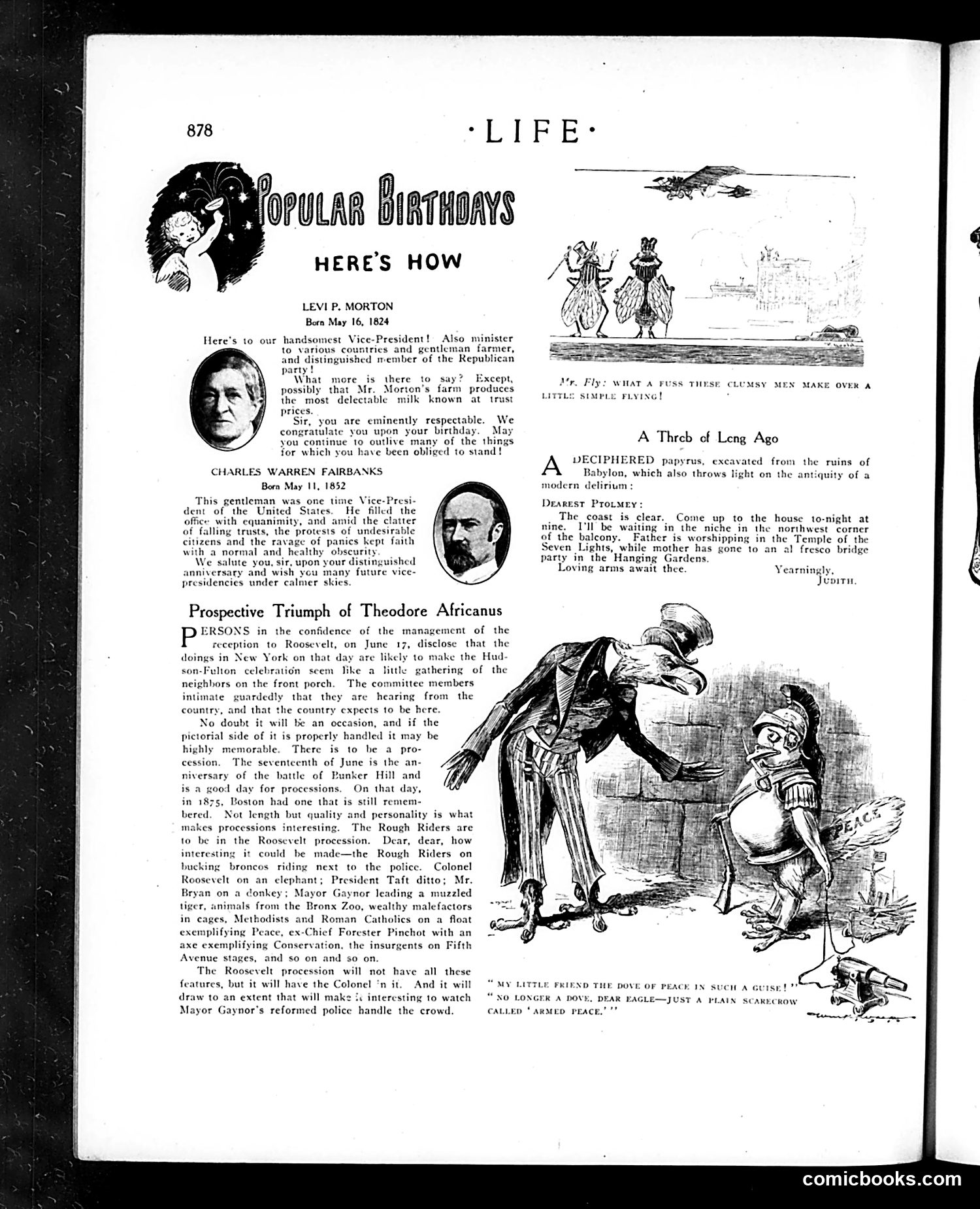
This page contains three satirical pieces typical of early 1900s American political commentary: **"Popular Birthdays"** mocks Vice Presidents Levi Morton and Charles Warren Fairbanks with backhanded compliments—praising their obscurity and unremarkable records while slyly referencing corporate trusts and political scandals they navigated. **"Prospective Triumph of Theodore Africanus"** satirizes an upcoming Roosevelt reception (June 17, likely 1910). The satire imagines an absurdly elaborate procession mixing political figures, wild animals, and social commentary—suggesting Roosevelt's popularity would draw massive crowds. The title's "Africanus" appears to mock grand historical pretensions. **"A Throb of Long Ago"** is a humorous mock-ancient text presenting a romantic note as a "deciphered papyrus" from Babylon, juxtaposing modern romantic secrecy with ancient settings for comic effect. The **cartoon** shows a military/political figure struggling with peace symbolism, captioned about doves becoming "scarecrows"—likely critiquing Roosevelt's militarism versus pacifist rhetoric.
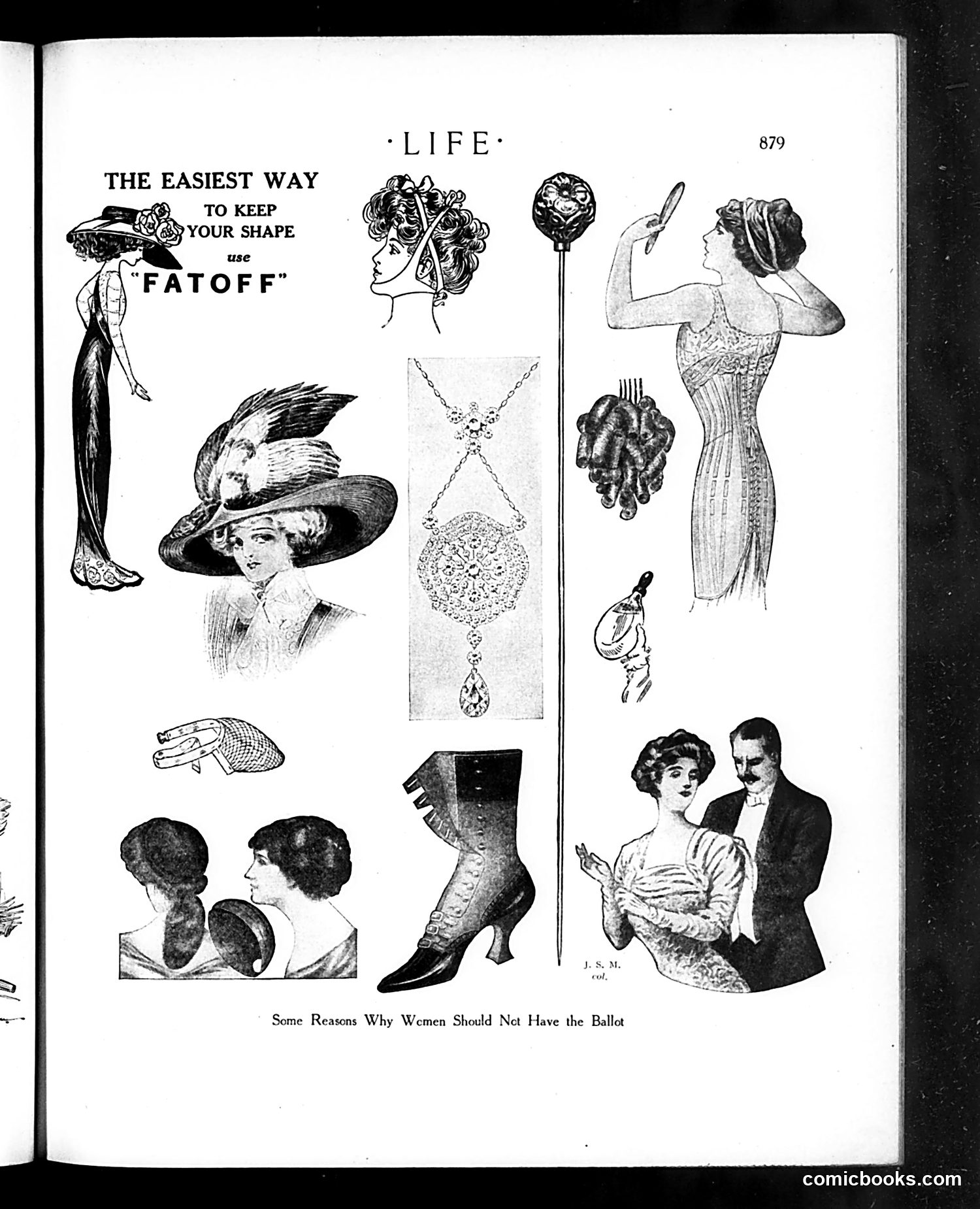
This is a **satirical anti-suffrage advertisement** (though the OCR appears garbled—"Wemen" and "Net" should likely read "Women" and "Not"). The page mocks arguments *against* women's voting rights through visual humor. The left side shows a "Fatoff" corset advertisement alongside images of fashionable women's accessories (hats, jewelry, shoes, hairstyles), and feminine silhouettes. The right side depicts women concerned with appearance and social activities. The satire's point: the caption "Some Reasons Why Women Should Not Have the Ballot" pairs these images suggesting opponents claimed women were too preoccupied with fashion, beauty, and social life to handle political responsibility. By juxtaposing superficial concerns with voting rights, Life magazine appears to be **mocking the anti-suffrage position**—implying it was absurd and based on sexist stereotypes rather than legitimate concerns. This reflects early 20th-century American suffrage debate.
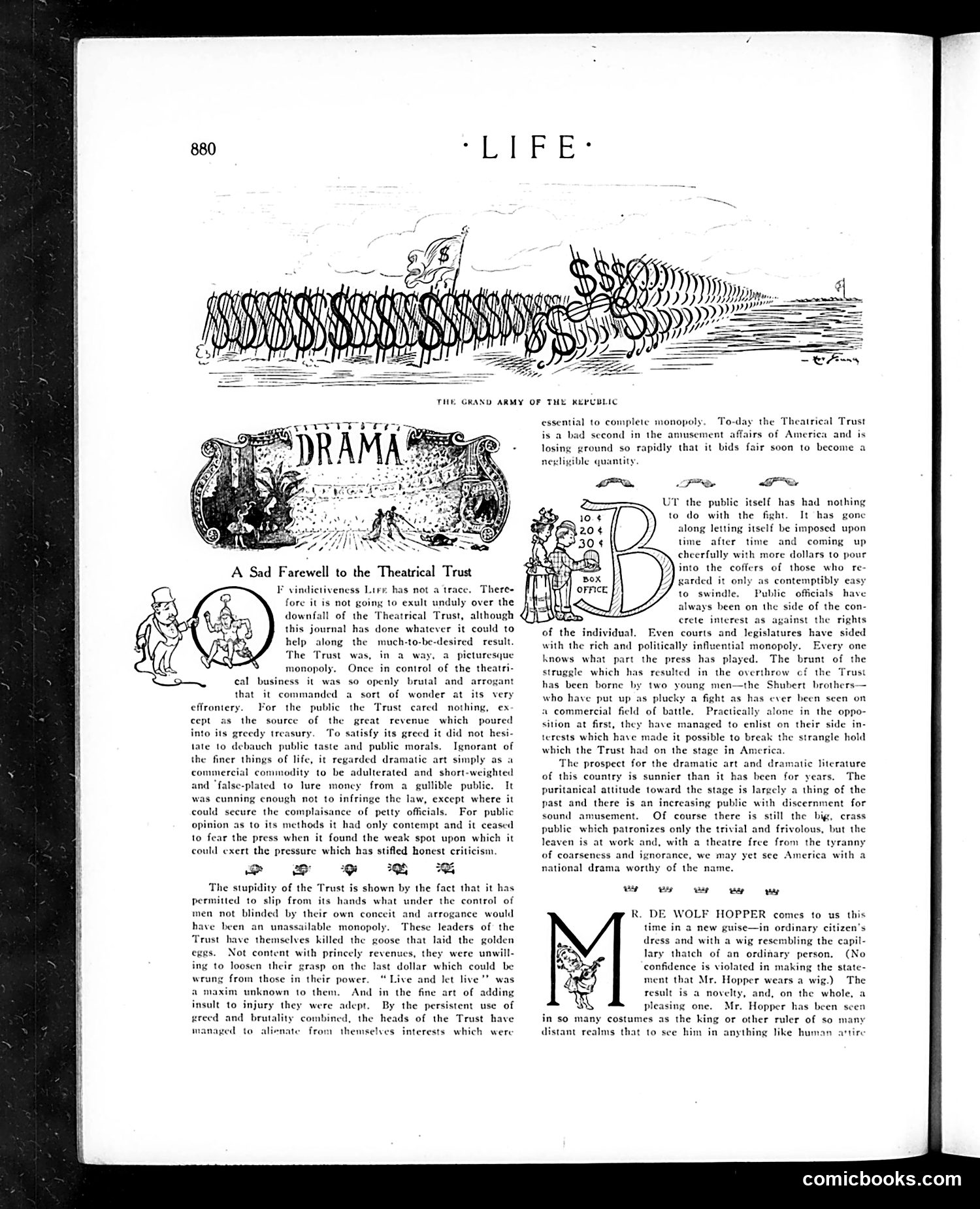
This page satirizes the **collapse of the Theatrical Trust**, a monopoly that controlled American theater. The cartoonist depicts its demise as a military defeat, with dollar signs replacing soldiers in the "army"—mocking how greed, not principle, motivated the Trust. The article praises the Trust's downfall, condemning it as a brutally exploitative monopoly that treated theater as mere commerce, debauched public taste, and corrupted officials and press. However, the satire's bite is two-edged: while celebrating the Trust's arrogance and comeuppance, the piece criticizes the **American public** for passively accepting exploitation for years, and notes that courts, legislatures, and officials sided with the monopoly's interests over the public's. The **Shubert brothers** (unnamed here but clearly referenced) are credited as the young rebels who broke the Trust's stranglehold. The article expresses hope that theater might now achieve artistic merit rather than serving only commercial greed.
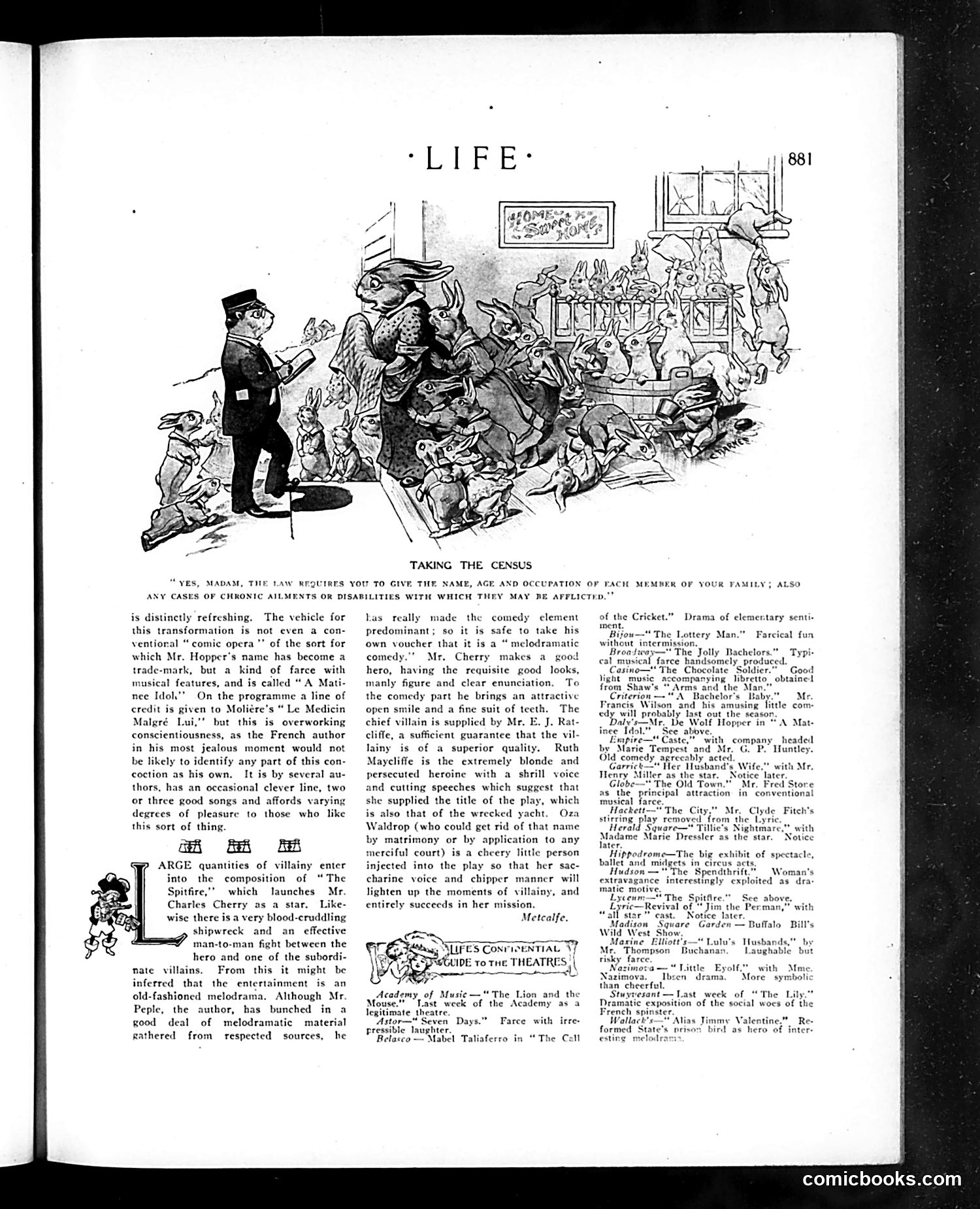
This page satirizes the **U.S. Census**, likely from the early 1900s. The main cartoon depicts a census-taker confronting a chaotic household—a woman surrounded by numerous children and household members in disarray. The humor targets the invasiveness of census questions: the official must ask not just names and ages, but also occupations and detailed medical information ("chronic ailments or disabilities"). The satire reflects contemporary anxiety about government intrusion into private family matters. The cartoon exaggerates the census-taker's formal authority against the domestic chaos he encounters, mocking both bureaucratic overreach and the difficulty families faced providing such personal information. The page also contains theater reviews, suggesting this is from Life magazine's typical mix of social commentary and entertainment coverage.
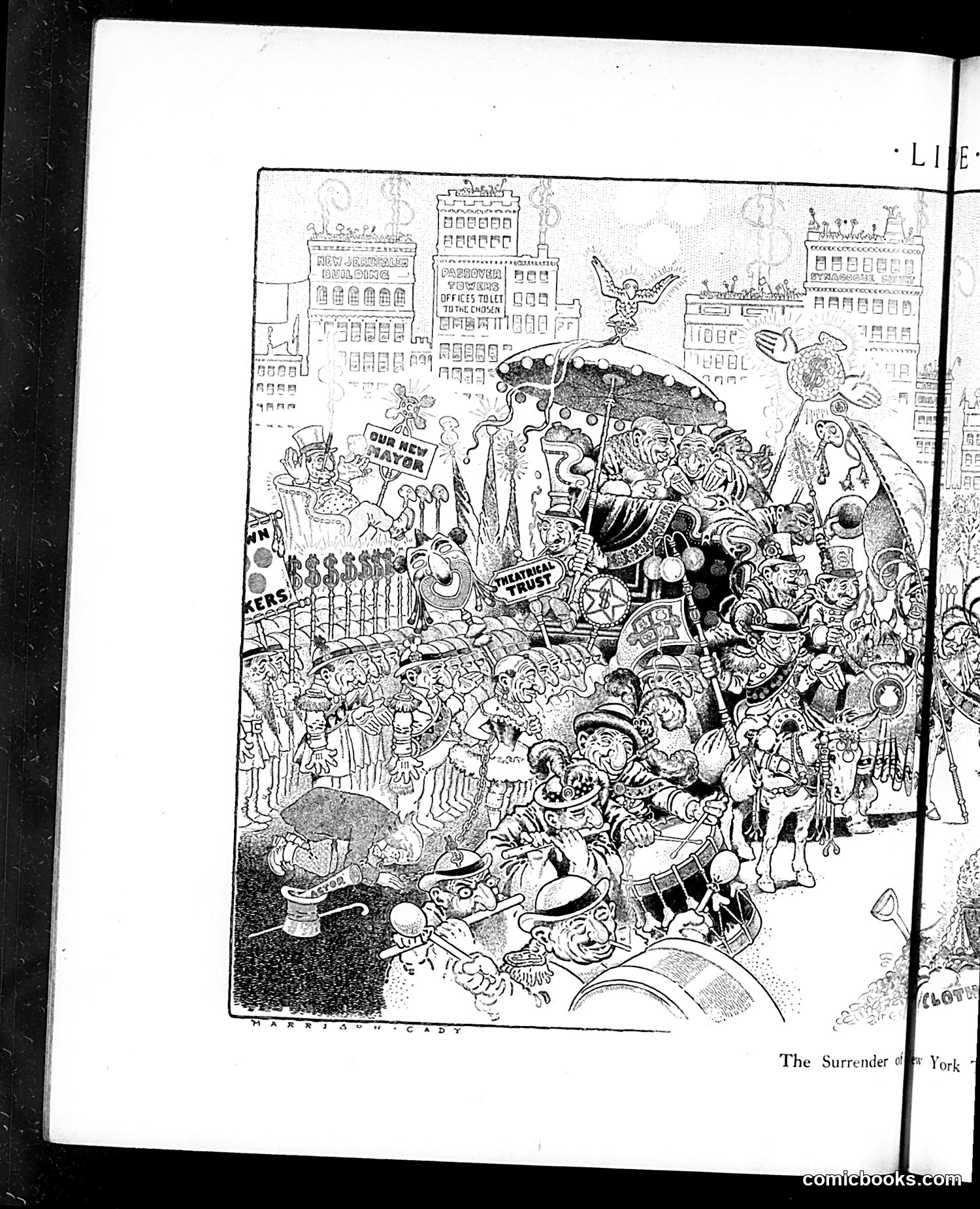
This satirical cartoon depicts New York City surrendering to carnival chaos and theatrical excess. The massive central figure appears to be a theatrical personality or showman dominating the cityscape, surrounded by performers, musicians, dancers, and spectators in elaborate costumes. References include "Theatrical Trust" and "Our New Mayor," suggesting satire about city leadership being overwhelmed by entertainment industry influence. The cartoon mocks how theatrical interests and commercial entertainment have taken over municipal governance. Tall buildings frame the chaotic scene, emphasizing the contrast between orderly urban architecture and the anarchic performance consuming it. This likely critiques early 20th-century concerns about commercialism and entertainment industry power corrupting city governance and civic culture.
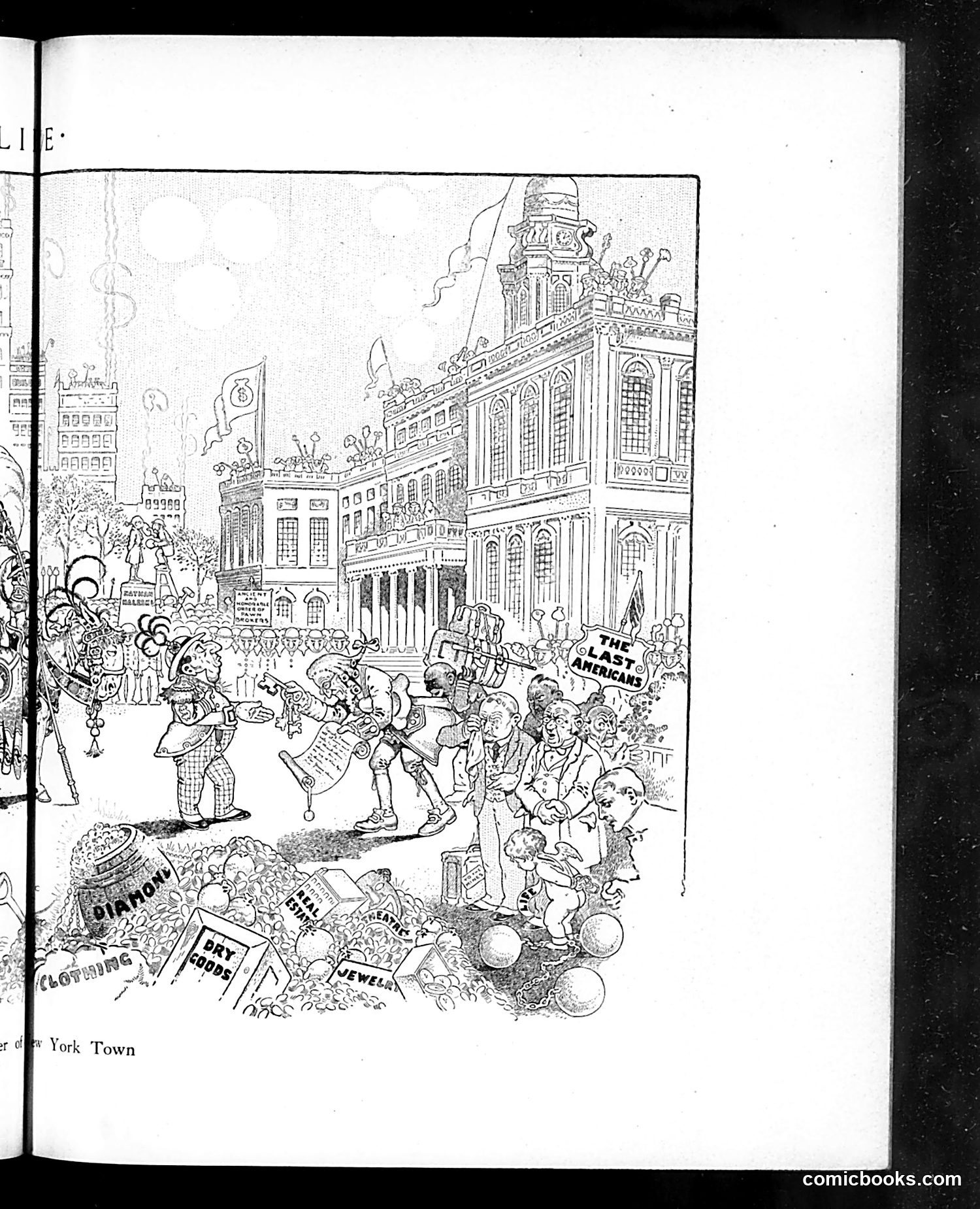
This satirical illustration depicts a chaotic street scene in New York, showing wealth disparity and consumer culture. The foreground is littered with luxury goods—labeled items including "DIAMONDS," "CLOTHING," "JEWELRY," and "FURS"—scattered like trash or spoils. Well-dressed figures and crowds surround grand commercial buildings in the background, suggesting rampant consumerism and materialism. The cartoon appears to critique early 20th-century urban excess and commercialism in New York City. The juxtaposition of fine merchandise treated as refuse suggests commentary on wasteful consumption or the frivolous nature of wealth accumulation during this period. The crowded, chaotic composition emphasizes how commerce dominates city life. The specific historical context—whether this references a particular economic event or social trend—remains unclear without additional page context.
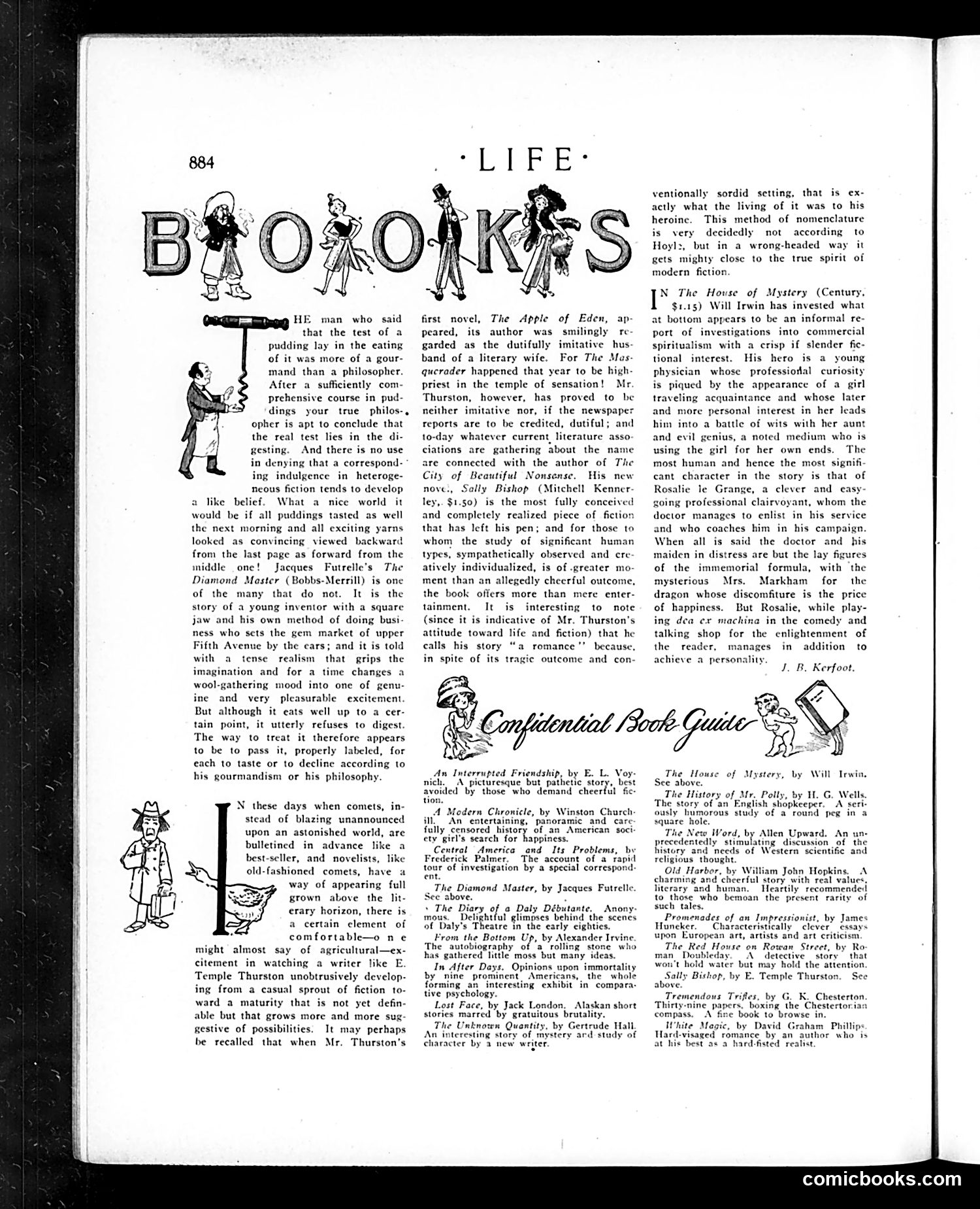
This page features a book review column discussing recent novels. The main text critiques Jacques Futrelle's *The Diamond Master*, using a metaphor comparing novels to puddings—they may taste good while reading but fail to "digest" afterward, meaning the plot doesn't hold up upon reflection. The column also praises E. Temple Thurston's *Sally Bishop*, noting his literary development from being dismissed as merely the husband of a famous writer (*The Masquerader*'s author) to becoming a serious novelist in his own right. Thurston calls his tragic story a "romance" rather than a tragedy—a comment on his artistic philosophy. The right side contains a "Confidential Book Guide" listing other contemporary titles with brief assessments, helping readers choose books by their mood preferences—notably distinguishing between those seeking cheerful outcomes versus those interested in serious character study.
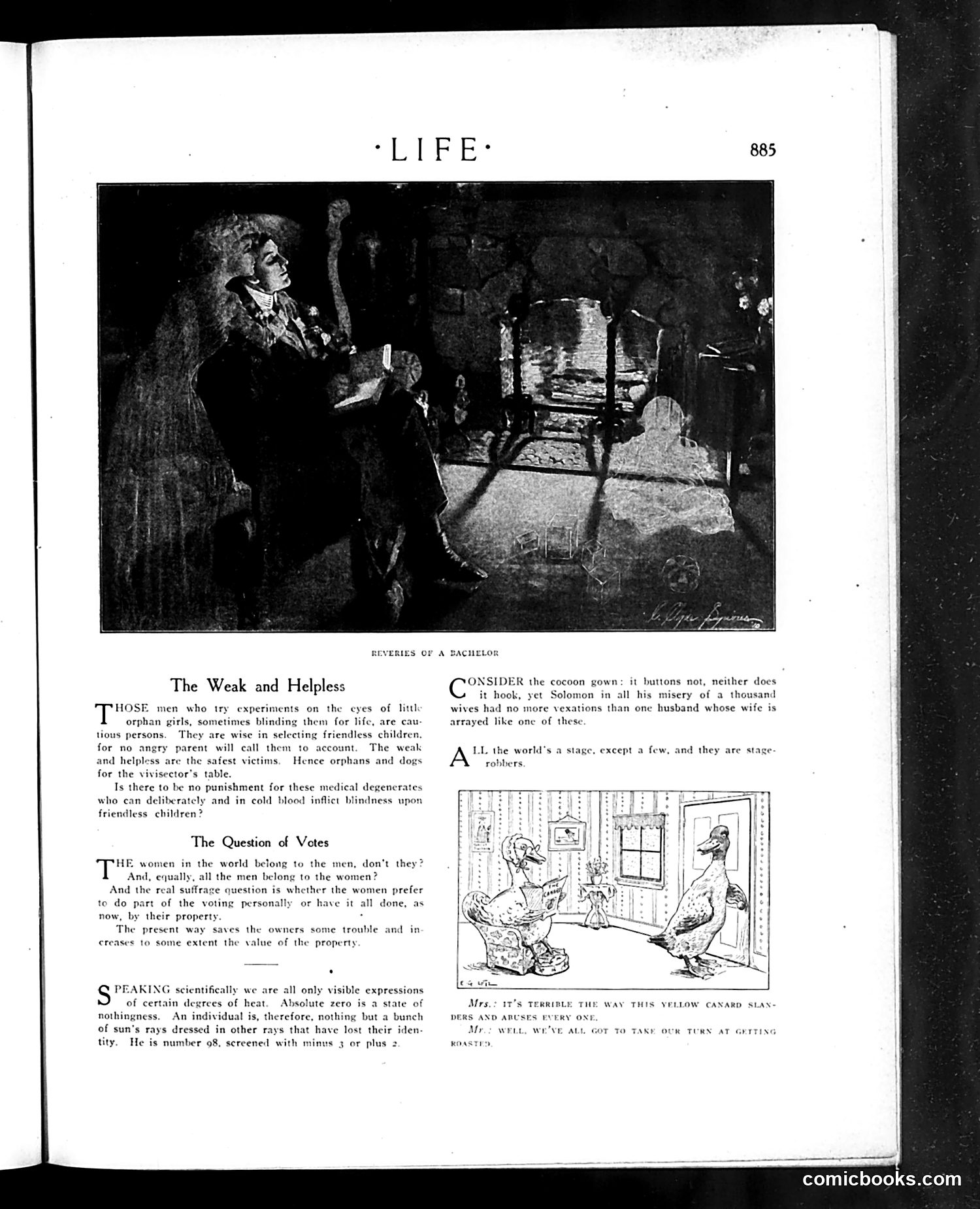
This page contains three distinct satirical pieces: **"The Weak and Helpless"** attacks medical experimenters who conduct eye tests on orphans and defenseless children, calling them "medical degenerates." This likely references actual vivisection controversies of the era—testing cosmetics or procedures on vulnerable populations. **"The Question of Votes"** satirizes women's suffrage debates. It mockingly suggests women "belong" to men and questions whether women should vote directly or let men vote on their behalf—a jab at anti-suffrage arguments that women's interests were already represented through male relatives. **"A Bachelor"** criticizes women's fashion, specifically the "cocoon gown" that buttons nowhere, comparing its complications unfavorably to Solomon's marital troubles. The cartoon (bottom) depicts two gossiping women discussing a "yellow canard" (false rumor) about a canary, with one proposing they "take our turn at getting roasted"—likely satirizing women's tendency toward gossip or social scandal-mongering. The overall tone is cynical about medical ethics, women's political status, and gender relations.
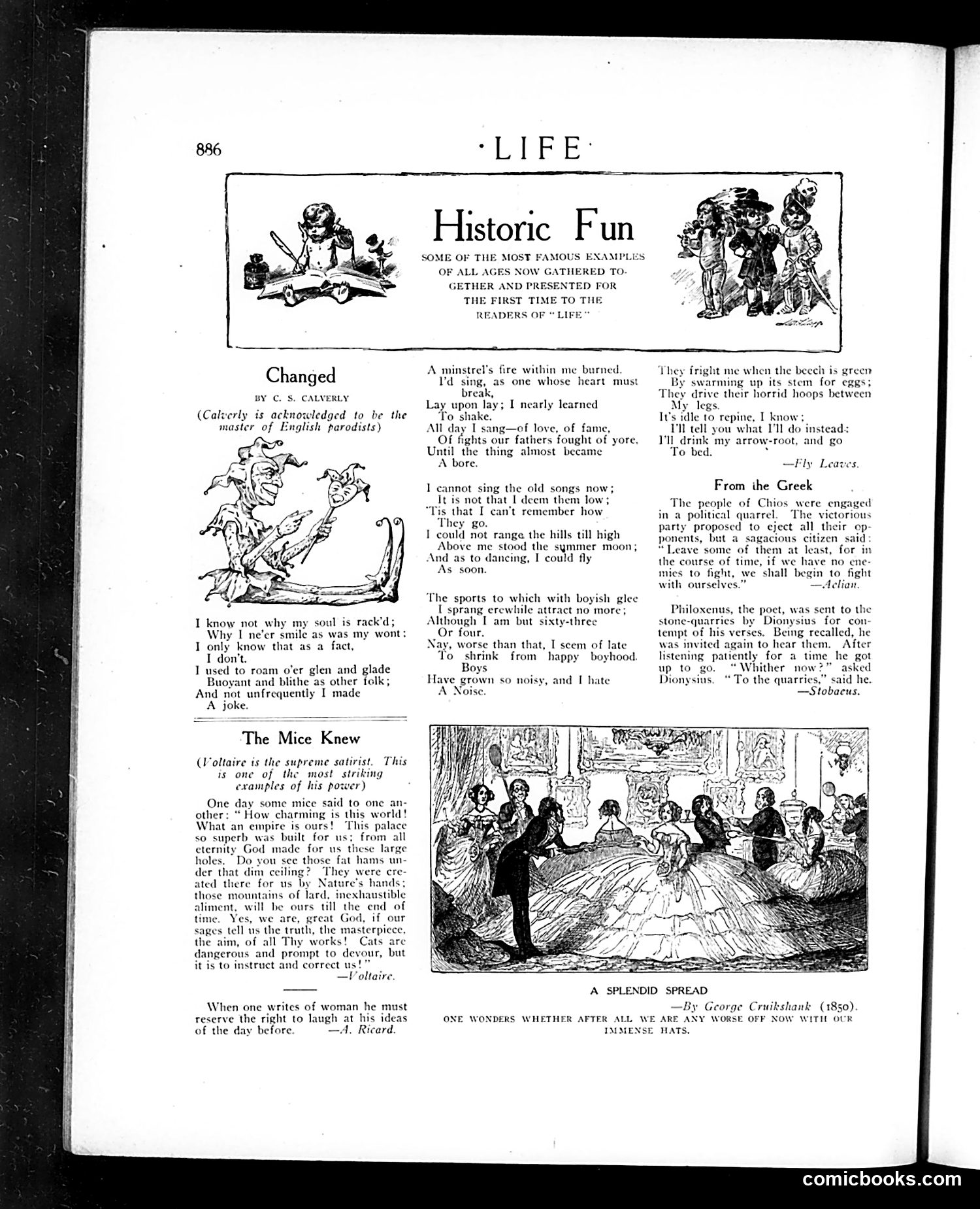
This is a literary humor page from *Life* magazine featuring classical and historical anecdotes rather than contemporary political cartoons. The content includes: 1. **"Changed" by C.S. Calverly** — A poem about aging and lost vitality. The speaker laments he no longer sings, dances, or enjoys boyish pursuits; now he's irritated by noisy children and prefers arrow-root and bed. It's gentle satire on middle age and nostalgia. 2. **"The Mice Knew"** — A passage attributed to Voltaire mocking religious complacency. Mice congratulate themselves as God's masterpiece while ignoring that cats threaten them; the satire critiques blind faith and self-delusion. 3. **Classical anecdotes from Greek sources** about political wisdom and artistic pride. 4. **A Cruikshank illustration** (1850) captioned about whether modern hats represent progress. The page is predominantly literary, presenting historical examples of satire and wit rather than current events commentary. It demonstrates *Life*'s role as a magazine of cultural sophistication and classical learning for educated readers.
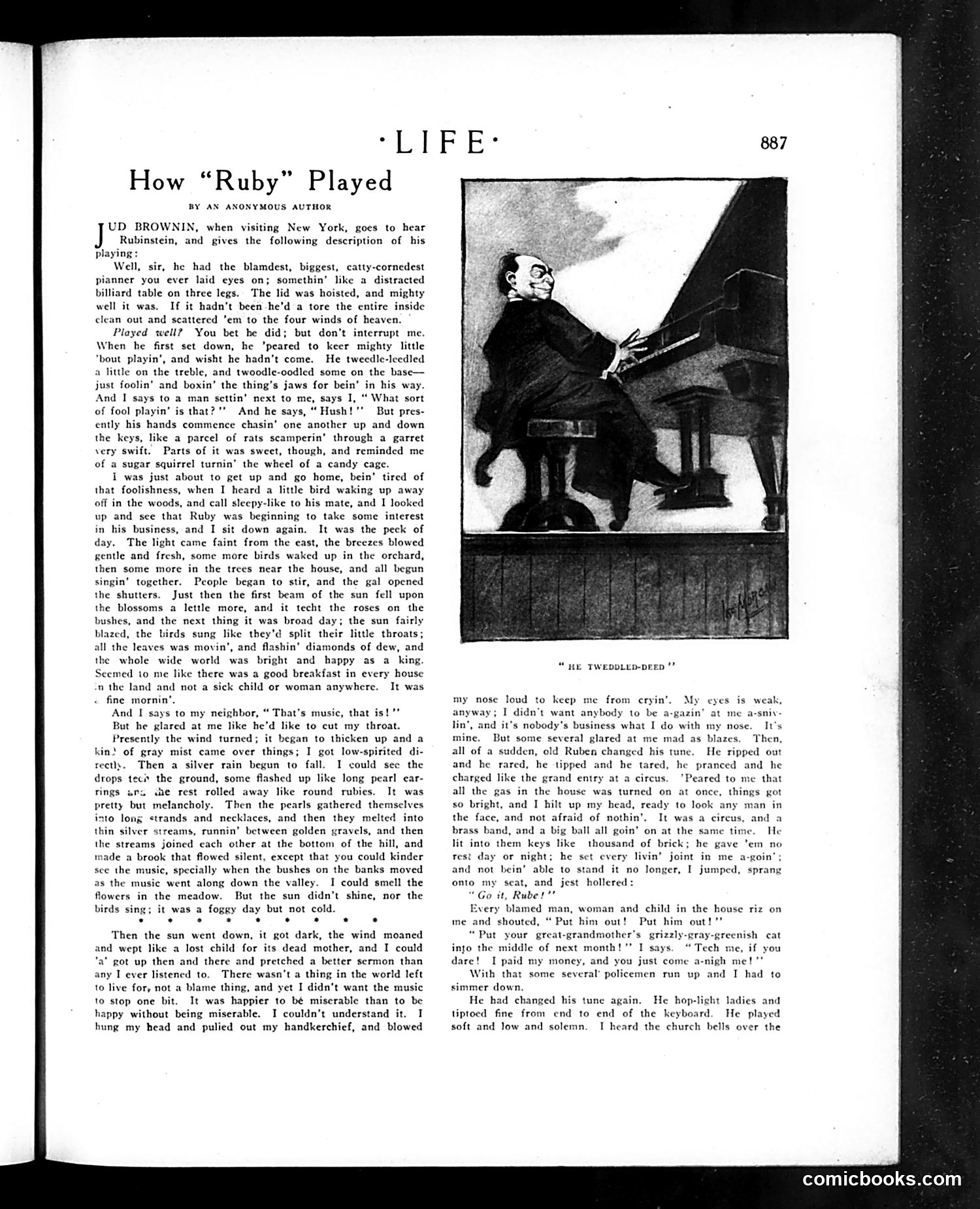
This page from Life magazine contains a humorous account of attending a piano recital by Anton Rubinstein, a famous 19th-century pianist. The accompanying illustration shows Rubinstein at the piano. The satire uses exaggerated, folksy dialect to describe the musician's performance in terms a rural American character might use. Rather than technical musical language, the narrator compares Rubinstein's playing to natural phenomena: birdsong at dawn, rainfall, flowing streams—suggesting the music's power to evoke vivid emotional and sensory experiences. The joke targets both pretentious concert-goers (who glare when the narrator speaks plainly about the music) and the difficulty of describing great art in everyday language. By having an unsophisticated observer capture Rubinstein's genius through simple imagery rather than musical terminology, Life satirizes the gap between elite cultural institutions and common people's genuine appreciation of artistry.
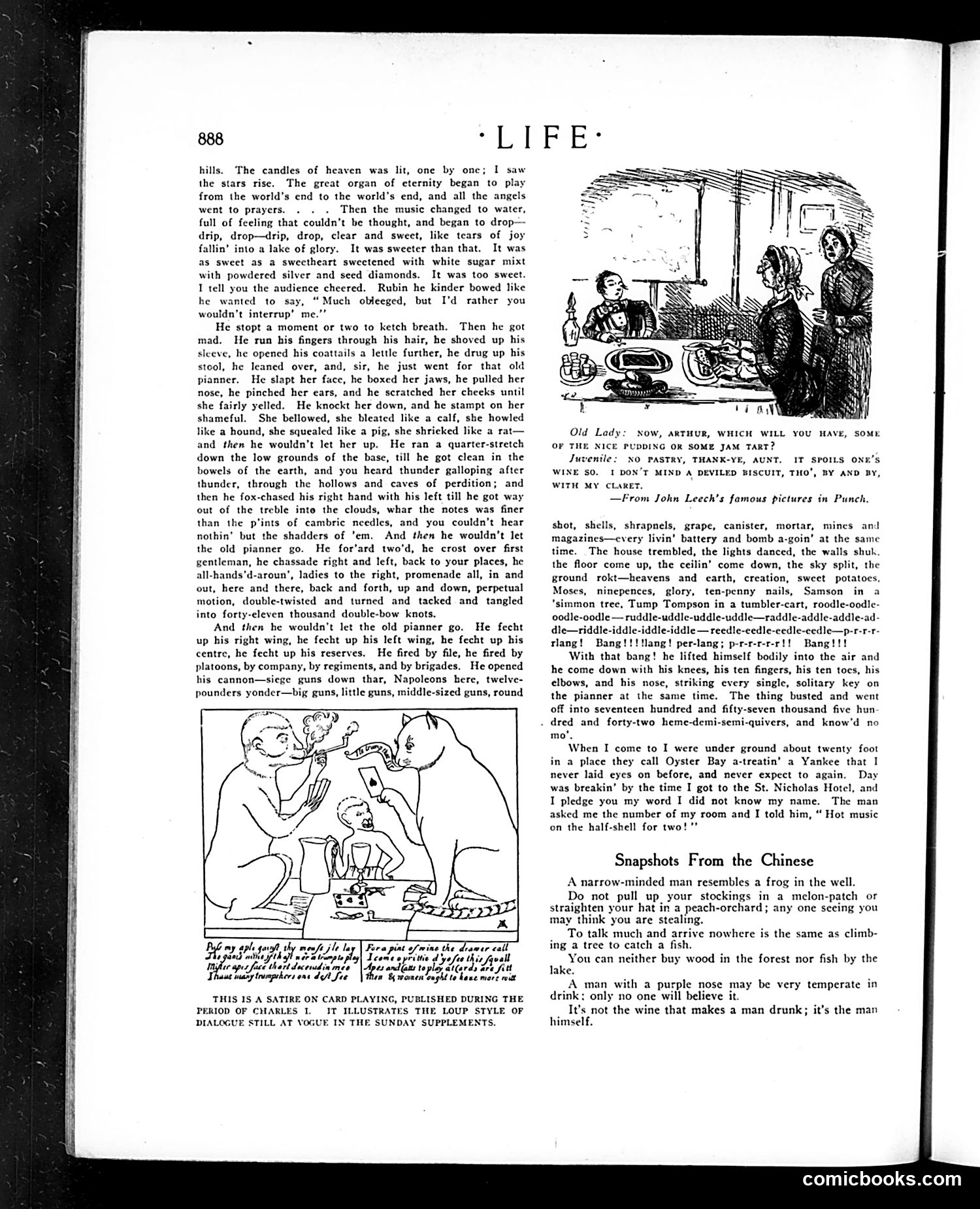
This page contains two distinct satirical pieces: **Upper section:** A vivid tall tale describing a pianist's dramatic performance. The narrator uses exaggerated, vernacular language to describe how a musician named Rubin violently attacks his piano, initially playing beautifully ("candles of heaven"), then assaulting the instrument with theatrical intensity—boxing it, scratching it, making it produce thunderous sounds. The satire mocks overwrought Romantic-era musical performance and the tendency toward bombastic emotional expression disguised as artistry. **Lower section:** A caption identifies this as satire on card-playing from the Charles I period, illustrating outdated "loup style" dialogue from Sunday supplements. An accompanying cartoon (by John Leech, famous Punch illustrator) shows a precocious child rejecting pudding but requesting wine and "deviled biscuit," satirizing affected, pretentious behavior in youth—poking fun at overly sophisticated or precious mannerisms presented as genteel refinement. Both target affectation masquerading as culture or sophistication.
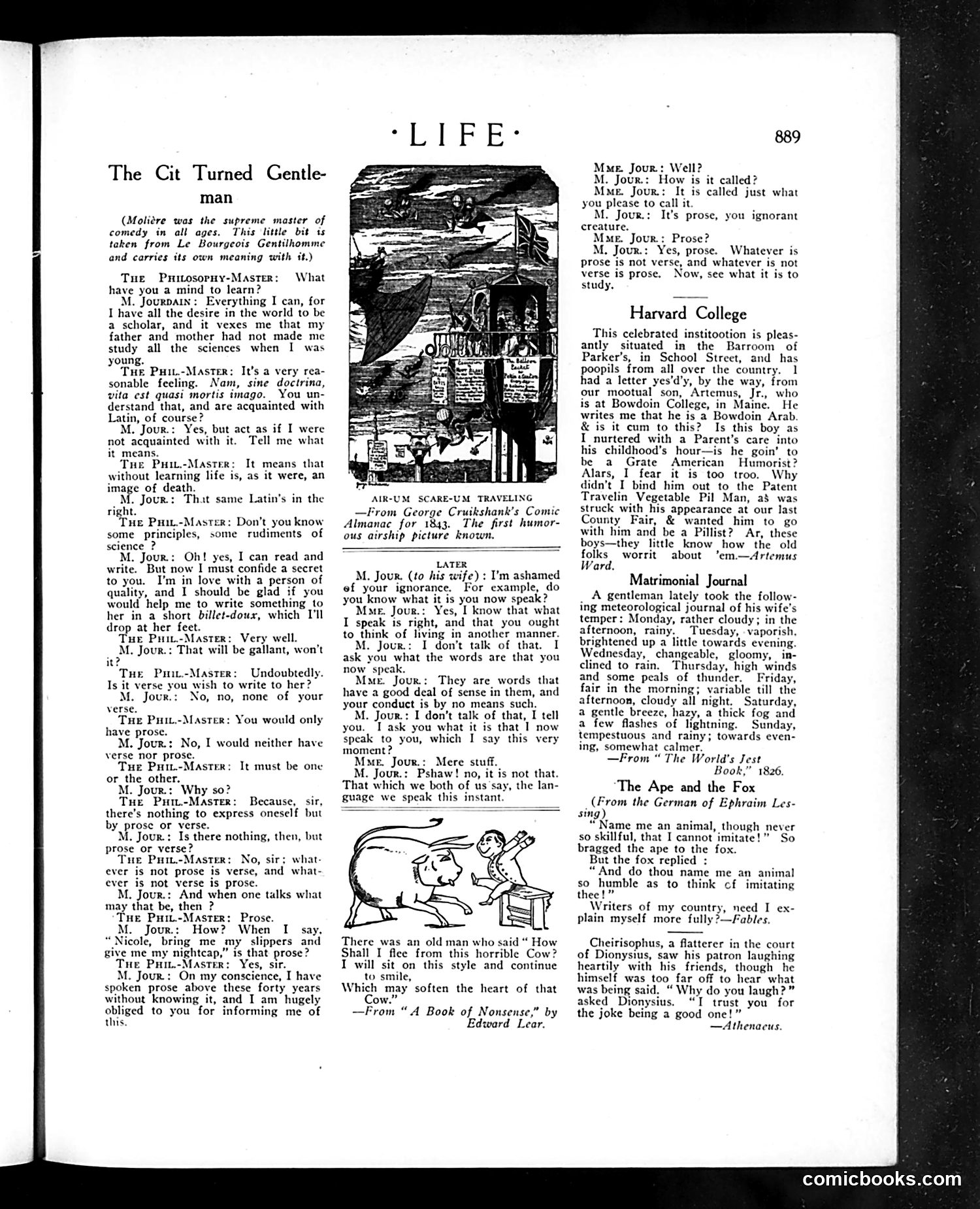
This page contains excerpts from Molière's classic French play *Le Bourgeois Gentilhomme* (The Bourgeois Gentleman), satirizing social pretension and ignorance. **The Main Dialogue**: A wealthy but uneducated commoner (M. Jourdan) hires a philosophy master to become cultured so he can impress a noblewoman. The humor lies in Jourdan's absurd reasoning—he demands writing that is neither verse nor prose, then learns with shock that his everyday speech is "prose." His wife's common sense contrasts with his newfound, shallow "learning." **The Satire's Point**: Molière mocks social climbers who pursue superficial education and status without genuine understanding. Jourdan's realization that he's "spoken prose for forty years without knowing it" exposes how pretentious self-improvement can be ridiculous. **The Airship Cartoon** (Cruikshank, 1843) appears unrelated—a whimsical early depiction of airship travel. The "Harvard College" note below appears to be contemporary satire about the institution itself, though it's partially cut off.
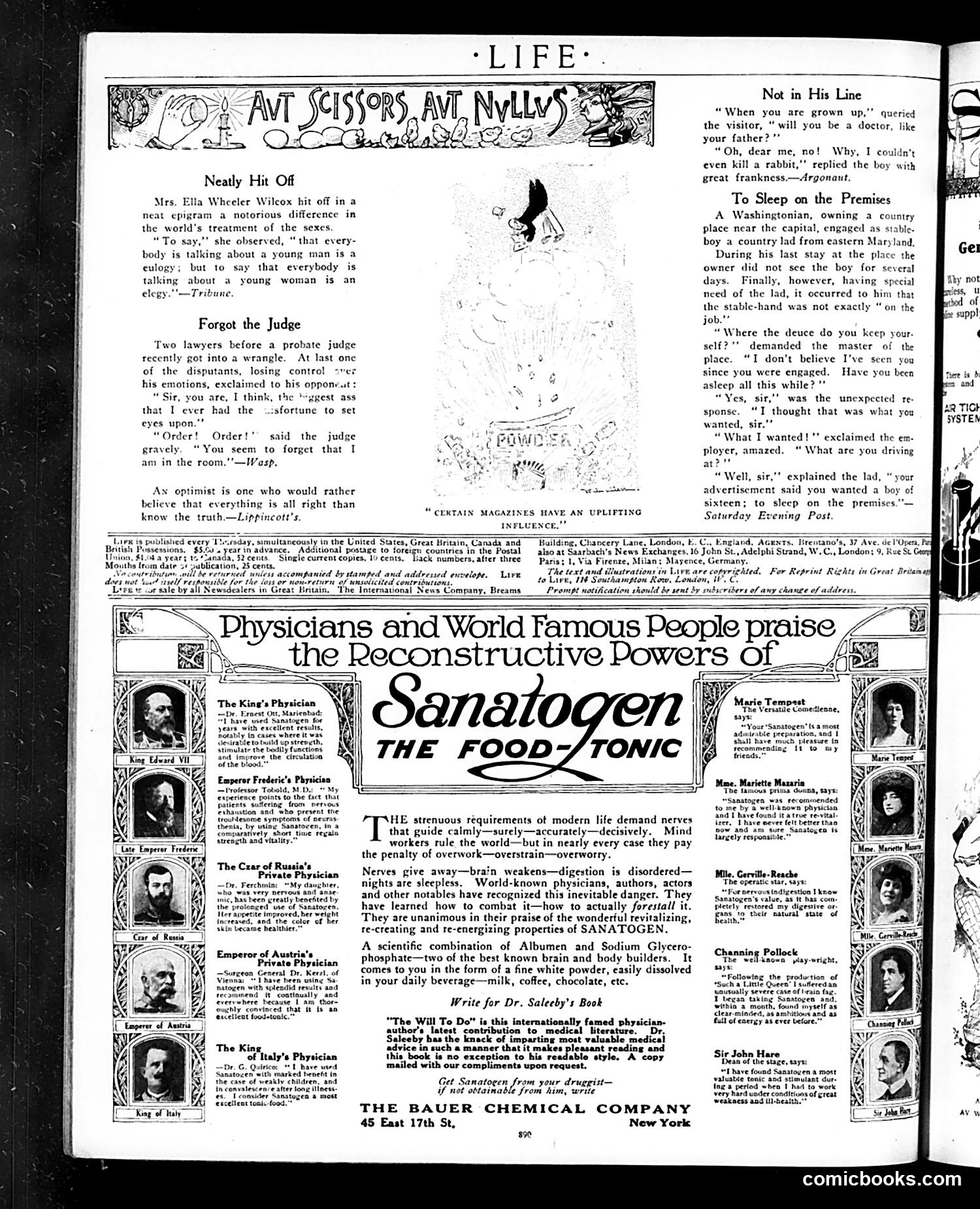
This page contains three brief humorous anecdotes and a large advertisement for Sanatogen tonic. **The three jokes:** 1. **"Neatly Hit Off"** — A quote from poet Ella Wheeler Wilcox satirizing gender double standards: calling a man a "eulogy" (praise) while the same behavior in a woman is an "elegy" (lament). It mocks how society judges men and women differently. 2. **"Forgot the Judge"** — Two lawyers argue before a judge; one calls the other an ass, and the judge interrupts saying the lawyer forgot *he* (the judge) is in the room. It's a self-important judge joke. 3. **"To Sleep on the Premises"** — A boy hired as a stable hand sleeps constantly because the job advertisement said "to sleep on the premises"—he took it literally as his job description rather than understanding it as living quarters. **The Advertisement:** Below occupies most of the page, featuring physicians and royalty (King Edward VII, Emperor Frederick, the Czar, etc.) praising Sanatogen, a "food-tonic" claimed to restore health and strength. This is typical patent-medicine marketing of the era, using false celebrity endorsements.
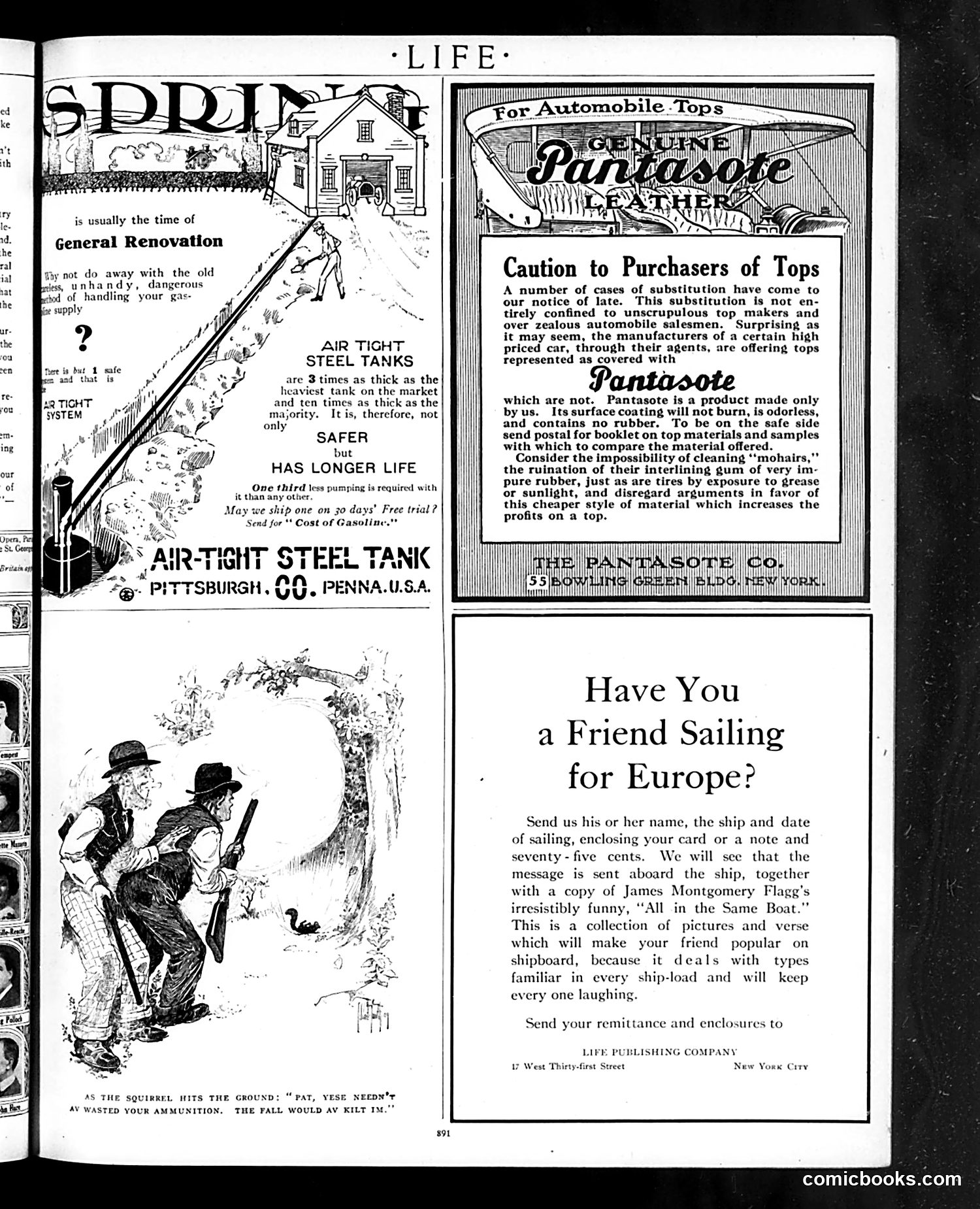
This page is primarily **advertising content** rather than editorial satire. The left side contains an ad for **Air-Tight Steel Tanks** (Pittsburgh, CO., Penna.), promoting their durability during spring renovation season—emphasizing they're safer and longer-lasting than alternatives. The bottom left shows a **hunting cartoon** where two men with guns have missed a bird, with the caption: "As the squirrel hits the ground: 'Pat, yese needn't a wasted your ammunition. The fall would av kilt 'im.'" This is simple slapstick humor about poor marksmanship. The right side contains warnings from **Pantasote Company** cautioning buyers against counterfeit automobile-top leather, and an ad encouraging readers to send friends' names for a humorous book being shipped to Europe. The page reflects early 20th-century consumer concerns about product authenticity and knockoffs.
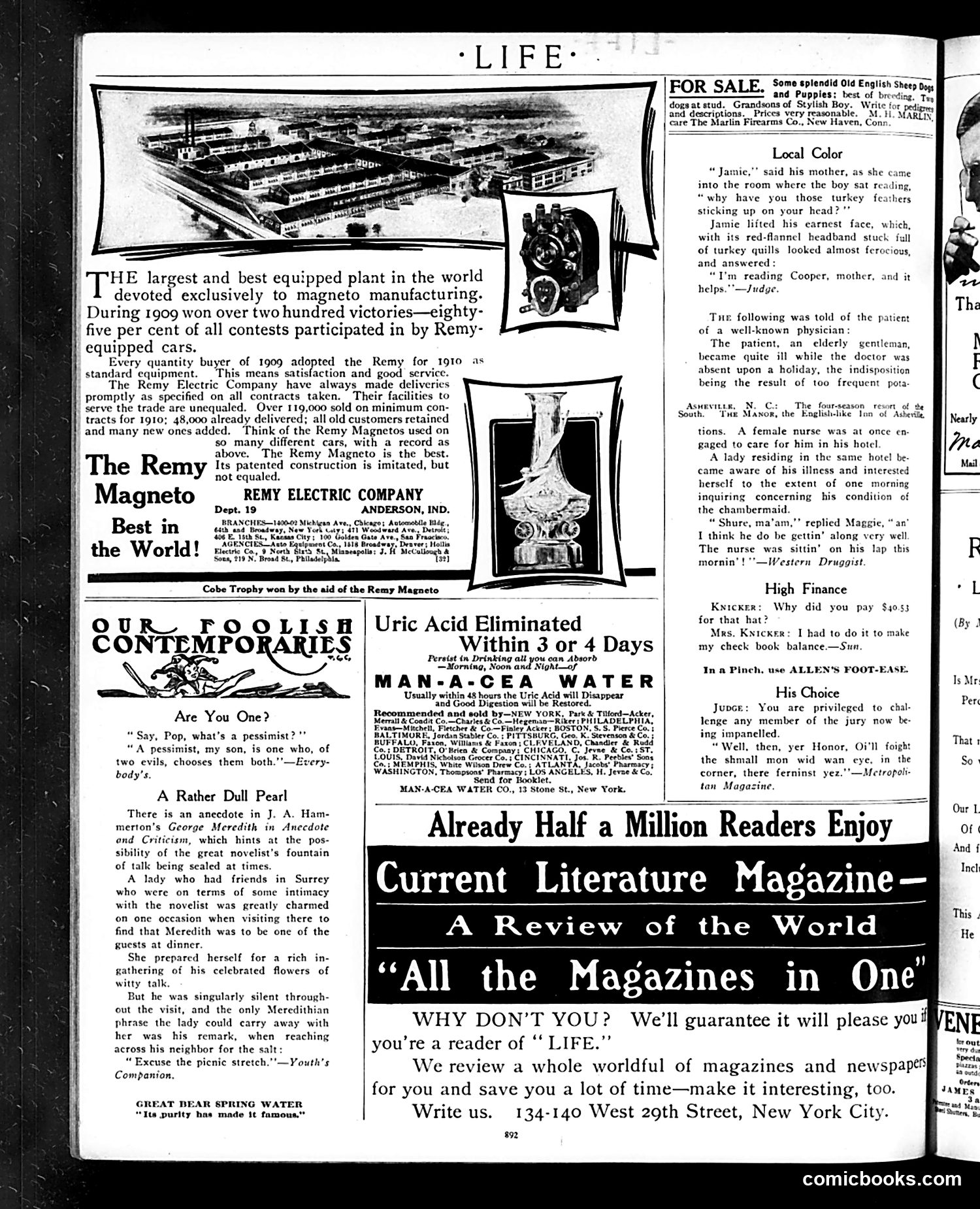
This page primarily features **advertisements and humorous anecdotes** rather than political cartoons. The title "Our Foolish Contemporaries" appears alongside a small illustration but lacks context identifying specific targets. The humor on this page is mostly **social satire**. "Local Color" jokes mock regional dialects and stereotypes—an Irish chambermaid's malapropism, a boy wearing turkey feathers while reading James Fenimore Cooper (likely imitating Native Americans from the novels). "High Finance" mocks women's shopping habits, while "His Choice" uses an Irish accent for comedic effect about jury selection. These reflect **early 1900s American attitudes**: casual ethnic stereotyping through dialect humor was considered acceptable entertainment. The page is dominated by patent medicine and automotive advertisements, with humor serving as filler content between commercial pitches—typical of *Life* magazine's format during this era.
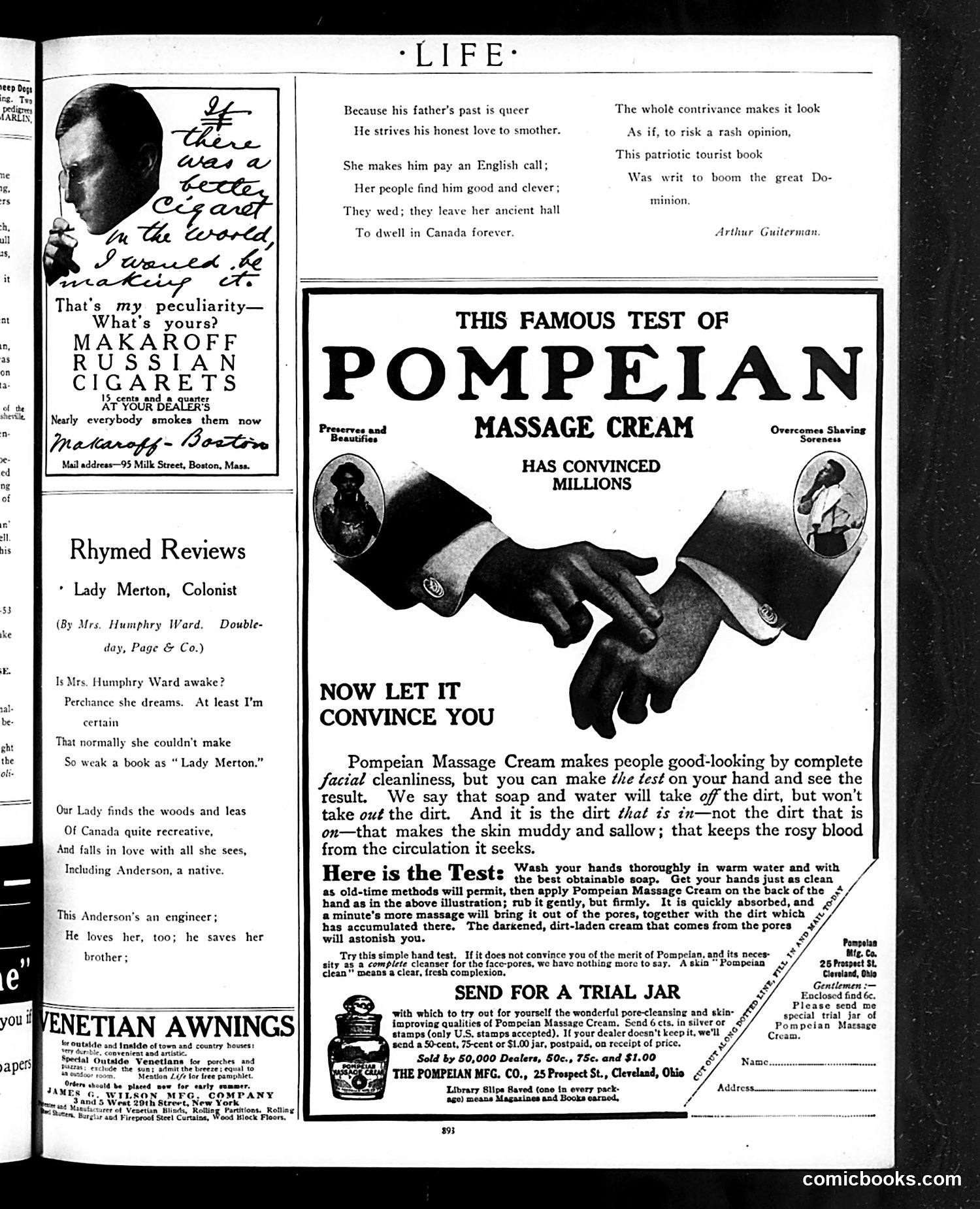
This page combines satirical literary criticism with period advertising. **"Rhymed Reviews" (left):** The unsigned verse mocks Mrs. Humphry Ward's novel *Lady Merton, Colonist*. The satire attacks the book's weak plot: a wealthy English widow visits Canada, falls in love with a local engineer, marries him despite his mysteriously disreputable father, and settles there permanently. The reviewer sarcastically praises this as a "patriotic tourist book" promoting Canadian immigration—suggesting Ward wrote propaganda disguised as romance fiction. The critique implies the novel is so contrived and unconvincing that Ward herself must have been "asleep" while writing it. **Advertisements:** The page also features cigarette, awning, and (primarily) Pompeian Massage Cream ads—typical early 20th-century product placement using pseudoscientific claims about skin cleansing. The juxtaposition is characteristic of *Life* magazine's format: biting literary satire alongside commercial endorsements, both competing for reader attention.
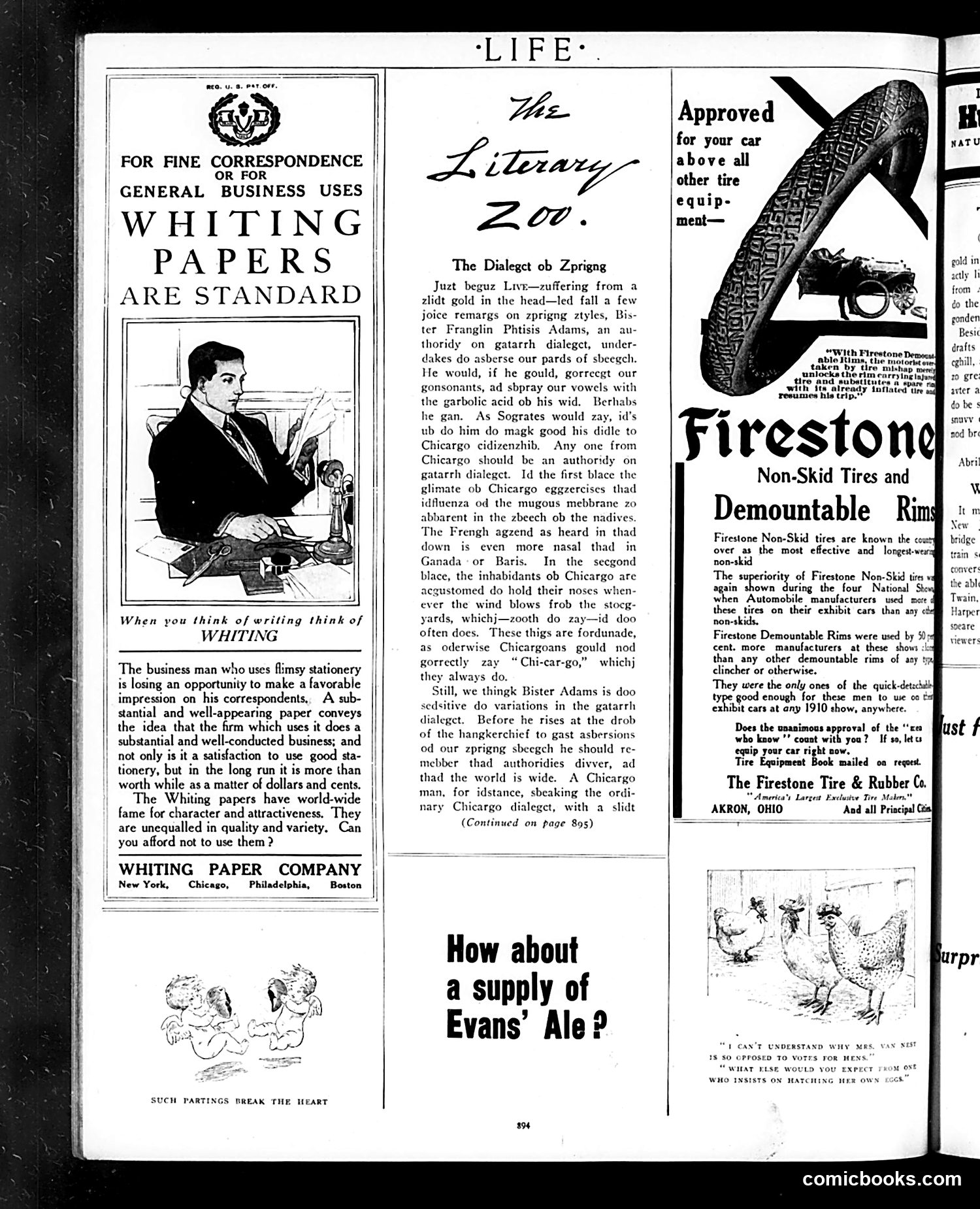
This page is primarily **advertising** with one small satirical cartoon. The main content consists of ads for Whiting Papers (stationery), Firestone tires, and Evans' Ale. The central article, "The Dialect ob Zprigg," is a humorous piece deliberately misspelling words to mock a Chicago accent and regional speech patterns—likely poking fun at Midwesterners' pronunciation. The only cartoon appears at bottom right: it depicts a woman opposing "votes for men," arguing that men who "insist on hatching her own eggs" shouldn't have voting rights. This is **feminist satire**—inverting the contemporary suffrage debate by suggesting women should vote because men are incompetent at domestic tasks. It's a clever reversal of anti-suffrage arguments that questioned women's competence for voting. The page reflects early 20th-century attitudes: regional dialect mockery was considered humor, and women's voting rights remained a contested issue.
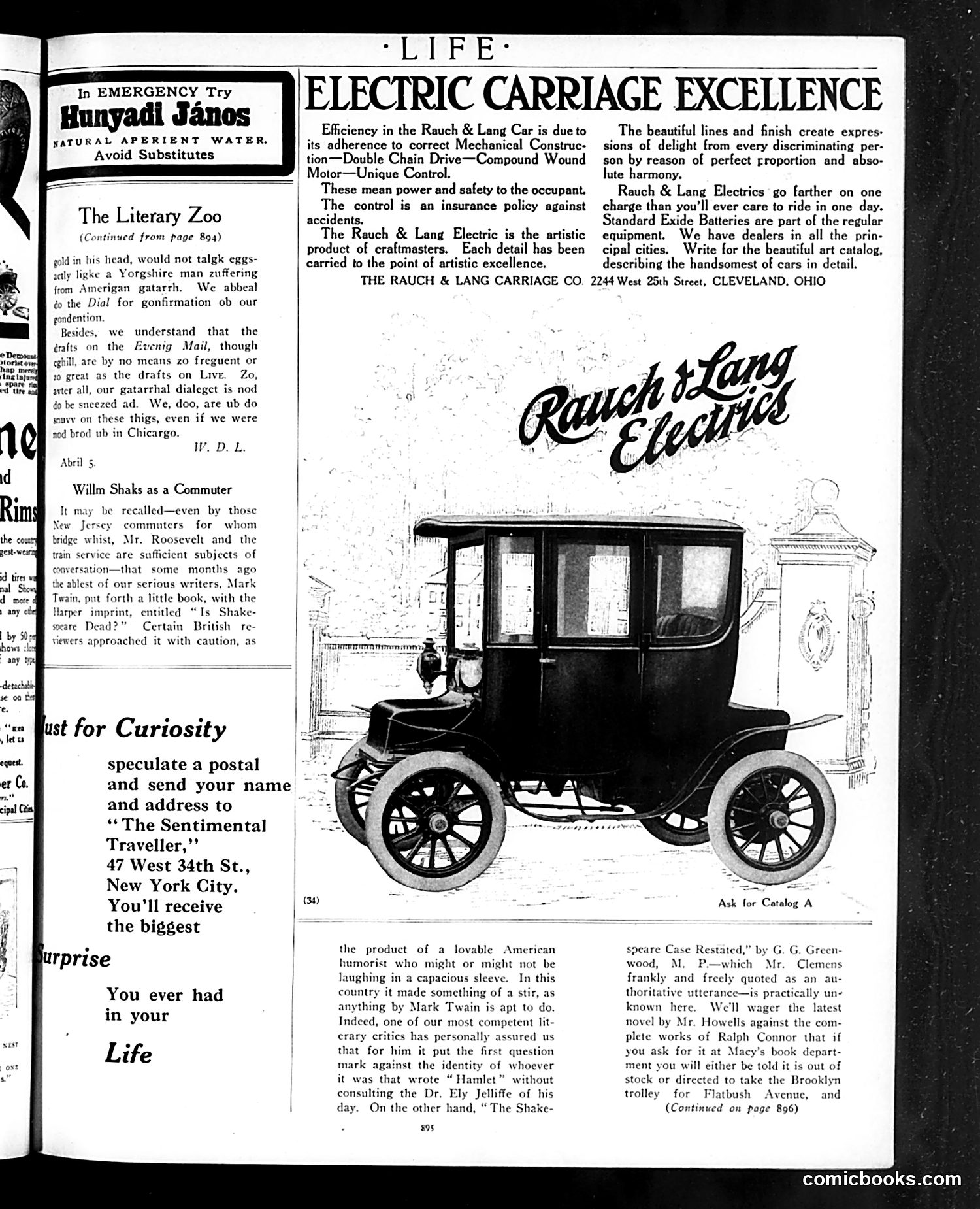
This page is primarily **advertising** rather than political satire. The dominant content is a full-page advertisement for the Rauch & Lang Electric carriage, featuring an illustration of an early electric automobile and marketing copy emphasizing its mechanical superiority, safety features, and artistic design. The page also contains two literary discussion pieces: "The Literary Zoo" (continuing from page 894) discusses literary criticism and dialect representation in publications, and "Willm Shaks as a Commuter" references Mark Twain's 1909 book "Is Shakespeare Dead?" — a humorous essay questioning Shakespeare's authorship of his own works. The text notes that this work "made something of a stir" among American readers and literary critics. A small sidebar advertises "The Sentimental Traveller" postal service offering curiosity items to Life readers. The page reflects early 20th-century concerns with emerging automobile technology and contemporary literary debates about authorship.
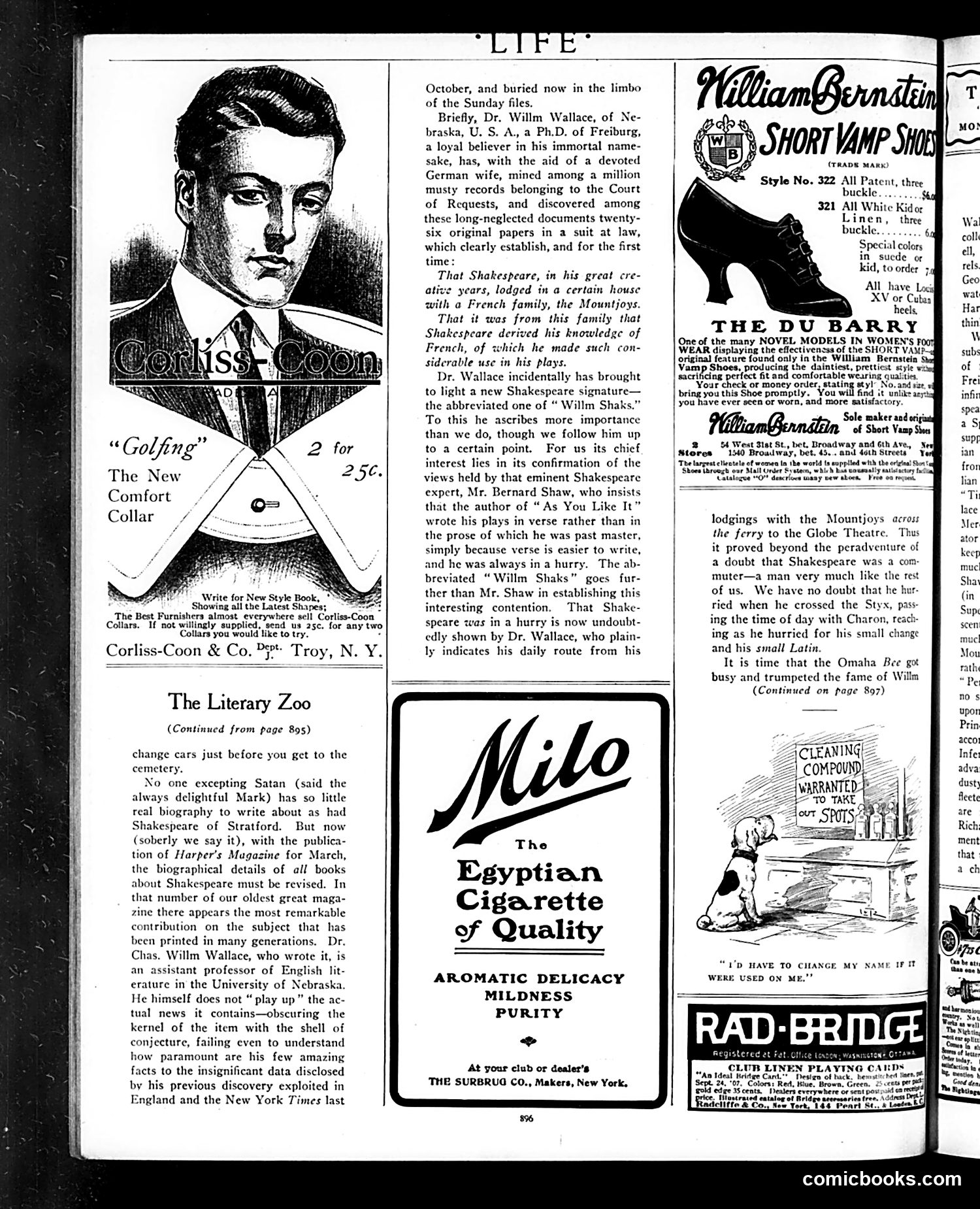
This page primarily contains **literary commentary and advertisements** rather than political cartoons. The main article discusses Dr. Charles Willm Wallace's scholarly discovery of 26 original legal documents proving Shakespeare lodged with a French family (the Mountjoys) during his creative years—establishing the source of Shakespeare's French language knowledge used in his plays. The piece is somewhat satirical about Wallace's understated presentation of his remarkable findings, suggesting he obscures the significance with academic hedging. The only cartoon element is a small portrait labeled "Golfing" at top left, advertising "The New Comfort Collar" by Corliss-Coon & Co.—a collar advertisement using a gentleman's head as a product display. The rest is period advertising for **William Bernstein Short Vamp Shoes**, **Milo Egyptian Cigarettes**, and **Rad-Bridge Club Linen Playing Cards**. This page is primarily a mix of literary content and commercial advertisements typical of *Life* magazine's format.
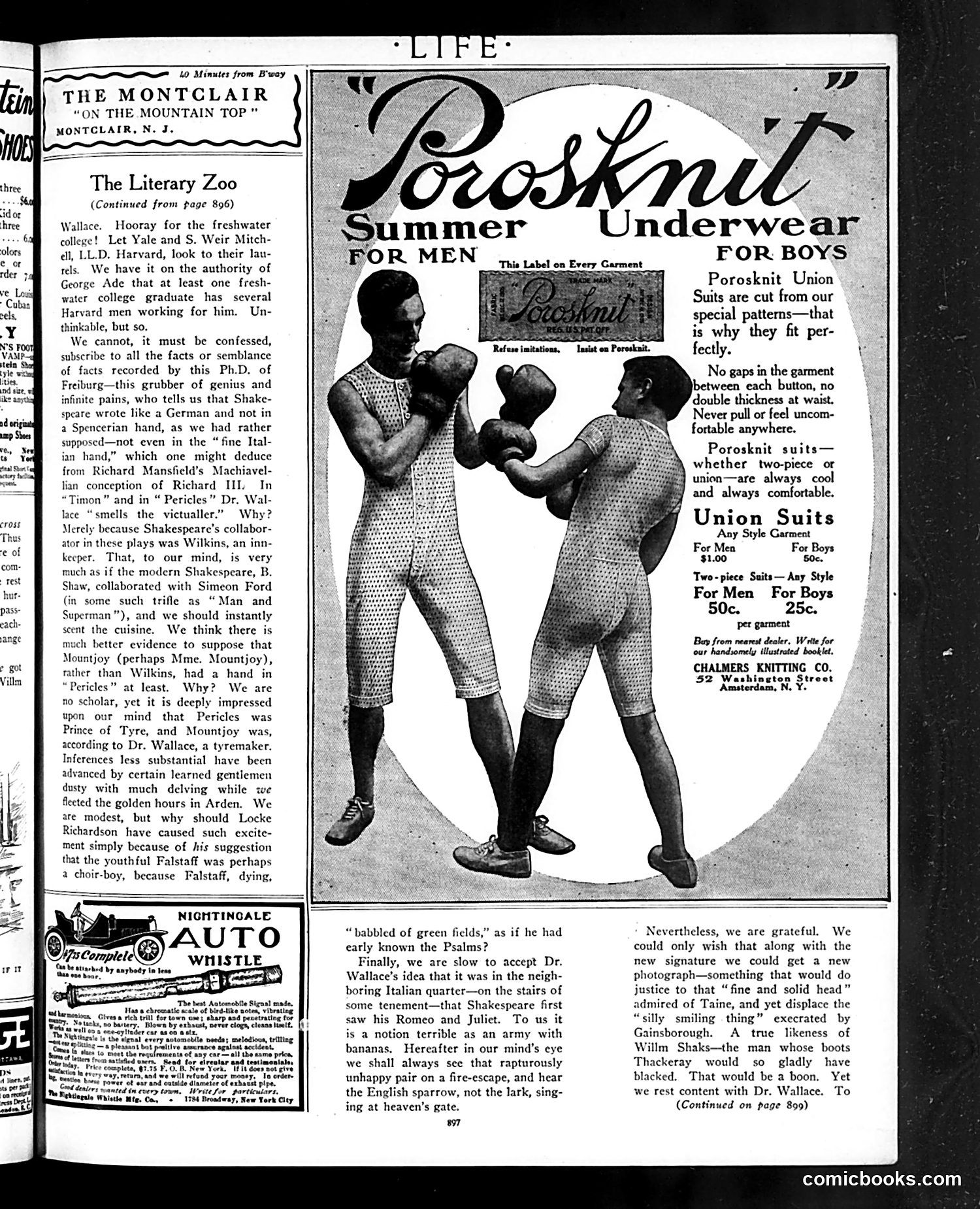
This page contains a literary essay titled "The Literary Zoo" (continued from page 896) that satirizes scholarly analysis of Shakespeare's work. The author mocks Dr. Wallace, a Ph.D. from Freiburg, for his theories about Shakespeare's authorship and influences—particularly Wallace's suggestion that Shakespeare collaborated with an innkeeper named Wilkins, and that Shakespeare drew inspiration from Italian tenement life rather than pastoral settings. The satire ridicules overly pedantic literary scholarship that makes absurd connections (comparing it to detecting cuisine from a playwright collaborating with a restaurant owner). The author defends Shakespeare's genius against reductive analysis while remaining humorously modest about their own lack of scholarly credentials. The right page is purely advertising for Porosknit brand underwear for men and boys, featuring a boxer in athletic wear.
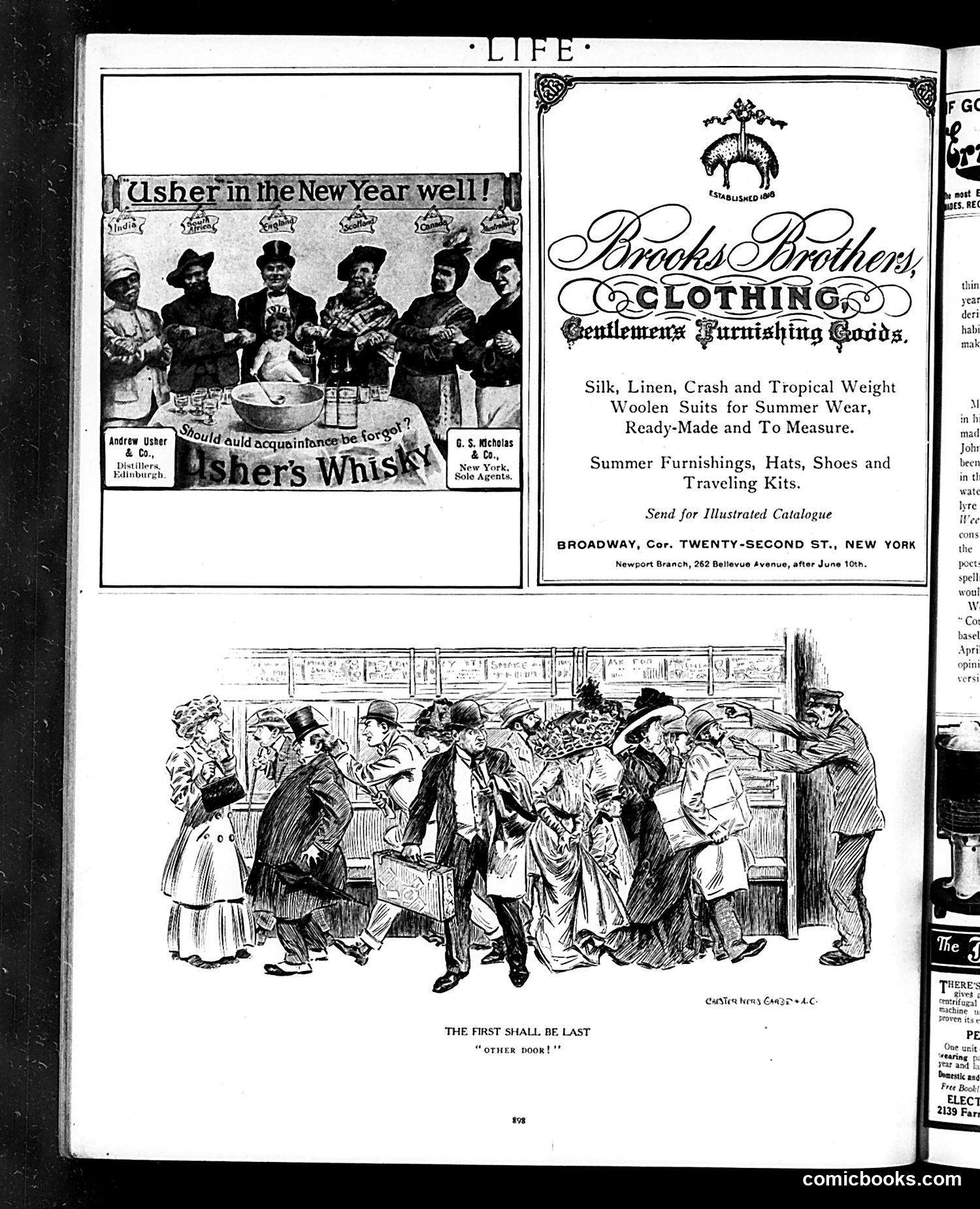
**Upper Left - "Usher in the New Year well!":** This advertisement for Usher's Whisky depicts six men in formal attire celebrating New Year's Eve. The caption "Should auld acquaintance be forgot?" references the Scottish song "Auld Lang Syne," traditionally sung at New Year celebrations. The humor plays on whisky as essential to proper holiday socializing—a straightforward period advertisement rather than satirical commentary. **Lower Cartoon - "The First Shall Be Last":** This sketch shows a crowded shop scene with the subtitle "'Other door!'" The satire appears to mock the chaos of post-holiday sales or shopping crowds, with wealthy patrons being directed away from the main entrance. The caption references Matthew 19:30 ("the first shall be last"), suggesting social reversal or ironic commentary on class distinctions during commercial activity. **Right side:** Brooks Brothers clothing advertisement.
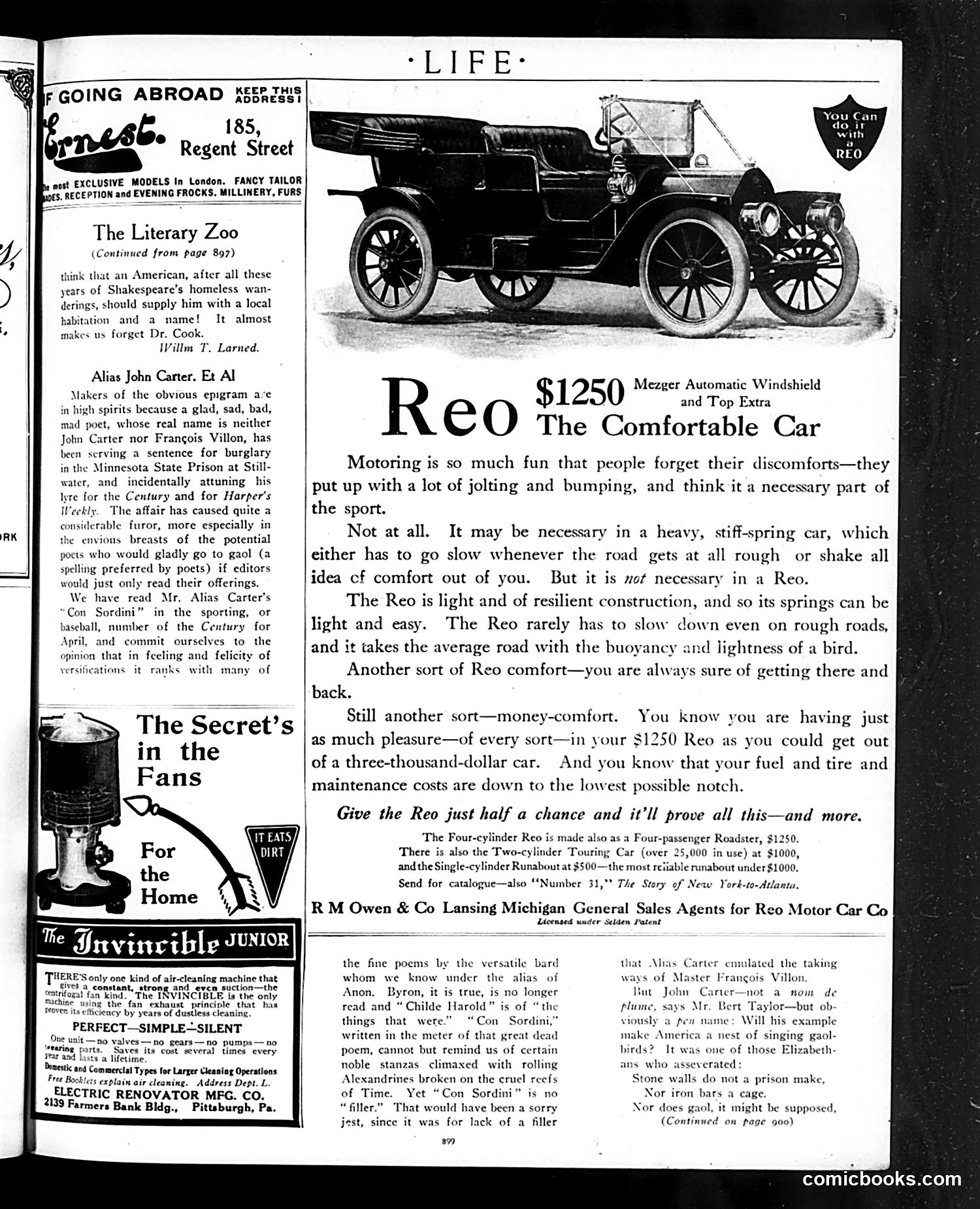
This page mixes literary criticism with automobile advertising. **"The Literary Zoo" section** satirizes a poet imprisoned for burglary who publishes under the alias "John Carter" (or "François Villon"). The piece mocks both the poet's criminal past and envious rival poets who would gladly go to jail if editors would publish their work. The satire suggests poets are so desperate for recognition they'd accept imprisonment as a trade-off for literary fame. **The Reo automobile advertisement** dominates the right side, promoting a $1,250 car emphasizing comfort and affordability—it claims to deliver luxury comparable to three-thousand-dollar vehicles. The ad highlights light construction, smooth suspension, and low maintenance costs as selling points to middle-class buyers. The page reflects early 1900s attitudes: romantic glamorization of bohemian poets despite criminal records, and aggressive marketing of automobiles as status symbols and practical transportation becoming accessible to ordinary Americans.
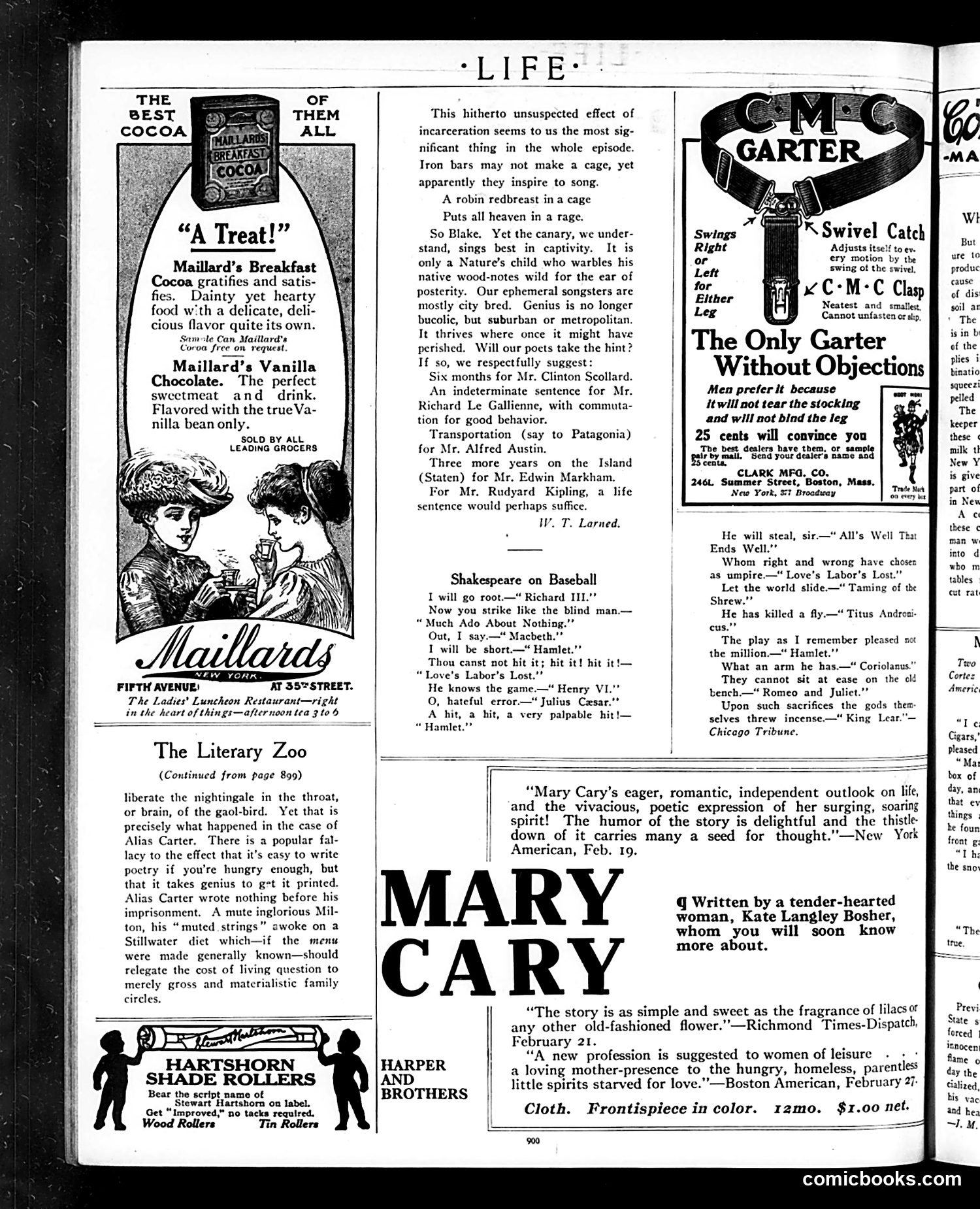
This page mixes **advertisements** with **literary satire and sports humor**. The main content is "The Literary Zoo," a satirical piece mocking contemporary poets by suggesting they should be imprisoned to inspire genius. It names real poets (Clinton Scollard, Richard Le Gallienne, Alfred Austin, Edwin Markham, Rudyard Kipling) and ironically proposes punishments—imprisonment, transportation, life sentences—claiming that confinement sparked poetic creativity in an unnamed "Alias Carter." Below that, "Shakespeare on Baseball" is a clever humor piece matching Shakespearean quotes to baseball terminology, creating puns. Lines like "Now you strike like the blind man" (Much Ado) and "A hit, a hit, a very palpable hit!" (Hamlet) show how Shakespeare's language coincidentally fits baseball language. The advertisements feature Maillard's Cocoa and a C.M.C. garter product, typical early-20th-century magazine filler. A book announcement for "Mary Cary" appears at bottom.
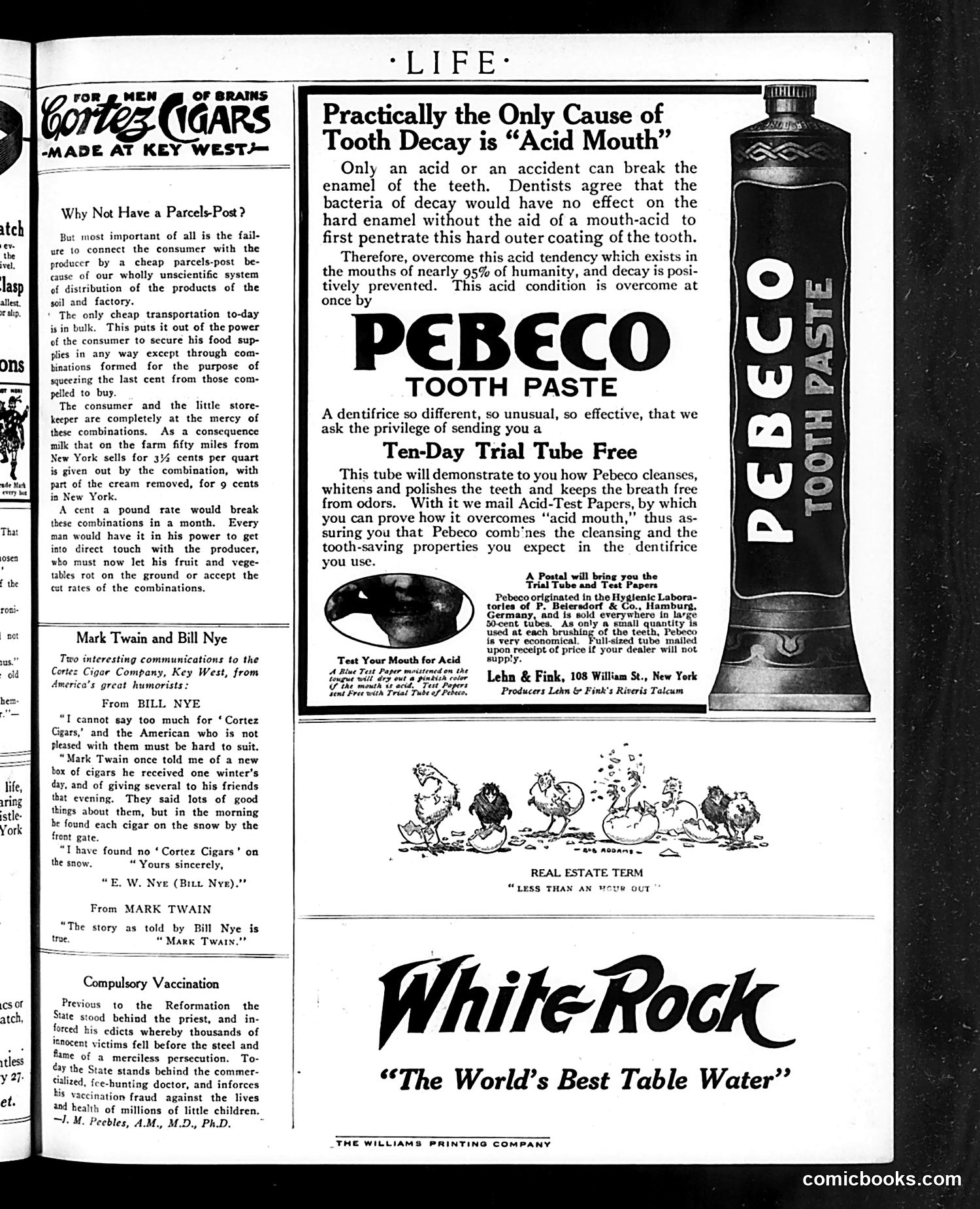
This page is primarily **advertising content** from an early 20th-century issue, with minimal editorial satire. ## Main Content: **Pebeco Tooth Paste Advertisement** dominates the center—a product claiming to cure tooth decay by neutralizing "acid mouth" (a condition affecting 95% of humanity, per the ad). The advertisement offers a free ten-day trial tube with acid-test papers, pitched as scientifically revolutionary. **Endorsements Section** features testimonials attributed to humorists Mark Twain and Bill Nye praising "Cortez Cigars" from Key West. These appear genuine period endorsements, not satire. **Left Column Editorial** includes pieces on parcel post reform and compulsory vaccination skepticism, criticizing the state's support for commercial interests over citizens' welfare. **Bottom Advertisement**: White Rock table water claims to be "The World's Best Table Water." The page reflects early-1900s advertising culture—mixing dubious medical claims with celebrity endorsements and reform-minded editorial content, all without modern FDA oversight or advertising standards.
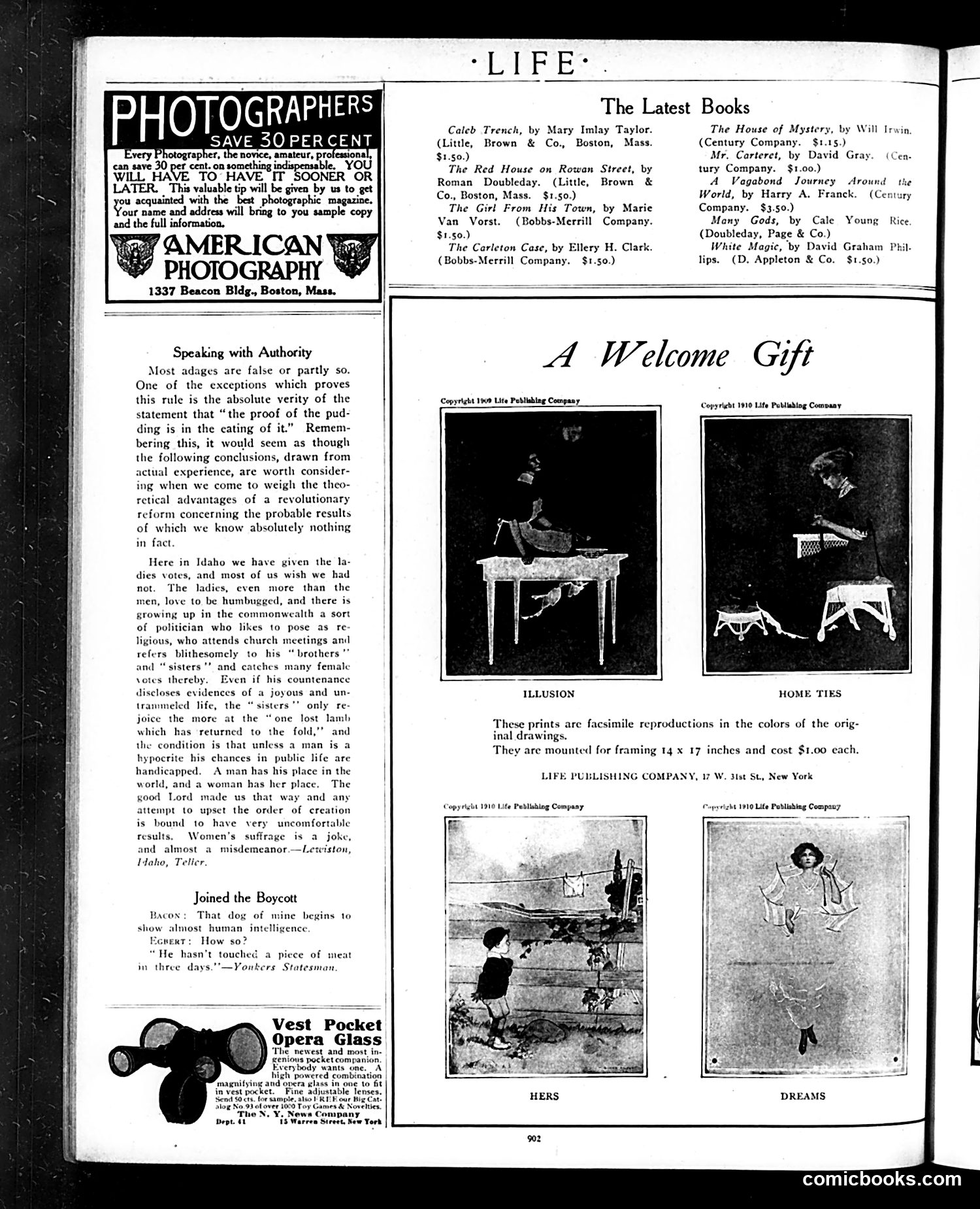
This page is primarily **advertising and book listings** from a 1910 issue of Life magazine. The content includes: **Advertisements:** Photography magazine subscriptions, opera glasses, and book recommendations (novels by popular contemporary authors). **Editorial content:** A column titled "Speaking with Authority" argues *against* women's suffrage, using Idaho as a case study. The author claims women voters are easily manipulated by hypocritical politicians and that women's voting disrupts natural gender roles—a common anti-suffrage argument of the era. **Humor section:** A brief joke about a dog joining a meat boycott, playing on contemporary boycott movements. **Art prints:** "A Welcome Gift" advertises four sentimental drawings (Illusion, Home Ties, Hers, Dreams) available for framing. The page reflects 1910s attitudes: commercialism, anti-women's-suffrage sentiment (notably ironic given Life's later progressive reputation), and genteel domestic imagery. No specific political figures are caricatured here.
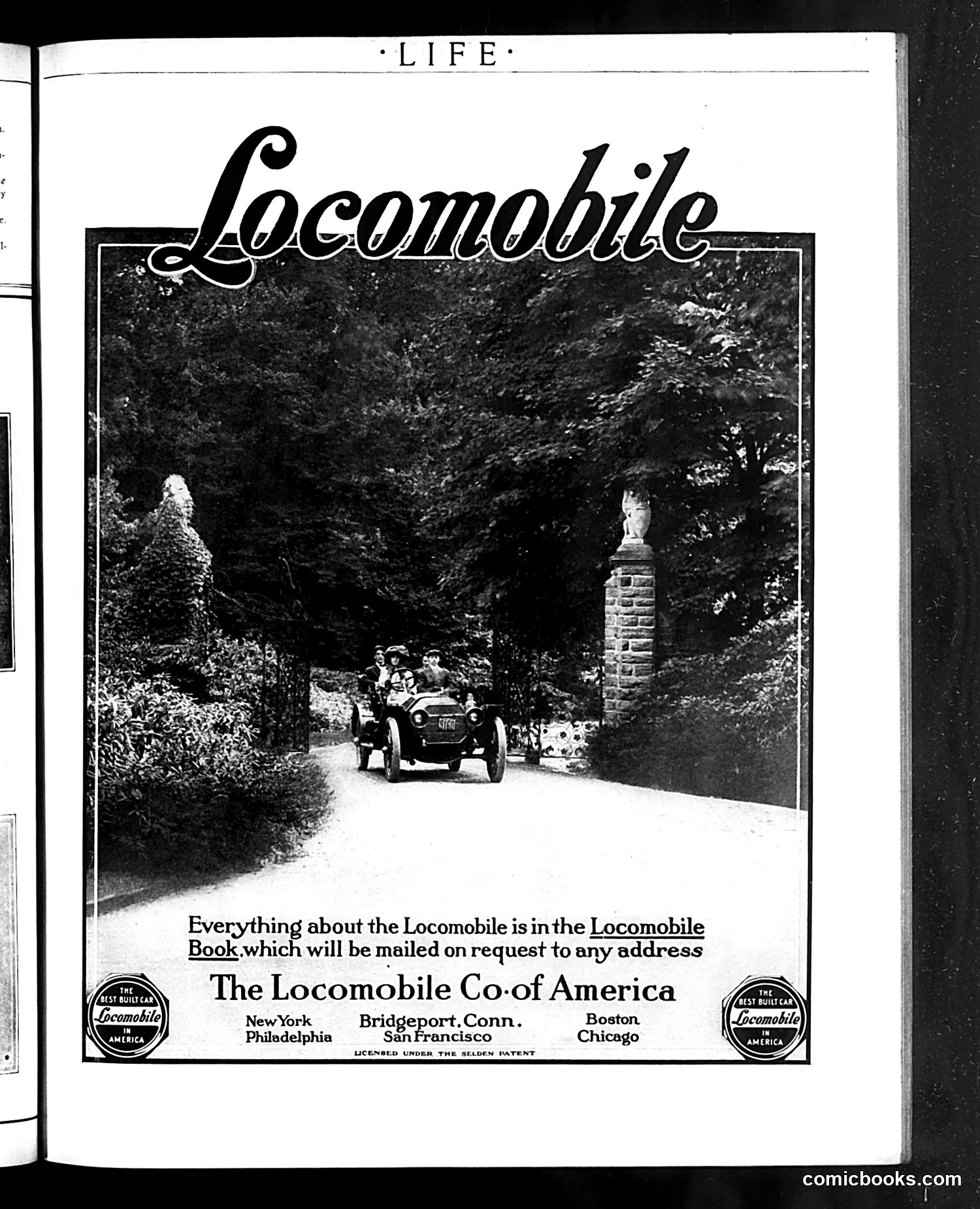
This is a **Locomobile automobile advertisement**, not political satire or a cartoon. The page shows a luxury early-automobile driving through an elegant tree-lined estate or park gate, with sculptural urns flanking the entrance. The image conveys wealth, sophistication, and leisure—aspirational marketing for an affluent audience. The text promotes the "Locomobile Book," offering detailed product information by mail. A notable detail is the reference to the "Selden Patent," indicating this car was licensed under a patent system that controlled early automobile manufacturing in America. For modern readers: this represents early-1900s automotive advertising targeting the wealthy, before cars became mass-market products.