
Life, 1910-05-12 · page 20 of 44
Life — May 12, 1910 — page 20: what you’re looking at
What you’re looking at
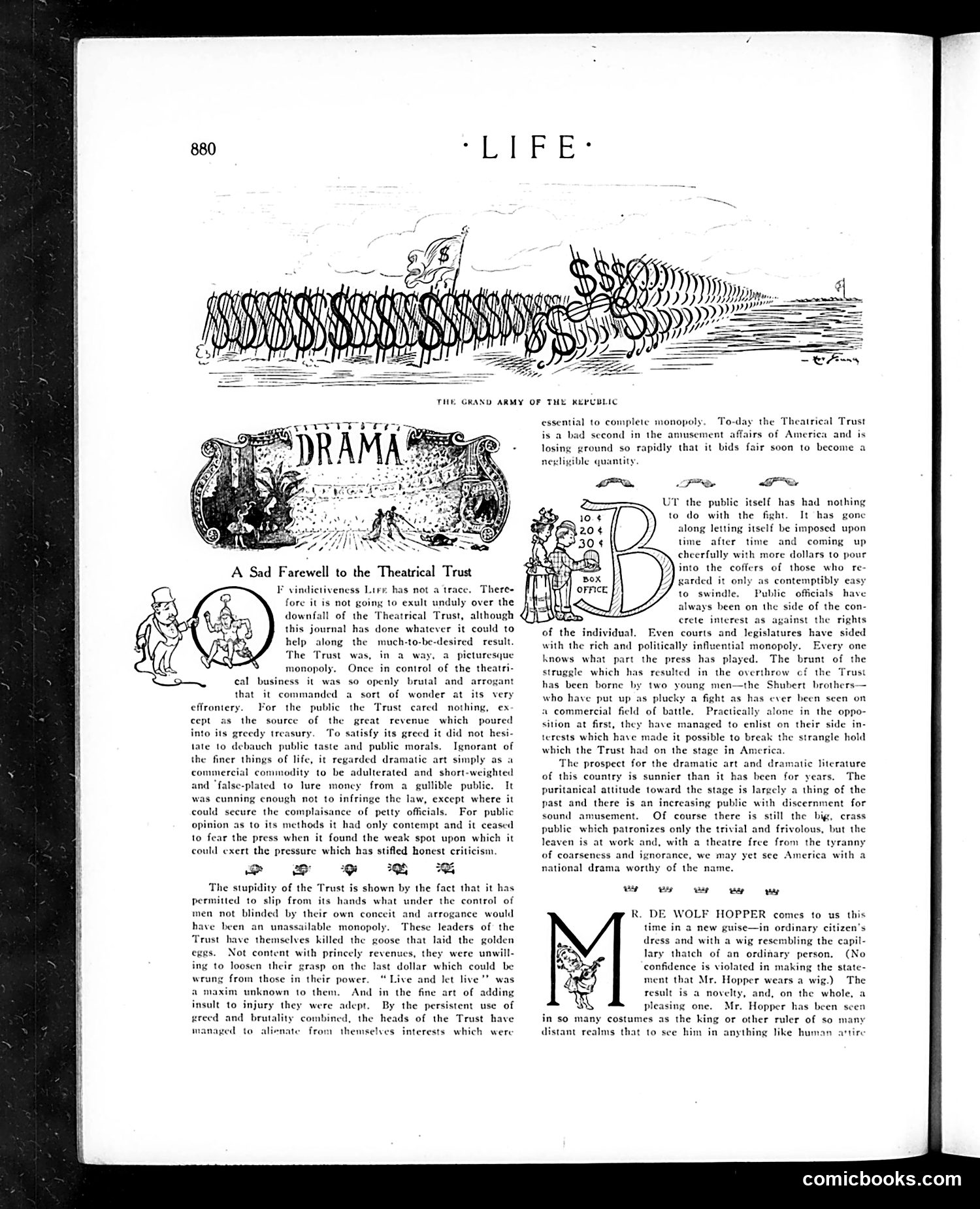
This page satirizes the **collapse of the Theatrical Trust**, a monopoly that controlled American theater. The cartoonist depicts its demise as a military defeat, with dollar signs replacing soldiers in the "army"—mocking how greed, not principle, motivated the Trust. The article praises the Trust's downfall, condemning it as a brutally exploitative monopoly that treated theater as mere commerce, debauched public taste, and corrupted officials and press. However, the satire's bite is two-edged: while celebrating the Trust's arrogance and comeuppance, the piece criticizes the **American public** for passively accepting exploitation for years, and notes that courts, legislatures, and officials sided with the monopoly's interests over the public's. The **Shubert brothers** (unnamed here but clearly referenced) are credited as the young rebels who broke the Trust's stranglehold. The article expresses hope that theater might now achieve artistic merit rather than serving only commercial greed.
📄 Transcribed text from this page (OCR, searchable)
Machine-transcribed from the original scan — historical spelling and the odd misread are preserved.
THE GRAND ARMY OF THE KEPUBLIC A Sad Farewell to the Theatrical Trust F vindictiveness Lire; has not a trace, Theres fore it is not going to exult unduly over the downfall of the Theatrical Trust, although this journal has done whatever it could to help along the much-to-be-desired result. he Trust was, in a way, a picturesque monopoly. Once in control of the theatri cal business it was so openly brutal and arrogant that it commanded a sort of wonder at its very cffrontery. For the public the Trust cared nothing, ex cept as the source of the great revenue which poured into its greedy treasury. To satisfy its greed it did not hesi tate to debauch public taste and public morals. Ignorant of the finer things of life, it regarded dramatic art simply as a commercial commodity to be adulterated and short-weighted and ‘false-plated to lure money from a gullible public. It was cunning enough not to infringe the law, except where it could secure the complaisance of petty officials. For public opinion as to its methods it had only contempt and it ceased to fear the press when it found the weak spot upon which it could exert the pressure which has stifled honest criticism ee > a) The stupidity of the Trust is shown by the fact that it has permitted to slip from its hands what under the control of men not blinded by their own conceit and arrogance would have been an unassailable monopoly. These leaders of the Trust have themselves killed the goose that laid the golden eggs. Not content with princely revenues, they were unwill- ing to loosen their grasp on the last dollar which could be wrung from those in their power. “Live and let live’? was naxim unknown to them. And in the fine art of adding sult to injury they were adept. By the persistent use of eed and brutality co . the heads of the Trust have managed to themselves interests which were To-day the Theatrical Trust fairs of America and is essential to complete monopoly is a bad second in the amusement a losing ground so rapidly that it bids fair soon to become a negligible quantity Pw UT the public itself has had nothing to do with the fight. It has gone along letting itself be imposed upon time after time and coming up cheerfully with more dollars to pour into the coffers of those who re- garded it only as contemptibly easy to swindle. Public officials have 's been on the side of the con- crete interest as of the individual. Even courts and legislatures have s with the rich and politically influential monopoly. Every one knows what part the press has played. The brunt of the struggle which has resulted in the overthrow of the Trust has been borne by two young men—the Shubert brothers— who have put up as plucky a fig 1 commercial field of battle. Pi sition at first, they have Fw oe a as has ever been seen on one in the oppo- anaged to enlist on their terests which have made it possible to break the strangle hold which the Trust had on the stage in America. The prospect for the dramatic art and dramatic literature of this country is sunnier than it has been for years. The puritanical attitude toward the stage is largely a thing of the past and there is an increasing public with discernment for sound amusement. Of course there is still the big, crass public which patronizes only the trivial and frivolous, but the leaven is at work and, with a theatre free from the tyranny of coarsencss and ignorance, we may yet see America with a national drama worthy of the name. ide ine wey rae oy R. DE WOLF HOPPER comes to us this time in a new guise—in ordinary citizen's dress and with a wig resembling the capil- lary thatch of an ordinary person, (No confidence is violated in making the state- ment that Mr. Hopper wears a wig.) The result novelty, and, on the whole, Mr. Hopper s the king or other ruler of so many distant realms that to sce him in anything like human attire pleasing one. has been seen in so many costumes comicbooks.com