
Life, 1910-05-12 · page 24 of 44
Life — May 12, 1910 — page 24: what you’re looking at
What you’re looking at
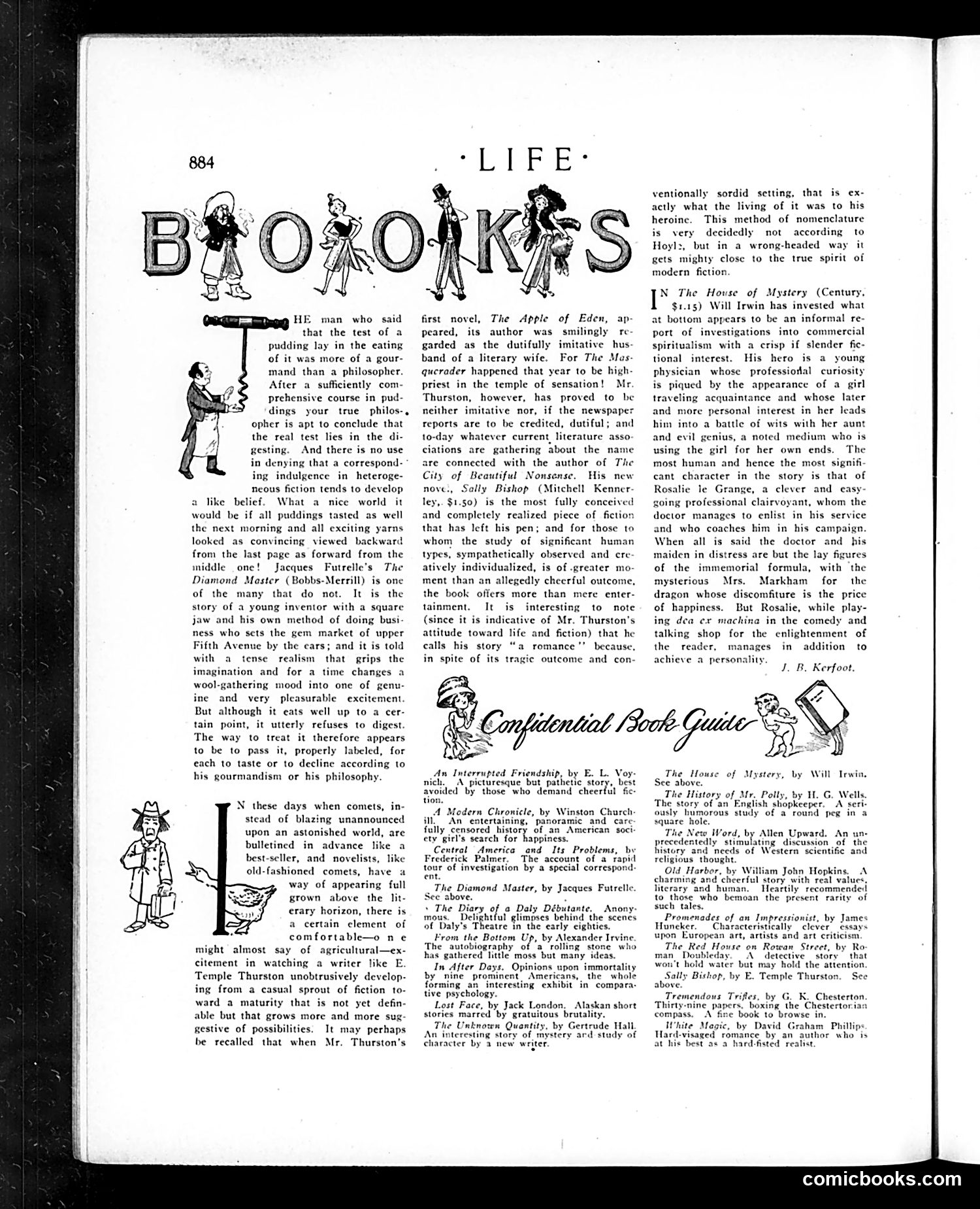
This page features a book review column discussing recent novels. The main text critiques Jacques Futrelle's *The Diamond Master*, using a metaphor comparing novels to puddings—they may taste good while reading but fail to "digest" afterward, meaning the plot doesn't hold up upon reflection. The column also praises E. Temple Thurston's *Sally Bishop*, noting his literary development from being dismissed as merely the husband of a famous writer (*The Masquerader*'s author) to becoming a serious novelist in his own right. Thurston calls his tragic story a "romance" rather than a tragedy—a comment on his artistic philosophy. The right side contains a "Confidential Book Guide" listing other contemporary titles with brief assessments, helping readers choose books by their mood preferences—notably distinguishing between those seeking cheerful outcomes versus those interested in serious character study.
📄 Transcribed text from this page (OCR, searchable)
Machine-transcribed from the original scan — historical spelling and the odd misread are preserved.
HE man who said that the test of a pudding lay in the eating of it was more of a gour- mand than a philosopher. After a sufficiently com- prehensive course in pud- dings your true philos-, opher is apt to conclude that the real test lies in the di- gesting. And there is no use ol in denying that a correspond- ing indulgence in heteroge- neous fiction tends to develop a ¢ belief. What a nice world it would be if all puddings tasted as well the next morning and all exciting yarns looked as convincing viewed backward from the last page as forward from the imiddle one! Jacques Futrelle’s The Diamond Master (Bobbs-Merrill) is one of the many that do not. It is the story of a young inventor with a square jaw and his own method of doing busi ness who sets the gem market of upper Fifth Avenue by the cars; and it is told with a tense realism that grips the imagination and for a time changes a wool-gathering mood into one of genu- ine and very pleasurable excitement But although it eats well up to a cer- tain point, it utterly refuses to digest The way to treat it therefore appears to be to pass it, properly labeled, for each to taste or to decline according to his gourmandism or his philosophy. N these days when comets, in- stead of blazing unannounced upon an astonished world, are bulletined in advance like a best-seller, and novelists, like old-fashioned comets, have & way of appearing full grown above the lit- erary horizon, there is a certain clement of comfortable—o ne might almost say of agricultural—ex- citement in watching a writer like E. Temple Thurston unobtrusively develop- ing from a casual sprout of fiction to- ward a maturity that is not yet defin- able but that grows more and more sug- gestive of possibilities. It may perhaps be recalled that when Mr. Thurston's first novel, The Apple of Eden, ap peared, its author was smilingly re- garded as the dutifully imitative hus- band of a literary wife. For The Mas- querader happened that year to be high- priest in the temple of sensation! Mr. Thurston, however, has proved to be neither imitative nor, if the newspaper reports are to be credited, dutiful; and to-day whatever current, literature asso: ciations are gathering about the name are connected with the author of The City of Beautiful Nonsense. His new nove:, Sally Bishop (Mitchell Kenner ley,. $1.50) is the most fully conceived and completely realized piece of fiction that has left his pen; and for those to whom the study of significant human types, sympathetically observed and ere atively individualized, is of .greater mo- ment than an allegedly cheerful outcome, the book offers more than mere enter- tainment. It is interesting to note (since it is indicative of Mr. Thurston’s attitude toward life and fiction) that he calls his story “a romance" because, in spite of its tragic outcome and con- An Interrupted Friendship, by E. L. Voy: nich. A picturesque but pathetic story, best avoided by those who demand cheerful fic tion. A Modern Chronicle, by Winston Church iM, “An entertaining, ‘panoramic and care fully ‘censored history of an American soci ety girl's search for happiness. Central America and Its Problems, by Frederick Palmer. The account of a rapid tour of investigation by a special correspond ent _ The Diamond Master, by Jacques Futrelle. See above. + The Diary of a Daly Débutante. Anony- mous. Delightful glimpses behind the scenes of Daly's Theatre in the early eighties, From the Bottom Up, by Alexander Irvine. The autobiography of ‘a rolling stone who has gathered little moss but many ideas. In After Days. Opinions upon immortality by nine prominent Americans, the whole forming an interesting exhibit in compara. tive psychology. Lost Face, by Jack London. Alaskan short stories marred by gratuitous brutality. The Unknown Quantity, by Gertrude Hall An interesting story of mystery ard study of character by a new writer. ventionally sordid setting, that is ex- actly what the living of it was to his heroine. This method of nomenclature is very decidedly not according to Hoyl:, but in a wrong-headed way it gets mighty close to the true spirit of modern fiction. N The House of Mystery (Century, I $1.15) Will Irwin has invested what at bottom appears to be an informal re- port of investigations into commercial spiritualism with a crisp if slender fic- tional interest. His hero is a young physician whose professiodal curiosity is piqued by the appearance of a girl traveling acquaintance and whose later and more personal interest in her leads him into a battle of wits with her aunt and evil genius, a noted medium who is using the girl for her own ends. The most human and hence the most signifi cant character in the story is that of Rosalie le Grange, a clever and easy- going professional clairvoyant, whom the doctor manages to enlist in his service and who coaches bim in his campaign When all is said the doctor and his maiden in distress are but the lay figures of the immemorial formula, with ‘the mysterious Mrs. Markham for the dragon whose discomfiture is the price of happiness. But Rosalie, while play- ing dea cx machina in the comedy and talking shop for the enlightenment of the reader, manages in addition to achieve a personality J. B, Kerfoot, The House of . by See above. The History of Mr. Polly, by H. G. Wells. The story of an English shopkeeper, A seri- ously humorous study of a round peg in a square hole. The New Word, by Ailen Upward. An un- precedentedly stimulating discussion of history and ‘needs of Western scientific and religious thought. Old Harbor, by William John Hopkins, A charm and cheerful story with real values, literary and human. Heartily recommended to those who bemoan the present rarity of such tales, Promenades of an Impressionist, by James Huneker. Characteristically clever essays upon European art, artists and art criticism, The Red House on Rowan Street, by Ro: pan Doubleday A detective story that xt hold water but may hold the attention. Sally Bishop, by E. Temple Thurston. See Irwin, y G. K., Chester . boxing the Chestertor ne book to browse in, White Magic, by David Graham Phillips Hard-visaged romance by an author who is at his best as a hard-fisted realist comicbooks.com