
Life, 1910-05-12 · page 28 of 44
Life — May 12, 1910 — page 28: what you’re looking at
What you’re looking at
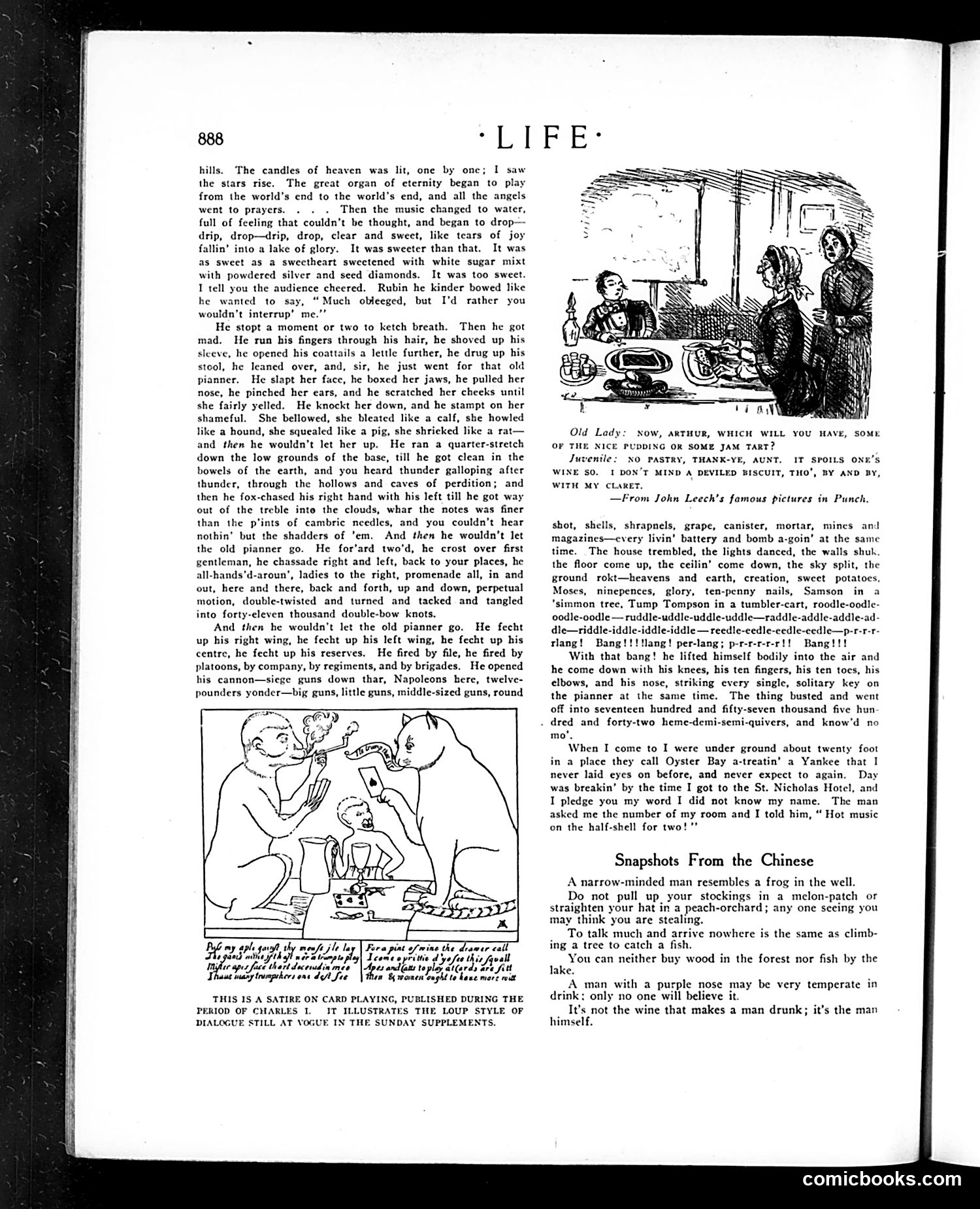
This page contains two distinct satirical pieces: **Upper section:** A vivid tall tale describing a pianist's dramatic performance. The narrator uses exaggerated, vernacular language to describe how a musician named Rubin violently attacks his piano, initially playing beautifully ("candles of heaven"), then assaulting the instrument with theatrical intensity—boxing it, scratching it, making it produce thunderous sounds. The satire mocks overwrought Romantic-era musical performance and the tendency toward bombastic emotional expression disguised as artistry. **Lower section:** A caption identifies this as satire on card-playing from the Charles I period, illustrating outdated "loup style" dialogue from Sunday supplements. An accompanying cartoon (by John Leech, famous Punch illustrator) shows a precocious child rejecting pudding but requesting wine and "deviled biscuit," satirizing affected, pretentious behavior in youth—poking fun at overly sophisticated or precious mannerisms presented as genteel refinement. Both target affectation masquerading as culture or sophistication.
📄 Transcribed text from this page (OCR, searchable)
Machine-transcribed from the original scan — historical spelling and the odd misread are preserved.
888 hills. The candles of heaven was lit, one by one; I saw the stars rise. The great organ of eternity began to play from the world’s end to the world’s end, and all the angels went to prayers. Then the music changed to water, full of feeling that couldn't be thought, and began to drop— drip, drop—drip, drop, clear and sweet, like tears of joy fallin’ into a lake of glory. It was sweeter than that. It was as sweet as a swectheart sweetened with white sugar mixt with powdered silver and seed diamonds. It was too sweet. I tell you the audience cheered. Rubin he kinder bowed like he wanted to say, “Much obleeged, but I'd rather you wouldn’t interrup’ me.’” He stopt a moment or two to ketch breath. Then he got mad. He run his fingers through his hair, he shoved up his sleeve, he opened his coattails a lettle further, he drug up his stool, he leaned over, and, sir, he just went for that old pianner. He slapt her face, he boxed her jaws, he pulled her nose, he pinched her ears, and he scratched her cheeks until she fairly yelled. He knockt her down, and he stampt on her shameful. She bellowed, she bleated like a calf, she howled like a hound, she squealed like a pig, she shricked like a rat— and then he wouldn’t let her up. He ran a quarter-stretch down the low grounds of the base, till he got clean in the bowels of the earth, and you heard thunder galloping after thunder, through the hollows and caves of perdition; and then he fox-chased his right hand with his left till he got way out of the treble into the clouds, whar the notes was finer than the p'ints of cambric needles, and you couldn't hear nothin’ but the shadders of 'em. And then he wouldn't let the old pianner go. He for’ard two'd, he crost over first gentleman, he chassade right and left, back to your places, he all-hands’d-aroun’, ladies to the right, promenade all, in and out, here and there, back and forth, up and down, perpetual motion, double-twisted and turned and tacked and tangled into forty-eleven thousand double-bow knots. And then he wouldn't let the old pianner go. He fecht up his right wing, he fecht up his left wing, he fecht up his centre, he fecht up his reserves. He fired by file, he fired by platoons, by company, by regiments, and by brigades. He opened his cannon—siege guns down thar, Napoleons here, twelve- nder—big guns, little guns, middle-sized guns, round Fora pint ofmine the drawer call Buby gpl sot tly meee be gaed mite yZth aft mera tram Teomeoprittie dy is fae inaiy trumpehers one deft Jee \ then &ranen vaght te hone mort wit THIS 1S A SATIRE ON CARD PLAYING, PUBLISHED DURING THE. PERIOD OF CHARLES I. IT ILLUSTRATES THE LOUP STYLE OF DIALOGUE STILL AT VOGUE IN THE SUNDAY SUPPLEMENTS. *LIPE: Old Lody: Now, artHUR, WHICH WILL You Mave, some OF THE NICE PUDDING OR SOME JAM TART? Juvenile: NO PASTRY, THANK-YE, AUNT, IT SPOILS ON WINE SO. I DON’T MIND A DEVILED BISCUIT, THO’, BY AND BY, WITH MY CLARET. —From John Leech’s famous pictures in Punch. shot, shells, shrapnels, grape, canister, mortar, mines and magazines—every in’ battery and bomb a-goin’ at the same time. The house trembled, the lights danced, the walls shuk. the floor come up, the ceilin’ come down, the sky split, the ground rokt—heavens and earth, creation, sweet potatoes, Moses, ninepences, glory, ten-penny nails, Samson in a *simmon tree, Tump Tompson in a tumbler-cart, roodle-oodle- oodle-oodle — ruddle-uddle-uddle-uddle—raddle-addle-addle-ad- dle—riddle-iddle-iddle-iddle — reedle-cedle-eedle-cedle—p- rlang! Bang!!! !ang! per-lang; p-r-r-r-r-r!! Bang!!! With that bang! he lifted himself bodily into the air and he come down with his knees, his ten fingers, his ten tocs, his elbows, and his nose, striking every single, solitary key on the pianner at the same time. The thing busted and went off into seventeen hundred and fifty-seven thousand five hun dred and forty-two heme-demi-semi-quivers, and know'd no mo’. When I come to I were under ground about twenty foot in a place they call Oyster Bay a-treatin’ a Yankee that | never laid eyes on before, and never expect to again. Day was breakin’ by the time I got to the St. Nicholas Hotel, and I pledge you my word I did not know my name. The man asked me the number of my room and I told him, “ Hot music on the half-shell for two!’ Snapshots From the Chinese A narrow-minded man resembles a frog in the well. Do not pull up your stockings in a melon-patch or straighten your hat in a peach-orchard; any one seeing you may think you are stealing. To talk much and arrive nowhere is the same as climb- ing a tree to catch a fish. You can neither buy wood in the forest nor fish by the lake. A man with a purple nose may be very temperate in drink: only no one will believe it. it Ina not the wine that makes a man drunk; it’s the man himself. comicbooks.com