
Life, 1910-05-12 · page 21 of 44
Life — May 12, 1910 — page 21: what you’re looking at
What you’re looking at
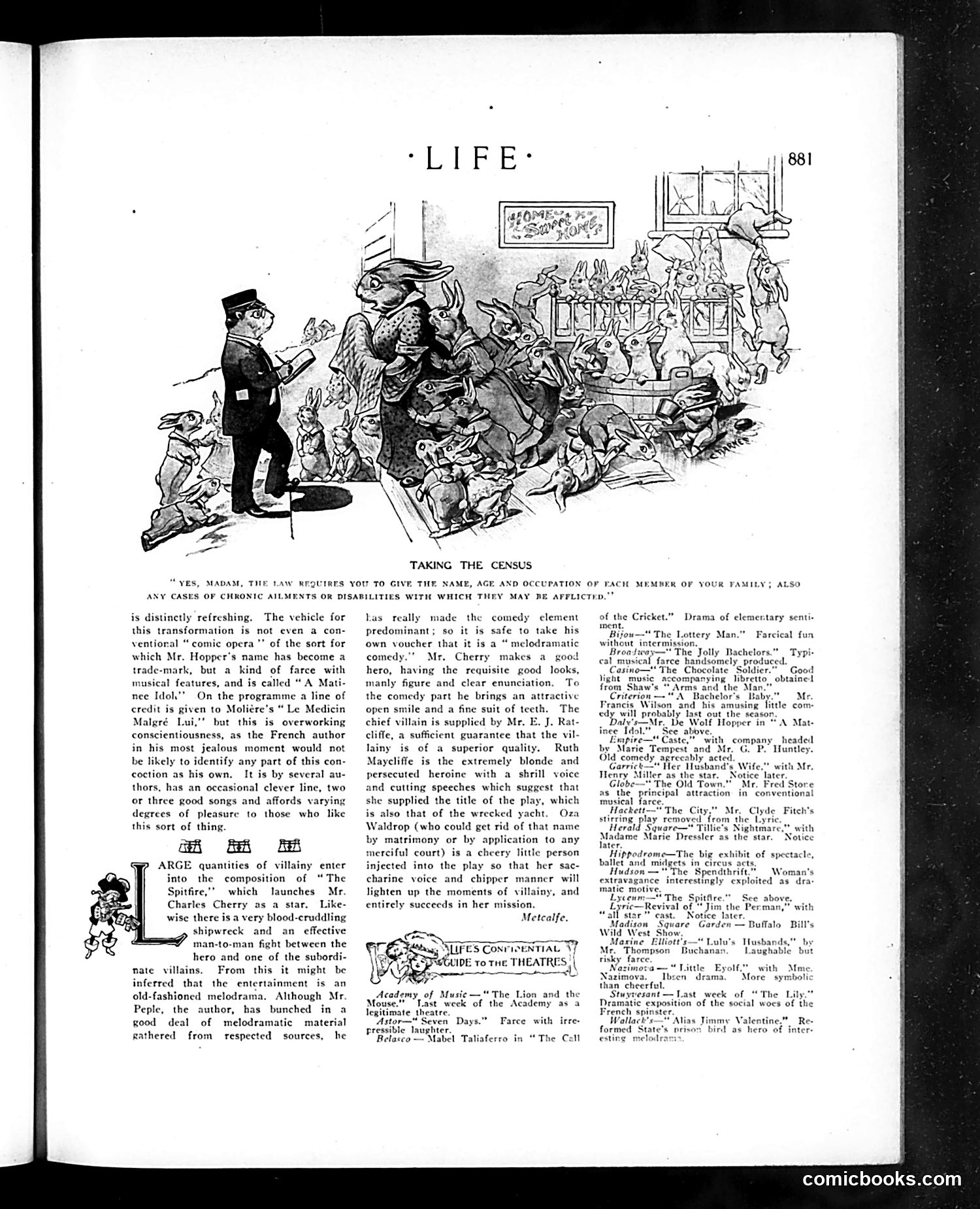
This page satirizes the **U.S. Census**, likely from the early 1900s. The main cartoon depicts a census-taker confronting a chaotic household—a woman surrounded by numerous children and household members in disarray. The humor targets the invasiveness of census questions: the official must ask not just names and ages, but also occupations and detailed medical information ("chronic ailments or disabilities"). The satire reflects contemporary anxiety about government intrusion into private family matters. The cartoon exaggerates the census-taker's formal authority against the domestic chaos he encounters, mocking both bureaucratic overreach and the difficulty families faced providing such personal information. The page also contains theater reviews, suggesting this is from Life magazine's typical mix of social commentary and entertainment coverage.
📄 Transcribed text from this page (OCR, searchable)
Machine-transcribed from the original scan — historical spelling and the odd misread are preserved.
TAKING THE CENSUS SIRES YOU TO GIVE THE NAME, AGE AND OCCUPATION OF FACH MEMBER OF YOUR FAMILY; HRONIC AILMENTS OR DISABILITIES WITH WHICH THEY MAY BE AFFLICTED.” “YES, MADAM, THE LAW ALSO ANY CASES OF is distinctly refreshing. The vehicle for this transformation is not even a con- ventional “ comic opera" of the sort for which Mr. Hopper’s name has become a trade-mark, but a kind of farce with musical features, and is called “ A Mati- nee Idoh’? On the programme a line of credit is given to Moliére’s “ Le Medicin Malgré Lui,’’ but this is overworking conscientiousness, as the French author in his most jealous moment would not be likely to identify any part of this con- coction as his own. It is by several au- thors, has an occasional clever line, two or three good songs and affords varyi degrees of pleasure to those who lik this sort of thing. ah RA A ARGE quantities of villainy enter into the composition of “The Spitfire,” which launches Charles Cherry as a star. wise there isa very blood-cruddling shipwreck and an effective man-to-man fight between the hero and one of the subordi- nate villains. From this it might be inferred that the entertainment is an old-fashioned melodrama. Although Mr. Peple, the author, has bunched in a good deal of melodramatic material gathered from respected sources, he Las really made the comedy clement predominant; so it is safe to take his own voucher that it is a “ melodramatic comedy.” Mr. Cherry makes a hero, having the requisite good looks, manly figure and clear enunciation. To the comedy part he brings an attractive open smile and a fine suit of teeth. The chief villain is supplied by Mr. E. J. Ra cliffe, a sufficient guarantee that the vil- lainy is of a superior quality. Ruth Maycliffe is the extremely blonde and persecuted heroine with a shrill voice and cutting speeches which suggest that she supplied the title of the play, which also that of the wrecked yacht. Oza Waldrop (who could get rid of that name by matrimony or by application to any erciful court) is a cheery little person injected into the play so that her sac- charine voice and chipper manner will lighten up the moments of villainy, and entirely succeeds in her mission. Metcalfe. good —_———~y FES CONVISENTIAL Vf Academy of Music—" The Lion and the Mouse." “Last week of the Academy as a legitimate theatre. Astor— Seven Days.” Fressible laughter. Belasco — Mabel Taliaferro in “The Cell Farce with irre Cricket.” Drama of elementary senti- “The Lottery Man.” remission. —"The Jolly Bachelors.” | T. ‘al farce handsomely produced. ‘asino—* The Chocolate Soldier.” ic 1K libretto, Arms and the Man.” A Bachelor's Baby.” Mr. Francis Wilson and his amusing le con edy will probably last out the seaso: p—Mr. De Wolf Hopper in “ A Mat- * See abow tc,” with company headed tarie Tempest and Mr. .” Huntley. Old comedy, agrees Garrict—" Her Husband's \' Farcical Good obtaine | with Mr. Notice later. Mr. Fred Store in conventional ney as the star. Globe—" The Old Town. s the principal attraction sical farce Hackett—"" The City,” Mr. Clyde Fiteh’s stirring play removed from the Lyric. Herald Square— Tillie’s Nightmar Madame Marie Dressler as the star. iater. Hippodrome—Th ballet and midgets Hudson — big exhibit of spectacle, circus acts, ‘he Spendthrift.” We y exploited as dra- ceun—" The S$; Exric—Revival of "J with “all star” cast. Notice later. Madison Square Garden — Buffalo Bill's Lulu's Husbands." by b Eyolf." with Mme drama, More symbolic Na: o—“ Little Nazimova. Ibsen than cheerful. Stuyvesant — Last week of “TI Lily.” Dramatic exposition of the social woes of the French spinster. Wallac * Alias Jimmy Val formed prison bird as hero of esting comicbooks.com