
Life, 1910-05-12 · page 26 of 44
Life — May 12, 1910 — page 26: what you’re looking at
What you’re looking at
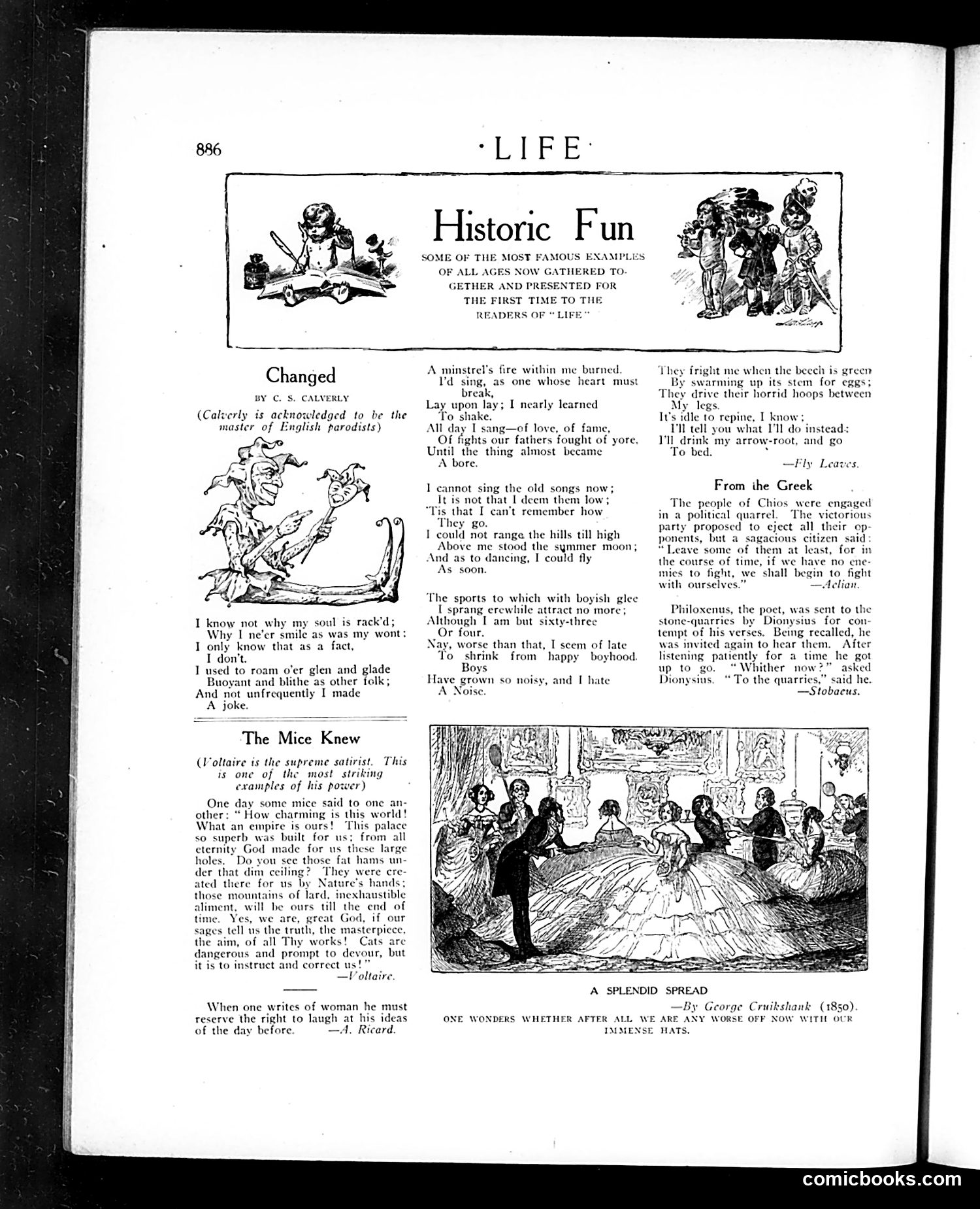
This is a literary humor page from *Life* magazine featuring classical and historical anecdotes rather than contemporary political cartoons. The content includes: 1. **"Changed" by C.S. Calverly** — A poem about aging and lost vitality. The speaker laments he no longer sings, dances, or enjoys boyish pursuits; now he's irritated by noisy children and prefers arrow-root and bed. It's gentle satire on middle age and nostalgia. 2. **"The Mice Knew"** — A passage attributed to Voltaire mocking religious complacency. Mice congratulate themselves as God's masterpiece while ignoring that cats threaten them; the satire critiques blind faith and self-delusion. 3. **Classical anecdotes from Greek sources** about political wisdom and artistic pride. 4. **A Cruikshank illustration** (1850) captioned about whether modern hats represent progress. The page is predominantly literary, presenting historical examples of satire and wit rather than current events commentary. It demonstrates *Life*'s role as a magazine of cultural sophistication and classical learning for educated readers.
📄 Transcribed text from this page (OCR, searchable)
Machine-transcribed from the original scan — historical spelling and the odd misread are preserved.
“LIFE: Changed BY C. S. CALVERLY I know not why my soul is rack'd; Why I ne'er smile as was my wont: I only know that as a fact, I don't. 1 used to roam o'er glen and glade Buoyant and blithe as other folk; And not unfrequently I made A joke. The Mice Knew (Voltaire is the supreme satirist. is one of the most striking examples of his power) This One day some mice said to one an- other: “ How charming is this world! What an empire is ours! This palace so superb was built for us; from all eternity God made for us these large holes. “Do you sce those fat hams un- der that dim ceiling? They were cre- ated there for us by N, “s hands; those mountains of 5 xhaustible aliment, will he ours till the end of time. Yes, we are, great God, if our sages tell us the truth, the masterpiece, the aim, of all Thy works! Cats arc dangerous and prompt to devour, but it is to instruct and correct us!” —Voltaire. When one writes of woman he must reserve the right to laugh at his ideas of the day before Ricard. —A SOME OF THE OF ALL AC A minstrel’s fire within me burned. I'd sing, as one whose heart must reak, Lay upon lay To shake. All_day I sang—of love, of fame, Of fights our fathers fought of yore, Until the thing almost became A bore, I nearly learned I cannot sing the old songs now It is not that I deem them low Tis that I can’t remember how They go. I could not range the hills till high Above me stood the symmer moon; And as to dancing, I could fly As soon. The sports to which with boyish glee I sprang erewhile attract no more Although [ am but sixty-three Or four. Nay, worse than that, T scem of late 0 shrink from happy boyhood. Boys ve grown so noisy, and [ hate Noise. Vhey fright me when the beech is green By swarming up its stem for egg They drive their horrid hoops between My. legs. It’s idle to repine, IT know; I'll tell you what I'll do instead: Vl drink ‘my arrow-root, and go To bed. : —Fly Le From ihe Greek The people of Chios were engaged political quarrel. The victorious proposed to eject all their op nts, but a sagacious citizen said “Leave some of them at least, for in ‘ourse of time, if we have no ene- s to fight, we ‘shall begin to fight s Aclian. Philoxenus, the poet, was sent to the stone-quarrics by Dionysius for con- tempt of his verses. Being recalled, he was invited again to hear them. After listening patiently for a time he got up to go. “Whither now?” asked Dionysius, “To the quarries,” said he. —Stobaeus. A SPLENDID SPREAD ONE WONDERS WHETHER AFTER ALL WE IMMENSE —By George Cruikshank (1850) ARE ANY WORSE OFF NOW WITIE OUR HATS, comicbooks.com