
Life, 1910-05-12 · page 13 of 44
Life — May 12, 1910 — page 13: what you’re looking at
What you’re looking at
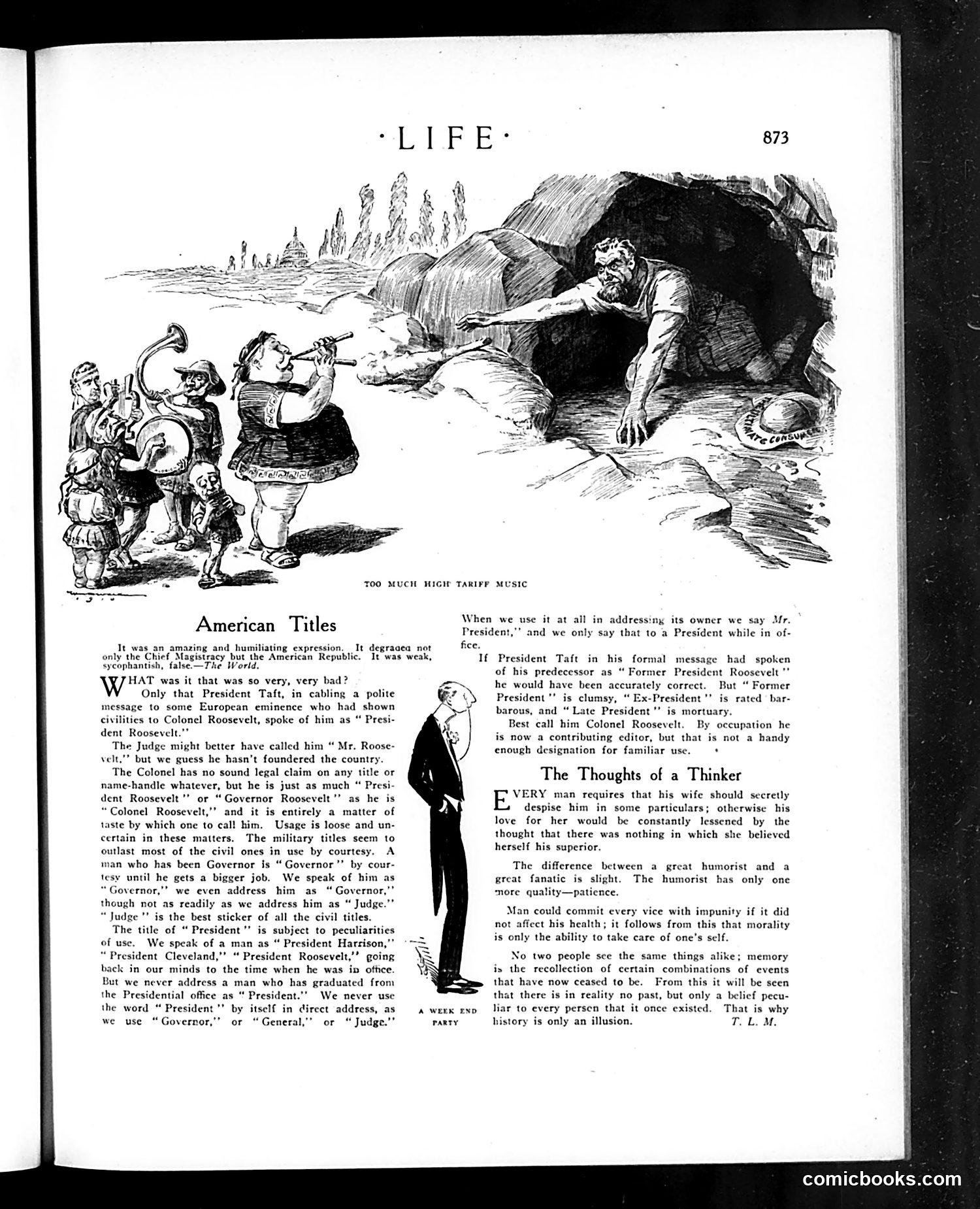
The main cartoon depicts a figure emerging from a cave, appearing distressed or exasperated, while musicians outside play instruments loudly. The caption "Too Much High Tariff Music" references debates over U.S. tariff policy—likely from the early 20th century when tariff disputes were contentious political issues. The figure in the cave appears to represent someone (possibly a political figure or the common citizen) driven to retreat by aggressive tariff-related rhetoric or policy. The "music" metaphor suggests constant, unwanted political messaging about tariffs. The surrounding text discusses presidential titles and addressing conventions, including references to Roosevelt, suggesting this addresses early 1900s political discourse. The satire criticizes what Life viewed as excessive or bothersome tariff advocacy in public debate.
📄 Transcribed text from this page (OCR, searchable)
Machine-transcribed from the original scan — historical spelling and the odd misread are preserved.
100 MUCH HIGH TARIFF MUSIC American Titles It was_an amazing and humiliating expression y the Chief Magistracy but the American Republic. sycophantish, false. —The World. HAT was it that was so very, very bad? Only that President Taft, in cabling a polite message to some European eminence who had shown civilities to Colonel Roosevelt, spoke of him as “ Presi- dent Roosevelt.” The Judge might better have called him “ Mr. Roose- velt,” but we guess he hasn’t foundered the country. The Colonel has no sound legal claim on any title or name-handle whatever, but he is just as much “ Pres dent Roosevelt” or “Governor Roosevelt” as he is “Colonel Roosevelt,” and it is entirely a matter of taste by which one to call him. Usage is loose and un- certain in these matters. The military titles seem to outlast most of the civil ones in use by courtesy. A man who has been Governor is “Governor” by cour- tesy until he gets a bigger job. We speak of him “Governor,” we even address him as “ Governor, though not as readily as we address him as “ Judge.’ “Judge "’ is the best sticker of all the civil titles. The title of “ President" is subject to peculiarities of use. We speak of nas “ President Harrison,” “President Cleveland,” “ President Roosevelt,” going back in our minds to the time when he was in ofhce. But we never address a man who has graduated from the Presidential office as “ President."” We never use the word “ President "” by itself in direct address, as we use “Governor,” or “General,” or “Judge.” It degraaea not Tt was weak, Wh Pre: A WEEK END PARTY en we use it at all in addressing its owner we say Mr. sident,"’ and we only say that to a President while in of- fice, If President Taft in his formal of his predecessor a message had spoken “Former President Roosevelt " he would have been accurately correct. But “ Former President" is clumsy, “Ex-President '’ is rated bar- barous, and “Late President" is mortuary. Best call him Colonel Roosevelt. By occupation he is now a contributing editor, but that is not a handy enough designation for familiar use. + The Thoughts of a Thinker EYE man requires that his wife should secretly despise him in some particulars; otherwise his love for her would be constantly lessened by the thought that there was nothing in which she believed herself his superior. The difference between a great humorist and a great fanatic is slight. The humorist has only one more quality—patience. Man could commit every vice with impunity if it did not affect his health; it follows from this that morality is only the ability to take care of one’s self. No two people sce the same things alike; memory is the recollection of certain combinations of events that have now ceased to be. From this it will be seen that there is in reality no past, but only a belief pecu- liar to every persen that it once existed. That is why history is only an illusion. T. LM. comicbooks.com