
Life, 1910-05-12 · page 29 of 44
Life — May 12, 1910 — page 29: what you’re looking at
What you’re looking at
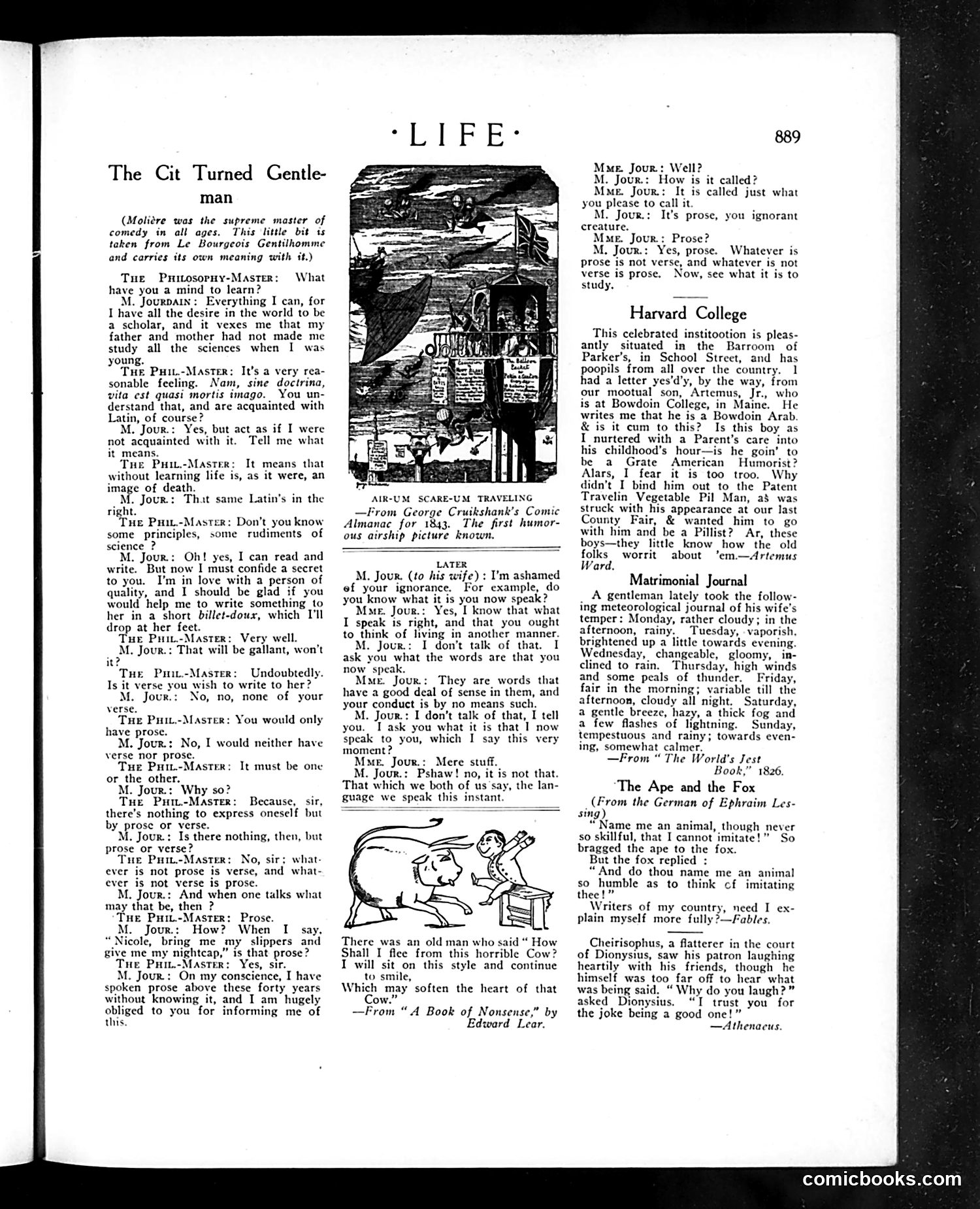
This page contains excerpts from Molière's classic French play *Le Bourgeois Gentilhomme* (The Bourgeois Gentleman), satirizing social pretension and ignorance. **The Main Dialogue**: A wealthy but uneducated commoner (M. Jourdan) hires a philosophy master to become cultured so he can impress a noblewoman. The humor lies in Jourdan's absurd reasoning—he demands writing that is neither verse nor prose, then learns with shock that his everyday speech is "prose." His wife's common sense contrasts with his newfound, shallow "learning." **The Satire's Point**: Molière mocks social climbers who pursue superficial education and status without genuine understanding. Jourdan's realization that he's "spoken prose for forty years without knowing it" exposes how pretentious self-improvement can be ridiculous. **The Airship Cartoon** (Cruikshank, 1843) appears unrelated—a whimsical early depiction of airship travel. The "Harvard College" note below appears to be contemporary satire about the institution itself, though it's partially cut off.
📄 Transcribed text from this page (OCR, searchable)
Machine-transcribed from the original scan — historical spelling and the odd misread are preserved.
The Cit Turned Gentle- man (Moliére was the supreme master of comedy in all ages. This little bit ts taken from Le Bourgeois Gentilhomme and carries its own meaning with it.) Tue Puuitosopuy-Master: What have you a mind to learn? M. Jourpain: Everything I can, for IT have all the desire in the world to be a scholar, and it vexes me that my father and mother had not made me study all the sciences when I was young. Tue Puit.-Master: It’s a very rea- sonable feeling. Nam, sine doctrina, vila est quasi mortis imago. You w derstand that, and are acquainted with Latin, of course? M. Jour.: Yes, but act_as if I were not acquainted with it. Tell me what it means. Tue Puit.-Master: It means that without learning life is, as it were, an image of death. . M. Jour.: That same Latin’s in the right. THe Puut.-Master: Don't you know some principles, some rudiments of science ? M. Jour: Oh! yes, I can read and write. But now I must confide a secret I'm in love with a person of quality, and I should be glad if you would help me to write something to her in a short billet-doux, which I'll drop at her feet. Tue Puit.-Master: Very well. M. Jour.: That will be gallant, won't it? Tue Pui.-Master: Undoubtedly. Is it verse you wish to write to her? M. Jour.: No, no, none of your verse. Tue Puit.-Master: You would only have prose. M. Jour.: No, I would neither have verse nor prose. Tue Pui.-Master: or the other, M. Jour.: Why so? Tue Puit.-Master: Because, sir, there’s nothing to express oneself but by prose or verse. M. Jour.: Is there nothing, then, but prose or verse? Tue Pui-Master: No, sir; what- ever is not prose is verse, and what- ever is not verse is prose. M. Jour.: And when one talks what may that be, then ? Tue Puit-Master: Prose. M. Jour.: How? When I y cole, bring me my slippers a give me my nightcap,” is that prose? Tue Pui.-Master: Yes, sir. M. Jour: On my conscience, I have spoken prose above these forty years without knowing it, and I am hugely obliged to you for informing me of this. Tt must be one AIR-UM SCARE-UM TRAVELING —From George Cruikshank’s Comic Almanac for 1843. The first humor- ous airship picture known, LATER M. Jour. (to his wife) : I'm ashamed ef your ignorance. For example, do you know what it is you now speak? Mae. Jour.: Yes, I know that what I speak is right, and that you ought to think of living in another manner. M. Jour.: I don’t talk of that. I ask you what the words are that you now’ speak. Mat. Jour: They are words that have a good deal of sense in them, and your conduct is by no means such, M. Jour.: I don’t talk of that, I tell you. I ask you what it is that I now speak to you, which I say this very moment? Mme. Jour.: Mere stuff. M. Jour.: Pshaw! no, it is not that. That which we both of us say, the lan- guage we speak this instant There was an old man who said “ How Shall I flee from this horrible Cow? I will sit on this style and continue to smile, Which may soften the heart of that Cow.” —From “A Book of Nonsense,” by Edward Lear. 889 Mae. Jour: Well? M. Jour.: How is it called? Mme. Jour.: It is called just what you please to call it. M. Jour.: It’s prose, you ignorant creature. Mae. Jour.: Prose? M, Jour.: Yes, prose. Whatever is prose is not verse, and whatever is not verse is prose. Now, see what it is to study, Harvard College This celebrated institootion is pleas- antly situated in the Barroom of Parker’s, in School Street, and has poopils from all over the country. 1 had a letter yes'd’y, by the w from our mootual son, Artemus, Jr., who is at Bowdoin College, in Maine. He writes me that he is a Bowdoin Arab. & is it cum to this? Is this boy as I nurtered with a Parent’s care into his childhood’s hour—is he goin’ to be a Grate American Humorist? Alars, I fear it is too troo. Why didn’t I bind him out to the Patent Travelin Vegetable Pil Man, a8 was struck with his appearance at our last County F; & wanted him to go with him and be a Pillist? Ar, these boys—they little know how the old folks| worrit about ’em.—Artemus Ward. Matrimonial Journal _ A gentleman lately took the follow- ing meteorological journal of his wife's temper: Monday, rather cloudy; in the afternoon, rainy. Tuesday, .vaporish, brightened up a little towards evening. Wednesday, changeable, gloomy, in- clined to rain. Thursday, high winds and some peals of thunder. Friday, fair in the morning; variable till the afternoon, cloudy all night. Saturday, a gentle breeze, hazy, a thick fog and a few flashes of lightning. Sunday, tempestuous and rainy; towards even- ing, somewhat calmer. —From “The World's Jest Book,” 1826. The Ape and the Fox (From the German of Ephraim Les- sing) “Name me an animal, though never so skillful, that I cannot imitate!" So bragged the ape to the fox. But the fox replied : “And do thou name me an animal so humble as to think cf imitating thee!” Writers of my country, need I ex- plain myself more fully ?—Fables. Cheirisophus, a flatterer in the court of Dionysius, saw his patron laughing heartily with his friends, though he himself was too far off to hear what was being said, “ Why do you laugh?” asked Dionysius. “TI trust you for the joke being a good one!” —Athenaeus. comicbooks.com