
A complete issue · 40 pages · 1910
Life — April 28, 1910
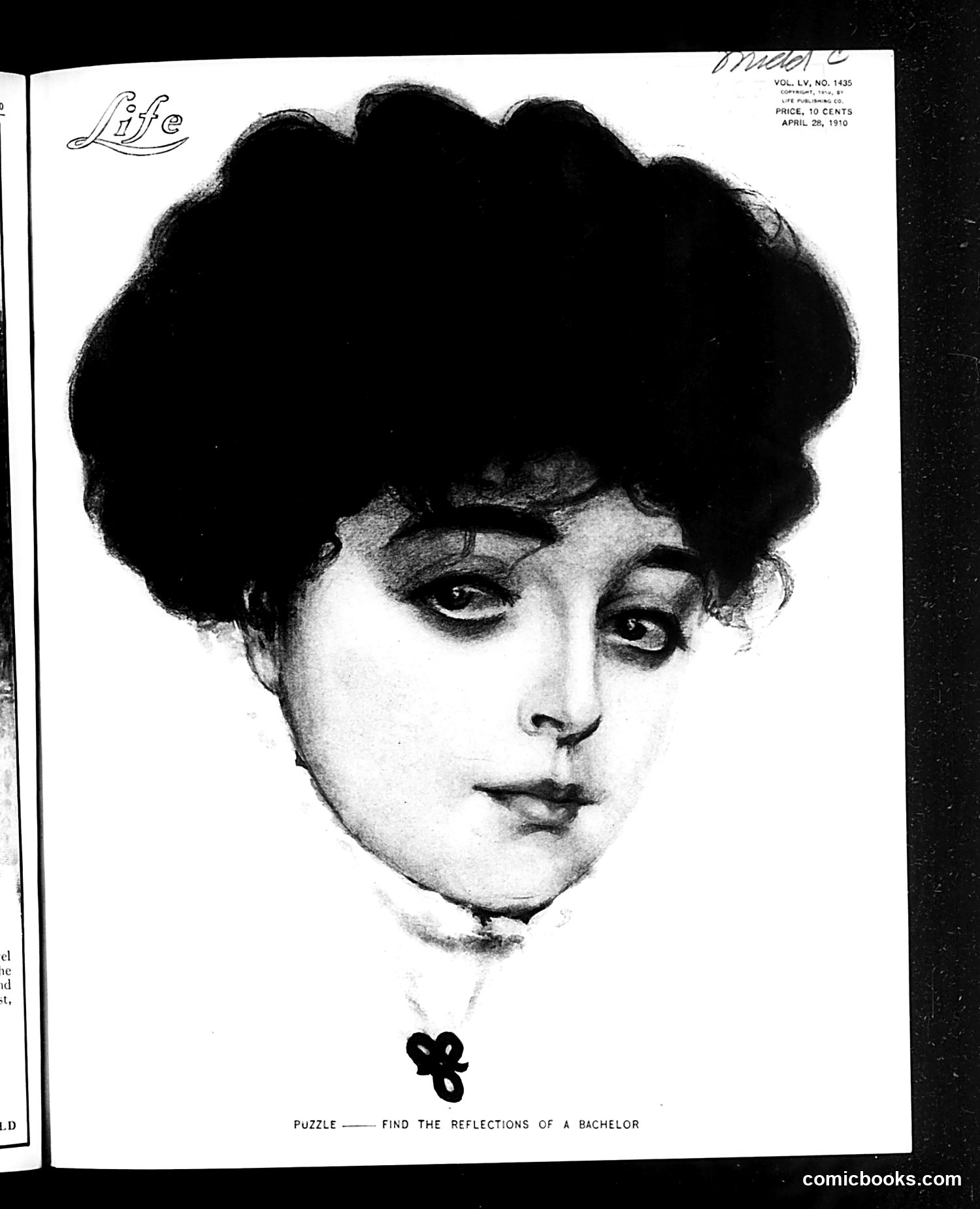
This is a cover illustration for *Life* magazine featuring a portrait of a woman with styled dark hair and early 1900s fashion. Below the portrait is a puzzle caption reading "FIND THE REFLECTIONS OF A BACHELOR." The satire appears to target bachelor culture and courtship customs of the Edwardian era. The puzzle format suggests readers should identify hidden "reflections"—likely facial features or expressions—that reveal a bachelor's romantic interests or intentions when viewing this woman's portrait. The humor relies on contemporary anxieties about marriage, courtship, and male romantic commitment. The "puzzle" format was typical of *Life*'s satirical approach, transforming social commentary into interactive entertainment for readers.
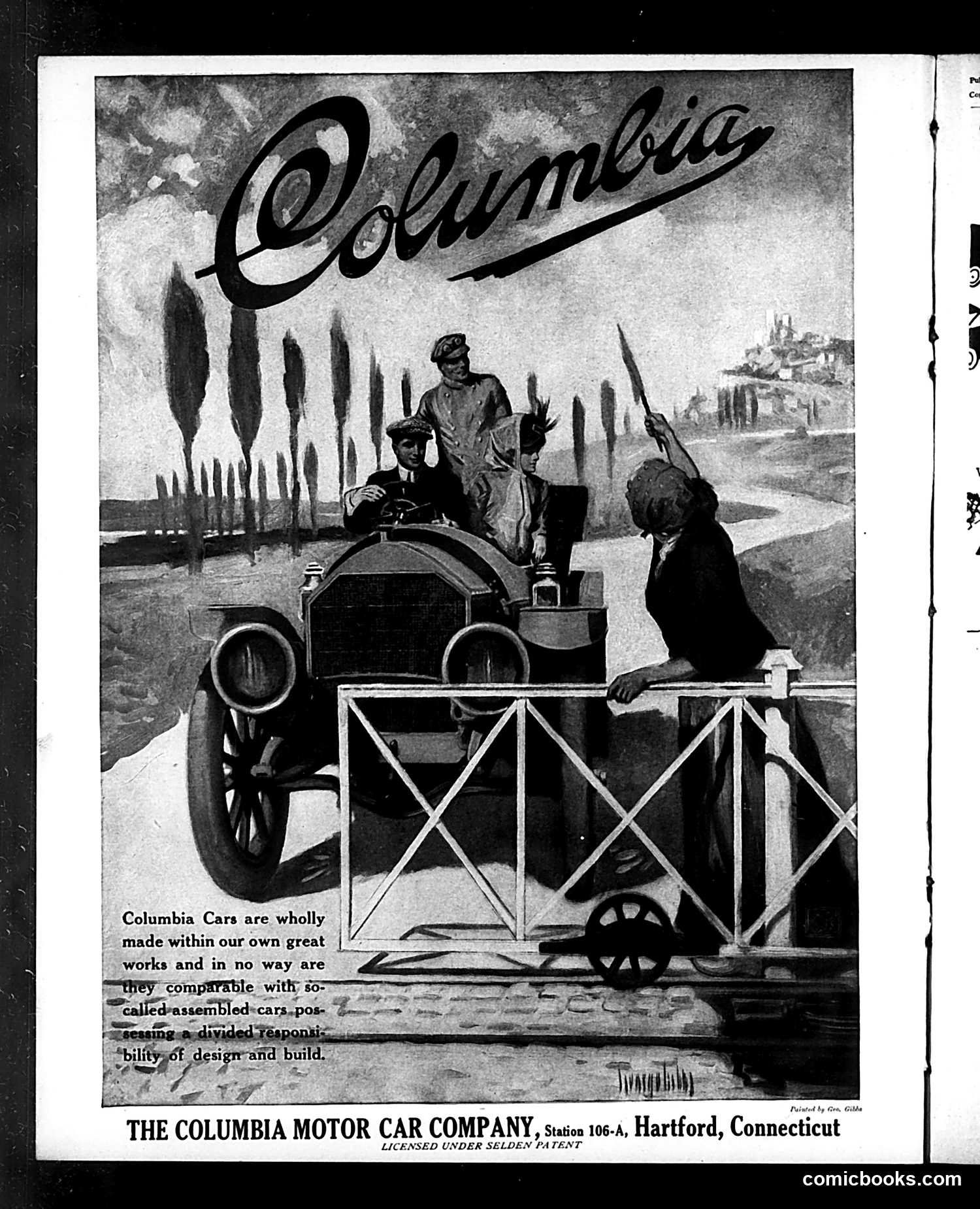
This is a **product advertisement**, not political satire. The Columbia Motor Car Company of Hartford, Connecticut is promoting their automobiles with an Italian-themed scenic backdrop (cypress trees, classical architecture). The ad's key claim appears in the text: Columbia cars are "wholly made within our own great works" and therefore superior to "so-called assembled-cars," which apparently were manufactured by combining parts from different suppliers—a common practice among early automakers. The advertisement emphasizes **domestic manufacturing pride and quality control** as competitive advantages. The elegant touring scene with well-dressed figures suggests Columbia positioned itself as a luxury vehicle for the affluent market. This reflects early-20th-century automobile industry competition between fully integrated manufacturers and assembly-based competitors.
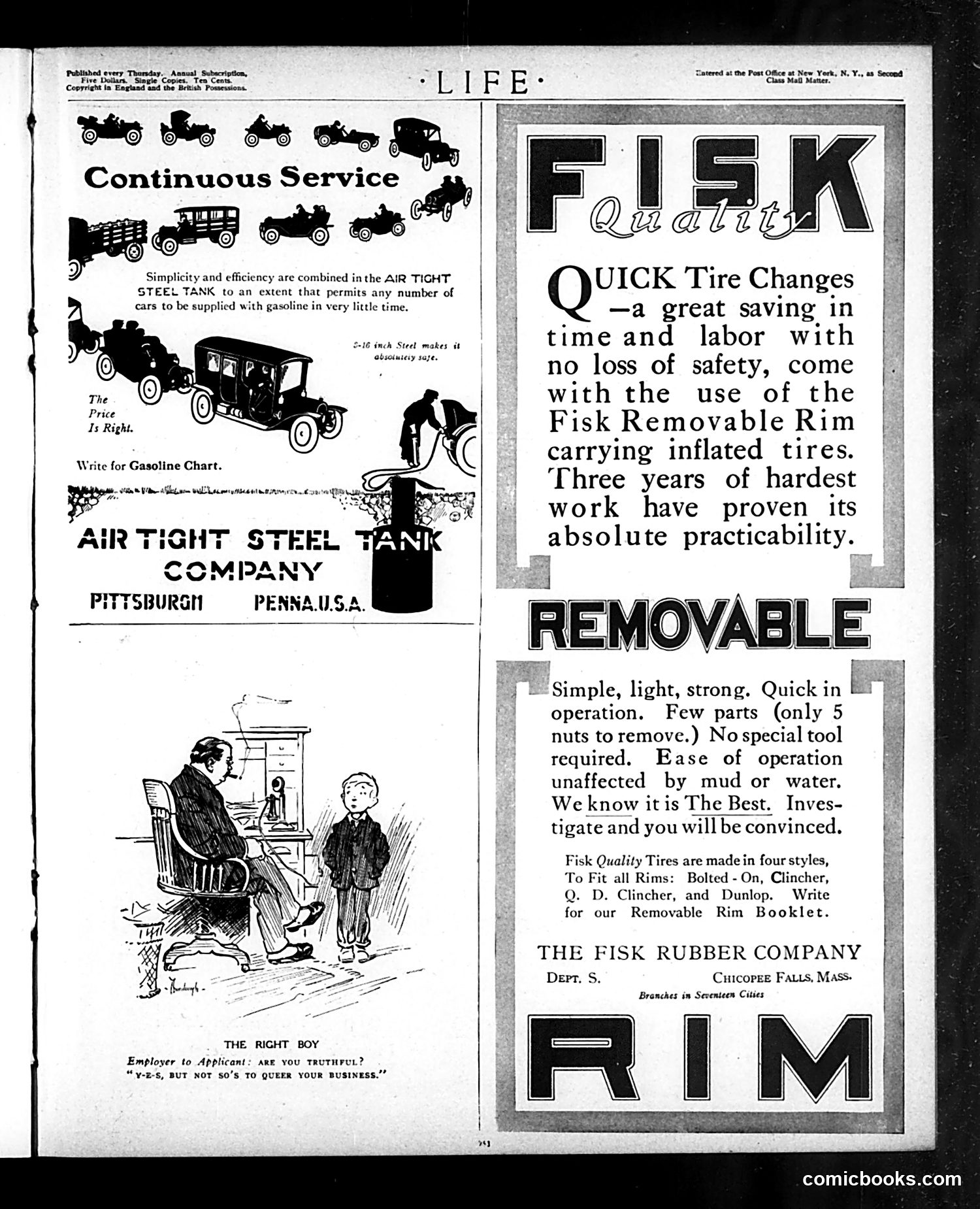
This cartoon satirizes workplace hiring practices, likely from the 1910s-1920s. An adult employer interviews a young boy, with the caption asking: "Employer to Applicant: ARE YOU TRUTHFUL? 'Y-E-S, BUT NOT SO'S TO QUEEA YOUR BUSINESS.'" The joke targets the hypocrisy of business culture: the employer demands honesty as a virtue, yet the boy's candid admission—that he'll bend the truth to protect the company's interests—is presented as the actual expectation. The satire suggests that "truthfulness" in business is merely performative; what employers truly want is loyalty and willingness to lie when profitable. The rest of the page contains period advertisements for automobiles, steel tanks, and tire rims—typical commercial content.
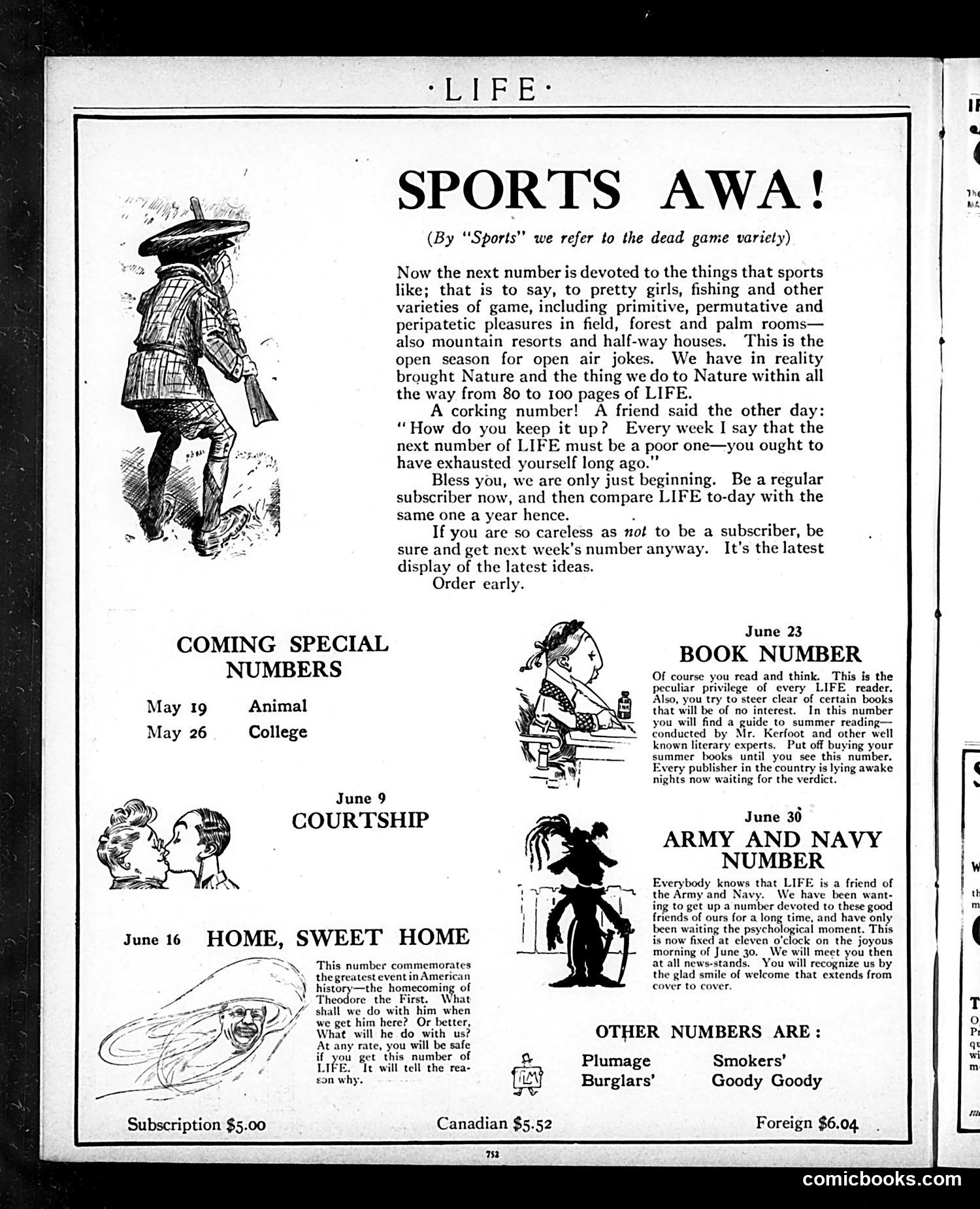
This page is primarily **promotional content** announcing upcoming special issues rather than political satire. The main cartoon shows a hunter with a rifle, illustrating the "Sports" theme—referring to outdoor activities like hunting, fishing, and nature pursuits. The text emphasizes Life's breadth of coverage, from 80-100 pages devoted to sports and outdoor recreation. Several special issues are advertised: an Animal number (May 19), College (May 26), Courtship (June 9), Home, Sweet Home (June 16), a Book Number (June 23), and an Army and Navy Number (June 30). The tone is lighthearted promotional copy encouraging subscriptions by highlighting Life's diverse content and urging readers to compare issues over time. There is **no significant political satire** on this particular page.
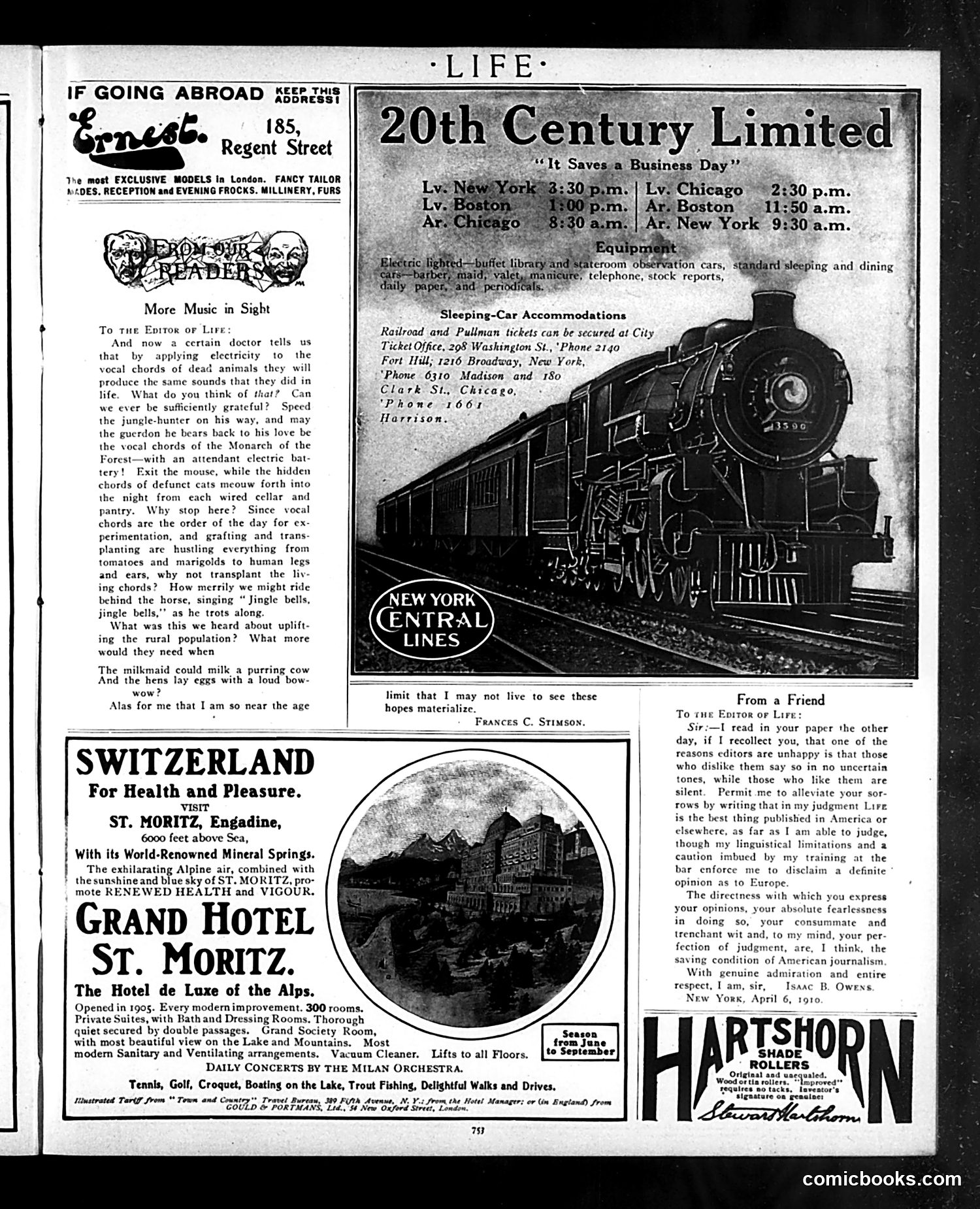
This page is **primarily advertisements** with one brief satirical article. The main content includes: **"More Music in Sight"** — A short satire by Frances C. Stimson mocking the idea of applying "electricity to the vocal chords of dead animals" to produce sounds. The author humorously questions whether such technology could replicate animal noises, suggesting absurd applications like having jungle animals perform in concert or transplanting animal vocal chords to humans. It's gentle mockery of contemporary technological enthusiasm and pseudo-scientific proposals. The remainder consists of travel and hospitality ads: the "20th Century Limited" train, the Grand Hotel St. Moritz in Switzerland, Ernest tailoring services, and Hartshorn Rollers. No political figures or significant historical events are referenced—this is primarily commercial content with light humor.
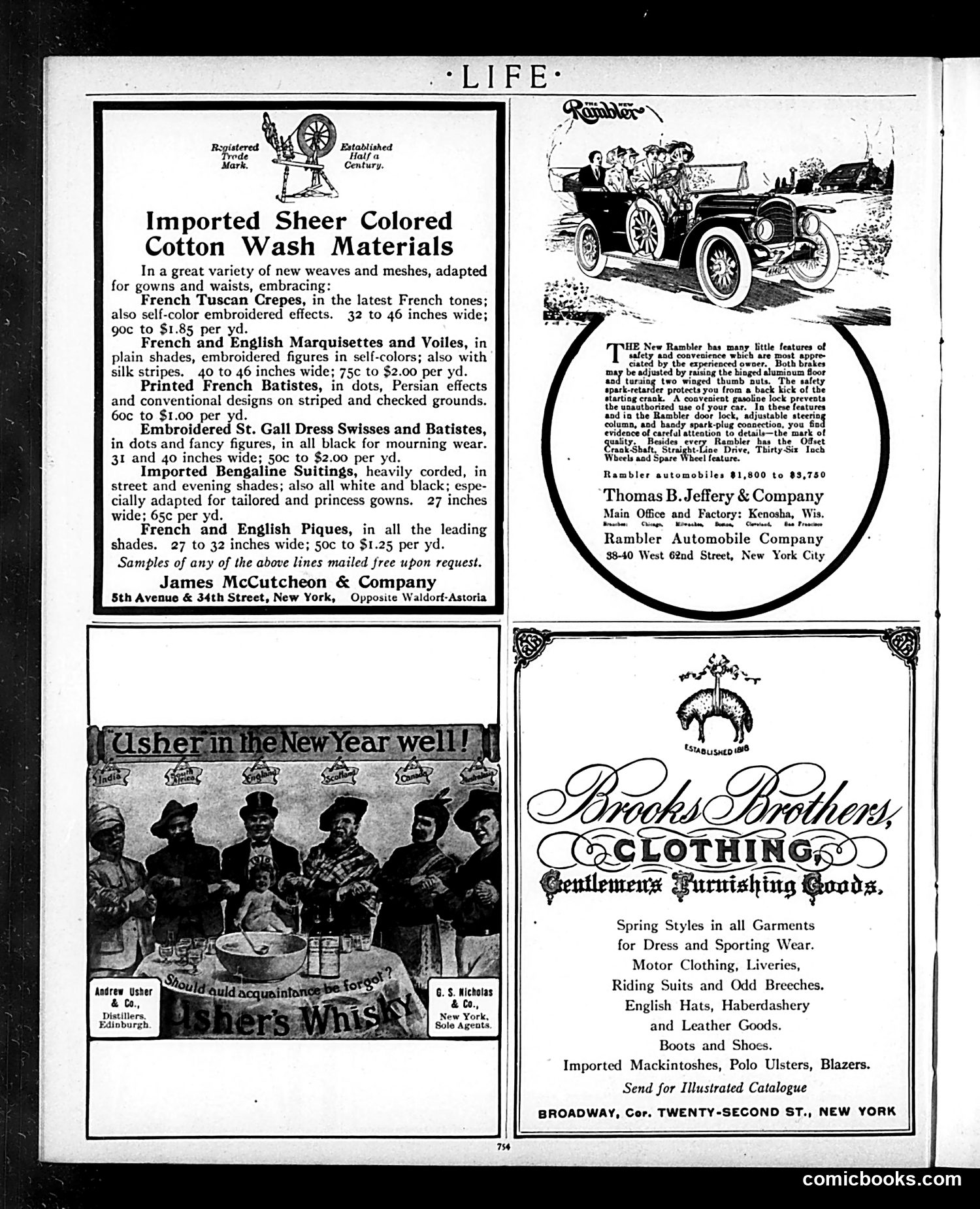
This page is predominantly **advertising** rather than satirical content. The top left features James McCutcheon & Company promoting imported cotton fabrics for women's clothing. The top right contains a Rambler automobile advertisement highlighting features like a "speedometer" and "gasoline lock." The bottom left shows **Usher's Whisky** advertising with six figures in formal dress (appearing to be dignitaries or world leaders based on their attire and regalia). The caption suggests whisky's social lubricant role: "Would auld acquaintance be forgot?" — a reference to the song "Auld Lang Syne." The bottom right advertises Brooks Brothers' clothing and furnishing goods. The page reflects early 20th-century consumer culture with minimal satirical content visible.
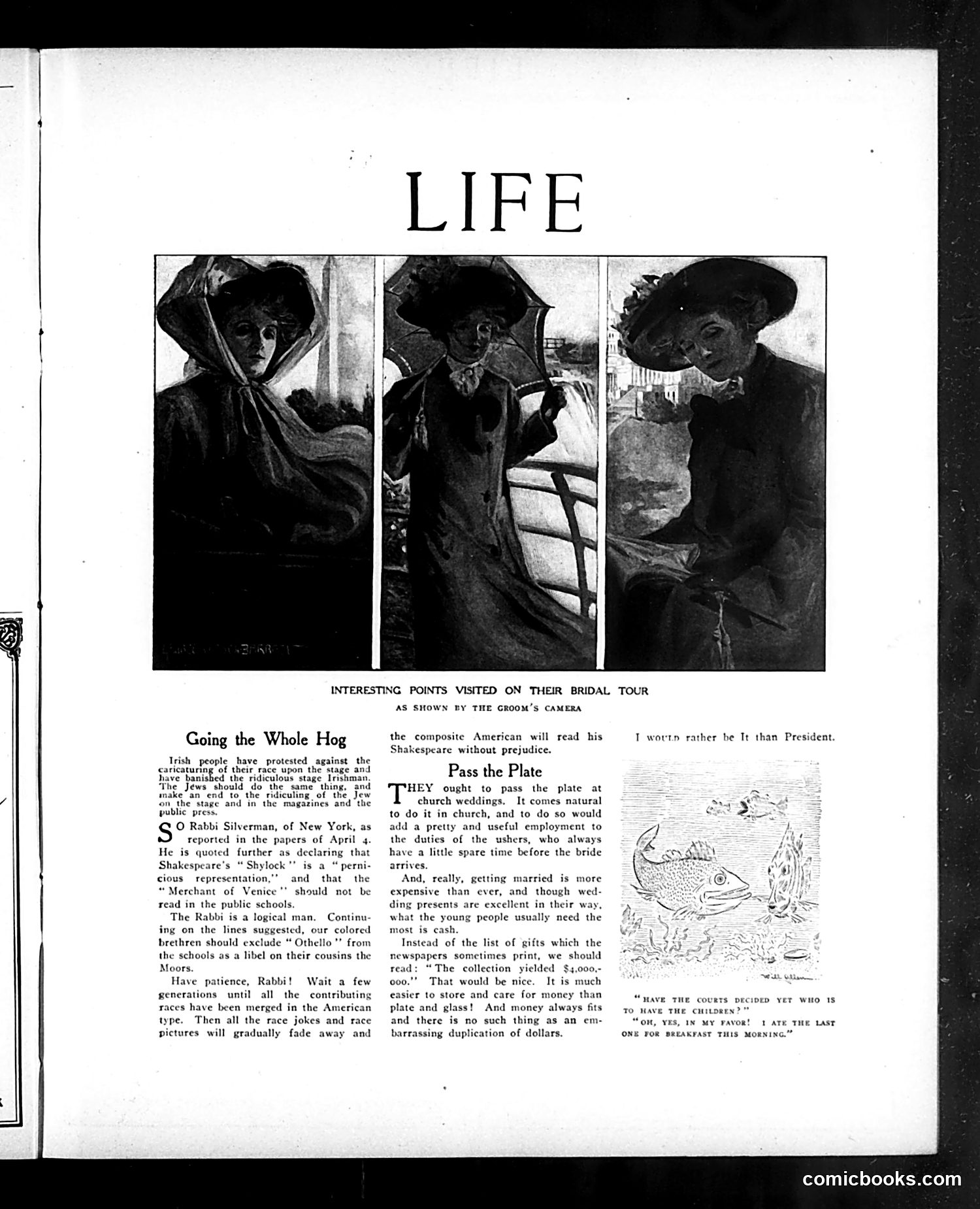
This page features two satirical pieces from Life magazine (a humor publication, not the photo magazine). **Top section**: Three photographs labeled "Interesting Points Visited on Their Bridal Tour as Shown by the Groom's Camera" appear to mock newlyweds' vacation photography—likely satirizing the earnestness of documenting travel. **"Going the Whole Hog"**: Mocks Rabbi O. S. Silverman of New York for allegedly declaring that "The Merchant of Venice" should be removed from public school curricula as offensive. The piece sarcastically suggests eventually all literature featuring ethnic stereotypes would be eliminated, absurdly predicting gradual erasure of racial humor from American culture. **"Pass the Plate"**: Satirizes wedding gift-giving customs, suggesting monetary gifts are more practical than china or glassware for newlyweds. The overall tone is light social commentary on contemporary customs and cultural debates.
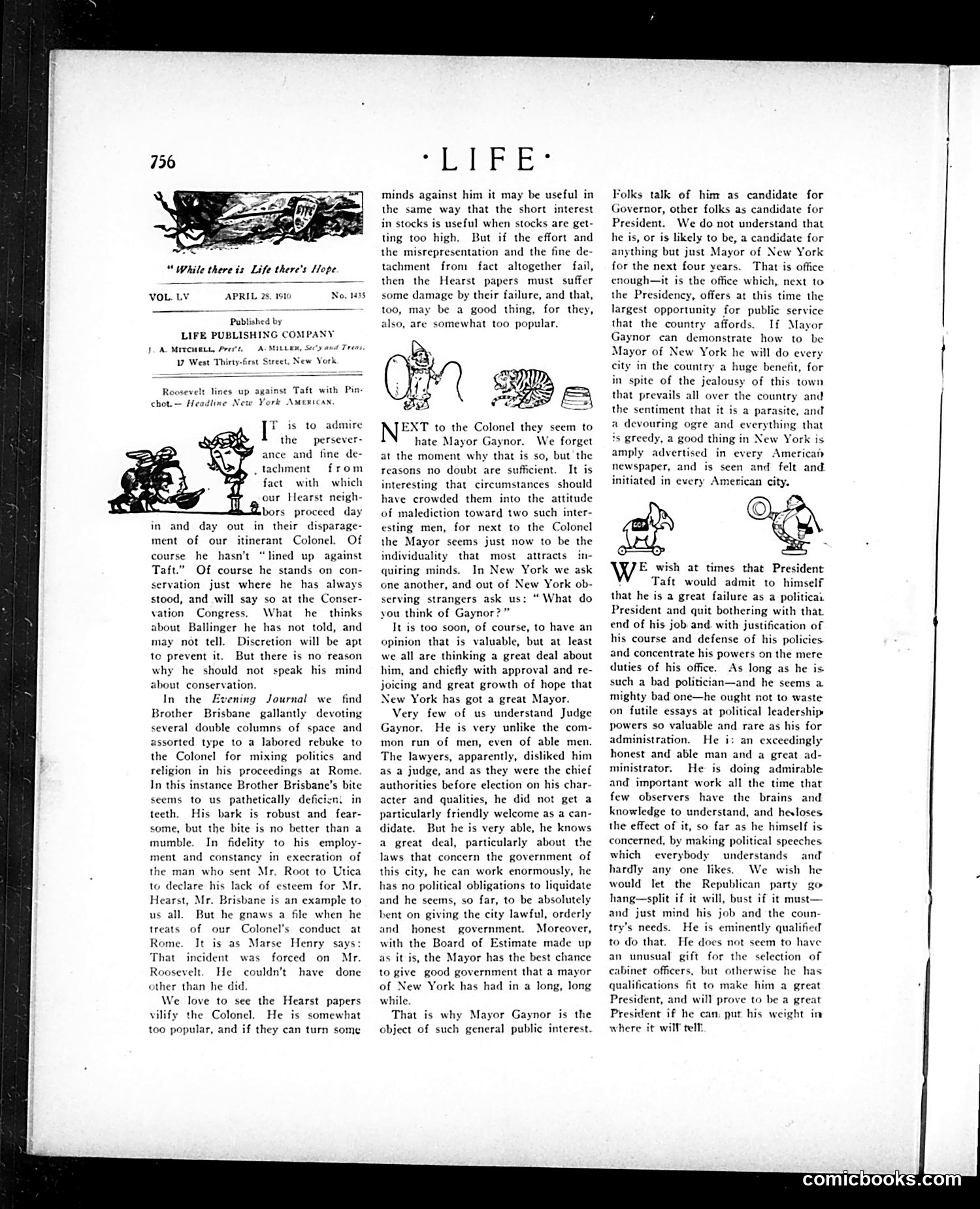
This page critiques Mayor William Jay Gaynor of New York City. The text discusses his unpopularity with various groups—lawyers disliked him as a judge candidate, and he faced criticism for mixing politics with religion at Rome proceedings. The accompanying cartoons (though small and somewhat unclear in reproduction) appear to satirize Gaynor's political position and public reception. The article acknowledges his administrative competence but suggests he lacks the political finesse needed for higher office, particularly the presidency. The piece also references Colonel Roosevelt's recent actions and the "Hearst papers," indicating this reflects broader 1910 New York political divisions among progressive factions. The overall tone is cautionary—praising Gaynor's honesty while questioning his suitability for national leadership.
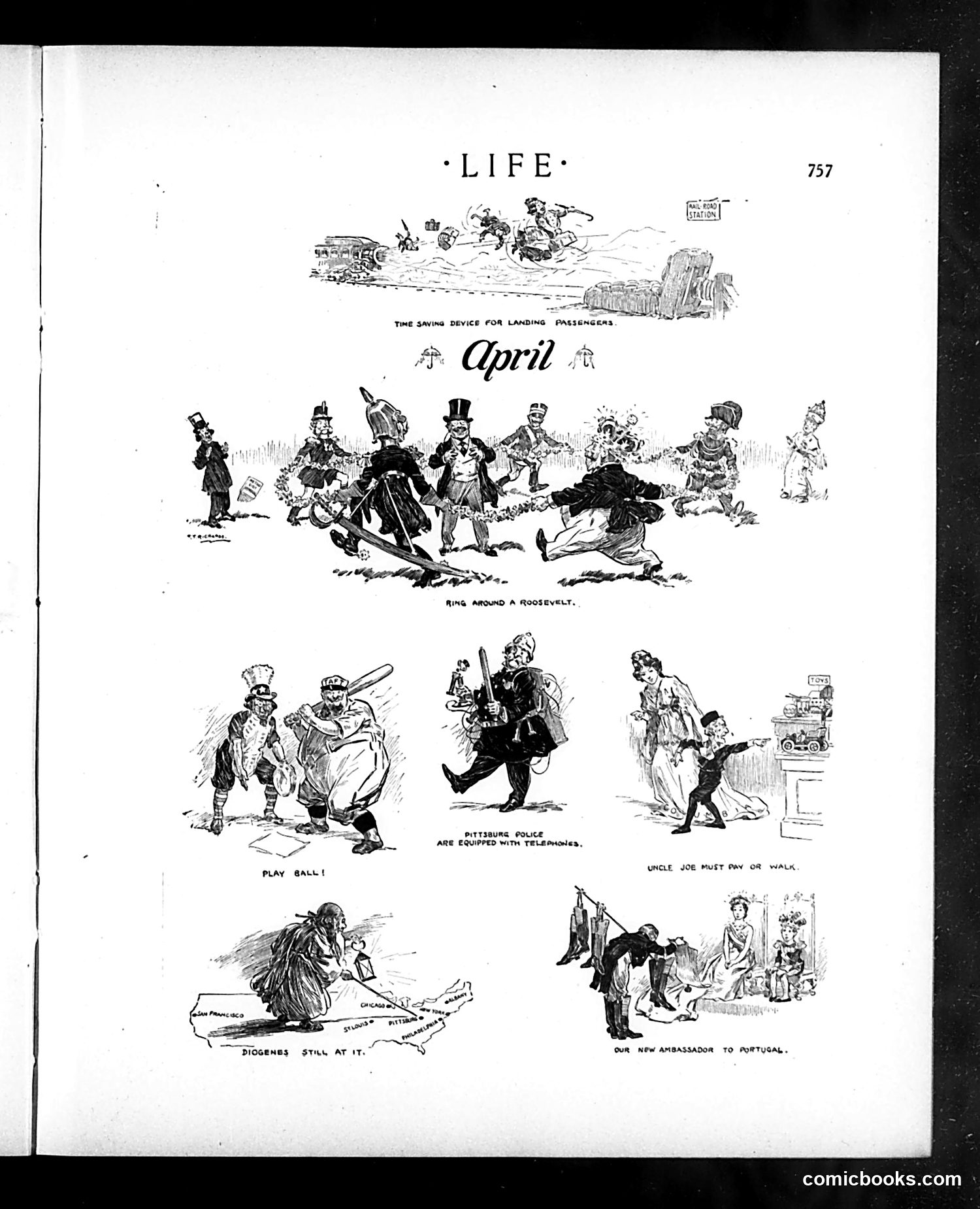
This page from *Life* magazine presents several April-themed satirical cartoons mocking contemporary political and social figures. The central image shows "Ring Around a Roosevelt" — a children's game adaptation featuring caricatured politicians in top hats dancing around a figure (likely President Roosevelt), satirizing political maneuvering. Other panels reference specific events: "Pittsburgh Police Are Equipped with Telephones," "Play Ball!" (baseball commentary), "Uncle Joe Must Pay or Walk," and "Diogenes Still At It" (classical reference to the philosopher's search for an honest man). The "New Ambassador to Portugal" panel suggests diplomatic appointments. Without clearer identifying details in the caricatures, specific individuals remain uncertain, though the cartoons clearly mock 1900s-era political figures, urban modernization, and current events.
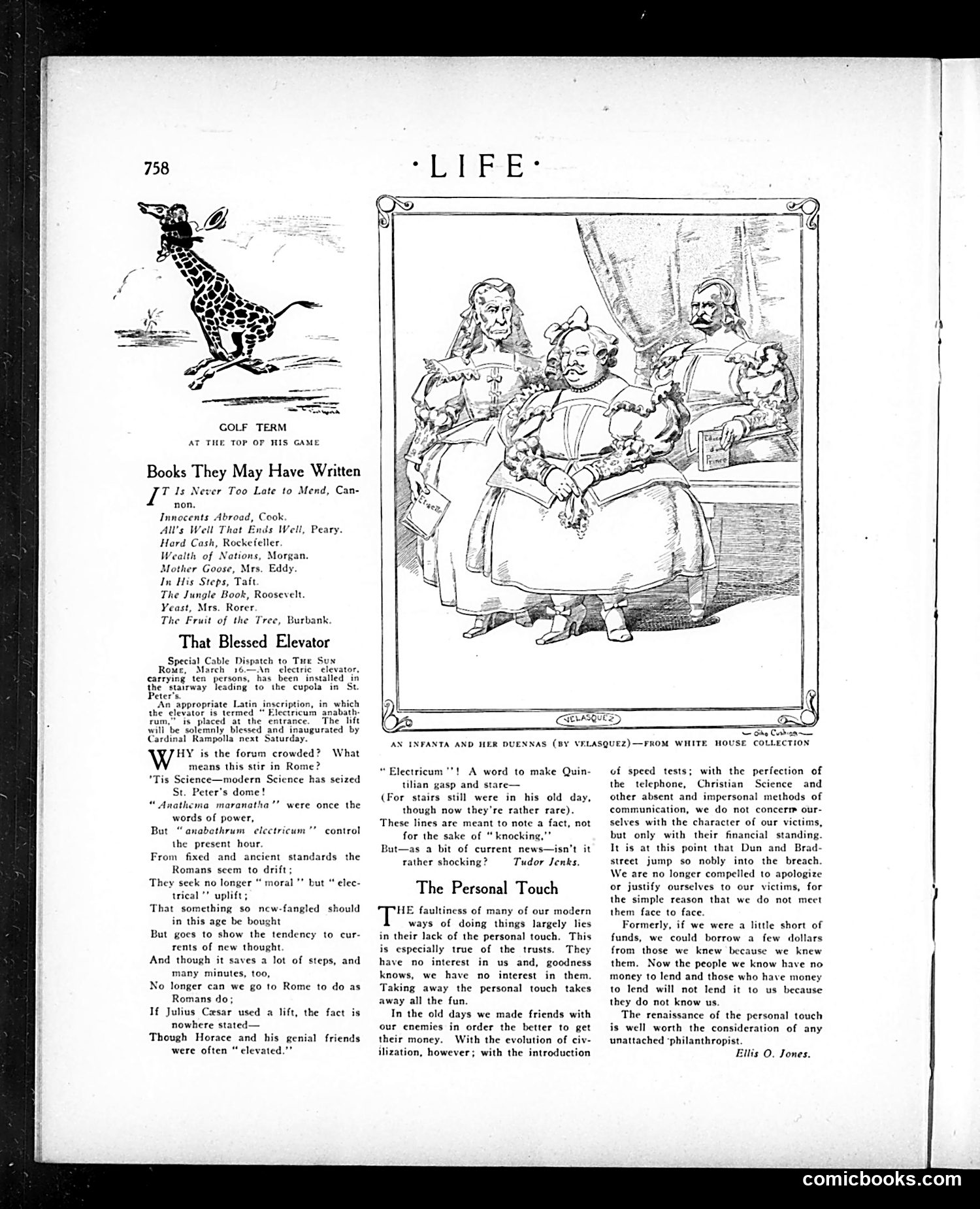
**The Main Cartoon:** "An Infanta and Her Duennas (by Velasquez)—From White House Collection" depicts a woman in elaborate dress surrounded by attendants, parodying the famous Velasquez painting. This appears to satirize a prominent woman's entourage or social pretensions, likely referencing someone from high society or politics circa this publication. **The Text Articles:** Include pieces on elevators, Latin phrases, and "The Personal Touch," discussing modern conveniences diminishing personal human connection. The recurring theme critiques how technology and social advancement have removed face-to-face interaction from daily life. **Overall Context:** This is a satirical social commentary typical of Life magazine, mocking both artistic pretension and the impersonal nature of modern civilization.
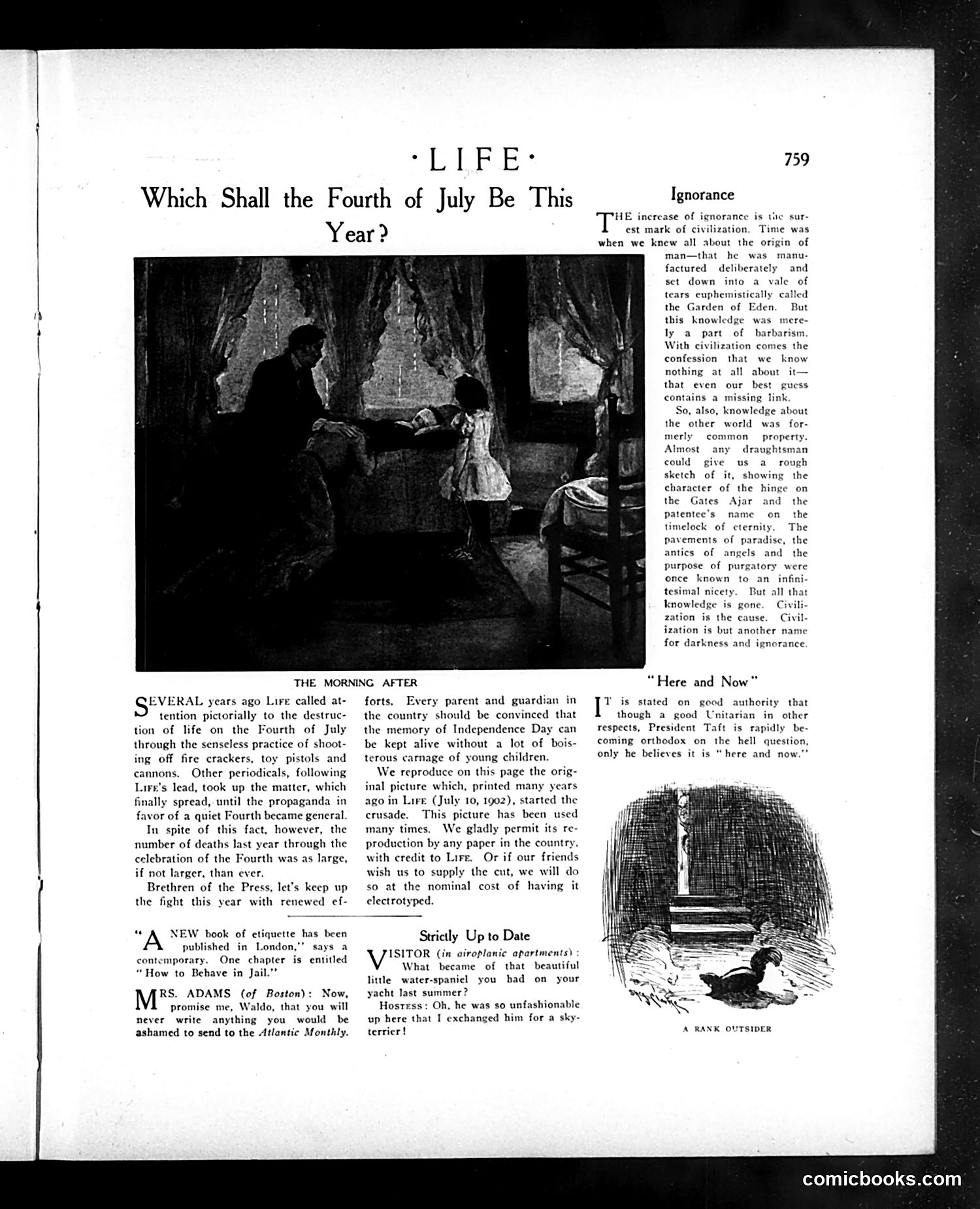
This page contains editorial commentary rather than political cartoons. The main article "Which Shall the Fourth of July Be This Year?" discusses concerns about dangerous Fourth of July celebrations—specifically deaths from fireworks and explosives. Life advocates for a safer, quieter Independence Day. The accompanying photograph "The Morning After" shows the aftermath of such violence, depicting casualties. The secondary items are lighter: "Ignorance" is a philosophical essay; "Here and Now" discusses President Taft's stated belief in the present moment; and "Strictly Up to Date" contains brief social humor about visitors exchanging animals. The small illustration "A Bank Outsider" depicts someone swimming, likely a humorous social observation. The overall page mixes serious public safety advocacy with lighter social commentary typical of Life's satirical approach.
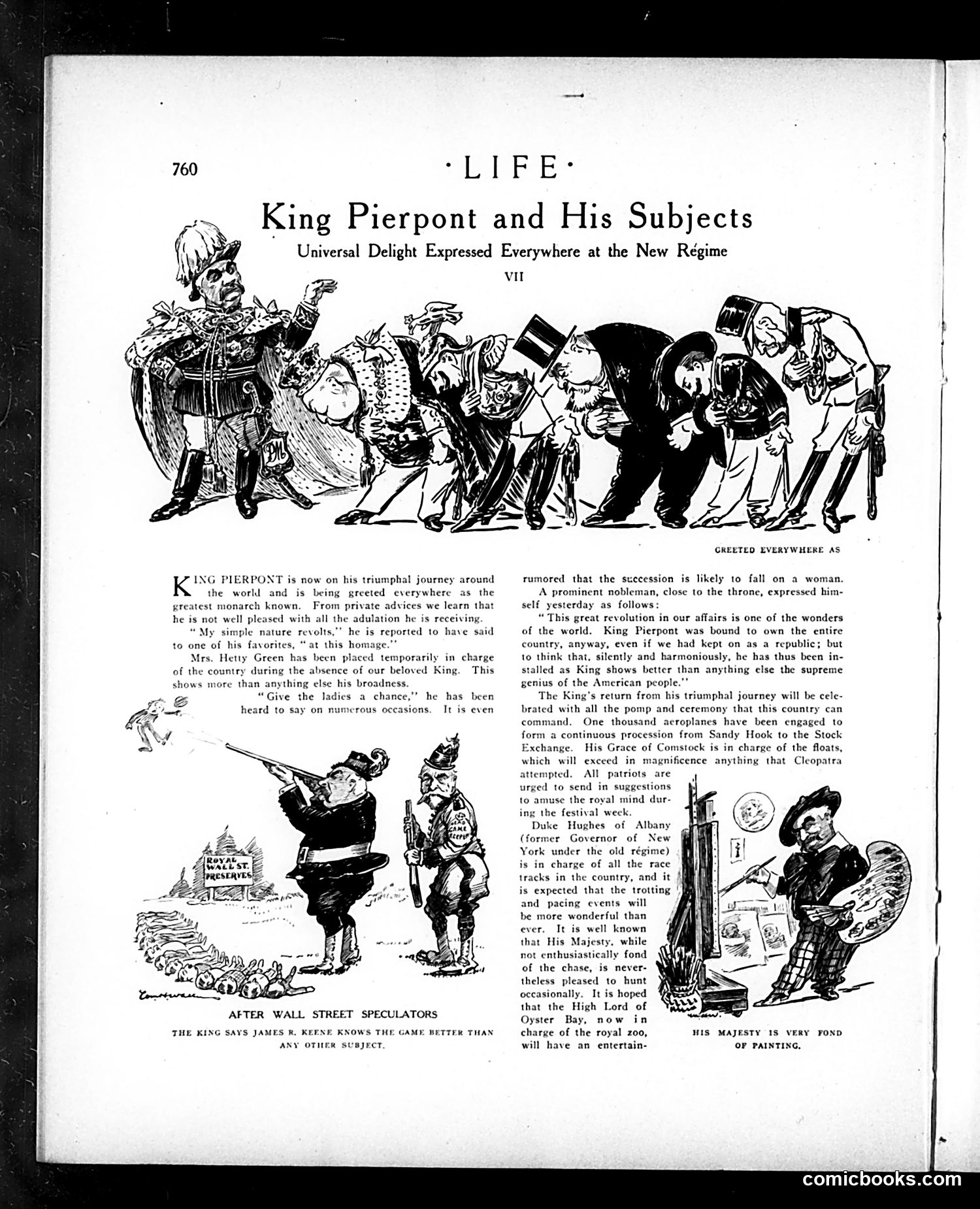
This is a satirical political cartoon about **J. P. Morgan** (the prominent banker, referred to as "King Pierpont"), presented as a monarch surveying his subordinates and subjects. The top illustration shows Morgan in regal dress gesturing over various caricatured figures—likely politicians and financiers—depicted as subservient courtiers. The satire mocks Morgan's immense wealth and influence over American politics and business during the early 1900s. The article references his recent travels, his control over financial markets ("Wall Street"), and his outsized power in shaping national affairs. The cartoons suggest Morgan operates like an absolute ruler rather than a private citizen, commanding politicians and controlling events like royal entertainments. This reflects widespread Progressive Era criticism of monopolistic power concentrated in wealthy industrialists.
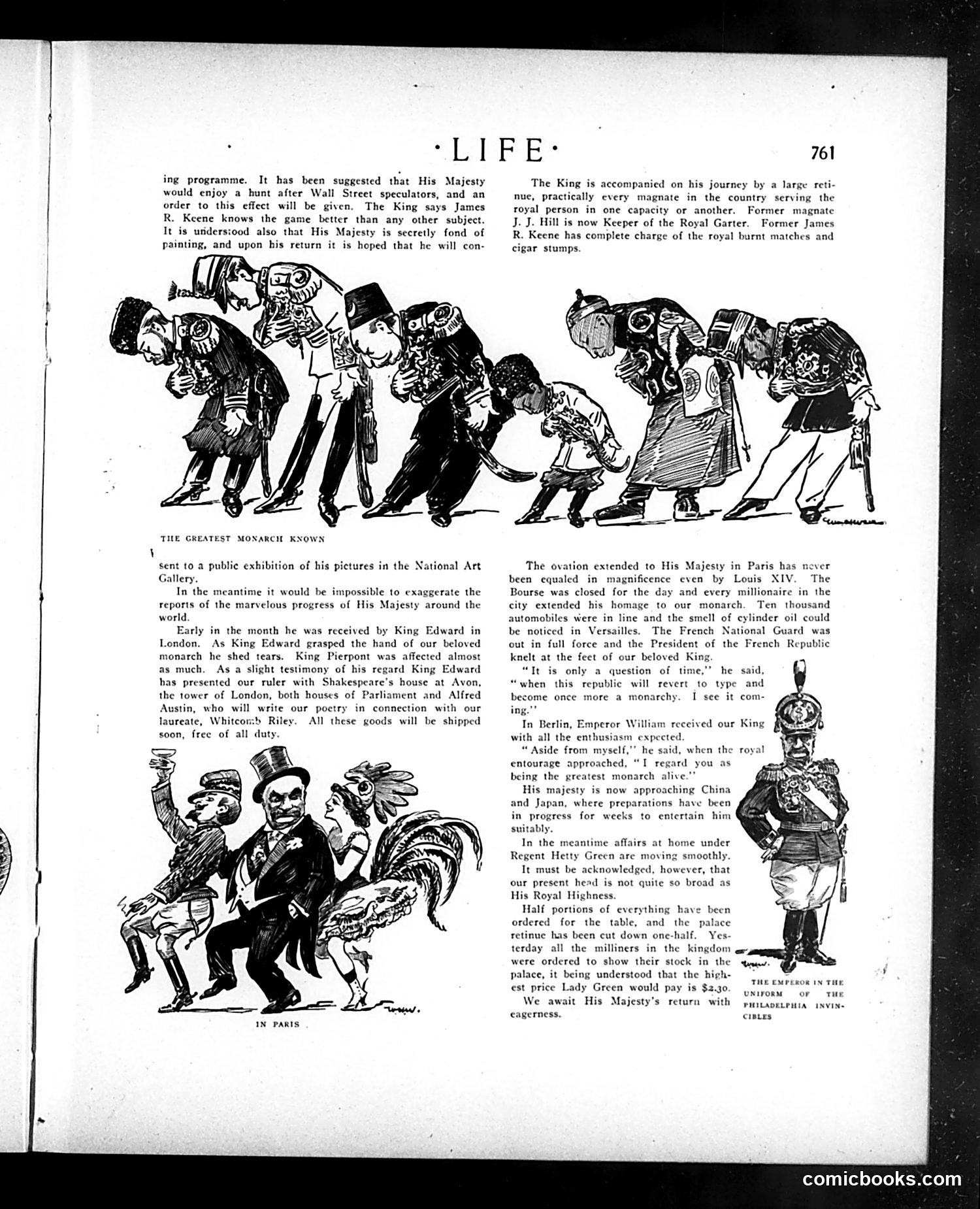
This page satirizes King George V's 1912 state visit to France and his broader European travels. **"The Greatest Monarch Known"** (top cartoon) depicts the King surrounded by bowing dignitaries in exaggerated poses, mocking the excessive ceremonial deference shown to him. **"In Paris"** (bottom cartoon) shows caricatured French figures—likely President Fallières and other officials—fawning over the King in an undignified manner, suggesting the French were overly eager to please Britain's monarch. The text confirms the King received unprecedented receptions in Paris and Berlin. Life's satire targets the absurdity of royal worship and diplomatic obsequiousness during this period of international relations, particularly the contrast between republican French ideals and their actual behavior toward European monarchs.
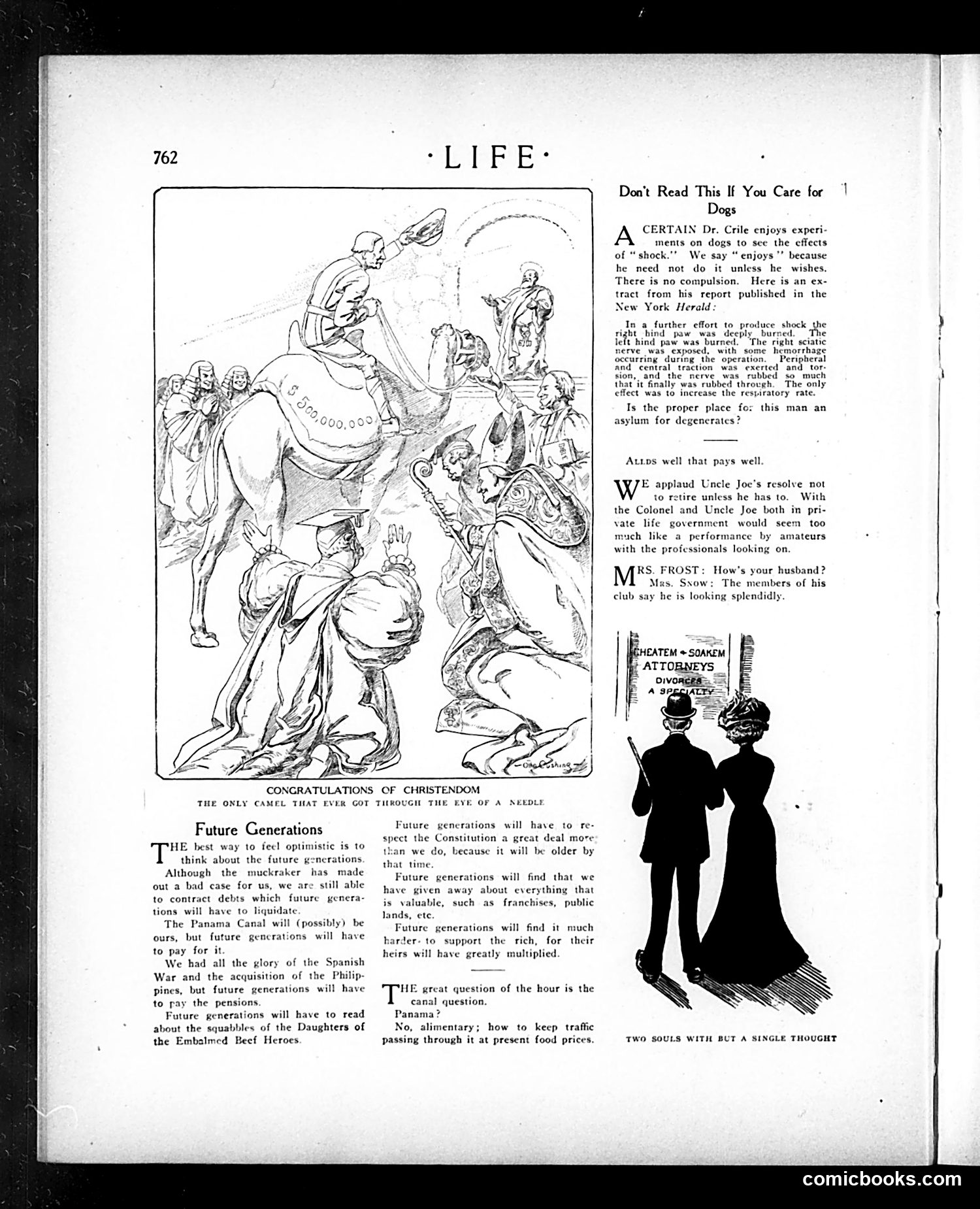
The page contains multiple satirical pieces from an early 20th-century Life magazine: **"Congratulations of Christendom"** depicts a bloated figure labeled with "$1,000,000" passing through a needle's eye—referencing the biblical saying about a camel passing through a needle's eye. This mocks wealthy industrialists or monopolists as hypocritically "Christian" while accumulating vast fortunes. **"Future Generations"** sarcastically criticizes current American leadership for leaving debts, unfunded military pensions, and squandered public resources for posterity to manage. It references the Panama Canal and Spanish-American War costs. **"Don't Read This If You Care for Dogs"** condemns Dr. Crile's animal experimentation, quoting his published report of deliberately burning and injuring dogs' nerves to study shock effects. The writer questions whether such a researcher belongs in an asylum. The remaining brief pieces mock political figures (likely "Uncle Joe" Cannon, a powerful Speaker) and social pretense. The cartoon style and subjects reflect Progressive-era concerns about corporate excess, government accountability, and animal welfare.
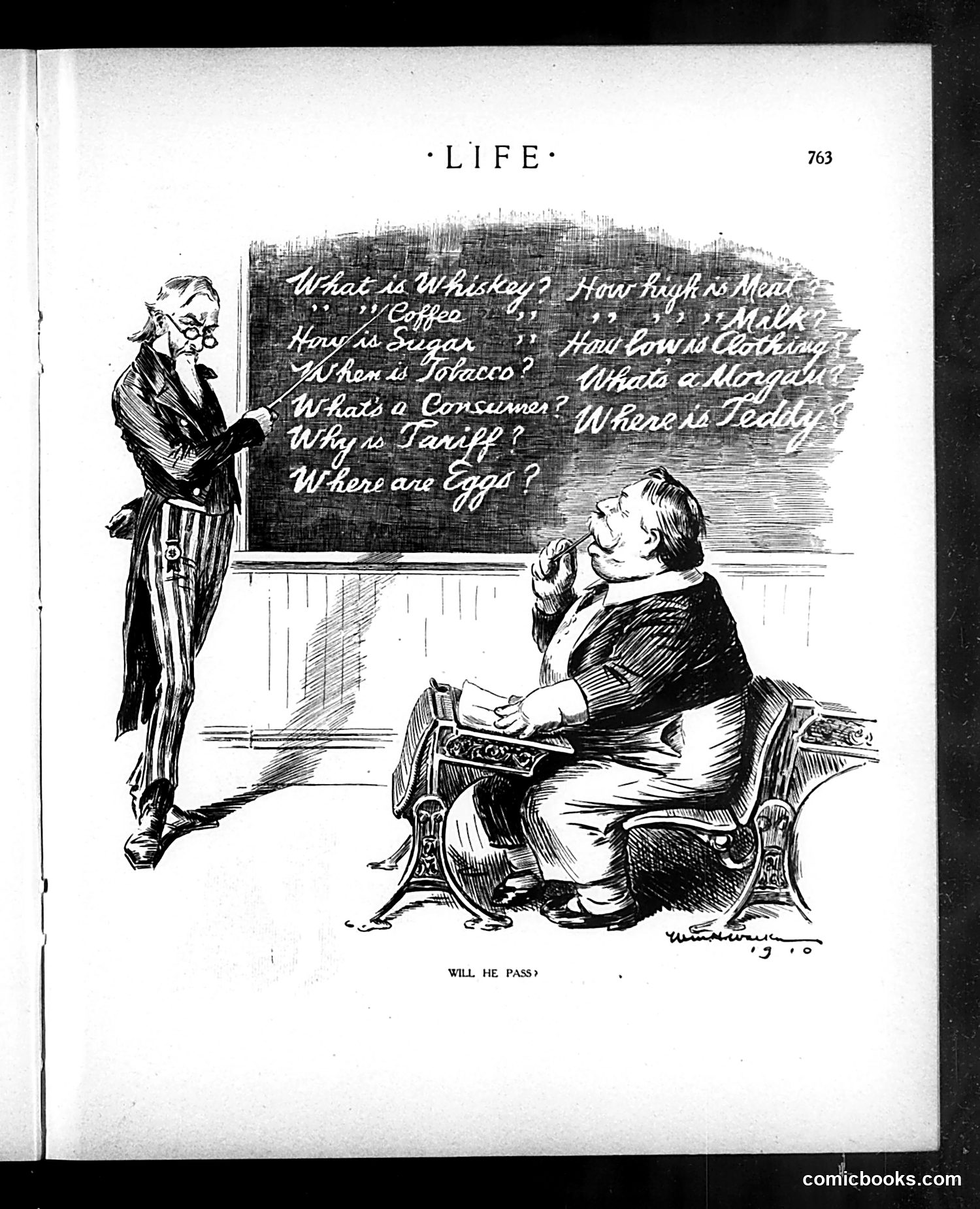
This single-panel cartoon depicts a classroom examination scene. A thin, stern-looking teacher stands at a blackboard covered with difficult questions: "What is Whiskey? How high is Meat? What's Coffee?" and similar queries about everyday consumer goods and commodities, along with questions about tariffs, finance, and economics. A rotund student sits struggling with the test. The caption asks "Will he pass?" The satire appears to target either: - Educational inadequacy regarding practical economic knowledge, or - Political/economic policy debates (possibly about tariffs or trade) where leaders or citizens are tested on complex commercial questions The exaggerated contrast between the teacher's severity and the student's bewilderment suggests the questions themselves may be unreasonably difficult or the educational system fundamentally flawed. Without clearer historical context or visible date, the specific political event referenced remains unclear.
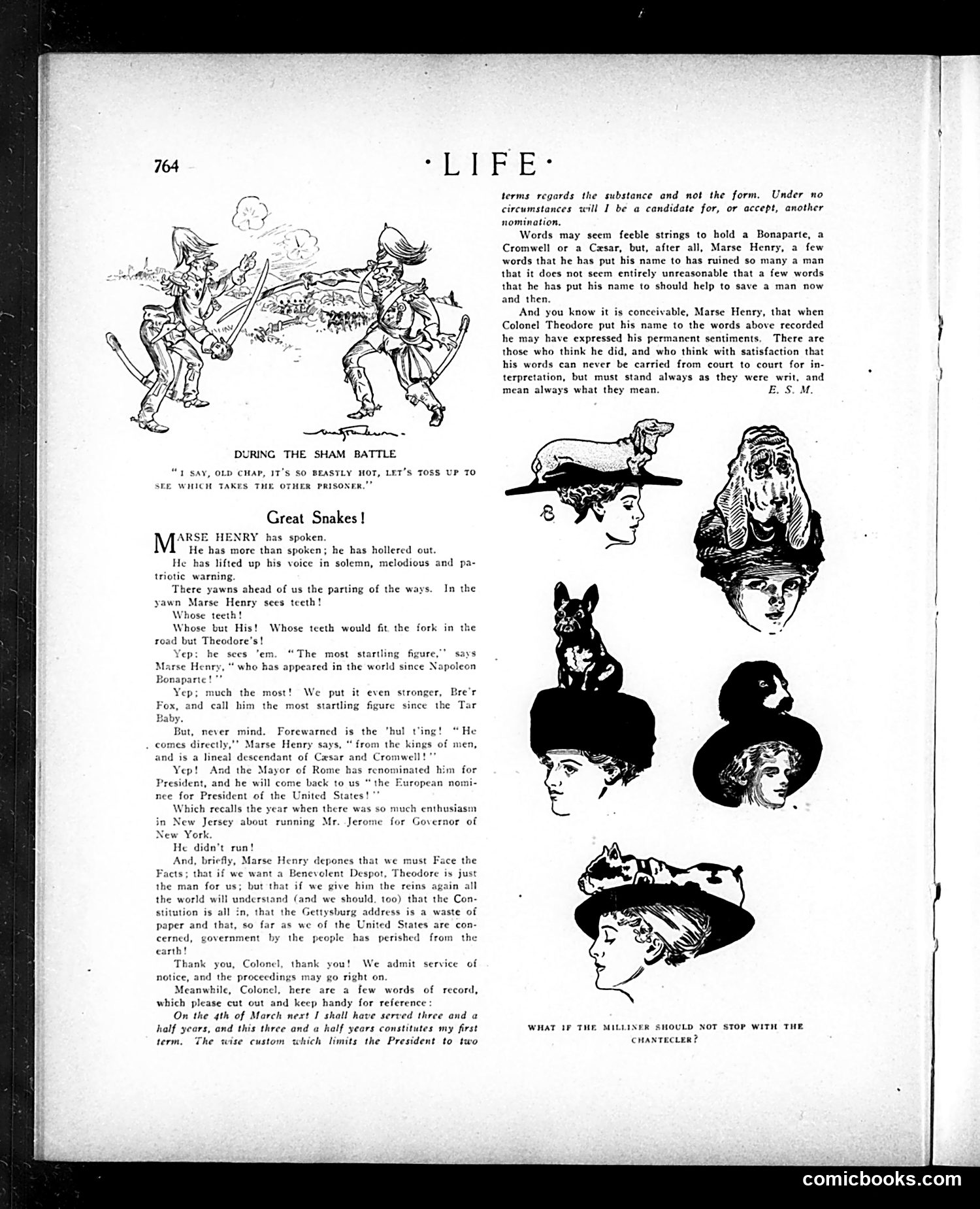
This *Life* magazine page satirizes Theodore Roosevelt's stated intention not to seek another presidential term. "Marse Henry" (likely Henry Watterson, a prominent political commentator) warns that Roosevelt—despite his public pledge to serve only two terms—poses a dangerous threat as a "Benevolent Despot" comparable to Bonaparte, Cromwell, and Caesar. The article quotes Roosevelt's actual declaration: "I shall not be a candidate for, or accept, another nomination." The satire's point: the author doubts Roosevelt will honor his word. He's comparing Roosevelt to figures who seized absolute power, suggesting that if given the presidency again, Roosevelt would undermine democratic institutions like the Constitution and the Gettysburg Address. The cartoon caricatures on the right appear to be various political figures responding to this drama, though specific identities are unclear from the image alone. The underlying anxiety reflects genuine contemporary concerns about Roosevelt's expanding executive power and whether his political influence would persist beyond his stated term limits.
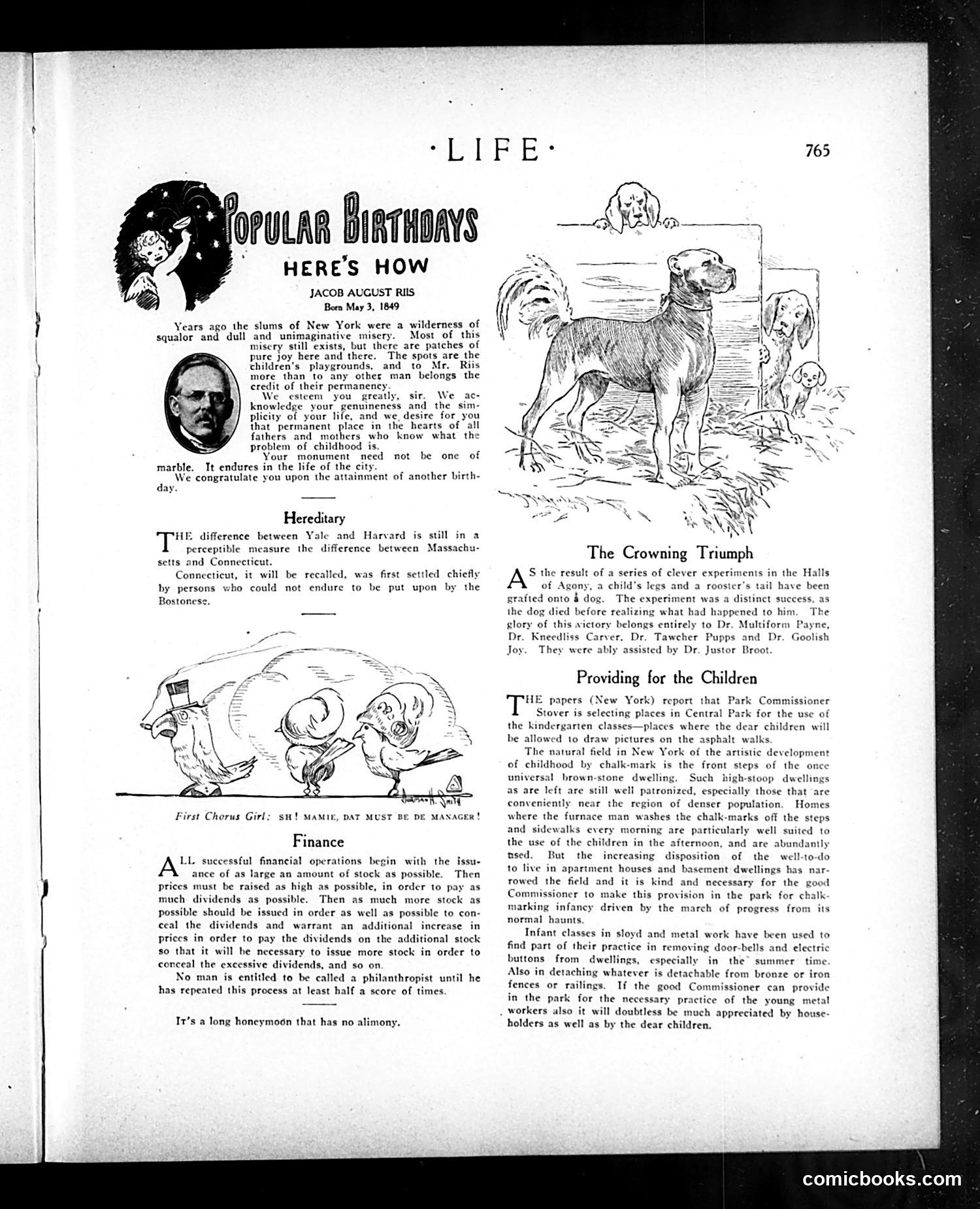
This page celebrates **Jacob Riis**, a social reformer born May 3, 1849, credited with establishing children's playgrounds in New York City slums. The tribute acknowledges his work improving urban childhood conditions. The page also contains three satirical sections: 1. **"Hereditary"** jokes about Yale vs. Harvard reflecting Connecticut vs. Massachusetts character differences. 2. **"Finance"** is sharp satire on stock manipulation schemes—issuing inflated stock to pay dividends, then issuing more stock to hide those dividends, in an endless cycle. The final line mocks wealthy men claiming philanthropy. 3. **"The Crowning Triumph"** satirizes extreme scientific experimentation (grafting a rooster's tail onto a dog), mocking pseudoscientific pretension by naming absurd doctors like "Dr. Kneedliss Carver." 4. **"Providing for the Children"** ironically praises the park commissioner for offering chalk-drawing spaces, since poor children traditionally drew on brownstone steps—now disappearing as tenements replaced rowhouses. The closing jab notes children practice metal work by stealing doorbell buttons.
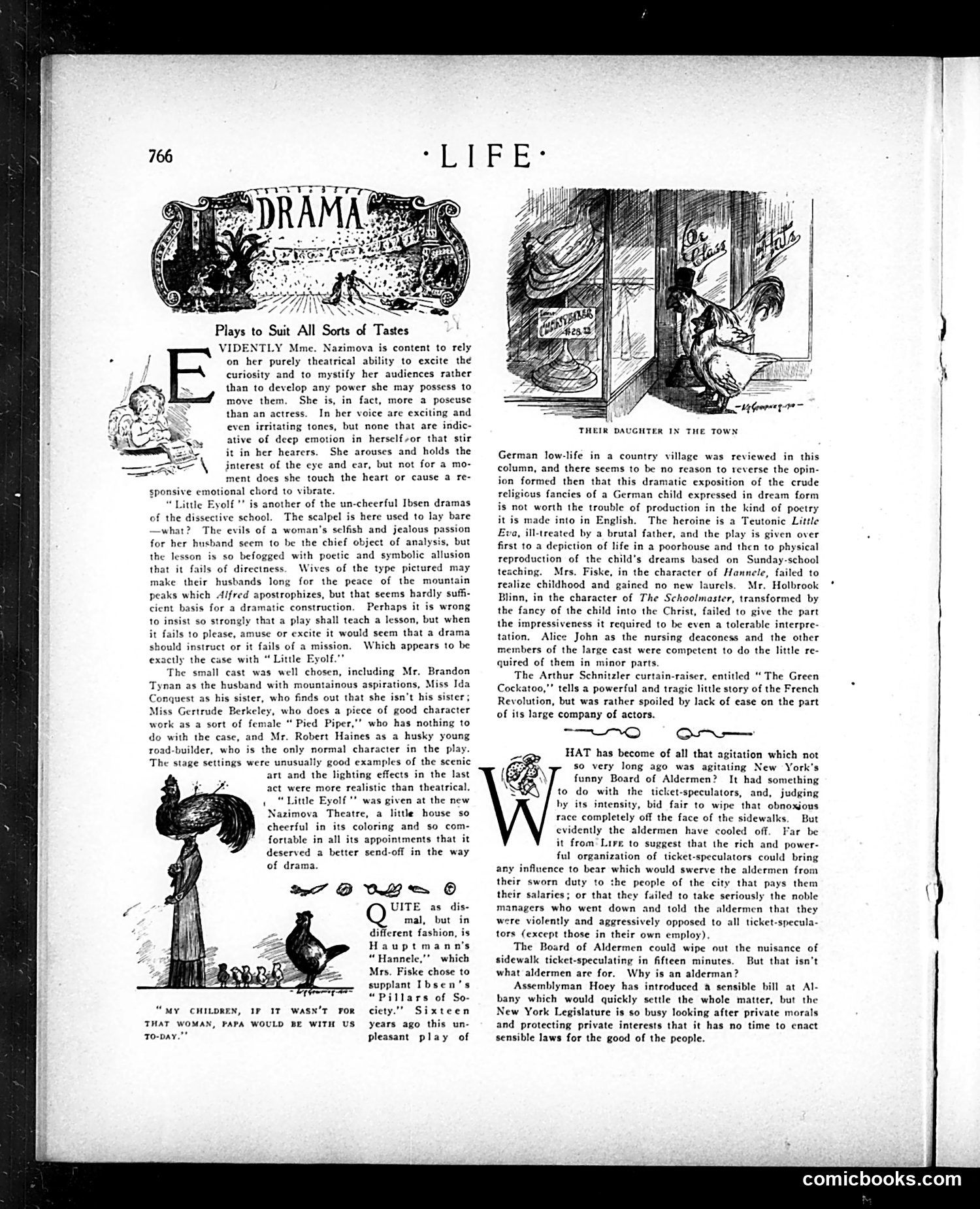
This page reviews theatrical productions, primarily critiquing actress Mme. Nazimova and plays by Ibsen and Hauptmann. The reviewer is dismissive: Nazimova is called a "poseuse" (poser) who excites curiosity but doesn't move audiences emotionally. "Little Eyolf," an Ibsen play about marital jealousy, is criticized as obscurely symbolic and emotionally unresolved—the reviewer questions whether a play needs to teach lessons if it fails to entertain. "Hannele," a Hauptmann drama about a brutalized German girl's religious fantasies, is dismissed as not worth producing. Mrs. Fiske's performance and the lead actor's portrayal of Christ are both deemed inadequate. The cartoon shows a child rejecting her mother, with dialogue suggesting paternal abandonment—likely illustrating the play's domestic dysfunction themes. The review reflects early-1900s theatrical criticism valuing emotional accessibility over symbolic complexity.
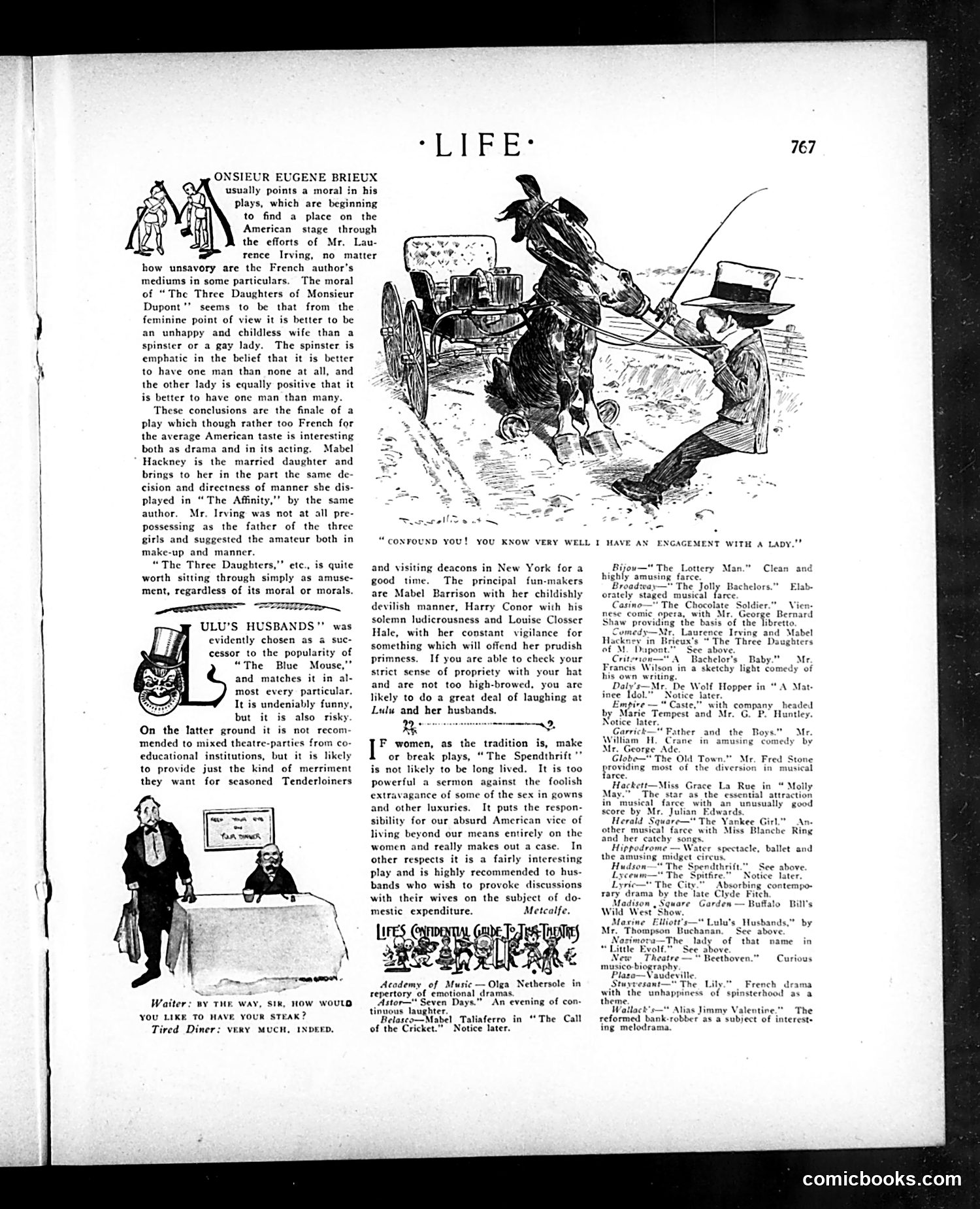
This page contains theatre reviews and two humorous cartoons satirizing dining and marital situations. The **top cartoon** depicts a man in a carriage with a woman, captioned "Confound you! You know very well I have an engagement with a lady." The joke mocks the Victorian-era convention of secret affairs—the man's irritated denial suggests he's been caught or confronted about illicit romantic involvement. The **bottom cartoon** shows a waiter asking a diner "By the way, sir, how would you like to have your steak?" The diner responds "Very much, indeed"—a non-sequitur joke playing on the diner's misinterpretation or the absurdity of asking someone how they'd *like* to have something, rather than what they'd like to eat. The page primarily reviews recent Broadway productions, including commentary on French playwright Eugène Brieux's work and shows like "Lulu's Husbands" and "The Spendthrift," which the critic notes preaches against women's excessive spending—a moralistic concern typical of the era.
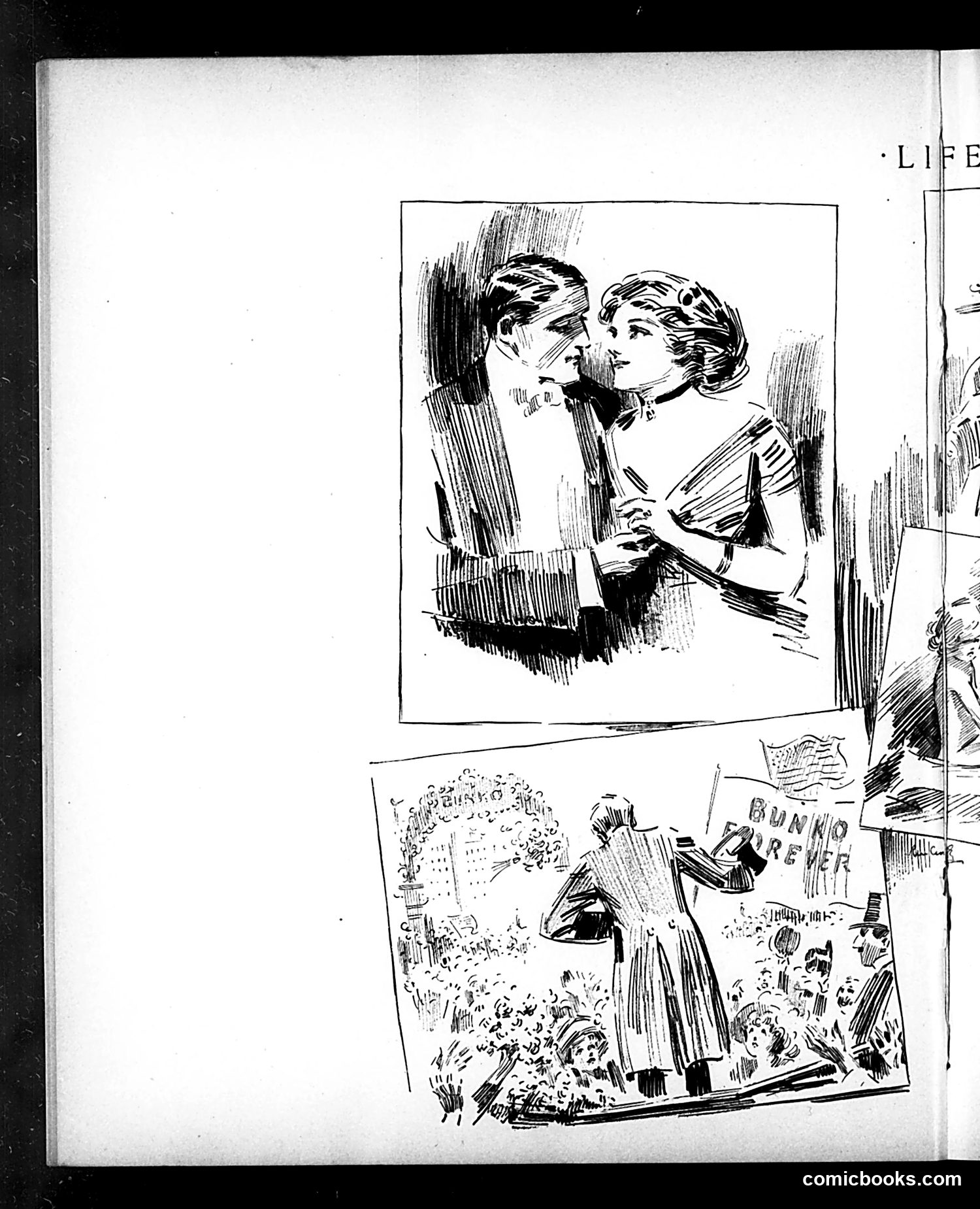
This page contains two cartoons from *Life* magazine's satirical section. The upper cartoon depicts a man and woman in an intimate moment—the woman appears to be showing or presenting something to the man, possibly a love letter or romantic note. The style suggests early-20th-century courtship humor. The lower cartoon shows a woman reading what appears to be theatrical or entertainment programs (visible text includes "BUNKO" and other partially legible titles), surrounded by smaller figures, suggesting commentary on popular entertainment or theatrical culture of the era. Both cartoons employ the magazine's characteristic ink-sketch style. Without clearer text or identifying captions visible in the image, the specific satirical subjects remain unclear, though they likely comment on contemporary social customs or entertainment trends.
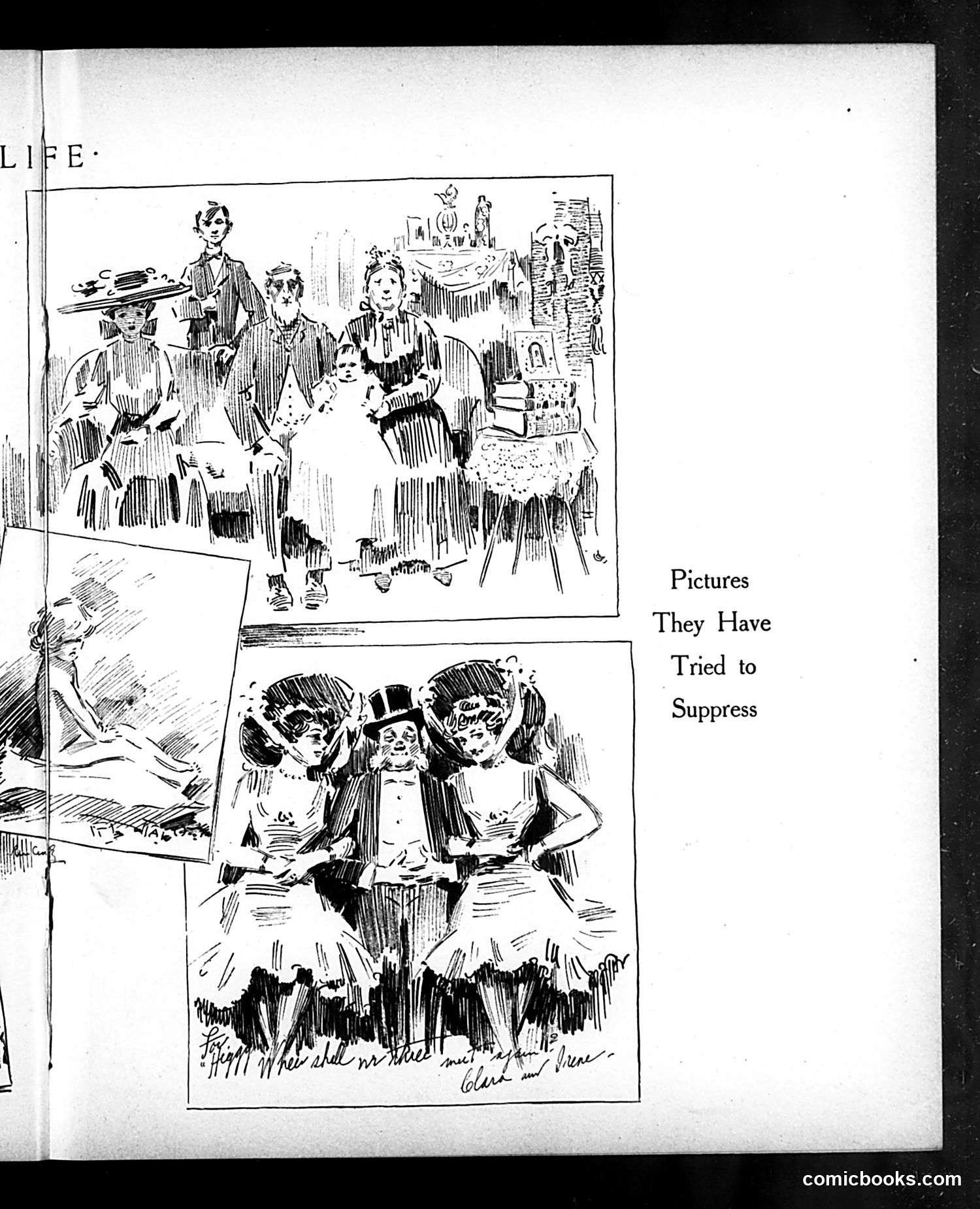
This page from *Life* magazine presents two satirical illustrations with the headline "Pictures They Have Tried to Suppress." The top cartoon depicts a domestic interior scene with several women and a child; the bottom shows three figures in theatrical or cabaret-style dress. The headline indicates these images were subject to censorship attempts, though the specific context—whether moral, political, or social—isn't entirely clear from this page alone. The artistic style suggests early-to-mid 20th century. The cartoons appear to mock either censorship efforts themselves or the subjects of suppression, but without additional context or publication date, the precise targets and satirical intent remain unclear.
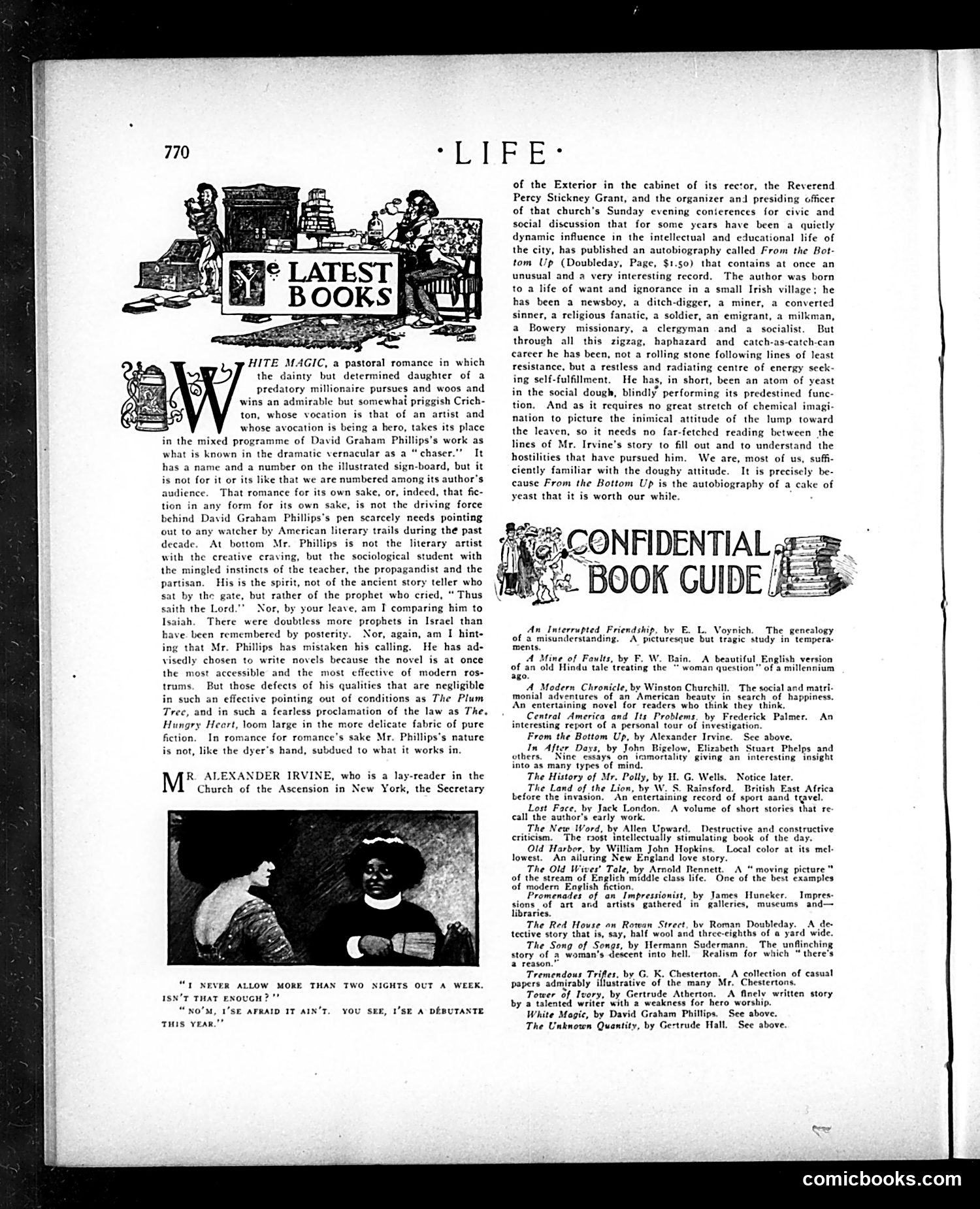
This page mixes book reviews with a cartoon joke about class and domesticity. The central cartoon depicts two figures—likely a wealthy employer and a young woman servant or "debutante"—discussing time off. The employer restricts the employee to two nights out weekly; the employee responds that two nights is insufficient because she's "a debutante this year." **The satire**: The joke exposes the absurdity of class pretension. A debutante was traditionally a young woman from an aristocratic family making her formal debut into society. The implication that a working-class woman (implied by her subservient position and dialect "I'se") claims debutante status is ridiculous—yet she's asserting her social aspirations despite her actual economic position. This mocks both the hollowness of social climbing and employers' obliviousness to their workers' independent lives. The surrounding text reviews books by authors like David Graham Phillips and Alexander Irvine, focusing on social criticism and working-class narratives—thematically aligned with the cartoon's class commentary.
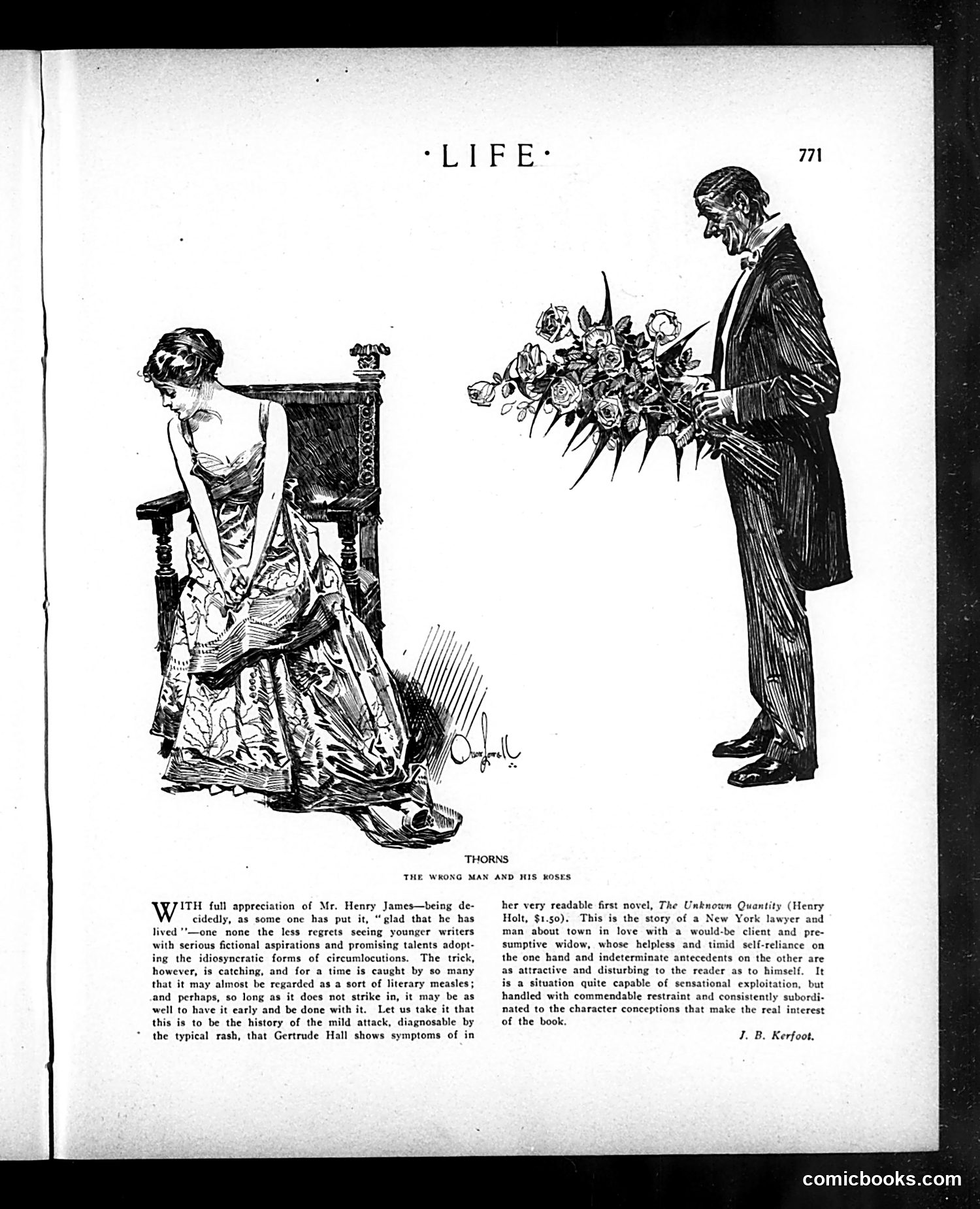
This illustration satirizes the literary style of Henry James and its influence on younger writers. The cartoon depicts a man presenting wilted roses to a seated woman—a visual metaphor for the overcomplicated, circuitous prose style ("idiosyncratic forms of circumlocutions") that James popularized. The text compares this stylistic trend to "literary measles"—a catching infection spreading among aspiring authors. The "thorns" in the image represent the difficulty and pain of this verbose approach. The review discusses Gertrude Hall's novel *The Unknown Quantity*, praising her for adopting James's complex style while maintaining narrative restraint and character focus. The joke: giving roses (romance, beauty) that are withered and thorny (James's convoluted writing) to an unimpressed woman perfectly captures the period's literary anxiety about style overwhelming substance.
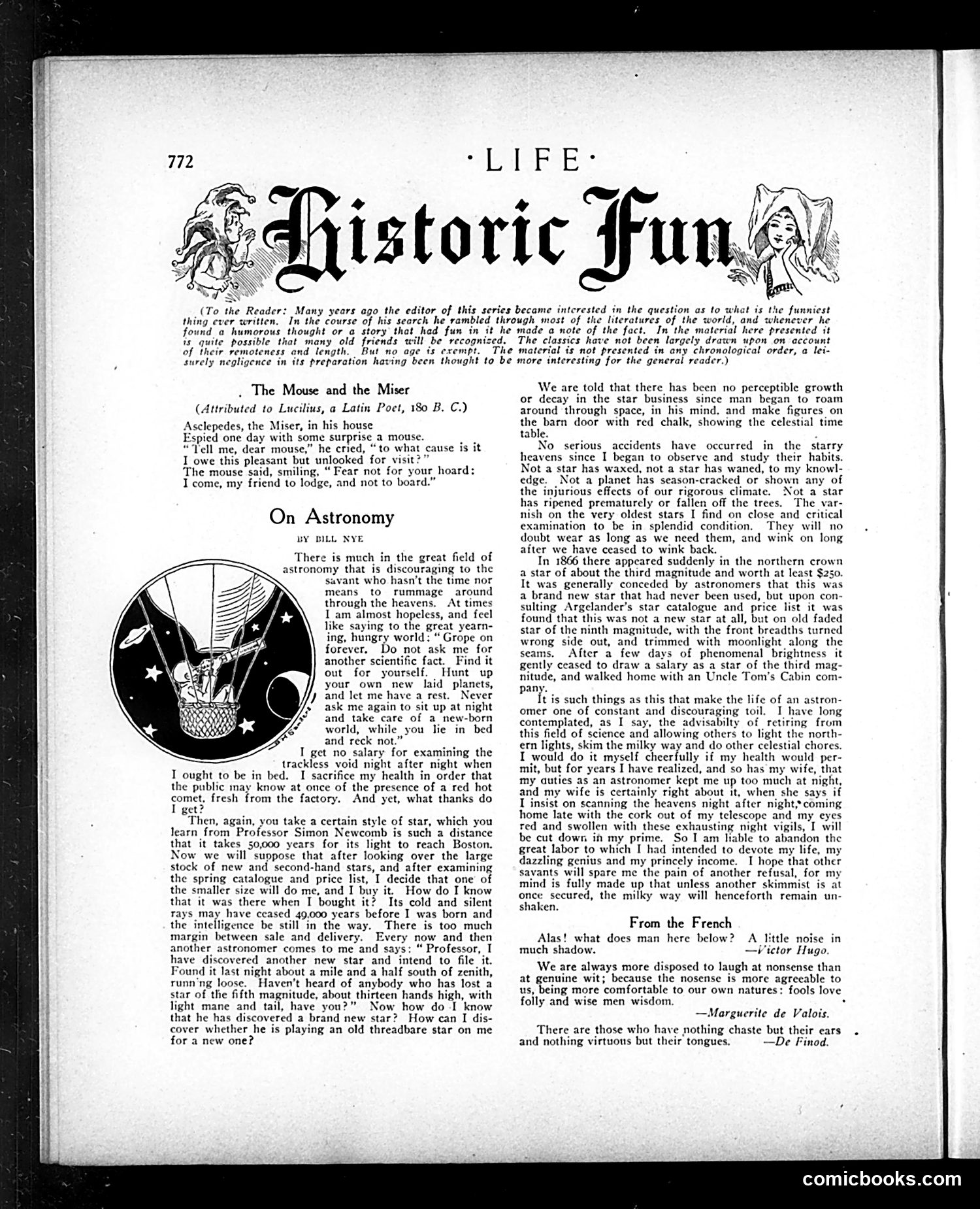
This page from Life presents humorous literary selections meant to entertain readers. It includes: **"The Mouse and the Miser"** — an ancient fable (attributed to Lucilius, 180 B.C.) using animal characters to make a moral point about greed. The poor mouse cleverly assures the miser he comes to lodge (stay temporarily) rather than board (eat his food), satirizing the miser's obsessive worry over his possessions. **"On Astronomy" by Bill Nye** — a humorously cynical essay lampooning both astronomy as a discipline and the public's expectations of scientists. Nye, a popular 19th-century humorist, sarcastically complains about the thankless work of observing distant stars, the impossibility of verifying discoveries, and the logical absurdities of astronomical timescales. The satire targets both scientific pretension and society's demands on intellectuals. Both pieces use humor to critique human nature — greed and vanity respectively.
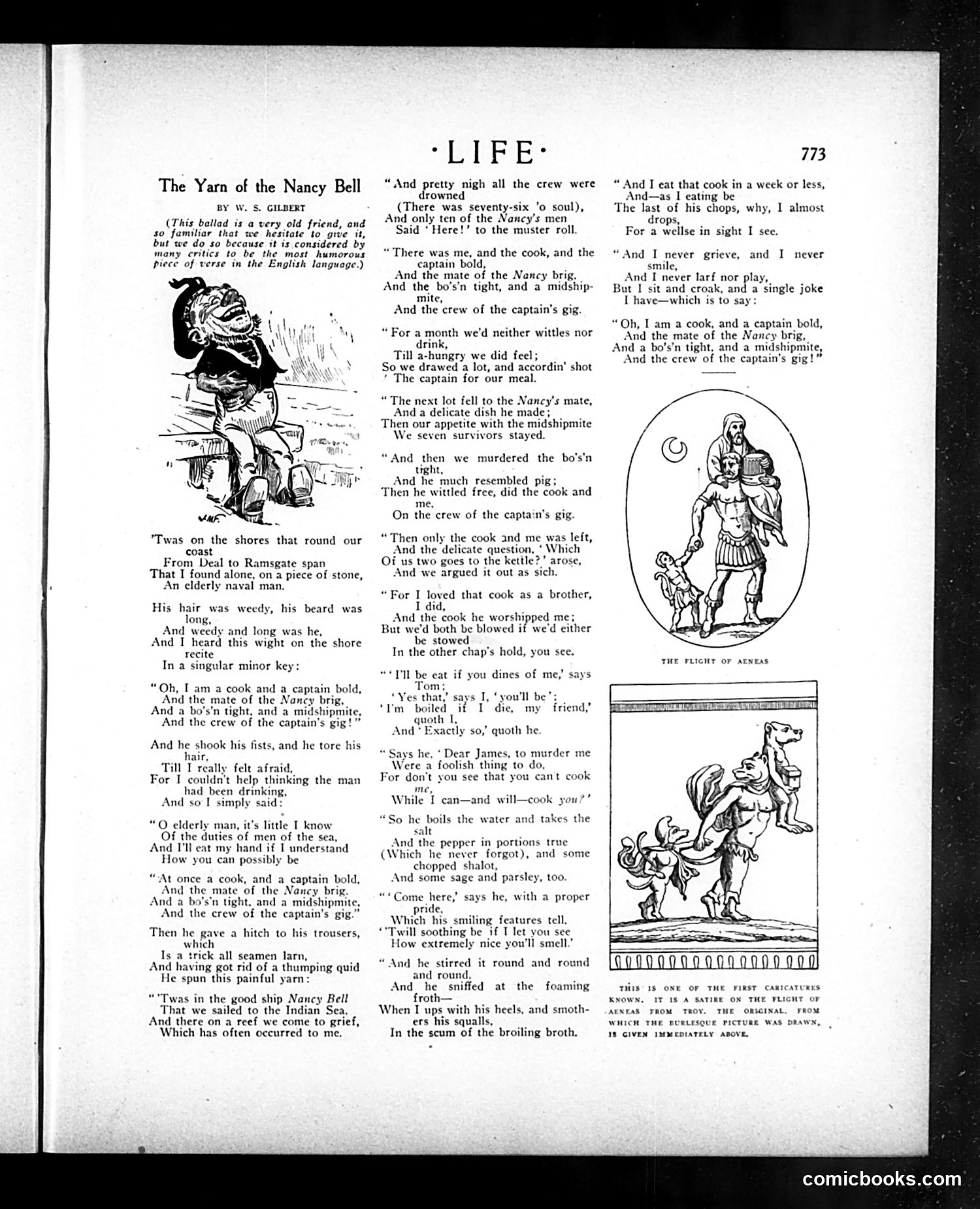
This page reproduces W.S. Gilbert's famous Victorian satirical ballad (a W.S. Gilbert work, likely from *Gilbert and Sullivan* fame). The poem is a darkly comedic tall tale about shipwreck survival. **The satire:** An old sailor recounts how his ship wrecked, leaving ten survivors who, starving, resort to cannibalism through lottery. Each victim is eaten in turn until only two remain—the cook and narrator. The cook persuades the narrator he's the better cook, then attempts to boil him. The narrator murders the cook first and eats him. **The joke for modern readers:** This is absurdist British humor—the elaborate, matter-of-fact recitation of increasingly horrific cannibalism, treated as mundane seafaring misfortune. The humor derives from the poem's formal, almost cheerful narrative tone applied to gruesome subject matter. The illustrations (a caricatured old sailor and classical figure) are typical *Life* magazine accompaniment to literary content. The 1893 *Life* magazine note calls it "the most humorous piece of verse in the English language"—Victorian audiences apparently found gothic absurdism hilarious.
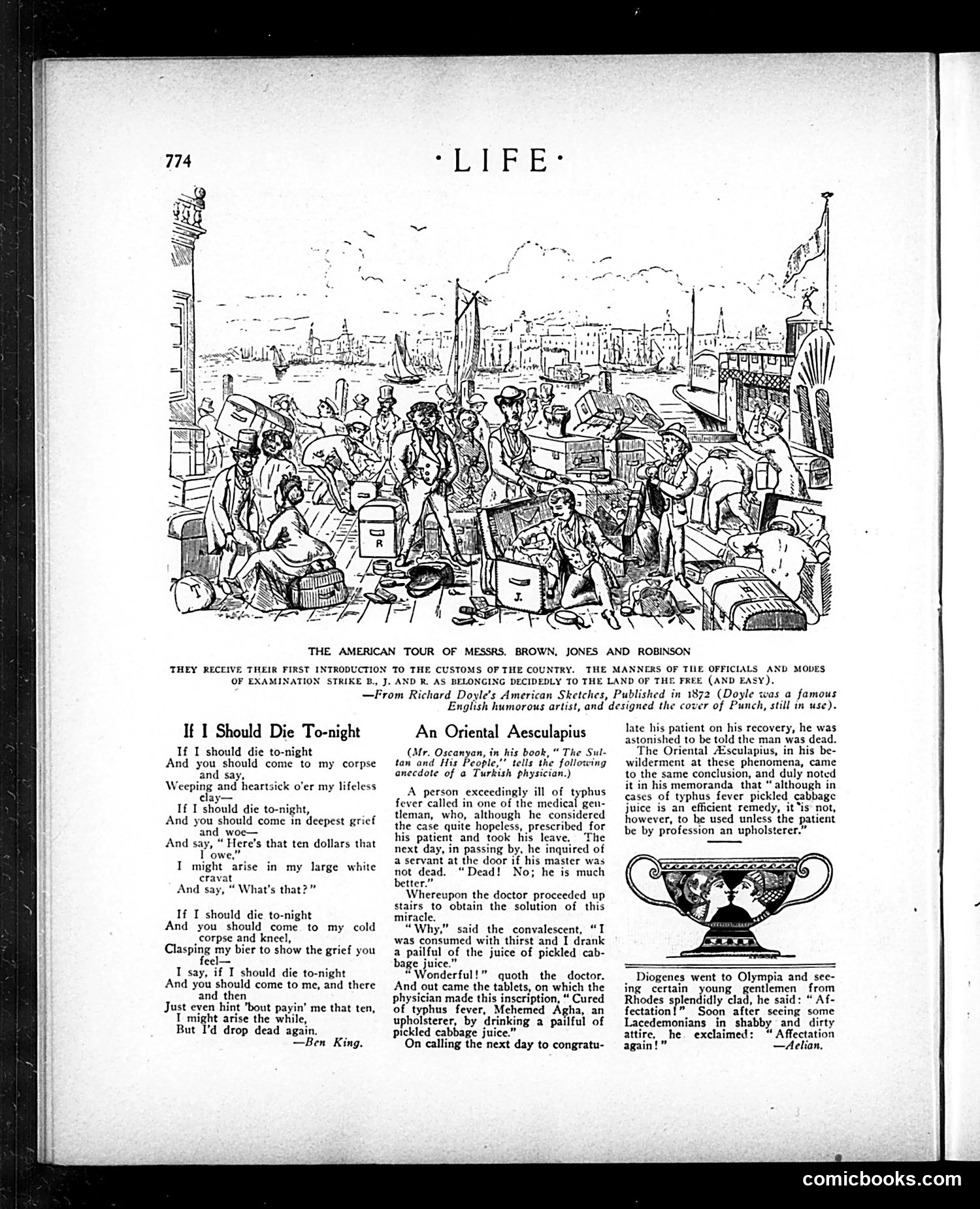
This page combines three satirical pieces from Richard Doyle's 1872 "American Sketches," originally published in the British humor magazine *Punch*. The large illustration depicts three British visitors ("Brown, Jones and Robinson") experiencing American customs and official procedures at what appears to be a port or dock. The caption sarcastically notes these customs seem decidedly characteristic of "the land of the free (and easy)"—mocking American informality and lax bureaucratic standards as seen through British eyes. Below are two humorous stories: **"If I Should Die To-night"** is a comic poem about a debtor who owes ten dollars; the speaker jokes he'd literally rise from the dead if someone reminded him to pay. **"An Oriental Aesculapius"** satirizes a Turkish physician's flawed logic: when a typhus patient recovers after drinking pickled cabbage juice, the doctor credits the remedy—then when the patient dies later, concludes the cure only works for upholsterers, missing the obvious contradiction. Together, these mock incompetence across cultures: American disorder, human absurdity, and medical charlatan-ism.
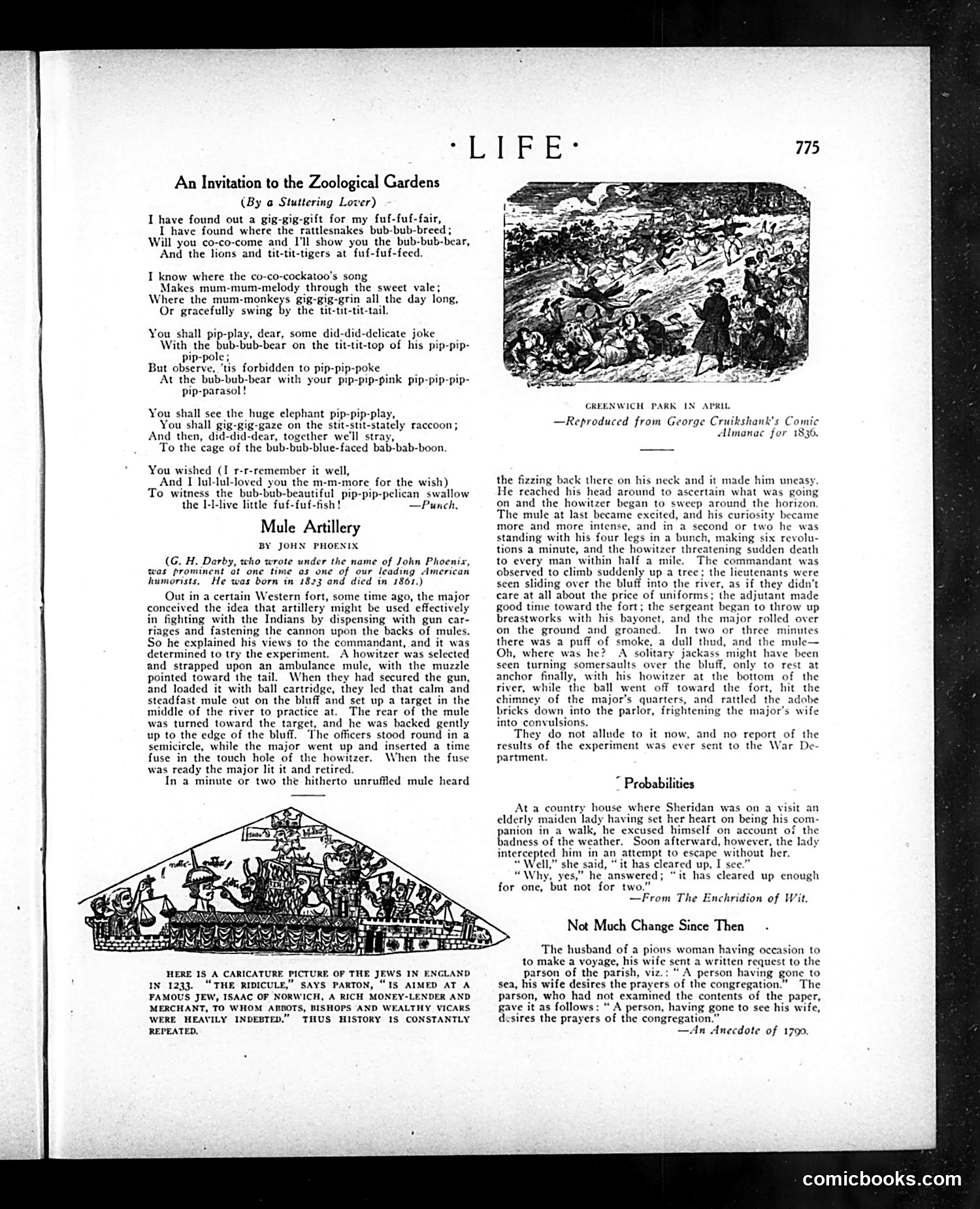
This page contains two satirical pieces: **"An Invitation to the Zoological Gardens"** is a humorous poem mocking a stuttering suitor trying to impress his girlfriend by inviting her to the zoo. The stuttering (represented by repeated syllables like "gig-gig," "bub-bub") is the joke—he can barely speak coherently while attempting romantic gestures. It's gentle mockery of both stuttering and awkward courtship. **"Mule Artillery"** is absurdist military satire. A major decides to mount a cannon on a mule's back (pointing toward its tail) to fight Indians without gun carriages. When the fuse ignites, the mule panics and spins wildly, sending officers fleeing in all directions—one up a tree, others into the river. The satire ridicules both impractical military "innovation" and the chaos that follows. The piece pokes fun at military incompetence and overconfidence in unconventional tactics. Both pieces reflect 19th-century American humor: slapstick, physical comedy, and mockery of pretension.
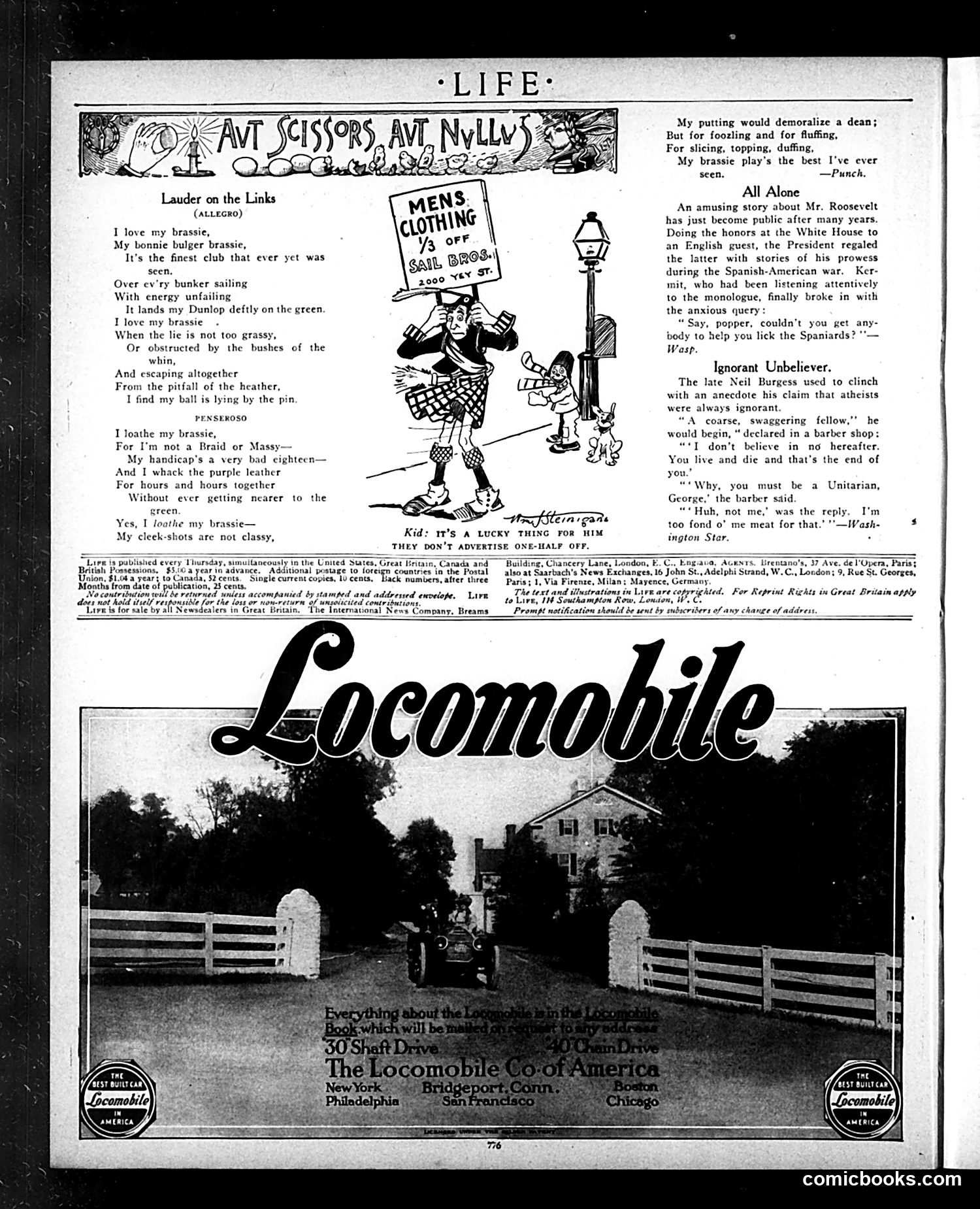
This page from *Life* magazine contains three distinct humor pieces: **"Lauder on the Links"** presents contrasting golf poems—one celebrating a "brassie" (golf club) with skill, the other lamenting poor play. The dual perspective satirizes golfers' tendency to blame equipment rather than ability. **"All Alone"** mocks President Theodore Roosevelt's self-aggrandizing Spanish-American War stories. His young son Kermit's innocent question—asking if his father needed help defeating Spain—undercuts Roosevelt's boasting by suggesting the conflict required minimal effort or assistance. **"Ignorant Unbeliever"** uses a barber-shop anecdote to satirize atheists as intellectually shallow. An atheist's crude materialism (prioritizing meat-eating over philosophical conviction) is presented as proof of general ignorance. The page also features a **Locomobile automobile advertisement** below, showing a car at an estate entrance. All three humor pieces employ gentle mockery of contemporary figures and attitudes—golfers, political leaders, and religious skeptics—typical of *Life*'s satirical approach.
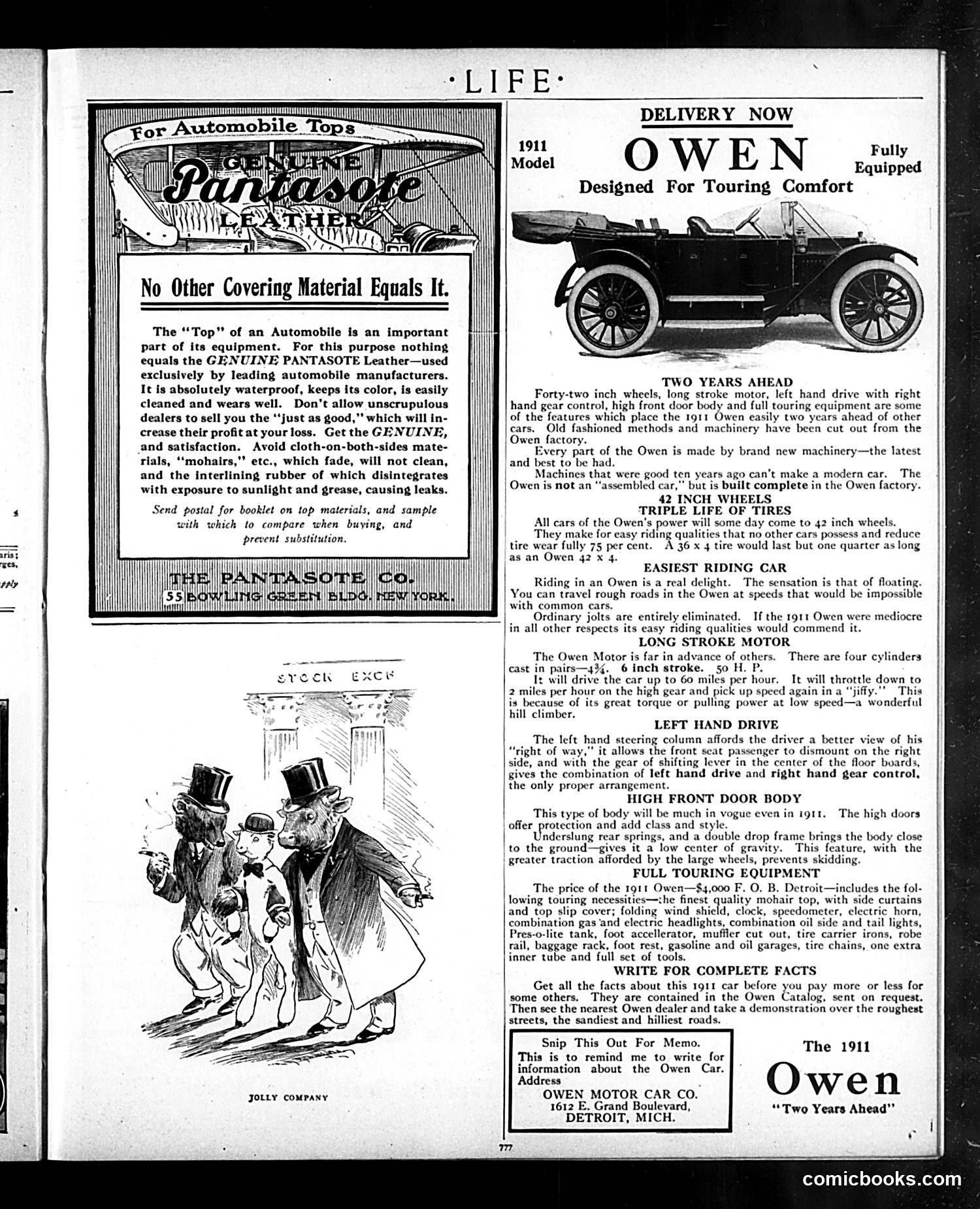
This page is primarily **automotive advertising** rather than political satire. The left side contains a Pantasote leather advertisement featuring a cartoon labeled "Jolly Company"—three anthropomorphized figures in top hats appearing to discuss or transact business. The cartoon's purpose is purely commercial: to humorously promote Pantasote as a superior automobile top material against inferior imitations. The right side is a full advertisement for the 1911 Owen automobile, marketed as "Two Years Ahead" of competitors. The ad emphasizes innovative features: 42-inch wheels, long-stroke motor, left-hand drive, high front doors, and complete factory assembly rather than parts assembly. At $4,000, it positions itself as a premium touring car. There is no political commentary or social satire on this page—it's a commercial publication showcasing early automotive innovation during the rapid mechanization of American transportation.
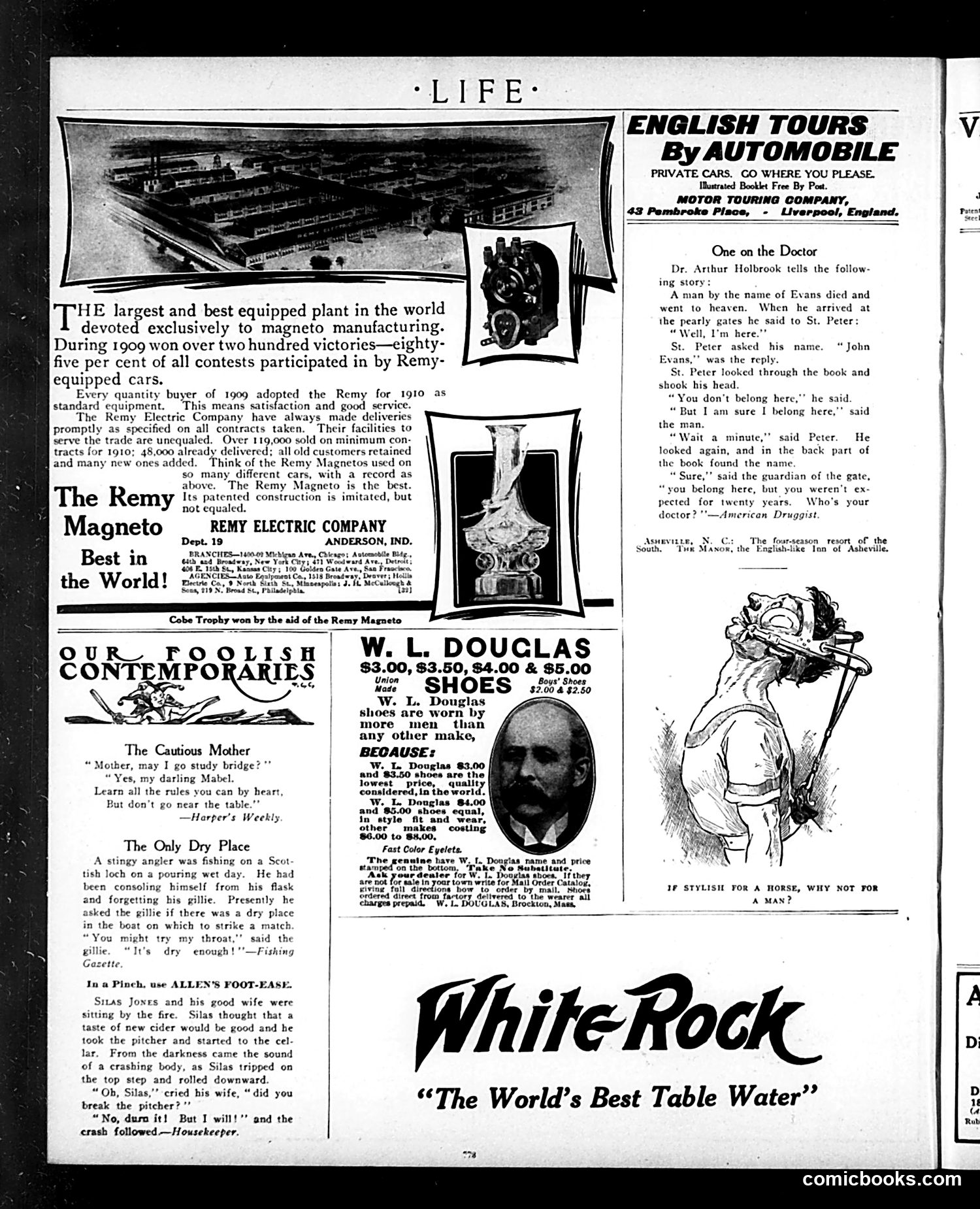
This page is primarily **advertising and humor content** rather than political commentary. The layout features: **Main Advertisements:** - Remy Electric Company magnetos (automobile parts), emphasizing 1909 racing victories - W.L. Douglas shoes, competing on price/quality - White Rock table water - Various smaller ads **Humorous Content** ("Our Foolish Contemporaries"): Four brief jokes satirizing everyday people: - A cautious mother warning her daughter about bridge (the card game, implying gambling) - A Scottish fisherman so stingy he neglects his fishing guide - A man who falls downstairs but prioritizes his pitcher over his own injury - A doctor anecdote about a man who died unexpectedly—the punchline being his doctor is blamed for the surprise These jokes reflect **period social anxieties**: gambling by women, class dynamics, domestic mishaps, and medical incompetence. The satire is gentle and domestic rather than political—typical of Life's lighter content aimed at middle-class readers. The page captures early 1910s consumer culture and genteel humor.
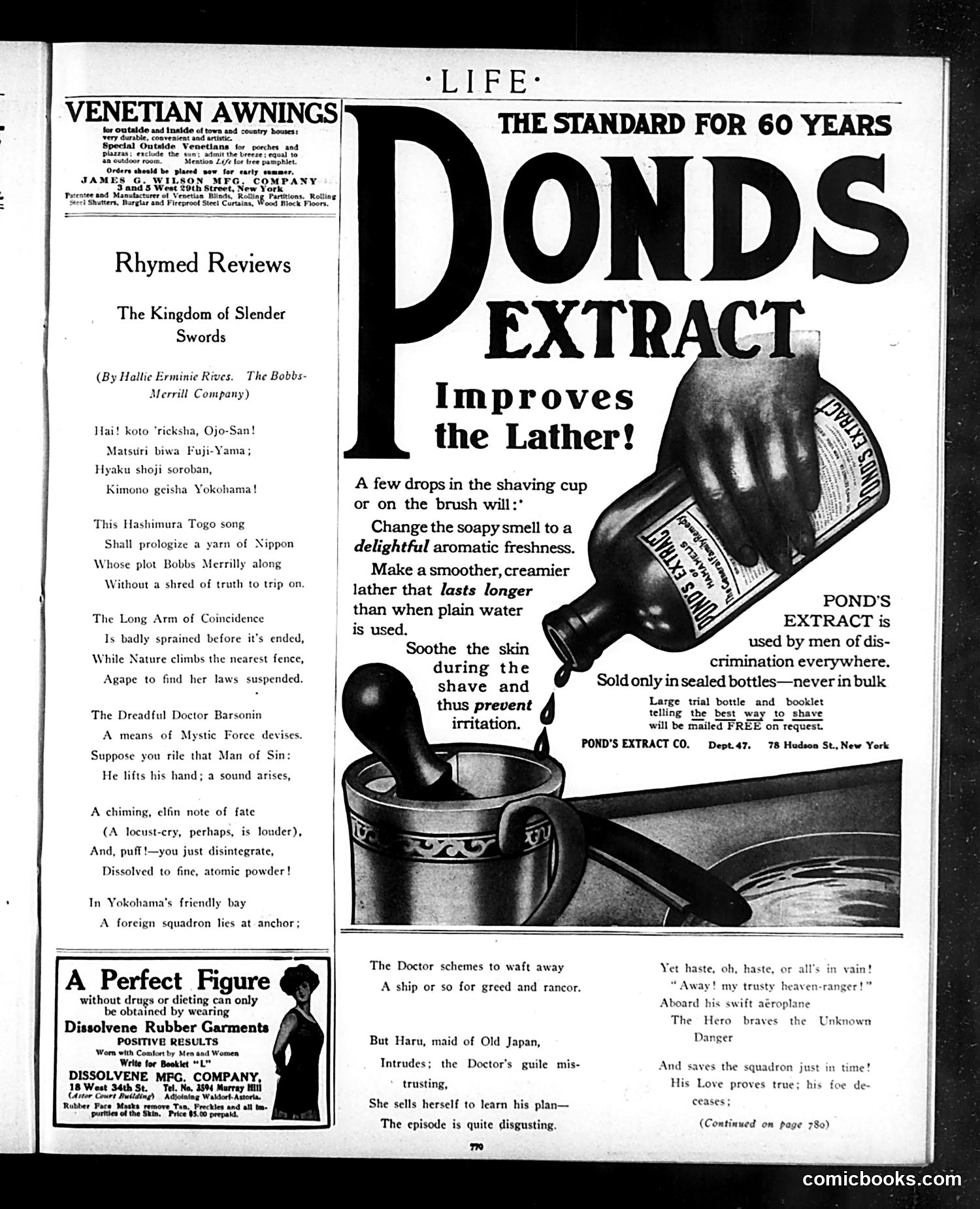
This page mixes **advertising with literary satire**, not political cartooning. The main content is a **rhymed book review** of "The Kingdom of Slender Swords" by Hallie Erminie Rives—a melodramatic novel set in Japan. The reviewer mocks the story's absurd plot: a mad scientist with mystical powers threatens a foreign naval squadron; a Japanese maid named Haru betrays him to stop him; an "aeroplane" hero saves the day and wins her love. The satire targets **overwrought romantic fiction** of the era—the reviewer notes the plot has "not a shred of truth to trip on" and calls a key scene "quite disgusting." The **advertisements** (Venetian Awnings, Pond's Extract shaving product, Dissolvene rubber garments) are typical early-20th-century magazine filler, unrelated to the editorial content. No specific political figures or events are referenced—this is simply Life magazine's humor directed at popular literature conventions.
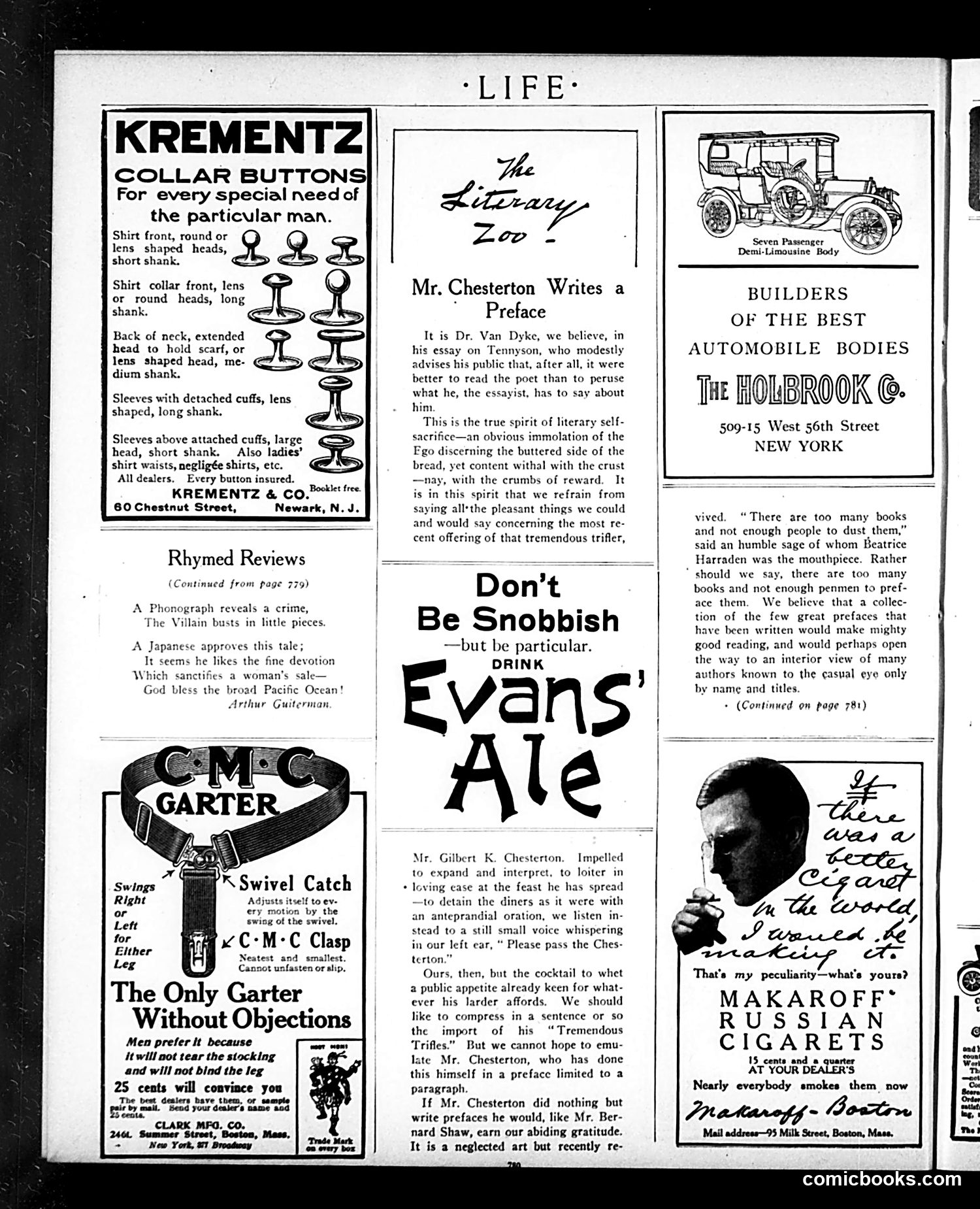
This page is primarily **advertising and literary content**, not political satire. The main feature is a preface by G.K. Chesterton discussing his book "Tremendous Trifles." The text humorously notes that Chesterton—like Bernard Shaw—is skilled at writing prefaces, and jokes that there are "too many books and not enough people to dust them." The surrounding advertisements are period-typical: Krementz collar buttons, garters, Evans' Ale, automobiles, and Makaroff Russian cigarettes. These ads reflect early 20th-century men's fashion and consumer goods. The page includes "Rhymed Reviews"—brief poetic critiques of books (one about a phonograph revealing a crime). The Evans' Ale advertisement uses the slogan "Don't Be Snobbish—but be particular," typical marketing language of the era. There is **no significant political cartoon or satire** on this page. It's a standard Life magazine spread mixing literary commentary with advertisements.
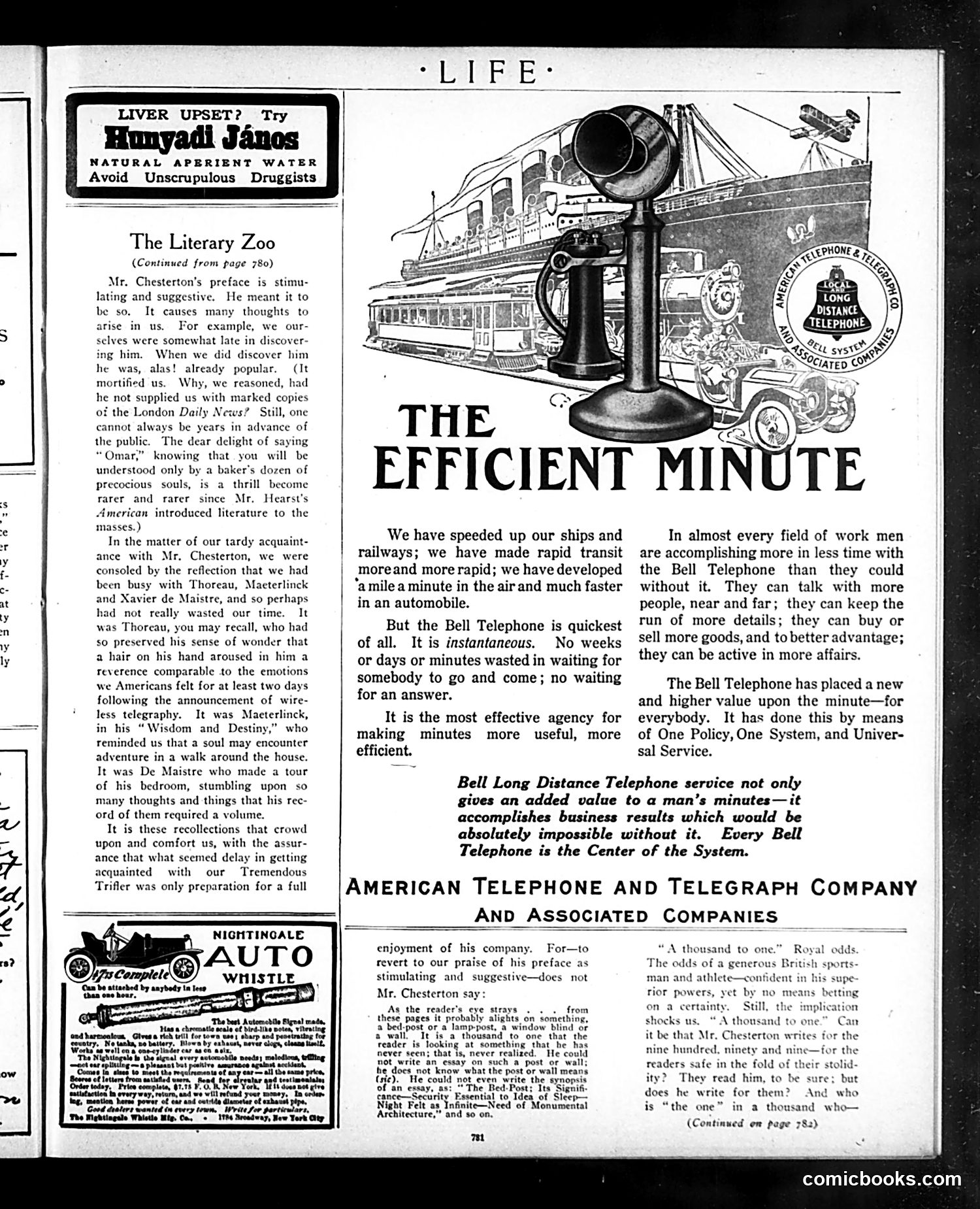
This page is primarily **advertising and literary criticism**, not political satire. The main content is "The Literary Zoo," a book review discussing G.K. Chesterton's preface to a literary collection. The critic humorously admits discovering Chesterton late, consoling himself that he'd been busy with other philosophers like Thoreau and Maeterlinck. The joke is self-deprecating: the magazine pokes fun at its own pretentiousness and the difficulty of staying ahead of literary trends, especially after mass audiences (via Hearst's publications) democratized literature. The dominant visual is a large **Bell Telephone advertisement** celebrating the telephone's efficiency in business—how it saves time compared to ships, railways, and automobiles. This reflects early-20th-century American optimism about technology. Side advertisements include **Hunyadi János** (a laxative) and the **Nightingale Auto Whistle**. The page offers no political cartoons or caricatures—it's a snapshot of 1920s middlebrow culture and early corporate advertising.
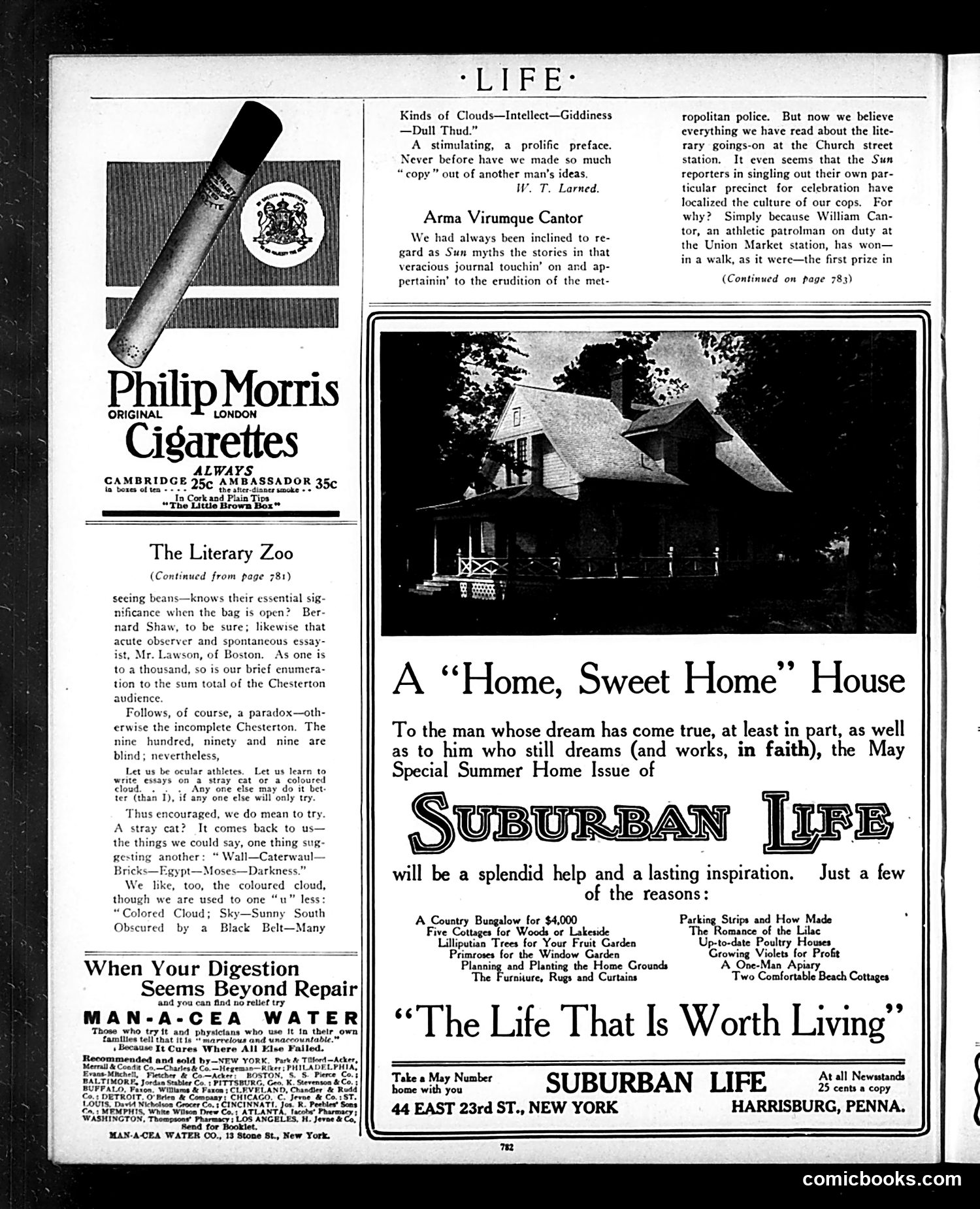
This page is primarily **advertising and editorial promotion** rather than political satire. The main content promotes *Suburban Life* magazine's special summer home issue, targeting middle-class Americans dreaming of country living. Articles advertised include affordable bungalows ($4,000), cottage designs, and gardening tips—reflecting early 20th-century suburban aspirations. The "Literary Zoo" section (continued from previous page) offers gentle satire on literary figures like G.K. Chesterton and Bernard Shaw, mocking their pretentiousness through examples of overwrought essay-writing about mundane subjects (cats, clouds). The humor is literary rather than political. Other advertisements—Philip Morris cigarettes and Man-a-cea Water digestive remedy—represent typical period marketing. The page reflects **pre-WWI American consumer culture**: optimism about homeownership, faith in commercial products, and satirical commentary on intellectuals rather than political institutions or events.
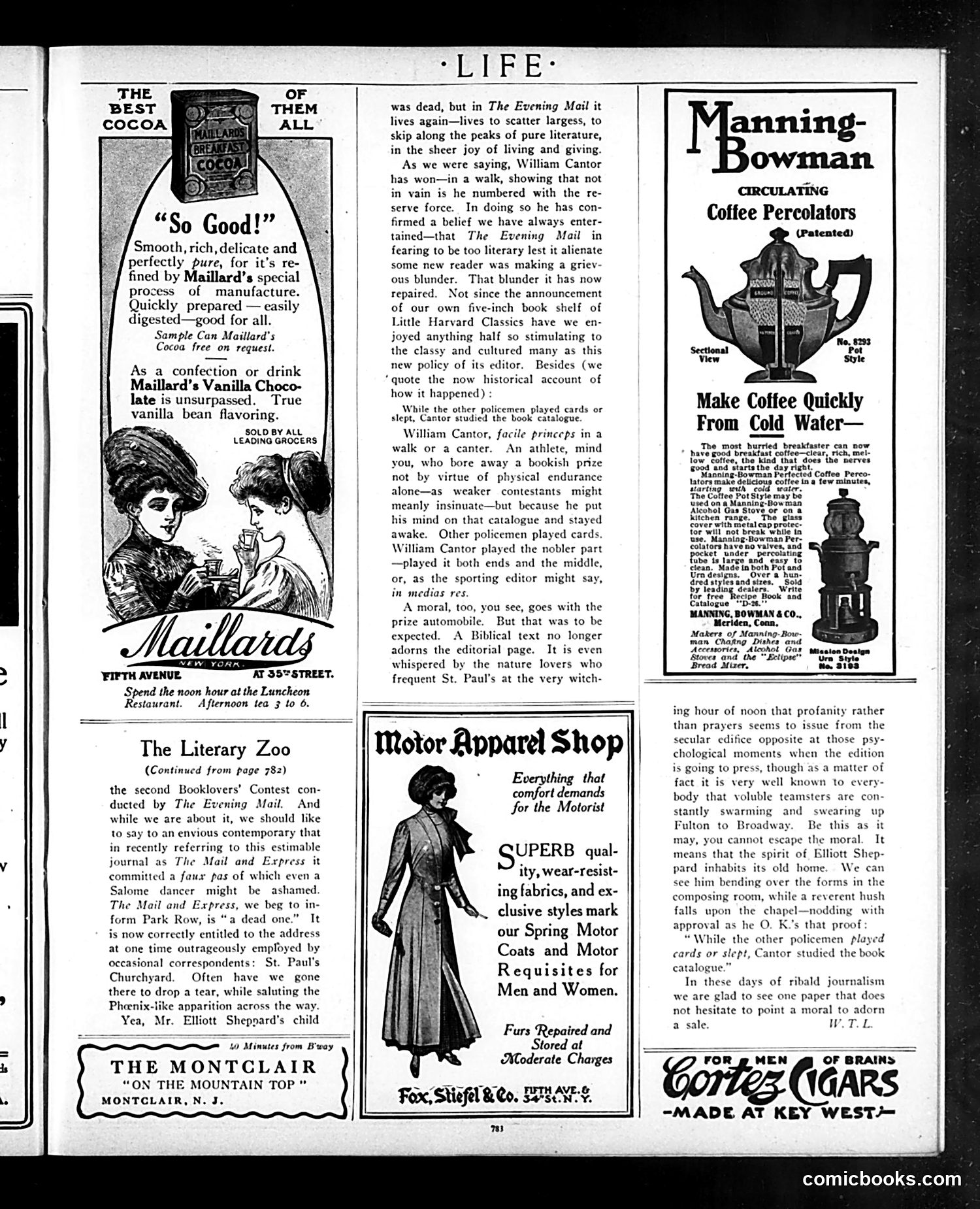
This page is primarily **advertisements and literary commentary**, not political satire. The main text, "The Literary Zoo" (continued), discusses *The Evening Mail* newspaper's literary contest, celebrating a policeman named William Cantor who won a prize automobile by studying a book catalogue instead of playing cards with fellow officers. The piece satirizes the newspaper's editorial shift toward literary content, suggesting that intellectualism and studious behavior are morally superior to idle leisure. The satire is **mild and self-congratulatory**—*Life* magazine uses Cantor's story to mock its unnamed contemporary rival (identified in context as *The Mail and Express*) while praising *The Evening Mail's* refined editorial direction. The page otherwise contains typical early-20th-century advertisements: Maillard's cocoa, Mailliard's chocolate restaurant, Manning-Bowman coffee percolators, Motor Apparel Shop, and Cortez cigars. No political figures or major social commentary appears.
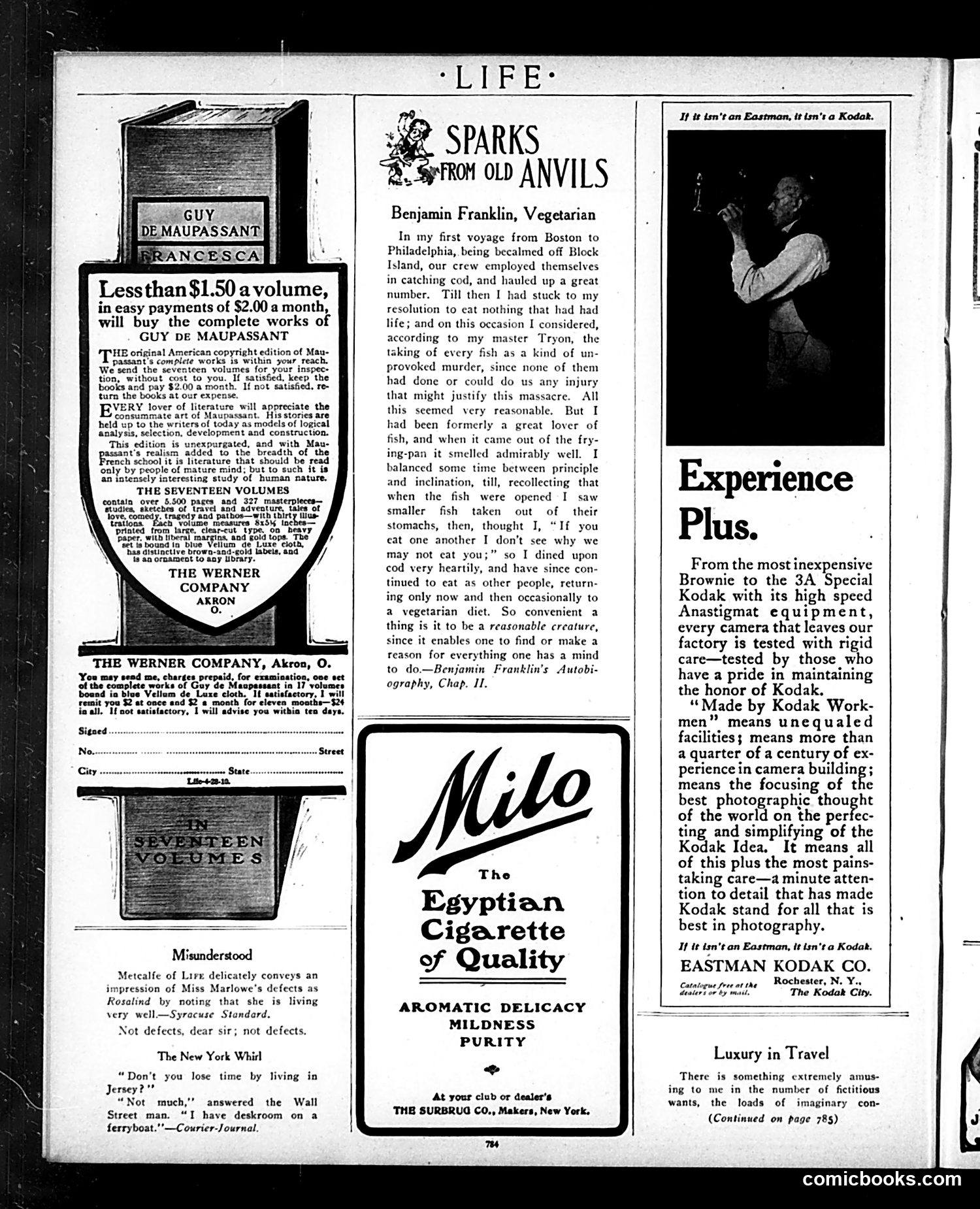
This page is primarily **advertising with satirical content interspersed**. The main advertisements promote Guy de Maupassant's complete works, Milo Egyptian cigarettes, and Kodak cameras. The satirical sections include: **"Sparks from Old Anvils"** features a Benjamin Franklin anecdote about his vegetarianism. Franklin initially refused to eat fish on principle, but when watching fishermen clean their catch and observing smaller fish in the stomachs, he rationalized eating them—a humorous commentary on how humans conveniently justify abandoning their principles. **"Misunderstood"** and **"The New York Whirl"** are brief satirical jokes: the first mocks a theater critic's backhanded compliment about actress Miss Marlowe; the second jokes about a Wall Street businessman who lives so close to ferryboats he maintains a desk on one—poking fun at urban overcrowding and work obsession. The page reflects early 20th-century American consumer culture and gentle social satire typical of *Life* magazine's era.
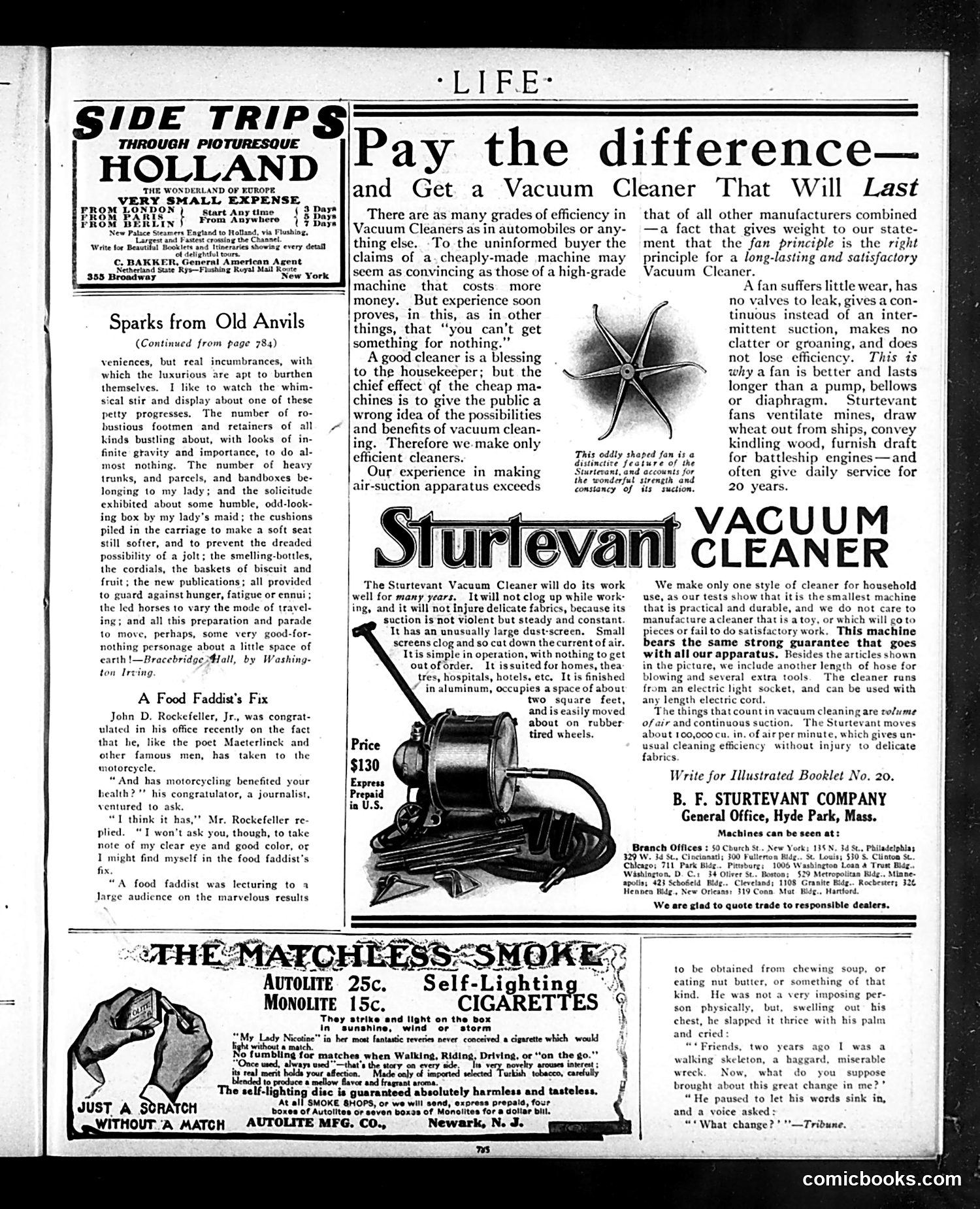
This page is primarily **advertising and travel content**, not political satire. The main elements are: 1. **Travel Advertisement**: "Side Trips Through Picturesque Holland" promoting a European tour package through travel agent C. Bakker. 2. **Literary Excerpt**: "Sparks from Old Anvils," a reprint from Washington Irving's *Bracebridge Hall*, satirizing the pretentious inefficiency of wealthy travelers and their entourages—a classic 19th-century social commentary on aristocratic excess. 3. **Anecdote**: A brief humorous story about John D. Rockefeller Jr. claiming motorcycling improved his health, poking gentle fun at "food faddists" and health crazes. 4. **Product Advertisements**: The bulk of the page features ads for the Sturtevant Vacuum Cleaner and Autolite self-lighting cigarettes. There are **no political cartoons** on this page. The content reflects early 1900s consumer culture and leisure interests rather than political commentary.
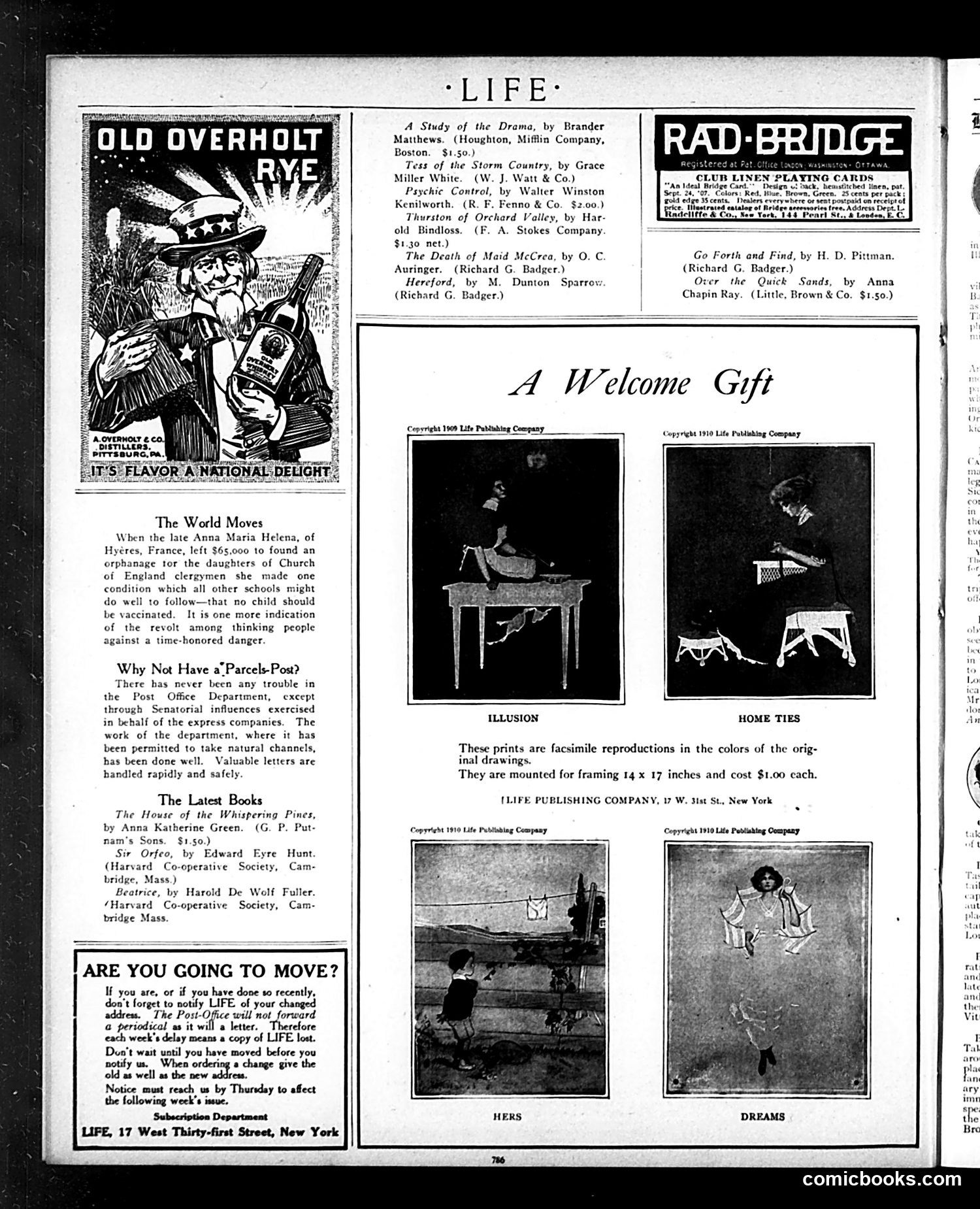
This is primarily a **book review and advertising page** rather than political satire. The left side features a prominent **Old Overholt Rye whiskey advertisement** with a caricatured frontiersman—typical period marketing using crude ethnic/regional stereotyping common in early 1900s advertising. The main content includes book reviews and two editorial pieces: one praising a French woman's $65,000 bequest to create an orphanage with an **anti-vaccination clause** (reflecting early 20th-century vaccine skepticism among "thinking people"), and another advocating for a **parcels post system**, criticizing express companies' influence on blocking postal innovation. The center spread advertises **Life Publishing Company's framed art prints** ($1 each) titled "Illusion," "Home Ties," "Heirs," and "Dreams"—sentimental domestic scenes typical of the era's popular art market. The page closes with a **subscription notice** reminding readers to update address changes when moving.
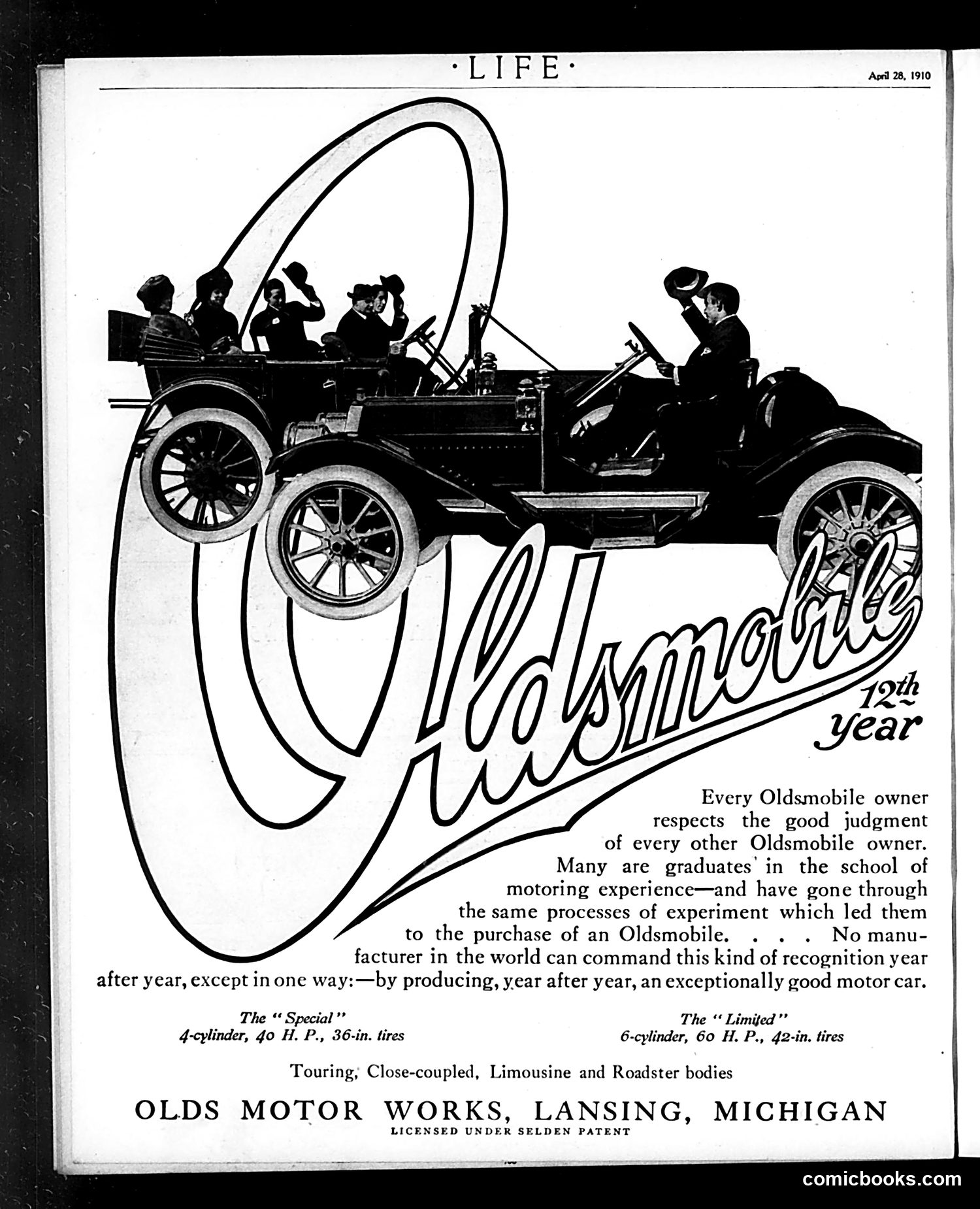
This is **primarily an advertisement**, not satire or political commentary. The page is a 1910 Oldsmobile ad from *Life* magazine's April 28 issue. The image shows an early automobile with passengers inside an oversized steering wheel—a visual metaphor suggesting control and reliability. The ad's message targets affluent buyers by claiming Oldsmobile owners share "good judgment" and respect each other's purchasing decisions, having tested competing vehicles before choosing Oldsmobile. The text emphasizes that sustained year-after-year recognition (the company's "12th year") proves manufacturing quality—essentially arguing that loyal repeat customers validate the product better than any marketing claim could. The two models listed (Special and Limited) with technical specs (cylinder count, horsepower, tire size) appeal to technically-minded early motorists who understood such specifications mattered. The "Selden Patent" reference at bottom indicates Oldsmobile operated under industry patent licensing—a significant legal framework of the era. This represents straightforward automotive advertising from the pre-Model T era when automobiles were luxury goods.