
Life, 1910-04-28 · page 24 of 40
Life — April 28, 1910 — page 24: what you’re looking at
What you’re looking at
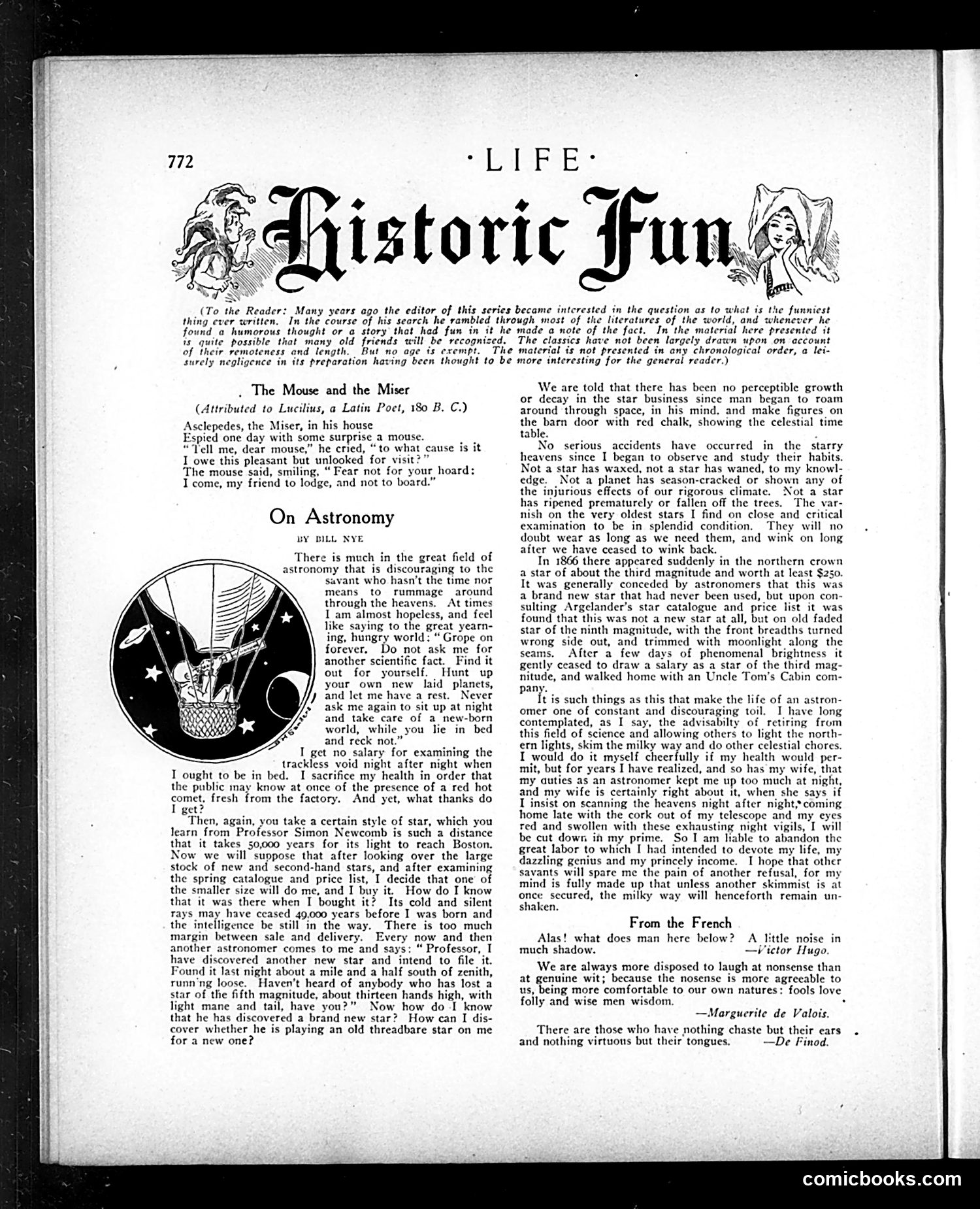
This page from Life presents humorous literary selections meant to entertain readers. It includes: **"The Mouse and the Miser"** — an ancient fable (attributed to Lucilius, 180 B.C.) using animal characters to make a moral point about greed. The poor mouse cleverly assures the miser he comes to lodge (stay temporarily) rather than board (eat his food), satirizing the miser's obsessive worry over his possessions. **"On Astronomy" by Bill Nye** — a humorously cynical essay lampooning both astronomy as a discipline and the public's expectations of scientists. Nye, a popular 19th-century humorist, sarcastically complains about the thankless work of observing distant stars, the impossibility of verifying discoveries, and the logical absurdities of astronomical timescales. The satire targets both scientific pretension and society's demands on intellectuals. Both pieces use humor to critique human nature — greed and vanity respectively.
📄 Transcribed text from this page (OCR, searchable)
Machine-transcribed from the original scan — historical spelling and the odd misread are preserved.
istoric Fu (To the Reader: Many years ago the editor of this series became interested in the question as to what is the funniest thing ever written. In the course of his search he rambled through most of the literatures of the world, and when found a humorous thought or a story that had fun in it he made a note of the fact. 7 he In the material here presented it ts quite possible that many old friends will be recognized. The classics have not been largely drawn upon on account of their remoteness and length. But no age is exempt. The material is not presented in any chronological order, a lei ‘surely negligence in its preparation having been thought to be more interesting for the general reader.) . The Mouse and the Miser (Attributed to Lucilius, a Latin Poet, 180 B. C.) Asclepedes, the Miser, in his house pied one day with some surprise a mouse. _. “Tell me, deat mouse,” he cried, “to what cause is it I owe this pleasant but unlooked for visit?” The mouse said, smiling, “Fear not for your hoard: I come, my friend to lodge, and not to board.” On Astronomy WY DILL NYE There is much in the great field of astronomy that is discouraging to the savant who hasn't the time nor means to rummage around through the heavens. At times I am almost hopeless, and feel like saying to the great yearn- ing, hungry world: “ Grope on forever. Do not ask me for another scientific fact. Find it out for yourself. Hunt up your own new laid planets, and let me have a rest. Never ask me again to sit up at night and take care of a new-born world, while you lie in bed and reck not.” I get no salary for examining the trackless void night after night when I ought to be in bed. I sacrifice my health in order that the public may know at once of the presence of a red hot comet: fresh from the factory. And yet, what thanks do get? Then, again, you take a certain style of star, which you learn from Professor Simon Newcomb is such a distance that it takes 50,000 years for its light to reach Boston. Now we will suppose that after looking over the large stock of new and second-hand stars, and after examining the spring catalogue and price list, I decide that one of the smaller size will do me, and I buy it. How do I know that it was there when I bought it? Its cold and silent s_may have ceased 49.000 years before I was born and the intelligence be still in the way. There is too much margin between sale and delivery. Every now and then another astronomer comes to me and says: “ Professor, I have discovered another new star and intend to file it. Found it last night about a mile and a half south of zenith, runn'ng loose. Haven't heard of anybody who has lost a star of the fifth magnitude, about thirteen hands high, with light mane and tail, have you?” Now how do -I know that he has discovered a brand new star? How can I dis- cover whether he is playing an old threadbare star on me for a new one? We are told that there has been no perceptible growth or decay in the star business since man began to roam around through space, in his mind, and make figures on the barn door with red chalk, showing the celestial time table. 2. No serious accidents have occurred in the starry heavens since I began to observe and study their habits. Not a star has waxed, not a star has waned, to my knowl- edge. Not a planet has season-cracked or shown any of the injurious effects of our rigorous climate. Not a star has ripened prematurely or fallen off the trees. The var- nish on the very oldest stars I find on close and critical examination to be in splendid condition. They will no doubt wear as long as we need them, and wink on long after we have ceased to wink back. In 1866 there appeared suddenly in the northern crown a star of about the third magnitude and worth at least $250. It was generally conceded by astronomers that this was a brand new star that had never been used, but upon con- sulting Argelander’s star catalogue and price list it was found that this was not a new star at all, but on old faded star of the ninth magnitude, with the front breadths turned wrong side out, and trimmed with moonlight along the seams. After a few days of phenome brightness it gently ceased to draw a salary as a star of the third ma; nitude, and walked home with an Uncle Tom’s Cabin com- pany. ie is such things as this that make the life of an astron- omer one of constant and discouraging toil. I have long contemplated, as I say, the advisabilty of retiring from this field of science and allowing others to light the north- ern lights, skim the milky way and do other celestial chores. I would do it myself cheerfully if my health would per- mit, but for years I have realized, and so has my wife, that my auties as an astronomer kept me up too much at night, and my wife is certainly right about it, when she says i I insist on scanning the heavens night after nights coming home late with the cork out of my telescope and ‘my eyes red and swollen with these exhausting night vigils, I will be cut down in my prime. So I am liable to abandon the great labor to which I had intended to devote my life, my dazzling genius and my princely income. I hope that other savants will spare me the pain of another refusal, for my mind is fully made up that unless another skimmist is at once secured, the milky way will henceforth remain un- shaken. From the French Alas! what does man here below? A little noise in much shadow. —Victor Hugo. We are always more disposed to laugh at nonsense than at genuine wit; because the nosense is more agreeable to us, being more comfortable to our own natures: fools love folly and wise men wisdom. —Marguerite de Valois. There are those who have nothing chaste but their ears and nothing virtuous but their tongues. —De Finod. comicbooks.com