
Life, 1910-04-28 · page 18 of 40
Life — April 28, 1910 — page 18: what you’re looking at
What you’re looking at
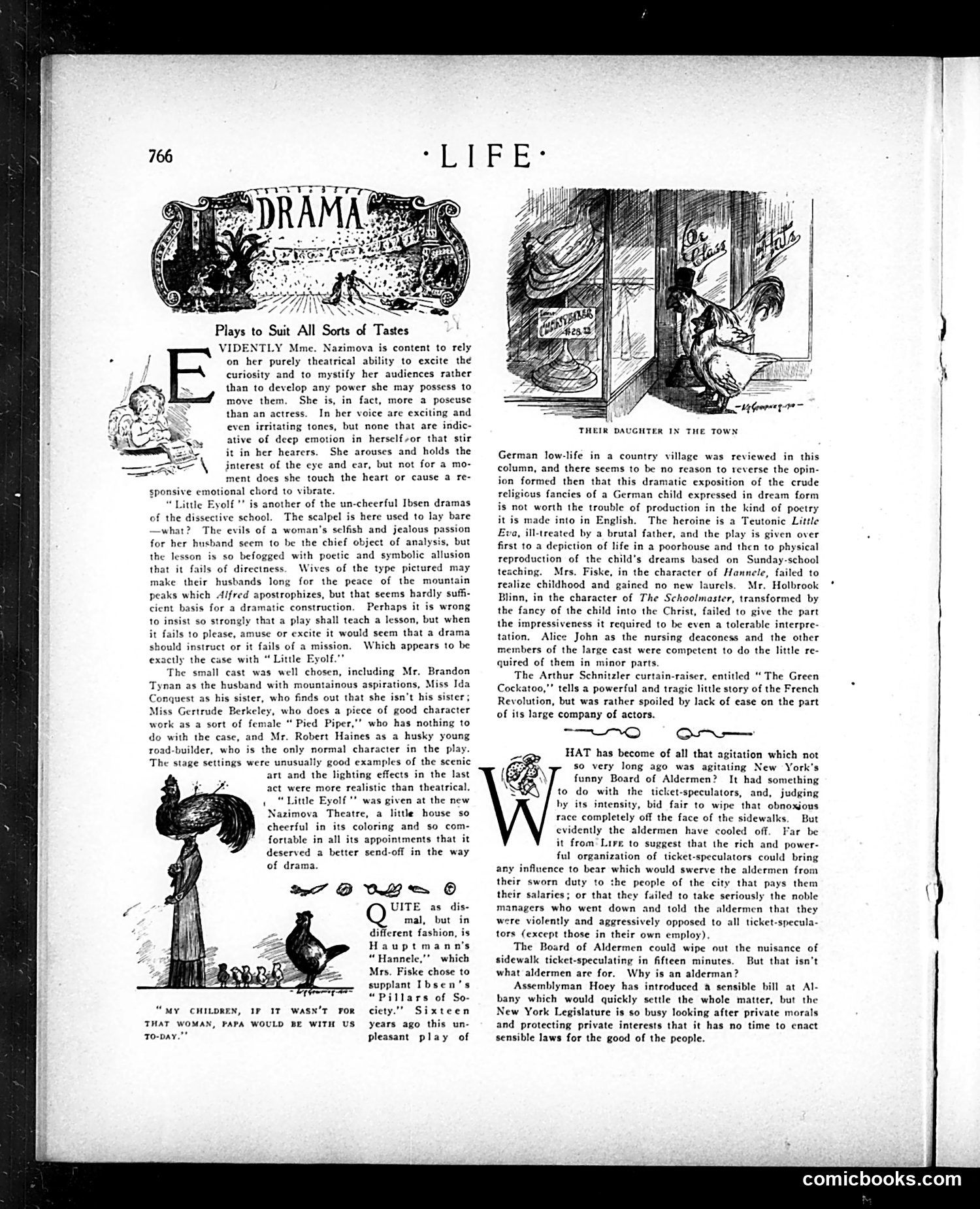
This page reviews theatrical productions, primarily critiquing actress Mme. Nazimova and plays by Ibsen and Hauptmann. The reviewer is dismissive: Nazimova is called a "poseuse" (poser) who excites curiosity but doesn't move audiences emotionally. "Little Eyolf," an Ibsen play about marital jealousy, is criticized as obscurely symbolic and emotionally unresolved—the reviewer questions whether a play needs to teach lessons if it fails to entertain. "Hannele," a Hauptmann drama about a brutalized German girl's religious fantasies, is dismissed as not worth producing. Mrs. Fiske's performance and the lead actor's portrayal of Christ are both deemed inadequate. The cartoon shows a child rejecting her mother, with dialogue suggesting paternal abandonment—likely illustrating the play's domestic dysfunction themes. The review reflects early-1900s theatrical criticism valuing emotional accessibility over symbolic complexity.
📄 Transcribed text from this page (OCR, searchable)
Machine-transcribed from the original scan — historical spelling and the odd misread are preserved.
Plays to Suit All Sorts of Tastes VIDENTLY Mme. Nazimova is content to rely J on her purely theatrical ability to excite the curiosity and to mystify her audiences rather > than to develop any power she may possess to < move them, She is, in fact, more a poseuse than an actress. In her voice are exciting and even irritating tones, but none that are indic- ative of deep emotion in herself/or that stir it in her hearers. She arouses and holds the jnterest of the eye and ear, but not for a mo- ment does she touch the heart or cause a re- sponsive emotional chord to vibrate. “Little Eyolf"’ is another of the un-cheerful Ibsen dramas of the dissective school. The scalpel is here used to lay bare —what? The evils of a woman's selfish and jealous passion for her husband seem to be the chief object of analysis, but the lesson is so befogged with poetic and symbolic allusion that it fails of directness. Wives of the type pictured may make their husbands long for the peace of the mountain peaks which Alfred apostrophizes, but that seems hardly suffi- cient basis for a dramatic construction. Perhaps it is wrong to insist so strongly that a play shall teach a lesson, but when it fails to please, amuse or excite it would seem that a drama should instruct or it fails of a mission. Which appears to be exactly the cuse with “ Little Eyolf.”’ The small cast was well chosen, including Mr. Brandon Tynan as the husband with mountainous aspirations, Miss Ida Conquest as his sister, who finds out that she isn’t his sister; Miss Gertrude Berkeley, who does a piece of good character work as a sort of female “ Pied Piper,” who has nothing to do with the case, and Mr. Robert Haines as a husky young road-builder, who is the only normal character in the play. gs were unusually good examples of the scenic art and the lighting effects in the last act were more realistic than theatrical. Little Eyolf "* was given at the new Nazimova Theatre, a little house so cheerful in its coloring and so com- fortable in all its appointments that it deserved a better send-off in the way of drama. wT OWL © UITE as di mal, but in different fashion, is Hauptmann’s “Hannele,"’ which Mrs. Fiske chose to supplant Ibsen's “Pillars of So- “My CHILDREN, 1P 17 WASN'T For ciety.” Sixteen THAT WOMAN, PAPA WOULD BE WITH US years ago this un- To-pay.”* pleasant play of THEIR DAUGHTER IN THE TOWN German low-life in a country village was reviewed in this column, and there seems to be no reason to reverse the opin- ion formed then that this dramatic exposition of the crude religious fancies of a German child expressed in dream form is not worth the trouble of production in the kind of poetry it is made into in English. The heroine is a Teutonic Little Eva, ill-treated by a brutal father, and the play is given over first to a depiction of life in a poorhouse and then to physical reproduction of the child’s dreams based on Sunday. teaching. Mrs. Fiske, in the character of Hannele, f. realize childhood and gained no new laurels. Mr. Holbrook Blinn, in the character of The Schoolmaster, transformed by the fancy of the child into the Christ, failed to give the part the impressiveness it required to be even a tolerable interpre- tation, Alice John as the nursing deaconess and the other members of the large cast were competent to do the little re- quired of them in minor parts. The Arthur Schnitzler curtain-raiser, entitled “ The Green Cockatoo,’’ tells a powerful and tragic little story of the French Revolution, but was rather spoiled by lack of ease on the part of its large company of actors. — OO Ome" HAT has become of all that agitation which not so very long ago was agitating New York's funny Board of Aldermen? It had something to do with the ticket-speculators, and, judging hy its intensity, bid fair to wipe that obnoxious race completely off the face of the sidewalks. But evidently the aldermen have cooled off. Far be it from Lire to suggest that the rich and power- ful organization of ticket-speculators could bring any influence to bear which would swerve the aldermen from their sworn duty to the people of the city that pays them their salaries; or that they failed to take seriously the noble managers who went down and told the aldermen that they were violently and aggressively opposed to all ticket-specula- tors (except those in their own employ), The Board of Aldermen could wipe out the nuisance of sidewalk ticket-speculating in fifteen minutes. But that isn’t what aldermen are for. Why is an alderman? Assemblyman Hoey has introduced a sensible bill at Al- bany which would quickly settle the whole matter, but the New York Legislature is so busy looking after private morals and protecting private interests that it has no time to enact sensible laws for the good of the people. comicbooks.com